

- Market Size (2026)
- USD 214.3 Mn
- Forecast (2036)
- USD 689.9 Mn
- CAGR (2026 to 2036)
- 12.4%
How big is Potassium Release Boosters Market in 2026?
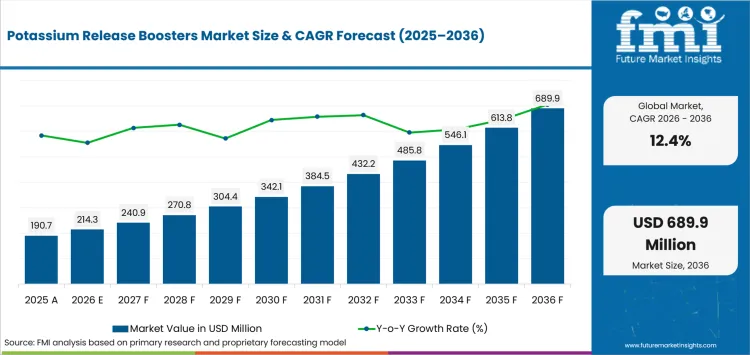
USD 214.3 million in 2026 and USD 689.9 million by 2036 at a 12.4% CAGR.
Demand for potassium release boosters is projected to expand from USD 214.3 million in 2026 to USD 689.9 million by 2036 at a 12.4% CAGR. Growers use these products where soil or fertilizer potassium is present but crop access is restricted. Sound Agriculture's February 2025 update documented improved root development and nutrient uptake in multiple crops within its commercial nutrient-efficiency program. Root-development evidence makes field response a relevant purchase test without proving a potassium-release effect by itself.
South Korea is reducing one practical barrier to commercial microbial production. MAFRA opened shared agricultural microorganism infrastructure in April 2026 with 40 tenant rooms and common fermentation plus packaging equipment. The ministry said companies without production facilities had struggled to commercialize microbial products. Domestic developers can now move from validated material to production without building a complete factory first. Markets without comparable infrastructure depend more heavily on contract manufacturers or imported finished formulations.
Key Takeaways
- Potassium release boosters gain attention where soil or fertilizer potassium cannot reach the crop fast enough to match nutrient demand.
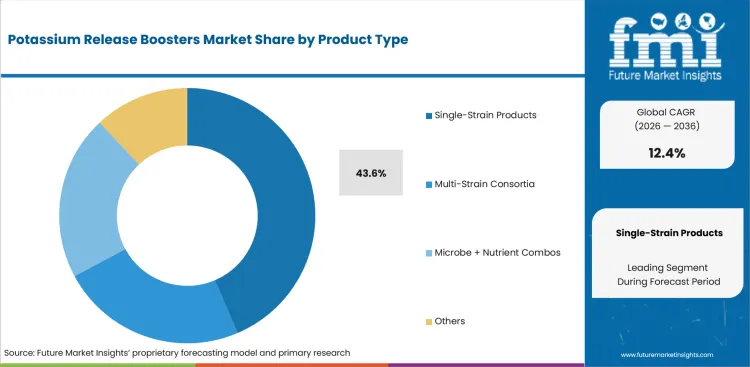
- Based on product type, single-strain products are projected to account for 43.6% in 2026 due to clearer organism identity and strain-level control.
- By crop type, cereals & grains are estimated to hold 42.3% in 2026 owing to broadacre fertility programs and repeatable per-acre evaluation.
- In 2026, soil application is expected to lead application method with 40.2% share attributable to direct placement near roots and soil potassium pools.
- Field variability and registration work can delay repeat purchasing because biological performance depends on formulation quality and local operating conditions.
- Some of the key players in this market include Verdesian Life Sciences, Novonesis, Pivot Bio, Groundwork BioAg, Locus Agricultural Solutions, Sound Agriculture, Rizobacter (Bioceres), and Lallemand Plant Care.
Analyst Perspective
"A potassium release booster should be judged against the field condition that restricts potassium access rather than against potash price alone. Repeat acreage depends on a consistent response in the grower's soil and application program under a practical measurement plan."
- Nikhil Kaitwade, Principal Consultant, Future Market Insights
How is the potassium release boosters market segmented?
Segmentation covers Product Type, Crop Type, Application Method, Farm Type and Sales Channel.
The potassium release boosters market is segmented by product type, crop type, application method, farm type and sales channel. Product types include single-strain products, multi-strain consortia, microbe + nutrient combos and others. Crop types cover cereals & grains, fruits & vegetables, oilseeds & pulses, turf & ornamentals and others. Application methods include soil application, foliar application, fertigation - drip, seed application and others. Farm types cover large commercial farms, mid-size farms, smallholders, greenhouses & nurseries and others. Sales channels include agri-input distributors, cooperatives, agri-retail chains, online - direct-to-farm and others.
What makes single-strain products central to the product type category?
Single-strain products give formulators a clear link between organism identity and the claimed agronomic function. A defined strain also makes agricultural microbial inputs easier to test against viability and storage controls. The European Commission's July 2025 proposal said new microorganisms or strains enter the EU positive list only after safety and agronomic-efficiency assessment.
- By product type, single-strain products are forecast to represent 43.6% in 2026 driven by clearer strain identity and direct performance qualification.
- Commercial adoption still depends on viable concentration and shelf stability at the stated strain level. Strain-specific controls let formulators audit one organism without assuming that a single strain will outperform a consortium in every soil.
Why do cereals & grains lead the crop type category?
Cereal programs offer enough acreage to test a nutrient-access claim without changing the whole fertility budget. USDA NASS estimated 95.2 million USA corn acres in June 2025. Dealer agronomy can use that planted base for field-scale comparisons in biofertilizer programs over different soils. Repeating the same protocol over large acreage lowers the cost of testing whether the response survives local variability.
- Cereals & grains are set to lead the crop type category with 42.3% share in 2026 due to large planted areas and familiar fertility workflows.
- Broadacre operators can isolate treated strips and compare tissue or yield response with untreated acres. Specialty crops can justify higher value per hectare but usually need more crop-specific protocols.
How does soil application support the application method category?
Potassium release takes place near the root-soil interface for microbial or mycorrhizal products. Soil placement puts the active biology beside the nutrient pool it is intended to influence. Corn and soy programs also let agronomists assess compatibility with existing biostimulant programs. Groundwork BioAg and Syngenta announced a July 2026 mycorrhizal partnership covering corn and soy plus cereals and sunflower in Latin America and Europe.
- Soil application is projected to hold 40.2% share in 2026 owing to placement near active roots and soil nutrient pools.
- Application fit depends on moisture and compatibility with planting equipment. Foliar or fertigation formats can be preferable where farms need fewer planting-time handling steps.
What supports large commercial farms in the farm type category?
Large farms can reserve strips or blocks for a biological input while keeping the rest of the nutrient program unchanged. Pivot Bio published February 2026 results from 134 field trials with 129 growers. Field-scale repetition is relevant to specialty fertilizer systems because one protocol can be repeated over many acres. Broadacre operators can use that repetition to judge whether a response survives different soils before expanding treatment acreage.
- Large commercial farms are likely to capture 45.2% share in 2026 attributable to trial capacity and standardized application economics over large acreage.
- Scale also raises the cost of extra handling. Products that fit normal planter or in-furrow operations have a clearer path to repeat acreage than programs requiring a separate pass.
What drives agri-input distributors in the sales channel category?
Biological crop nutrition often needs local agronomy to win a repeat order. Distributors can align storage and application advice with existing crop micronutrient programs. Regional advisers also give manufacturers a channel for comparing biological treatments with the farm's current nutrient program. Pivot Bio announced a January 2025 distribution collaboration with MFA Incorporated for corn growers in Missouri and neighboring states.
- Agri-input distributors are projected to account for 46.1% in 2026 due to local inventory reach and agronomic support during product evaluation.
- Direct sales fit large accounts with internal agronomy. Distributor-led programs are stronger with an adviser diagnosing the field condition ahead of product selection.
What are the drivers, restraints and opportunities in the Potassium Release Boosters Market?
Demand rises as growers seek more usable potassium from existing nutrient pools. Field consistency and product rules slow adoption. Commercial openings are strongest where suppliers pair a credible release mechanism with local agronomy and repeatable verification.
- Driver: Fertility programs are placing more weight on nutrient-use efficiency and measurable uptake instead of nutrient tonnage alone.
- Restraint: Microbial products face performance variability plus registration and labelling requirements that can narrow the addressable formulation set.
- Opportunity: Root-zone programs can turn a potassium-access claim into repeat purchases once local field evidence supports the economics.
Fertility plans are giving more weight to nutrient uptake per unit applied. England's June 2026 Farming Roadmap calls for better nutrient uptake efficiency and on-farm trials of novel fertilisers. Potassium release boosters can complement organic fertilizer programs where soil tests show adequate reserves but crop access is constrained. The strongest case is on farms that can compare tissue or yield response before repeating the purchase.
Registration can delay a microbial offer even with credible agronomy. Claims that cross category definitions face comparable boundary questions in controlled-release nutrient products. DEFRA said in March 2026 that current fertiliser rules were widely seen as outdated and proposed a more agile framework for new products. Manufacturers need an early classification decision before spending on labels and commercial channel expansion.
Locus Agricultural Solutions launched foliar and inoculant biologicals in January 2025 after replicated third-party trials. Potassium-focused firms face the same commercial test at the point of repeat purchase. A fertilizer additive system needs a field protocol that records the starting soil condition and the treated response. Local advisers can compare that record with the existing fertility baseline. Renewal follows only if the crop response remains distinct enough to justify another application.
Which country CAGRs are profiled in the Potassium Release Boosters Market?
| Country | CAGR |
|---|---|
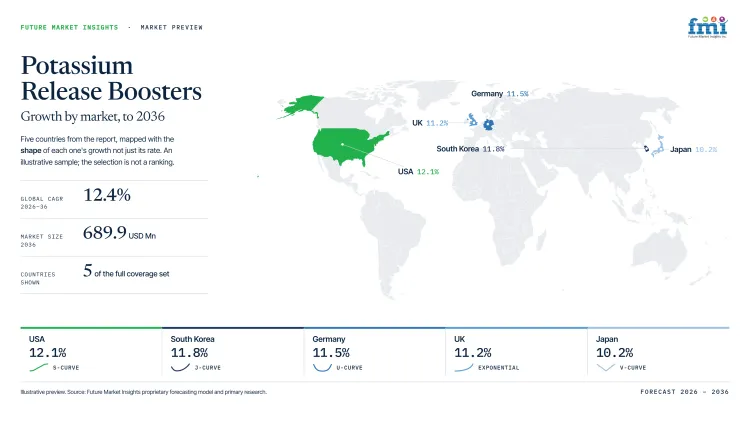
| USA | 12.1% |
| South Korea | 11.8% |
| Germany | 11.5% |
| UK | 11.2% |
| Japan | 10.2% |
How do country-level CAGRs compare in the Potassium Release Boosters Market?
The 1.9 percentage-point spread separates the USA at 12.1% from Japan at 10.2% without creating a wide growth divide. South Korea and Germany form the middle band at 11.8% and 11.5%. Small forecast gaps mean local commercialization conditions can matter more than the ranking itself.
- USA biological-input retail gives field programs several routes to repeat acreage.
- South Korean policy directs capital toward domestic green-bio commercialization.
- Germany's crop-input distribution base offsets slower product qualification.
- UK growth depends on repeat-purchase discipline more than scale-up capacity.
- Uneven adviser coverage limits Japan despite national lower-impact investment.
The rate cluster therefore hides different commercial execution costs. The full report provides country-level CAGR analysis across North America, Latin America, Western Europe, Eastern Europe, East Asia, South Asia and Pacific and Middle East and Africa.
Country-wise Analysis
- Large USA corn and soybean programs give biological input companies room to repeat commercial trials over different soils. Potassium release booster demand in the USA is forecast to rise at 12.1% CAGR over the forecast period driven by broadacre validation. USDA NASS estimated that USA growers planted 95.3 million corn acres in 2026. The planted base supports strip trials and tissue testing at a scale that smaller markets cannot match. Farm agronomists can compare the response with the grower's existing potassium program during the same season. Weather and soil variability can blur a potassium-specific treatment effect across field trials. Entrants therefore need protocols that separate potassium response from other nutrient or moisture effects.
- Formal fertilizer registration requirements shape South Korean product entry and commercial launch timing. MAFRA designated seven Green Bio Industry Promotion Zones in December 2025 and grouped companies near verification and certification facilities. In South Korea, potassium release booster demand is predicted to advance at 11.8% CAGR through 2036 supported by domestic verification capacity. Local test partners can run adaptation work before distributors commit inventory to a new biological line. The public infrastructure lowers the cost of repeating tests without removing formal market-entry checks. Registration and quality inspection requirements remain a material friction for new market entrants. Companies with Korean technical partners can prepare local dossiers and field protocols without relying on overseas performance data alone.
- Under Germany's detailed fertilizer rules, crop-nutrition decisions pass through a mature agronomy network. Germany's potassium release boosters sector is projected to record 11.5% CAGR during the assessment period attributable to interest in nutrient efficiency. Destatis reported in June 2026 that German fertilizer producer prices were 13.2% higher than a year earlier. Higher input prices give advisers a reason to test products that can improve nutrient access within the existing fertility plan. Classification and claim-control requirements remain the main entry friction for biological products. A distinct potassium-access claim needs field evidence that separates the response from humic acid inputs and other soil treatments. humic acid inputs
- In UK, written nutrient plans increasingly structure annual fertilizer decisions in farms. DEFRA reported in June 2026 that 69% of farms had a nutrient management plan. Potassium release booster sales in the UK are forecast to expand at 11.2% CAGR by 2036 driven by tighter matching of nutrient use to crop need. Written plans give farms a defined point to compare biological inputs with existing potash choices and water-soluble fertilizer programs. Agronomy records make untreated and treated results easier to compare within the same season. The friction is proving that another input earns its place in the plan. Product instructions need simple application steps plus evidence that fits the farm's normal review and supports repeat use.
- Japanese crop programs differ sharply between rice and intensive horticulture, which makes one national application protocol difficult to standardize. MAFF adopted MIDORI BOOST in June 2026 and set concentrated actions through 2030 to attract private investment toward lower-impact agriculture. The policy gives biological developers a clear public direction without removing farm-level operating constraints. Adoption of potassium release boosters in Japan is anticipated to expand at 10.2% CAGR through 2036 supported by demand for lower-impact farm inputs. Concentrated formulations and familiar application equipment can limit extra handling during field use. Seasonal labor shortages can make a separate application harder to schedule. Local proof still needs different protocols for rice and horticulture.
Who are the notable companies in the Potassium Release Boosters Market?
Verdesian Life Sciences, Novonesis, Pivot Bio, Groundwork BioAg, Locus Agricultural Solutions, Sound Agriculture, Rizobacter (Bioceres), and Lallemand Plant Care are the notable companies profiled in this market.
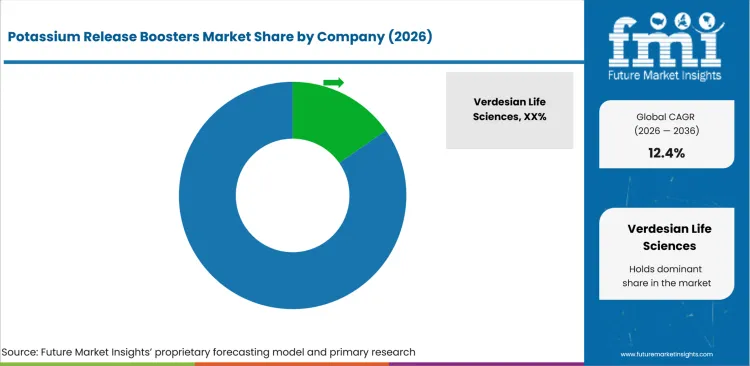
Potassium release boosters draw companies from nutrient-use-efficiency chemistry and microbial crop nutrition. Verdesian Life Sciences and Sound Agriculture publish nutrient-availability positions. Novonesis and Rizobacter operate broad biological crop-input portfolios with international channels. Groundwork BioAg and Lallemand Plant Care bring mycorrhizal or root-zone microorganism expertise. Pivot Bio contributes large-acre microbial deployment. Locus Agricultural Solutions supplies inoculant and soil-focused biological programs. Product-level potassium claims vary by jurisdiction.
- Verdesian Life Sciences and Novonesis form the nutrient-efficiency group. Sound Agriculture and Rizobacter (Bioceres) also fit this group.
- Groundwork BioAg and Locus Agricultural Solutions form the root-zone group with Lallemand Plant Care.
- Pivot Bio represents the broadacre microbial crop-nutrition group.
Competitive Benchmarking: Potassium Release Boosters Market
| Company | Biological Nutrient Platform Breadth | Root-Zone Delivery Evidence | Application and Channel Readiness | Geographic Reach |
|---|---|---|---|---|
| Verdesian Life Sciences | High | Medium | High | North America and selected international markets |
| Novonesis | High | Medium | High | Global |
| Pivot Bio | Medium | High | High | North America with expansion markets |
| Groundwork BioAg | Medium | High | High | North America, Europe and Latin America |
| Locus Agricultural Solutions | Medium | High | Medium | North America |
| Sound Agriculture | Medium | High | Medium | USA with Latin America expansion |
| Rizobacter (Bioceres) | High | High | High | 45+ countries |
| Lallemand Plant Care | High | High | Medium | Global |
Scoring basis: High platform breadth requires at least three verified biological nutrition or crop-input routes. Medium requires two and Low identifies one documented route. High root-zone evidence requires direct microbial or mycorrhizal activity at roots. Medium requires indirect nutrient-access evidence and Low identifies a different placement focus. High application and channel readiness requires multiple documented placement formats plus more than one commercial route. Medium identifies one supported placement or channel path. Low identifies one narrow documented path.
Key Developments in the Potassium Release Boosters Market
- In December 2025, Verdesian Life Sciences announced three new nutrient-use-efficiency products including AMPLIO soil biostimulant for microbial activity and nutrient cycling. The launch strengthens its soil-focused offer without claiming that every new product releases potassium.
- In June 2026, Novonesis signed a USA distribution agreement with Rovensa Next covering selected biofertilizers and other agricultural biosolutions from the 2027 season. The agreement widens access to microbial nutrient tools through an established crop-input channel.
- In November 2025, Pivot Bio launched dry planter-box formulations for corn and cotton that place microbial crop nutrition directly into planting operations. The launch sets a convenience benchmark for root-associated biology but does not establish a potassium-release claim.
Key Players in the Potassium Release Boosters Market
Nutrient-Efficiency and Biosolution Platforms
- Verdesian Life Sciences
- Novonesis
- Sound Agriculture
- Rizobacter (Bioceres)
Root-Zone Biological Platforms
- Groundwork BioAg
- Locus Agricultural Solutions
- Lallemand Plant Care
Broadacre Microbial Crop-Nutrition Platform
- Pivot Bio
Potassium Release Boosters Market - Report Scope
| Coverage field | Report scope |
|---|---|
| Market breakdown | By product type, crop type, application method, farm type, sales channel and region. |
| Quantitative Units | USD million. |
| Market Definition | Revenue from crop-input products sold to improve potassium release, mobilization, availability or plant uptake within the stated segmentation universe. Adjacent products without a potassium-release function are excluded. |
| Regions Covered | North America, Latin America, Western Europe, Eastern Europe, East Asia, South Asia and Pacific and Middle East and Africa. |
| Countries Covered | USA, South Korea, Germany, UK, Japan, and 25+ additional countries included in the full report. |
| Key Companies Profiled | Verdesian Life Sciences, Novonesis, Pivot Bio, Groundwork BioAg, Locus Agricultural Solutions, Sound Agriculture, Rizobacter (Bioceres), Lallemand Plant Care. |
| Forecast Period | 2026 to 2036. |
| Approach | Primary and secondary research with market triangulation. |
Potassium Release Boosters Market - Research Methodology
| Method | Approach |
|---|---|
| Primary Research | FMI analysts gathered input from manufacturers, service providers, technology developers, distributors, end users, procurement teams, and subject-matter experts. Interviews examined purchasing decisions, product or service evaluation, adoption barriers, approval requirements, pricing considerations, and expectations for technical or commercial support. Respondents were also asked what evidence is required before a trial, pilot, or initial order develops into regular purchasing. |
| Desk Research | Desk research covered government statistics, regulatory publications, trade data, industry associations, technical literature, standards, company filings, product information, and official corporate announcements. Sources were reviewed for relevance, publication date, geographic coverage, and consistency with the defined market scope. Claims relating to performance, applications, approvals, capacity, investment, and commercial activity were retained only when supported by credible public evidence. |
| Market Sizing and Forecasting | The market model combined the baseline value with historical performance, segment structure, pricing and volume indicators, adoption levels, company participation, and country-level demand conditions. Forecast assumptions considered economic activity, investment trends, regulatory developments, technology adoption, purchasing cycles, supply availability, and barriers to wider market use. Segment and regional estimates were reconciled before the final market total was calculated. |
| Data Validation | Estimates were checked against multiple independent indicators, including public data, company activity, trade patterns, industry developments, and findings from primary interviews. Validation also tested whether products, services, applications, and company revenues fell within the defined market boundaries. Adjacent categories, unsupported claims, overlapping revenues, and activities without direct market relevance were excluded to reduce double counting and maintain consistency across segments and countries. |
Potassium Release Boosters Market by Segments
Potassium Release Boosters Market segmented by Product Type:
- Single-Strain Products
- Multi-Strain Consortia
- Microbe + Nutrient Combos
- Others
Potassium Release Boosters Market segmented by Crop Type:
- Cereals & Grains
- Fruits & Vegetables
- Oilseeds & Pulses
- Turf & Ornamentals
- Others
Potassium Release Boosters Market segmented by Application Method:
- Soil Application
- Foliar Application
- Fertigation - Drip
- Seed Application
- Others
Potassium Release Boosters Market segmented by Farm Type:
- Large Commercial Farms
- Mid-Size Farms
- Smallholders
- Greenhouses & Nurseries
- Others
Potassium Release Boosters Market segmented by Sales Channel:
- Agri-Input Distributors
- Cooperatives
- Agri-Retail Chains
- Online - Direct-to-Farm
- Others
Potassium Release Boosters Market by Region:
- North America
- United States
- Canada
- Latin America
- Brazil
- Mexico
- Argentina
- Chile
- Western Europe
- Germany
- France
- United Kingdom
- Italy
- Spain
- Benelux
- Nordics
- Eastern Europe
- Poland
- Czech Republic
- Romania
- Hungary
- East Asia
- China
- Japan
- South Korea
- South Asia and Pacific
- India
- ASEAN
- Australia and New Zealand
- Middle East and Africa
- GCC Countries
- South Africa
- Türkiye
- Israel
Research Sources and Bibliography
- Sound Agriculture. (2025, February 28). Sound Agriculture reports strong 2024 product performance and expansion to LATAM.
- Ministry of Agriculture, Food and Rural Affairs. (2026, April 8). 미생물 산업 혁신을 이끌 ‘공유 공장’ 문 연다 [A shared factory opens to lead microorganism industry innovation].
- European Commission. (2025, July 8). Simplification of certain requirements and procedures for chemical products.
- USA Department of Agriculture, National Agricultural Statistics Service. (2025, June 30). Corn planted acreage up 5% from 2024, soybean acreage down 4% from last year.
- USA Department of Agriculture, National Agricultural Statistics Service. (2026, June 30). Corn planted acreage down 3% from 2025, soybean acreage up 5% from last year.
- Groundwork BioAg. (2026, July 14). Syngenta and Groundwork BioAg enter partnership to bring innovation in biologicals and soil carbon solutions to farmers.
- Pivot Bio. (2026, February 24). Pivot Bio releases 2025 field performance data demonstrating consistent yield gains and synthetic nitrogen displacement while lowering fertilizer costs.
- Pivot Bio. (2025, January 23). Pivot Bio announces distribution partnership with MFA Incorporated.
- Department for Environment, Food & Rural Affairs. (2026, June 24). Farming Roadmap 2050: Growing England's Future.
- Department for Environment, Food & Rural Affairs. (2026, March 19). New fertiliser regulations to back British farmers and cut pollution.
- Department for Environment, Food & Rural Affairs. (2026, June 11). Nutrient management: Farm Practices Survey 2026.
- Ministry of Agriculture, Food and Rural Affairs. (2025, December 4). The ROK creates an innovative ecosystem for the green-bio industry.
- German Federal Statistical Office. (2026, June 19). Producer prices in May 2026: +2.2% on May 2025.
- Ministry of Agriculture, Forestry and Fisheries. (2026, June 25). 「みどり加速化GXプラン」を決定しました! [MIDORI BOOST plan adopted].
- Verdesian Life Sciences. (2025, December 9). Verdesian Life Sciences marks another banner year of innovation and growth with several key nutrient use efficiency product introductions in 2025
- Novonesis. (2026, June 11). Rovensa Next to distribute Novonesis biosolutions for plant health in the United States.
- Pivot Bio. (2025, November 13). Pivot Bio expands weatherproof nitrogen portfolio with new dry planter box treatments for corn and cotton.
- Verdesian Life Sciences. (2025, July 1). Crop+ Organic earns OMRI certification.
- Pivot Bio. (2025, August 21). Pivot Bio partners with Soil and Water Outcomes Fund.
- Locus Agriculture. (2026, January 20). Veteran grower Chris Weaver partners with Locus Agriculture, Concept AgriTek and AgroTech USA to set non-irrigated soybean yield record.
- Groundwork BioAg. (2026, June 24). Groundwork BioAg issues first verified carbon credits under Rootella Carbon program.
- Pivot Bio. (2025, July 7). Pivot Bio expands retailer network through partnership with Aurora Cooperative.
- Verdesian Life Sciences. (2026, May 5). Take Off LS earns industry biostimulant certification from The Fertilizer Institute.
- Bioceres Crop Solutions Corp. (2025, November 10). Annual report on Form 20-F for the fiscal year ended June 30, 2025
- Lallemand Plant Care. (2026). Lallemand Plant Care. Retrieved September 8, 2026.
- Locus Agriculture. (2025, January 21). Experts predict higher 2025 row crop yields with newly released biologicals.
- Pivot Bio. (2026, April 28). Pivot Bio Expands St. Louis Footprint with New Centers of Excellence for Crop Nutrition Innovation and Manufacturing.
- Groundwork BioAg. (2025, September 10). Groundwork BioAg Announces First Commercial Insetting Deployment of Durable Carbon Removal.
- Lallemand Plant Care. (2025, February 11). Inoculant Innovation to Power Your Pulses.
This bibliography is provided for reader reference and is not exhaustive. The full report contains the complete reference list and detailed citations.
This Report Answers
- How large is the potassium release boosters market in 2026 and 2036?
- Which soil and crop conditions make potassium-release products commercially relevant?
- Which product type accounts for 43.6% of demand in 2026?
- Why do cereals & grains represent the leading crop type?
- How do application method and farm scale affect product evaluation?
- How do country growth rates differ among the profiled markets?
- Which companies participate in microbial nutrient-access and root-zone biological programs?
- What limits repeat purchasing after an initial field trial?
Frequently Asked Questions
How big is the potassium release boosters market in 2026?
The potassium release boosters market is valued at USD 214.3 million in 2026 and is projected to reach USD 689.9 million by 2036. Growth is driven by demand for better access to potassium already present in soil or fertilizer programs.
What is the CAGR of the potassium release boosters market from 2026 to 2036?
The potassium release boosters market is projected to grow at a CAGR of 12.4% between 2026 and 2036. Expansion is supported by nutrient-efficiency programs and wider use of microbial or root-zone tools in commercial fertility planning.
Which product type leads the potassium release boosters market?
The single-strain products segment is expected to hold 43.6% of the potassium release boosters market in 2026, driven by clear strain identity and direct performance qualification. Strain-level controls also make viability and storage checks easier to audit.
Which countries are projected to record the highest growth in the potassium release boosters market?
The USA is projected to grow at 12.1% CAGR through 2036 and South Korea follows at 11.8%. Germany is projected at 11.5% as trial capacity and qualification infrastructure differ among the leading profiled countries.
Which companies are active in the potassium release boosters market?
Key companies operating in the market include Verdesian Life Sciences, Novonesis, Pivot Bio, Groundwork BioAg, Locus Agricultural Solutions, Sound Agriculture, Rizobacter (Bioceres), and Lallemand Plant Care. They compete on field evidence, root-zone delivery and access to established crop-input channels.
Preview the report firsthand - request a free sample
Get SampleGet the brochure for pricing and purchase details.
Get PDFTable of Content
- Key Takeaways
- Market Size and CAGR
- Top Growth Driver
- Fastest Growing Segment
- Leading Region
- Key Companies
- Emerging Opportunities
- Executive Summary
- Global Market Outlook
- Demand-side Trends
- Supply-side Trends
- Technology Roadmap Analysis
- Analysis and Recommendations
- Analyst Perspective (What is happening? Why now? What should investors know?)
- Key Questions Answered
- How large is the market?
- What is the CAGR?
- What are key trends?
- Which region dominates?
- Who are the leaders?
- Market Overview
- Market Coverage / Taxonomy
- Market Definition / Scope / Limitations
- Research Methodology
- Chapter Orientation
- Analytical Lens and Working Hypotheses
- Market Structure, Signals, and Trend Drivers
- Benchmarking and Cross-market Comparability
- Market Sizing, Forecasting, and Opportunity Mapping
- Research Design and Evidence Framework
- Desk Research Programme (Secondary Evidence)
- Expert Input and Fieldwork (Primary Evidence)
- Tooling, Models, and Reference Databases
- Data Engineering and Model Build
- Quality Assurance and Audit Trail
- Market Background
- Market Dynamics (Drivers, Restraints, Opportunity, Trends)
- Scenario Forecast (Optimistic, Likely, Conservative)
- Impact Analysis
- AI Impact
- Sustainability Impact
- Regulatory Impact
- Technology Impact
- Consumer / Buyer Analysis
- Purchase Drivers
- Adoption Barriers
- Buyer Journey
- Opportunity Map Analysis
- Product Life Cycle Analysis
- Supply Chain Analysis
- Investment Feasibility Matrix
- Value Chain Analysis
- PESTLE and Porter's Analysis
- Regulatory Landscape
- Regional Parent Market Outlook
- Production and Consumption Statistics
- Import and Export Statistics
- Global Market Analysis and Forecast, 2021 to 2036
- Historical Market Size Value (USD Million) Analysis, 2021 to 2025
- Current and Future Market Size Value (USD Million) Projections, 2026 to 2036
- Y-o-Y Growth Trend Analysis
- Absolute $ Opportunity Analysis
- Global Market Pricing Analysis, 2021 to 2036
- Global Market Analysis and Forecast, By Product Type, 2021 to 2036
- Introduction / Key Findings
- Historical Market Size Value (USD Million) Analysis By Product Type, 2021 to 2025
- Current and Future Market Size Value (USD Million) Analysis and Forecast By Product Type, 2026 to 2036
- Single-Strain Products
- Multi-Strain Consortia
- Microbe + Nutrient Combos
- Others
- Single-Strain Products
- Y-o-Y Growth Trend Analysis By Product Type, 2021 to 2025
- Absolute $ Opportunity Analysis By Product Type, 2026 to 2036
- Global Market Analysis and Forecast, By Crop Type, 2021 to 2036
- Introduction / Key Findings
- Historical Market Size Value (USD Million) Analysis By Crop Type, 2021 to 2025
- Current and Future Market Size Value (USD Million) Analysis and Forecast By Crop Type, 2026 to 2036
- Cereals & Grains
- Fruits & Vegetables
- Oilseeds & Pulses
- Turf & Ornamentals
- Others
- Cereals & Grains
- Y-o-Y Growth Trend Analysis By Crop Type, 2021 to 2025
- Absolute $ Opportunity Analysis By Crop Type, 2026 to 2036
- Global Market Analysis and Forecast, By Application Method, 2021 to 2036
- Introduction / Key Findings
- Historical Market Size Value (USD Million) Analysis By Application Method, 2021 to 2025
- Current and Future Market Size Value (USD Million) Analysis and Forecast By Application Method, 2026 to 2036
- Soil Application
- Foliar Application
- Fertigation / Drip
- Seed Application
- Others
- Soil Application
- Y-o-Y Growth Trend Analysis By Application Method, 2021 to 2025
- Absolute $ Opportunity Analysis By Application Method, 2026 to 2036
- Global Market Analysis and Forecast, By Farm Type, 2021 to 2036
- Introduction / Key Findings
- Historical Market Size Value (USD Million) Analysis By Farm Type, 2021 to 2025
- Current and Future Market Size Value (USD Million) Analysis and Forecast By Farm Type, 2026 to 2036
- Large Commercial Farms
- Mid-Size Farms
- Smallholders
- Greenhouses & Nurseries
- Others
- Large Commercial Farms
- Y-o-Y Growth Trend Analysis By Farm Type, 2021 to 2025
- Absolute $ Opportunity Analysis By Farm Type, 2026 to 2036
- Global Market Analysis and Forecast, By Sales Channel, 2021 to 2036
- Introduction / Key Findings
- Historical Market Size Value (USD Million) Analysis By Sales Channel, 2021 to 2025
- Current and Future Market Size Value (USD Million) Analysis and Forecast By Sales Channel, 2026 to 2036
- Agri-Input Distributors
- Cooperatives
- Agri-Retail Chains
- Online / Direct-to-Farm
- Others
- Agri-Input Distributors
- Y-o-Y Growth Trend Analysis By Sales Channel, 2021 to 2025
- Absolute $ Opportunity Analysis By Sales Channel, 2026 to 2036
- Global Market Analysis and Forecast, By Region, 2021 to 2036
- Introduction
- Historical Market Size Value (USD Million) Analysis By Region, 2021 to 2025
- Current Market Size Value (USD Million) Analysis and Forecast By Region, 2026 to 2036
- North America
- Latin America
- Western Europe
- Eastern Europe
- East Asia
- South Asia and Pacific
- Middle East & Africa
- Market Attractiveness Analysis By Region
- North America Market Analysis and Forecast, By Country, 2021 to 2036
- Historical Market Size Value (USD Million) Trend Analysis By Market Taxonomy, 2021 to 2025
- Market Size Value (USD Million) Forecast By Market Taxonomy, 2026 to 2036
- By Country
- USA
- Canada
- By Product Type
- By Crop Type
- By Application Method
- By Farm Type
- By Sales Channel
- By Country
- Market Attractiveness Analysis
- By Country
- By Product Type
- By Crop Type
- By Application Method
- By Farm Type
- By Sales Channel
- Key Takeaways
- Latin America Market Analysis and Forecast, By Country
- Historical Market Size Value (USD Million) Trend Analysis By Market Taxonomy, 2021 to 2025
- Market Size Value (USD Million) Forecast By Market Taxonomy, 2026 to 2036
- By Country
- Brazil
- Mexico
- Chile
- Rest of Latin America
- By Product Type
- By Crop Type
- By Application Method
- By Farm Type
- By Sales Channel
- By Country
- Market Attractiveness Analysis
- By Country
- By Product Type
- By Crop Type
- By Application Method
- By Farm Type
- By Sales Channel
- Key Takeaways
- Western Europe Market Analysis and Forecast, By Country
- Historical Market Size Value (USD Million) Trend Analysis By Market Taxonomy, 2021 to 2025
- Market Size Value (USD Million) Forecast By Market Taxonomy, 2026 to 2036
- By Country
- Germany
- UK
- Italy
- Spain
- France
- Nordic
- BENELUX
- Rest of Western Europe
- By Product Type
- By Crop Type
- By Application Method
- By Farm Type
- By Sales Channel
- By Country
- Market Attractiveness Analysis
- By Country
- By Product Type
- By Crop Type
- By Application Method
- By Farm Type
- By Sales Channel
- Key Takeaways
- Eastern Europe Market Analysis and Forecast, By Country
- Historical Market Size Value (USD Million) Trend Analysis By Market Taxonomy, 2021 to 2025
- Market Size Value (USD Million) Forecast By Market Taxonomy, 2026 to 2036
- By Country
- Russia
- Poland
- Hungary
- Balkan & Baltic
- Rest of Eastern Europe
- By Product Type
- By Crop Type
- By Application Method
- By Farm Type
- By Sales Channel
- By Country
- Market Attractiveness Analysis
- By Country
- By Product Type
- By Crop Type
- By Application Method
- By Farm Type
- By Sales Channel
- Key Takeaways
- East Asia Market Analysis and Forecast, By Country
- Historical Market Size Value (USD Million) Trend Analysis By Market Taxonomy, 2021 to 2025
- Market Size Value (USD Million) Forecast By Market Taxonomy, 2026 to 2036
- By Country
- China
- Japan
- South Korea
- By Product Type
- By Crop Type
- By Application Method
- By Farm Type
- By Sales Channel
- By Country
- Market Attractiveness Analysis
- By Country
- By Product Type
- By Crop Type
- By Application Method
- By Farm Type
- By Sales Channel
- Key Takeaways
- South Asia and Pacific Market Analysis and Forecast, By Country
- Historical Market Size Value (USD Million) Trend Analysis By Market Taxonomy, 2021 to 2025
- Market Size Value (USD Million) Forecast By Market Taxonomy, 2026 to 2036
- By Country
- India
- ASEAN
- Australia & New Zealand
- Rest of South Asia and Pacific
- By Product Type
- By Crop Type
- By Application Method
- By Farm Type
- By Sales Channel
- By Country
- Market Attractiveness Analysis
- By Country
- By Product Type
- By Crop Type
- By Application Method
- By Farm Type
- By Sales Channel
- Key Takeaways
- Middle East & Africa Market Analysis and Forecast, By Country
- Historical Market Size Value (USD Million) Trend Analysis By Market Taxonomy, 2021 to 2025
- Market Size Value (USD Million) Forecast By Market Taxonomy, 2026 to 2036
- By Country
- Kingdom of Saudi Arabia
- Other GCC Countries
- Türkiye
- South Africa
- Other African Union
- Rest of Middle East & Africa
- By Product Type
- By Crop Type
- By Application Method
- By Farm Type
- By Sales Channel
- By Country
- Market Attractiveness Analysis
- By Country
- By Product Type
- By Crop Type
- By Application Method
- By Farm Type
- By Sales Channel
- Key Takeaways
- Key Countries Market Analysis
- USA
- Pricing Analysis
- Market Share Analysis, 2025
- By Product Type
- By Crop Type
- By Application Method
- By Farm Type
- By Sales Channel
- Canada
- Pricing Analysis
- Market Share Analysis, 2025
- By Product Type
- By Crop Type
- By Application Method
- By Farm Type
- By Sales Channel
- Mexico
- Pricing Analysis
- Market Share Analysis, 2025
- By Product Type
- By Crop Type
- By Application Method
- By Farm Type
- By Sales Channel
- Brazil
- Pricing Analysis
- Market Share Analysis, 2025
- By Product Type
- By Crop Type
- By Application Method
- By Farm Type
- By Sales Channel
- Chile
- Pricing Analysis
- Market Share Analysis, 2025
- By Product Type
- By Crop Type
- By Application Method
- By Farm Type
- By Sales Channel
- Germany
- Pricing Analysis
- Market Share Analysis, 2025
- By Product Type
- By Crop Type
- By Application Method
- By Farm Type
- By Sales Channel
- UK
- Pricing Analysis
- Market Share Analysis, 2025
- By Product Type
- By Crop Type
- By Application Method
- By Farm Type
- By Sales Channel
- Italy
- Pricing Analysis
- Market Share Analysis, 2025
- By Product Type
- By Crop Type
- By Application Method
- By Farm Type
- By Sales Channel
- Spain
- Pricing Analysis
- Market Share Analysis, 2025
- By Product Type
- By Crop Type
- By Application Method
- By Farm Type
- By Sales Channel
- France
- Pricing Analysis
- Market Share Analysis, 2025
- By Product Type
- By Crop Type
- By Application Method
- By Farm Type
- By Sales Channel
- India
- Pricing Analysis
- Market Share Analysis, 2025
- By Product Type
- By Crop Type
- By Application Method
- By Farm Type
- By Sales Channel
- ASEAN
- Pricing Analysis
- Market Share Analysis, 2025
- By Product Type
- By Crop Type
- By Application Method
- By Farm Type
- By Sales Channel
- Australia & New Zealand
- Pricing Analysis
- Market Share Analysis, 2025
- By Product Type
- By Crop Type
- By Application Method
- By Farm Type
- By Sales Channel
- China
- Pricing Analysis
- Market Share Analysis, 2025
- By Product Type
- By Crop Type
- By Application Method
- By Farm Type
- By Sales Channel
- Japan
- Pricing Analysis
- Market Share Analysis, 2025
- By Product Type
- By Crop Type
- By Application Method
- By Farm Type
- By Sales Channel
- South Korea
- Pricing Analysis
- Market Share Analysis, 2025
- By Product Type
- By Crop Type
- By Application Method
- By Farm Type
- By Sales Channel
- Russia
- Pricing Analysis
- Market Share Analysis, 2025
- By Product Type
- By Crop Type
- By Application Method
- By Farm Type
- By Sales Channel
- Poland
- Pricing Analysis
- Market Share Analysis, 2025
- By Product Type
- By Crop Type
- By Application Method
- By Farm Type
- By Sales Channel
- Hungary
- Pricing Analysis
- Market Share Analysis, 2025
- By Product Type
- By Crop Type
- By Application Method
- By Farm Type
- By Sales Channel
- Kingdom of Saudi Arabia
- Pricing Analysis
- Market Share Analysis, 2025
- By Product Type
- By Crop Type
- By Application Method
- By Farm Type
- By Sales Channel
- Türkiye
- Pricing Analysis
- Market Share Analysis, 2025
- By Product Type
- By Crop Type
- By Application Method
- By Farm Type
- By Sales Channel
- South Africa
- Pricing Analysis
- Market Share Analysis, 2025
- By Product Type
- By Crop Type
- By Application Method
- By Farm Type
- By Sales Channel
- USA
- Market Structure Analysis
- Competition Dashboard
- Competition Benchmarking
- Market Share Analysis of Top Players
- By Regional
- By Product Type
- By Crop Type
- By Application Method
- By Farm Type
- By Sales Channel
- Emerging Startups
- Innovation Benchmarking
- Competition Analysis
- Competition Deep Dive
- Verdesian Life Sciences
- Overview
- Product Portfolio
- Profitability by Market Segments
- Sales Footprint
- Strategy Overview
- Marketing Strategy
- Product Strategy
- Channel Strategy
- Novonesis
- Pivot Bio
- Groundwork BioAg
- Locus Agricultural Solutions
- Sound Agriculture
- Rizobacter (Bioceres)
- Lallemand Plant Care
- Verdesian Life Sciences
- Case Studies
- Success Stories
- Recent Developments
- Competition Deep Dive
- Assumptions & Acronyms Used


