

- Market Size (2026)
- USD 1420.0 Mn
- Forecast (2036)
- USD 3181.1 Mn
- CAGR (2026 to 2036)
- 8.4%
How big is the Precision Feed Milling Market in 2026?
USD 1,420.0 million in 2026 and USD 3,181.1 million by 2036 at a 8.4% CAGR.
Animal-protein planning is pushing feed mills toward tighter additive dosing and stronger documentation. OECD-FAO projected global poultry consumption at 173 million tonnes by 2034, which supports closer buyer attention to formulation control and feed efficiency. The precision feed milling category is expected to gain from this shift where mills need consistent blending, species-specific support and cleaner evidence before procurement expands.
Feed mills, premix suppliers and livestock integrators are expected to treat the category as a risk-control purchase. FDA finalized Guidance for Industry 294 in January 2025, reinforcing how animal food ingredient consultation shapes supplier records and launch readiness. Buyers gain from suppliers that connect product files to mill handling, ration design and repeat batch performance before a formulation change reaches production scale.
Product value is likely to rise in programs that connect additive selection to formulation systems and farm outcome records. Mature markets are projected to weight audit records and service continuity. Higher-growth markets are expected to weight access, local technical help and channel scale. Procurement teams are likely to favor partners that reduce technical handoffs before trial risk spreads across nutrition and operations teams.
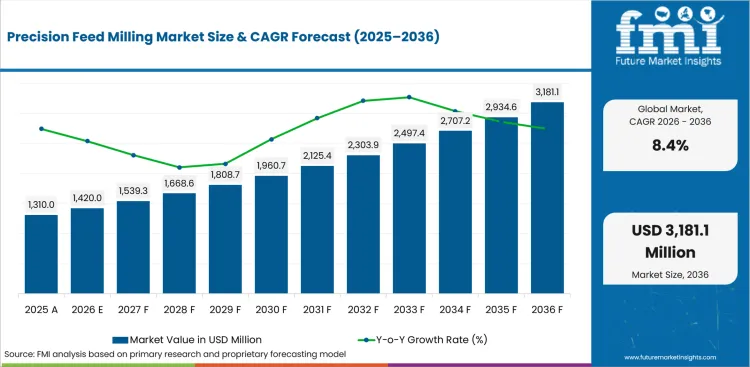
| Metric | Value |
|---|---|
| 2025 Market Size | USD 1,310.0 million |
| 2026 Market Size | USD 1,420.0 million |
| 2036 Market Size | USD 3,181.1 million |
| Forecast CAGR (2026-2036) | 8.4% |
| Leading Form | Dry |
| Dry Share (2026) | 39.5% |
| Leading Source | Microbial |
| Microbial Share (2026) | 37.0% |
| Leading Livestock | Poultry |
| Poultry Share (2026) | 35.0% |
| Fastest-growing Country | India |
| India CAGR by 2036 | 7.6% |
Summary of the Precision Feed Milling Market
| Market Signal | Commercial Impact |
|---|---|
| Demand and Growth Drivers | Feed-efficiency accountability is expected to increase demand for accurate dosing and batch documentation across integrated feed programs.
|
| Product and Segment View | Dry formats, microbial sources and broiler use cases lead the 2026 segment view for supplier screening. Gut-health positioning remains the functional thread behind formulation trials and integrated broiler programs.
|
| Geography and Growth Outlook | Asia and North America are expected to shape procurement priorities through livestock scale, feed modernization and audit-ready formulation practices.
|
| Competitive Landscape | Competition is projected to revolve around nutrition proof, strain evidence and field-level support for broiler accounts. Supplier shortlists are expected to favor documentation quality and regional service before broader adoption.
|
| Analyst Perspective | Commercial value is expected to shift toward mill-ready evidence and supplier support. Supplier retention is likely to depend on proof that multibiotics improve routine flock performance.
|
Source: FMI's proprietary forecasting model and primary research
How is the precision feed milling market segmented?
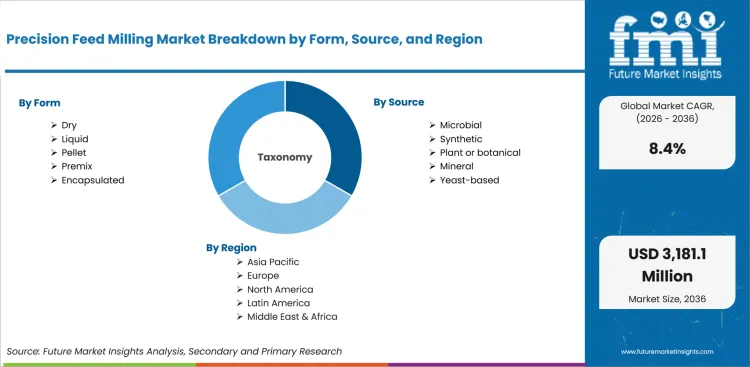
The precision feed milling industry is segmented by form, source, livestock, function, and region.
The precision feed milling market is segmented by form, source, livestock, function, and region. By form, the market covers dry, liquid, pellet, premix, and encapsulated formats. By source, it covers synthetic, microbial, plant or botanical, mineral, and yeast-based inputs. By livestock, it covers poultry, swine, ruminants, aquaculture, and equine and pets. By function, it covers gut health, growth performance, immunity, nutrient utilization, and stress management. Regional coverage includes North America, Europe, East Asia, South Asia, and Latin America, supported by related demand in feed palatability enhancers and specialist additive programs.
How does dry shape demand within the form category?
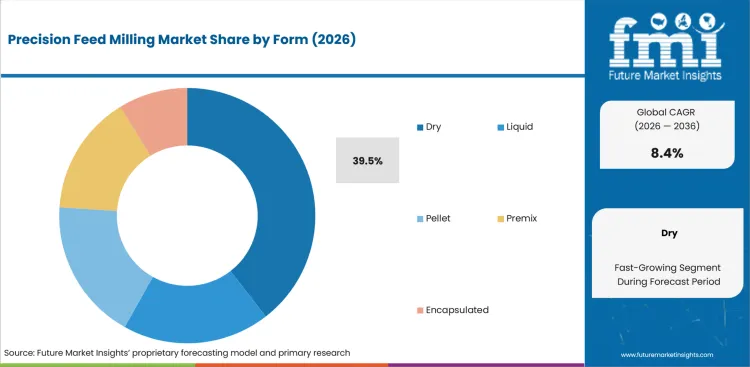
Form selection is expected to influence whether an additive fits daily mill work or becomes a handling burden. Dry formats carry procurement weight due to dosing familiarity, storage practicality and blending compatibility. DEFRA reported that compound feed production increased 4.4% in the United Kingdom during 2024, which supports closer attention to forms that fit routine mill lines. Suppliers therefore need handling proof before buyers approve broader plant programs.
- Dry is expected to account for 39.5% market share in 2026, supported by line compatibility and storage control. USDA ERS reported in May 2026 that corn accounts for more than 95% of United States feed grain production and use, which explains why mill buyers value formats that behave predictably beside bulk grain inputs.
- The executive case for dry centers on lower handling risk: feed manufacturers gain a familiar format that simplifies storage and dosing trials. Dry additive programs also help quality teams compare flow behavior and blending results before commercial orders move into larger poultry feed or ruminant feed programs.
What supports demand for microbial source choices?
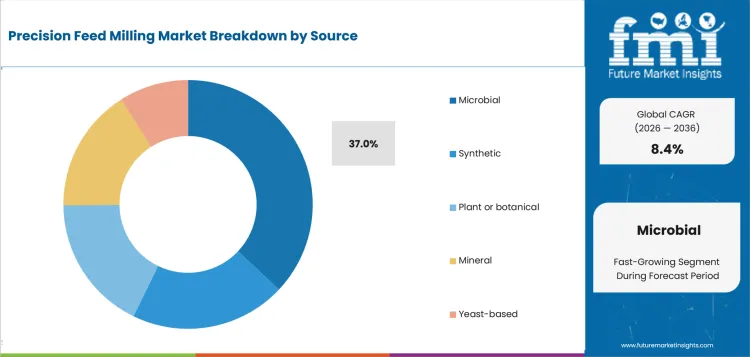
Source decisions are expected to shape buyer trust before an additive reaches a commercial diet. Microbial inputs fit programs that seek biological performance evidence and clearer batch identity. EFSA held a 2026 guidance event for microorganism feed additive dossiers, pointing to tighter technical expectations for safety and efficacy files. Procurement teams need traceability and reliable batch behavior before supplier changes move forward.
- Microbial is projected to represent 37.0% of the market in 2026, driven by dossier expectations and gut-health positioning. EFSA updated its feed additive application procedure in February 2026, which keeps source verification and evidence quality central to buyer approval in regulated accounts.
- Brand and premix teams in animal nutrition gain from animal feed probiotics and microbial inputs due to clearer strain logic and batch-review discipline. The buying decision remains practical due to proof needs for stability, dosage behavior and farm-level response before buyers extend the source into more commercial diets.
How do buyers evaluate poultry within the livestock category?
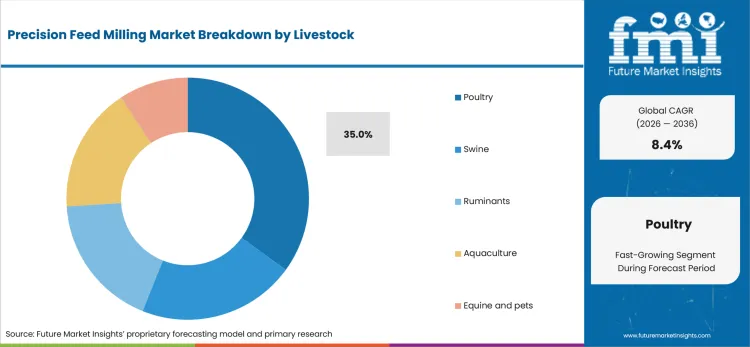
Livestock selection is expected to influence trial speed and evidence expectations more than broad animal-nutrition positioning. Poultry creates a narrower operating case due to short cycles and close feed-conversion tracking. OECD-FAO projected poultry to provide 62% of additional meat consumed globally by 2034, which supports closer buyer review of additives that show quick flock-level feedback.
- Poultry is anticipated to hold 35.0% share in 2026, attributable to flock-scale economics and faster performance signals. OECD-FAO projected global poultry consumption to reach 173 million tonnes by 2034, which supports demand for additives that fit high-volume feed programs and frequent ration review.
- For nutrition directors, poultry reduces trial ambiguity due to shorter cycles and cleaner batch-to-flock records across diet changes. Procurement teams are expected to select suppliers that connect ration data, health observations and feed conversion evidence before broader contracts cover multiple production sites.
What drives gut health within the function category?
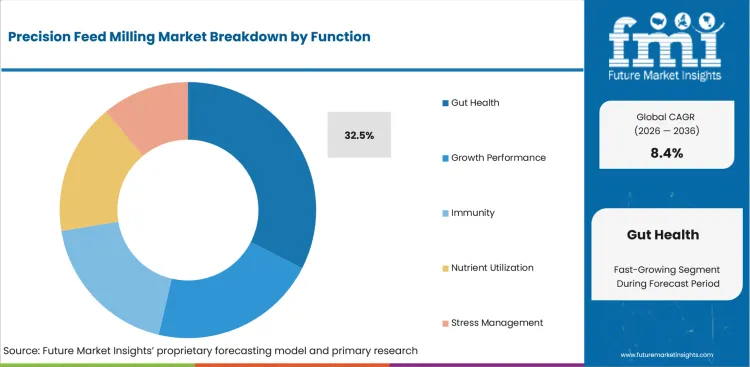
Function selection is expected to make the buyer case more concrete before a mill expands use. Gut health creates a defined performance promise that must fit trial files and species routines. FAO projected livestock antimicrobial use could reach 143,481 tonnes by 2040 under current trends, which raises interest in feed strategies that support preventive nutrition and documented animal health outcomes.
- Gut health is forecast to capture 32.5% share in 2026, owing to preventive nutrition needs and performance-stability programs. Cargill stated in March 2025 that its mycotoxin research uses more than 400,000 feed samples, which shows how evidence depth shapes buyer confidence around gut-related claims.
- The buying decision for gut health is about measurable risk control: nutrition teams need trial designs that link additive use to feed conversion and health records. Suppliers using natural feed additives are expected to gain trial access where buyers need clearer evidence before reducing problem-driven ration changes.
What are the drivers, restraints, and opportunities in the precision feed milling market?
Near-term purchases are being shaped by feed-cost exposure and proof burden. Species-specific service packages shape the supplier access route outlined below.
- Driver: Feed-cost exposure and raw-material variability are expected to push spending toward additives that improve ration predictability and batch consistency.
- Restraint: Weak trial ownership is anticipated to delay supplier approval in mills that need aligned nutrition and operations evidence.
- Opportunity: Species-specific premixes are projected to create account-entry routes for suppliers that combine products and technical service.
Feed manufacturers are expected to increase buying activity if additive programs connect ration stability to measurable plant outcomes. USDA’s 2026 Livestock and Poultry Outlook projected red meat and poultry output at 108.4 billion pounds, reinforcing the scale behind feed-efficiency decisions. Suppliers that explain mill impact in operational terms are likely to gain trial access before broader purchase contracts.
Quality teams are likely to slow adoption in accounts that lack clear ownership across formulation, purchasing and production. Trial design also needs a named owner before rollout. FDA’s January 2025 animal food ingredient consultation guidance keeps safety review visible during supplier qualification. Documentation gaps are expected to keep mill approvals slower in accounts that require formal additive review.
Implementation barriers are projected to create a route for vendors that bundle additives and application support. ADM opened an animal health and wellness R&D center in June 2025, signaling supplier investment in applied nutrition support. The portfolio shift is expected to widen account access for feed premix programs that need evidence, training and service continuity before scale-up.
Which country CAGRs are profiled in the precision feed milling market?
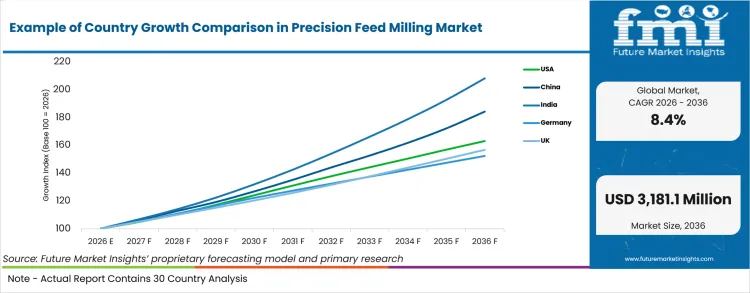
| Country | CAGR |
|---|---|
| United States | 5.0% |
| China | 6.3% |
| India | 7.6% |
| Germany | 4.3% |
| United Kingdom | 4.6% |
| Japan | 3.6% |
| South Korea | 4.9% |
Source: FMI's proprietary forecasting model and primary research
How do country-level CAGRs compare in the precision feed milling market?
Country CAGR profiles in the precision feed milling market reflect livestock intensity, feed-cost pressure and supplier documentation needs. India and China show higher conversion potential through dairy, poultry and industrial feed systems. The United States and South Korea form a mid-tier adoption band shaped by large livestock operations and technical feed programs. The United Kingdom and Germany show steadier evidence-led purchasing through regulated additive review. Japan reflects a careful adoption cycle where feed-cost pressure and supplier trust guide account conversion.
- By 2036, the United States is projected to grow at 5.0% CAGR due to large feed operations and tighter supplier qualification. USDA NASS reported 86.2 million cattle and calves on farms in January 2026. Poultry and ruminant programs are expected to gain attention from buyers that need proven additive behavior across high-volume plants.
- China’s demand outlook is anticipated to advance at 6.3% CAGR over the assessment period, supported by industrial livestock density and local service needs. The State Council reported 96.63 million tonnes of total meat output across main species in 2024. Coastal feed groups are expected to prioritize mill-ready trial support and faster technical response.
- India is forecast to rise at 7.6% CAGR over the forecast period, attributable to dairy scale and expanding poultry nutrition needs. PIB reported total milk production of 247.87 million tonnes during 2024-25. Dairy cooperatives and poultry integrators are expected to expand additive review in accounts that need cost discipline and ration consistency.
- Adoption in Germany is estimated to post 4.3% CAGR over the forecast period, owing to structured livestock production and careful claims review. Destatis reported commercial meat production of 6.8 million tonnes in 2025. Feed suppliers are expected to gain consideration where documentation supports regulated nutrition programs and stable batch release.
- The United Kingdom outlook is projected to record 4.6% CAGR over the assessment period, driven by feed-price sensitivity and audit-led buyer behavior. DEFRA reported livestock populations in the United Kingdom at 1 June 2025 across cattle, sheep and pigs. Regional compounders are expected to favor dry additive formats that fit existing handling systems.
- In Japan, precision feed milling demand is predicted to advance at 3.6% CAGR over the forecast period due to conservative supplier approval and feed-cost pressure. USDA FAS reported Japan heavily depends on imported feed grains. Feed buyers are expected to trial additives selectively where technical documentation and stable supply reduce ration risk.
- South Korea is estimated to post 4.9% CAGR over the forecast period, supported by smart livestock programs and feed-import exposure. Ministry of Data and Statistics reported 3.422 million Korean native cattle and beef cattle in the third quarter of 2025. Integrators are likely to prioritize suppliers that support digital farm records and consistent additive dosing.
Who are the notable companies in the precision feed milling market?
Cargill, ADM, dsm-firmenich, Kemin Industries, Alltech, Novonesis, Adisseo, and Trouw Nutrition are the notable companies shaping this market.
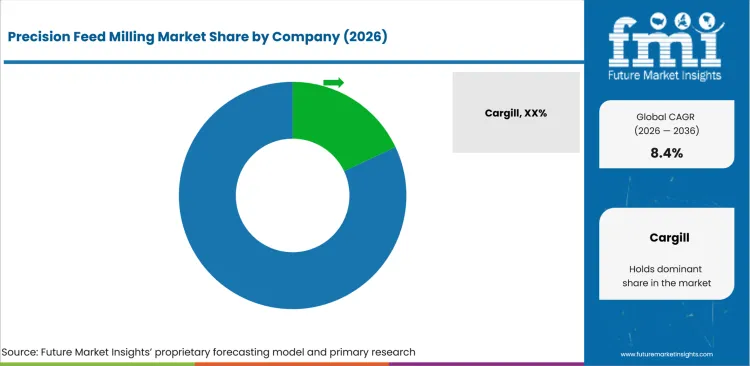
Competition in the precision feed milling market is split by portfolio breadth, bioscience capability and application support for commercial feed accounts. Cargill and ADM are more suited to multi-species nutrition programs. Kemin Industries and Alltech remain practical choices for targeted gut-health and animal performance accounts. Novonesis and dsm-firmenich are better positioned in enzyme-linked programs. Adisseo and Trouw Nutrition gain preference in accounts needing formulation depth and service continuity. The competitive outlook is expected to center on which supplier reduces trial risk and documentation work.
- Cargill and ADM focus on nutrition breadth, which addresses feed manufacturers needing ingredient coverage and support depth in one supplier screen. Buyers use these portfolios to reduce qualification work before launch and compare technical service across ruminant, swine and poultry programs.
- Buyers choosing Novonesis or dsm-firmenich are typically looking for bioscience fit due to enzyme behavior and microbial know-how. Novonesis’ 2025 Feed Enzyme Alliance completion gives buyers a clearer route to enzyme supply and application support in performance-led accounts.
- Kemin Industries and Alltech gain preference in species-focused environments due to targeted nutrition support and farm-level service routines. These suppliers help buyers connect animal health observations to additive choices before new products enter wider ration programs.
- In formulation-heavy accounts, Adisseo and Trouw Nutrition are prominent due to application support and broader feed-additive portfolios. Procurement teams select these suppliers in accounts whose internal nutrition groups need help translating starter feed and gut-health ideas into repeatable programs.
Competitive Benchmarking: Precision Feed Milling Market
| Company | Additive Fit | Technical Service | Livestock Reach | Account Access |
|---|---|---|---|---|
| Cargill | High | Strong | Global | High |
| ADM | High | Strong | Global | Strong |
| dsm-firmenich | Strong | High | Global | High |
| Kemin Industries | Strong | Strong | Global | Strong |
| Alltech | High | Strong | Global | Strong |
| Novonesis | Strong | High | Global | High |
| Adisseo | High | Strong | Global | Strong |
| Trouw Nutrition | High | Strong | Global | High |
Source: Future Market Insights competitive analysis, 2026. Ratings reflect relative portfolio relevance and workflow fit. Service capability and geographic reach shape the remaining comparison.
Key Developments in the Precision Feed Milling Market
- In June 2025, Novonesis completed the acquisition of dsm-firmenich’s share of the Feed Enzyme Alliance. The company said regulatory approvals had been achieved. Feed buyers are expected to review the change where enzyme supply continuity and application support influence broader additive programs.
- In June 2025, ADM opened an R&D center dedicated to animal health and wellness. The site supports work across nutrition, microbiome science and animal performance. Commercial feed accounts are likely to use this capability during trials that need clearer evidence before supplier approval.
- In September 2025, ADM and Alltech announced a North American animal feed joint venture. The arrangement brought together feed manufacturing and nutrition expertise. Regional feed customers are expected to evaluate the venture where service coverage and product access influence account decisions.
- In March 2026, Adisseo expanded its butyrate portfolio with Sanion Tetra. The portfolio extension targets gut-health and performance applications in animal nutrition. Buyers are likely to review the product where protected delivery and formulation support affect broader gut-health programs.
Key Players in the Precision Feed Milling Market
Integrated animal nutrition suppliers
- Cargill
- ADM
- Trouw Nutrition
Bioscience and enzyme specialists
- dsm-firmenich
- Novonesis
Species nutrition and additive suppliers
- Kemin Industries
- Alltech
- Adisseo
Precision Feed Milling Market - Report Scope
| Coverage field | Report scope |
|---|---|
| Market breakdown | Precision Feed Milling Market Breakdown by form, source, livestock, function, and region |
| Market Definition | Precision feed milling products and supporting additives used by feed mills, premix suppliers and livestock integrators to improve ration consistency and species-specific performance. |
| Regions Covered | North America, Latin America, Europe, East Asia, South Asia and Pacific, Middle East and Africa |
| Countries Covered | United States, China, India, Germany, United Kingdom, Japan, South Korea and additional country markets |
| Key Companies Profiled | Cargill, ADM, dsm-firmenich, Kemin Industries, Alltech, Novonesis, Adisseo, Trouw Nutrition |
| Forecast Period | 2026 to 2036 |
| Approach | Hybrid methodology using segment adoption, buyer use cases, country CAGRs, supplier portfolios, and verified public-source signals |
Source: Future Market Insights - analysis driven by proprietary forecasting models and primary research
Precision Feed Milling Market - Research Methodology
| Method | Approach |
|---|---|
| Primary Research | FMI analysts reviewed inputs from feed mill operators, premix suppliers, nutrition heads, livestock integrators, distributor teams, and additive formulators. Supplier interviews focused on dosage behavior, ingredient documentation, species fit, trial ownership, and adoption barriers across dry, microbial, poultry, and gut-health programs. |
| Desk Research | Desk research covered official livestock sources, national feed indicators, regulatory references, company product information, and public animal-nutrition data. Product relevance was checked against precision feed milling use cases, additive handling, feed safety, source documentation, and channel suitability across commercial feed accounts. |
| Market Sizing and Forecasting | The model combined finished feed demand, additive adoption, livestock mix, function positioning, and country-level animal-protein indicators. Forecast assumptions were adjusted for dry format preference, microbial sourcing, poultry demand, gut-health positioning, and documentation requirements in regulated feed programs. |
| Data Validation | Forecasts were checked against livestock output, additive supplier portfolios, feed production evidence, and country-level animal nutrition indicators. Company portfolios were reviewed to avoid counting adjacent animal-health products without direct precision feed milling relevance. |
Source: Future Market Insights (FMI) analysis, based on proprietary forecasting model and primary research
Precision Feed Milling Market by Segments
Precision Feed Milling Market segmented by Form:
- Dry
- Liquid
- Pellet
- Premix
- Encapsulated
Precision Feed Milling Market segmented by Source:
- Synthetic
- Microbial
- Plant or botanical
- Mineral
- Yeast-based
Precision Feed Milling Market segmented by Livestock:
- Poultry
- Swine
- Ruminants
- Aquaculture
- Equine and pets
Precision Feed Milling Market segmented by Function:
- Gut health
- Growth performance
- Immunity
- Nutrient utilization
- Stress management
Precision Feed Milling Market by Region:
- North America
- United States
- Canada
- Europe
- Germany
- United Kingdom
- France
- Italy
- Spain
- Asia Pacific
- China
- Japan
- South Korea
- Taiwan
- Singapore
- Latin America
- Brazil
- Mexico
- Argentina
- Middle East & Africa
- GCC Countries
- South Africa
- Israel
Research Sources and Bibliography
- Organisation for Economic Co-operation and Development and Food and Agriculture Organization of the United Nations. (2025, July). OECD-FAO Agricultural Outlook 2025-2034.
- Organisation for Economic Co-operation and Development and Food and Agriculture Organization of the United Nations. (2025, July). Meat: OECD-FAO Agricultural Outlook 2025-2034.
- Food and Agriculture Organization of the United Nations. (2026, June). The future of antimicrobial use in livestock.
- USA Department of Agriculture, National Agricultural Statistics Service. (2026, January). United States cattle inventory down slightly.
- People’s Republic of China State Council. (2025, January). China’s production of cattle, sheep, poultry remains stable in 2024.
- Press Information Bureau, Government of India. (2025, November). Release of Basic Animal Husbandry Statistics 2025.
- Department for Environment, Food & Rural Affairs. (2025, July). Agriculture in the United Kingdom 2024.
- Department for Environment, Food & Rural Affairs. (2025, December). Livestock populations in the United Kingdom at 1 June 2025.
- USA Department of Agriculture, Foreign Agricultural Service. (2026, March). Report Name: Grain and Feed Annual.
- Ministry of Data and Statistics, Republic of Korea. (2025, October). Livestock Statistics in the Third Quarter of 2025.
- European Food Safety Authority. (2026, May). Ready for EFSA’s new Guidance? Build a fit for purpose feed additive dossier for microorganism submission.
- European Food Safety Authority. (2026, February). Feed additives application procedure.
- USA Department of Agriculture, Economic Research Service. (2026, May). Corn and Other Feed Grains - Feed Grains Sector at a Glance.
- USA Department of Agriculture. (2026, February). Livestock and Poultry Outlook.
- USA Food and Drug Administration. (2025, January). CVM GFI #294 - Animal Food Ingredient Consultation (AFIC).
- Statistisches Bundesamt. (2026, February). Commercial meat production.
- Cargill. (2025, March). Cargill Animal Nutrition & Health Presents New Insights on Mycotoxins and Poultry Gut Health.
- Novonesis. (2025, June). Deal to acquire dsm-firmenich’s share of the Feed Enzyme Alliance is completed, supporting Novonesis’ growth strategy.
- ADM. (2025, June). ADM Opens Pioneering R&D Center Dedicated to Animal Health and Wellness.
- ADM. (2025, September). ADM, Alltech to Bring Together Unparalleled Expertise and Experience in New North American Animal Feed Joint Venture.
- Adisseo. (2026, March). Adisseo Expands Butyrate Portfolio with Sanion Tetra.
This bibliography is provided for reader reference and uses primary government, standards-body, official trade body, and company sources.
This Report Answers
- What is the expected value of the precision feed milling market in 2026 and 2036?
- What CAGR is forecast for the precision feed milling market from 2026 to 2036?
- Which segments shape form and source demand alongside livestock and function demand?
- Which buyer pressures are expected to support precision feed milling adoption?
- How do country CAGRs differ across the profiled markets?
- Which companies compete across additives and bioscience alongside technical service channels?
- How does FMI validate forecasts and avoid duplicate external statistics?
- What buyer factors should suppliers address before broader account expansion?
- How do trial evidence and documentation affect supplier selection?
Frequently Asked Questions
Why should executives track the Precision Feed Milling Market?
Executives should track this market due to a clear shift from broad additive buying toward documented ration performance and supplier accountability.
What business problem does the Precision Feed Milling Market address?
It helps buyers reduce dosing error and formulation uncertainty across feed mills that need repeatable additive behavior during commercial batching.
What should procurement leaders evaluate before selecting suppliers?
Procurement leaders should evaluate additive documentation, trial design, batch consistency, technical service depth and species-specific proof before approving broader supply programs.
What limits return on investment for buyers?
Return on investment is limited by weak trial ownership, inconsistent mill handling, slow documentation review and poor alignment between nutrition and operations teams.
How do suppliers build executive confidence?
Suppliers build confidence by providing practical trial protocols, clear formulation records, repeatable batch evidence and service support across multi-site feed accounts.
Preview the report firsthand - request a free sample
Get SampleGet the brochure for pricing and purchase details.
Get PDFTable of Content
- Key Takeaways
- Market Size and CAGR
- Top Growth Driver
- Fastest Growing Segment
- Leading Region
- Key Companies
- Emerging Opportunities
- Executive Summary
- Global Market Outlook
- Demand-side Trends
- Supply-side Trends
- Technology Roadmap Analysis
- Analysis and Recommendations
- Analyst Perspective (What is happening? Why now? What should investors know?)
- Key Questions Answered
- How large is the market?
- What is the CAGR?
- What are key trends?
- Which region dominates?
- Who are the leaders?
- Market Overview
- Market Coverage / Taxonomy
- Market Definition / Scope / Limitations
- Research Methodology
- Chapter Orientation
- Analytical Lens and Working Hypotheses
- Market Structure, Signals, and Trend Drivers
- Benchmarking and Cross-market Comparability
- Market Sizing, Forecasting, and Opportunity Mapping
- Research Design and Evidence Framework
- Desk Research Programme (Secondary Evidence)
- Expert Input and Fieldwork (Primary Evidence)
- Tooling, Models, and Reference Databases
- Data Engineering and Model Build
- Quality Assurance and Audit Trail
- Market Background
- Market Dynamics (Drivers, Restraints, Opportunity, Trends)
- Scenario Forecast (Optimistic, Likely, Conservative)
- Impact Analysis
- AI Impact
- Sustainability Impact
- Regulatory Impact
- Technology Impact
- Consumer / Buyer Analysis
- Purchase Drivers
- Adoption Barriers
- Buyer Journey
- Opportunity Map Analysis
- Product Life Cycle Analysis
- Supply Chain Analysis
- Investment Feasibility Matrix
- Value Chain Analysis
- PESTLE and Porter's Analysis
- Regulatory Landscape
- Regional Parent Market Outlook
- Production and Consumption Statistics
- Import and Export Statistics
- Global Market Analysis and Forecast, 2021 to 2036
- Historical Market Size Value (USD Million) & Volume (Unit) Analysis, 2021 to 2025
- Current and Future Market Size Value (USD Million) & Volume (Unit) Projections, 2026 to 2036
- Y-o-Y Growth Trend Analysis
- Absolute $ Opportunity Analysis
- Global Market Pricing Analysis, 2021 to 2036
- Global Market Analysis and Forecast, By Form, 2021 to 2036
- Introduction / Key Findings
- Historical Market Size Value (USD Million) & Volume (Unit) Analysis By Form, 2021 to 2025
- Current and Future Market Size Value (USD Million) & Volume (Unit) Analysis and Forecast By Form, 2026 to 2036
- Dry
- Liquid
- Pellet
- Premix
- Encapsulated
- Dry
- Y-o-Y Growth Trend Analysis By Form, 2021 to 2025
- Absolute $ Opportunity Analysis By Form, 2026 to 2036
- Global Market Analysis and Forecast, By Source, 2021 to 2036
- Introduction / Key Findings
- Historical Market Size Value (USD Million) & Volume (Unit) Analysis By Source, 2021 to 2025
- Current and Future Market Size Value (USD Million) & Volume (Unit) Analysis and Forecast By Source, 2026 to 2036
- Microbial
- Synthetic
- Plant or botanical
- Mineral
- Yeast-based
- Microbial
- Y-o-Y Growth Trend Analysis By Source, 2021 to 2025
- Absolute $ Opportunity Analysis By Source, 2026 to 2036
- Global Market Analysis and Forecast, By Livestock, 2021 to 2036
- Introduction / Key Findings
- Historical Market Size Value (USD Million) & Volume (Unit) Analysis By Livestock, 2021 to 2025
- Current and Future Market Size Value (USD Million) & Volume (Unit) Analysis and Forecast By Livestock, 2026 to 2036
- Poultry
- Swine
- Ruminants
- Aquaculture
- Equine and pets
- Poultry
- Y-o-Y Growth Trend Analysis By Livestock, 2021 to 2025
- Absolute $ Opportunity Analysis By Livestock, 2026 to 2036
- Global Market Analysis and Forecast, By Function, 2021 to 2036
- Introduction / Key Findings
- Historical Market Size Value (USD Million) & Volume (Unit) Analysis By Function, 2021 to 2025
- Current and Future Market Size Value (USD Million) & Volume (Unit) Analysis and Forecast By Function, 2026 to 2036
- Gut Health
- Growth Performance
- Immunity
- Nutrient Utilization
- Stress Management
- Gut Health
- Y-o-Y Growth Trend Analysis By Function, 2021 to 2025
- Absolute $ Opportunity Analysis By Function, 2026 to 2036
- Global Market Analysis and Forecast, By Region, 2021 to 2036
- Introduction
- Historical Market Size Value (USD Million) & Volume (Unit) Analysis By Region, 2021 to 2025
- Current Market Size Value (USD Million) & Volume (Unit) Analysis and Forecast By Region, 2026 to 2036
- North America
- Latin America
- Western Europe
- Eastern Europe
- East Asia
- South Asia and Pacific
- Middle East & Africa
- Market Attractiveness Analysis By Region
- North America Market Analysis and Forecast, By Country, 2021 to 2036
- Historical Market Size Value (USD Million) & Volume (Unit) Trend Analysis By Market Taxonomy, 2021 to 2025
- Market Size Value (USD Million) & Volume (Unit) Forecast By Market Taxonomy, 2026 to 2036
- By Country
- USA
- Canada
- By Form
- By Source
- By Livestock
- By Function
- By Country
- Market Attractiveness Analysis
- By Country
- By Form
- By Source
- By Livestock
- By Function
- Key Takeaways
- Latin America Market Analysis and Forecast, By Country
- Historical Market Size Value (USD Million) & Volume (Unit) Trend Analysis By Market Taxonomy, 2021 to 2025
- Market Size Value (USD Million) & Volume (Unit) Forecast By Market Taxonomy, 2026 to 2036
- By Country
- Brazil
- Chile
- Mexico
- Rest of Latin America
- By Form
- By Source
- By Livestock
- By Function
- By Country
- Market Attractiveness Analysis
- By Country
- By Form
- By Source
- By Livestock
- By Function
- Key Takeaways
- Western Europe Market Analysis and Forecast, By Country
- Historical Market Size Value (USD Million) & Volume (Unit) Trend Analysis By Market Taxonomy, 2021 to 2025
- Market Size Value (USD Million) & Volume (Unit) Forecast By Market Taxonomy, 2026 to 2036
- By Country
- Germany
- UK
- Italy
- Spain
- France
- Nordic
- BENELUX
- Rest of Western Europe
- By Form
- By Source
- By Livestock
- By Function
- By Country
- Market Attractiveness Analysis
- By Country
- By Form
- By Source
- By Livestock
- By Function
- Key Takeaways
- Eastern Europe Market Analysis and Forecast, By Country
- Historical Market Size Value (USD Million) & Volume (Unit) Trend Analysis By Market Taxonomy, 2021 to 2025
- Market Size Value (USD Million) & Volume (Unit) Forecast By Market Taxonomy, 2026 to 2036
- By Country
- Russia
- Poland
- Hungary
- Balkan & Baltic
- Rest of Eastern Europe
- By Form
- By Source
- By Livestock
- By Function
- By Country
- Market Attractiveness Analysis
- By Country
- By Form
- By Source
- By Livestock
- By Function
- Key Takeaways
- East Asia Market Analysis and Forecast, By Country
- Historical Market Size Value (USD Million) & Volume (Unit) Trend Analysis By Market Taxonomy, 2021 to 2025
- Market Size Value (USD Million) & Volume (Unit) Forecast By Market Taxonomy, 2026 to 2036
- By Country
- China
- Japan
- South Korea
- By Form
- By Source
- By Livestock
- By Function
- By Country
- Market Attractiveness Analysis
- By Country
- By Form
- By Source
- By Livestock
- By Function
- Key Takeaways
- South Asia and Pacific Market Analysis and Forecast, By Country
- Historical Market Size Value (USD Million) & Volume (Unit) Trend Analysis By Market Taxonomy, 2021 to 2025
- Market Size Value (USD Million) & Volume (Unit) Forecast By Market Taxonomy, 2026 to 2036
- By Country
- India
- ASEAN
- Australia & New Zealand
- Rest of South Asia and Pacific
- By Form
- By Source
- By Livestock
- By Function
- By Country
- Market Attractiveness Analysis
- By Country
- By Form
- By Source
- By Livestock
- By Function
- Key Takeaways
- Middle East & Africa Market Analysis and Forecast, By Country
- Historical Market Size Value (USD Million) & Volume (Unit) Trend Analysis By Market Taxonomy, 2021 to 2025
- Market Size Value (USD Million) & Volume (Unit) Forecast By Market Taxonomy, 2026 to 2036
- By Country
- Kingdom of Saudi Arabia
- Other GCC Countries
- Türkiye
- South Africa
- Other African Union
- Rest of Middle East & Africa
- By Form
- By Source
- By Livestock
- By Function
- By Country
- Market Attractiveness Analysis
- By Country
- By Form
- By Source
- By Livestock
- By Function
- Key Takeaways
- Key Countries Market Analysis
- USA
- Pricing Analysis
- Market Share Analysis, 2025
- By Form
- By Source
- By Livestock
- By Function
- Canada
- Pricing Analysis
- Market Share Analysis, 2025
- By Form
- By Source
- By Livestock
- By Function
- Mexico
- Pricing Analysis
- Market Share Analysis, 2025
- By Form
- By Source
- By Livestock
- By Function
- Brazil
- Pricing Analysis
- Market Share Analysis, 2025
- By Form
- By Source
- By Livestock
- By Function
- Chile
- Pricing Analysis
- Market Share Analysis, 2025
- By Form
- By Source
- By Livestock
- By Function
- Germany
- Pricing Analysis
- Market Share Analysis, 2025
- By Form
- By Source
- By Livestock
- By Function
- UK
- Pricing Analysis
- Market Share Analysis, 2025
- By Form
- By Source
- By Livestock
- By Function
- Italy
- Pricing Analysis
- Market Share Analysis, 2025
- By Form
- By Source
- By Livestock
- By Function
- Spain
- Pricing Analysis
- Market Share Analysis, 2025
- By Form
- By Source
- By Livestock
- By Function
- France
- Pricing Analysis
- Market Share Analysis, 2025
- By Form
- By Source
- By Livestock
- By Function
- India
- Pricing Analysis
- Market Share Analysis, 2025
- By Form
- By Source
- By Livestock
- By Function
- ASEAN
- Pricing Analysis
- Market Share Analysis, 2025
- By Form
- By Source
- By Livestock
- By Function
- Australia & New Zealand
- Pricing Analysis
- Market Share Analysis, 2025
- By Form
- By Source
- By Livestock
- By Function
- China
- Pricing Analysis
- Market Share Analysis, 2025
- By Form
- By Source
- By Livestock
- By Function
- Japan
- Pricing Analysis
- Market Share Analysis, 2025
- By Form
- By Source
- By Livestock
- By Function
- South Korea
- Pricing Analysis
- Market Share Analysis, 2025
- By Form
- By Source
- By Livestock
- By Function
- Russia
- Pricing Analysis
- Market Share Analysis, 2025
- By Form
- By Source
- By Livestock
- By Function
- Poland
- Pricing Analysis
- Market Share Analysis, 2025
- By Form
- By Source
- By Livestock
- By Function
- Hungary
- Pricing Analysis
- Market Share Analysis, 2025
- By Form
- By Source
- By Livestock
- By Function
- Kingdom of Saudi Arabia
- Pricing Analysis
- Market Share Analysis, 2025
- By Form
- By Source
- By Livestock
- By Function
- Türkiye
- Pricing Analysis
- Market Share Analysis, 2025
- By Form
- By Source
- By Livestock
- By Function
- South Africa
- Pricing Analysis
- Market Share Analysis, 2025
- By Form
- By Source
- By Livestock
- By Function
- USA
- Market Structure Analysis
- Competition Dashboard
- Competition Benchmarking
- Market Share Analysis of Top Players
- By Regional
- By Form
- By Source
- By Livestock
- By Function
- Emerging Startups
- Innovation Benchmarking
- Competition Analysis
- Competition Deep Dive
- Cargill
- Overview
- Product Portfolio
- Profitability by Market Segments (Product/Region/Sales Channel)
- Sales Footprint
- Strategy Overview
- Marketing Strategy
- Product Strategy
- Channel Strategy
- ADM
- Trouw Nutrition
- dsm-firmenich
- Novonesis
- Kemin Industries
- Alltech
- Adisseo
- Cargill
- Case Studies
- Success Stories
- Recent Developments
- Competition Deep Dive
- Assumptions & Acronyms Used


