

- Market Size (2026)
- USD 76.4 Mn
- Forecast (2036)
- USD 151.7 Mn
- CAGR (2026 to 2036)
- 7.1%
How big is Purple Wheat Flour Market in 2026?
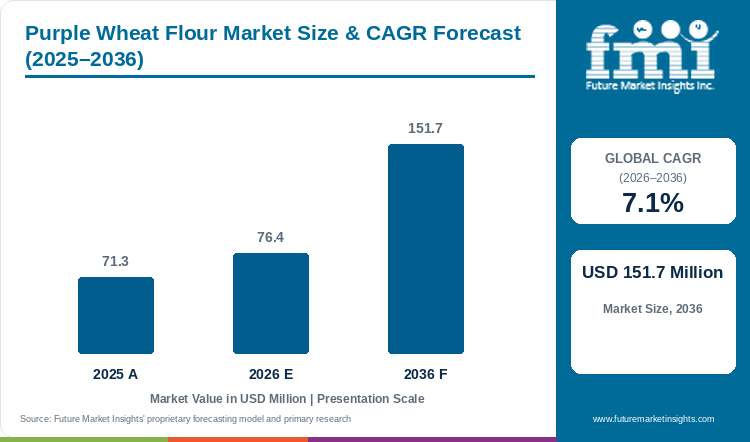
Assessed at USD 71.3 million in 2025 and progressing to USD 76.4 million in 2026, the global purple wheat flour market valuation is on course to reach USD 151.7 million by 2036, supported by a forecast-period CAGR of 7.1%.
Clean-label dye withdrawals are rewriting bakery color sourcing, and purple wheat flour arrives as the pigment that survives audit because its anthocyanins live in the pericarp rather than in an ingredient list. The global purple wheat flour market was valued at USD 71.3 million in 2025 and is estimated to reach USD 76.4 million in 2026. The market is projected to reach USD 151.7 million by 2036, expanding at a compound annual growth rate (CAGR) of 7.1% between 2026 and 2036. Whole-grain milled grade is predicted at 43.8% of 2026 segment share on full pericarp inclusion that preserves native anthocyanin loading of 130 to 340 mg per kilogram. Demand growth moves in step with the functional flours market at 6.7% CAGR, because both classes wait on the same constraint, which is identity-preserved seed supply rather than brand interest [8]. The growth in purple wheat cultivation is also reflected in sourcing programs, as GoodMills Group aligned its European specialty flour operations with low-carbon wheat sourcing through the Sustainable Wheat Initiative in June 2025 [10], and Scoular published expanded regenerative and identity-preserved wheat programs for milling customers in October 2025 [23]. Bakeries adopting the flour still absorb 25% to 45% anthocyanin degradation in oven, so the converters that reformulate coating and cold-set applications ahead of those losses hold the labeling advantage through 2036.
Key Market Trends & Insights
- By milling grade: Full pericarp inclusion that preserves 130 to 340 mg/kg native anthocyanins places Whole-Grain Milled Grade at a predicted 43.8% share of the milling grade segment in 2026.
- By physical form: Standard Dry Flour is expected to represent 54.6% of the physical form segment in 2026 because existing pneumatic bakery silos and gravimetric feeders require zero hardware modification.
- By application: Daily retail sandwich-bread and sourdough boule turnover gives Bread & Rolls a projected 37.4% share of the application segment in 2026.
- By claim: Conventional Clean-Label is anticipated to capture 52.3% of the claim segment in 2026 to provide straightforward whole-wheat ingredient declarations without organic price surcharges.
- By sales channel: Identity-preserved crop contracting and batch farinograph alignment make Direct to Industrial Bakeries the leading sales channel segment at an estimated 55.8% share in 2026.
Regional Highlights
- Top national expansion: Specialty millers in the USA are forecast to record a leading 7.9% CAGR through 2036, supported by identity-preserved cleaning investments and consumer whole-grain demand.
- Broader country progression: Turnover in Germany is projected to rise at a 7.6% CAGR ahead of France at 7.3% and the UK at 7.0%, whereas Japan is expected to register a 5.8% CAGR through 2036.
Market Size & Forecast
Table 1: Market Size and Forecast for the Purple Wheat Flour Market (USD million and CAGR percentage), 2025 to 2036
| Metric | Value |
|---|---|
| 2025 Market Size | USD 71.3 million |
| Estimated Market Size in 2026 | USD 76.4 million |
| Projected Market Size by 2036 | USD 151.7 million |
| CAGR, 2026 to 2036 | 7.1% |
| Added Revenue, 2026 to 2036 | USD 75.3 million |
Coarse pericarp bran shards puncture expanding carbon-dioxide gas cells during dough proofing, making bran particle reduction the decisive technical factor for repeat industrial flour orders. Whenever whole purple kernels are ground too coarsely, sharp outer seed-coat fragments weaken the gluten film and depress loaf volume on continuous tunnel ovens. Comparative noodle and whole-wheat trials published in Frontiers in Nutrition in December 2025 across blue, purple, black, and white wheats confirmed that pigmented whole-wheat products retain 42.75% to 88.97% of native anthocyanins and deliver 16.31% to 47.42% higher ABTS antioxidant capacity than white wheat controls [2]. Specialty millers capture that antioxidant profile without loaf collapse by micronizing outer pericarp streams below 75 microns and gluten-free flours and ancient-grain blends.
Grain-Harvest and Milled-Flour Tonnage Sizing
Table 2: Grain-Harvest and Milled-Flour Tonnage Sizing for the Purple Wheat Flour Market (USD million and operational ranges), 2025 to 2036
| Metric | 2025 | 2026 | 2036 |
|---|---|---|---|
| Market size (USD million) | 71.3 | 76.4 | 151.7 |
| Commercial purple wheat flour volume (thousand MT) | 44.0 to 45.6 | 46.4 to 48.0 | 81.0 to 83.8 |
| Identity-preserved purple grain input (thousand MT) | 51.8 to 54.3 | 54.6 to 57.1 | 95.3 to 99.8 |
| Realized B2B contract price per MT (USD) | 1,560 to 1,625 | 1,590 to 1,650 | 1,810 to 1,875 |
Operational note: Tonnage ranges reflect an 84% to 86% whole-grain and high-extraction milling yield from identity-preserved Triticum aestivum purple-pericarp cultivars across North America and Europe specialty mills.
Closed identity-preserved farm contracting and dedicated elevator bin segregation govern B2B contract pricing and supply continuity across the purple wheat flour market. Accidental commingling with commodity red winter wheat dilutes violet crumb color, requiring specialty millers to pay contracted farm premiums that hold B2B flour realizations at USD 1,590 to USD 1,650 per metric ton in 2026. Industrial bakery quality-assurance teams also require batch certificates verifying Hagberg falling numbers above 250 seconds and monomeric anthocyanin levels and lupin flour hydrothermal pre-treatments before clearing bulk railcar shipments.
Per Capita & Industrial Bakery Spending Sizing
Table 3: Per Capita and Industrial Bakery Spending Indicators for the Purple Wheat Flour Market (USD), 2025 to 2036
| Metric | 2025 | 2026 | 2036 |
|---|---|---|---|
| Addressable whole-grain bakery consumer pool (million) | 420.0 | 432.0 | 555.0 |
| Spend per 1,000 whole-grain consumers (USD) | 169.8 | 176.9 | 273.3 |
| Annual spend per qualified bakery plant (USD thousand) | 26.5 to 30.2 | 28.0 to 31.8 | 46.5 to 52.0 |
| Direct industrial bakery contract share (%) | 53.5% to 55.5% | 54.8% to 56.8% | 60.0% to 63.0% |
Table 4: Industrial Bakery & Specialty Mill Indicators for the Purple Wheat Flour Market (USD and percentages), 2026
| Metric | Value | Institutional Reference Basis |
|---|---|---|
| Market size, 2026 | USD 76.4 million | 2026 global revenue baseline |
| Qualified specialty & artisan bakery plants | 2,560 facilities | Global specialty grain and clean-label bakery registry |
| Market spend per bakery facility | USD 29,844 | Annualized purple wheat flour procurement |
| Direct to industrial bakeries revenue, 2026 | USD 42.6 million | 55.8% sales channel allocation |
Replacing liquid fruit and vegetable color extracts with dry-milled pigmented wheat eliminates chilled-storage overheads and carrier-maltodextrin label declarations in commercial bakeries. Whereas liquid anthocyanin extracts bleed into dough water and require E163 or color-extract labeling, dry purple wheat pericarp flows directly through existing gravimetric feeders for functional fiber bakery lines. Qualified specialty and artisan bakery plants spend an average of USD 29,844 per facility in 2026 on direct mill supply agreements to differentiate clean-label bread and cracker assortments.
Analyst Perspective
"Commercial adoption of purple wheat flour is decided at the industrial bake trial rather than by raw kernel color. Millers that combine identity-preserved cultivar segregation with superfine pericarp particle control and sourdough pH stabilization protocols will secure recurring bulk contracts across premium bread and snack manufacturers."
- Nandini Roy Choudhury, Principal Analyst at Future Market Insights
How is the purple wheat flour market segmented?
The purple wheat flour market is segmented by milling grade, physical form, application, claim, sales channel, and region. In 2026, Whole-Grain Milled Grade is projected at 43.8% of the milling grade segment, Standard Dry Flour at 54.6% of the physical form segment, Bread & Rolls at 37.4% of the application segment, Conventional Clean-Label at 52.3% of the claim segment, and Direct to Industrial Bakeries at 55.8% of the sales channel segment.
By milling grade: Whole-Grain Milled Grade, High-Extraction Bread Grade, Superfine Pericarp Grade, and Fine Patisserie Grade.
By physical form: Standard Dry Flour, Superfine Micronized Flour, Coarse Meal & Blends, and Stabilized Sourdough Blends.
By application: Bread & Rolls, Biscuits & Crackers, Cakes & Muffins, Viennoiserie & Pizza Dough, and Pasta & Noodles.
By claim: Conventional Clean-Label, Identity-Preserved, Certified Organic, and Regenerative Verified.
By sales channel: Direct to Industrial Bakeries, Specialty Ingredient Distributors, Foodservice & Artisan Supply, and Online B2B.
Why does Whole-Grain Milled Grade anchor the milling grade segment?
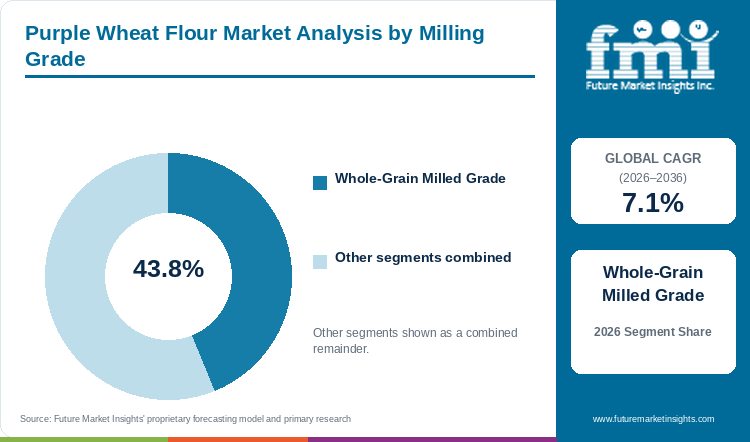
Whole-Grain Milled Grade is predicted to capture 43.8% of the milling grade segment in 2026 because retaining the outer pericarp preserves 130 to 340 mg/kg native anthocyanins and 100% whole-grain label eligibility.
Table 5: Milling Grade Share for the Purple Wheat Flour Market (percentage share), 2026
| Milling Grade | Share (2026) |
|---|---|
| Whole-Grain Milled Grade | 43.8% |
| Other Segments Combined | 56.2% |
| Total | 100.0% |
Calculated as the balance remaining after deducting the leading segment's reported share from 100.0%.
Table 6: Milling Grade Leadership and Market Growth for the Purple Wheat Flour Market (segment and CAGR percentage), 2026 to 2036
| Metric | Value |
|---|---|
| Global CAGR (2026 to 2036) | 7.1% |
| Leading Segment | Whole-Grain Milled Grade |
Because purple wheat localizes its cyanidin-3-glucoside and peonidin-3-glucoside pigments strictly within the outer pericarp layer [1], conventional white endosperm roller milling strips away up to 85% of the grain's natural color and phenolic content. Mill extraction economics therefore compel industrial bakers to procure whole-grain roller or stone-milled grades that preserve both 100% whole-grain label claims and natural bakery ingredients pigment intensity.
- Whole-Grain Milled Grade is predicted to capture 43.8% of the milling grade segment in 2026 through complete retention of the anthocyanin-rich outer seed coat.
- Recombining micronized purple pericarp streams with roller-milled endosperm maintains an 84% to 86% whole-grain extraction yield while boosting extractable bread anthocyanins by 40.07% [1].
What keeps Standard Dry Flour foremost in the physical form segment?
Standard Dry Flour is expected to represent 54.6% of the physical form segment in 2026 as 120-to-250-micron granulation flows directly through existing pneumatic bakery silos.
High-speed bread and cracker plants receive bulk flour through pneumatic blow-lines and rotary sifters engineered for 120-to-250-micron particle distributions. While May 2026 research in Food Chemistry X established that superfine 75.1-micron purple wheat bran maximizes extractable anthocyanins [1], standard 120-to-250-micron dry milled flour acts as the primary volume workhorse that blends smoothly with corn flour and bakery shortenings without silo bridging.
- Standard Dry Flour is expected to represent 54.6% of the physical form segment in 2026 because it requires zero capital modification across existing pneumatic plant dosing lines.
- Bran modification research published in Foods in April 2026 demonstrated that pairing steam explosion with enzymatic hydrolysis converts insoluble wheat-bran fiber into soluble fiber and lifts whole-wheat bread specific volume [3].
How do Bread & Rolls lead the application segment?
Bread & Rolls are projected to hold 37.4% of the application segment in 2026, supported by high daily sandwich-loaf volume and sourdough pH anthocyanin stabilization.
Controlled lactic-acid sourdough fermentation drops dough pH below 4.8, shifting outer-pericarp anthocyanin chromophores into their heat-stable red-violet flavylium cation state during deck and tunnel baking. High daily supermarket replenishment of sliced sandwich loaves and sourdough boules makes bread lines the primary volume anchor and packaged bread programs.
- Bread & Rolls are projected to hold 37.4% of the application segment in 2026 owing to daily retail loaf velocity and acidic sourdough color retention.
- Fortified baking trials in Food Chemistry X in May 2026 verified that 30% superfine purple wheat bran inclusion delivers 233.59% higher extractable total anthocyanins than 10% inclusion while preserving crumb structure [1].
Why does Conventional Clean-Label lead the claim segment?
Conventional Clean-Label is anticipated to generate 52.3% of the claim segment in 2026 by enabling simple whole-wheat ingredient declarations without organic price surcharges.
Regulatory prohibitions against unsubstantiated clinical antioxidant claims on food labels combined with lower farm-gate grain costs keep conventional clean-label purple wheat flour ahead of certified organic tiers. Because food-safety agencies bar therapeutic health claims based solely on in-vitro radical-scavenging assays, commercial bakeries position purple wheat around clean-label whole-grain fiber and natural violet crumb color without paying organic land-transition surcharges. Production forecasts in the April 2026 USDA Foreign Agricultural Service European Union Grain and Feed Annual report (E42026-0034) place MY 2026/27 EU grain output at 277 million metric tons during expanding intra-EU specialty wheat trade [4].
- Conventional Clean-Label is anticipated to capture 52.3% of the claim segment in 2026 as bakeries prioritize recognizable whole-wheat ingredient decks without organic price premiums.
- USDA Foreign Agricultural Service grain tracking in April 2026 documented 277 million metric tons of projected MY 2026/27 EU cereal output supporting intra-EU specialty milling contracts [4].
Why do Direct to Industrial Bakeries contracts lead the sales channel segment?
Direct to Industrial Bakeries is estimated to account for 55.8% of the sales channel segment in 2026 through pre-harvest single-cultivar contracting and farinograph dough alignment.
Proprietary seed licensing on purple wheat cultivars and the need for pre-harvest acreage reservation compel industrial bakeries to contract directly with primary specialty mills. Because varieties such as AnthoGrain and PurPur are grown under closed identity-preserved farm agreements rather than traded on spot grain exchanges, wholesale brokers cannot guarantee multi-ton year-round supply. Operations data from the January 2025 ministerial visit to Limagrain's Jacquet bakery plant in Saint-Beauzire confirmed that 100% of its flour is sourced from 1,300 cooperative farmer-members supplying continuous 3x8 baking shifts where 95% of loaves earn Nutri-Score A or B [5].
- Direct to Industrial Bakeries is estimated to account for 55.8% of the sales channel segment in 2026 through pre-harvest crop contracting and dedicated elevator bin segregation.
- Limagrain's January 2025 Saint-Beauzire operational disclosure verified 100% cooperative farmer-member flour supply across continuous 3x8 industrial bread lines [5].
What are the drivers, restraints, and opportunities in the purple wheat flour market?
Clean-label dye removal and whole-grain fiber fortification drive demand in the purple wheat flour market, whereas 25% to 45% oven anthocyanin degradation and single-cultivar elevator segregation costs restrain rapid scaling.
- Driver: Consumer preference for whole-grain nutrition and natural visual differentiation spurs industrial bread and cracker reformulation.
- Restraint: Thermal pigment loss of 25% to 45% during oven baking and identity-preserved storage costs slow commercial qualification.
- Opportunity: Superfine micronized purple pericarp fractions and pre-acidified sourdough blends unlock stable violet crumb color in commercial bakeries.
Growth Analysis and Future Potential: Qualitative Demand Catalysts
Lactic-acid sourdough fermentation stabilizes natural pericarp pigments while softening coarse whole-wheat bran, serving as a primary technical driver for purple wheat flour adoption. Lowering dough pH below 4.8 during bulk fermentation converts anthocyanins into thermally stable red-violet cations that survive 200-degree-Celsius oven baking without synthetic dyes. Experimental baking research published in Current Research in Food Science in April 2025 established that tailor-made sourdough fermentation of whole-grain sprouted wheat and barley flours improves bioactive compound retention and crumb elasticity over conventional yeast baking [6]. Industrial bakeries are applying those sourdough protocols across purple wheat loaves and bakery mixes to win clean-label supermarket shelf space.
Risk Assessment of the Purple Wheat Flour Market: Operational and Formulation Friction
Weaker wet-gluten elasticity in pigmented wheat lines and mandatory wheat-allergen segregation rules remain the chief operational restraints slowing industrial bakery conversion. Because purple wheat is a Triticum aestivum cultivar containing gluten proteins, it cannot enter celiac-safe free-from rooms and requires explicit wheat-allergen declarations and dedicated silo lines. Consumer survey findings in Coeliac UK's January 2026 Gluten Free Shopping Habits Report covering 3,785 shoppers shows strict retail auditing over specialist bakery labeling across UK supermarkets [7]. Thermal baking losses of 25% to 45% of native anthocyanins at 210 degrees Celsius [2] also force plant bakers to co-dose critical wheat gluten and baking ingredients.
Commercial Opportunity Analysis: Formulation Differentiation and Value-Add Formats
Abrasive pearling and superfine micronization of the outer purple pericarp coat allow specialty millers to market concentrated natural color-and-fiber fractions at premium margins. Rather than shipping 100% wholemeal grist that can weigh down high-speed pan loaves, millers pearl off the outer 8% to 12% pigmented seed coat and pulverize it into a 75-micron powder that bakers dose at 10% to 20% into strong bread flour [1]. In July 2025, Ardent Mills entered an agreement to acquire Stone Mill in Richardton, North Dakota to expand its identity-preserved specialty grain cleaning and milling capacity [8]. That concentrated pericarp fraction lets commercial bakeries upgrade sourdough bread and laminated snack lines without sacrificing loaf volume.
Purple Wheat Flour Market by Country (2026 to 2036)
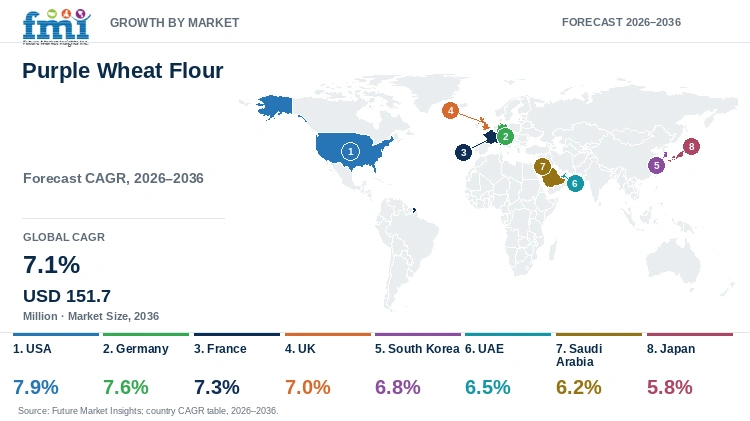
Country-level demand patterns depend on domestic identity-preserved specialty milling capacity and commercial sourdough bakery adoption. The USA is projected to lead expansion at a 7.9% CAGR from 2026 to 2036, closely followed by Germany at 7.6% and France at 7.3%, whereas Japan is forecast to record a 5.8% CAGR because soft white shokupan bread standards moderate whole-grain substitution.
Table 7: Country CAGR and Primary Growth Levers for the Purple Wheat Flour Market (CAGR percentage and operational drivers), 2026 to 2036
| Country | CAGR (2026 to 2036) | Primary Growth Lever |
|---|---|---|
| USA | 7.9% | Identity-preserved specialty mill acquisitions and clean-label functional grain demand |
| Germany | 7.6% | Central Europe PurPur purple-wheat bread programs and low-carbon milling initiatives |
| France | 7.3% | Cooperative 1,300-grower traceability and clean-label artisan boulangerie upgrades |
| UK | 7.0% | AHDB Group 1 wheat blending and domestic specialty milling recovery |
| South Korea | 6.8% | Premium café bakery anthocyanin bread launches and diversified grain milling |
| UAE | 6.5% | Luxury hospitality artisan bread programs and Sharjah Saba Sanabel wheat-sector investment |
| Saudi Arabia | 6.2% | Premium retail bakery expansion under SFDA import clearance and Arabic labeling rules |
| Japan | 5.8% | Targeted whole-grain health bread adoption moderated by 38% calorie self-sufficiency imports |
Source: Future Market Insights analysis
USA Purple Wheat Flour Market Outlook (2026 to 2036)
Consolidation of Northern Plains identity-preserved grain cleaning facilities and retail demand for fiber-dense baking mixes give the USA a leading 7.9% CAGR for purple wheat flour from 2026 to 2036. Unlike fragmented European gristmills, large North America milling platforms are acquiring dedicated cleaning and micron-milling plants to guarantee single-cultivar purity for national bread and snack brands. Ardent Mills agreed in July 2025 to acquire specialty processor Stone Mill in North Dakota [8], while King Arthur Baking rolled out five new retail baking mixes across the USA in April 2026 [9]. Segregated railcar freight surcharges between northern plains elevators and coastal bakeries nevertheless moderate adoption among smaller regional bakers.
Key takeaway: In the USA, identity-preserved specialty milling infrastructure and strong functional whole-grain demand are projected to anchor commercial adoption of purple wheat flour.
Germany Purple Wheat Flour Market Outlook (2026 to 2036)
Mainstream retail acceptance of PurPur purple-wheat loaves across supermarket bake-off counters and artisan Meisterbäckereien makes Germany the largest market in Europe, with sales projected to expand at a 7.6% CAGR from 2026 to 2036. Grocery chains in Germany require specialty flour millers to pair single-cultivar grain traceability with audited farm carbon reductions. In June 2025, GoodMills Group signed the Sustainable Wheat Initiative Europe manifesto committing to cut greenhouse gas emissions from wheat and flour by 30% by 2030 across its European milling network [10]. Industrial bake-off producers in Germany combine purple wholemeal with lactic sourdough starters to lock in violet crumb color, though discount-grocer price caps restrain margin expansion.
Key takeaway: In Germany, established PurPur purple-wheat bread programs and Sustainable Wheat Initiative Europe commitments are expected to sustain industrial demand for traceable purple wheat flour.
France Purple Wheat Flour Market Outlook (2026 to 2036)
Cooperative farm-to-bakery supply chains that link regional seed breeding directly to industrial sandwich-bread plants distinguish France from spot-traded grain markets. Because European Union food-labeling rules bar unapproved clinical antioxidant claims on retail packs, millers in France market purple wheat flour around domestic farm provenance and Nutri-Score A or B whole-grain fiber density. Operational disclosures from Limagrain in January 2025 detailed short cooperative supply circuits transforming wheat from 1,300 farmer-members in France for industrial bakeries such as Jacquet, where 95% of loaves achieve Nutri-Score A or B [5] [11]. That vertical cooperative integration supports a projected 7.3% CAGR for purple wheat flour demand in France from 2026 to 2036.
Key takeaway: In France, cooperative farm-to-mill traceability chains and artisan boulangerie differentiation are projected to drive steady uptake of identity-preserved purple wheat flour.
UK Purple Wheat Flour Market Outlook (2026 to 2036)
Blending imported superfine purple wheat pericarp into domestic bread-wheat grists enables commercial millers in the UK to achieve natural violet loaf color while preserving the high protein elasticity required by Chorleywood plant bakeries. Artisan sourdough bakeries and supermarket premium bread tiers across the UK use pigmented wholemeal blends to differentiate crowded shelf fixtures, driving a 7.0% CAGR from 2026 to 2036. Crop projections in the April 2026 USDA Foreign Agricultural Service United Kingdom Grain and Feed Annual report confirm recovering domestic UK milling wheat output in MY 2026/27 [12]. Coeliac UK's January 2026 survey of 3,785 consumers simultaneously reinforces strict retail compliance on wheat-allergen labeling across UK grocery aisles [7].
Key takeaway: In the UK, domestic milling wheat recovery and artisan sourdough bakery growth are estimated to support blended purple wheat flour adoption.
South Korea Purple Wheat Flour Market Outlook (2026 to 2036)
Government farm subsidies encouraging growers to shift surplus paddy rice acreage into food wheat and a trend-driven urban bakery-café sector shape commercial demand in South Korea. Franchise bakery cafés in Seoul and Busan formulate naturally pigmented purple-wheat sourdough campagnes and bagels to attract health-conscious young shoppers. Policy tracking in the June 2026 USDA Foreign Agricultural Service South Korea Grain and Feed Update documents national incentives supporting domestic wheat and specialty grain diversification [13], while the November 2025 Retail Foods Annual report (KS2025-0038) highlights premium retail bakery expansion [14]. Importers blending North America AnthoGrain and Europe PurPur flours sustain a 6.8% CAGR in South Korea through 2036.
Key takeaway: In South Korea, premium bakery-café menu differentiation and grain diversification policies are forecast to sustain specialty purple wheat flour demand.
UAE Purple Wheat Flour Market Outlook (2026 to 2036)
State-backed desert wheat cultivation projects and five-star hotel and airline flight-kitchen demand make the UAE a distinctive growth market in the Middle East. Luxury resort boulangeries and central catering commissaries in Dubai and Abu Dhabi procure pigmented whole-grain flours to serve international hospitality guests. Emirates News Agency (WAM) dispatches in February 2025 documented the third-season harvest of Sharjah's Saba Sanabel wheat project in Mleiha, where sensor-guided irrigation cut water use by 30% while yielding wheat at 19.3% protein content [15]. Because summer heat degrades outer-pericarp anthocyanins, UAE distributors store imported Europe PurPur and Canada AnthoGrain sacks below 22 degrees Celsius, supporting a 6.5% CAGR through 2036.
Key takeaway: In the UAE, luxury hospitality bakery demand and national wheat-sector investments are anticipated to support imports of identity-preserved purple wheat flour.
Saudi Arabia Purple Wheat Flour Market Outlook (2026 to 2036)
Rapid openings of artisan bakery cafés and premium supermarket bread counters across Riyadh and Jeddah are lifting specialty whole-grain flour orders in Saudi Arabia, while port inspection rules govern supplier onboarding. Commercial bakeries are introducing naturally pigmented whole-wheat loaves for urban shoppers seeking high-fiber alternatives to refined white flatbreads. Food clearance rules updated by the Saudi Food and Drug Authority (SFDA) in August 2026 require foreign flour consignments to carry authenticated health certificates and Arabic country-of-origin and allergen labels at Saudi Arabia ports [16]. European and Canada specialty millers partnering with pre-cleared local distributors sustain a 6.2% CAGR in Saudi Arabia from 2026 to 2036.
Key takeaway: In Saudi Arabia, premium retail bakery expansion and strict SFDA Arabic labeling compliance are predicted to structure commercial imports of purple wheat flour.
Japan Purple Wheat Flour Market Outlook (2026 to 2036)
Consumer preference for pillowy, ultra-soft white shokupan sandwich loaves milled from low-ash endosperm flour holds purple wheat flour expansion in Japan to a measured 5.8% CAGR from 2026 to 2036. Because coarse whole-grain bran disrupts the delicate crumb stringiness prized by shoppers in Japan, mainstream plant bakeries restrict full-kernel purple wheat substitution. Food balance statistics in the April 2025 99th Statistical Yearbook of the Ministry of Agriculture, Forestry and Fisheries (MAFF) and the November 2025 USDA Foreign Agricultural Service Japan Retail Foods Annual report (JA2025-0048) place retail food sales in Japan at USD 193 billion [17] [18]. Specialty bakers in Japan consequently dose 75-micron superfine purple bran into targeted health rolls and crackers.
Key takeaway: In Japan, strict milling-ash tolerances and consumer preference for soft bread crumb are projected to focus purple wheat flour adoption on specialty health loaves and crackers.
Full report country CAGRs cover: North America; Latin America; Western Europe; Eastern Europe; East Asia; South Asia and Pacific; Middle East and Africa.
Who are the notable companies in the purple wheat flour market?
InfraReady Products Ltd., GoodMills Group, Ardent Mills, Limagrain Ingredients, Bay State Milling, King Arthur Baking, ADM, Bob's Red Mill, Doves Farm, and Scoular are the notable companies in the purple wheat flour market.
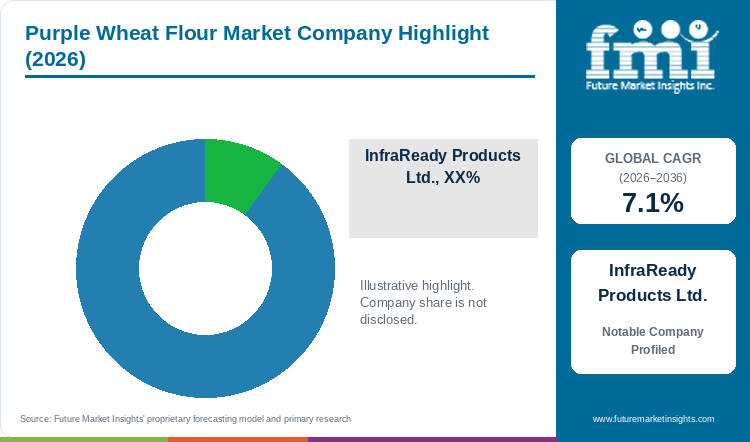
Market structure in purple wheat milling centers on proprietary cultivar licensing and identity-preserved elevator segregation. AnthoGrain licensee InfraReady Products in Canada and PurPur miller GoodMills Group in Europe anchor dedicated purple-pericarp grain contracting. Cooperative miller Limagrain Ingredients and North America platforms Ardent Mills and Bay State Milling with ADM and Scoular provide segregated grain cleaning and pilot rheology labs, while King Arthur Baking and Bob's Red Mill with Doves Farm serve retail and artisan bakers.
- Dedicated Purple-Wheat & Ancient-Grain Millers: InfraReady Products and GoodMills Group with Limagrain Ingredients commercialize AnthoGrain purple wheat, Europe PurPur purple-wheat flours, and traceable cooperative specialty flours.
- Industrial Specialty Milling & Identity-Preserved Platforms: Ardent Mills and Bay State Milling with ADM and Scoular operate North America specialty grain cleaning, identity-preserved supply chains, and industrial bakery application centers.
- Branded Heritage & Artisan Baking Flour Channels: King Arthur Baking and Bob's Red Mill with Doves Farm supply farm-traceable whole-wheat and stoneground heritage flours across retail and craft-bakery channels.
Competitive Benchmarking: Purple Wheat Flour Market
Table 8: Competitive Benchmarking for the Purple Wheat Flour Market (qualitative capability ratings), 2026
| Company | Grain Identity & Pericarp Segregation | Bakery Rheology & Color-Retention Support | Specialty Flour Distribution Channels | Geographic Reach |
|---|---|---|---|---|
| InfraReady Products Ltd. | High | High | High | Canada, USA, Europe, and Asia export markets |
| GoodMills Group | High | High | High | Seven Europe milling markets and Hamburg innovation hub |
| Ardent Mills | High | High | High | USA, Canada, and Puerto Rico milling network |
| Limagrain Ingredients | High | High | Medium | France and pan-European cooperative grain-to-flour channels |
| Bay State Milling | High | High | Medium | USA specialty grain and functional wheat network |
| King Arthur Baking | High | Medium | High | USA retail, baker-education, and wholesale channels |
| ADM | Medium | High | High | North America and Europe industrial bulk flour operations |
| Bob's Red Mill | Medium | Medium | High | USA and international stoneground specialty channels |
| Doves Farm | High | Medium | High | UK heritage and organic specialty flour channels |
| Scoular | High | Medium | Medium | North America and Asia identity-preserved grain networks |
Capability assessment basis: Tier rankings evaluate documented single-cultivar purple and ancient wheat segregation and pilot bakery rheology support.
Key Developments in the Purple Wheat Flour Market
- In July 2025, Ardent Mills entered an agreement to acquire Stone Mill in North Dakota, expanding its identity-preserved grain cleaning and specialty milling infrastructure for emerging nutrition ingredients [8].
- In June 2025, GoodMills Group joined the Sustainable Wheat Initiative Europe, aligning its Europe specialty and industrial flour operations with low-carbon wheat sourcing [10].
- In October 2025, Scoular published its sustainability progress report highlighting expanded regenerative agriculture and identity-preserved wheat sourcing programs for milling customers [23].
Key Players in the Purple Wheat Flour Market
Dedicated Purple-Wheat & Ancient-Grain Millers
- InfraReady Products Ltd.
- GoodMills Group
- Limagrain Ingredients
Industrial Specialty Milling & Identity-Preserved Platforms
- Ardent Mills
- Bay State Milling
- ADM
- Scoular
Branded Heritage & Artisan Baking Flour Channels
- King Arthur Baking
- Bob's Red Mill
- Doves Farm
Purple Wheat Flour Market - Report Scope
Table 9: Report Scope for the Purple Wheat Flour Market (coverage fields and definitions), 2026 to 2036
| Coverage field | Report scope |
|---|---|
| Market breakdown | Milling Grade; Physical Form; Application; Claim; Sales Channel |
| Quantitative Units | USD Million |
| Market Definition | Includes commercial miller and ingredient supplier revenue from anthocyanin-pigmented purple wheat (Triticum aestivum) flour across whole-grain, high-extraction, superfine pericarp-enriched, and pre-stabilized bakery grades. Category Scope Note: Excludes unmilled raw purple wheat grain traded for non-milling feed, blue aleurone or black wheat varieties, non-cereal purple flours (purple corn, ube, sweet potato), and finished retail baked goods. |
| Regions Covered | North America; Latin America; Western Europe; Eastern Europe; East Asia; South Asia and Pacific; Middle East and Africa |
| Countries Covered | USA, Germany, France, UK, South Korea, UAE, Saudi Arabia, Japan, and additional countries in the full report |
| Key Companies Covered | InfraReady Products Ltd., GoodMills Group, Ardent Mills, Limagrain Ingredients, Bay State Milling, King Arthur Baking, ADM, Bob's Red Mill, Doves Farm, Scoular |
| Forecast Period | 2026 to 2036 |
| Approach | Primary and secondary research with top-down and bottom-up market triangulation. |
Purple Wheat Flour Market - Research Methodology
Table 10: Research Methodology for the Purple Wheat Flour Market (research methods and approach), 2026 edition
| Method | Approach |
|---|---|
| Primary Research | Structured interviews with Canada and Europe purple-wheat millers, industrial bread R&D technologists, identity-preserved grain merchandisers, and artisan bakery distributors to validate extraction yields and B2B pricing. |
| Secondary Research | Analysis of peer-reviewed cereal chemistry journals (Foods, Food Chemistry: X, Food Science and Biotechnology), EU Regulation (EC) 1924/2006 health-claim registries, AHDB wheat quality specs, USDA FAS grain reports, and miller capital filings. |
| Market Sizing and Forecasting | Bottom-up identity-preserved purple wheat harvest tonnage and whole-grain milling extraction yields (84% to 86%) reconciled against top-down specialty bakery flour procurement budgets from 2026 to 2036. |
| Country Forecasting Model | Econometric country projections weight whole-grain bread consumption, specialty and ancient-grain milling capacity, sourdough boulangerie density, and import labeling compliance across eight national markets. |
| Operational Benchmark Traceability | Milled flour tonnage, grain input volumes, and per-bakery spending indicators in Tables 2, 3, and 4 trace to AnthoGrain and Europe PurPur milling yields, AHDB protein/falling-number specs, and commercial baking trials. |
| Data Triangulation and Validation | Revenue estimates are cross-checked against contracted purple-wheat acreage and B2B flour shipment invoices while excluding finished bakery retail sales, raw feed grain, and non-wheat purple flours to prevent double counting. |
Purple Wheat Flour Market by Segments
Purple Wheat Flour Market segmented by Milling Grade:
- Whole-Grain Milled Grade
- High-Extraction Bread Grade
- Superfine Pericarp Grade
- Fine Patisserie Grade
Purple Wheat Flour Market segmented by Physical Form:
- Standard Dry Flour
- Superfine Micronized Flour
- Coarse Meal & Blends
- Stabilized Sourdough Blends
Purple Wheat Flour Market segmented by Application:
- Bread & Rolls
- Biscuits & Crackers
- Cakes & Muffins
- Viennoiserie & Pizza Dough
- Pasta & Noodles
Purple Wheat Flour Market segmented by Claim:
- Conventional Clean-Label
- Identity-Preserved
- Certified Organic
- Regenerative Verified
Purple Wheat Flour Market segmented by Sales Channel:
- Direct to Industrial Bakeries
- Specialty Ingredient Distributors
- Foodservice & Artisan Supply
- Online B2B
Purple Wheat Flour Market by Region
- North America
- USA
- Canada
- Latin America
- Brazil
- Mexico
- Argentina
- Chile
- Western Europe
- Germany
- France
- UK
- Italy
- Spain
- Benelux
- Nordics
- Eastern Europe
- Poland
- Czech Republic
- Romania
- Hungary
- East Asia
- China
- Japan
- South Korea
- South Asia and Pacific
- India
- ASEAN
- Australia and New Zealand
- Middle East and Africa
- GCC Countries
- South Africa
- Türkiye
- Israel
Research Sources and Bibliography
- [1] Jiang, Y., Wu, K., Tan, E. N., Xu, X., Cheng, K. H. M., & Zhou, W. (2026, May 27). Unlocking the potential of purple wheat bran through superfine grinding: Effects on its physicochemical properties and fortified bread quality. Food Chemistry: X, 36, 104020 (PMC13231008).
- [2] Li, Y., Yu, X., Tian, X., Li, M., Zhang, J., Ma, Y., & Yin, C. (2025, December 12). Quality and nutritional properties of noodles: a systematic comparison of noodles based on blue, purple, black, and white whole wheat flours. Frontiers in Nutrition, 12, 1738148 (PubMed Central PMC12742469 / PMID 41459065).
- [3] Li, X., Guo, X., Yu, J., et al. (2026, April 22). Synergistic Modification of Steam Explosion Combined with Enzymatic Hydrolysis on Wheat Bran to Improve Dough Properties, Bread Quality, and In Vitro Digestibility. Foods, 15(9), 1465 (PubMed PMID 42121411).
- [4] USDA Foreign Agricultural Service. (2026, April 20). European Union: Grain and Feed Annual. Global Agricultural Information Network (GAIN Report E42026-0034).
- [5] Limagrain Cooperative. (2025, January 5). Ministerial visit to the Jacquet plant in saint-Beauzire - Limagrain. Limagrain Corporate Newsroom.
- [6] Perri, G., Difonzo, G., Ciraldo, L., et al. (2025, April 12). Tailor-made fermentation of sprouted wheat and barley flours and their application in bread making: A comprehensive comparison with conventional approaches in the baking industry. Current Research in Food Science, 10, 101053 (PubMed PMID 40290370).
- [7] Coeliac UK. (2026, January 30). Gluten Free Shopping Habits Report launches - Coeliac UK. Coeliac UK Policy & Research.
- [8] Ardent Mills. (2025, July 31). Ardent Mills Enters Agreement to Acquire Stone Mill in North Dakota, Expanding Emerging Nutrition Portfolio. Ardent Mills Newsroom.
- [9] King Arthur Baking Company. (2026, April 21). King Arthur Baking Taps Celebrations, Gluten-Free Demand, and Everyday Ease with Five New Mixes This Spring. King Arthur Baking Official Newsroom.
- [10] GoodMills Group GmbH. (2025, June 11). GoodMills joins the Sustainable Wheat Initiative Europe. GoodMills Group Corporate Releases.
- [11] Limagrain Cooperative. (2025, January 22). Discover the Limagrain Highlights. Limagrain Corporate Newsroom.
- [12] USDA Foreign Agricultural Service. (2026, April 30). United Kingdom: Grain and Feed Annual. Global Agricultural Information Network (GAIN).
- [13] USDA Foreign Agricultural Service. (2026, June 29). South Korea: Grain and Feed Update. Global Agricultural Information Network (GAIN).
- [14] USDA Foreign Agricultural Service. (2025, November 19). South Korea: Retail Foods Annual | USDA Foreign Agricultural Service. Global Agricultural Information Network (GAIN Report KS2025-0038).
- [15] Emirates News Agency (WAM). (2025, February 26). Sharjah Ruler attends 3rd season harvest of 'Saba Sanabel'. Emirates News Agency Official Dispatches.
- [16] Saudi Food and Drug Authority. (2026, August 21). Conditions & Requirements for Importing Food to Saudi Arabia. SFDA Regulations Portal.
- [17] Ministry of Agriculture, Forestry and Fisheries, Japan. (2025, April 1). THE 99th STATISTICAL YEARBOOK OF MINISTRY OF AGRICULTURE, FORESTRY AND FISHERIES. MAFF Japan Food Balance & Self-Sufficiency Statistics.
- [18] USDA Foreign Agricultural Service. (2025, November 19). Japan: Retail Foods Annual | USDA Foreign Agricultural Service. Global Agricultural Information Network (GAIN Report JA2025-0048).
- [19] USDA Foreign Agricultural Service. (2026, July 30). European Union: Grain and Feed Quarterly. Global Agricultural Information Network (GAIN).
- [20] Palombieri, S., Bruno, G., Garcia Molina, M. D., Cammerata, A., Miccoli, C., Felici, L., Francesconi, S., Giuberti, G., Castellani, F., & Sestili, F. (2026, May 4). Bran-Enriched Fractions from Blue and Purple Wheat Improve Antioxidant Potential and Nutritional Profile. Foods, 15(9), 1598.
- [21] General Mills, Inc. (2025, June 25). General Mills Reports Fiscal 2025 Fourth-quarter and Full-year Results and Provides Fiscal 2026 Outlook. General Mills Investor Press Releases.
- [22] Bay State Milling Company. (2026, May 19). Bay State Milling Named a 2026 US Best Managed Gold Honoree. Bay State Milling Official Newsroom.
- [23] Scoular. (2025, October 2). Scoular progresses on regenerative agriculture, other sustainability goals. The Scoular Company Sustainability Releases.
This bibliography is provided for reader reference and is not exhaustive. The full report contains the complete reference list and detailed citations.
This Report Answers
- How large is the purple wheat flour market in 2026 and what is forecast for 2036?
- Which whole-grain and clean-label pressures support demand for purple wheat flour?
- Why does Whole-Grain Milled Grade lead the milling grade segment?
- Why does Standard Dry Flour lead the physical form segment globally?
- How do growth rates differ across the USA and Germany as well as France and the UK?
- Which leading companies supply AnthoGrain, PurPur, and identity-preserved specialty flours today?
- What limits adoption or supplier switching in the purple wheat flour market?
- What should industrial bakery buyers evaluate before purchasing purple wheat flour?
Frequently Asked Questions
How big is the purple wheat flour market in 2026, and what is forecast for 2036?
Global purple wheat flour demand is expected to reach USD 76.4 million in 2026 from USD 71.3 million in 2025. Global revenues are anticipated to climb to USD 151.7 million by 2036 as industrial and artisan bakeries scale pigmented whole-grain loaves and snacks.
What is the CAGR for the purple wheat flour market from 2026 to 2036?
Global purple wheat flour sales are projected to advance at a 7.1% CAGR between 2026 and 2036, generating USD 75.3 million in incremental revenue across direct industrial bakery contracts and specialty distributors.
Which milling grade segment leads the purple wheat flour market?
Full pericarp retention during kernel grinding gives Whole-Grain Milled Grade a predicted 43.8% share of the milling grade segment in 2026.
Which physical form segment leads the purple wheat flour market?
Standard Dry Flour is expected to represent 54.6% of the physical form segment in 2026 because it flows directly through existing pneumatic bakery silos and gravimetric mixers.
Which country has a notable growth outlook during the assessment period?
Specialty flour turnover in the USA is projected to lead national expansion at a 7.9% CAGR through 2036, supported by identity-preserved specialty milling investments and clean-label whole-grain demand.
Who are the key players in the market?
InfraReady Products Ltd., GoodMills Group, Ardent Mills, Limagrain Ingredients, Bay State Milling, King Arthur Baking, ADM, Bob's Red Mill and Doves Farm and Scoular lead commercial supply across specialty grain milling and identity-preserved bakery channels.
Preview the report firsthand - request a free sample
Get SampleGet the brochure for pricing and purchase details.
Get PDFTable of Content
- Key Takeaways
- Market Size and CAGR
- Top Growth Driver
- Fastest Growing Segment
- Leading Region
- Key Companies
- Emerging Opportunities
- Executive Summary
- Global Market Outlook
- Demand-side Trends
- Supply-side Trends
- Technology Roadmap Analysis
- Analysis and Recommendations
- Analyst Perspective (What is happening? Why now? What should investors know?)
- Key Questions Answered
- How large is the market?
- What is the CAGR?
- What are key trends?
- Which region dominates?
- Who are the leaders?
- Market Overview
- Market Coverage / Taxonomy
- Market Definition / Scope / Limitations
- Research Methodology
- Chapter Orientation
- Analytical Lens and Working Hypotheses
- Market Structure, Signals, and Trend Drivers
- Benchmarking and Cross-market Comparability
- Market Sizing, Forecasting, and Opportunity Mapping
- Research Design and Evidence Framework
- Desk Research Programme (Secondary Evidence)
- Expert Input and Fieldwork (Primary Evidence)
- Tooling, Models, and Reference Databases
- Data Engineering and Model Build
- Quality Assurance and Audit Trail
- Market Background
- Market Dynamics (Drivers, Restraints, Opportunity, Trends)
- Scenario Forecast (Optimistic, Likely, Conservative)
- Impact Analysis
- AI Impact
- Sustainability Impact
- Regulatory Impact
- Technology Impact
- Consumer / Buyer Analysis
- Purchase Drivers
- Adoption Barriers
- Buyer Journey
- Opportunity Map Analysis
- Product Life Cycle Analysis
- Supply Chain Analysis
- Investment Feasibility Matrix
- Value Chain Analysis
- PESTLE and Porter's Analysis
- Regulatory Landscape
- Regional Parent Market Outlook
- Production and Consumption Statistics
- Import and Export Statistics
- Global Market Analysis and Forecast, 2021 to 2036
- Historical Market Size Value (USD Million) Analysis, 2021 to 2025
- Current and Future Market Size Value (USD Million) Projections, 2026 to 2036
- Y-o-Y Growth Trend Analysis
- Absolute $ Opportunity Analysis
- Global Market Pricing Analysis, 2021 to 2036
- Global Market Analysis and Forecast, By Milling Grade, 2021 to 2036
- Introduction / Key Findings
- Historical Market Size Value (USD Million) Analysis By Milling Grade, 2021 to 2025
- Current and Future Market Size Value (USD Million) Analysis and Forecast By Milling Grade, 2026 to 2036
- Whole-Grain Milled Grade
- High-Extraction Bread Grade
- Superfine Pericarp Grade
- Fine Patisserie Grade
- Y-o-Y Growth Trend Analysis By Milling Grade, 2021 to 2025
- Absolute $ Opportunity Analysis By Milling Grade, 2026 to 2036
- Global Market Analysis and Forecast, By Physical Form, 2021 to 2036
- Introduction / Key Findings
- Historical Market Size Value (USD Million) Analysis By Physical Form, 2021 to 2025
- Current and Future Market Size Value (USD Million) Analysis and Forecast By Physical Form, 2026 to 2036
- Standard Dry Flour
- Superfine Micronized Flour
- Coarse Meal & Blends
- Stabilized Sourdough Blends
- Y-o-Y Growth Trend Analysis By Physical Form, 2021 to 2025
- Absolute $ Opportunity Analysis By Physical Form, 2026 to 2036
- Global Market Analysis and Forecast, By Application, 2021 to 2036
- Introduction / Key Findings
- Historical Market Size Value (USD Million) Analysis By Application, 2021 to 2025
- Current and Future Market Size Value (USD Million) Analysis and Forecast By Application, 2026 to 2036
- Bread & Rolls
- Biscuits & Crackers
- Cakes & Muffins
- Viennoiserie & Pizza Dough
- Pasta & Noodles
- Y-o-Y Growth Trend Analysis By Application, 2021 to 2025
- Absolute $ Opportunity Analysis By Application, 2026 to 2036
- Global Market Analysis and Forecast, By Claim, 2021 to 2036
- Introduction / Key Findings
- Historical Market Size Value (USD Million) Analysis By Claim, 2021 to 2025
- Current and Future Market Size Value (USD Million) Analysis and Forecast By Claim, 2026 to 2036
- Conventional Clean-Label
- Identity-Preserved
- Certified Organic
- Regenerative Verified
- Y-o-Y Growth Trend Analysis By Claim, 2021 to 2025
- Absolute $ Opportunity Analysis By Claim, 2026 to 2036
- Global Market Analysis and Forecast, By Sales Channel, 2021 to 2036
- Introduction / Key Findings
- Historical Market Size Value (USD Million) Analysis By Sales Channel, 2021 to 2025
- Current and Future Market Size Value (USD Million) Analysis and Forecast By Sales Channel, 2026 to 2036
- Direct to Industrial Bakeries
- Specialty Ingredient Distributors
- Foodservice & Artisan Supply
- Online B2B
- Y-o-Y Growth Trend Analysis By Sales Channel, 2021 to 2025
- Absolute $ Opportunity Analysis By Sales Channel, 2026 to 2036
- Global Market Analysis and Forecast, By Region, 2021 to 2036
- Introduction
- Historical Market Size Value (USD Million) Analysis By Region, 2021 to 2025
- Current Market Size Value (USD Million) Analysis and Forecast By Region, 2026 to 2036
- North America
- Latin America
- Western Europe
- Eastern Europe
- East Asia
- South Asia and Pacific
- Middle East and Africa
- Market Attractiveness Analysis By Region
- North America Market Analysis and Forecast, By Country, 2021 to 2036
- Historical Market Size Value (USD Million) Trend Analysis By Market Taxonomy, 2021 to 2025
- Market Size Value (USD Million) Forecast By Market Taxonomy, 2026 to 2036
- By Country
- USA
- Canada
- By Milling Grade
- By Physical Form
- By Application
- By Claim
- By Sales Channel
- By Country
- Market Attractiveness Analysis
- By Country
- By Milling Grade
- By Physical Form
- By Application
- By Claim
- By Sales Channel
- Key Takeaways
- Latin America Market Analysis and Forecast, By Country
- Historical Market Size Value (USD Million) Trend Analysis By Market Taxonomy, 2021 to 2025
- Market Size Value (USD Million) Forecast By Market Taxonomy, 2026 to 2036
- By Country
- Brazil
- Mexico
- Argentina
- Chile
- By Milling Grade
- By Physical Form
- By Application
- By Claim
- By Sales Channel
- By Country
- Market Attractiveness Analysis
- By Country
- By Milling Grade
- By Physical Form
- By Application
- By Claim
- By Sales Channel
- Key Takeaways
- Western Europe Market Analysis and Forecast, By Country
- Historical Market Size Value (USD Million) Trend Analysis By Market Taxonomy, 2021 to 2025
- Market Size Value (USD Million) Forecast By Market Taxonomy, 2026 to 2036
- By Country
- Germany
- France
- UK
- Italy
- Spain
- Benelux
- Nordics
- By Milling Grade
- By Physical Form
- By Application
- By Claim
- By Sales Channel
- By Country
- Market Attractiveness Analysis
- By Country
- By Milling Grade
- By Physical Form
- By Application
- By Claim
- By Sales Channel
- Key Takeaways
- Eastern Europe Market Analysis and Forecast, By Country
- Historical Market Size Value (USD Million) Trend Analysis By Market Taxonomy, 2021 to 2025
- Market Size Value (USD Million) Forecast By Market Taxonomy, 2026 to 2036
- By Country
- Poland
- Czech Republic
- Romania
- Hungary
- By Milling Grade
- By Physical Form
- By Application
- By Claim
- By Sales Channel
- By Country
- Market Attractiveness Analysis
- By Country
- By Milling Grade
- By Physical Form
- By Application
- By Claim
- By Sales Channel
- Key Takeaways
- East Asia Market Analysis and Forecast, By Country
- Historical Market Size Value (USD Million) Trend Analysis By Market Taxonomy, 2021 to 2025
- Market Size Value (USD Million) Forecast By Market Taxonomy, 2026 to 2036
- By Country
- China
- Japan
- South Korea
- By Milling Grade
- By Physical Form
- By Application
- By Claim
- By Sales Channel
- By Country
- Market Attractiveness Analysis
- By Country
- By Milling Grade
- By Physical Form
- By Application
- By Claim
- By Sales Channel
- Key Takeaways
- South Asia and Pacific Market Analysis and Forecast, By Country
- Historical Market Size Value (USD Million) Trend Analysis By Market Taxonomy, 2021 to 2025
- Market Size Value (USD Million) Forecast By Market Taxonomy, 2026 to 2036
- By Country
- India
- ASEAN
- Australia and New Zealand
- By Milling Grade
- By Physical Form
- By Application
- By Claim
- By Sales Channel
- By Country
- Market Attractiveness Analysis
- By Country
- By Milling Grade
- By Physical Form
- By Application
- By Claim
- By Sales Channel
- Key Takeaways
- Middle East and Africa Market Analysis and Forecast, By Country
- Historical Market Size Value (USD Million) Trend Analysis By Market Taxonomy, 2021 to 2025
- Market Size Value (USD Million) Forecast By Market Taxonomy, 2026 to 2036
- By Country
- GCC Countries
- South Africa
- Türkiye
- Israel
- By Milling Grade
- By Physical Form
- By Application
- By Claim
- By Sales Channel
- By Country
- Market Attractiveness Analysis
- By Country
- By Milling Grade
- By Physical Form
- By Application
- By Claim
- By Sales Channel
- Key Takeaways
- Key Countries Market Analysis
- USA
- Pricing Analysis
- Market Share Analysis, 2025
- By Milling Grade
- By Physical Form
- By Application
- By Claim
- By Sales Channel
- Canada
- Pricing Analysis
- Market Share Analysis, 2025
- By Milling Grade
- By Physical Form
- By Application
- By Claim
- By Sales Channel
- Mexico
- Pricing Analysis
- Market Share Analysis, 2025
- By Milling Grade
- By Physical Form
- By Application
- By Claim
- By Sales Channel
- Brazil
- Pricing Analysis
- Market Share Analysis, 2025
- By Milling Grade
- By Physical Form
- By Application
- By Claim
- By Sales Channel
- Chile
- Pricing Analysis
- Market Share Analysis, 2025
- By Milling Grade
- By Physical Form
- By Application
- By Claim
- By Sales Channel
- Germany
- Pricing Analysis
- Market Share Analysis, 2025
- By Milling Grade
- By Physical Form
- By Application
- By Claim
- By Sales Channel
- UK
- Pricing Analysis
- Market Share Analysis, 2025
- By Milling Grade
- By Physical Form
- By Application
- By Claim
- By Sales Channel
- Italy
- Pricing Analysis
- Market Share Analysis, 2025
- By Milling Grade
- By Physical Form
- By Application
- By Claim
- By Sales Channel
- Spain
- Pricing Analysis
- Market Share Analysis, 2025
- By Milling Grade
- By Physical Form
- By Application
- By Claim
- By Sales Channel
- France
- Pricing Analysis
- Market Share Analysis, 2025
- By Milling Grade
- By Physical Form
- By Application
- By Claim
- By Sales Channel
- India
- Pricing Analysis
- Market Share Analysis, 2025
- By Milling Grade
- By Physical Form
- By Application
- By Claim
- By Sales Channel
- ASEAN
- Pricing Analysis
- Market Share Analysis, 2025
- By Milling Grade
- By Physical Form
- By Application
- By Claim
- By Sales Channel
- Australia and New Zealand
- Pricing Analysis
- Market Share Analysis, 2025
- By Milling Grade
- By Physical Form
- By Application
- By Claim
- By Sales Channel
- China
- Pricing Analysis
- Market Share Analysis, 2025
- By Milling Grade
- By Physical Form
- By Application
- By Claim
- By Sales Channel
- Japan
- Pricing Analysis
- Market Share Analysis, 2025
- By Milling Grade
- By Physical Form
- By Application
- By Claim
- By Sales Channel
- South Korea
- Pricing Analysis
- Market Share Analysis, 2025
- By Milling Grade
- By Physical Form
- By Application
- By Claim
- By Sales Channel
- Poland
- Pricing Analysis
- Market Share Analysis, 2025
- By Milling Grade
- By Physical Form
- By Application
- By Claim
- By Sales Channel
- Hungary
- Pricing Analysis
- Market Share Analysis, 2025
- By Milling Grade
- By Physical Form
- By Application
- By Claim
- By Sales Channel
- Türkiye
- Pricing Analysis
- Market Share Analysis, 2025
- By Milling Grade
- By Physical Form
- By Application
- By Claim
- By Sales Channel
- South Africa
- Pricing Analysis
- Market Share Analysis, 2025
- By Milling Grade
- By Physical Form
- By Application
- By Claim
- By Sales Channel
- UAE
- Pricing Analysis
- Market Share Analysis, 2025
- By Milling Grade
- By Physical Form
- By Application
- By Claim
- By Sales Channel
- Saudi Arabia
- Pricing Analysis
- Market Share Analysis, 2025
- By Milling Grade
- By Physical Form
- By Application
- By Claim
- By Sales Channel
- USA
- Market Structure Analysis
- Competition Dashboard
- Competition Benchmarking
- Market Share Analysis of Top Players
- By Regional
- By Milling Grade
- By Physical Form
- By Application
- By Claim
- By Sales Channel
- Emerging Startups
- Innovation Benchmarking
- Competition Analysis
- Competition Deep Dive
- InfraReady Products Ltd.
- Overview
- Product Portfolio
- Profitability by Market Segments
- Sales Footprint
- Strategy Overview
- Marketing Strategy
- Product Strategy
- Channel Strategy
- GoodMills Group
- Ardent Mills
- Limagrain Ingredients
- Bay State Milling
- King Arthur Baking
- ADM
- Bob's Red Mill
- Doves Farm
- Scoular
- InfraReady Products Ltd.
- Case Studies
- Success Stories
- Recent Developments
- Competition Deep Dive
- Assumptions & Acronyms Used


