

- Market Size (2026)
- USD 591.1 Mn
- Forecast (2036)
- USD 1276.1 Mn
- CAGR (2026 to 2036)
- 8.0%
How big is Reusable Pharma Shippers Market in 2026?
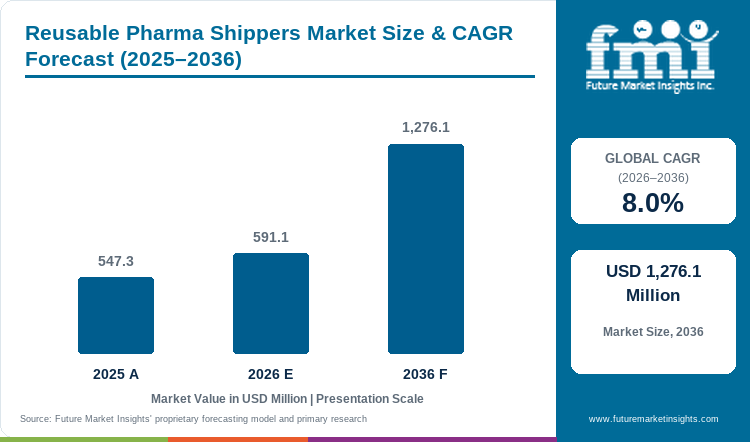
USD 591.1 million in 2026 and USD 1,276.1 million by 2036, expanding at 8.0% CAGR.
Demand for reusable pharma shippers is projected to expand at 8.0% CAGR between 2026 and 2036, growing from USD 547.3 million in 2025 to USD 591.1 million in 2026, and escalating to USD 1,276.1 million by 2036. Pharmaceutical shippers create greater value when they remain in qualified circulation across recurring logistics lanes rather than being used for a single movement. Envirotainer launched its one-pallet RelEye RKN in March 2025 with more than 130 hours of autonomy and real-time monitoring for pharmaceutical air freight. Buyers are more likely to invest in reusable shipping assets when validated duration and planned return programs support repeated utilization across the same distribution network.
Country economics are changing the reusable case because freight cost and fleet recovery vary by route. The Saudi Food and Drug Authority and Saudia Cargo launched an April 2026 initiative offering pharmaceutical shippers price reductions of up to 50% on air freight. The program also referenced advanced cold-chain capability and precise temperature control for medicines moving under national requirements. Lower freight expense improves total-lane economics where durable assets circulate repeatedly between the same gateways. Germany and the USA depend more on mature distribution networks and service capacity than temporary freight incentives.
Key Takeaways
- Pharmaceutical teams increase reusable-shipper use when qualified thermal protection can circulate reliably on repeat distribution lanes with planned recovery.
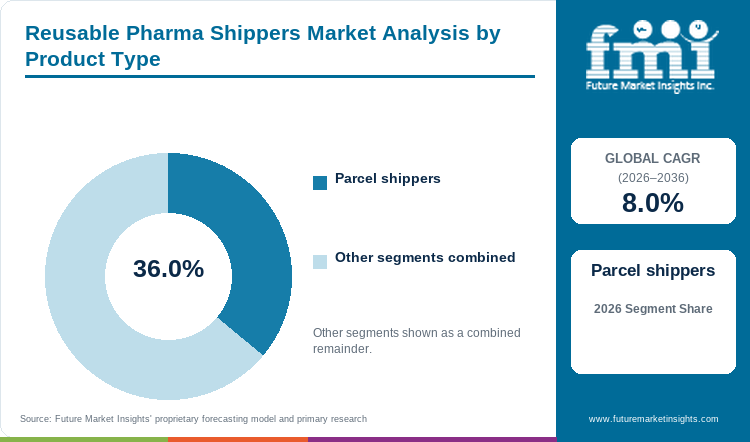
- Parcel shippers are set to lead the product type category with 36.0% share in 2026, driven by frequent small consignments that support faster asset turns.
- By material, paper-based systems are estimated to hold 35.0% in 2026, supported by fiber structures that reduce disposable protective content around qualified thermal components.
- The performance class category is forecast to be led by standard duty at 37.0% share in 2026, attributable to predictable routes that need right-duration protection without heavy overdesign.
- Fragmented destinations weaken reuse economics because recovery delays and empty repositioning reduce productive asset cycles before the next qualified shipment.
- Some of the key players in this market include Peli BioThermal, ThermoSafe, Cold Chain Technologies, CSafe, Envirotainer, SkyCell, va-Q-tec Thermal Solutions GmbH, Sofrigam, Intelsius, and EMBALL'ISO.
Analyst Perspective
"Reusable shippers earn their place when lane qualification and recovery planning are designed together before purchase. Pharmaceutical teams should compare thermal protection with realistic asset-turn frequency because a durable shipper only saves cost while it keeps circulating."
- Nandini Roy Choudhury, Principal Consultant, Future Market Insights
How is the reusable pharma shippers market segmented?
The reusable pharma shippers market is segmented by product type, material, performance class, end use, sales channel and region.
The reusable pharma shippers market is segmented by product type, material, performance class, end use, sales channel and region. Product type covers parcel shippers, pallet shippers, PCM systems and vacuum panel systems for different payload scales. Material covers paper-based, foam, air & film and thermal insulated systems used within reusable shipping configurations. Performance class separates standard duty, heavy duty and temperature-assured formats according to required protection duration. End use and sales channel distinguish shipment setting from the purchasing route used for reusable systems.
How do parcel shippers shape selection within the product type category?
Parcel shippers fit specialty-pharmacy and clinical routes where compact payloads move frequently enough to support planned recovery. Intelsius acquired Emacold in July 2025 and said its Mexico operation would initially offer ORCA Multi-Use and ORCA Pallet systems from Mexico through Central America. That expansion places reusable parcel formats closer to regional temperature-controlled routes where short recovery loops improve fleet use.
- Based on product type, parcel shippers are projected to account for 36.0% in 2026, driven by frequent small consignments and faster recovery cycles.
- Pharmaceutical teams select parcel-scale assets where payload size and route repetition do not justify pallet equipment for every shipment.
What supports paper-based systems within the material category?
Paper-based systems reduce disposable protective content where fiber components can work beside qualified reusable thermal elements. Pregis acquired MP Global Packaging's cold-chain business in August 2026 and added paper-based thermal packaging for temperature-sensitive shipments. The acquisition broadens access to fiber-based protection used beside qualified reusable systems on cold-chain routes. Packaging engineers still need moisture resistance and repeated-handling performance before approving paper-led protection for regular pharmaceutical distribution.
- In 2026, paper-based systems are expected to lead material with 35.0% share, supported by fiber structures that reduce difficult-to-recover disposable components.
- Engineers qualify replaceable fiber parts only when moisture exposure and repeated handling preserve the validated thermal configuration during distribution.
How do pharmaceutical teams evaluate standard duty within performance class?
Standard-duty formats suit predictable parcel lanes where qualification can match protection to routine transit without paying for extended bulk performance. Cold Chain Technologies reported in January 2026 that its 2025 parcel expansion added EcoFlex sizes supported by the ReNew return and refurbishment program. The update links routine temperature-sensitive parcel use with recovery support instead of treating durability as a stand-alone packaging feature.
- By performance class, standard duty is forecast to represent 37.0% in 2026, attributable to routine lanes that favor right-duration protection.
- Pharmaceutical teams reserve heavier protection for longer or less predictable routes where standard configurations cannot cover validated exposure conditions.
What supports e-commerce & parcel within the end use category?
Patient-specific and specialty-pharmacy shipments create frequent small consignments that can justify reusable parcels when recovery is built into delivery. ThermoSafe launched Orion Express in February 2026 for domestic and time-critical routes including specialty-pharmacy urgent orders and patient-specific shipments. The release ties reusable rental capacity directly to short pharmaceutical parcel lanes where predictable transit and planned returns can produce repeated asset turns.
- E-commerce & parcel is likely to capture 36.0% share in 2026, owing to end-use demand from repeated small orders that increases circulation opportunities.
- Pharmacies and service partners improve fleet availability when return instructions are simple enough for distributed recipients to complete consistently.
How do direct accounts shape the sales channel category?
Direct accounts fit reusable programs because qualification records and fleet availability must remain coordinated after the first shipment. Cold Chain Technologies expanded its Asia-Pacific support in August 2025 with a Tokyo hub and new distribution arrangements for reusable pallet and thermal-packaging services. The investment shows why direct account relationships extend beyond equipment supply into conditioning availability and regional service coverage for repeat pharmaceutical lanes.
- Direct accounts are projected to hold 41.0% share in 2026, reinforced by sales channel arrangements that coordinate qualification and fleet planning for reusable programs.
- Direct relationships let suppliers adjust asset positioning and service capacity as qualified pharmaceutical routes change during multi-cycle distribution programs.
What are the drivers, restraints and opportunities in the Reusable Pharma Shippers Market?
Recurring pharmaceutical lanes raise demand for qualified reusable assets, weak recovery lowers fleet utilization, and managed return services can improve reuse economics without relaxing product-quality controls.
- Driver: Reuse requirements and frequent pharmaceutical lanes increase demand for assets that can complete documented qualified cycles repeatedly.
- Restraint: Sparse destinations and weak return compliance reduce asset turns while increasing inspection and empty-repositioning expense for reusable programs.
- Opportunity: Managed return networks can shorten recovery time and convert reverse logistics from a buyer task into a contracted service.
Transport reuse rules raise the value of documented circulation
European packaging rules are making documented reuse a purchasing requirement for specified transport formats used after August 12, 2026. Regulation (EU) 2025/40 sets reuse obligations for covered transport packaging and defines operating requirements for reusable systems placed on the Union market. Pharmaceutical teams still need medicine-protection controls before adding reusable packing systems to regulated lanes. Suppliers therefore must document reuse cycles and packaging condition between shipments without weakening thermal qualification. Buyers can compare those circulation records with the temperature evidence already required for pharmaceutical distribution. Programs that satisfy both obligations can replace one-way transport formats without forcing quality teams to accept a separate undocumented recovery process.
Return density determines whether reuse survives total-lane costing
Reusable assets lose their cost advantage when recovery takes too long or destinations cannot support dependable returns after delivery. Peli BioThermal stated in October 2025 that not every lane works with reusable parcel shippers when it launched Vēro One for routes where reuse is not feasible. That statement puts the constraint at lane level instead of treating durability as an automatic economic benefit. Lost assets and empty repositioning can absorb savings from repeated pack-outs even after thermal qualification is complete. Pharmaceutical teams therefore compare protective packaging choices against actual return frequency and pickup control. Reuse works commercially where recovery ownership and turnaround time can be defined before the first shipment leaves origin.
Managed reverse logistics turns recovery into a service opportunity
Service providers can improve reusable-shipper economics by controlling the return leg instead of leaving recovery to every receiving site. SkyCell launched Net ZERO Reverse in March 2025 with Emirates SkyCargo and another airline to return empty pharmaceutical containers by ocean after one-way air leases. The model reduces the need to fly empty assets back to origin and gives cold chain packaging services a direct operating role in repositioning. Suppliers can charge for collection and redeployment while reducing administrative work for pharmaceutical shippers. International lanes make this service route commercially relevant when reusable containers carry sufficient shipment value and empty air returns would otherwise weaken fleet economics.
Which country CAGRs are profiled in the Reusable Pharma Shippers Market?
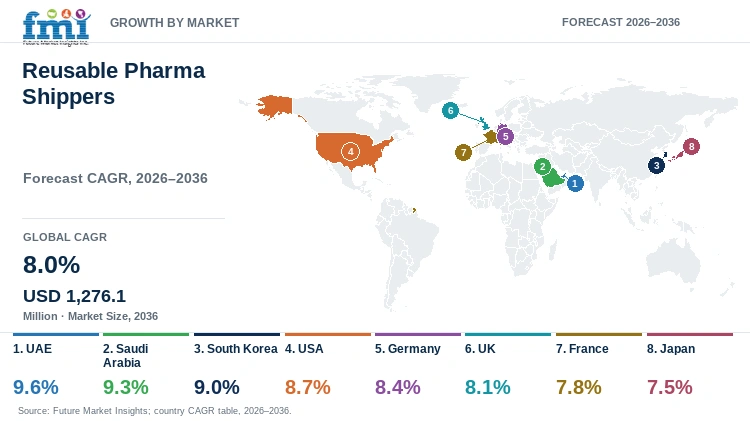
| Country | CAGR |
|---|---|
| UAE | 9.6% |
| Saudi Arabia | 9.3% |
| South Korea | 9.0% |
| USA | 8.7% |
| Germany | 8.4% |
| UK | 8.1% |
| France | 7.8% |
| Japan | 7.5% |
How do country-level CAGRs compare in the Reusable Pharma Shippers Market?
The country forecasts span 2.1 percentage points from the UAE at 9.6% to Japan at 7.5%. Gulf markets and South Korea form the upper group, while the USA and major European markets occupy a narrower middle band.
- The UAE’s position as a major air-cargo hub makes locally available reusable shipping assets especially valuable for frequent pharmaceutical transfers and redistribution activities.
- In Saudi Arabia, medicine-distribution controls and expanding air-freight capabilities are strengthening demand for reusable solutions in temperature-sensitive logistics.
- South Korea’s export-oriented biopharmaceutical sector places growing emphasis on documented storage performance and compliant transport procedures.
- The USA’s extensive parcel and healthcare logistics network supports efficient recovery and redeployment of reusable pharma shippers through regional service locations.
- Germany’s stringent pharmaceutical distribution requirements increase the importance of documented temperature control and transport-condition monitoring.
- In the UK, public-sector procurement frameworks encourage the use of temperature-controlled shipping systems with validated storage and transport performance.
- France’s wholesale pharmaceutical distribution environment places quality-compliance requirements directly within medicine-handling and logistics operations.
- Japan’s mature pharmaceutical supply chain rewards reusable shipping solutions that provide reliable thermal conditioning and efficient asset return cycles
Comparable CAGRs still produce different sales conditions because freight structure and regulatory controls shape recovery requirements differently in each country. The full report provides country-level CAGR analysis across North America, Latin America, Western Europe, Eastern Europe, East Asia, South Asia and Pacific, and the Middle East and Africa.
Country-wise Analysis
- UAE pharmaceutical logistics use major air gateways where temperature-sensitive shipments can change custody several times before final delivery. By 2036, UAE is projected to grow at 9.6% CAGR, led by hub-connected routes that can keep reusable systems in circulation. In January 2026 the Ministry of Health and Prevention transferred medicine-related regulatory services to the Emirates Drug Establishment including good-practice compliance functions. The transfer centralizes medicine oversight under the national drug regulator while reusable fleets still depend on airline acceptance and nearby inventory. Service providers can reduce idle time by positioning recovered assets near airport handling points and assigning return responsibility before each qualified shipment leaves the hub.
- Saudi pharmaceutical distribution must protect medicines during long routes that can face high ambient temperatures and repeated air-cargo handoffs. Saudi Arabia's reusable pharma shippers outlook is anticipated to advance at 9.3% CAGR over the assessment period, influenced by controlled distribution under national storage and transport requirements. The Saudi Food and Drug Authority published updated Good Storage and Distribution Practices guidance in 2025 covering storage and transport responsibilities for pharmaceuticals. The national requirement keeps temperature protection and documented handling inside the distributor operating model. Reusable suppliers must pair validated thermal performance with clear recovery ownership because long repositioning legs can erode the cost advantage after a technically successful delivery.
- South Korean biopharma shipments frequently enter export channels where packaging must remain controlled through storage and international transport handoffs. Reusable pharma shipper demand in South Korea is forecast to rise at 9.0% CAGR over the forecast period, reinforced by regulated distribution programs for biopharmaceutical products. The Ministry of Food and Drug Safety issued its 2025 manufacturing and distribution management plan for the Biopharmaceutical and Herbal Medicine Bureau in January 2025. National oversight gives pharmaceutical operators a defined compliance setting for reusable assets but overseas circulation can still strand equipment far from the next origin. Local recovery partners therefore need to coordinate returns with airline handoffs instead of treating reverse movement as a separate packaging task.
- The USA combines extensive parcel coverage with healthcare distribution routes where pharmaceutical packaging programs already manage controlled handling on repeat domestic lanes. Adoption of reusable pharma shippers in the USA is estimated to expand at 8.7% CAGR through 2036, owing to healthcare routes that require controlled handling and temperature monitoring. The CDC updated its Vaccine Storage and Handling Toolkit in July 2026 with national guidance covering cold-chain transport and temperature monitoring for immunization products. Those national handling controls keep documented temperature monitoring inside routine healthcare distribution and give reusable programs a defined qualification baseline. Regional refurbishment capacity can shorten recovery gaps when operators consolidate returns from large accounts and use pickup procedures that prevent fleet imbalance between qualified origins.
- German medicine distribution places documented transport conditions inside the operating requirements for wholesalers and pharmacies handling temperature-sensitive products. The German reusable pharma shippers sector is projected to record 8.4% CAGR during the assessment period, shaped by documented transport controls and repeat-route qualification. The Federal Ministry of Health stated in September 2025 that proposed pharmacy reforms would require cold-chain medicines shipped to patients to use suitable transport providers under documented conditions. The requirement makes route documentation and transport-provider suitability part of the operating test for reusable shipments. Reusable suppliers still need auditable cleaning and recovery procedures so a returned asset can re-enter service without weakening the documented transport controls applied to medicines.
- UK healthcare distribution uses national contracting routes that combine pharmaceutical storage with onward temperature-controlled transport under one service framework. In the UK, reusable pharma shipper demand is predicted to advance at 8.1% CAGR through 2036, due to national contracting routes that specify temperature-controlled pharmaceutical transport. Crown Commercial Service framework RM6354 started in February 2026 and its pharmaceutical lot includes refrigerated storage plus temperature-controlled onward vehicles throughout the UK. The specification makes controlled handling a buyer requirement and keeps transport conditions visible during contracted pharmaceutical distribution. Reusable suppliers still need recovery coverage after delivery because delayed returns can reduce fleet availability before the next scheduled dispatch from a contracted storage location.
- France places medicine wholesaler inspection under national oversight while pharmaceutical distribution continues to depend on documented good-distribution practices. France is estimated to post 7.8% CAGR over the forecast period, aided by national wholesale inspection and documented distribution-quality controls. ANSM stated in its 2025 work program that it assumed full responsibility for inspecting wholesale medicine distributors from January 1, 2025. Those inspections check wholesale distribution practices and public-service obligations that shape documented medicine handling nationwide. Reusable programs therefore need clear custody and cleaning histories before each repeated cycle because undocumented recovery steps can weaken the inspection record surrounding temperature-sensitive pharmaceutical distribution.
- Japanese medicine distribution depends on structured wholesaler procedures that limit unnecessary variation between manufacturers and downstream healthcare accounts. Reusable pharma shipper sales in Japan are forecast to expand at 7.5% CAGR by 2036, led by mature medicine-distribution routines and structured wholesaler procedures. The Ministry of Health, Labour and Welfare revised its prescription-drug distribution improvement guidelines in March 2026 for organizations operating in the national medicine channel. Reusable suppliers must fit retrieval into those routines without creating extra handoffs that delay scheduled deliveries. Local inventory and conditioning support can reduce turnaround pressure when the same shipper must return quickly enough for another qualified movement through Japan.
Who are the notable companies in the Reusable Pharma Shippers Market?
Peli BioThermal, ThermoSafe, Cold Chain Technologies, CSafe, Envirotainer, SkyCell, va-Q-tec Thermal Solutions GmbH, Sofrigam, Intelsius, and EMBALL'ISO are notable companies serving the reusable pharma shippers market.
Direct reusable competition includes temperature-control specialists because buyers need qualified hardware together with leasing or recovery support. Entry depends on documented thermal performance and service capacity that keeps assets available between pharmaceutical shipments. The commercial divide is whether a provider owns the fleet, rents passive systems or supports customer-owned reusable packaging with return and refurbishment services.
- Peli BioThermal, ThermoSafe, Cold Chain Technologies and CSafe cover reusable parcel or pallet formats with service support for pharmaceutical distribution.
- Envirotainer and SkyCell operate reusable container fleets for air-freight routes where monitoring and network availability influence buyer choice.
- va-Q-tec Thermal Solutions GmbH, Sofrigam, Intelsius and EMBALL'ISO provide passive reusable systems with different rental and reverse-service models.
Competitive Benchmarking: Reusable Pharma Shippers Market
| Company | Reusable Parcel Capability | Reusable Bulk or Pallet Capability | Return or Refurbishment Service | Geographic Reach |
|---|---|---|---|---|
| Peli BioThermal | High | High | High | North America, Europe, Asia and international partners |
| ThermoSafe | High | High | High | Americas, Europe, Asia and Middle East service network |
| Cold Chain Technologies | High | High | High | North America, Europe and Asia-Pacific hub network |
| CSafe | Low | High | Medium | Global pharmaceutical cold-chain network |
| Envirotainer | Medium | High | High | Global station and airline network |
| SkyCell | Low | High | High | Global pharmaceutical air-cargo network |
| va-Q-tec Thermal Solutions GmbH | High | Low | High | Germany, Switzerland and selected European routes |
| Sofrigam | Medium | High | High | Europe with international pharmaceutical coverage |
| Intelsius | High | High | High | Europe, North America and international distribution |
| EMBALL'ISO | Medium | Medium | High | International pharmaceutical cold-chain coverage |
Scoring basis: High format capability requires dated official evidence of a dedicated reusable pharmaceutical family plus qualification or service support at that scale. Medium records one narrower reusable route and Low records no dated official evidence meeting the Medium threshold. High service coverage requires a managed lease, return or refurbishment network with operating support. Medium records a narrower rental or recovery service and Low records no dated official service evidence. Geographic reach remains descriptive because the table uses it to show operating coverage rather than capability intensity.
Key Developments in the Reusable Pharma Shippers Market
- In September 2026, CSafe launched the reusable Silverskin RE PMC thermal cover with a full refurbishment model for multi-pallet pharmaceutical air freight.
- In March 2026, Peli BioThermal announced a Polar Group partnership that expanded sales and leasing support for reusable cold-chain solutions in Brazil.
- In October 2025, ThermoSafe announced Etihad Cargo's approval of Pegasus ULD for pharmaceutical uplift through the carrier's international network.
Key Players in the Reusable Pharma Shippers Market
Closed-Loop Parcel and Bulk Platforms
- Peli BioThermal
- ThermoSafe
- Cold Chain Technologies
- CSafe
Air-Cargo Container Networks
- Envirotainer
- SkyCell
Passive Thermal and Circular Packaging Specialists
- va-Q-tec Thermal Solutions GmbH
- Sofrigam
- Intelsius
- EMBALL'ISO
Reusable Pharma Shippers Market - Report Scope
| Coverage field | Report scope |
|---|---|
| Market breakdown | By product type, material, performance class, end use, sales channel and region. |
| Quantitative Units | USD million. |
| Market Definition | Revenue from reusable shipping containers and reusable thermal or protective shipper systems used to move pharmaceutical and healthcare payloads through repeated qualified distribution cycles. |
| Regions Covered | North America, Latin America, Western Europe, Eastern Europe, East Asia, South Asia and Pacific, and Middle East and Africa. |
| Countries Covered | UAE, Saudi Arabia, South Korea, USA, Germany, UK, France, Japan, and 20+ countries included in the full report. |
| Key Companies Profiled | Peli BioThermal, ThermoSafe, Cold Chain Technologies, CSafe, Envirotainer, SkyCell, va-Q-tec Thermal Solutions GmbH, Sofrigam, Intelsius, and EMBALL'ISO. |
| Forecast Period | 2026 to 2036. |
| Approach | Primary and secondary research with market triangulation. |
Reusable Pharma Shippers Market - Research Methodology
| Method | Approach |
|---|---|
| Primary Research | FMI analysts gathered input from manufacturers, service providers, technology developers, distributors, end users, procurement teams, and subject-matter experts. Interviews examined purchasing decisions, product or service evaluation, adoption barriers, approval requirements, pricing considerations, and expectations for technical or commercial support. Respondents were also asked what evidence is required before a trial, pilot, or initial order develops into regular purchasing. |
| Desk Research | Desk research covered government statistics, regulatory publications, trade data, industry associations, technical literature, standards, company filings, product information, and official corporate announcements. Sources were reviewed for relevance, publication date, geographic coverage, and consistency with the defined market scope. Claims relating to performance, applications, approvals, capacity, investment, and commercial activity were retained only when supported by credible public evidence. |
| Market Sizing and Forecasting | The market model combined the baseline value with historical performance, segment structure, pricing and volume indicators, adoption levels, company participation, and country-level demand conditions. Forecast assumptions considered economic activity, investment trends, regulatory developments, technology adoption, purchasing cycles, supply availability, and barriers to wider market use. Segment and regional estimates were reconciled before the final market total was calculated. |
| Data Validation | Estimates were checked against multiple independent indicators, including public data, company activity, trade patterns, industry developments, and findings from primary interviews. Validation also tested whether products, services, applications, and company revenues fell within the defined market boundaries. Adjacent categories, unsupported claims, overlapping revenues, and activities without direct market relevance were excluded to reduce double counting and maintain consistency across segments and countries. |
Reusable Pharma Shippers Market by Segments
Reusable Pharma Shippers Market segmented by Product Type:
- Parcel shippers
- Pallet shippers
- PCM systems
- Vacuum panel systems
Reusable Pharma Shippers Market segmented by Material:
- Paper-based systems
- Foam systems
- Air & film systems
- Thermal insulated systems
Reusable Pharma Shippers Market segmented by Performance Class:
- Standard duty
- Heavy duty
- Temperature-assured
Reusable Pharma Shippers Market segmented by End Use:
- E-commerce & parcel
- Electronics & industrial
- Pharma & healthcare
- Food & grocery
Reusable Pharma Shippers Market segmented by Sales Channel:
- Direct accounts
- Packaging distributors
- Online B2B
Reusable Pharma Shippers Market by Region:
- North America
- United States
- Canada
- Latin America
- Brazil
- Mexico
- Argentina
- Chile
- Western Europe
- Germany
- France
- United Kingdom
- Italy
- Spain
- Benelux
- Nordics
- Eastern Europe
- Poland
- Czech Republic
- Romania
- Hungary
- East Asia
- China
- Japan
- South Korea
- South Asia and Pacific
- India
- ASEAN
- Australia and New Zealand
- Middle East and Africa
- GCC Countries
- South Africa
- Türkiye
- Israel
Research Sources and Bibliography
- Envirotainer. (2025, March 3). Envirotainer launches RelEye® RKN.
- Saudi Food and Drug Authority. (2026, April 29). Saudia Cargo and SFDA Announce Major Air Freight Support Initiative for Pharmacutical Shipments.
- Intelsius. (2025, July 3). Intelsius Acquires Emacold, Expanding Footprint in Mexico and Central America.
- Pregis. (2026, August 6). Pregis Acquires MP Global Packaging Cold Chain and Thermal Packaging Business.
- Cold Chain Technologies. (2026, January 14). Cold Chain Technologies: going further in 2025.
- ThermoSafe. (2026, February 5). ThermoSafe Expands Orion™ Reusable Platform with Launch of Orion™ Express for Right-Duration, Time-Critical Shipments.
- Cold Chain Technologies. (2025, August 27). Cold Chain Technologies Signals Major APAC Investment with New Hubs and Distributors.
- European Parliament and Council of the European Union. (2025, January 22). Regulation (EU) 2025/40 on packaging and packaging waste.
- Peli BioThermal. (2025, October 9). Peli BioThermal Showcases Next Chapter of Cold Chain Innovation at LogiPharma US.
- SkyCell. (2025, March). SkyCell Launches Net ZERO Reverse: Transforming Sustainable Pharma Supply Chain.
- Ministry of Health and Prevention. (2026, January 5). Ministry of Health and Prevention transfer key services to Emirates Drug Establishment.
- Saudi Food and Drug Authority. (2025, October). Drug Sector Guidelines: Guideline of Good Storage and Distribution Practices (GSDP).
- Ministry of Food and Drug Safety. (2025, January 2). 2025 basic plan for manufacturing and distribution management under the Biopharmaceutical and Herbal Medicine Bureau.
- Centers for Disease Control and Prevention. (2026, July 1). Vaccine Storage and Handling Toolkit [2026/07].
- Federal Ministry of Health. (2025, September 16). Warken: Wir stärken die Apotheken vor Ort - jetzt und für die Zukunft.
- Crown Commercial Service. (2026, February 5). Courier, Distribution, Storage and Specialist Solutions (RM6354).
- Agence nationale de sécurité du médicament et des produits de santé. (2025, January 8). Programme de travail 2025.
- Ministry of Health, Labour and Welfare. (2026, March 4). Revision of the guidelines to be observed by distribution stakeholders toward improving distribution of prescription pharmaceuticals.
- CSafe. (2026, September 1). CSafe Expands Reusable Thermal Cover Portfolio with the Launch of Silverskin RE PMC.
- Peli BioThermal. (2026, March 12). Peli BioThermal Announces Strategic Partnership with Polar Group in Brazil.
- ThermoSafe. (2025, October 28). Etihad Cargo Approves Pegasus ULD® for Pharmaceutical Uplift.
- ThermoSafe. (2026, May 27). ThermoSafe Expands USA Based VIP Manufacturing to Strengthen Cold Chain Supply Assurance for Life Sciences Customers.
- Envirotainer. (2025, November 11). Envirotainer launches next-generation Live Monitoring solution.
- SkyCell. (2026, April). Introducing the 6500X: Protection Beyond Limits.
- Peli BioThermal. (2025, October 9). Peli BioThermal Announces Acquisition to Expand Cold Chain Logistics Solutions and Advance Cryogenic Cell and Gene Therapy Transport.
- Envirotainer. (2025, August 15). Envirotainer invests in Swiss Airtainer to accelerate sustainable innovation in pharmaceutical cold chain.
- Cold Chain Technologies. (2025, May 6). Let’s Go Further with the CCT Tower Elite - A Universal Solution for Global Pharma Logistics.
- Peli BioThermal. (2025, November 14). Peli BioThermal Expands Allentown Facility to Strengthen Global Cold Chain Support.
- ThermoSafe. (2025, November 3). Arsenal Capital Partners Completes Acquisition of ThermoSafe.
- Cold Chain Technologies. (2025, March 5). Cold Chain Technologies Acquires Global Cold Chain Solutions, Expanding Its Asia Pacific Presence & Capabilities.
- CSafe. (2026, August 11). CSafe Launches Mobile App for CSafe Connect, Bringing Real-Time Shipment Visibility and Control to the Field.
- Envirotainer. (2026, July 22). Envirotainer Opens Sixth India Station in Navi Mumbai, Doubling Cold Chain Capacity for the Western India Pharmaceutical Corridor.
- SkyCell. (2026, June 23). SkyCell and Yusen Logistics Extend Their Global Collaboration to the China-Japan Corridor.
- va-Q-tec. (2025, September 16). Secure home delivery over the last mile.
- Sofrigam. (2026, July 30). The right solution for the right need.
- Validaide. (2026, March). Validaide and Emball'Iso partner to optimize cold chain packaging.
This bibliography is provided for reader reference and is not exhaustive. The full report contains the complete reference list and detailed citations.
This Report Answers
- How large is the reusable pharma shippers market in 2026 and 2036?
- Which operating conditions make reusable pharmaceutical shipping assets commercially viable on repeat distribution routes?
- Which product type accounts for 36.0% of 2026 product-type demand?
- How do paper materials change reusable shipper qualification and replacement decisions?
- Which recovery conditions reduce asset turns and weaken reuse economics on dispersed routes?
- How do the eight supplied country growth rates differ through 2036?
- Which national distribution controls shape reusable pharma shipper adoption in each country?
- Which companies provide reusable parcels, pallets and leased pharmaceutical containers with recovery support?
- How do benchmarked suppliers differ by format capability, service support and geographic reach?
Frequently Asked Questions
How big is the reusable pharma shippers market in 2026?
The reusable pharma shippers market is valued at USD 591.1 million in 2026 and is projected to reach USD 1,276.1 million by 2036. Repeat pharmaceutical lanes support expansion when qualified thermal assets can return reliably for another shipment.
What is the CAGR of the reusable pharma shippers market from 2026 to 2036?
The reusable pharma shippers market is projected to grow at an 8.0% CAGR between 2026 and 2036. Growth depends on repeat shipment density and recovery systems that keep qualified assets productive between distribution cycles.
Which product type leads the reusable pharma shippers market by 2026 share?
The parcel shippers segment is estimated to hold 36.0% of product type demand in the reusable pharma shippers market during 2026. Frequent small consignments improve asset-turn potential when recovery and conditioning are organized for repeat routes.
How much value will the reusable pharma shippers market add between 2026 and 2036?
The reusable pharma shippers market is expected to add USD 685.0 million in value between 2026 and 2036. The additional value depends on pharmaceutical lanes that support enough productive reuse cycles to justify recovery expense.
Which countries record the highest supplied CAGRs in the reusable pharma shippers market?
The UAE records 9.6% CAGR and Saudi Arabia records 9.3% through 2036 within the supplied country comparison. South Korea follows at 9.0% as air-cargo connectivity and national distribution controls shape reusable-asset requirements.
Preview the report firsthand - request a free sample
Get SampleGet the brochure for pricing and purchase details.
Get PDFTable of Content
- Key Takeaways
- Market Size and CAGR
- Top Growth Driver
- Fastest Growing Segment
- Leading Region
- Key Companies
- Emerging Opportunities
- Executive Summary
- Global Market Outlook
- Demand-side Trends
- Supply-side Trends
- Technology Roadmap Analysis
- Analysis and Recommendations
- Analyst Perspective (What is happening? Why now? What should investors know?)
- Key Questions Answered
- How large is the market?
- What is the CAGR?
- What are key trends?
- Which region dominates?
- Who are the leaders?
- Market Overview
- Market Coverage / Taxonomy
- Market Definition / Scope / Limitations
- Research Methodology
- Chapter Orientation
- Analytical Lens and Working Hypotheses
- Market Structure, Signals, and Trend Drivers
- Benchmarking and Cross-market Comparability
- Market Sizing, Forecasting, and Opportunity Mapping
- Research Design and Evidence Framework
- Desk Research Programme (Secondary Evidence)
- Expert Input and Fieldwork (Primary Evidence)
- Tooling, Models, and Reference Databases
- Data Engineering and Model Build
- Quality Assurance and Audit Trail
- Market Background
- Market Dynamics (Drivers, Restraints, Opportunity, Trends)
- Scenario Forecast (Optimistic, Likely, Conservative)
- Impact Analysis
- AI Impact
- Sustainability Impact
- Regulatory Impact
- Technology Impact
- Consumer / Buyer Analysis
- Purchase Drivers
- Adoption Barriers
- Buyer Journey
- Opportunity Map Analysis
- Product Life Cycle Analysis
- Supply Chain Analysis
- Investment Feasibility Matrix
- Value Chain Analysis
- PESTLE and Porter's Analysis
- Regulatory Landscape
- Regional Parent Market Outlook
- Production and Consumption Statistics
- Import and Export Statistics
- Global Market Analysis and Forecast, 2021 to 2036
- Historical Market Size Value (USD Million) Analysis, 2021 to 2025
- Current and Future Market Size Value (USD Million) Projections, 2026 to 2036
- Y-o-Y Growth Trend Analysis
- Absolute $ Opportunity Analysis
- Global Market Pricing Analysis, 2021 to 2036
- Global Market Analysis and Forecast, By Product Type, 2021 to 2036
- Introduction / Key Findings
- Historical Market Size Value (USD Million) Analysis By Product Type, 2021 to 2025
- Current and Future Market Size Value (USD Million) Analysis and Forecast By Product Type, 2026 to 2036
- Parcel shippers
- Pallet shippers
- PCM systems
- Vacuum panel systems
- Y-o-Y Growth Trend Analysis By Product Type, 2021 to 2025
- Absolute $ Opportunity Analysis By Product Type, 2026 to 2036
- Global Market Analysis and Forecast, By Material, 2021 to 2036
- Introduction / Key Findings
- Historical Market Size Value (USD Million) Analysis By Material, 2021 to 2025
- Current and Future Market Size Value (USD Million) Analysis and Forecast By Material, 2026 to 2036
- Paper-based systems
- Foam systems
- Air & film systems
- Thermal insulated systems
- Y-o-Y Growth Trend Analysis By Material, 2021 to 2025
- Absolute $ Opportunity Analysis By Material, 2026 to 2036
- Global Market Analysis and Forecast, By Performance Class, 2021 to 2036
- Introduction / Key Findings
- Historical Market Size Value (USD Million) Analysis By Performance Class, 2021 to 2025
- Current and Future Market Size Value (USD Million) Analysis and Forecast By Performance Class, 2026 to 2036
- Standard duty
- Heavy duty
- Temperature-assured
- Y-o-Y Growth Trend Analysis By Performance Class, 2021 to 2025
- Absolute $ Opportunity Analysis By Performance Class, 2026 to 2036
- Global Market Analysis and Forecast, By End Use, 2021 to 2036
- Introduction / Key Findings
- Historical Market Size Value (USD Million) Analysis By End Use, 2021 to 2025
- Current and Future Market Size Value (USD Million) Analysis and Forecast By End Use, 2026 to 2036
- E-commerce & parcel
- Electronics & industrial
- Pharma & healthcare
- Food & grocery
- Y-o-Y Growth Trend Analysis By End Use, 2021 to 2025
- Absolute $ Opportunity Analysis By End Use, 2026 to 2036
- Global Market Analysis and Forecast, By Sales Channel, 2021 to 2036
- Introduction / Key Findings
- Historical Market Size Value (USD Million) Analysis By Sales Channel, 2021 to 2025
- Current and Future Market Size Value (USD Million) Analysis and Forecast By Sales Channel, 2026 to 2036
- Direct accounts
- Packaging distributors
- Online B2B
- Y-o-Y Growth Trend Analysis By Sales Channel, 2021 to 2025
- Absolute $ Opportunity Analysis By Sales Channel, 2026 to 2036
- Global Market Analysis and Forecast, By Region, 2021 to 2036
- Introduction
- Historical Market Size Value (USD Million) Analysis By Region, 2021 to 2025
- Current Market Size Value (USD Million) Analysis and Forecast By Region, 2026 to 2036
- North America
- Latin America
- Western Europe
- Eastern Europe
- East Asia
- South Asia and Pacific
- Middle East and Africa
- Market Attractiveness Analysis By Region
- North America Market Analysis and Forecast, By Country, 2021 to 2036
- Historical Market Size Value (USD Million) Trend Analysis By Market Taxonomy, 2021 to 2025
- Market Size Value (USD Million) Forecast By Market Taxonomy, 2026 to 2036
- By Country
- United States
- Canada
- By Product Type
- By Material
- By Performance Class
- By End Use
- By Sales Channel
- By Country
- Market Attractiveness Analysis
- By Country
- By Product Type
- By Material
- By Performance Class
- By End Use
- By Sales Channel
- Key Takeaways
- Latin America Market Analysis and Forecast, By Country
- Historical Market Size Value (USD Million) Trend Analysis By Market Taxonomy, 2021 to 2025
- Market Size Value (USD Million) Forecast By Market Taxonomy, 2026 to 2036
- By Country
- Brazil
- Mexico
- Argentina
- Chile
- By Product Type
- By Material
- By Performance Class
- By End Use
- By Sales Channel
- By Country
- Market Attractiveness Analysis
- By Country
- By Product Type
- By Material
- By Performance Class
- By End Use
- By Sales Channel
- Key Takeaways
- Western Europe Market Analysis and Forecast, By Country
- Historical Market Size Value (USD Million) Trend Analysis By Market Taxonomy, 2021 to 2025
- Market Size Value (USD Million) Forecast By Market Taxonomy, 2026 to 2036
- By Country
- Germany
- France
- United Kingdom
- Italy
- Spain
- Benelux
- Nordics
- By Product Type
- By Material
- By Performance Class
- By End Use
- By Sales Channel
- By Country
- Market Attractiveness Analysis
- By Country
- By Product Type
- By Material
- By Performance Class
- By End Use
- By Sales Channel
- Key Takeaways
- Eastern Europe Market Analysis and Forecast, By Country
- Historical Market Size Value (USD Million) Trend Analysis By Market Taxonomy, 2021 to 2025
- Market Size Value (USD Million) Forecast By Market Taxonomy, 2026 to 2036
- By Country
- Poland
- Czech Republic
- Romania
- Hungary
- By Product Type
- By Material
- By Performance Class
- By End Use
- By Sales Channel
- By Country
- Market Attractiveness Analysis
- By Country
- By Product Type
- By Material
- By Performance Class
- By End Use
- By Sales Channel
- Key Takeaways
- East Asia Market Analysis and Forecast, By Country
- Historical Market Size Value (USD Million) Trend Analysis By Market Taxonomy, 2021 to 2025
- Market Size Value (USD Million) Forecast By Market Taxonomy, 2026 to 2036
- By Country
- China
- Japan
- South Korea
- By Product Type
- By Material
- By Performance Class
- By End Use
- By Sales Channel
- By Country
- Market Attractiveness Analysis
- By Country
- By Product Type
- By Material
- By Performance Class
- By End Use
- By Sales Channel
- Key Takeaways
- South Asia and Pacific Market Analysis and Forecast, By Country
- Historical Market Size Value (USD Million) Trend Analysis By Market Taxonomy, 2021 to 2025
- Market Size Value (USD Million) Forecast By Market Taxonomy, 2026 to 2036
- By Country
- India
- ASEAN
- Australia and New Zealand
- By Product Type
- By Material
- By Performance Class
- By End Use
- By Sales Channel
- By Country
- Market Attractiveness Analysis
- By Country
- By Product Type
- By Material
- By Performance Class
- By End Use
- By Sales Channel
- Key Takeaways
- Middle East and Africa Market Analysis and Forecast, By Country
- Historical Market Size Value (USD Million) Trend Analysis By Market Taxonomy, 2021 to 2025
- Market Size Value (USD Million) Forecast By Market Taxonomy, 2026 to 2036
- By Country
- GCC Countries
- South Africa
- Türkiye
- Israel
- By Product Type
- By Material
- By Performance Class
- By End Use
- By Sales Channel
- By Country
- Market Attractiveness Analysis
- By Country
- By Product Type
- By Material
- By Performance Class
- By End Use
- By Sales Channel
- Key Takeaways
- Key Countries Market Analysis
- United States
- Pricing Analysis
- Market Share Analysis, 2025
- By Product Type
- By Material
- By Performance Class
- By End Use
- By Sales Channel
- Canada
- Pricing Analysis
- Market Share Analysis, 2025
- By Product Type
- By Material
- By Performance Class
- By End Use
- By Sales Channel
- Mexico
- Pricing Analysis
- Market Share Analysis, 2025
- By Product Type
- By Material
- By Performance Class
- By End Use
- By Sales Channel
- Brazil
- Pricing Analysis
- Market Share Analysis, 2025
- By Product Type
- By Material
- By Performance Class
- By End Use
- By Sales Channel
- Chile
- Pricing Analysis
- Market Share Analysis, 2025
- By Product Type
- By Material
- By Performance Class
- By End Use
- By Sales Channel
- Germany
- Pricing Analysis
- Market Share Analysis, 2025
- By Product Type
- By Material
- By Performance Class
- By End Use
- By Sales Channel
- United Kingdom
- Pricing Analysis
- Market Share Analysis, 2025
- By Product Type
- By Material
- By Performance Class
- By End Use
- By Sales Channel
- Italy
- Pricing Analysis
- Market Share Analysis, 2025
- By Product Type
- By Material
- By Performance Class
- By End Use
- By Sales Channel
- Spain
- Pricing Analysis
- Market Share Analysis, 2025
- By Product Type
- By Material
- By Performance Class
- By End Use
- By Sales Channel
- France
- Pricing Analysis
- Market Share Analysis, 2025
- By Product Type
- By Material
- By Performance Class
- By End Use
- By Sales Channel
- India
- Pricing Analysis
- Market Share Analysis, 2025
- By Product Type
- By Material
- By Performance Class
- By End Use
- By Sales Channel
- ASEAN
- Pricing Analysis
- Market Share Analysis, 2025
- By Product Type
- By Material
- By Performance Class
- By End Use
- By Sales Channel
- Australia and New Zealand
- Pricing Analysis
- Market Share Analysis, 2025
- By Product Type
- By Material
- By Performance Class
- By End Use
- By Sales Channel
- China
- Pricing Analysis
- Market Share Analysis, 2025
- By Product Type
- By Material
- By Performance Class
- By End Use
- By Sales Channel
- Japan
- Pricing Analysis
- Market Share Analysis, 2025
- By Product Type
- By Material
- By Performance Class
- By End Use
- By Sales Channel
- South Korea
- Pricing Analysis
- Market Share Analysis, 2025
- By Product Type
- By Material
- By Performance Class
- By End Use
- By Sales Channel
- Poland
- Pricing Analysis
- Market Share Analysis, 2025
- By Product Type
- By Material
- By Performance Class
- By End Use
- By Sales Channel
- Hungary
- Pricing Analysis
- Market Share Analysis, 2025
- By Product Type
- By Material
- By Performance Class
- By End Use
- By Sales Channel
- Türkiye
- Pricing Analysis
- Market Share Analysis, 2025
- By Product Type
- By Material
- By Performance Class
- By End Use
- By Sales Channel
- South Africa
- Pricing Analysis
- Market Share Analysis, 2025
- By Product Type
- By Material
- By Performance Class
- By End Use
- By Sales Channel
- UAE
- Pricing Analysis
- Market Share Analysis, 2025
- By Product Type
- By Material
- By Performance Class
- By End Use
- By Sales Channel
- Saudi Arabia
- Pricing Analysis
- Market Share Analysis, 2025
- By Product Type
- By Material
- By Performance Class
- By End Use
- By Sales Channel
- United States
- Market Structure Analysis
- Competition Dashboard
- Competition Benchmarking
- Market Share Analysis of Top Players
- By Regional
- By Product Type
- By Material
- By Performance Class
- By End Use
- By Sales Channel
- Emerging Startups
- Innovation Benchmarking
- Competition Analysis
- Competition Deep Dive
- Peli BioThermal
- Overview
- Product Portfolio
- Profitability by Market Segments
- Sales Footprint
- Strategy Overview
- Marketing Strategy
- Product Strategy
- Channel Strategy
- ThermoSafe
- Cold Chain Technologies
- CSafe
- Envirotainer
- SkyCell
- va-Q-tec Thermal Solutions GmbH
- Sofrigam
- Intelsius
- EMBALL'ISO
- Peli BioThermal
- Case Studies
- Success Stories
- Recent Developments
- Competition Deep Dive
- Assumptions & Acronyms Used


