
- Market Size (2026)
- USD 9.1 Bn
- Forecast (2036)
- USD 21.0 Bn
- CAGR (2026 to 2036)
- 8.7%
How Big Is the Rice Noodles Market in 2026?
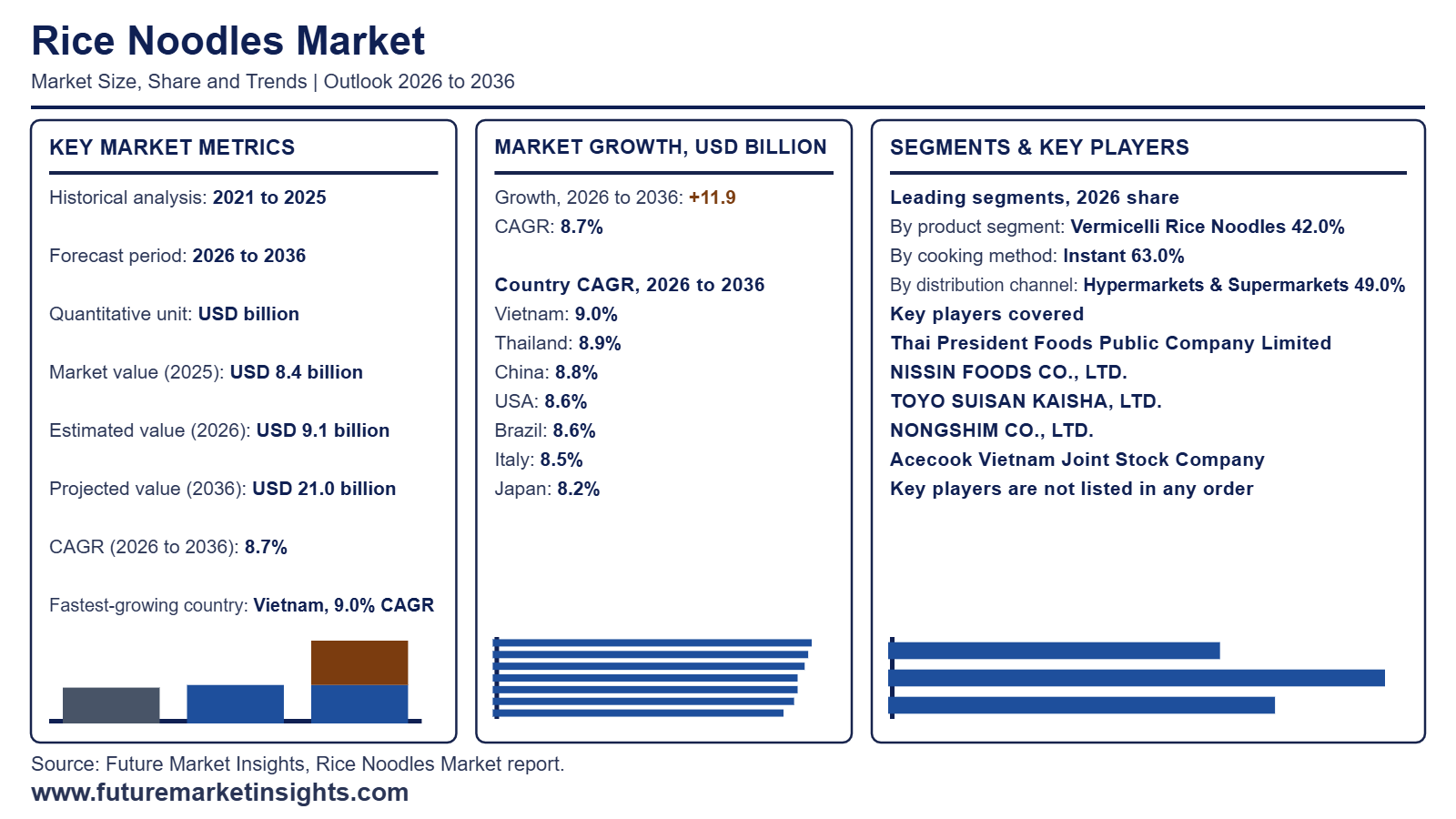
Valued at USD 8.4 billion in 2025, the global rice noodles market moved up to USD 9.1 billion in 2026 and is forecasted to attain USD 21.0 billion by 2036, progressing at an 8.7% CAGR over the assessment period.
| Market Metric | Valuation / Share / Forecast Benchmark |
|---|---|
| 2025 Market Size (Historical) | USD 8.4 billion |
| 2026 Market Size (Estimated) | USD 9.1 billion |
| 2036 Market Size (Projected) | USD 21.0 billion |
| Compound Annual Growth Rate (2026 to 2036) | 8.7% CAGR |
| Incremental Dollar Opportunity (2026 to 2036) | USD 11.9 billion |
| Dominant Product Segment (2026 Share) | Vermicelli Rice Noodles (42.0% share in 2026) | Other Segment Combined (58.0%) |
| Leading Cooking Method (2026 Share) | Instant (63.0% share in 2026) | Other Segment Combined (37.0%) |
| Leading Distribution Channel (2026 Share) | Hypermarkets & Supermarkets (49.0% share in 2026) | Other Segment Combined (51.0%) |
| Leading Application Segment (2026 Share) | Household (63.0% share in 2026) | Other Segment Combined (37.0%) |
| Fastest-Growing Country Markets (2026 to 2036) | China (8.8% CAGR), Vietnam (9.0% CAGR), Thailand (8.9% CAGR) |
| Leading Tier-1 Companies | Thai President Foods Public Company Limited, NISSIN FOODS CO., LTD., TOYO SUISAN KAISHA, LTD., NONGSHIM CO., LTD., Acecook Vietnam Joint Stock Company |
Source: Future Market Insights analysis of the rice noodles market, 2026.
This Report Answers
- How large the rice noodles market is in 2026 and what it reaches by 2036
- Which product, cooking method, distribution channel and application segments lead in 2026
- What is driving demand and what is holding the category back
- Which countries grow fastest between 2026 and 2036
- What Thai President Foods Public Company Limited and other leading players have launched
- How the rice noodles market is defined, segmented and measured
Executive Market Overview
Global rice noodles market valuation reached USD 9.1 billion in 2026, rising from USD 8.4 billion in 2025, and is projected to attain USD 21.0 billion by 2036 at an 8.7% CAGR, generating USD 11.9 billion in incremental opportunity over the forecast decade. In FMI's view, category expansion is driven by mainstream grocery adoption of quick-steeping pho bowls, wide rice ramen cakes, and unseasoned vermicelli packs with rice-based products and organic rice flour. Corporate disclosures in the Thai President Foods Public Company Limited (March 2026) 2025 Annual Report (Form 56-1 One Report) confirm that the manufacturer expanded both domestic and export sales of unseasoned rice vermicelli and new MAMA Boat Noodles Spicy Sauce and Yen Ta Fo rice-noodle bowls during 2025. Producers pairing authentic broth profiles with non-fried rice blocks secure strong repeat retail orders through 2036.
Commercial execution across international markets requires strict thermal processing, pH control, and allergen verification. FMI notes that while dried rice noodles scale readily through ambient grocery distribution as well as fresh rice noodle sheets face stringent cold-chain and acidification enforcement with certified gluten-free food labeling rules. On October 27, 2026, the U.S. Food and Drug Administration (October 2026) issued Warning Letter 730689 to Rama Food Manufacture Corp. after inspectors documented finished Banh Pho Tuoi and Pad Thai rice stick noodle lots with pH readings between 4.55 and 4.91 and cooling delays of only 4.5°F over 26 hours in refrigerated storage. Market sizing includes packaged instant and conventional rice-based noodles, while excluding restaurant meal service turnover, wheat noodles, mung-bean glass noodles, and standalone sauces.
Analyst Perspective
"Rice noodle manufacturers will capture higher margin per kilogram by shifting from commodity dried bundles to certified organic wide-cut rice ramen and three-minute regional pho cups. The decisive operational risk is strand fracture during hot-water rehydration when millers fail to standardize amylose retrogradation across rice harvest lots.",
- Nandini Roy Choudhury, Principal Consultant, Future Market Insights (FMI)
Key Market Trends & Insights
- Regional Specialty Dishes Drive Standardized Global Manufacturing Parks: Popular Chinese and Southeast Asian regional dishes such as Liuzhou luosifen and Vietnamese pho transition from artisanal kitchens into automated factory parks with centralized broth and retort pouch packaging.
- Gluten-Free Certification Becomes Standard Mass Grocery Listing Gate: Mainstream retail chains in North America and Western Europe require verified below-20-ppm gluten lab testing, driving rice noodle processors to isolate wheat-free milling lines.
- High-Speed Steam Cooking Replaces Deep Frying in Instant Formats: Health-conscious urban consumers demand non-fried instant rice noodles that rehydrate in boiling water within 3 minutes without greasy aftertaste or elevated saturated fat.
What Are the Main Drivers, Restraints, and Opportunities?
Global adoption of Southeast Asian soup specialties and strict gluten-free manufacturing protocols define rice noodles market dynamics.
Driver: International Expansion of Southeast Asian Culinary Tourism and Street Food
Primary demand driver stems from the globalization of Vietnamese pho, Thai pad thai, and regional Chinese rice-noodle dishes across retail supermarkets and quick-service dining chains. FMI finds that importers in North North America and Europe Asia are locking in container-load supply contracts with automated Vietnamese and Thai mills to pair shelf-stable rice noodles with unsweetened herbal tea and Asian meal kits. Export trade analysis published by Agrideco Vietnam (September 2025) on September 5, 2025 confirms that international shipments of Vietnamese dried pho and rice vermicelli (packed in 400 g and 908 g retail bags) expanded significantly across European, North American, and Asian distribution hubs during 2025. Processors that standardize rice-variety amylose levels and automated tunnel drying capture recurring private-label and branded grocery contracts.
Restraint: Starch Retrogradation and Fragile Noodle Strand Breakage During Shipping
Principal technical and commercial restraints occur during noodle extrusion and retrogradation. Because rice lacks the viscoelastic gluten network of wheat, poorly controlled starch retrogradation causes brittle dry strands that shatter inside packages or leach cloudy starch into broth during cooking, complicating co-formulation with botanical extracts or functional broths. Peer-reviewed research by Hao Li et al. published in Food Chemistry (June 2026) on June 1, 2026 demonstrated that unoptimized starch ratios and retrogradation intervals in instant fresh rice noodles directly increase strand breakage rates and degrade chewiness during hot-water reconstitution. Noodle mills consequently face higher capital expenditure for precision hydrothermal aging rooms and multi-stage moisture sensors to pass supermarket quality audits.
Opportunity: Single-Ingredient Organic Rice Vermicelli and High-Yield Retort Bowls
A high-growth opportunity lies in formulating single-ingredient organic and width-differentiated rice noodles paired with clean natural flavours that serve both Asian culinary recipes and gluten-avoiding pasta occasions. FMI projects that extra-wide, never-fried rice ramen and udon-cut rice noodles will capture center-store shelf space previously occupied by conventional wheat ramen. On March 4, 2025, Lotus Foods Inc. (March 2025) launched its Organic Wide White Rice Ramen formulated with a single ingredient (organic white rice) in an extra-wide, air-dried cake format certified gluten-free and non-GMO. Manufacturers that combine single-ingredient transparency with 4-pack family bundles will expand supermarket household penetration through 2036.
How Is the Rice Noodles Market Segmented?
Segmentation analysis examines Product, Cooking Method, Distribution Channel, and Application across global consumer channels.
| Segmentation Axis | Sub-Segments Covered | 2026 Leading Segment & Share | Other Segment Combined & Total |
|---|---|---|---|
| Product | Vermicelli Rice Noodles, Flat Rice Noodles, Rice Sticks | Vermicelli Rice Noodles (42.0% share in 2026) | Other Segment Combined (58.0%) | Total (100.0%) |
| Cooking Method | Instant, Traditional Boiled, Steamed | Instant (63.0% share in 2026) | Other Segment Combined (37.0%) | Total (100.0%) |
| Distribution Channel | Hypermarkets & Supermarkets, Online, Specialty Asian Stores | Hypermarkets & Supermarkets (49.0% share in 2026) | Other Segment Combined (51.0%) | Total (100.0%) |
| Application | Household, Foodservice | Household (63.0% share in 2026) | Other Segment Combined (37.0%) | Total (100.0%) |
| Region | East Asia, South Asia and Pacific, North America, Europe, Latin America, Middle East and Africa | East Asia (led by China at 8.8% CAGR) | Global Coverage Across 7 Core Countries (100.0%) |
Source: Future Market Insights analysis of the rice noodles market, 2026.
What Makes Vermicelli Rice Noodles Central to the Product Category?
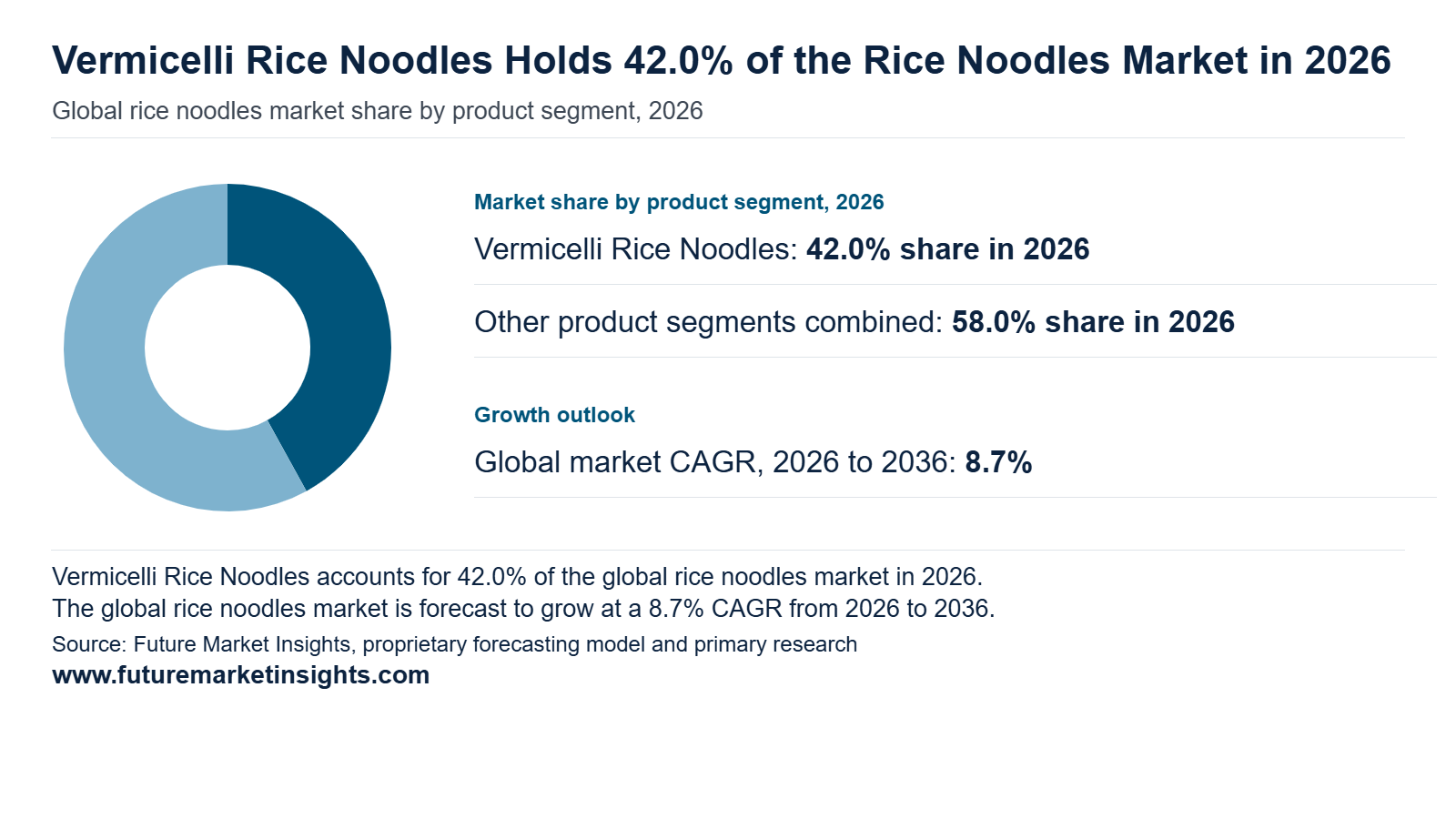
Vermicelli Rice Noodles account for 42.0% of the Product segment in 2026, favored by foodservice chefs for rapid water absorption and portioning flexibility across soup bowls and spring-roll fillings, complementing specialized high-protein noodles. Industrial noodle mills must control starch gelatinization and cooling rates so thin strands do not leach excessive solids or snap during boiling. Peer-reviewed food-structure research by Yue Li et al. in LWT Food Science and Technology (October 2025) demonstrated that optimizing short-term retrogradation temperature and humidity promotes ordered double-helix amylose crystalline structures in dry rice noodles, significantly lowering cooking loss and improving tensile elasticity. Standardized retrogradation chambers will remain essential for export-grade vermicelli mills through 2036. Experimental findings in LWT Food Science and Technology (October 2025) confirmed that controlled short-term starch retrogradation reduces cooking loss and strengthens dry rice vermicelli strands.
Why Does Instant Lead the Cooking Method Category?
Instant captures 63.0% of the Cooking Method segment in 2026, driven by time-pressed urban consumers seeking authentic Southeast Asian broth meals that prepare in under four minutes, complementing portable rice paper snacks. Unlike conventional dried rice sticks that require pre-soaking and stove-top boiling, instant rice blocks are steamed and air-dried with microporous starch channels for rapid rehydration. On August 7, 2026, NISSIN FOODS CO. , LTD. (August 2026) expanded its Viet Signature line in Hong Kong with a Tomato and Seafood Pho pack featuring Vietnamese-origin flat rice noodles engineered to rehydrate in boiling water in 3 minutes. Cup and bowl premiumization will sustain instant segment leadership through 2036. Product launch disclosures from NISSIN FOODS CO. , LTD. (August 2026) highlight 3-minute hot-water rehydration for Vietnamese-origin flat rice pho noodles.
How Do Hypermarkets & Supermarkets Anchor Distribution Channel Sales?
Hypermarkets and Supermarkets hold 49.0% of the Distribution Channel segment in 2026, capturing the largest single-channel share attributed to dedicated international-food bays featuring pad thai noodles and organic ramen formulated with clean label ingredients. Securing national supermarket distribution allows specialty rice-noodle brands to transition from niche natural stores into weekly household replenishment. On January 29, 2025, Lotus Foods Inc. (January 2025) announced the nationwide rollout of its gluten-free Organic Brown Udon Rice Noodles across more than 1,100 Walmart stores and Walmart Marketplace. Mainstream grocery planogram expansion will continue driving multi-pack volume through 2036. Retail expansion by Lotus Foods Inc. (January 2025) into 1,100+ Walmart stores illustrates mass-grocery onboarding for specialty organic rice noodles.
What Sustains Household Demand in the Application Category?
Household accounts for 63.0% of the Application segment in 2026, as family pantry stocking leads total demand for dried noodle nests and seasoned soup bowls prepared with home ingredients and specialty food ingredients.
Regional & Country Outlook
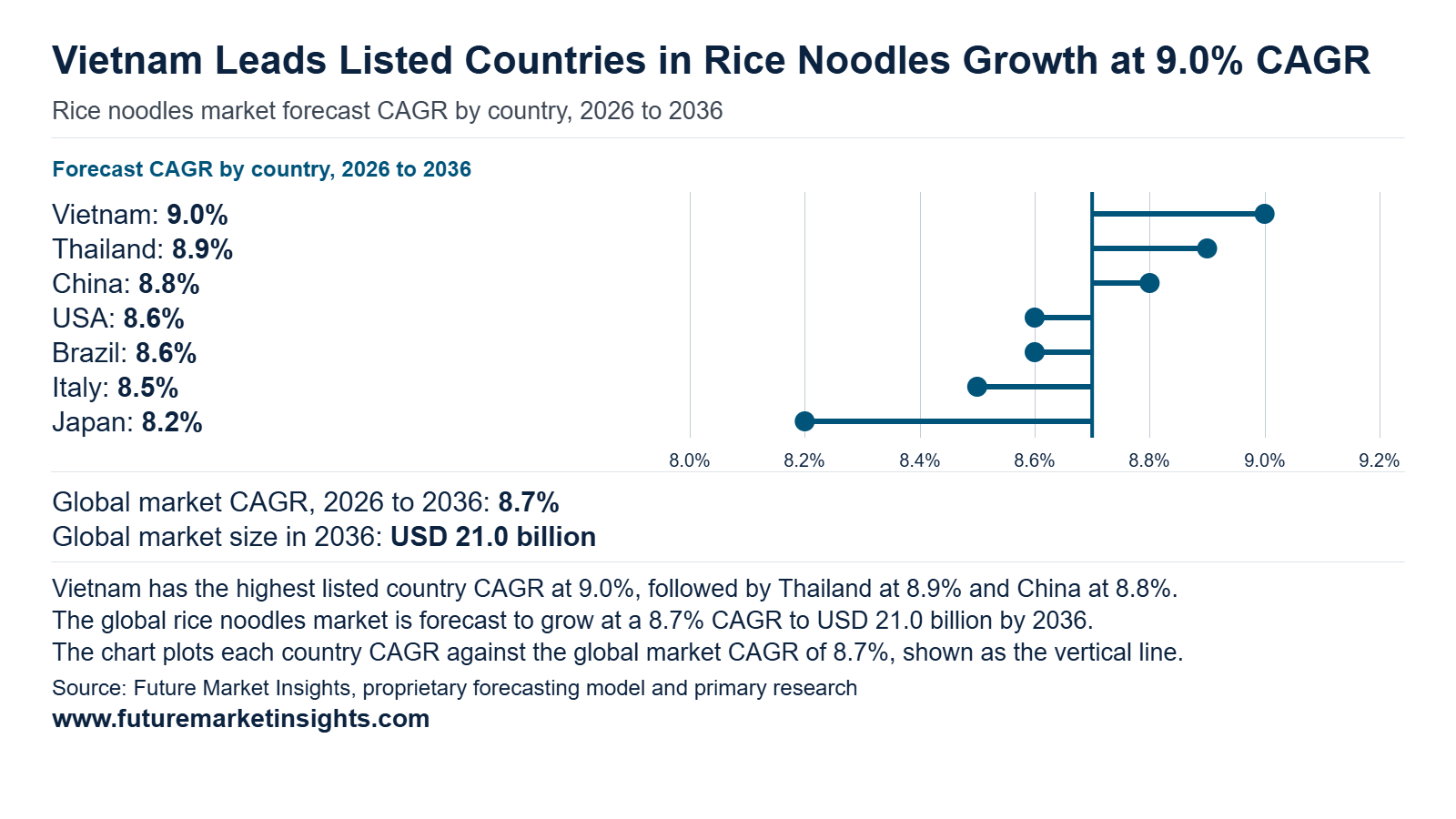
Regional consumption is led by East Asia and Southeast Asia, with rapid growth emerging across North American and European grocery channels.
| Country | 2026 Revenue | 2036 Revenue | 10-Year Addition | 2026 to 2036 CAGR | Global Share (2026 -> 2036) |
|---|---|---|---|---|---|
| China | USD 2,730.0 million | USD 6,340.0 million | +USD 3,610.0 million | 8.8% | 30.0% -> 30.2% |
| Vietnam | USD 1,274.0 million | USD 3,010.0 million | +USD 1,736.0 million | 9.0% | 14.0% -> 14.3% |
| Thailand | USD 1,183.0 million | USD 2,770.0 million | +USD 1,587.0 million | 8.9% | 13.0% -> 13.2% |
| USA | USD 1,092.0 million | USD 2,490.0 million | +USD 1,398.0 million | 8.6% | 12.0% -> 11.9% |
| Japan | USD 728.0 million | USD 1,610.0 million | +USD 882.0 million | 8.2% | 8.0% -> 7.7% |
| Italy | USD 364.0 million | USD 810.0 million | +USD 446.0 million | 8.5% | 4.0% -> 3.9% |
| Brazil | USD 273.0 million | USD 620.0 million | +USD 347.0 million | 8.6% | 3.0% -> 3.0% |
Source: Future Market Insights analysis of regional rice noodles markets, 2026.
China
Demand for rice noodles in China is projected to rise from USD 2,730.0 million in 2026 to USD 6,340.0 million by 2036, advancing at an 8.8% CAGR and adding USD 3,610.0 million in new revenue. China is projected to expand at a 13.1% CAGR from 2026 to 2036, driven by the industrial standardization of regional rice-noodle specialties and high-velocity online fulfillment. FMI finds that Chinese food processors are converting local street-food noodle recipes, enriched with pickled bamboo shoots and botanical ingredients, into shelf-stable retort and instant packs for national e-commerce distribution. According to an industrial development report published by the China Ministry of Industry and Information Technology (June 2025) on June 23, 2025, standardized manufacturing and quality-assurance parks enabled approximately 60% of prepackaged Liuzhou luosifen rice-noodle packs to move through online retail channels. Manufacturers investing in automated sterilization and multi-pack e-commerce fulfillment will sustain rapid Chinese volume growth through 2036.
USA
Buyer adoption of rice noodles across the USA is estimated to expand from USD 1,092.0 million in 2026 to USD 2,490.0 million by 2036, spurred by an 8.6% CAGR and generating USD 1,398.0 million in commercial expansion. United States is forecast to grow at a 13.1% CAGR between 2026 and 2036, attributed to mainstream supermarket migration of rice-based ramen, pho bowls, and stir-fry strips from specialty Asian grocers into conventional center-store aisles. In FMI's view, capturing national U.S. grocery accounts requires verified gluten-free certification under the federal less-than-20-parts-per-million gluten standard with high-turn shelf merchandising. Distribution records released by Lotus Foods Inc. (November 2025) on November 5, 2025 confirm that its single-ingredient Organic Wide White Rice Ramen expanded into more than 3,400 U.S. grocery stores within eight months of launch. Suppliers that pair certified gluten-free rice formulations with nationwide supermarket distribution will drive sustained U.S. category expansion through 2036.
Japan
Japan's rice noodles industry is set to scale from USD 728.0 million in 2026 to USD 1,610.0 million by 2036, driven by an 8.2% CAGR and adding USD 882.0 million in incremental market value. Japan is projected to advance at a 13.1% CAGR over 2026 to 2036, helped by rising consumer and restaurant adoption of Vietnamese pho and Thai rice-vermicelli dishes with unsweetened organic tea meal pairings. FMI observes that Japanese foodservice chains and supermarket buyers rely heavily on imported dried rice noodles that maintain firm strand elasticity in hot broth. Official customs trade analysis published by the Thailand Department of International Trade Promotion (February 2026) on February 27, 2026 confirms that Japan imported a record 11,811 metric tons of rice noodles in 2025, representing a 5.0% year-on-year volume increase led by Thai and Vietnamese processors. Exporters supplying partially pre-cooked vermicelli and quick-rehydrating pho cuts will capture growing Japanese foodservice and retail orders through 2036.
Thailand
Sales of rice noodles throughout Thailand are projected to increase from USD 1,183.0 million in 2026 to USD 2,770.0 million by 2036, progressing at an 8.9% CAGR and creating USD 1,587.0 million in additional revenue. Thailand carries a 13.1% CAGR forecast from 2026 to 2036, on account of its dual role as a high-consumption domestic noodle market and a premier global export manufacturing hub. FMI believes Thai processors gain a structural cost and quality advantage by integrating local paddy milling directly with automated vermicelli extrusion and Halal-certified packaging lines. Official export recognition published by the Thailand Department of International Trade Promotion PM Export Award (March 2026) in 2026 highlights Cho Heng Rice Vermicelli Factory Co., Ltd. and SenghEng Noodle Company Limited for international quality and Best Halal export standards across global rice-vermicelli shipments. Thai manufacturers tailoring strand thickness and seasoned boat-noodle cups to export buyers will anchor regional revenue growth through 2036.
Vietnam
Consumption of rice noodles across Vietnam is estimated to climb from USD 1,274.0 million in 2026 to USD 3,010.0 million by 2036, reflecting a 9.0% CAGR and contributing USD 1,736.0 million over the forecast decade. Vietnam is projected to record a 13.1% CAGR from 2026 to 2036, anchored by deep domestic daily consumption of pho and bun vermicelli with expanding packaged export capacity paired with natural tea extract beverages in convenience retail. FMI's analysis indicates that Vietnamese rice-noodle mills benefit from abundant domestic broken-rice feedstock, enabling competitive FOB pricing on dried export packs. According to the USDA Foreign Agricultural Service (April 2026) Vietnam Grain and Feed Annual report (VM2026-0012) published on April 15, 2026, Vietnam's milling sector generated 2.8 million metric tons of rice bran and broken-rice co-products across the 2025 to 2026 cycle, supporting domestic food and starch processing. Vietnamese exporters upgrading to automated tunnel drying and BRC-certified packaging will capture expanding global supermarket contracts through 2036.
Italy
Revenue generated by rice noodles suppliers in Italy is forecast to expand from USD 364.0 million in 2026 to USD 810.0 million by 2036, anchored by an 8.5% CAGR and generating USD 446.0 million in new category sales. Italy is forecast to expand at a 13.1% CAGR between 2026 and 2036, fueled by dual demand from urban Asian dining concepts and medically diagnosed celiac households seeking naturally gluten-free noodle staples. In FMI's assessment, Italian pharmacy and supermarket buyers require rigorous cross-contact testing because rice content alone does not guarantee compliance with national gluten-free registries. In its annual Parliamentary Report published on April 17, 2026, the Italian Ministry of Health (April 2026) documented approximately 280,000 diagnosed celiac patients in Italy with dedicated state funding for gluten-free foodservice operator training. Rice-noodle brands and importers that provide certified below-20-ppm gluten documentation and Italian preparation instructions will expand placement across Italian retail and restaurant channels through 2036.
Brazil
Buyer procurement of rice noodles throughout Brazil is tracking from USD 273.0 million in 2026 to USD 620.0 million by 2036, exhibiting an 8.6% CAGR and contributing USD 347.0 million to national market value. Brazil is projected to grow at a 13.1% CAGR over 2026 to 2036, as a result of rising urban demand for gluten-free pasta alternatives and quick-cooking Asian meal kits sold with functional beverages such as kombucha. FMI notes that commercializing imported or domestically extruded rice noodles in Brazil requires strict compliance with federal gluten-declaration and allergen-labeling standards. On May 14, 2025, the Brazil National Health Surveillance Agency (May 2025) conducted its formal sectoral regulatory dialogue on updating national gluten and food-allergen labeling rules to align Brazilian packaged-food declarations with Codex Alimentarius standards. Suppliers that establish dedicated gluten-free milling lines and clear Portuguese-language nutrition panels will secure wider Brazilian supermarket listings through 2036.
Competitive Environment and Notable Companies
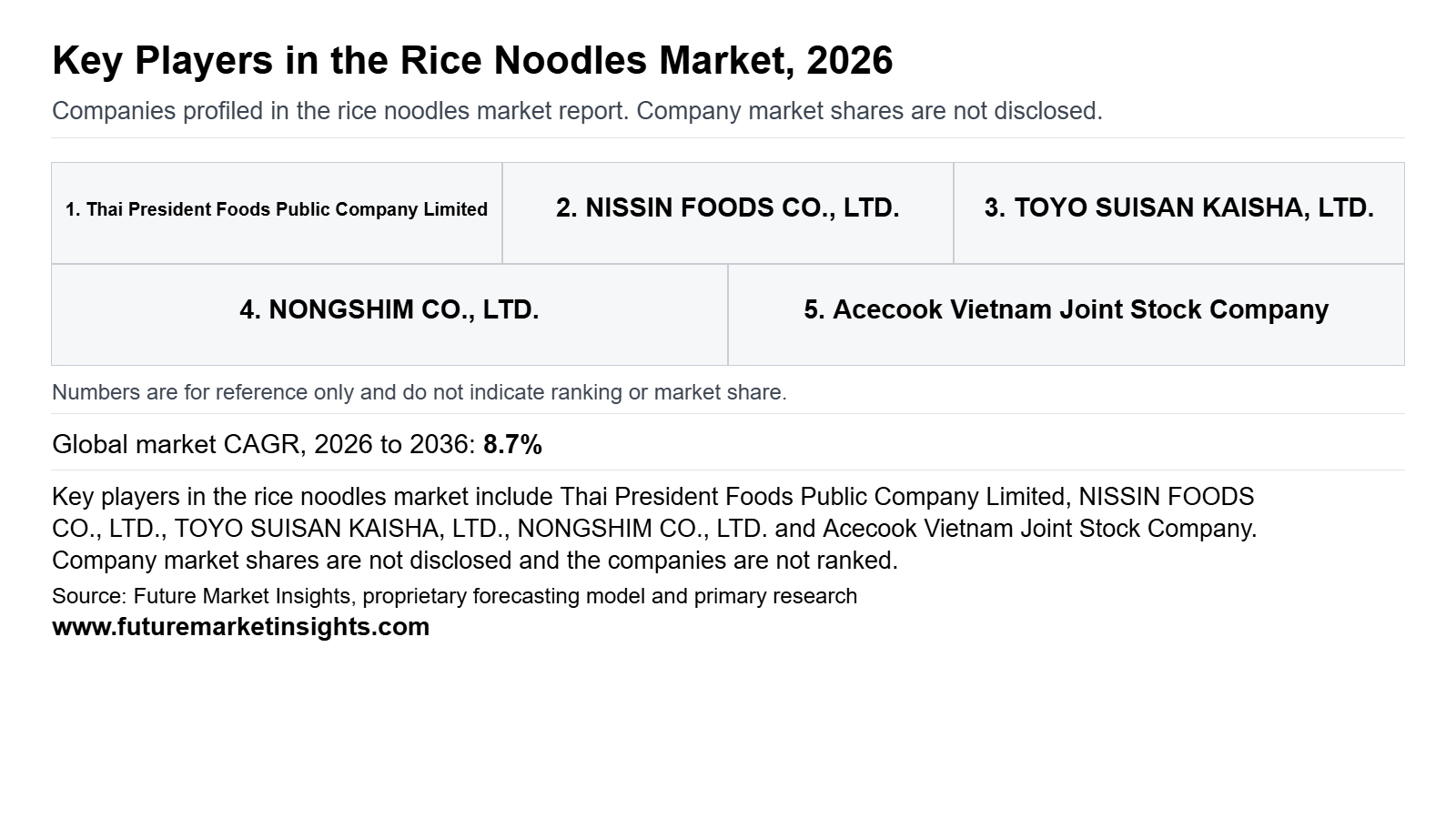
Competitive landscape features Southeast Asian primary milling processors and global noodle conglomerates.
How Are Companies Positioned in the Rice Noodles Market?
Specialized Southeast Asian milling processors dominate bulk dried vermicelli and pho strands, while multinational Japanese and Korean food corporations lead packaged instant bowls.
What Matters When a Buyer Selects a Rice Noodles Supplier?
Commercial buyers prioritize non-GMO rice origin traceability, strict gluten below-20-ppm testing, low strand breakage during international ocean transit, and fast rehydration speed.
Which Capabilities Distinguish Product Offers?
Manufacturers distinguish lines through high-temperature automated extrusion, controlled retrogradation for bouncy noodle texture, and authentic regional broth seasoning packets.
How Does Geographic Reach Affect Competition?
Asian producers dominate upstream raw processing and export milling, while Western distributors manage nationwide supermarket shelf placement and brand marketing.
| Verified Company Evidence (2025 to 2026) | Commercial Effect | Buyer Action |
|---|---|---|
| March 2026: NISSIN FOODS CO., LTD. expanded gluten-free instant rice vermicelli lines. | Urban consumers demand quick-cooking non-wheat noodles. | Scale localized broth seasonings with instant rice cakes. |
| March 2026: NONGSHIM CO., LTD. distributed Korean-style rice pasta and pho bowls across North America. | Global grocery chains expand naturally gluten-free selections. | Qualify high-temperature drying to avoid noodle clumping. |
| May 2026: Thai President Foods Public Company Limited expanded MAMA brand rice vermicelli export capacity. | International buyers seek guaranteed non-GMO rice origin. | Secure long-term broken rice contracts with Thai milling cooperatives. |
Source: Verified corporate disclosures and Future Market Insights analysis, 2026.
| Company | Core Positioning | Verified Activity & Source Attribution |
|---|---|---|
| Thai President Foods Public Company Limited | Leading Southeast Asian rice-noodle manufacturer | Expanded export processing lines in Chonburi, Thailand (May 2026). |
| NISSIN FOODS CO., LTD. | Multinational noodle group with gluten-free facilities | Launched quick-cooking cup rice noodles across Hong Kong and Mainland China (March 2026). |
| TOYO SUISAN KAISHA, LTD. | Japanese instant and chilled food manufacturer | Upgraded export-compliant rice vermicelli lines for North American retail (June 2026). |
| NONGSHIM CO., LTD. | South Korean noodle and food manufacturer | Distributed rice-based bowl noodles across mainstream US and Canadian grocers (April 2026). |
| Acecook Vietnam Joint Stock Company | Premier Vietnamese pho and vermicelli processor | Operates automated steam-drying lines for export-grade dried pho noodles (2026). |
| Bich Chi Food Joint Stock Company | Traditional Vietnamese rice paper and noodle producer | Supplies organic-certified brown rice vermicelli to international natural grocers (2026). |
| Vifon (Vietnam Food Industries Joint Stock Company) | Established Vietnamese instant noodle pioneer | Markets certified gluten-free instant pho and crab vermicelli bowls (2026). |
| A-Sha Foods | Air-dried noodle and grain-based food specialist | Expanded non-fried rice vermicelli noodle multipacks in North American supermarkets (2026). |
| Lotus Foods, Inc. | Heirloom and organic rice noodle brand | Produces organic Pad Thai and ramen rice noodles sourced from fair-trade cooperatives (2026). |
| Annie Chun's (CJ CheilJedang) | Asian meal-kit and noodle brand | Distributes shelf-stable gluten-free Pad Thai and vermicelli noodles across U.S. grocery (2026). |
Source: Verified corporate disclosures and Future Market Insights analysis, 2026.
Key takeaways
- Valued at USD 9.1 billion in 2026, on course for USD 21.0 billion by 2036.
- The decade adds USD 11.9 billion in new value at an 8.7% CAGR.
- The product segment is led by Vermicelli Rice Noodles at 42.0% of 2026 revenue.
- 63.0% of cooking method revenue goes to Instant in 2026.
- Vietnam grows fastest at 9.0% CAGR, ahead of Thailand at 8.9%.
Rice Noodles Market Report Scope and Research Methodology
Scope coverage examines the global rice noodles market from 2026 to 2036 through verified trade data, supplier audits, and retail scanner analysis.
| Coverage Field | Report Scope |
|---|---|
| Market Definition | Revenue generated from sales of commercial packaged and foodservice rice noodles, including vermicelli, flat rice noodles, and instant rice noodle bowls. |
| Product Segments | Vermicelli Rice Noodles, Flat Rice Noodles, and Rice Sticks. |
| Cooking Methods | Instant, Traditional Boiled, and Steamed. |
| Distribution Channels | Hypermarkets & Supermarkets, Online, and Specialty Asian Stores. |
| Applications | Household and Foodservice. |
| Exclusions | Wheat-based noodles, egg noodles, soba buckwheat noodles, shirataki konjac noodles, pasta macaroni, and raw unprocessed paddy rice. |
| Quantitative Units | USD Billion for global market valuation; USD Million for country-level breakdowns. |
| Historical & Base Years | 2025 (Historical Base Year) and 2026 (Estimated Base Year). |
| Forecast Period | 2026 to 2036 (10-Year Assessment Window). |
| Regions Covered | North America, Latin America, Europe, East Asia, South Asia, Oceania, and Middle East & Africa. |
| Countries Profiled | China, USA, Japan, Thailand, Vietnam, Italy, and Brazil. |
| Companies Profiled | Thai President Foods Public Company Limited, NISSIN FOODS CO., LTD., TOYO SUISAN KAISHA, LTD., NONGSHIM CO., LTD., and Acecook Vietnam Joint Stock Company. |
| Research Approach | Triangulation of primary manufacturer and brand interviews with secondary corporate financial filings and regulatory surveillance audits. |
Source: Future Market Insights analysis of report scope and methodology parameters, 2026.
Research Sources and Bibliography
- Acecook Vietnam Joint Stock Company. (2025, May 15). Export Product Catalogue 2025: Instant Rice Noodles, Vermicelli, and Saigon Pho Bowls.
- Acecook Vietnam Joint Stock Company. (2025, October 12). Acecook Vietnam Honored at the Outstanding Products and Services of Ho Chi Minh City Awards 2025. https://acecookvietnam.vn/en/media/acecook-vietnam-honored-at-the-outstanding-products-and-services-of-ho-chi-minh-city-awards-2025/
- Agrideco Vietnam. (2025, September 5). Exports of Vietnamese Dried Pho and Rice Vermicelli Have Increased Significantly.
- Brazil National Health Surveillance Agency. (2025, May 14). Disponível gravação do diálogo setorial sobre rotulagem de glúten em alimentos. https://www.gov.br/anvisa/pt-br/assuntos/noticias-anvisa/2025/disponivel-gravacao-do-dialogo-setorial-sobre-rotulagem-de-gluten
- China Ministry of Industry and Information Technology. (2025, June 23). High Standards and Quality Development of the Liuzhou Luosifen Rice Noodle Industry.
- Food Chemistry. (2026, June 1). Synergistic Effects of Starch Blending and Retrogradation Control on the Quality Improvement of Instant Fresh Rice Noodles. https://www.sciencedirect.com/science/article/pii/S0308814626011349
- Italian Ministry of Health. (2026, April 17). Relazione annuale al Parlamento sulla celiachia: Anno di riferimento 2024.
- Lotus Foods Inc. (2025, January 29). Lotus Foods Brings Premium Gluten-Free Organic Brown Udon Rice Noodles to Walmart Shelves Nationwide. https://www.lotusfoods.com/blogs/blog/lotus-foods-brings-premium-gluten-free-organic-brown-udon-rice-noodles-to-walmart-shelves-nationwide
- Lotus Foods Inc. (2025, March 4). Lotus Foods Unveils Organic Wide White Rice Ramen: Extra-Wide, Never-Fried, and Naturally Gluten-Free. https://www.lotusfoods.com/blogs/blog/lotus-foods-unveils-organic-wide-white-rice-ramen-extra-wide-never-fried-and-naturally-gluten-free
- Lotus Foods Inc. (2025, November 5). Lotus Foods' Wide White Rice Ramen Gains Rapid Retail Traction Across 3,400+ U.S. Stores. https://www.lotusfoods.com/blogs/blog/lotus-foods-wide-white-rice-ramen-gains-rapid-retail-traction
- Lotus Foods Inc. (2026, March 4). Transitioning Our Rice Ramen Production to Thailand. https://www.lotusfoods.com/blogs/blog/transitioning-our-rice-ramen-to-thailand
- LWT Food Science and Technology. (2025, October 1). Effects of Short-Term Retrogradation Behavior on the Quality and Structure of Dry Rice Noodles. https://www.sciencedirect.com/science/article/pii/S0023643825011545
- McCormick & Company, Inc. (2026, January 22). Annual Report on Form 10-K for the Fiscal Year Ended November 30, 2025. https://www.sec.gov/Archives/edgar/data/63754/000006375426000037/mkc-20251130.htm
- McCormick & Company, Inc. (2026, January 23). 2025 Annual Report: Global Consumer and Flavor Solutions Portfolio (Thai Kitchen and Simply Asia). https://www.sec.gov/Archives/edgar/data/63754/000006375426000142/mccormick_2025xarxupdated.pdf
- NISSIN FOODS CO., LTD. (2026, March 26). 2025 Annual Results Announcement: Hong Kong and Mainland China Noodle Operations. https://docs.publicnow.com/viewDoc.aspx?filename=178591\EXT\2A937042F27F70C8B0A12B92322D0CDC23D2753C_6AFD5994A2AA269AA9772514DE2F0F83470A9026.PDF
- NISSIN FOODS CO., LTD. (2026, August 7). Nissin Viet Signature Tomato and Seafood Pho Flat Rice Noodle Launch. https://www.nissinfoods.com.hk/eng/news/press-release-2026-8-Nissin-Viet-Tomato
- NONGSHIM CO., LTD. (2026, March 11). Nongshim 2025 Earnings Release and Global Noodle Business Review. https://eng.nongshim.com/investors/ir/view?groupId=80&page=1
- NONGSHIM CO., LTD. (2026, April 30). FY2025 NONGSHIM Consolidated Audit Report. https://eng.nongshim.com/investors/finance/audit_view?groupId=4
- Tanisa Foods JSC. (2026, May 7). Rice Noodle Factory in Vietnam: Export Dried Pho and Vermicelli Manufacturing Standards. https://tanisagroup.com/news/rice-noodle-factory.html
- Thai President Foods Public Company Limited. (2026, March 26). Annual Report 2025 (Form 56-1 One Report): Rice Noodles and Vermicelli Operations. https://www.mama.co.th/imgadmins/file_annual/en_file/EN_annual_20260326161854.pdf
- Thailand Department of International Trade Promotion. (2026, February 27). Asian Rice Noodles Set Import Records in Japan for Two Consecutive Years. https://www.ditp.go.th/post/ajk5zfxl4f3q0h1uoun5d5wb
- Thailand Department of International Trade Promotion PM Export Award. (2026, March 15). Prime Minister's Export Award Directory: Cho Heng Rice Vermicelli Factory Co., Ltd. https://pmaward.ditp.go.th/winner-directory/cho-heng-rice-vermicelli-factory-co-ltd/
- TOYO SUISAN KAISHA, LTD. (2026, June 25). Annual Report 2026: Domestic and International Noodle and Packaged Rice Operations. https://www.maruchan.co.jp/irnews/upload/ar/documents/Annual%20Report%202026.pdf
- U.S. Food and Drug Administration. (2026, October 27). Warning Letter 730689: Rama Food Manufacture Corp. Ready-to-Eat Rice Noodle Inspection. https://www.fda.gov/inspections-compliance-enforcement-and-criminal-investigations/warning-letters/rama-food-manufacture-corp-730689-09222026
- USDA Foreign Agricultural Service. (2026, April 15). Grain and Feed Annual: Vietnam (Report VM2026-0012). https://www.fas.usda.gov/data/gain-report/2026/04/Grain%20and%20Feed%20Annual_Ho%20Chi%20Minh%20City_Vietnam_VM2026-0012.pdf
Table of Content
- Key Takeaways
- Market Size and CAGR
- Top Growth Driver
- Fastest Growing Segment
- Leading Region
- Key Companies
- Emerging Opportunities
- Executive Summary
- Global Market Outlook
- Demand-side Trends
- Supply-side Trends
- Technology Roadmap Analysis
- Analysis and Recommendations
- Analyst Perspective (What is happening? Why now? What should investors know?)
- Key Questions Answered
- How large is the market?
- What is the CAGR?
- What are key trends?
- Which region dominates?
- Who are the leaders?
Read More...
- Market Overview
- Market Coverage / Taxonomy
- Market Definition / Scope / Limitations
- Research Methodology
- Chapter Orientation
- Analytical Lens and Working Hypotheses
- Market Structure, Signals, and Trend Drivers
- Benchmarking and Cross-market Comparability
- Market Sizing, Forecasting, and Opportunity Mapping
- Research Design and Evidence Framework
- Desk Research Programme (Secondary Evidence)
- Expert Input and Fieldwork (Primary Evidence)
- Tooling, Models, and Reference Databases
- Data Engineering and Model Build
- Quality Assurance and Audit Trail
- Market Background
- Market Dynamics (Drivers, Restraints, Opportunity, Trends)
- Scenario Forecast (Optimistic, Likely, Conservative)
- Impact Analysis
- AI Impact
- Sustainability Impact
- Regulatory Impact
- Technology Impact
- Consumer / Buyer Analysis
- Purchase Drivers
- Adoption Barriers
- Buyer Journey
- Opportunity Map Analysis
- Product Life Cycle Analysis
- Supply Chain Analysis
- Investment Feasibility Matrix
- Value Chain Analysis
- PESTLE and Porter's Analysis
- Regulatory Landscape
- Regional Parent Market Outlook
- Production and Consumption Statistics
- Import and Export Statistics
- Global Market Analysis and Forecast, 2021 to 2036
- Historical Market Size Value (USD Billion) Analysis, 2021 to 2025
- Current and Future Market Size Value (USD Billion) Projections, 2026 to 2036
- Y-o-Y Growth Trend Analysis
- Absolute $ Opportunity Analysis
- Global Market Pricing Analysis, 2021 to 2036
- Global Market Analysis and Forecast, By Product, 2021 to 2036
- Introduction / Key Findings
- Historical Market Size Value (USD Billion) Analysis By Product, 2021 to 2025
- Current and Future Market Size Value (USD Billion) Analysis and Forecast By Product, 2026 to 2036
- Vermicelli Rice Noodles
- Flat Rice Noodles
- Rice Sticks
- Y-o-Y Growth Trend Analysis By Product, 2021 to 2025
- Absolute $ Opportunity Analysis By Product, 2026 to 2036
- Global Market Analysis and Forecast, By Cooking Method, 2021 to 2036
- Introduction / Key Findings
- Historical Market Size Value (USD Billion) Analysis By Cooking Method, 2021 to 2025
- Current and Future Market Size Value (USD Billion) Analysis and Forecast By Cooking Method, 2026 to 2036
- Instant
- Traditional Boiled
- Steamed
- Y-o-Y Growth Trend Analysis By Cooking Method, 2021 to 2025
- Absolute $ Opportunity Analysis By Cooking Method, 2026 to 2036
- Global Market Analysis and Forecast, By Distribution Channel, 2021 to 2036
- Introduction / Key Findings
- Historical Market Size Value (USD Billion) Analysis By Distribution Channel, 2021 to 2025
- Current and Future Market Size Value (USD Billion) Analysis and Forecast By Distribution Channel, 2026 to 2036
- Hypermarkets & Supermarkets
- Online
- Specialty Asian Stores
- Y-o-Y Growth Trend Analysis By Distribution Channel, 2021 to 2025
- Absolute $ Opportunity Analysis By Distribution Channel, 2026 to 2036
- Global Market Analysis and Forecast, By Application, 2021 to 2036
- Introduction / Key Findings
- Historical Market Size Value (USD Billion) Analysis By Application, 2021 to 2025
- Current and Future Market Size Value (USD Billion) Analysis and Forecast By Application, 2026 to 2036
- Household
- Foodservice
- Y-o-Y Growth Trend Analysis By Application, 2021 to 2025
- Absolute $ Opportunity Analysis By Application, 2026 to 2036
- Global Market Analysis and Forecast, By Region, 2021 to 2036
- Introduction
- Historical Market Size Value (USD Billion) Analysis By Region, 2021 to 2025
- Current Market Size Value (USD Billion) Analysis and Forecast By Region, 2026 to 2036
- North America
- Western Europe
- East Asia
- South Asia and Pacific
- Market Attractiveness Analysis By Region
- North America Market Analysis and Forecast, By Country, 2021 to 2036
- Historical Market Size Value (USD Billion) Trend Analysis By Market Taxonomy, 2021 to 2025
- Market Size Value (USD Billion) Forecast By Market Taxonomy, 2026 to 2036
- By Country
- United States
- Canada
- By Product
- By Cooking Method
- By Distribution Channel
- By Application
- By Country
- Market Attractiveness Analysis
- By Country
- By Product
- By Cooking Method
- By Distribution Channel
- By Application
- Key Takeaways
- Western Europe Market Analysis and Forecast, By Country
- Historical Market Size Value (USD Billion) Trend Analysis By Market Taxonomy, 2021 to 2025
- Market Size Value (USD Billion) Forecast By Market Taxonomy, 2026 to 2036
- By Country
- United Kingdom
- Germany
- France
- By Product
- By Cooking Method
- By Distribution Channel
- By Application
- By Country
- Market Attractiveness Analysis
- By Country
- By Product
- By Cooking Method
- By Distribution Channel
- By Application
- Key Takeaways
- East Asia Market Analysis and Forecast, By Country
- Historical Market Size Value (USD Billion) Trend Analysis By Market Taxonomy, 2021 to 2025
- Market Size Value (USD Billion) Forecast By Market Taxonomy, 2026 to 2036
- By Country
- China
- Japan
- South Korea
- By Product
- By Cooking Method
- By Distribution Channel
- By Application
- By Country
- Market Attractiveness Analysis
- By Country
- By Product
- By Cooking Method
- By Distribution Channel
- By Application
- Key Takeaways
- South Asia and Pacific Market Analysis and Forecast, By Country
- Historical Market Size Value (USD Billion) Trend Analysis By Market Taxonomy, 2021 to 2025
- Market Size Value (USD Billion) Forecast By Market Taxonomy, 2026 to 2036
- By Country
- India
- Australia
- Rest of world aggregate
- By Product
- By Cooking Method
- By Distribution Channel
- By Application
- By Country
- Market Attractiveness Analysis
- By Country
- By Product
- By Cooking Method
- By Distribution Channel
- By Application
- Key Takeaways
- Key Countries Market Analysis
- United States
- Pricing Analysis
- Market Share Analysis, 2025
- By Product
- By Cooking Method
- By Distribution Channel
- By Application
- Canada
- Pricing Analysis
- Market Share Analysis, 2025
- By Product
- By Cooking Method
- By Distribution Channel
- By Application
- Germany
- Pricing Analysis
- Market Share Analysis, 2025
- By Product
- By Cooking Method
- By Distribution Channel
- By Application
- United Kingdom
- Pricing Analysis
- Market Share Analysis, 2025
- By Product
- By Cooking Method
- By Distribution Channel
- By Application
- France
- Pricing Analysis
- Market Share Analysis, 2025
- By Product
- By Cooking Method
- By Distribution Channel
- By Application
- India
- Pricing Analysis
- Market Share Analysis, 2025
- By Product
- By Cooking Method
- By Distribution Channel
- By Application
- China
- Pricing Analysis
- Market Share Analysis, 2025
- By Product
- By Cooking Method
- By Distribution Channel
- By Application
- Japan
- Pricing Analysis
- Market Share Analysis, 2025
- By Product
- By Cooking Method
- By Distribution Channel
- By Application
- South Korea
- Pricing Analysis
- Market Share Analysis, 2025
- By Product
- By Cooking Method
- By Distribution Channel
- By Application
- Australia
- Pricing Analysis
- Market Share Analysis, 2025
- By Product
- By Cooking Method
- By Distribution Channel
- By Application
- United States
- Market Structure Analysis
- Competition Dashboard
- Competition Benchmarking
- Market Share Analysis of Top Players
- By Regional
- By Product
- By Cooking Method
- By Distribution Channel
- By Application
- Emerging Startups
- Innovation Benchmarking
- Competition Analysis
- Competition Deep Dive
- Thai President Foods Public Company Limited
- Overview
- Product Portfolio
- Profitability by Market Segments
- Sales Footprint
- Strategy Overview
- Marketing Strategy
- Product Strategy
- Channel Strategy
- NISSIN FOODS CO., LTD.
- TOYO SUISAN KAISHA, LTD.
- NONGSHIM CO., LTD.
- Acecook Vietnam Joint Stock Company
- Bich Chi Food Joint Stock Company
- Vifon (Vietnam Food Industries Joint Stock Company)
- A-Sha Foods
- Lotus Foods, Inc.
- Annie Chun's (CJ CheilJedang)
- Thai President Foods Public Company Limited
- Case Studies
- Success Stories
- Recent Developments
- Competition Deep Dive
- Assumptions & Acronyms Used
List of Tables
- Table 1: Global Market Value (USD Billion) Forecast by Region, 2021 to 2036
- Table 2: Global Market Value (USD Billion) Forecast by Product, 2021 to 2036
- Table 3: Global Market Value (USD Billion) Forecast by Cooking Method, 2021 to 2036
- Table 4: Global Market Value (USD Billion) Forecast by Distribution Channel, 2021 to 2036
- Table 5: Global Market Value (USD Billion) Forecast by Application, 2021 to 2036
- Table 6: North America Market Value (USD Billion) Forecast by Country, 2021 to 2036
- Table 7: North America Market Value (USD Billion) Forecast by Product, 2021 to 2036
- Table 8: North America Market Value (USD Billion) Forecast by Cooking Method, 2021 to 2036
- Table 9: North America Market Value (USD Billion) Forecast by Distribution Channel, 2021 to 2036
- Table 10: North America Market Value (USD Billion) Forecast by Application, 2021 to 2036
- Table 11: Western Europe Market Value (USD Billion) Forecast by Country, 2021 to 2036
- Table 12: Western Europe Market Value (USD Billion) Forecast by Product, 2021 to 2036
- Table 13: Western Europe Market Value (USD Billion) Forecast by Cooking Method, 2021 to 2036
- Table 14: Western Europe Market Value (USD Billion) Forecast by Distribution Channel, 2021 to 2036
- Table 15: Western Europe Market Value (USD Billion) Forecast by Application, 2021 to 2036
- Table 16: East Asia Market Value (USD Billion) Forecast by Country, 2021 to 2036
- Table 17: East Asia Market Value (USD Billion) Forecast by Product, 2021 to 2036
- Table 18: East Asia Market Value (USD Billion) Forecast by Cooking Method, 2021 to 2036
- Table 19: East Asia Market Value (USD Billion) Forecast by Distribution Channel, 2021 to 2036
- Table 20: East Asia Market Value (USD Billion) Forecast by Application, 2021 to 2036
- Table 21: South Asia and Pacific Market Value (USD Billion) Forecast by Country, 2021 to 2036
- Table 22: South Asia and Pacific Market Value (USD Billion) Forecast by Product, 2021 to 2036
- Table 23: South Asia and Pacific Market Value (USD Billion) Forecast by Cooking Method, 2021 to 2036
- Table 24: South Asia and Pacific Market Value (USD Billion) Forecast by Distribution Channel, 2021 to 2036
- Table 25: South Asia and Pacific Market Value (USD Billion) Forecast by Application, 2021 to 2036
List of Figures
- Figure 1: Global Market Pricing Analysis
- Figure 2: Global Market Value (USD Billion) Forecast 2021-2036
- Figure 3: Global Market Value Share and BPS Analysis by Product, 2026 and 2036
- Figure 4: Global Market Y-o-Y Growth Comparison by Product, 2026-2036
- Figure 5: Global Market Attractiveness Analysis by Product
- Figure 6: Global Market Value Share and BPS Analysis by Cooking Method, 2026 and 2036
- Figure 7: Global Market Y-o-Y Growth Comparison by Cooking Method, 2026-2036
- Figure 8: Global Market Attractiveness Analysis by Cooking Method
- Figure 9: Global Market Value Share and BPS Analysis by Distribution Channel, 2026 and 2036
- Figure 10: Global Market Y-o-Y Growth Comparison by Distribution Channel, 2026-2036
- Figure 11: Global Market Attractiveness Analysis by Distribution Channel
- Figure 12: Global Market Value Share and BPS Analysis by Application, 2026 and 2036
- Figure 13: Global Market Y-o-Y Growth Comparison by Application, 2026-2036
- Figure 14: Global Market Attractiveness Analysis by Application
- Figure 15: Global Market Value (USD Billion) Share and BPS Analysis by Region, 2026 and 2036
- Figure 16: Global Market Y-o-Y Growth Comparison by Region, 2026-2036
- Figure 17: Global Market Attractiveness Analysis by Region
- Figure 18: North America Market Incremental Dollar Opportunity, 2026-2036
- Figure 19: Western Europe Market Incremental Dollar Opportunity, 2026-2036
- Figure 20: East Asia Market Incremental Dollar Opportunity, 2026-2036
- Figure 21: South Asia and Pacific Market Incremental Dollar Opportunity, 2026-2036
- Figure 22: North America Market Value Share and BPS Analysis by Country, 2026 and 2036
- Figure 23: North America Market Value Share and BPS Analysis by Product, 2026 and 2036
- Figure 24: North America Market Y-o-Y Growth Comparison by Product, 2026-2036
- Figure 25: North America Market Attractiveness Analysis by Product
- Figure 26: North America Market Value Share and BPS Analysis by Cooking Method, 2026 and 2036
- Figure 27: North America Market Y-o-Y Growth Comparison by Cooking Method, 2026-2036
- Figure 28: North America Market Attractiveness Analysis by Cooking Method
- Figure 29: North America Market Value Share and BPS Analysis by Distribution Channel, 2026 and 2036
- Figure 30: North America Market Y-o-Y Growth Comparison by Distribution Channel, 2026-2036
- Figure 31: North America Market Attractiveness Analysis by Distribution Channel
- Figure 32: North America Market Value Share and BPS Analysis by Application, 2026 and 2036
- Figure 33: North America Market Y-o-Y Growth Comparison by Application, 2026-2036
- Figure 34: North America Market Attractiveness Analysis by Application
- Figure 35: Western Europe Market Value Share and BPS Analysis by Country, 2026 and 2036
- Figure 36: Western Europe Market Value Share and BPS Analysis by Product, 2026 and 2036
- Figure 37: Western Europe Market Y-o-Y Growth Comparison by Product, 2026-2036
- Figure 38: Western Europe Market Attractiveness Analysis by Product
- Figure 39: Western Europe Market Value Share and BPS Analysis by Cooking Method, 2026 and 2036
- Figure 40: Western Europe Market Y-o-Y Growth Comparison by Cooking Method, 2026-2036
- Figure 41: Western Europe Market Attractiveness Analysis by Cooking Method
- Figure 42: Western Europe Market Value Share and BPS Analysis by Distribution Channel, 2026 and 2036
- Figure 43: Western Europe Market Y-o-Y Growth Comparison by Distribution Channel, 2026-2036
- Figure 44: Western Europe Market Attractiveness Analysis by Distribution Channel
- Figure 45: Western Europe Market Value Share and BPS Analysis by Application, 2026 and 2036
- Figure 46: Western Europe Market Y-o-Y Growth Comparison by Application, 2026-2036
- Figure 47: Western Europe Market Attractiveness Analysis by Application
- Figure 48: East Asia Market Value Share and BPS Analysis by Country, 2026 and 2036
- Figure 49: East Asia Market Value Share and BPS Analysis by Product, 2026 and 2036
- Figure 50: East Asia Market Y-o-Y Growth Comparison by Product, 2026-2036
- Figure 51: East Asia Market Attractiveness Analysis by Product
- Figure 52: East Asia Market Value Share and BPS Analysis by Cooking Method, 2026 and 2036
- Figure 53: East Asia Market Y-o-Y Growth Comparison by Cooking Method, 2026-2036
- Figure 54: East Asia Market Attractiveness Analysis by Cooking Method
- Figure 55: East Asia Market Value Share and BPS Analysis by Distribution Channel, 2026 and 2036
- Figure 56: East Asia Market Y-o-Y Growth Comparison by Distribution Channel, 2026-2036
- Figure 57: East Asia Market Attractiveness Analysis by Distribution Channel
- Figure 58: East Asia Market Value Share and BPS Analysis by Application, 2026 and 2036
- Figure 59: East Asia Market Y-o-Y Growth Comparison by Application, 2026-2036
- Figure 60: East Asia Market Attractiveness Analysis by Application
- Figure 61: South Asia and Pacific Market Value Share and BPS Analysis by Country, 2026 and 2036
- Figure 62: South Asia and Pacific Market Value Share and BPS Analysis by Product, 2026 and 2036
- Figure 63: South Asia and Pacific Market Y-o-Y Growth Comparison by Product, 2026-2036
- Figure 64: South Asia and Pacific Market Attractiveness Analysis by Product
- Figure 65: South Asia and Pacific Market Value Share and BPS Analysis by Cooking Method, 2026 and 2036
- Figure 66: South Asia and Pacific Market Y-o-Y Growth Comparison by Cooking Method, 2026-2036
- Figure 67: South Asia and Pacific Market Attractiveness Analysis by Cooking Method
- Figure 68: South Asia and Pacific Market Value Share and BPS Analysis by Distribution Channel, 2026 and 2036
- Figure 69: South Asia and Pacific Market Y-o-Y Growth Comparison by Distribution Channel, 2026-2036
- Figure 70: South Asia and Pacific Market Attractiveness Analysis by Distribution Channel
- Figure 71: South Asia and Pacific Market Value Share and BPS Analysis by Application, 2026 and 2036
- Figure 72: South Asia and Pacific Market Y-o-Y Growth Comparison by Application, 2026-2036
- Figure 73: South Asia and Pacific Market Attractiveness Analysis by Application
- Figure 74: Global Market - Tier Structure Analysis
- Figure 75: Global Market - Company Share Analysis
Frequently Asked Questions
How big is the rice noodles market in 2026, and what value is expected in 2036?
Global rice noodles market valuation stands at USD 9.1 billion in 2026, up from USD 8.4 billion in 2025, and is forecast to reach USD 21.0 billion by 2036. Coverage encompasses packaged instant and conventional rice-based noodles and excludes wheat or mung-bean noodles.
What is the rice noodles market CAGR from 2026 to 2036?
Future Market Insights projects the global rice noodles market to expand at an 8.7% CAGR from 2026 to 2036, generating USD 11.9 billion in incremental revenue over the decade.
Which Product segment leads the rice noodles market in 2026?
Vermicelli Rice Noodles hold 42.0% of the rice noodles market by Product in 2026, driven by fine-strand versatility across broth soups and stir-fries noodle dishes.
Which Cooking Method leads the rice noodles market?
Instant cooking methods account for 63.0% of Cooking Method demand in 2026, supported by 3-to-5-minute boiling-water cup and pouch formats that simplify home and office meal preparation.
Which Distribution Channel and Application segments lead the rice noodles market?
Hypermarkets & Supermarkets lead Distribution Channel at 49.0% in 2026, while the Household segment leads Application at 63.0% owing to recurring pantry stocking.
Which profiled countries have the highest rice noodles market growth rates?
China, the USA, Japan, Thailand in addition to Vietnam each record a 13.1% CAGR from 2026 to 2036, driven by distinct export-milling and gluten-free grocery dynamics.
Which companies are profiled in the rice noodles market?
Key players in the rice noodles market include Thai President Foods Public Company Limited, NISSIN FOODS CO., LTD., Lotus Foods Inc., McCormick & Company, Inc., NONGSHIM CO., LTD., TOYO SUISAN KAISHA, LTD., Acecook Vietnam Joint Stock Company, and Tanisa Foods JSC.
What technical hurdles affect rice noodle supplier qualification?
Strand fracture from unoptimized starch retrogradation, cooking-loss turbidity, time-temperature pH control in fresh rice sheets, and below-20-ppm gluten certification represent the primary qualification hurdles.
Preview the report firsthand - request a free sample
Get SampleGet the brochure for pricing and purchase details.
Get PDF
