

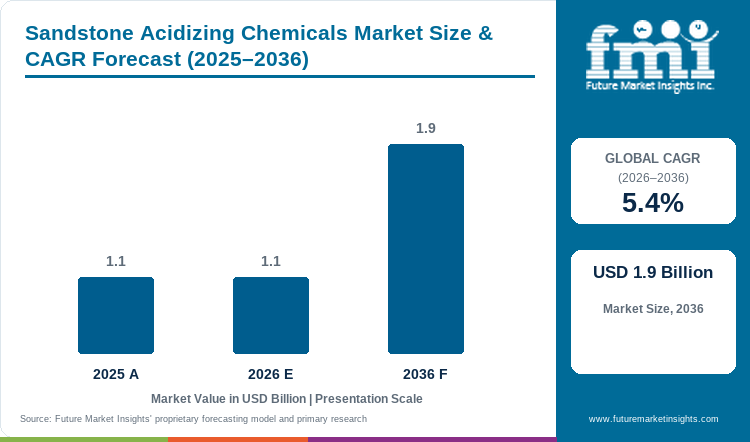
- Market Size (2026)
- USD 1.1 Bn
- Forecast (2036)
- USD 1.9 Bn
- CAGR (2026 to 2036)
- 5.4%
How big is Sandstone Acidizing Chemicals Market in 2026?
USD 1.1 billion in 2026 and USD 1.9 billion by 2036 at a 5.4% CAGR.
Demand for sandstone acidizing chemicals is projected to expand at a 5.4% CAGR between 2026 and 2036, increasing valuation from USD 1.1 billion to USD 1.9 billion. The market was valued at USD 1.1 billion in 2025. Operators generally require diagnostic evaluation and chemistry validation before committing to sandstone acidizing treatments. In April 2026, SLB reported that OneSTEP EF sandstone stimulation at Brazil's Marimba field delivered nearly threefold higher oil rates after rigorous corrosion testing. The result gives operators a direct production case for qualified stimulation on aging sandstone wells.
Country demand differs because stimulation activity and candidate-well quality vary by basin. Halliburton reported in July 2026 that North America revenue rose 7% sequentially partly from higher US Land stimulation activity, while Latin America revenue increased 3% with stronger stimulation activity in Mexico and Argentina. Sandstone acidizing orders still depend on eligible intervals and local service execution. Mexico therefore carries a faster authorized CAGR than Japan, where the domestic campaign base is smaller.
Key Takeaways
- Sandstone acidizing demand requires diagnostics linking lost productivity to removable near-wellbore damage in serviceable producing completions.
- By chemical type, mud acid systems are estimated to hold 28.0% in 2026 owing to familiar HCl/HF treatment practice.
- Quartz-rich sandstone is expected to hold 31.0% of formation type demand in 2026 driven by interpretable siliceous mineralogy.
- Formation damage removal is set to hold 31.0% of application demand in 2026 attributable to direct remediation spending.
- HF handling and fluid-rock compatibility limit adoption because poor treatment design can replace removable damage with new impairment.
- Some of the key players in this market include SLB, Halliburton, Baker Hughes, ChampionX (part of SLB), Clariant, Innospec, Nouryon, SNF, TETRA Technologies, and Aubin (Italmatch Chemicals).
Analyst Perspective
"Sandstone acidizing chemistry earns value before pumping begins because mineralogy and damage diagnosis determine whether treatment can restore flow safely. Commercial teams should judge offers by laboratory qualification and field execution support because acid price does not capture failure risk."
- Nikhil Kaitwade, Principal Consultant, Future Market Insights
How is the sandstone acidizing chemicals market segmented?
The market is analyzed by chemical type, formation type, application, well type, sales channel and region.
The taxonomy covers chemical type, formation type, application, well type, sales channel and region. Chemical types include mud acid, HF, organic and chelating systems plus clay stabilizers and corrosion inhibitor packages. Formation and application categories separate mineralogy from remediation tasks, while well type and sales channel identify the operating setting and field-delivery route.
What makes mud acid systems central to the chemical type category?
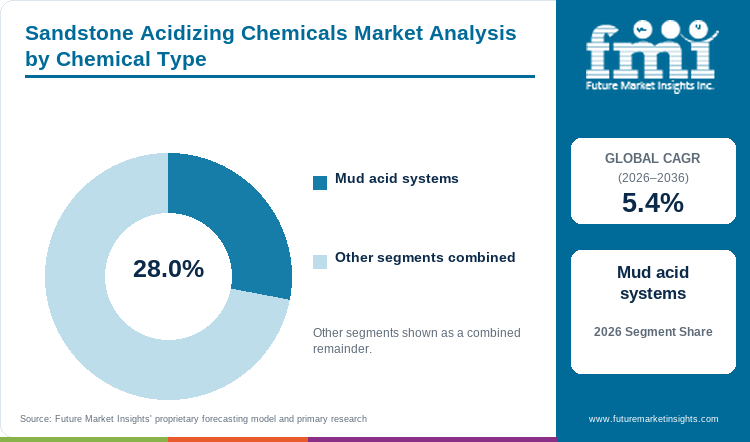
Mud acid systems remain a practical reference route for sandstone damage containing clay and aluminosilicate material that HCl alone cannot dissolve. Operators qualify acid strength against mineralogy and brine chemistry before selecting well stimulation materials and the supporting protection package for a planned treatment.
- By chemical type, mud acid systems are estimated to hold 28.0% in 2026 owing to familiar HCl/HF treatment logic for siliceous damage.
- Operators qualify mud acid strength against mineralogy and brine chemistry before field crews mix and pump the final treatment package.
Why does quartz-rich sandstone lead the formation type category?
Quartz-rich sandstone gives engineers a clearer starting point for acid design once accessory clay and feldspar are quantified before treatment. Selection among oilfield chemicals still depends on core mineralogy and brine compatibility since modest reactive-mineral content can change precipitation risk.
- In 2026, quartz-rich sandstone is expected to lead formation type with 31.0% share driven by a more interpretable siliceous framework for treatment design.
- Quartz-rich intervals still require accessory clay and feldspar screening because minor reactive minerals can change precipitation risk during acid treatment.
How does formation damage removal shape the application category?
Formation damage removal has direct intervention logic because operators can compare pre-job impairment with post-treatment production recovery. Residue from drilling and completion fluids can form part of the diagnosed restriction when laboratory work confirms that chemistry can remove the material safely.
- Formation damage removal is set to lead the application category with 31.0% share in 2026 attributable to direct spending on diagnosed near-wellbore impairment.
- Formation-damage programs require laboratory confirmation that the diagnosed restriction is chemically removable before operators approve an acid treatment.
What supports oil wells within the well type category?
Oil wells support repeat intervention decisions because liquid-production recovery can be valued directly against chemical and service cost. Existing oil and gas field services provide alternative workover routes, so acidizing must show that removable damage is the binding constraint before treatment is approved.
- Based on well type, oil wells are projected to account for 32.0% in 2026 due to measurable production recovery from serviceable completions.
- Oil-well intervention budgets favor acidizing only after production diagnostics show that removable near-wellbore damage is limiting recoverable flow.
What drives stimulation service companies within the sales channel category?
Stimulation service companies coordinate laboratory design with fluid mixing and pumping controls before the acid package reaches a producing well. They also select treatment-protection inputs such as corrosion inhibitors when metallurgy and acid strength require additional control during execution.
- The sales channel category is forecast to be led by stimulation service companies at 46.0% share in 2026 due to integrated field execution.
- Service companies convert chemical demand into field volume by combining formulation qualification with mixing and pumping under one treatment program.
What are the drivers, restraints and opportunities in the Sandstone Acidizing Chemicals Market?
Existing-well productivity supports demand, HF handling and compatibility limit treatment selection, and lower-volume stimulation systems improve economics for selected offshore interventions.
- Driver: Operators allocate remediation spending to serviceable wells after diagnostics confirm removable sandstone damage as the production constraint.
- Restraint: HF-bearing chemistry raises handling and compatibility requirements that can delay treatment approval or eliminate marginal candidate wells.
- Opportunity: Lower-volume sandstone treatments can improve offshore economics where fewer fluid stages reduce vessel handling without weakening treatment performance.
Damage Diagnosis Directs Existing-Well Remediation Spending
Existing-well remediation spending rises where operators can identify serviceable wells with recoverable impairment. Baker Hughes announced in September 2026 a multi-year OGDC contract that will evaluate more than 120 mature-field wells and build redevelopment plans. That scale shows why oilfield production chemicals and intervention services compete for budgets tied to restoring output from existing assets.
HF Handling and Compatibility Restrict Candidate Wells
HF-bearing chemistry raises qualification requirements because corrosion and fluid-rock compatibility can turn a remedial treatment into new impairment. SLB reported in April 2026 that rigorous corrosion testing preceded OneSTEP EF deployment on aging sandstone wells at Brazil's Marimba field. The treatment nearly tripled oil rates, so operators screen metallurgy and compatibility before approving packages that also use oilfield scale inhibitors during remediation.
Lower-Volume Treatments Can Improve Offshore Intervention Economics
Regional access to stimulation chemistry can convert qualified treatment designs into field volume more quickly. Clariant appointed Gapuma Group in July 2026 to distribute well-service additives for stimulation in Nigeria plus Côte d'Ivoire and Ghana. The agreement gives service companies and formulators a local route to chemistry while hydraulic fracturing services remain an alternative for wells requiring a different stimulation mechanism.
Which country CAGRs are profiled in the Sandstone Acidizing Chemicals Market?
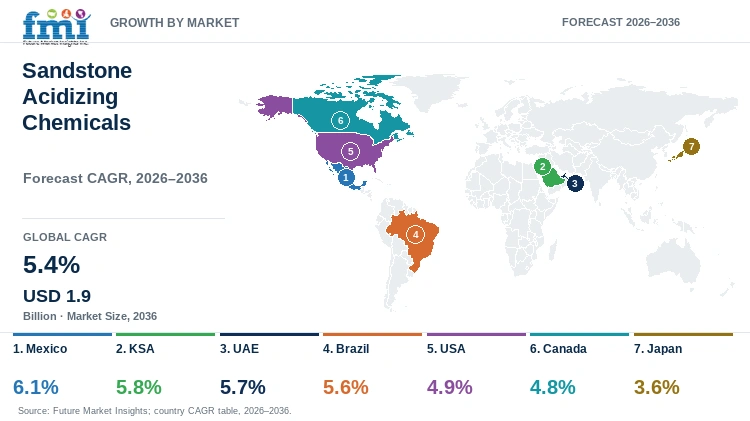
| Country | CAGR |
|---|---|
| Mexico | 6.1% |
| KSA | 5.8% |
| UAE | 5.7% |
| Brazil | 5.6% |
| USA | 4.9% |
| Canada | 4.8% |
| Japan | 3.6% |
How do country-level CAGRs compare in the Sandstone Acidizing Chemicals Market?
The forecasts span 2.5 points between Mexico at 6.1% and Japan at 3.6% CAGR. Mexico and KSA join UAE and Brazil in the upper group while USA and Canada cluster near 4.9%. Japan forms a lower-growth case because its smaller domestic upstream base supports fewer intervention campaigns overall.
- Mexico's Pemex-centered capital cycle favors local inventory and service alignment for mature-field intervention scheduling.
- KSA treatment economics depend on high-temperature fluid stability and qualified field support for sandstone intervention planning.
- UAE offshore work gives blending readiness and logistics discipline greater weight during sandstone treatment selection.
- Brazil requires field-specific sandstone screening because national offshore programs do not convert uniformly into matrix acidizing.
- USA basin diversity favors rapid laboratory screening and regional service coverage over one national treatment recipe.
- Canada's conventional workover opportunity competes with oil-sands activity outside the defined sandstone acidizing boundary.
- Japan's smaller domestic campaign base favors flexible batch supply and technical support between infrequent interventions.
Comparable CAGRs mask different chemical demand because sandstone inventory and service access vary by country. The full report provides country-level CAGR analysis across North America, Latin America, Western Europe, Eastern Europe, East Asia, South Asia and Pacific, and Middle East and Africa.
Country-wise Analysis
- Pemex-led intervention planning in Mexico concentrates chemical demand in mature producing assets where treatment budgets compete with mechanical workovers. Sandstone acidizing chemical demand in Mexico is forecast to rise at 6.1% CAGR over the 2026 to 2036 period. Local service inventories and compatible onshore drilling fluids can shorten mobilization once a sandstone interval passes mineralogy and damage screening. Suppliers still need field-specific qualification because national upstream spending does not identify which wells are technically suitable for matrix acidizing.
- USA operators compare remedial acid jobs with mechanical cleanouts and new drilling because reservoir mineralogy varies sharply between producing basins. Sandstone acidizing chemical industry in USA is projected to expand at 4.9% CAGR over the assessment period. Regional laboratories and service crews can shorten qualification time for compatible formulations in active oilfield districts. Suppliers still need well-level evidence of removable sandstone damage before intervention budgets convert into acid volume.
- Japan has a small domestic upstream base with chemical demand concentrated in a limited number of producing assets and intervention campaigns. Sandstone acidizing chemical demand is predicted to expand at 3.6% CAGR over the 2026 to 2036 period. Flexible batch supply and remote technical support can reduce the cost of serving occasional treatments without maintaining large local inventories. The narrow candidate-well pool limits dedicated field staffing between campaigns and raises the importance of accurate pre-job screening.
- Brazil combines mature-field intervention work with a large offshore portfolio that includes reservoir types outside sandstone matrix acidizing. Sandstone acidizing chemical sales are forecast to expand at 5.6% CAGR by 2036. Local offshore service capacity can support qualified treatments once mineralogy confirms a sandstone interval with removable damage. Suppliers must screen assets individually because national upstream programs do not translate uniformly into demand for sandstone acid systems.
- KSA sandstone interventions can face reservoir temperatures that make corrosion control and acid reaction rates decisive during treatment design. Sandstone acidizing chemical industry in KSA is forecast to rise at 5.8% CAGR from 2026 to 2036. Regional pressure-pumping expertise built on fracturing fluid chemistries can support field execution without proving sandstone suitability by itself. Formulators must qualify temperature stability and mineral compatibility before an operator approves chemistry for an eligible sandstone interval.
- UAE operators place a high cost on intervention failure because offshore rig and vessel time can make remedial work expensive. Sandstone acidizing chemical demand is estimated to expand at 5.7% CAGR over the 2026 to 2036 period. Local engineering and logistics capacity can improve execution readiness for qualified sandstone treatments in offshore programs. Suppliers must still confirm interval mineralogy because major UAE development activity includes reservoir types outside the defined market.
- Canada offers selective conventional-well intervention demand inside an upstream sector where much production falls outside sandstone matrix acidizing. In Canada, sandstone acidizing chemical demand is anticipated to record 4.8% CAGR between 2026 and 2036. Regional service infrastructure can support qualified workovers despite dispersed producing areas and seasonal mobilization constraints. Suppliers still need to identify a narrow eligible well base because oil-sands output does not convert directly into matrix-acidizing chemical demand.
Who are the notable companies in the Sandstone Acidizing Chemicals Market?
SLB, Halliburton, Baker Hughes, ChampionX (part of SLB), Clariant, Innospec, Nouryon, SNF, TETRA Technologies, and Aubin (Italmatch Chemicals) are notable companies serving this market.
Competition separates integrated stimulation contractors from specialty formulators and completion-chemistry businesses with different field responsibilities. ChampionX operates within SLB while SNF owns the former Syensqo Oil & Gas business and Aubin operates within Italmatch Chemicals.
- SLB, Halliburton and Baker Hughes pair stimulation engineering with documented field-delivery capacity for reservoir intervention programs.
- ChampionX within SLB plus Clariant and Innospec provide formulation depth in treatment protection and stimulation-adjacent chemistry.
- Nouryon and SNF provide specialty-chemistry support while TETRA Technologies concentrates on completion-fluid programs for offshore wells.
- Aubin participates within Italmatch Chemicals through well-service chemistry used in stimulation and other energy applications.
Competitive Benchmarking: Sandstone Acidizing Chemicals Market
| Company | Sandstone Acid System Depth | Treatment Protection Chemistry | Field Design & Delivery Support | Geographic Reach |
|---|---|---|---|---|
| SLB | High | High | High | Global |
| Halliburton | High | High | High | Global |
| Baker Hughes | High | Medium | High | Global |
| ChampionX (part of SLB) | Low | High | Medium | North America and international through SLB |
| Clariant | Medium | High | Medium | Americas, Europe, Middle East, Asia and Africa |
| Innospec | Low | High | Medium | Americas, Europe, Middle East and Asia-Pacific |
| Nouryon | Medium | High | High | North America, Europe, Middle East and Asia |
| SNF | Medium | High | Medium | Americas, Europe, Middle East and Asia |
| TETRA Technologies | Low | Medium | High | Americas, Europe, Middle East, Asia and Africa |
| Aubin (Italmatch Chemicals) | Low | Medium | Medium | Europe, Middle East and selected international markets |
Scoring basis: High acid-system depth requires multiple documented acidizing or integrated stimulation routes with direct sandstone relevance. Medium identifies one direct route while Low identifies narrower chemistry with limited sandstone depth. High treatment-protection chemistry requires three documented functions while Medium covers one or two and Low reflects one adjacent function. High field support requires laboratory or engineering capability plus multi-basin execution while Medium reflects fewer support modes and Low indicates limited delivery.
Key Developments in the Sandstone Acidizing Chemicals Market
- In April 2026, SLB reported a OneSTEP EF sandstone stimulation deployment at Brazil's Marimba field that delivered nearly threefold higher oil rates after corrosion testing.
- In February 2026, Halliburton and Pertamina signed an MOU that includes acid-stimulation evaluation and integrated treatment design for selected Indonesian onshore fields.
- In January 2026, SNF completed its acquisition of Syensqo's Oil & Gas division and added its technical teams plus oilfield-chemistry portfolio to the group.
Key Players in the Sandstone Acidizing Chemicals Market
Integrated Stimulation Contractors
- SLB
- Halliburton
- Baker Hughes
Specialty Oilfield Chemistry Businesses
- ChampionX (part of SLB)
- Clariant
- Innospec
- Nouryon
- SNF
Completion and Well-Service Chemistry Specialists
- TETRA Technologies
- Aubin (Italmatch Chemicals)
Sandstone Acidizing Chemicals Market - Report Scope
| Coverage field | Report scope |
|---|---|
| Market breakdown | By chemical type, formation type, application, well type, sales channel and region. |
| Quantitative Units | USD billion. |
| Market Definition | Chemical systems and treatment-protection additives used to remediate damage or stimulate eligible sandstone intervals in oil and gas wells. |
| Regions Covered | North America, Latin America, Europe, East Asia, South Asia and Pacific and Middle East and Africa. |
| Countries Covered | Mexico, KSA, UAE, Brazil, USA, Canada, Japan, and 20+ countries included in the full report. |
| Key Companies Profiled | SLB, Halliburton, Baker Hughes, ChampionX (part of SLB), Clariant, Innospec, Nouryon, SNF, TETRA Technologies, and Aubin (Italmatch Chemicals). |
| Forecast Period | 2026 to 2036. |
| Approach | Primary and secondary research with market triangulation. |
Sandstone Acidizing Chemicals Market - Research Methodology
| Method | Approach |
|---|---|
| Primary Research | FMI analysts gathered input from manufacturers, service providers, technology developers, distributors, end users, procurement teams, and subject-matter experts. Interviews examined purchasing decisions, product or service evaluation, adoption barriers, approval requirements, pricing considerations, and expectations for technical or commercial support. Respondents were also asked what evidence is required before a trial, pilot, or initial order develops into regular purchasing. |
| Desk Research | Desk research covered government statistics, regulatory publications, trade data, industry associations, technical literature, standards, company filings, product information, and official corporate announcements. Sources were reviewed for relevance, publication date, geographic coverage, and consistency with the defined market scope. Claims relating to performance, applications, approvals, capacity, investment, and commercial activity were retained only when supported by credible public evidence. |
| Market Sizing and Forecasting | The market model combined the baseline value with historical performance, segment structure, pricing and volume indicators, adoption levels, company participation, and country-level demand conditions. Forecast assumptions considered economic activity, investment trends, regulatory developments, technology adoption, purchasing cycles, supply availability, and barriers to wider market use. Segment and regional estimates were reconciled before the final market total was calculated. |
| Data Validation | Estimates were checked against multiple independent indicators, including public data, company activity, trade patterns, industry developments, and findings from primary interviews. Validation also tested whether products, services, applications, and company revenues fell within the defined market boundaries. Adjacent categories, unsupported claims, overlapping revenues, and activities without direct market relevance were excluded to reduce double counting and maintain consistency across segments and countries. |
Sandstone Acidizing Chemicals Market by Segments
Sandstone Acidizing Chemicals Market segmented by Chemical Type:
- Mud acid systems
- HF acid blends
- Organic acid systems
- Chelating acid systems
- Clay stabilizers
- Corrosion inhibitor packages
Sandstone Acidizing Chemicals Market segmented by Formation Type:
- Quartz-rich sandstone
- Clay-rich sandstone
- Feldspathic sandstone
- Tight sandstone
- High-temperature sandstone
Sandstone Acidizing Chemicals Market segmented by Application:
- Formation damage removal
- Permeability restoration
- Fines control
- Scale dissolution
- Near-wellbore stimulation
Sandstone Acidizing Chemicals Market segmented by Well Type:
- Oil wells
- Gas wells
- Horizontal wells
- Mature wells
- Offshore wells
Sandstone Acidizing Chemicals Market segmented by Sales Channel:
- Stimulation service companies
- Specialty acid suppliers
- Direct operator supply
- Regional distributors
Sandstone Acidizing Chemicals Market by Region:
- North America
- United States
- Canada
- Latin America
- Brazil
- Mexico
- Argentina
- Chile
- Western Europe
- Germany
- France
- United Kingdom
- Italy
- Spain
- Benelux
- Nordics
- Eastern Europe
- Poland
- Czech Republic
- Romania
- Hungary
- East Asia
- China
- Japan
- South Korea
- South Asia and Pacific
- India
- ASEAN
- Australia and New Zealand
- Middle East and Africa
- GCC Countries
- South Africa
- Türkiye
- Israel
Research Sources and Bibliography
- SLB. (2026, April 24). SLB Announces First-Quarter 2026 Results.
- Halliburton. (2026, July 21). Halliburton announces second quarter 2026 results.
- Baker Hughes. (2026, September 2). Baker Hughes Collaborates with OGDC to Optimize Existing Well Production, Supporting Energy Continuity in Pakistan.
- Clariant. (2026, July 29). Clariant appoints Gapuma Group as Well Service Additives distributor across West Africa.
- Halliburton. (2026, February 22). Pertamina and Halliburton sign an integrated unconventional fracturing MOU in Indonesia.
- SNF. (2026, January 2). SNF GROUP COMPLETES THE ACQUISITION OF THE OIL & GAS DIVISION OF SYENSQO.
- SLB. (2026, August 6). SLB and Equinor Sign Multi-Year Stimulation Agreement for Norwegian Continental Shelf.
- Halliburton. (2026, July 15). Aramco awards Halliburton long-term contract for unconventional gas program.
- Baker Hughes. (2026, May 28). Baker Hughes, Equinor Extend Significant Contracts to Support North Sea Energy Production.
- SLB. (2026, August 18). SLB to Support Offshore Production Restoration for Brunei Shell Petroleum.
- TETRA Technologies. (2026, June 29). TETRA TECHNOLOGIES INTRODUCES TETRA NEPTUNE Z-LITE DEEPWATER COMPLETIONS FLUID.
- SLB. (2026, July 24). SLB Announces Second-Quarter 2026 Results.
- Clariant. (2026, June 24). Clariant achieves North Sea breakthrough with OSPAR-compliant low-dosage hydrate inhibitor technology.
- Innospec. (2026, May 7). Innospec Reports First Quarter 2026 Financial Results.
- SNF. (2026, March 31). SNF Flopam India Secures Landmark INR 547 Crore (59 MUSD) ONGC Project for full field Polymer Injection at Bechraji Field.
- Baker Hughes. (2026, September 4). Baker Hughes Awarded Offshore Production Enhancement and Stimulation Services Contract by bp.
- SLB. (2026, August 24). SLB Launches ExaCT Electrical Downhole CT Control System.
- TETRA Technologies. (2026, August 3). TETRA TECHNOLOGIES, INC. REPORTS STRONG SECOND-QUARTER 2026 RESULTS.
This bibliography is provided for reader reference and is not exhaustive. The full report contains the complete reference list and detailed citations.
This Report Answers
- What are the 2026 and 2036 sandstone acidizing market values?
- Which well conditions support sandstone acidizing demand?
- Why do mud acid systems hold 28.0% of 2026 chemical type demand?
- Why does quartz-rich sandstone hold 31.0% of 2026 formation type demand?
- Why does formation damage removal hold 31.0% of 2026 application demand?
- How do country CAGRs compare across Mexico, KSA, UAE, Brazil, USA, Canada and Japan?
- Which companies serve integrated stimulation and specialty chemistry roles?
- Which technical constraints delay sandstone acidizing treatment approval?
Frequently Asked Questions
How big is the sandstone acidizing chemicals market in 2026?
The sandstone acidizing chemicals market is valued at USD 1.1 billion in 2026 and is projected to reach USD 1.9 billion by 2036. Existing-well productivity supports repeat treatment spending where diagnostics confirm removable sandstone damage in serviceable producing completions.
What is the CAGR of the sandstone acidizing chemicals market from 2026 to 2036?
The sandstone acidizing chemicals market is projected to grow at a CAGR of 5.4% between 2026 and 2036. Expansion depends on mature-well remediation and mineralogy-specific chemistry that passes fluid-compatibility qualification before field execution.
Which chemical type leads the sandstone acidizing chemicals market?
The mud acid systems segment is expected to hold 28.0% of the sandstone acidizing chemicals market in 2026, supported by established HCl/HF treatment practice. Its position depends on compatible mineralogy and brine chemistry in qualified sandstone wells before field execution.
Which application leads the sandstone acidizing chemicals market?
The formation damage removal segment is expected to hold 31.0% of the sandstone acidizing chemicals market in 2026, supported by direct remediation spending. Operators purchase these treatments after diagnostics confirm removable near-wellbore damage as the production constraint.
Which companies are active in the sandstone acidizing chemicals market?
Key companies operating in the sandstone acidizing chemicals market include SLB, Halliburton, Baker Hughes, ChampionX (part of SLB), Clariant, Innospec, Nouryon, SNF, TETRA Technologies, and Aubin (Italmatch Chemicals). Their roles include integrated stimulation and specialty formulation plus treatment-protection chemistry for producing sandstone wells.
Preview the report firsthand - request a free sample
Get SampleGet the brochure for pricing and purchase details.
Get PDFTable of Content
- Key Takeaways
- Market Size and CAGR
- Top Growth Driver
- Fastest Growing Segment
- Leading Region
- Key Companies
- Emerging Opportunities
- Executive Summary
- Global Market Outlook
- Demand-side Trends
- Supply-side Trends
- Technology Roadmap Analysis
- Analysis and Recommendations
- Analyst Perspective (What is happening? Why now? What should investors know?)
- Key Questions Answered
- How large is the market?
- What is the CAGR?
- What are key trends?
- Which region dominates?
- Who are the leaders?
- Market Overview
- Market Coverage / Taxonomy
- Market Definition / Scope / Limitations
- Research Methodology
- Chapter Orientation
- Analytical Lens and Working Hypotheses
- Market Structure, Signals, and Trend Drivers
- Benchmarking and Cross-market Comparability
- Market Sizing, Forecasting, and Opportunity Mapping
- Research Design and Evidence Framework
- Desk Research Programme (Secondary Evidence)
- Expert Input and Fieldwork (Primary Evidence)
- Tooling, Models, and Reference Databases
- Data Engineering and Model Build
- Quality Assurance and Audit Trail
- Market Background
- Market Dynamics (Drivers, Restraints, Opportunity, Trends)
- Scenario Forecast (Optimistic, Likely, Conservative)
- Impact Analysis
- AI Impact
- Sustainability Impact
- Regulatory Impact
- Technology Impact
- Consumer / Buyer Analysis
- Purchase Drivers
- Adoption Barriers
- Buyer Journey
- Opportunity Map Analysis
- Product Life Cycle Analysis
- Supply Chain Analysis
- Investment Feasibility Matrix
- Value Chain Analysis
- PESTLE and Porter's Analysis
- Regulatory Landscape
- Regional Parent Market Outlook
- Production and Consumption Statistics
- Import and Export Statistics
- Global Market Analysis and Forecast, 2021 to 2036
- Historical Market Size Value (USD Billion) Analysis, 2021 to 2025
- Current and Future Market Size Value (USD Billion) Projections, 2026 to 2036
- Y-o-Y Growth Trend Analysis
- Absolute $ Opportunity Analysis
- Global Market Pricing Analysis, 2021 to 2036
- Global Market Analysis and Forecast, By Chemical Type, 2021 to 2036
- Introduction / Key Findings
- Historical Market Size Value (USD Billion) Analysis By Chemical Type, 2021 to 2025
- Current and Future Market Size Value (USD Billion) Analysis and Forecast By Chemical Type, 2026 to 2036
- Mud acid systems
- HF acid blends
- Organic acid systems
- Chelating acid systems
- Clay stabilizers
- Corrosion inhibitor packages
- Y-o-Y Growth Trend Analysis By Chemical Type, 2021 to 2025
- Absolute $ Opportunity Analysis By Chemical Type, 2026 to 2036
- Global Market Analysis and Forecast, By Formation Type, 2021 to 2036
- Introduction / Key Findings
- Historical Market Size Value (USD Billion) Analysis By Formation Type, 2021 to 2025
- Current and Future Market Size Value (USD Billion) Analysis and Forecast By Formation Type, 2026 to 2036
- Quartz-rich sandstone
- Clay-rich sandstone
- Feldspathic sandstone
- Tight sandstone
- High-temperature sandstone
- Y-o-Y Growth Trend Analysis By Formation Type, 2021 to 2025
- Absolute $ Opportunity Analysis By Formation Type, 2026 to 2036
- Global Market Analysis and Forecast, By Application, 2021 to 2036
- Introduction / Key Findings
- Historical Market Size Value (USD Billion) Analysis By Application, 2021 to 2025
- Current and Future Market Size Value (USD Billion) Analysis and Forecast By Application, 2026 to 2036
- Formation damage removal
- Permeability restoration
- Fines control
- Scale dissolution
- Near-wellbore stimulation
- Y-o-Y Growth Trend Analysis By Application, 2021 to 2025
- Absolute $ Opportunity Analysis By Application, 2026 to 2036
- Global Market Analysis and Forecast, By Well Type, 2021 to 2036
- Introduction / Key Findings
- Historical Market Size Value (USD Billion) Analysis By Well Type, 2021 to 2025
- Current and Future Market Size Value (USD Billion) Analysis and Forecast By Well Type, 2026 to 2036
- Oil wells
- Gas wells
- Horizontal wells
- Mature wells
- Offshore wells
- Y-o-Y Growth Trend Analysis By Well Type, 2021 to 2025
- Absolute $ Opportunity Analysis By Well Type, 2026 to 2036
- Global Market Analysis and Forecast, By Sales Channel, 2021 to 2036
- Introduction / Key Findings
- Historical Market Size Value (USD Billion) Analysis By Sales Channel, 2021 to 2025
- Current and Future Market Size Value (USD Billion) Analysis and Forecast By Sales Channel, 2026 to 2036
- Stimulation service companies
- Specialty acid suppliers
- Direct operator supply
- Regional distributors
- Y-o-Y Growth Trend Analysis By Sales Channel, 2021 to 2025
- Absolute $ Opportunity Analysis By Sales Channel, 2026 to 2036
- Global Market Analysis and Forecast, By Region, 2021 to 2036
- Introduction
- Historical Market Size Value (USD Billion) Analysis By Region, 2021 to 2025
- Current Market Size Value (USD Billion) Analysis and Forecast By Region, 2026 to 2036
- North America
- Latin America
- Western Europe
- Eastern Europe
- East Asia
- South Asia and Pacific
- Middle East and Africa
- Market Attractiveness Analysis By Region
- North America Market Analysis and Forecast, By Country, 2021 to 2036
- Historical Market Size Value (USD Billion) Trend Analysis By Market Taxonomy, 2021 to 2025
- Market Size Value (USD Billion) Forecast By Market Taxonomy, 2026 to 2036
- By Country
- United States
- Canada
- By Chemical Type
- By Formation Type
- By Application
- By Well Type
- By Sales Channel
- By Country
- Market Attractiveness Analysis
- By Country
- By Chemical Type
- By Formation Type
- By Application
- By Well Type
- By Sales Channel
- Key Takeaways
- Latin America Market Analysis and Forecast, By Country
- Historical Market Size Value (USD Billion) Trend Analysis By Market Taxonomy, 2021 to 2025
- Market Size Value (USD Billion) Forecast By Market Taxonomy, 2026 to 2036
- By Country
- Brazil
- Mexico
- Argentina
- Chile
- By Chemical Type
- By Formation Type
- By Application
- By Well Type
- By Sales Channel
- By Country
- Market Attractiveness Analysis
- By Country
- By Chemical Type
- By Formation Type
- By Application
- By Well Type
- By Sales Channel
- Key Takeaways
- Western Europe Market Analysis and Forecast, By Country
- Historical Market Size Value (USD Billion) Trend Analysis By Market Taxonomy, 2021 to 2025
- Market Size Value (USD Billion) Forecast By Market Taxonomy, 2026 to 2036
- By Country
- Germany
- France
- United Kingdom
- Italy
- Spain
- Benelux
- Nordics
- By Chemical Type
- By Formation Type
- By Application
- By Well Type
- By Sales Channel
- By Country
- Market Attractiveness Analysis
- By Country
- By Chemical Type
- By Formation Type
- By Application
- By Well Type
- By Sales Channel
- Key Takeaways
- Eastern Europe Market Analysis and Forecast, By Country
- Historical Market Size Value (USD Billion) Trend Analysis By Market Taxonomy, 2021 to 2025
- Market Size Value (USD Billion) Forecast By Market Taxonomy, 2026 to 2036
- By Country
- Poland
- Czech Republic
- Romania
- Hungary
- By Chemical Type
- By Formation Type
- By Application
- By Well Type
- By Sales Channel
- By Country
- Market Attractiveness Analysis
- By Country
- By Chemical Type
- By Formation Type
- By Application
- By Well Type
- By Sales Channel
- Key Takeaways
- East Asia Market Analysis and Forecast, By Country
- Historical Market Size Value (USD Billion) Trend Analysis By Market Taxonomy, 2021 to 2025
- Market Size Value (USD Billion) Forecast By Market Taxonomy, 2026 to 2036
- By Country
- China
- Japan
- South Korea
- By Chemical Type
- By Formation Type
- By Application
- By Well Type
- By Sales Channel
- By Country
- Market Attractiveness Analysis
- By Country
- By Chemical Type
- By Formation Type
- By Application
- By Well Type
- By Sales Channel
- Key Takeaways
- South Asia and Pacific Market Analysis and Forecast, By Country
- Historical Market Size Value (USD Billion) Trend Analysis By Market Taxonomy, 2021 to 2025
- Market Size Value (USD Billion) Forecast By Market Taxonomy, 2026 to 2036
- By Country
- India
- ASEAN
- Australia and New Zealand
- By Chemical Type
- By Formation Type
- By Application
- By Well Type
- By Sales Channel
- By Country
- Market Attractiveness Analysis
- By Country
- By Chemical Type
- By Formation Type
- By Application
- By Well Type
- By Sales Channel
- Key Takeaways
- Middle East and Africa Market Analysis and Forecast, By Country
- Historical Market Size Value (USD Billion) Trend Analysis By Market Taxonomy, 2021 to 2025
- Market Size Value (USD Billion) Forecast By Market Taxonomy, 2026 to 2036
- By Country
- GCC Countries
- South Africa
- Türkiye
- Israel
- By Chemical Type
- By Formation Type
- By Application
- By Well Type
- By Sales Channel
- By Country
- Market Attractiveness Analysis
- By Country
- By Chemical Type
- By Formation Type
- By Application
- By Well Type
- By Sales Channel
- Key Takeaways
- Key Countries Market Analysis
- United States
- Pricing Analysis
- Market Share Analysis, 2025
- By Chemical Type
- By Formation Type
- By Application
- By Well Type
- By Sales Channel
- Canada
- Pricing Analysis
- Market Share Analysis, 2025
- By Chemical Type
- By Formation Type
- By Application
- By Well Type
- By Sales Channel
- Mexico
- Pricing Analysis
- Market Share Analysis, 2025
- By Chemical Type
- By Formation Type
- By Application
- By Well Type
- By Sales Channel
- Brazil
- Pricing Analysis
- Market Share Analysis, 2025
- By Chemical Type
- By Formation Type
- By Application
- By Well Type
- By Sales Channel
- Chile
- Pricing Analysis
- Market Share Analysis, 2025
- By Chemical Type
- By Formation Type
- By Application
- By Well Type
- By Sales Channel
- Germany
- Pricing Analysis
- Market Share Analysis, 2025
- By Chemical Type
- By Formation Type
- By Application
- By Well Type
- By Sales Channel
- United Kingdom
- Pricing Analysis
- Market Share Analysis, 2025
- By Chemical Type
- By Formation Type
- By Application
- By Well Type
- By Sales Channel
- Italy
- Pricing Analysis
- Market Share Analysis, 2025
- By Chemical Type
- By Formation Type
- By Application
- By Well Type
- By Sales Channel
- Spain
- Pricing Analysis
- Market Share Analysis, 2025
- By Chemical Type
- By Formation Type
- By Application
- By Well Type
- By Sales Channel
- France
- Pricing Analysis
- Market Share Analysis, 2025
- By Chemical Type
- By Formation Type
- By Application
- By Well Type
- By Sales Channel
- India
- Pricing Analysis
- Market Share Analysis, 2025
- By Chemical Type
- By Formation Type
- By Application
- By Well Type
- By Sales Channel
- ASEAN
- Pricing Analysis
- Market Share Analysis, 2025
- By Chemical Type
- By Formation Type
- By Application
- By Well Type
- By Sales Channel
- Australia and New Zealand
- Pricing Analysis
- Market Share Analysis, 2025
- By Chemical Type
- By Formation Type
- By Application
- By Well Type
- By Sales Channel
- China
- Pricing Analysis
- Market Share Analysis, 2025
- By Chemical Type
- By Formation Type
- By Application
- By Well Type
- By Sales Channel
- Japan
- Pricing Analysis
- Market Share Analysis, 2025
- By Chemical Type
- By Formation Type
- By Application
- By Well Type
- By Sales Channel
- South Korea
- Pricing Analysis
- Market Share Analysis, 2025
- By Chemical Type
- By Formation Type
- By Application
- By Well Type
- By Sales Channel
- Poland
- Pricing Analysis
- Market Share Analysis, 2025
- By Chemical Type
- By Formation Type
- By Application
- By Well Type
- By Sales Channel
- Hungary
- Pricing Analysis
- Market Share Analysis, 2025
- By Chemical Type
- By Formation Type
- By Application
- By Well Type
- By Sales Channel
- Türkiye
- Pricing Analysis
- Market Share Analysis, 2025
- By Chemical Type
- By Formation Type
- By Application
- By Well Type
- By Sales Channel
- South Africa
- Pricing Analysis
- Market Share Analysis, 2025
- By Chemical Type
- By Formation Type
- By Application
- By Well Type
- By Sales Channel
- KSA
- Pricing Analysis
- Market Share Analysis, 2025
- By Chemical Type
- By Formation Type
- By Application
- By Well Type
- By Sales Channel
- UAE
- Pricing Analysis
- Market Share Analysis, 2025
- By Chemical Type
- By Formation Type
- By Application
- By Well Type
- By Sales Channel
- United States
- Market Structure Analysis
- Competition Dashboard
- Competition Benchmarking
- Market Share Analysis of Top Players
- By Regional
- By Chemical Type
- By Formation Type
- By Application
- By Well Type
- By Sales Channel
- Emerging Startups
- Innovation Benchmarking
- Competition Analysis
- Competition Deep Dive
- SLB
- Overview
- Product Portfolio
- Profitability by Market Segments
- Sales Footprint
- Strategy Overview
- Marketing Strategy
- Product Strategy
- Channel Strategy
- Halliburton
- Baker Hughes
- ChampionX (part of SLB)
- Clariant
- Innospec
- Nouryon
- SNF
- TETRA Technologies
- Aubin (Italmatch Chemicals)
- SLB
- Case Studies
- Success Stories
- Recent Developments
- Competition Deep Dive
- Assumptions & Acronyms Used


