

- Market Size (2026)
- USD 640.6 Mn
- Forecast (2036)
- USD 1053.5 Mn
- CAGR (2026 to 2036)
- 5.1%
How big is Screen Springs Market in 2026?
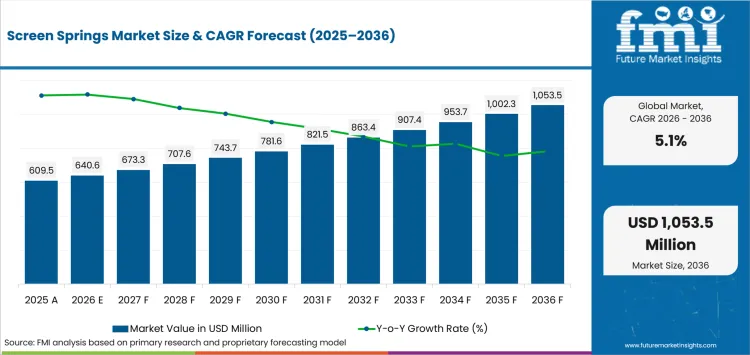
USD 640.6 million in 2026 and USD 1053.5 million by 2036 at a 5.1% CAGR.
Demand for screen springs is projected to expand at 5.1% CAGR between 2026 and 2036. The 2025 baseline was USD 609.5 million before valuation reached USD 640.6 million in 2026 and moves toward USD 1053.5 million by 2036. The USA Geological Survey reported in February 2026 that USA mineral production value increased 5.6% during 2025 to USD 112 billion. The production base sustains screening equipment that needs correctly rated springs during overhauls and failure replacement.
Australian mining projects create a different order pattern because remote plants place more weight on local spares and installation accuracy. The Australian Bureau of Statistics reported in May 2025 that mining capital expenditure rose 1.9% during the March quarter. Australian mining investment supports surface mining equipment additions while mature USA sites rely more heavily on replacement cycles and vibration control systems that preserve existing machine interfaces.
Key Takeaways of Screen Springs Market
- Plant uptime supports screen spring demand because fatigue or lost deflection can interrupt crushing and sizing operations during scheduled production.
- Coil springs are projected to account for 46.0% of spring type demand in 2026 due to familiar geometry and repeatable replacement fit.
- In 2026 vibrating screens are estimated to hold 56.0% of screen type demand because suspension performance directly affects deck motion.
- By material carbon steel is forecast to represent 34.0% in 2026 owing to established forming routes and practical replacement economics.
- Application qualification restrains substitution because a physically compatible spring can still alter natural frequency or load distribution on an operating screen.
- Lesjöfors, MW Components, Coil Spring Specialties, Mubea, Lee Spring, Vibramech, Firestone Airide and Trelleborg represent the key players in the sector.
Analyst Perspective
"Screen spring purchases should start with operating mass and required travel instead of catalogue dimensions alone. Commercial advantage comes from proving spring rate and interface fit before a planned shutdown begins."
- Nikhil Kaitwade, Principal Consultant, Future Market Insights
How is the Screen Springs Market segmented?
The screen springs market is segmented by spring type, screen type, material, end use, demand type and region.
Screen type includes vibrating screens, grizzly screens, dewatering screens and trommel screens. Material covers carbon steel, alloy steel, stainless steel and rubber / elastomer. End use includes aggregates, cement, mining, recycling and food / chemicals. Demand type distinguishes OEM fitment from replacement / spares.
What makes coil springs central to the spring type category?
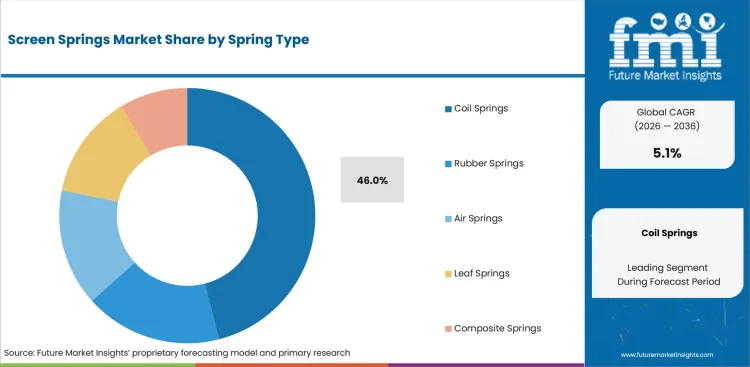
Coil springs suit multi-point screen suspensions because engineers can tune load and travel without redesigning the complete support arrangement. Their familiar geometry also simplifies industrial spring design during matched-set replacement on established machines with known seat dimensions and operating travel.
- By spring type coil springs are projected to account for 46.0% in 2026 due to proven fit across conventional vibrating screen layouts.
- Lesjöfors completed its International Industrial Springs acquisition in April 2025 and added a third dedicated hot-coiling location, extending the group's manufacturing presence into the Indian market. The acquired IIS operations, specialising in disc springs and washers, broaden the product portfolio available to industrial customers without altering the modelled segment share.
Why do vibrating screens lead the screen type category?
Vibrating screens rely on suspension stiffness to convert excitation into controlled deck motion while limiting transmitted force. A spring mismatch changes the dynamic response and makes vibration screening machines more sensitive to replacement quality during routine plant maintenance.
- In 2026 vibrating screens are expected to lead screen type with 56.0% share since suspension performance is integral to machine motion.
- Metso launched ELL Series vibrating screens in June 2026 with up to 20% higher throughput in the same footprint. Higher deck duty raises the value of controlled suspension behavior and planned replacement access during maintenance.
How does carbon steel influence material selection?
Carbon steel remains practical for established screening duties that need predictable strength and conventional spring forming at manageable component cost. Stainless or alloy grades gain preference when corrosion or higher stress changes the operating requirement.
- The material category is forecast to be led by carbon steel at 34.0% share in 2026 due to familiar manufacturing and repair economics.
- The American Iron and Steel Institute revised full-year 2025 USA steel shipments to 91.2 million net tons in March 2026. The shipment scale supports broad carbon-steel availability while screen duty still determines the required grade and treatment.
What supports aggregates as the leading end-use category?
Aggregate plants operate screening between crushing stages and repeated sizing loads make spring condition part of daily equipment availability. The same maintenance chain connects stone crushing equipment with aggregate processing equipment during shutdown planning and spare-part preparation.
- Aggregates are set to lead the end-use category with 32.0% share in 2026 because continuous sizing creates recurring spring service occasions.
- Metso inaugurated a new South African screen center in January 2025 to increase regional supply and delivery capability for screening solutions. Local screen support shortens the service route that also governs access to matched suspension components.
What are the drivers, restraints and opportunities in the Screen Springs Market?
Continuous screening duty supports replacement demand while dynamic qualification slows substitution and harsh-material applications widen the need for engineered isolation.
- Driver: High-capacity mineral and aggregate screening creates recurring fitment and replacement demand for suspension components that preserve machine availability.
- Restraint: Spring stiffness and geometry require application checks because an incorrect replacement can change machine response despite fitting the mounting seat.
- Opportunity: Harsh and difficult feed conditions create room for isolation designs that combine appropriate stiffness with better damping or environmental resistance.
High-Capacity Screening Sustains Recurring Replacement Demand
Continuous duty exposes screen springs to repeated load cycles and converts fatigue control into a maintenance requirement. Metso launched its Grande Series in December 2025 for high-capacity 24/7 mining and aggregate applications with easier screen replacement among the stated benefits. Plants operating underground mining equipment therefore value scheduled spares that preserve suspension geometry before a spring failure interrupts throughput.
Qualification Time Limits Generic Spring Substitution
Spring purchases face a validation burden because free height and stiffness must match the machine mass and excitation regime. Destatis reported in March 2025 that German machinery prices were 1.9% above February 2024 levels. Higher capital-equipment costs increase the penalty for trial-and-error substitution and favor documented interchange data before maintenance teams approve a replacement.
Difficult Feed Conditions Expand Isolation Requirements
Fine or moist material can demand different motion and damping behavior from a screen suspension. Metso launched GFF flip-flow screens in April 2026 for difficult fine dry screening with anti-blinding behavior that reduces unplanned stoppages. Suppliers of industrial rubber components can address this route when elastomer isolation improves environmental resistance without forcing a complete support redesign.
Which country CAGRs are profiled in the Screen Springs Market?
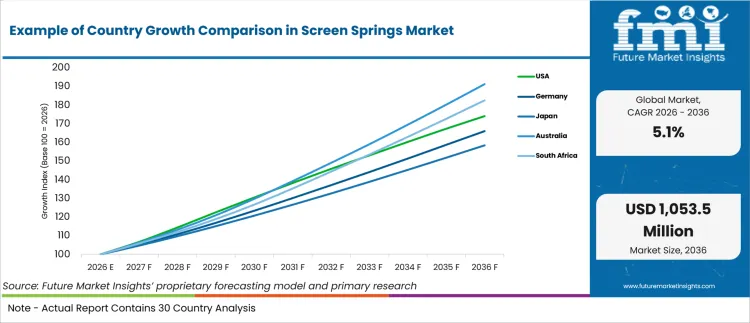
| Country | CAGR |
|---|---|
| Australia | 4.9% |
| South Africa | 4.8% |
| USA | 4.3% |
| Germany | 3.9% |
| Japan | 3.6% |
How do country-level CAGRs compare in the Screen Springs Market?
The 1.3-point range forms a compact growth band instead of a divided country pattern across the five profiled markets. Australia and South Africa cluster near the upper end as mineral activity sustains screen utilization. The USA, Germany and Japan depend more on replacement within mature equipment bases and tighter engineering change controls.
- Remote Australian mines reward regional spring stocking because repeat shipments can extend already costly equipment outages during active production.
- South African beneficiation projects reward nearby technical support because local processing sites need serviceable screening assets and accessible replacement parts.
- USA aggregate plants prioritize matched spring sets and short lead times during scheduled maintenance across a mature screening base.
- German processors emphasize lifecycle documentation because established plants often extend existing screens instead of purchasing complete machine replacements.
- Japanese maintenance teams require repeatable fatigue records because component changes on mature machinery receive disciplined engineering review before approval.
Similar forecast rates therefore mask distinct service routes and qualification burdens that determine how demand converts into orders. The full report provides country-level CAGR analysis across North America, Latin America, Europe, East Asia, South Asia, Oceania and the Middle East and Africa.
Country-wise Analysis
- Australian mining operations often run far from major component warehouses and the Australian Bureau of Statistics reported in December 2025 that mineral exploration expenditure rose 2.4% to AUD 998.3 million during the September quarter. Screen spring demand in Australia is forecast to expand at 4.9% CAGR over the forecast period as active mineral projects sustain screening workloads and regional stocking improves access to matched replacement parts. Remote freight remains a material friction because an incorrect spring can extend downtime across another delivery cycle and therefore favors suppliers with verified interchange records plus dependable stock near established mining corridors.
- South African mineral processors increasingly link screening reliability with local beneficiation and the Department of Mineral and Petroleum Resources reported in May 2025 that Cabinet approved a national strategy centered on exploration plus downstream mineral processing. South Africa is estimated to post 4.8% CAGR over the forecast period as existing plants and new projects require serviceable screening assets supported by local engineering and the established Germiston screening supply base. Tight operating budgets remain a material friction and therefore favor spring suppliers that can document load fit plus maintain local spares without forcing a complete screen redesign during scheduled maintenance.
- American aggregate plants operate a large mature screening base and the United States Geological Survey reported in February 2026 that crushed stone remained the leading nonfuel mineral commodity by production value during 2025 at about USD 26.8 billion. Screen spring demand in the USA is forecast to rise at 4.3% CAGR over the forecast period as continuous sizing activity sustains replacement occasions and broad domestic distribution supports shorter replenishment lead times. Substitution risk remains the main friction on proven equipment and maintenance teams therefore require dimensional interchange plus matched spring rates before approving a different source for planned outages.
- German processors often retain proven screening assets and Destatis reported in February 2025 that producer prices for stone and gravel related materials were 3.4% above the previous year across the domestic industrial supply base. The German screen springs sector is projected to record 3.9% CAGR during the assessment period as mature plants continue scheduled component replacement and strong local engineering depth supports precise retrofit engineering work. Cost pressure remains a friction because operators can defer noncritical changes and spring suppliers therefore need traceable materials plus predictable delivery to reduce the perceived risk of changing an established component source.
- Japanese cement and industrial processors apply disciplined engineering change control and METI reported in September 2025 that production machinery capacity rose 1.3% month on month in July while its operating ratio increased 4.9%. Adoption of screen springs in Japan is estimated to expand at 3.6% CAGR through 2036 as equipment activity sustains selective replacement demand and domestic manufacturing discipline supports detailed local component qualification. A high threshold for changing proven components remains the main friction and outside suppliers need fatigue documentation plus consistent material control before maintenance teams accept a new spring specification on mature screening assets.
Who are the notable companies in the Screen Springs Market?
Lesjöfors, MW Components, Coil Spring Specialties, Mubea, Lee Spring, Vibramech, Firestone Airide and Trelleborg are the notable companies serving this market.
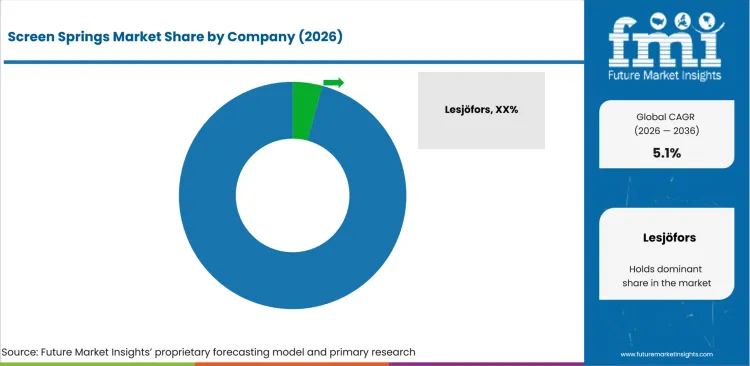
Competition divides between heavy metal spring manufacturers and screen-focused isolation specialists because buyers compare different failure risks. Metal spring groups compete on load range and repeatable geometry that protects known machine response across established installations. Isolation specialists compete on damping and machine behavior where elastomer properties change vibration transfer during equipment operation. The strongest position combines engineering records with smart mining systems service expectations and a delivery route that protects planned shutdown schedules.
- Lesjöfors, MW Components, Coil Spring Specialties, Mubea and Lee Spring compete mainly through metal spring manufacturing plus build-to-spec engineering.
- Vibramech competes from the screen equipment side and combines coil or elastomer isolation choices with machine-specific application knowledge.
- Firestone Airide and Trelleborg address vibration isolation with elastomer technologies that become relevant when damping or environmental resistance changes the specification.
Competitive Benchmarking: Screen Springs Market
| Company | Heavy-Duty Metal Spring Capability | Elastomer Isolation Capability | Screen-Application Evidence | Geographic Reach |
|---|---|---|---|---|
| Lesjöfors | High | Low | Low | Europe, North America and Asia |
| MW Components | High | Medium | Low | United States and international sales |
| Coil Spring Specialties | High | Low | Low | United States and Canada |
| Mubea | Medium | Low | Low | Europe, Asia and the Americas |
| Lee Spring | Medium | Low | Low | United States, Europe, Mexico, China and India |
| Vibramech | Medium | High | High | Africa, Australia, China, India and North America |
| Firestone Airide | Low | High | High | Global off-highway distribution |
| Trelleborg | Low | High | High | Global anti-vibration network |
Key Developments in the Screen Springs Market
- In February 2026, Lee Spring acquired Thomas Spring, a Connecticut-based manufacturer specialising in flat springs, adding specialised flat-spring manufacturing capacity and technical expertise to its wider spring solutions portfolio.
- In January 2026, Mubea consolidated three Czech operations including Mubea IT Spring Wire under one corporate structure for coordinated regional manufacturing activity.
- In December 2025, Lee Spring India achieved AS9100D certification and expanded documented quality controls across its stock and custom spring manufacturing operations.
Key Players in the Screen Springs Market
Industrial Metal Spring Platforms
- Lesjöfors
- MW Components
- Mubea
- Lee Spring
Custom Coil Spring Specialists
- Coil Spring Specialties
Screen and Vibration-Isolation Specialists
- Vibramech
- Firestone Airide
- Trelleborg
Screen Springs Market - Report Scope
| Coverage field | Report scope |
|---|---|
| Market breakdown | By spring type, screen type, material, end use, demand type and region. |
| Quantitative Units | Revenue in USD million and CAGR in %. |
| Market Definition | Commercial screen springs and vibration-isolation elements sold for OEM fitment or replacement across vibrating, grizzly, dewatering and trommel screening installations. Complete screens, screen media and drives are excluded. |
| Regions Covered | North America, Latin America, Europe, East Asia, South Asia and Pacific, and Middle East and Africa. |
| Countries Covered | Australia, South Africa, USA, Germany, Japan, and 20+ countries included in the full report. |
| Key Companies Profiled | Lesjöfors, MW Components, Coil Spring Specialties, Mubea, Lee Spring, Vibramech, Firestone Airide and Trelleborg. |
| Forecast Period | 2026 to 2036. |
| Approach | Primary and secondary research with market triangulation. |
Screen Springs Market - Research Methodology
| Method | Approach |
|---|---|
| Primary Research | FMI analysts gathered input from manufacturers, service providers, technology developers, distributors, end users, procurement teams, and subject-matter experts. Interviews examined purchasing decisions, product or service evaluation, adoption barriers, approval requirements, pricing considerations, and expectations for technical or commercial support. Respondents were also asked what evidence is required before a trial, pilot, or initial order develops into regular purchasing. |
| Desk Research | Desk research covered government statistics, regulatory publications, trade data, industry associations, technical literature, standards, company filings, product information, and official corporate announcements. Sources were reviewed for relevance, publication date, geographic coverage, and consistency with the defined market scope. Claims relating to performance, applications, approvals, capacity, investment, and commercial activity were retained only when supported by credible public evidence. |
| Market Sizing and Forecasting | The market model combined the baseline value with historical performance, segment structure, pricing and volume indicators, adoption levels, company participation, and country-level demand conditions. Forecast assumptions considered economic activity, investment trends, regulatory developments, technology adoption, purchasing cycles, supply availability, and barriers to wider market use. Segment and regional estimates were reconciled before the final market total was calculated. |
| Data Validation | Estimates were checked against multiple independent indicators, including public data, company activity, trade patterns, industry developments, and findings from primary interviews. Validation also tested whether products, services, applications, and company revenues fell within the defined market boundaries. Adjacent categories, unsupported claims, overlapping revenues, and activities without direct market relevance were excluded to reduce double counting and maintain consistency across segments and countries. |
Screen Springs Market by Segments
Screen Springs Market segmented by Spring Type:
- Coil Springs
- Rubber Springs
- Air Springs
- Leaf Springs
- Composite Springs
Screen Springs Market segmented by Screen Type:
- Vibrating Screens
- Grizzly Screens
- Dewatering Screens
- Trommel Screens
Screen Springs Market segmented by Material:
- Carbon Steel
- Alloy Steel
- Stainless Steel
- Rubber / Elastomer
Screen Springs Market segmented by End Use:
- Aggregates
- Cement
- Mining
- Recycling
- Food / Chemicals
Screen Springs Market segmented by Demand Type:
- OEM Fitment
- Replacement / Spares
Screen Springs Market by Region:
- North America
- United States
- Canada
- Latin America
- Brazil
- Mexico
- Chile
- Rest of Latin America
- Western Europe
- Germany
- United Kingdom
- Italy
- Spain
- France
- Nordics
- Benelux
- Rest of Western Europe
- Eastern Europe
- Russia
- Poland
- Hungary
- Balkan and Baltic States
- Rest of Eastern Europe
- East Asia
- China
- Japan
- South Korea
- South Asia and Pacific
- India
- ASEAN
- Australia and New Zealand
- Rest of South Asia and Pacific
- Middle East and Africa
- Kingdom of Saudi Arabia
- Other GCC Countries
- Türkiye
- South Africa
- Other African Union Countries
- Rest of Middle East and Africa
Research Sources and Bibliography
- USA Geological Survey. (2026, February 6). Value of USA mineral production rose last year, driven by precious metals prices.
- Australian Bureau of Statistics. (2025, May 29). Private New Capital Expenditure and Expected Expenditure, Australia, March 2025.
- Lesjöfors. (2025, April 3). Acquisition of India based International Industrial Springs completed.
- Metso. (2026, June 23). Metso launches ELL Series screens to boost quarry throughput by up to 20% without expanding footprint.
- American Iron and Steel Institute. (2026, March 17). AISI Releases Revised 2025 Steel Shipment Data.
- Metso. (2025, January 21). Metso celebrates new screen center inauguration in South Africa.
- Metso. (2025, December 5). Metso expands screening portfolio with Grande Series screens to maximize productivity and flexibility for customers.
- Federal Statistical Office of Germany. (2025, March 20). Producer prices in February 2025: +0.7% on February 2024.
- Metso. (2026, April 10). Metso launches new flip-flow screens for fine dry screening.
- Australian Bureau of Statistics. (2025, December 1). Mineral and Petroleum Exploration, Australia, September 2025.
- Department of Mineral and Petroleum Resources, South Africa. (2025, May 20). Minister Gwede Mantashe: Approval of Critical Minerals and Metals Strategy for South Africa and Draft Mineral Resources Development Bill.
- USA Geological Survey. (2026, February 6). Mineral Commodity Summaries 2026.
- Federal Statistical Office of Germany. (2025, February 20). Producer prices in January 2025: +0.5% on January 2024.
- Ministry of Economy, Trade and Industry, Japan. (2025, September 12).
- Lee Spring. (2026, February 12). Lee Spring Continues Strategic Expansion with Thomas Spring Acquisition.
- Mubea. (2026, January 1). Mubea News Portal: Merger of MUBEA-HZP, Mubea IT Spring Wire and Mubea Stabilizer Bar Systems.
- Lee Spring. (2025, December 8). Lee Spring India Achieves AS9100D Certification, Reinforcing Commitment to Quality Excellence Across Industries.
This bibliography is provided for reader reference and is not exhaustive. The full report contains the complete reference list and detailed citations
This Report Answers
- What is the screen springs market size in 2026 and what value is projected for 2036?
- Which equipment and maintenance conditions create recurring demand for screen springs across mineral and aggregate processing plants?
- Why do coil springs account for 46.0% of spring type demand during the 2026 base year?
- How does vibrating screen operation translate suspension stiffness into a direct equipment performance and maintenance requirement?
- Why does carbon steel remain commercially relevant across established screen spring applications and replacement programs?
- How do screen spring growth conditions differ across Australia, South Africa, USA, Germany and Japan?
- Which companies compete through heavy metal spring capability and which focus on screen-specific vibration isolation?
- What qualification checks should screen OEMs and maintenance teams complete before approving a replacement spring specification?
Frequently Asked Questions
How big is the Screen Springs Market in 2026?
The screen springs market is expected to be valued at USD 640.6 million in 2026 and reach USD 1053.5 million by 2036. Recurring replacement demand follows the installed base of screens that require matched suspension components during maintenance.
What is the CAGR of the Screen Springs Market from 2026 to 2036?
The screen springs market is projected to grow at a CAGR of 5.1% between 2026 and 2036. Expansion is supported by new screen fitment plus recurring spring replacement across mineral and aggregate processing equipment.
Which spring type segment is projected to account for 46.0% of the Screen Springs Market?
The coil springs segment is projected to account for 46.0% of spring type demand in the screen springs market during 2026. Familiar geometry supports matched-set replacement across established vibrating screen designs with known load and travel requirements.
Which demand type shapes recurring screen spring revenue through 2036?
Replacement / spares represent the recurring demand route within the screen springs market after OEM specifications establish the original spring interface. Maintenance teams purchase these components to restore load support without replacing the complete screening machine.
Which companies are active in the Screen Springs Market?
The screen springs market includes Lesjöfors, MW Components, Coil Spring Specialties, Mubea, Lee Spring, Vibramech, Firestone Airide and Trelleborg. Their roles span metal spring manufacture plus screen-specific or elastomer vibration isolation for industrial equipment.
Preview the report firsthand - request a free sample
Get SampleGet the brochure for pricing and purchase details.
Get PDFTable of Content
- Key Takeaways
- Market Size and CAGR
- Top Growth Driver
- Fastest Growing Segment
- Leading Region
- Key Companies
- Emerging Opportunities
- Executive Summary
- Global Market Outlook
- Demand-side Trends
- Supply-side Trends
- Technology Roadmap Analysis
- Analysis and Recommendations
- Analyst Perspective (What is happening? Why now? What should investors know?)
- Key Questions Answered
- How large is the market?
- What is the CAGR?
- What are key trends?
- Which region dominates?
- Who are the leaders?
- Market Overview
- Market Coverage / Taxonomy
- Market Definition / Scope / Limitations
- Research Methodology
- Chapter Orientation
- Analytical Lens and Working Hypotheses
- Market Structure, Signals, and Trend Drivers
- Benchmarking and Cross-market Comparability
- Market Sizing, Forecasting, and Opportunity Mapping
- Research Design and Evidence Framework
- Desk Research Programme (Secondary Evidence)
- Expert Input and Fieldwork (Primary Evidence)
- Tooling, Models, and Reference Databases
- Data Engineering and Model Build
- Quality Assurance and Audit Trail
- Market Background
- Market Dynamics (Drivers, Restraints, Opportunity, Trends)
- Scenario Forecast (Optimistic, Likely, Conservative)
- Impact Analysis
- AI Impact
- Sustainability Impact
- Regulatory Impact
- Technology Impact
- Consumer / Buyer Analysis
- Purchase Drivers
- Adoption Barriers
- Buyer Journey
- Opportunity Map Analysis
- Product Life Cycle Analysis
- Supply Chain Analysis
- Investment Feasibility Matrix
- Value Chain Analysis
- PESTLE and Porter's Analysis
- Regulatory Landscape
- Regional Parent Market Outlook
- Production and Consumption Statistics
- Import and Export Statistics
- Global Market Analysis and Forecast, 2021 to 2036
- Historical Market Size Value (USD Million) Analysis, 2021 to 2025
- Current and Future Market Size Value (USD Million) Projections, 2026 to 2036
- Y-o-Y Growth Trend Analysis
- Absolute $ Opportunity Analysis
- Global Market Pricing Analysis, 2021 to 2036
- Global Market Analysis and Forecast, By Spring Type, 2021 to 2036
- Introduction / Key Findings
- Historical Market Size Value (USD Million) Analysis By Spring Type, 2021 to 2025
- Current and Future Market Size Value (USD Million) Analysis and Forecast By Spring Type, 2026 to 2036
- Coil Springs
- Rubber Springs
- Air Springs
- Leaf Springs
- Composite Springs
- Coil Springs
- Y-o-Y Growth Trend Analysis By Spring Type, 2021 to 2025
- Absolute $ Opportunity Analysis By Spring Type, 2026 to 2036
- Global Market Analysis and Forecast, By Screen Type, 2021 to 2036
- Introduction / Key Findings
- Historical Market Size Value (USD Million) Analysis By Screen Type, 2021 to 2025
- Current and Future Market Size Value (USD Million) Analysis and Forecast By Screen Type, 2026 to 2036
- Vibrating Screens
- Grizzly Screens
- Dewatering Screens
- Trommel Screens
- Vibrating Screens
- Y-o-Y Growth Trend Analysis By Screen Type, 2021 to 2025
- Absolute $ Opportunity Analysis By Screen Type, 2026 to 2036
- Global Market Analysis and Forecast, By Material, 2021 to 2036
- Introduction / Key Findings
- Historical Market Size Value (USD Million) Analysis By Material, 2021 to 2025
- Current and Future Market Size Value (USD Million) Analysis and Forecast By Material, 2026 to 2036
- Alloy Steel
- Carbon Steel
- Stainless Steel
- Rubber / Elastomer
- Alloy Steel
- Y-o-Y Growth Trend Analysis By Material, 2021 to 2025
- Absolute $ Opportunity Analysis By Material, 2026 to 2036
- Global Market Analysis and Forecast, By End Use, 2021 to 2036
- Introduction / Key Findings
- Historical Market Size Value (USD Million) Analysis By End Use, 2021 to 2025
- Current and Future Market Size Value (USD Million) Analysis and Forecast By End Use, 2026 to 2036
- Mining
- Aggregates
- Cement
- Recycling
- Food / Chemicals
- Mining
- Y-o-Y Growth Trend Analysis By End Use, 2021 to 2025
- Absolute $ Opportunity Analysis By End Use, 2026 to 2036
- Global Market Analysis and Forecast, By Demand Type, 2021 to 2036
- Introduction / Key Findings
- Historical Market Size Value (USD Million) Analysis By Demand Type, 2021 to 2025
- Current and Future Market Size Value (USD Million) Analysis and Forecast By Demand Type, 2026 to 2036
- Replacement / Spares
- OEM Fitment
- Replacement / Spares
- Y-o-Y Growth Trend Analysis By Demand Type, 2021 to 2025
- Absolute $ Opportunity Analysis By Demand Type, 2026 to 2036
- Global Market Analysis and Forecast, By Region, 2021 to 2036
- Introduction
- Historical Market Size Value (USD Million) Analysis By Region, 2021 to 2025
- Current Market Size Value (USD Million) Analysis and Forecast By Region, 2026 to 2036
- North America
- Latin America
- Western Europe
- Eastern Europe
- East Asia
- South Asia and Pacific
- Middle East & Africa
- Market Attractiveness Analysis By Region
- North America Market Analysis and Forecast, By Country, 2021 to 2036
- Historical Market Size Value (USD Million) Trend Analysis By Market Taxonomy, 2021 to 2025
- Market Size Value (USD Million) Forecast By Market Taxonomy, 2026 to 2036
- By Country
- USA
- Canada
- By Spring Type
- By Screen Type
- By Material
- By End Use
- By Demand Type
- By Country
- Market Attractiveness Analysis
- By Country
- By Spring Type
- By Screen Type
- By Material
- By End Use
- By Demand Type
- Key Takeaways
- Latin America Market Analysis and Forecast, By Country
- Historical Market Size Value (USD Million) Trend Analysis By Market Taxonomy, 2021 to 2025
- Market Size Value (USD Million) Forecast By Market Taxonomy, 2026 to 2036
- By Country
- Brazil
- Mexico
- Chile
- Rest of Latin America
- By Spring Type
- By Screen Type
- By Material
- By End Use
- By Demand Type
- By Country
- Market Attractiveness Analysis
- By Country
- By Spring Type
- By Screen Type
- By Material
- By End Use
- By Demand Type
- Key Takeaways
- Western Europe Market Analysis and Forecast, By Country
- Historical Market Size Value (USD Million) Trend Analysis By Market Taxonomy, 2021 to 2025
- Market Size Value (USD Million) Forecast By Market Taxonomy, 2026 to 2036
- By Country
- Germany
- UK
- Italy
- Spain
- France
- Nordic
- BENELUX
- Rest of Western Europe
- By Spring Type
- By Screen Type
- By Material
- By End Use
- By Demand Type
- By Country
- Market Attractiveness Analysis
- By Country
- By Spring Type
- By Screen Type
- By Material
- By End Use
- By Demand Type
- Key Takeaways
- Eastern Europe Market Analysis and Forecast, By Country
- Historical Market Size Value (USD Million) Trend Analysis By Market Taxonomy, 2021 to 2025
- Market Size Value (USD Million) Forecast By Market Taxonomy, 2026 to 2036
- By Country
- Russia
- Poland
- Hungary
- Balkan & Baltic
- Rest of Eastern Europe
- By Spring Type
- By Screen Type
- By Material
- By End Use
- By Demand Type
- By Country
- Market Attractiveness Analysis
- By Country
- By Spring Type
- By Screen Type
- By Material
- By End Use
- By Demand Type
- Key Takeaways
- East Asia Market Analysis and Forecast, By Country
- Historical Market Size Value (USD Million) Trend Analysis By Market Taxonomy, 2021 to 2025
- Market Size Value (USD Million) Forecast By Market Taxonomy, 2026 to 2036
- By Country
- China
- Japan
- South Korea
- By Spring Type
- By Screen Type
- By Material
- By End Use
- By Demand Type
- By Country
- Market Attractiveness Analysis
- By Country
- By Spring Type
- By Screen Type
- By Material
- By End Use
- By Demand Type
- Key Takeaways
- South Asia and Pacific Market Analysis and Forecast, By Country
- Historical Market Size Value (USD Million) Trend Analysis By Market Taxonomy, 2021 to 2025
- Market Size Value (USD Million) Forecast By Market Taxonomy, 2026 to 2036
- By Country
- India
- ASEAN
- Australia & New Zealand
- Rest of South Asia and Pacific
- By Spring Type
- By Screen Type
- By Material
- By End Use
- By Demand Type
- By Country
- Market Attractiveness Analysis
- By Country
- By Spring Type
- By Screen Type
- By Material
- By End Use
- By Demand Type
- Key Takeaways
- Middle East & Africa Market Analysis and Forecast, By Country
- Historical Market Size Value (USD Million) Trend Analysis By Market Taxonomy, 2021 to 2025
- Market Size Value (USD Million) Forecast By Market Taxonomy, 2026 to 2036
- By Country
- Kingdom of Saudi Arabia
- Other GCC Countries
- Türkiye
- South Africa
- Other African Union
- Rest of Middle East & Africa
- By Spring Type
- By Screen Type
- By Material
- By End Use
- By Demand Type
- By Country
- Market Attractiveness Analysis
- By Country
- By Spring Type
- By Screen Type
- By Material
- By End Use
- By Demand Type
- Key Takeaways
- Key Countries Market Analysis
- USA
- Pricing Analysis
- Market Share Analysis, 2025
- By Spring Type
- By Screen Type
- By Material
- By End Use
- By Demand Type
- Canada
- Pricing Analysis
- Market Share Analysis, 2025
- By Spring Type
- By Screen Type
- By Material
- By End Use
- By Demand Type
- Mexico
- Pricing Analysis
- Market Share Analysis, 2025
- By Spring Type
- By Screen Type
- By Material
- By End Use
- By Demand Type
- Brazil
- Pricing Analysis
- Market Share Analysis, 2025
- By Spring Type
- By Screen Type
- By Material
- By End Use
- By Demand Type
- Chile
- Pricing Analysis
- Market Share Analysis, 2025
- By Spring Type
- By Screen Type
- By Material
- By End Use
- By Demand Type
- Germany
- Pricing Analysis
- Market Share Analysis, 2025
- By Spring Type
- By Screen Type
- By Material
- By End Use
- By Demand Type
- UK
- Pricing Analysis
- Market Share Analysis, 2025
- By Spring Type
- By Screen Type
- By Material
- By End Use
- By Demand Type
- Italy
- Pricing Analysis
- Market Share Analysis, 2025
- By Spring Type
- By Screen Type
- By Material
- By End Use
- By Demand Type
- Spain
- Pricing Analysis
- Market Share Analysis, 2025
- By Spring Type
- By Screen Type
- By Material
- By End Use
- By Demand Type
- France
- Pricing Analysis
- Market Share Analysis, 2025
- By Spring Type
- By Screen Type
- By Material
- By End Use
- By Demand Type
- India
- Pricing Analysis
- Market Share Analysis, 2025
- By Spring Type
- By Screen Type
- By Material
- By End Use
- By Demand Type
- ASEAN
- Pricing Analysis
- Market Share Analysis, 2025
- By Spring Type
- By Screen Type
- By Material
- By End Use
- By Demand Type
- Australia & New Zealand
- Pricing Analysis
- Market Share Analysis, 2025
- By Spring Type
- By Screen Type
- By Material
- By End Use
- By Demand Type
- China
- Pricing Analysis
- Market Share Analysis, 2025
- By Spring Type
- By Screen Type
- By Material
- By End Use
- By Demand Type
- Japan
- Pricing Analysis
- Market Share Analysis, 2025
- By Spring Type
- By Screen Type
- By Material
- By End Use
- By Demand Type
- South Korea
- Pricing Analysis
- Market Share Analysis, 2025
- By Spring Type
- By Screen Type
- By Material
- By End Use
- By Demand Type
- Russia
- Pricing Analysis
- Market Share Analysis, 2025
- By Spring Type
- By Screen Type
- By Material
- By End Use
- By Demand Type
- Poland
- Pricing Analysis
- Market Share Analysis, 2025
- By Spring Type
- By Screen Type
- By Material
- By End Use
- By Demand Type
- Hungary
- Pricing Analysis
- Market Share Analysis, 2025
- By Spring Type
- By Screen Type
- By Material
- By End Use
- By Demand Type
- Kingdom of Saudi Arabia
- Pricing Analysis
- Market Share Analysis, 2025
- By Spring Type
- By Screen Type
- By Material
- By End Use
- By Demand Type
- Türkiye
- Pricing Analysis
- Market Share Analysis, 2025
- By Spring Type
- By Screen Type
- By Material
- By End Use
- By Demand Type
- South Africa
- Pricing Analysis
- Market Share Analysis, 2025
- By Spring Type
- By Screen Type
- By Material
- By End Use
- By Demand Type
- USA
- Market Structure Analysis
- Competition Dashboard
- Competition Benchmarking
- Market Share Analysis of Top Players
- By Regional
- By Spring Type
- By Screen Type
- By Material
- By End Use
- By Demand Type
- Emerging Startups
- Innovation Benchmarking
- Competition Analysis
- Competition Deep Dive
- Lesjöfors
- Overview
- Product Portfolio
- Profitability by Market Segments
- Sales Footprint
- Strategy Overview
- Marketing Strategy
- Product Strategy
- Channel Strategy
- Coil Spring Specialties
- MW Components
- Century Spring
- Mubea
- Lee Spring
- Vibramech
- Marsh Mellow / Firestone
- Trelleborg
- Katy Spring
- Lesjöfors
- Case Studies
- Success Stories
- Recent Developments
- Competition Deep Dive
- Assumptions & Acronyms Used


