

- Market Size (2026)
- USD 1.1 Bn
- Forecast (2036)
- USD 2.0 Bn
- CAGR (2026 to 2036)
- 5.7%
How big is Silo Discharge Valves Market in 2026?
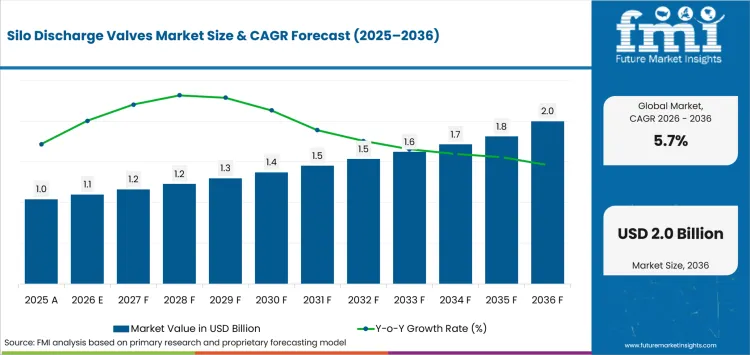
USD 1.1 billion in 2026 and USD 2.0 billion by 2036 at a 5.7% CAGR.
Demand for silo discharge valves is projected to rise at 5.7% CAGR through 2036, increasing valuation from USD 1.1 billion in 2026 to USD 2.0 billion by 2036. Cement plants add discharge positions as new bulk material handling systems expand storage and transfer capacity around dry powders. Global Energy Monitor’s Global Cement and Concrete Tracker, updated in July 2026, covered 3,884 cement plants across 171 countries and areas with 6.1 billion tonnes of annual cement capacity. That installed asset base keeps silo outlets, clinker handling points and cement discharge equipment exposed to recurring isolation and replacement cycles without treating cement capacity as valve revenue.
Country demand differs as Italy combines active construction with mature plants that channel spending toward retrofit work instead of entirely new discharge layouts. Istat reported that calendar-adjusted Italian construction production rose 2.9% year on year in May 2026, maintaining activity around cement-linked assets that require planned maintenance. In mature European sites, industrial valve systems compete on dimensional fit and service access as shutdown windows limit how extensively operators can modify existing handling lines.
Key Takeaways of Silo Discharge Valves Market
- Dry-bulk throughput and planned replacement cycles sustain orders as plant teams must isolate abrasive material without adding leakage or unplanned downtime.
- Based on valve type, butterfly valves are projected to account for 24.0% in 2026 due to compact geometry across gravity-discharge layouts.
- In 2026, pneumatic actuation is expected to lead actuation with 46.0% share because automated lines require repeatable remote cycling and interlocking.
- By material, carbon steel is forecast to represent 31.0% in 2026 driven by structural strength and practical acquisition cost across abrasive duties.
- Abrasion and fixed brownfield interfaces slow substitution as plants verify seals and dimensions inside a limited shutdown window.
- WAMGROUP, Vortex Global, Coperion, DMN-WESTINGHOUSE, Rotolok, Gericke, Rieco Industries and Polimak form the reconciled company register.
Analyst Perspective
“A silo discharge valve should be judged against the stored material, outlet geometry and maintenance window ahead of price comparison. The stronger offer controls leakage and abrasion without forcing plant engineers to redesign surrounding conveyors or extend a planned shutdown.”
- Nikhil Kaitwade, Principal Consultant, Future Market Insights
How is the Silo Discharge Valves Market segmented?
The silo discharge valves market is segmented by valve type, actuation, material, application, sales channel and region.
Valve type covers butterfly valves, slide gate valves, rotary valves, cone discharge valves, double flap valves and diverter valves. Actuation includes pneumatic, manual, electric and hydraulic. Material covers carbon steel, stainless steel, cast iron and wear-lined construction. Applications include cement, fly ash, raw meal and coal/additive silos. Sales channels cover bulk handling OEMs, direct plant sales and MRO distributors.
What makes butterfly valves central to the valve type category?
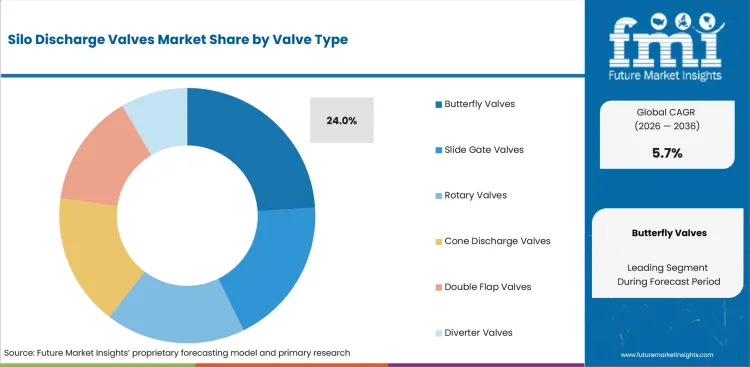
Butterfly valves suit gravity outlets that need compact shutoff between a silo cone and downstream equipment. Their quarter-turn body limits installation depth at outlets with screw conveyor systems that leave little room for a larger gate assembly.
- Based on valve type, butterfly valves are projected to account for 24.0% in 2026 due to compact isolation across established silo outlet arrangements during routine replacement work.
- Global Energy Monitor’s July 2026 Global Cement and Concrete Tracker identified 3,884 cement plants worldwide and 6.1 billion tonnes of annual cement capacity, showing the breadth of installed cement-storage and handling assets that require compact outlet isolation. The statistic explains discharge-cycle exposure and does not prove the modelled 24.0% share.
Why does pneumatic actuation lead the actuation category?
Pneumatic actuation fits discharge points that cycle frequently or respond to interlocks from downstream equipment. Coperion reported in March 2026 that its Chinaplas display paired a high-pressure rotary valve with a two-way diverter valve inside integrated conveying equipment. Plant engineers use such powered valves to coordinate repeated starts and stops across automated transfer sequences.
- In 2026, pneumatic actuation is expected to lead actuation with 46.0% share because automated transfer systems require repeatable remote cycling.
- Plant engineers use pneumatic conveying diverters with interlocked controls to coordinate repeated transfer cycles. Remote operation reduces the need to station an operator beside each silo outlet during routine loading.
What supports carbon steel in the material category?
Carbon steel gives many dry-bulk valves the required structural strength at a lower purchase cost than stainless construction. Local liners can protect severe contact points across connected material handling equipment during routine service.
- By material, carbon steel is forecast to represent 31.0% in 2026 driven by structural strength and practical acquisition cost across routine dry-bulk duties.
- Gericke reported in September 2025 that rotary valves in abrasive service can use wear-resistant coatings on internal surfaces. That requirement makes surface protection a separate specification decision from the base valve material at concentrated wear zones near dust extraction systems.
Why do cement silos lead the application category?
Cement silos create repeated isolation points across storage and dispatch systems that handle abrasive powder during normal plant operation. The American Cement Association reported in June 2026 that about 65 million metric tons of blended cement were consumed during 2025, keeping handling assets exposed to discharge cycles.
- The application category is forecast to be led by cement silos at 41.0% share in 2026 due to recurring isolation points across large installed storage bases.
- Maintenance teams compare sealing life and service access to protect downstream equipment during planned stops and routine process changes. Replaceable wear parts also reduce the maintenance burden at established cement facilities.
What are the drivers, restraints and opportunities in the Silo Discharge Valves Market?
High dry-bulk throughput raises replacement exposure, changing CCR rules can delay brownfield scope, and regional engineering coverage shortens the route to service-led orders.
- Driver: Rising bulk-solids throughput adds discharge cycles and increases wear-driven replacement exposure across silo-intensive industrial plants.
- Restraint: Changing coal-ash compliance pathways can delay brownfield equipment scope as utilities reassess closure and material-handling requirements.
- Opportunity: Regional engineering coverage shortens application review and parts coordination in markets with limited direct manufacturer service.
High Throughput Keeps Discharge Hardware in the Replacement Cycle
Plant operators replace discharge hardware as repeated bulk-solids movement wears sealing surfaces and moving components at silo outlets. Global Energy Monitor’s Global Cement and Concrete Tracker, updated in July 2026, identified 6.1 billion tonnes of annual cement capacity across 3,884 tracked plants, underscoring the scale of installed dry-bulk assets linked to silo bin activators and discharge valves. New capacity adds discharge positions while established plants add inspection and replacement work as abrasive cycles accumulate.
Regulatory Timing Can Delay Brownfield Ash-Handling Decisions
Coal-ash projects face regulatory timing that can change brownfield equipment scope while plant owners are finalizing discharge interfaces. EPA proposed CCR amendments in April 2026 covering disposal requirements and beneficial-use pathways, giving utilities reason to revisit closure plans tied to fly-ash handling. Valve specifications can remain open longer if a facility has not finalized the compliance route governing its ash-management work.
Regional Technical Coverage Shortens the Path to Replacement Orders
Vortex Global appointed Optimum Industrial Technologies across Saudi Arabia, Jordan, Iraq, Oman and the UAE in January 2026 to extend local dry-bulk engineering service coverage across five Middle Eastern markets. Regional engineers can review outlet interfaces and coordinate spare parts close to each plant, reducing specification delays in markets with limited direct factory coverage during planned brownfield valve replacement work.
Which country CAGRs are profiled in the Silo Discharge Valves Market?
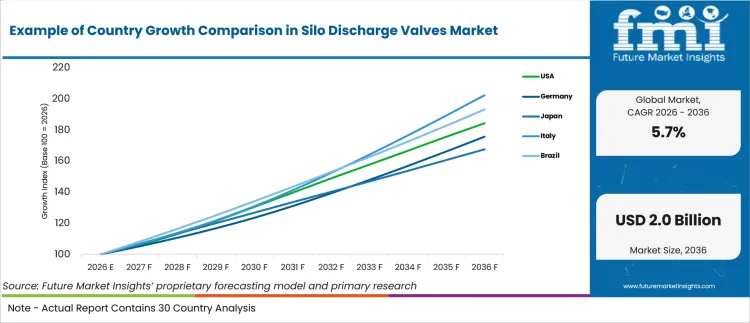
| Country | CAGR |
|---|---|
| Italy | 5.4% |
| Brazil | 5.3% |
| USA | 4.8% |
| Germany | 4.5% |
| Japan | 4.2% |
How do country-level CAGRs compare in the Silo Discharge Valves Market?
The five profiles span 1.2 percentage points, creating two close pairs around a USA transition position. Italy and Brazil combine stronger project activity with mature installed bases. Germany and Japan depend more on replacement discipline and documented fit. The narrow range therefore signals different order-conversion conditions without implying sharply different market momentum.
- Italy links modernization spending with short shutdown windows at mature cement plants.
- Brazil’s dispersed cement network makes local spares and service radius unusually important.
- USA ash-handling projects track federal CCR schedules during final brownfield interface design.
- Germany’s integrated process lines place documentation ahead of rapid component substitution.
- Japan’s concentrated cement network favors interchangeable footprints that lower maintenance risk.
Similar CAGRs can therefore produce different specification routes and service requirements.
The full report provides country-level CAGR analysis across North America, Latin America, Europe, East Asia, South Asia, Oceania and the Middle East and Africa.
Country-wise Analysis
- Italian cement plants operate inside mature production layouts and Istat reported in June 2026 that construction confidence rose from 99.4 to 101.7 as current-order views improved across the national construction sector. Silo discharge valve demand in Italy is forecast to expand at 5.4% CAGR over the assessment period, underpinned by engineering channels that can document outlet interfaces and coordinate replacement work within scheduled plant shutdowns. Retrofit economics remain disciplined as each valve must fit existing cones and connected conveyors without extending production interruptions, which favors compact dimensions and complete EU-ready documentation over changes that require extensive redesign of surrounding handling equipment.
- Brazilian cement and mineral plants span long service corridors that raise the cost of emergency valve replacement and make regional stockholding essential for planned maintenance across dispersed production sites nationwide. SNIC reported in June 2026 that first-half cement sales reached 32.9 million tonnes and increased 2.3% year on year, keeping silo discharge equipment active while uneven project economics limit premium upgrades. Silo discharge valve sales in Brazil are forecast to grow at 5.3% CAGR through 2036, attributable to local distributors and field technicians who shorten parts delivery while durable wear components reduce freight exposure across dispersed production sites.
- USA utilities and cement operators manage brownfield discharge systems with fixed piping and established maintenance procedures, so dimensional compatibility and accessible MRO support determine whether replacement work fits scheduled plant outages. Demand for silo discharge valves in the USA is forecast to rise at 4.8% CAGR over the forecast period, owing to engineering firms capable of matching existing brownfield interfaces without extending planned production interruptions. EPA finalized a rule in February 2026 that extended key CCR management-unit compliance deadlines and changed some ash-handling schedules, requiring locally stocked parts plus documented retrofit dimensions as utilities revise project timing across affected ash-management projects nationwide.
- German process plants rely on detailed engineering records before altering mature bulk-material transfer lines, as small interface changes can affect adjacent conveying equipment and the length of scheduled production shutdowns. Destatis reported in July 2026 that industrial production rose 0.9% month on month in May while construction production also increased 0.9%, giving plant engineers an active but disciplined capital environment for replacements. Germany is estimated to post 4.5% CAGR over the forecast period, shaped by service channels that can qualify seals and actuators while documented wear performance reduces approval risk for replacement valves inside existing plant layouts during scheduled maintenance.
- The Japan Cement Association reported in July 2025 that 26 plants owned by 15 companies supported 47 million tons of clinker capacity, defining a concentrated installed base that produces recurring replacement work across established sites. Adoption of silo discharge valves in Japan is estimated to expand at 4.2% CAGR through 2036, reflecting the discipline of plant engineering teams that coordinate component renewal within tightly controlled maintenance windows and proven service routines. Interchangeable footprints and dependable parts support help producers limit outage risk, but unfamiliar valve configurations face a higher qualification threshold as maintenance teams must protect proven cone, conveyor and actuator interfaces during replacement.
Who are the notable companies in the Silo Discharge Valves Market?
WAMGROUP, Vortex Global, Coperion, DMN-WESTINGHOUSE, Rotolok, Gericke, Rieco Industries and Polimak are the notable companies serving this market.
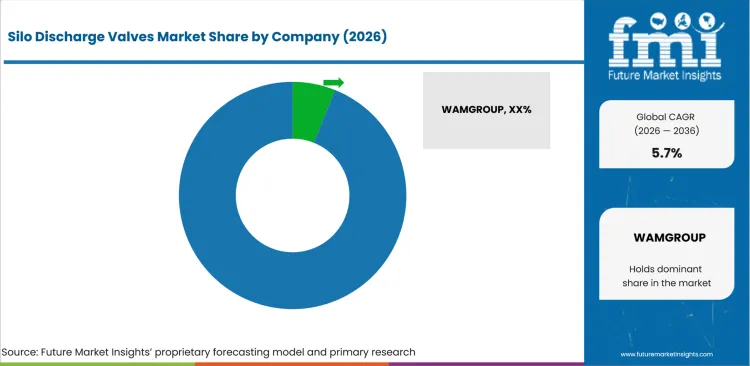
The competitive field is fragmented across integrated bulk-handling OEMs, dedicated dry-bulk valve specialists and regional engineering manufacturers. Entry depends on more than machining a valve body as installed silo outlets impose fixed flange geometry and material-specific wear limits. Plants also expect service access and locally available parts during short maintenance windows. Manufacturers with documented installation fit can win integrated work while valve specialists remain competitive in difficult isolation or routing duties.
- Integrated bulk-handling platforms include WAMGROUP and Coperion alongside Gericke and Rieco Industries for projects coordinating silo valves with conveying equipment and sack tip stations.
- Dry-bulk valve specialists include Vortex Global and DMN-WESTINGHOUSE alongside Rotolok for applications centered on isolation and material routing.
- Polimak combines valve supply with turnkey bulk-solids engineering for projects that need equipment integration across storage and conveying steps.
Competitive Benchmarking: Silo Discharge Valves Market
| Company | Bulk-Handling Integration | Dry-Bulk Valve Breadth | Application Support Depth | Geographic Reach |
|---|---|---|---|---|
| WAMGROUP | High | High | High | Global |
| Vortex Global | Medium | High | High | Global |
| Coperion | High | High | High | Global |
| DMN-WESTINGHOUSE | Medium | Medium | High | Europe, North America and global partners |
| Rotolok | Medium | High | High | Europe, Americas, Asia Pacific and Africa |
| Gericke | High | Medium | High | Europe, Americas and Asia |
| Rieco Industries | High | Medium | Medium | India and international projects |
| Polimak | High | Medium | Medium | Türkiye and international projects |
Key Developments in the Silo Discharge Valves Market
- In July 2025, Gericke RotaVal launched an updated Fast Clean rotary valve range featuring the patented RotaLign self-centralising rotor system, ATEX certification, and an IPx9K-certified high-pressure external washdown option across its HDMF and BSMF series.
- In April 2026, Vortex Global appointed INDASOL Industrial Solutions as its Poland representative for slide gates and diverter valves alongside engineered dry-bulk solutions.
- In February 2025, Coperion announced an expansion of its Niederlenz test center that was planned to add an airlock system with filtration for bulk-material containment trials.
Key Players in the Silo Discharge Valves Market
Integrated Bulk-Handling Platforms
- WAMGROUP
- Coperion
- Gericke
- Rieco Industries
Dry-Bulk Valve Specialists
- Vortex Global
- DMN-WESTINGHOUSE
- Rotolok
Bulk-Solids Engineering Specialist
- Polimak
Silo Discharge Valves Market - Report Scope
| Coverage field | Report scope |
|---|---|
| Market breakdown | By valve type, actuation, material, application, sales channel and region. |
| Quantitative Units | Revenue in USD million and CAGR in %. |
| Market Definition | Commercial valves used to isolate, meter or route dry bulk solids at silo and related storage discharge points. |
| Regions Covered | North America, Latin America, Europe, East Asia, South Asia and Pacific and Middle East and Africa. |
| Countries Covered | Italy, Brazil, USA, Germany, Japan, and 20+ countries included in the full report. |
| Key Companies Profiled | WAMGROUP, Vortex Global, Coperion, DMN-WESTINGHOUSE, Rotolok, Gericke, Rieco Industries, Polimak. |
| Forecast Period | 2026 to 2036. |
| Approach | Primary and secondary research with market triangulation. |
Silo Discharge Valves Market - Research Methodology
| Method | Approach |
|---|---|
| Primary Research | FMI analysts gathered input from manufacturers, service providers, technology developers, distributors, end users, procurement teams, and subject-matter experts. Interviews examined purchasing decisions, product or service evaluation, adoption barriers, approval requirements, pricing considerations, and expectations for technical or commercial support. Respondents were also asked what evidence is required before a trial, pilot, or initial order develops into regular purchasing. |
| Desk Research | Desk research covered government statistics, regulatory publications, trade data, industry associations, technical literature, standards, company filings, product information, and official corporate announcements. Sources were reviewed for relevance, publication date, geographic coverage, and consistency with the defined market scope. Claims relating to performance, applications, approvals, capacity, investment, and commercial activity were retained only when supported by credible public evidence. |
| Market Sizing and Forecasting | The market model combined the baseline value with historical performance, segment structure, pricing and volume indicators, adoption levels, company participation, and country-level demand conditions. Forecast assumptions considered economic activity, investment trends, regulatory developments, technology adoption, purchasing cycles, supply availability, and barriers to wider market use. Segment and regional estimates were reconciled before the final market total was calculated. |
| Data Validation | Estimates were checked against multiple independent indicators, including public data, company activity, trade patterns, industry developments, and findings from primary interviews. Validation also tested whether products, services, applications, and company revenues fell within the defined market boundaries. Adjacent categories, unsupported claims, overlapping revenues, and activities without direct market relevance were excluded to reduce double counting and maintain consistency across segments and countries. |
Silo Discharge Valves Market by Segments
Silo Discharge Valves Market segmented by Valve Type:
- Butterfly Valves
- Slide Gate Valves
- Rotary Valves
- Cone Discharge Valves
- Double Flap Valves
- Diverter Valves
Silo Discharge Valves Market segmented by Actuation:
- Pneumatic
- Manual
- Electric
- Hydraulic
Silo Discharge Valves Market segmented by Material:
- Carbon Steel
- Stainless Steel
- Cast Iron
- Wear-lined
Silo Discharge Valves Market segmented by Application:
- Cement Silos
- Fly Ash Silos
- Raw Meal Silos
- Coal / Additive Silos
Silo Discharge Valves Market segmented by Sales Channel:
- Bulk Handling OEMs
- Direct Plant Sales
- MRO Distributors
Silo Discharge Valves Market by Region:
- North America
- United States
- Canada
- Latin America
- Brazil
- Mexico
- Chile
- Rest of Latin America
- Western Europe
- Germany
- United Kingdom
- Italy
- Spain
- France
- Nordics
- Benelux
- Rest of Western Europe
- Eastern Europe
- Russia
- Poland
- Hungary
- Balkan and Baltic States
- Rest of Eastern Europe
- East Asia
- China
- Japan
- South Korea
- South Asia and Pacific
- India
- ASEAN
- Australia and New Zealand
- Rest of South Asia and Pacific
- Middle East and Africa
- Kingdom of Saudi Arabia
- Other GCC Countries
- Türkiye
- South Africa
- Other African Union Countries
- Rest of Middle East and Africa
Research Sources and Bibliography
- Global Energy Monitor. (2026, July). Global Cement and Concrete Tracker.
- Italian National Institute of Statistics. (2026, July 17). Production in the construction sector - May 2026.
- Coperion. (2026, March 15). Coperion at Chinaplas 2026.
- Gericke. (2025, September 12). Rotary Valves for corrosive atmosphere and abrasive products.
- American Cement Association. (2026, June 18). ACA Launches First-Ever Blended Cement Awards.
- USA Environmental Protection Agency. (2026, April 9). 2026 Proposed Amendments to Coal Combustion Residuals Regulations.
- Vortex Global. (2026, January 29). Vortex Global Appoints Optimum Industrial Technologies as New Representative for parts of the Middle East.
- Italian National Institute of Statistics. (2026, June 26). Consumer and business confidence - June 2026.
- National Cement Industry Union. (2026, June). Resultados Preliminares Junho 2026.
- USA Environmental Protection Agency. (2026, February 6). EPA Strengthens Grid Reliability & Energy Security with Extended Compliance Deadline for Several Coal Combustion Residual Management Unit Requirements.
- German Federal Statistical Office. (2026, July 7). Production in May 2026: +0.9% on the previous month.
- Japan Cement Association. (2025, July). Statistics.
- WAMGROUP®. (2025, May 10). WAMGROUP® NEWS Issue No. 1 | MAY 2025.
- DMN-WESTINGHOUSE. (2025, August 13). The correct rotor choice: the key to efficient process performances.
- Rotolok. (n.d.). About Rotolok USA's Rotary Airlock Manufacturing Facilities. Retrieved August 13, 2026.
- RIECO Industries. (2025, June 9). Understanding Rotary Airlock Valves: Features and Precautions to Maintain.
- Polimak. (n.d.). About us. Retrieved August 13, 2026.
- Gericke RotaVal. (2025, July 29). Gericke RotaVal Adds Innovative Features to its Fast Clean Rotary Valves. BulkInside.
- Vortex Global. (2026, April 24). Vortex Global Appoints INDASOL as New Poland Rep.
- Coperion. (2025, February 12). Coperion Announces Expansion of Switzerland Test Center to Enhance Capabilities.
- Gericke. (2025, September 12). Gericke RotaVal adds Innovative features to its Fast Clean Rotary Valves.
- Vortex Global. (2025, January 29). Vortex Welcomes Larus Projekt as Representative for Parts of Southeast Europe.
- Vortex Global. (2025, October 16). Vortex Global Announces Transition of North & South Carolina Territory Representation to Adams Brothers Inc.
This bibliography is provided for reader reference and is not exhaustive. The full report contains the complete reference list and detailed citations.
This Report Answers
- How large is the silo discharge valves market in 2026 and what valuation is projected for 2036?
- Which operating conditions sustain replacement demand for silo discharge valves across dry-bulk processing plants?
- Why do butterfly valves hold the largest verified valve type share in the 2026 segment structure?
- How does pneumatic actuation change valve selection within automated conveying and transfer systems?
- Why do cement silos create recurring discharge valve demand across storage and dispatch operations?
- How do country growth rates differ across Italy, Brazil, the USA, Germany and Japan?
- Which supplier capabilities matter most when plants compare silo discharge valve alternatives for brownfield installations?
- What can delay replacement decisions even when a plant has identified an active discharge valve requirement?
Frequently Asked Questions
How big is the Silo Discharge Valves Market in 2026?
The silo discharge valves market is valued at USD 1.1 billion in 2026 and is projected to reach USD 2.0 billion by 2036. Growth is driven by recurring replacement demand and expanding dry-bulk material handling operations across industrial sectors.
What is the CAGR of the Silo Discharge Valves Market from 2026 to 2036?
The silo discharge valves market is projected to grow at a CAGR of 5.7% between 2026 and 2036. Expansion is supported by increasing bulk-material processing activity and the need to replace valves exposed to abrasive operating conditions.
Which valve type leads the Silo Discharge Valves Market?
Butterfly valves are projected to account for 24.0% of the market in 2026. Their leading share is supported by compact design, ease of operation, and suitability for gravity-fed bulk material discharge systems.
Which actuation type leads the Silo Discharge Valves Market?
Pneumatic actuation is projected to account for 46.0% of the market in 2026. Its dominance is driven by compatibility with automated handling systems and the ability to deliver reliable remote valve operation.
Which companies are active in the Silo Discharge Valves Market?
Key companies operating in the market include WAMGROUP, Vortex Global, Coperion, DMN-WESTINGHOUSE, Rotolok, Gericke, Rieco Industries, and Polimak. These companies compete through bulk-material handling expertise, specialized valve technologies, and regional service capabilities.
Preview the report firsthand - request a free sample
Get SampleGet the brochure for pricing and purchase details.
Get PDFTable of Content
- Key Takeaways
- Market Size and CAGR
- Top Growth Driver
- Fastest Growing Segment
- Leading Region
- Key Companies
- Emerging Opportunities
- Executive Summary
- Global Market Outlook
- Demand-side Trends
- Supply-side Trends
- Technology Roadmap Analysis
- Analysis and Recommendations
- Analyst Perspective (What is happening? Why now? What should investors know?)
- Key Questions Answered
- How large is the market?
- What is the CAGR?
- What are key trends?
- Which region dominates?
- Who are the leaders?
- Market Overview
- Market Coverage / Taxonomy
- Market Definition / Scope / Limitations
- Research Methodology
- Chapter Orientation
- Analytical Lens and Working Hypotheses
- Market Structure, Signals, and Trend Drivers
- Benchmarking and Cross-market Comparability
- Market Sizing, Forecasting, and Opportunity Mapping
- Research Design and Evidence Framework
- Desk Research Programme (Secondary Evidence)
- Expert Input and Fieldwork (Primary Evidence)
- Tooling, Models, and Reference Databases
- Data Engineering and Model Build
- Quality Assurance and Audit Trail
- Market Background
- Market Dynamics (Drivers, Restraints, Opportunity, Trends)
- Scenario Forecast (Optimistic, Likely, Conservative)
- Impact Analysis
- AI Impact
- Sustainability Impact
- Regulatory Impact
- Technology Impact
- Consumer / Buyer Analysis
- Purchase Drivers
- Adoption Barriers
- Buyer Journey
- Opportunity Map Analysis
- Product Life Cycle Analysis
- Supply Chain Analysis
- Investment Feasibility Matrix
- Value Chain Analysis
- PESTLE and Porter's Analysis
- Regulatory Landscape
- Regional Parent Market Outlook
- Production and Consumption Statistics
- Import and Export Statistics
- Global Market Analysis and Forecast, 2021 to 2036
- Historical Market Size Value (USD Million) Analysis, 2021 to 2025
- Current and Future Market Size Value (USD Million) Projections, 2026 to 2036
- Y-o-Y Growth Trend Analysis
- Absolute $ Opportunity Analysis
- Global Market Pricing Analysis, 2021 to 2036
- Global Market Analysis and Forecast, By Valve Type, 2021 to 2036
- Introduction / Key Findings
- Historical Market Size Value (USD Million) Analysis By Valve Type, 2021 to 2025
- Current and Future Market Size Value (USD Million) Analysis and Forecast By Valve Type, 2026 to 2036
- Butterfly Valves
- Slide Gate Valves
- Rotary Valves
- Cone Discharge Valves
- Double Flap Valves
- Diverter Valves
- Butterfly Valves
- Y-o-Y Growth Trend Analysis By Valve Type, 2021 to 2025
- Absolute $ Opportunity Analysis By Valve Type, 2026 to 2036
- Global Market Analysis and Forecast, By Actuation, 2021 to 2036
- Introduction / Key Findings
- Historical Market Size Value (USD Million) Analysis By Actuation, 2021 to 2025
- Current and Future Market Size Value (USD Million) Analysis and Forecast By Actuation, 2026 to 2036
- Pneumatic
- Manual
- Electric
- Hydraulic
- Pneumatic
- Y-o-Y Growth Trend Analysis By Actuation, 2021 to 2025
- Absolute $ Opportunity Analysis By Actuation, 2026 to 2036
- Global Market Analysis and Forecast, By Material, 2021 to 2036
- Introduction / Key Findings
- Historical Market Size Value (USD Million) Analysis By Material, 2021 to 2025
- Current and Future Market Size Value (USD Million) Analysis and Forecast By Material, 2026 to 2036
- Carbon Steel
- Stainless Steel
- Cast Iron
- Wear-lined
- Carbon Steel
- Y-o-Y Growth Trend Analysis By Material, 2021 to 2025
- Absolute $ Opportunity Analysis By Material, 2026 to 2036
- Global Market Analysis and Forecast, By Application, 2021 to 2036
- Introduction / Key Findings
- Historical Market Size Value (USD Million) Analysis By Application, 2021 to 2025
- Current and Future Market Size Value (USD Million) Analysis and Forecast By Application, 2026 to 2036
- Cement Silos
- Fly Ash Silos
- Raw Meal Silos
- Coal / Additive Silos
- Cement Silos
- Y-o-Y Growth Trend Analysis By Application, 2021 to 2025
- Absolute $ Opportunity Analysis By Application, 2026 to 2036
- Global Market Analysis and Forecast, By Sales Channel, 2021 to 2036
- Introduction / Key Findings
- Historical Market Size Value (USD Million) Analysis By Sales Channel, 2021 to 2025
- Current and Future Market Size Value (USD Million) Analysis and Forecast By Sales Channel, 2026 to 2036
- Bulk Handling OEMs
- Direct Plant Sales
- MRO Distributors
- Bulk Handling OEMs
- Y-o-Y Growth Trend Analysis By Sales Channel, 2021 to 2025
- Absolute $ Opportunity Analysis By Sales Channel, 2026 to 2036
- Global Market Analysis and Forecast, By Region, 2021 to 2036
- Introduction
- Historical Market Size Value (USD Million) Analysis By Region, 2021 to 2025
- Current Market Size Value (USD Million) Analysis and Forecast By Region, 2026 to 2036
- North America
- Latin America
- Western Europe
- Eastern Europe
- East Asia
- South Asia and Pacific
- Middle East & Africa
- Market Attractiveness Analysis By Region
- North America Market Analysis and Forecast, By Country, 2021 to 2036
- Historical Market Size Value (USD Million) Trend Analysis By Market Taxonomy, 2021 to 2025
- Market Size Value (USD Million) Forecast By Market Taxonomy, 2026 to 2036
- By Country
- USA
- Canada
- By Valve Type
- By Actuation
- By Material
- By Application
- By Sales Channel
- By Country
- Market Attractiveness Analysis
- By Country
- By Valve Type
- By Actuation
- By Material
- By Application
- By Sales Channel
- Key Takeaways
- Latin America Market Analysis and Forecast, By Country
- Historical Market Size Value (USD Million) Trend Analysis By Market Taxonomy, 2021 to 2025
- Market Size Value (USD Million) Forecast By Market Taxonomy, 2026 to 2036
- By Country
- Brazil
- Mexico
- Chile
- Rest of Latin America
- By Valve Type
- By Actuation
- By Material
- By Application
- By Sales Channel
- By Country
- Market Attractiveness Analysis
- By Country
- By Valve Type
- By Actuation
- By Material
- By Application
- By Sales Channel
- Key Takeaways
- Western Europe Market Analysis and Forecast, By Country
- Historical Market Size Value (USD Million) Trend Analysis By Market Taxonomy, 2021 to 2025
- Market Size Value (USD Million) Forecast By Market Taxonomy, 2026 to 2036
- By Country
- Germany
- UK
- Italy
- Spain
- France
- Nordic
- BENELUX
- Rest of Western Europe
- By Valve Type
- By Actuation
- By Material
- By Application
- By Sales Channel
- By Country
- Market Attractiveness Analysis
- By Country
- By Valve Type
- By Actuation
- By Material
- By Application
- By Sales Channel
- Key Takeaways
- Eastern Europe Market Analysis and Forecast, By Country
- Historical Market Size Value (USD Million) Trend Analysis By Market Taxonomy, 2021 to 2025
- Market Size Value (USD Million) Forecast By Market Taxonomy, 2026 to 2036
- By Country
- Russia
- Poland
- Hungary
- Balkan & Baltic
- Rest of Eastern Europe
- By Valve Type
- By Actuation
- By Material
- By Application
- By Sales Channel
- By Country
- Market Attractiveness Analysis
- By Country
- By Valve Type
- By Actuation
- By Material
- By Application
- By Sales Channel
- Key Takeaways
- East Asia Market Analysis and Forecast, By Country
- Historical Market Size Value (USD Million) Trend Analysis By Market Taxonomy, 2021 to 2025
- Market Size Value (USD Million) Forecast By Market Taxonomy, 2026 to 2036
- By Country
- China
- Japan
- South Korea
- By Valve Type
- By Actuation
- By Material
- By Application
- By Sales Channel
- By Country
- Market Attractiveness Analysis
- By Country
- By Valve Type
- By Actuation
- By Material
- By Application
- By Sales Channel
- Key Takeaways
- South Asia and Pacific Market Analysis and Forecast, By Country
- Historical Market Size Value (USD Million) Trend Analysis By Market Taxonomy, 2021 to 2025
- Market Size Value (USD Million) Forecast By Market Taxonomy, 2026 to 2036
- By Country
- India
- ASEAN
- Australia & New Zealand
- Rest of South Asia and Pacific
- By Valve Type
- By Actuation
- By Material
- By Application
- By Sales Channel
- By Country
- Market Attractiveness Analysis
- By Country
- By Valve Type
- By Actuation
- By Material
- By Application
- By Sales Channel
- Key Takeaways
- Middle East & Africa Market Analysis and Forecast, By Country
- Historical Market Size Value (USD Million) Trend Analysis By Market Taxonomy, 2021 to 2025
- Market Size Value (USD Million) Forecast By Market Taxonomy, 2026 to 2036
- By Country
- Kingdom of Saudi Arabia
- Other GCC Countries
- Türkiye
- South Africa
- Other African Union
- Rest of Middle East & Africa
- By Valve Type
- By Actuation
- By Material
- By Application
- By Sales Channel
- By Country
- Market Attractiveness Analysis
- By Country
- By Valve Type
- By Actuation
- By Material
- By Application
- By Sales Channel
- Key Takeaways
- Key Countries Market Analysis
- USA
- Pricing Analysis
- Market Share Analysis, 2025
- By Valve Type
- By Actuation
- By Material
- By Application
- By Sales Channel
- Canada
- Pricing Analysis
- Market Share Analysis, 2025
- By Valve Type
- By Actuation
- By Material
- By Application
- By Sales Channel
- Mexico
- Pricing Analysis
- Market Share Analysis, 2025
- By Valve Type
- By Actuation
- By Material
- By Application
- By Sales Channel
- Brazil
- Pricing Analysis
- Market Share Analysis, 2025
- By Valve Type
- By Actuation
- By Material
- By Application
- By Sales Channel
- Chile
- Pricing Analysis
- Market Share Analysis, 2025
- By Valve Type
- By Actuation
- By Material
- By Application
- By Sales Channel
- Germany
- Pricing Analysis
- Market Share Analysis, 2025
- By Valve Type
- By Actuation
- By Material
- By Application
- By Sales Channel
- UK
- Pricing Analysis
- Market Share Analysis, 2025
- By Valve Type
- By Actuation
- By Material
- By Application
- By Sales Channel
- Italy
- Pricing Analysis
- Market Share Analysis, 2025
- By Valve Type
- By Actuation
- By Material
- By Application
- By Sales Channel
- Spain
- Pricing Analysis
- Market Share Analysis, 2025
- By Valve Type
- By Actuation
- By Material
- By Application
- By Sales Channel
- France
- Pricing Analysis
- Market Share Analysis, 2025
- By Valve Type
- By Actuation
- By Material
- By Application
- By Sales Channel
- India
- Pricing Analysis
- Market Share Analysis, 2025
- By Valve Type
- By Actuation
- By Material
- By Application
- By Sales Channel
- ASEAN
- Pricing Analysis
- Market Share Analysis, 2025
- By Valve Type
- By Actuation
- By Material
- By Application
- By Sales Channel
- Australia & New Zealand
- Pricing Analysis
- Market Share Analysis, 2025
- By Valve Type
- By Actuation
- By Material
- By Application
- By Sales Channel
- China
- Pricing Analysis
- Market Share Analysis, 2025
- By Valve Type
- By Actuation
- By Material
- By Application
- By Sales Channel
- Japan
- Pricing Analysis
- Market Share Analysis, 2025
- By Valve Type
- By Actuation
- By Material
- By Application
- By Sales Channel
- South Korea
- Pricing Analysis
- Market Share Analysis, 2025
- By Valve Type
- By Actuation
- By Material
- By Application
- By Sales Channel
- Russia
- Pricing Analysis
- Market Share Analysis, 2025
- By Valve Type
- By Actuation
- By Material
- By Application
- By Sales Channel
- Poland
- Pricing Analysis
- Market Share Analysis, 2025
- By Valve Type
- By Actuation
- By Material
- By Application
- By Sales Channel
- Hungary
- Pricing Analysis
- Market Share Analysis, 2025
- By Valve Type
- By Actuation
- By Material
- By Application
- By Sales Channel
- Kingdom of Saudi Arabia
- Pricing Analysis
- Market Share Analysis, 2025
- By Valve Type
- By Actuation
- By Material
- By Application
- By Sales Channel
- Türkiye
- Pricing Analysis
- Market Share Analysis, 2025
- By Valve Type
- By Actuation
- By Material
- By Application
- By Sales Channel
- South Africa
- Pricing Analysis
- Market Share Analysis, 2025
- By Valve Type
- By Actuation
- By Material
- By Application
- By Sales Channel
- USA
- Market Structure Analysis
- Competition Dashboard
- Competition Benchmarking
- Market Share Analysis of Top Players
- By Regional
- By Valve Type
- By Actuation
- By Material
- By Application
- By Sales Channel
- Emerging Startups
- Innovation Benchmarking
- Competition Analysis
- Competition Deep Dive
- WAMGROUP
- Overview
- Product Portfolio
- Profitability by Market Segments
- Sales Footprint
- Strategy Overview
- Marketing Strategy
- Product Strategy
- Channel Strategy
- Vortex Global
- Coperion
- DMN-WESTINGHOUSE
- Schenck Process
- Rotolok
- Mucon
- Rieco Industries
- Gericke
- Polimak
- WAMGROUP
- Case Studies
- Success Stories
- Recent Developments
- Competition Deep Dive
- Assumptions & Acronyms Used


