

- Industry Size (2026)
- USD 520.6 Mn
- Forecast (2036)
- USD 932.3 Mn
- CAGR (2026 to 2036)
- 6.0%
Silo Bin Activators Market Size, Market Forecast and Outlook By FMI
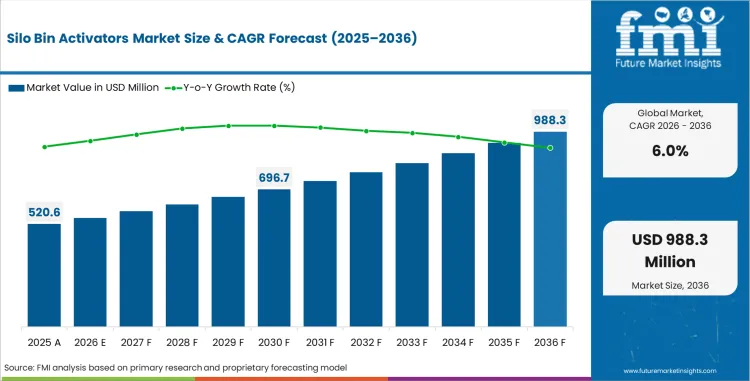
The silo bin activators market was valued at USD 491.1 million in 2025. Industry is estimated to reach USD 520.6 million in 2026, reflecting steady demand for bulk material discharge systems. The market is projected to grow at a CAGR of 6.0% from 2026 to 2036, with total revenue expected to reach USD 932.3 million by 2036. Shift away from static hopper designs toward systems that can handle cohesive and moisture-sensitive materials is propelling industry expansion.
Summary of Silo Bin Activators Market
- The market is forecast to reach USD 932.3 million by 2036.
- The market is expected to grow at a CAGR of 6.0% from 2026 to 2036.
- The market was estimated at USD 491.1 million in 2025.
- The forecast period represents an incremental opportunity of USD 411.7 million.
- Silo bin activators are used to maintain material flow, reduce bridging, and ensure consistent discharge of powders and granular materials.
- Demand is driven by the need for efficient bulk material handling in cement, food, and chemical processing industries.
- Vibratory and controlled activation systems are gaining adoption for improving flow consistency and reducing material segregation.
- New installations are expected to dominate with a 58.0% share in 2026, supported by ongoing industrial expansion.
- Vibratory activators are projected to lead the segment with a 44.0% share in 2026.
- The cement industry is anticipated to account for 28.0% share of end use in 2026.
- Medium-capacity units are expected to hold a 46.0% share, reflecting demand from standard industrial storage systems.
- India, China, and the United States are the key growth markets, with India leading at a 6.7% CAGR.
- Market growth is constrained by long equipment lifespans and higher replacement-driven demand in mature regions.
- Key companies include WAMGROUP, Martin Engineering, Vibra Screw, Coperion, AUMUND, Dynamic Air, and Nol-Tec Systems.
Key Takeaways, Market Size, and Forecast
- The Silo Bin Activators Market is projected to grow from USD 520.6 million in 2026 to USD 932.3 million by 2036, expanding at a CAGR of 6.0% over the forecast period.
- The market was valued at USD 491.1 million in 2025, reflecting steady baseline demand from bulk solids handling industries.
- By 2036, global revenue from silo bin activators is expected to reach USD 932.3 million, supported by increasing adoption in cement, chemicals, and food processing facilities.
- From 2026 to 2036, the market is anticipated to expand at a compound annual growth rate of 6.0%, driven by the need for reliable discharge of cohesive materials.
- The market is projected to generate an incremental opportunity of USD 411.7 million during the forecast period, reflecting sustained capital expenditure on bulk material handling upgrades.
- In 2026, Vibratory Activators are expected to account for 44.0% of the activator type segment, owing to their suitability for powders and granular materials.
- Cement applications are forecast to represent 28.0% share of end-use demand in 2026, supported by continuous handling of clinker, cement, and alternative fuels.
- India (6.7% CAGR) and China (5.9% CAGR) are among the fastest-growing national markets between 2026 and 2036, led by infrastructure expansion and automation of bulk material discharge systems.
Processing facilities face ongoing challenges with material bridging and flow interruptions inside storage vessels. Flow performance has become a key factor in equipment selection, with preference for designs that support consistent discharge patterns. Hygroscopic and fine powders require controlled flow conditions to avoid compaction and blockage during storage and handling. Delays in upgrading discharge systems increase the risk of extended downtime caused by material buildup inside silos. Maintenance cycles can extend when compacted materials require manual intervention for removal. Facilities are also handling lower-grade and higher-moisture inputs, which increases flow resistance and places higher demand on discharge systems.
Shear-cell flow testing is now used to assess material behavior before selecting storage and discharge equipment. Materials with high cohesive strength require active flow aids instead of passive hopper designs. This shift increases demand for equipment that supports continuous discharge under varying material conditions.
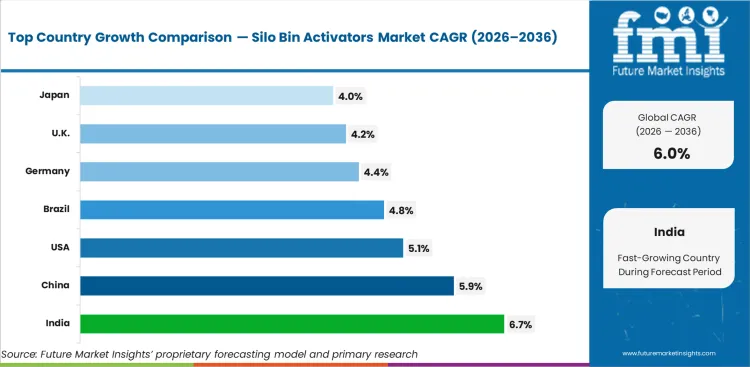
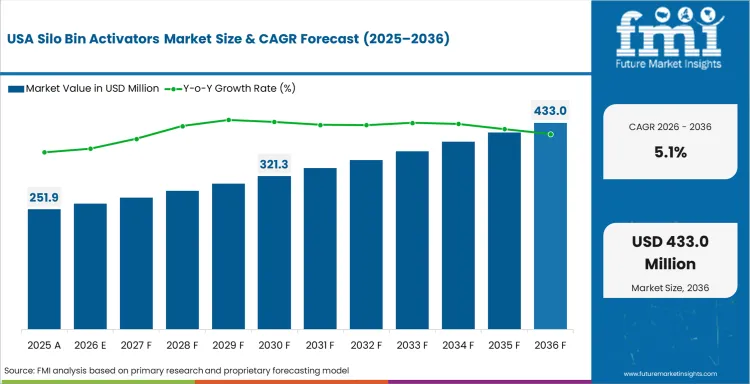
India is projected to grow at a CAGR of 6.7% in the silo bin activators market from 2026 to 2036, supported by demand from fly ash handling and blending operations. China is expected to expand at a CAGR of 5.9% over the same period, with demand linked to automation of bulk material discharge in chemical processing. The United States is anticipated to grow at a CAGR of 5.1% over the study period, driven by safety requirements that limit manual intervention in storage vessels. Brazil is forecast to record a CAGR of 4.8% during the forecast period, supported by upgrades in agricultural bulk storage systems. Germany is likely to grow at 4.4% through 2036, with demand focused on handling higher-moisture alternative fuels in industrial processes. The United Kingdom is expected to expand at a CAGR of 4.2% over the forecast period, driven by upgrades in port-based bulk storage infrastructure. Japan is projected to grow at a CAGR of 4.0% from 2026 to 2036, with focus on vibration-controlled systems suited for seismic conditions.
Segmental Analysis
Silo Bin Activators Market Analysis by Activator Type
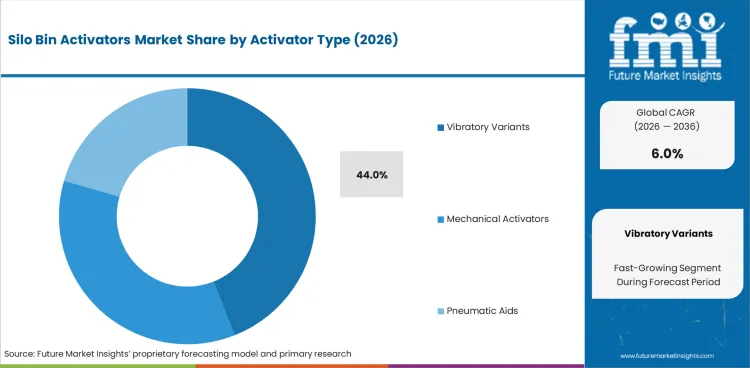
Continuous processing protocols dictate equipment selection criteria for facility directors facing strict plant modernization mandates. Evaluating vibratory vs pneumatic bin activator options, vibratory variants are anticipated to hold 44.0% share in 2026 as no bulk ingredient handler tolerates unnecessary internal moving parts dragging through abrasive powders. FMI's assessment indicates maintenance engineering managers depend entirely on these suspended vibratory bin activators to transmit kinetic energy directly into stored material without tearing apart structural welds. Facilities operating continuous discharge lines gain reliable flow profiles required for downstream fluidized conveying equipment. Relying strictly on high-pressure air cannons exposes high-volume producers to severe bridging if moisture infiltrates pneumatic networks; analyzing a bin activator vs air cannon often reveals the former's superior consistency. What raw installation metrics fail to reveal is that suspended vibratory cones often act as structural shock absorbers; they generate localized shear forces while isolating violent shaking from primary vessel walls. Independent processors lacking robust vibration isolation face immediate fatigue cracking in lower hopper sections. Specifying correct dynamic dampening ensures safe screw conveyors operation.
- Baseline handling requirement: Suspended configurations establish fundamental extraction capabilities for cohesive powder processing lines. Plant directors achieve reliable throughput modeling data.
- Extended structural mapping: Targeted kinetic energy reveals material shear patterns inside complex dumping workflows over thousands of shifts. Production engineers adjust vibration amplitudes to prevent localized vessel damage.
- Safety bottleneck prevention: Successful completion of uninterrupted basic discharging unlocks commercial line approvals. Factory procurement teams avoid purchasing over-engineered mechanical sweep infrastructure.
Silo Bin Activators Market Analysis by End Use
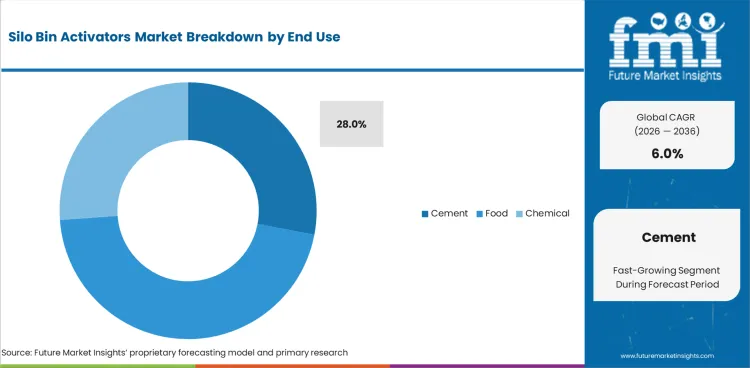
The adoption of silo bin activators in cement industry applications are likely to reach 28.0% share in 2026 because modern kilns increasingly burn shredded alternative fuels requiring aggressive continuous extraction. Plant reliability engineers leverage heavy-duty mechanical sweeps to drag interlocking biomass out of massive storage domes. Purchasing departments at building materials agencies optimize capital expenditure by avoiding massive multi-floor gravity drops when possible. Running fully automated batching systems incurs exorbitant facility upgrade costs. One contradiction characterizing heavy industrial extraction involves structural load; while vibrating units are moderately priced, requisite reinforcing beams to support massive dynamic loads often exceed equipment costs. Managers miscalculating total dynamic stress face collapsing hoppers during powder dispenser trials. Furthermore, optimizing silo bin activators for food processing requires strict hygienic compliance, whereas sourcing silo bin activators for chemical plants demands extreme corrosion resistance to feed precise powder packing machine lines safely.
- Chemical alignment precision: Rigs operating in abrasive environments mirror exact specifications of heavy wear containers. Engineering teams validate real-world abrasion profiles efficiently.
- Infrastructure cost optimization: Facilities avoid installing massive dedicated screw bottoms required for extreme cohesive extraction. Capital expenditure directors maintain sustainable operating margins.
- Toxicity synchronization testing: Engineers deploy multiple sealed rigs simultaneously to manage complex explosive powders across networked lines. Developers verify grounding stability before full production.
Silo Bin Activators Market Analysis by Bin Size
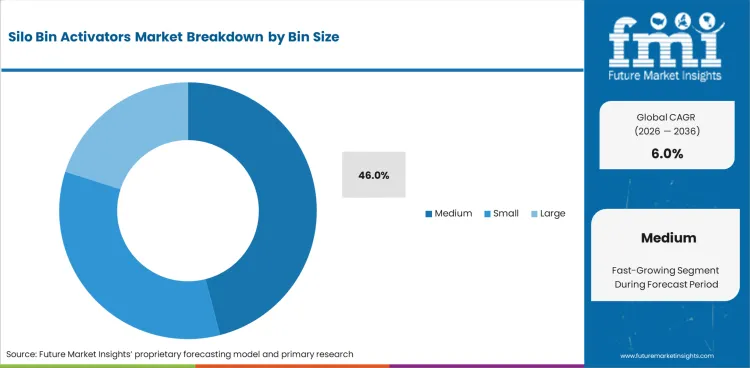
Storage geometry influences discharge performance, particularly in mid-sized silos where gravitational flow remains insufficient. Medium-sized configurations are anticipated to capture approximately 46.0% share of the market in 2026, reflecting their dependence on assisted extraction systems. Limited head pressure increases the risk of material stagnation, requiring continuous agitation. System upgrades often involve structural modifications to maintain flow consistency. Equipment selection depends on addressing geometric constraints while preserving material handling efficiency across varying storage capacities.
- Blinding resistance necessity: Basic extraction testing protocols require specialized internal baffle designs. Maintenance supervisors avoid internal clogs during multi-month production cycles.
- Cross-contamination risk: Switching powders within a single intake hopper introduces massive batch corruption variables. Quality assurance directors demand dedicated discharge profiles for specific allergen handling.
- Velocity mapping capability: Testing heavy particulates at extreme flow variations requires advanced variable frequency drives on unbalance motors. Process engineers calculate precise aerodynamic capture velocities.
Silo Bin Activators Market Analysis by Installation
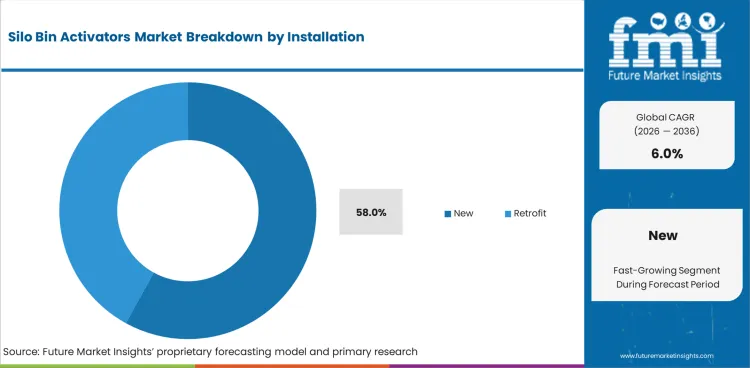
Integration strategy determines long-term system performance across new and existing facilities. New installations are expected to account for nearly 58.0% of deployment in 2026, reflecting the advantage of designing systems with integrated vibration control. Early-stage integration ensures alignment between structural design and operational requirements. Retrofitting introduces compatibility challenges, particularly where existing structures lack reinforcement. System performance depends on managing vibration transfer to prevent interference with adjacent equipment and measurement systems.
- Iterative flow discovery: Operators deploy active test rigs to deliberately tweak experimental discharge formulations under precise vibration conditions. Research directors identify arching weaknesses efficiently.
- Proprietary formulation security: Keeping mechanical additions optimized prevents sensitive bulk material flow ratios from bottlenecking downstream capacity. Chief technology officers maintain absolute control over proprietary recipes.
- Pre-blending readiness: Engineered extraction ensures minor ingredients pass official quality protocols on initial attempts before entering blending lines. Compliance managers avoid expensive external rework fees.
Silo Bin Activators Market Drivers, Restraints, and Opportunities
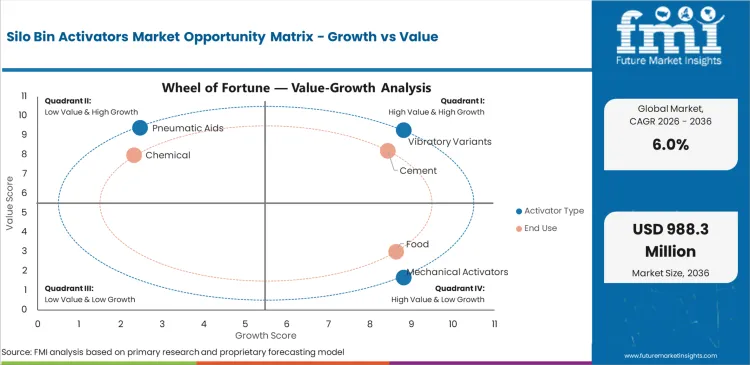
Mass flow requirements in bulk handling systems are pushing facilities to install active discharge equipment that ensures consistent material movement. Processing plants cannot rely on manual intervention or confined-space entry to resolve flow blockages. Reliable discharge performance has become essential for maintaining continuous operations and meeting production commitments. Delays in upgrading discharge systems increase the risk of downtime and loss of processing contracts.
Structural limitations in existing silos create challenges during equipment upgrades. Differences in wall thickness and construction standards across older installations restrict the use of high-intensity vibrating discharge systems. Retrofitting often requires detailed inspection, including thickness measurement and reinforcement work before installation. These steps increase project time and cost. Alternative discharge setups such as modular intermediate bulk container systems are being introduced to improve flexibility. These systems address some retrofit constraints but remain limited in handling large volumes required in continuous processing environments.
Opportunities in the Silo Bin Activators Industry
- Predictive maintenance software integration: Equipment manufacturers can bundle AI-driven vibration monitoring models directly into automated material handling systems control architecture. Plant directors capture premium uptime by anticipating fatigue failures early.
- Automated continuous weighing capabilities: Integrating loss-in-weight load cells allows real-time material tracking without pausing extraction sequences. Process engineers achieve higher dosing resolution safely.
- Mobile modular transfer stations: Building self-contained extraction environments enables flexible routing across multiple process lines. Production planners validate diverse cohesive material changes efficiently.
Regional Analysis
Based on regional analysis, Silo Bin Activators is segmented into North America, Europe, and Asia Pacific across 40 plus countries.
.webp "Top Country Growth Comparison Silo Bin Activators Market Cagr (2026 2036)")
| Country | CAGR (2026 to 2036) |
|---|---|
| India | 6.7% |
| China | 5.9% |
| USA | 5.1% |
| Brazil | 4.8% |
| Germany | 4.4% |
| UK | 4.2% |
| Japan | 4.0% |
Source: Future Market Insights (FMI) analysis, based on proprietary forecasting model and primary research
Asia Pacific Silo Bin Activators Market Analysis
State-backed centralized infrastructure modernization targets force an immediate expansion of physical extraction capacity across regional manufacturing hubs. Regional chemical developers mandate localized flow validation for massive projects, refusing to accept cohesive material testing data generated in different climate zones. FMI analysts note that strict compliance pushes processing plants to build entirely new high-capacity cement facilities dedicated exclusively to alternative fuel consumption. Facilities race to secure necessary structural reinforcement before local substations hit maximum capacity. Operating legacy intake lines alongside fully automated material handling equipment further strains regional engineering resources.
- India: India is anticipated to record 6.7% CAGR in the silo bin activators market during 2026 to 2036. Expansion in cement, chemicals, and infrastructure-linked manufacturing increases demand for efficient flow promotion systems. Plant operators prioritize multi-line extraction setups that support continuous discharge of cohesive materials. Equipment selection depends on the ability to handle variable material properties without flow interruption. Bulk procurement by large industrial groups supports steady demand. Installation timelines are often compressed due to ongoing capacity expansion projects. These conditions sustain adoption of robust and adaptable activator systems across high-throughput facilities.
- China: Industrial facilities in China are upgrading material handling systems to address flow inconsistencies in cohesive and fine powders. Legacy setups often struggle with bridging and irregular discharge under continuous operation. The silo bin activators market in China is expected to grow at 5.9% over the assessment period. Operators prioritize equipment that ensures stable mass flow while maintaining throughput across long production cycles. Regulatory oversight on handling hazardous materials also influences equipment design and selection. Procurement decisions are aligned with improving operational stability and minimizing downtime. These factors support consistent demand across processing industries.
- Japan: Manufacturing environments in Japan require precise control over material flow, particularly in food and specialty chemical applications. Equipment is selected based on its ability to prevent contamination while maintaining consistent discharge. Growth in Japan is likely to reach 4.0% over the 2026 to 2036 period. Operators prioritize systems with clean-in-place functionality and minimal manual intervention. Compact designs support installation in space-constrained facilities. Reliability and repeatability remain critical in high-specification production environments. These requirements sustain demand for advanced and hygienic flow activation systems.
FMI's report includes extensive analysis of emerging Southeast Asian manufacturing hubs. Rapid industrialization across adjacent nations drives secondary demand for standardized dynamic validation protocols.
North America Silo Bin Activators Market Analysis
Federal occupational safety programs specifically targeting confined space entry mitigation create a huge influx of capital for independent chemical processors. Safety compliance officers require facility managers to utilize automated flow promotion centers to release operating permits. Strict regulatory enforcement guarantees high replacement rates for any plant operating legacy manual hoppers. Purchasing departments secure high-power vibratory rigs to handle anticipated surges in cohesive formulation evaluations integrating safe storage and handling equipment architectures.
- USA: The silo bin activators market in the United States is anticipated to expand at 5.1% CAGR between 2026 and 2036, driven by regulatory requirements related to confined space operations and safe material handling. Facilities replace manual discharge systems with automated activators that improve flow consistency. Retrofitting existing plants remains a dominant factor shaping procurement decisions. Equipment must integrate into established layouts without disrupting operations. Reliability and compliance remain central to equipment selection. These conditions support steady demand across industrial processing environments.
FMI's report includes analysis of Canadian processing dynamics. Cross-border agricultural integration initiatives push northern plants to standardize cold-weather bridging mitigation protocols.
Europe Silo Bin Activators Market Analysis
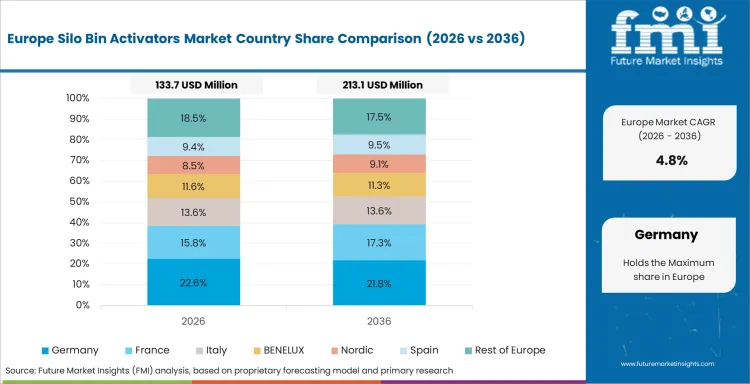
Stringent cross-border ATEX standardization mandates require equipment manufacturers to map complex static discharge risks continuously over thousands of operational hours. Compliance managers rely on certified activators to prove long-term explosion prevention stability under simulated atmospheric variations. FMI observes that independent processors prioritize sophisticated grounding control suites over raw extraction capacity to generate compliant certification dossiers. Operating high-precision static diagnostic alarms alongside traditional material handling equipment becomes a baseline requirement.
- Germany: Germany’s silo bin activators market is likely to grow at 4.4% CAGR from 2026 to 2036, supported by demand from industrial facilities requiring stable discharge of fine powders under continuous operation. Equipment selection focuses on systems with advanced monitoring capabilities that detect irregular material flow. Operators prioritize reliability and integration with existing plant infrastructure. Automation improves precision in discharge control across complex processing environments. These factors support demand for technically advanced activators aligned with strict industrial standards.
- UK: Biomass processing and industrial material handling requirements shape demand for silo bin activators in the United Kingdom. Operators require systems that prevent bridging and ensure uninterrupted discharge across variable material conditions. Growth in the United Kingdom remains at 4.2% CAGR through 2036, supported by increasing use of alternative fuels in energy and processing applications. Equipment must handle inconsistent feedstock characteristics without disrupting operations. Reliability under fluctuating load conditions remains critical. These factors sustain steady adoption across industrial and energy-linked facilities.
Competitive Aligners for Market Players
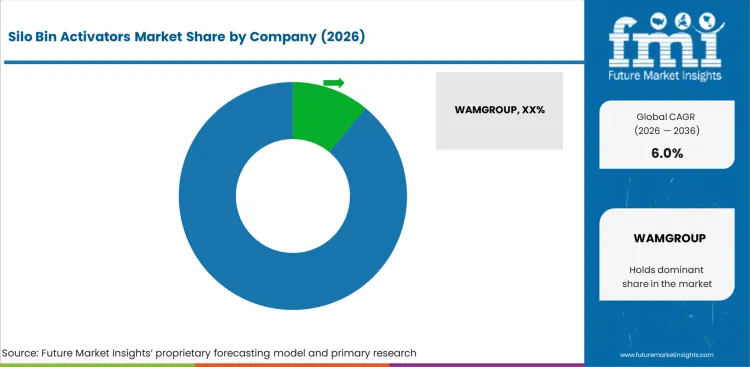
Engineering capability in vibration control and force management plays a central role in supplier selection, often outweighing basic fabrication capacity. Buyers assess how well systems manage dynamic loads within the structural limits of existing silos. Equipment design must balance discharge efficiency with controlled transmission of vibration to avoid structural strain. Processing plants evaluate systems based on how easily operators can replace flexible sealing components without releasing dust. Maintenance tasks such as sleeve replacement must be completed quickly while maintaining containment. Suppliers offering modular suspension and sealing designs reduce downtime and improve operational control.
Established suppliers benefit from global service coverage and long-standing industrial relationships. Equipment reliability remains critical, as failure in high-load discharge systems can damage storage vessels and disrupt operations. Procurement teams require proven fatigue resistance and performance data before approving new equipment, even when lower-cost options are available.
Processing facilities standardize connector and sealing interfaces to avoid dependence on specific suppliers. Equipment selection favors designs that support interchangeable components rather than proprietary locking systems. Suppliers that restrict compatibility face resistance during evaluation. Competition is expected to shift toward monitoring and diagnostics. Manufacturers are likely to differentiate through systems that track structural stress and predict maintenance needs, alongside improvements in mechanical design and discharge performance.
Key Players in Silo Bin Activators Industry
- WAMGROUP
- Martin Engineering
- Vibra Screw
- Coperion
- AUMUND
- Dynamic Air
- Nol-Tec Systems
Scope of the Report
| Metric | Value |
|---|---|
| Quantitative Units | USD 520.6 million to USD 932.3 million, at a CAGR of 6.0% |
| Market Definition | Specialized kinetic devices attached to storage vessel outlets to promote consistent downward flow of cohesive dry bulk solids via applied mechanical energy. |
| Segmentation | Activator Type, End Use, Bin Size, Installation, Material, Motion Type, and Region |
| Regions Covered | North America, Latin America, Europe, East Asia, South Asia & Pacific, Middle East & Africa |
| Countries Covered | USA, Germany, UK, China, India, Japan, Brazil |
| Key Companies Profiled | WAMGROUP, Martin Engineering, Vibra Screw, Coperion, AUMUND, Dynamic Air, Nol-Tec Systems |
| Forecast Period | 2026 to 2036 |
| Approach | Independent material handling facility capital expenditure data cross-validated with federal occupational safety program equipment registries. |
Source: Future Market Insights (FMI) analysis, based on proprietary forecasting model and primary research
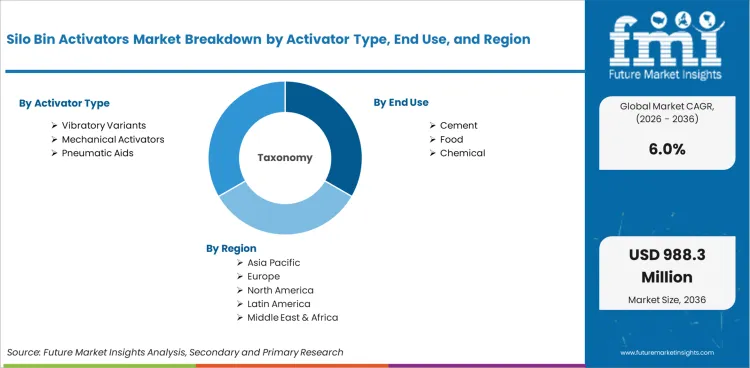
Silo Bin Activators Market Analysis by Segments
Activator Type
- Vibratory Activators
- Mechanical Activators
- Pneumatic Aids
End Use
- Cement
- Food
- Chemicals
- Power
Bin Size
- Small
- Medium
- Large
Installation
- Retrofit
- New System
Material
- Carbon Steel
- Stainless Steel
- Other
Motion Type
- Circular
- Linear
- Pulsed
Region:
- North America
- United States
- Canada
- Europe
- Germany
- United Kingdom
- France
- Italy
- Spain
- Asia Pacific
- China
- Japan
- South Korea
- Taiwan
- Singapore
- Latin America
- Brazil
- Mexico
- Argentina
- Middle East & Africa
- GCC Countries
- South Africa
- Israel
Bibliography
- American Chemistry Council. (2025). Economic Sentiment Index Q3 2025.
- European Commission, Eurostat. (2025, December 16). Chemicals production and consumption statistics.
- European Commission, Eurostat. (2025). Trade and production of chemicals and related products.
- USA Department of Agriculture, Foreign Agricultural Service. (2026, March). India: Food Processing Ingredients Annual.
- USA Geological Survey. (2026). Cement. In Mineral commodity summaries 2026.
This bibliography is provided for reader reference. The full FMI report contains the complete reference list with primary source documentation.
This Report Addresses
- Component specification criteria procurement managers utilize evaluating aerodynamic extraction bases.
- Capital expenditure impacts plant directors navigate building continuous multi-line discharging floors.
- Powder incompatibility constraints engineering teams solve maximizing individual intake platform utilization.
- Exposure barriers independent processors bypass integrating advanced predictive structural fatigue algorithms.
- Ventilation connectivity complications facility planners resolve operating fully integrated extraction frameworks safely.
- Wetted material requirements R&D directors implement handling extreme cohesive powder testing environments.
- Occupational validation mandates compelling massive near-term safety expansions across global manufacturing agencies.
- Ergonomic vulnerabilities processing operators face lacking adequate automated waste compaction channels.
Frequently Asked Questions
How big is this forecast by 2036?
Capital expenditure data indicates industry revenue hits USD 520.6 million in 2026, advancing to USD 932.3 million by 2036. This figure establishes clear structural intent from independent processing agencies preparing massive occupational safety certification pipelines over upcoming decades.
What is a silo bin activator?
These represent specialized mechanical or vibratory devices attached to storage vessel outlets to promote consistent downward flow, preventing clogs inside industrial vessels.
How does a bin activator work in bulk solids handling?
These units break material bridges and eliminate ratholing through applied kinetic energy, utilizing suspended cones to transmit vibrations directly into stored powder without damaging the surrounding structural steel.
Why do powders bridge or rathole in silos?
Powder flow problems in silos occur when cohesive materials lack sufficient gravitational head pressure, causing internal friction to overcome downward forces, locking particles together above the discharge outlet.
Which industries use silo bin activators most?
Installations inside the cement industry, chemical production, and food processing represent the largest operational base, requiring heavy-duty material extraction daily.
Why do vibratory activators lead this sector?
Vibratory variants hold 44.0% share in 2026 because no bulk ingredient handler tolerates unnecessary internal moving parts dragging through highly abrasive powders during continuous discharge operations.
Is new system demand larger than retrofit demand?
New system configurations account for 58.0% share in 2026 because integrating dynamic vibration during initial silo design prevents severe structural mismatches that frequently plague older vessel walls.
Which countries are growing fastest in silo bin activators?
India leads adoption globally with a 6.7% CAGR, followed closely by China, as both nations aggressively expand centralized manufacturing and enforce stricter material handling safety standards.
Who are the main manufacturers in this space?
Leading global equipment suppliers include WAMGROUP, Martin Engineering, Vibra Screw, Coperion, AUMUND, Dynamic Air, and Nol-Tec Systems.
How do bin activators compare with air cannons and aerators?
Evaluating a bin activator vs air cannon reveals that mechanical and vibratory systems provide continuous shear forces, whereas air cannons offer pulsed pneumatic bursts that can introduce unwanted moisture into hygroscopic powder lines.
What factors affect silo bin activator pricing?
Pricing depends heavily on bin size, construction materials (like food-grade stainless steel), and ATEX explosion-proof certifications required for safely processing combustible dry bulk solids.
Preview the report firsthand - request a free sample
Get SampleGet the brochure for pricing and purchase details.
Get PDFTable of Content
- Executive Summary
- Global Market Outlook
- Demand-side Trends
- Supply-side Trends
- Technology Roadmap Analysis
- Analysis and Recommendations
- Market Overview
- Market Coverage / Taxonomy
- Market Definition / Scope / Limitations
- Research Methodology
- Chapter Orientation
- Analytical Lens and Working Hypotheses
- Market Structure, Signals, and Trend Drivers
- Benchmarking and Cross-market Comparability
- Market Sizing, Forecasting, and Opportunity Mapping
- Research Design and Evidence Framework
- Desk Research Programme (Secondary Evidence)
- Company Annual and Sustainability Reports
- Peer-reviewed Journals and Academic Literature
- Corporate Websites, Product Literature, and Technical Notes
- Earnings Decks and Investor Briefings
- Statutory Filings and Regulatory Disclosures
- Technical White Papers and Standards Notes
- Trade Journals, Industry Magazines, and Analyst Briefs
- Conference Proceedings, Webinars, and Seminar Materials
- Government Statistics Portals and Public Data Releases
- Press Releases and Reputable Media Coverage
- Specialist Newsletters and Curated Briefings
- Sector Databases and Reference Repositories
- FMI Internal Proprietary Databases and Historical Market Datasets
- Subscription Datasets and Paid Sources
- Social Channels, Communities, and Digital Listening Inputs
- Additional Desk Sources
- Expert Input and Fieldwork (Primary Evidence)
- Primary Modes
- Qualitative Interviews and Expert Elicitation
- Quantitative Surveys and Structured Data Capture
- Blended Approach
- Why Primary Evidence is Used
- Field Techniques
- Interviews
- Surveys
- Focus Groups
- Observational and In-context Research
- Social and Community Interactions
- Stakeholder Universe Engaged
- C-suite Leaders
- Board Members
- Presidents and Vice Presidents
- R&D and Innovation Heads
- Technical Specialists
- Domain Subject-matter Experts
- Scientists
- Physicians and Other Healthcare Professionals
- Governance, Ethics, and Data Stewardship
- Research Ethics
- Data Integrity and Handling
- Primary Modes
- Tooling, Models, and Reference Databases
- Desk Research Programme (Secondary Evidence)
- Data Engineering and Model Build
- Data Acquisition and Ingestion
- Cleaning, Normalisation, and Verification
- Synthesis, Triangulation, and Analysis
- Quality Assurance and Audit Trail
- Market Background
- Market Dynamics
- Drivers
- Restraints
- Opportunity
- Trends
- Scenario Forecast
- Demand in Optimistic Scenario
- Demand in Likely Scenario
- Demand in Conservative Scenario
- Opportunity Map Analysis
- Product Life Cycle Analysis
- Supply Chain Analysis
- Investment Feasibility Matrix
- Value Chain Analysis
- PESTLE and Porter’s Analysis
- Regulatory Landscape
- Regional Parent Market Outlook
- Production and Consumption Statistics
- Import and Export Statistics
- Market Dynamics
- Global Market Analysis 2021 to 2025 and Forecast, 2026 to 2036
- Historical Market Size Value (USD Million) Analysis, 2021 to 2025
- Current and Future Market Size Value (USD Million) Projections, 2026 to 2036
- Y-o-Y Growth Trend Analysis
- Absolute $ Opportunity Analysis
- Global Market Pricing Analysis 2021 to 2025 and Forecast 2026 to 2036
- Global Market Analysis 2021 to 2025 and Forecast 2026 to 2036, By Activator Type
- Introduction / Key Findings
- Historical Market Size Value (USD Million) Analysis By Activator Type , 2021 to 2025
- Current and Future Market Size Value (USD Million) Analysis and Forecast By Activator Type , 2026 to 2036
- Vibratory Variants
- Mechanical Activators
- Pneumatic Aids
- Vibratory Variants
- Y-o-Y Growth Trend Analysis By Activator Type , 2021 to 2025
- Absolute $ Opportunity Analysis By Activator Type , 2026 to 2036
- Global Market Analysis 2021 to 2025 and Forecast 2026 to 2036, By End Use
- Introduction / Key Findings
- Historical Market Size Value (USD Million) Analysis By End Use, 2021 to 2025
- Current and Future Market Size Value (USD Million) Analysis and Forecast By End Use, 2026 to 2036
- Cement
- Food
- Chemical
- Cement
- Y-o-Y Growth Trend Analysis By End Use, 2021 to 2025
- Absolute $ Opportunity Analysis By End Use, 2026 to 2036
- Global Market Analysis 2021 to 2025 and Forecast 2026 to 2036, By Bin Size
- Introduction / Key Findings
- Historical Market Size Value (USD Million) Analysis By Bin Size, 2021 to 2025
- Current and Future Market Size Value (USD Million) Analysis and Forecast By Bin Size, 2026 to 2036
- Medium
- Small
- Large
- Medium
- Y-o-Y Growth Trend Analysis By Bin Size, 2021 to 2025
- Absolute $ Opportunity Analysis By Bin Size, 2026 to 2036
- Global Market Analysis 2021 to 2025 and Forecast 2026 to 2036, By Installation
- Introduction / Key Findings
- Historical Market Size Value (USD Million) Analysis By Installation, 2021 to 2025
- Current and Future Market Size Value (USD Million) Analysis and Forecast By Installation, 2026 to 2036
- New
- Retrofit
- New
- Y-o-Y Growth Trend Analysis By Installation, 2021 to 2025
- Absolute $ Opportunity Analysis By Installation, 2026 to 2036
- Global Market Analysis 2021 to 2025 and Forecast 2026 to 2036, By Region
- Introduction
- Historical Market Size Value (USD Million) Analysis By Region, 2021 to 2025
- Current Market Size Value (USD Million) Analysis and Forecast By Region, 2026 to 2036
- North America
- Latin America
- Western Europe
- Eastern Europe
- East Asia
- South Asia and Pacific
- Middle East & Africa
- Market Attractiveness Analysis By Region
- North America Market Analysis 2021 to 2025 and Forecast 2026 to 2036, By Country
- Historical Market Size Value (USD Million) Trend Analysis By Market Taxonomy, 2021 to 2025
- Market Size Value (USD Million) Forecast By Market Taxonomy, 2026 to 2036
- By Country
- USA
- Canada
- Mexico
- By Activator Type
- By End Use
- By Bin Size
- By Installation
- By Country
- Market Attractiveness Analysis
- By Country
- By Activator Type
- By End Use
- By Bin Size
- By Installation
- Key Takeaways
- Latin America Market Analysis 2021 to 2025 and Forecast 2026 to 2036, By Country
- Historical Market Size Value (USD Million) Trend Analysis By Market Taxonomy, 2021 to 2025
- Market Size Value (USD Million) Forecast By Market Taxonomy, 2026 to 2036
- By Country
- Brazil
- Chile
- Rest of Latin America
- By Activator Type
- By End Use
- By Bin Size
- By Installation
- By Country
- Market Attractiveness Analysis
- By Country
- By Activator Type
- By End Use
- By Bin Size
- By Installation
- Key Takeaways
- Western Europe Market Analysis 2021 to 2025 and Forecast 2026 to 2036, By Country
- Historical Market Size Value (USD Million) Trend Analysis By Market Taxonomy, 2021 to 2025
- Market Size Value (USD Million) Forecast By Market Taxonomy, 2026 to 2036
- By Country
- Germany
- UK
- Italy
- Spain
- France
- Nordic
- BENELUX
- Rest of Western Europe
- By Activator Type
- By End Use
- By Bin Size
- By Installation
- By Country
- Market Attractiveness Analysis
- By Country
- By Activator Type
- By End Use
- By Bin Size
- By Installation
- Key Takeaways
- Eastern Europe Market Analysis 2021 to 2025 and Forecast 2026 to 2036, By Country
- Historical Market Size Value (USD Million) Trend Analysis By Market Taxonomy, 2021 to 2025
- Market Size Value (USD Million) Forecast By Market Taxonomy, 2026 to 2036
- By Country
- Russia
- Poland
- Hungary
- Balkan & Baltic
- Rest of Eastern Europe
- By Activator Type
- By End Use
- By Bin Size
- By Installation
- By Country
- Market Attractiveness Analysis
- By Country
- By Activator Type
- By End Use
- By Bin Size
- By Installation
- Key Takeaways
- East Asia Market Analysis 2021 to 2025 and Forecast 2026 to 2036, By Country
- Historical Market Size Value (USD Million) Trend Analysis By Market Taxonomy, 2021 to 2025
- Market Size Value (USD Million) Forecast By Market Taxonomy, 2026 to 2036
- By Country
- China
- Japan
- South Korea
- By Activator Type
- By End Use
- By Bin Size
- By Installation
- By Country
- Market Attractiveness Analysis
- By Country
- By Activator Type
- By End Use
- By Bin Size
- By Installation
- Key Takeaways
- South Asia and Pacific Market Analysis 2021 to 2025 and Forecast 2026 to 2036, By Country
- Historical Market Size Value (USD Million) Trend Analysis By Market Taxonomy, 2021 to 2025
- Market Size Value (USD Million) Forecast By Market Taxonomy, 2026 to 2036
- By Country
- India
- ASEAN
- Australia & New Zealand
- Rest of South Asia and Pacific
- By Activator Type
- By End Use
- By Bin Size
- By Installation
- By Country
- Market Attractiveness Analysis
- By Country
- By Activator Type
- By End Use
- By Bin Size
- By Installation
- Key Takeaways
- Middle East & Africa Market Analysis 2021 to 2025 and Forecast 2026 to 2036, By Country
- Historical Market Size Value (USD Million) Trend Analysis By Market Taxonomy, 2021 to 2025
- Market Size Value (USD Million) Forecast By Market Taxonomy, 2026 to 2036
- By Country
- Kingdom of Saudi Arabia
- Other GCC Countries
- Turkiye
- South Africa
- Other African Union
- Rest of Middle East & Africa
- By Activator Type
- By End Use
- By Bin Size
- By Installation
- By Country
- Market Attractiveness Analysis
- By Country
- By Activator Type
- By End Use
- By Bin Size
- By Installation
- Key Takeaways
- Key Countries Market Analysis
- USA
- Pricing Analysis
- Market Share Analysis, 2025
- By Activator Type
- By End Use
- By Bin Size
- By Installation
- Canada
- Pricing Analysis
- Market Share Analysis, 2025
- By Activator Type
- By End Use
- By Bin Size
- By Installation
- Mexico
- Pricing Analysis
- Market Share Analysis, 2025
- By Activator Type
- By End Use
- By Bin Size
- By Installation
- Brazil
- Pricing Analysis
- Market Share Analysis, 2025
- By Activator Type
- By End Use
- By Bin Size
- By Installation
- Chile
- Pricing Analysis
- Market Share Analysis, 2025
- By Activator Type
- By End Use
- By Bin Size
- By Installation
- Germany
- Pricing Analysis
- Market Share Analysis, 2025
- By Activator Type
- By End Use
- By Bin Size
- By Installation
- UK
- Pricing Analysis
- Market Share Analysis, 2025
- By Activator Type
- By End Use
- By Bin Size
- By Installation
- Italy
- Pricing Analysis
- Market Share Analysis, 2025
- By Activator Type
- By End Use
- By Bin Size
- By Installation
- Spain
- Pricing Analysis
- Market Share Analysis, 2025
- By Activator Type
- By End Use
- By Bin Size
- By Installation
- France
- Pricing Analysis
- Market Share Analysis, 2025
- By Activator Type
- By End Use
- By Bin Size
- By Installation
- India
- Pricing Analysis
- Market Share Analysis, 2025
- By Activator Type
- By End Use
- By Bin Size
- By Installation
- ASEAN
- Pricing Analysis
- Market Share Analysis, 2025
- By Activator Type
- By End Use
- By Bin Size
- By Installation
- Australia & New Zealand
- Pricing Analysis
- Market Share Analysis, 2025
- By Activator Type
- By End Use
- By Bin Size
- By Installation
- China
- Pricing Analysis
- Market Share Analysis, 2025
- By Activator Type
- By End Use
- By Bin Size
- By Installation
- Japan
- Pricing Analysis
- Market Share Analysis, 2025
- By Activator Type
- By End Use
- By Bin Size
- By Installation
- South Korea
- Pricing Analysis
- Market Share Analysis, 2025
- By Activator Type
- By End Use
- By Bin Size
- By Installation
- Russia
- Pricing Analysis
- Market Share Analysis, 2025
- By Activator Type
- By End Use
- By Bin Size
- By Installation
- Poland
- Pricing Analysis
- Market Share Analysis, 2025
- By Activator Type
- By End Use
- By Bin Size
- By Installation
- Hungary
- Pricing Analysis
- Market Share Analysis, 2025
- By Activator Type
- By End Use
- By Bin Size
- By Installation
- Kingdom of Saudi Arabia
- Pricing Analysis
- Market Share Analysis, 2025
- By Activator Type
- By End Use
- By Bin Size
- By Installation
- Turkiye
- Pricing Analysis
- Market Share Analysis, 2025
- By Activator Type
- By End Use
- By Bin Size
- By Installation
- South Africa
- Pricing Analysis
- Market Share Analysis, 2025
- By Activator Type
- By End Use
- By Bin Size
- By Installation
- USA
- Market Structure Analysis
- Competition Dashboard
- Competition Benchmarking
- Market Share Analysis of Top Players
- By Regional
- By Activator Type
- By End Use
- By Bin Size
- By Installation
- Competition Analysis
- Competition Deep Dive
- WAMGROUP
- Overview
- Product Portfolio
- Profitability by Market Segments (Product/Age /Sales Channel/Region)
- Sales Footprint
- Strategy Overview
- Marketing Strategy
- Product Strategy
- Channel Strategy
- Martin Engineering
- Vibra Screw
- Coperion
- AUMUND
- Dynamic Air
- WAMGROUP
- Competition Deep Dive
- Assumptions & Acronyms Used


