

- Market Size (2026)
- USD 860.7 Mn
- Forecast (2036)
- USD 1928.2 Mn
- CAGR (2026 to 2036)
- 8.4%
How big is Smart Navigation Controllers Market in 2026?
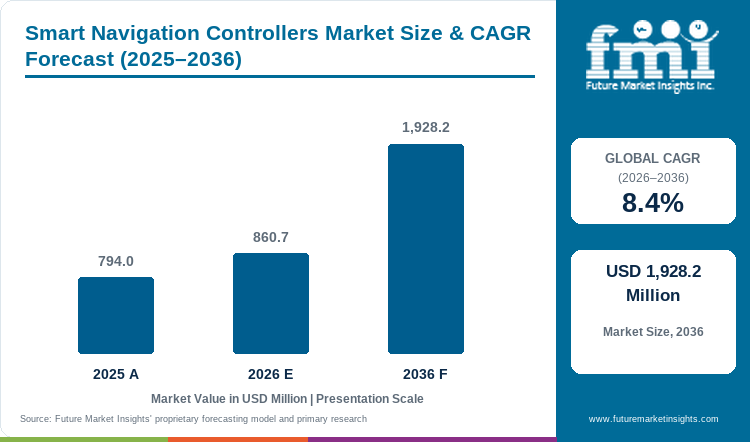
USD 860.7 million in 2026 and USD 1,928.2 million by 2036 at an 8.4% CAGR.
Demand for smart navigation controllers is projected to expand at 8.4% CAGR between 2026 and 2036, growing from USD 794.0 million in 2025 to USD 860.7 million in 2026, and escalating to USD 1,928.2 million by 2036. Marine operators are giving controller integration more weight because chart data now carries richer route and depth information into bridge systems. The International Hydrographic Organization confirmed in March 2026 that Phase 1 S-100 product specifications entered operational use during January 2026. Controllers that can consume reliable digital inputs without obscuring manual takeover give boatbuilders and retrofit installers a clearer path from navigation data to supervised course execution.
Country demand is following different installed fleets and operating routes because replacement and approval cycles vary materially by vessel class. The United States supports a large recreational replacement base while Dutch inland operators increasingly test automated track control for efficiency. The USA Coast Guard counted 11,674,073 registered recreational vessels during 2024 in its June 2025 boating statistics. That installed base keeps dealer-led retrofit work commercially relevant even when new-boat sales soften. Commercial operators place greater weight on network assurance and documented control states because advanced functions must integrate with existing bridge equipment and safety procedures.
Key Takeaways
- Navigation automation increases demand when controllers reduce course-management workload without removing clear manual intervention from the operator.
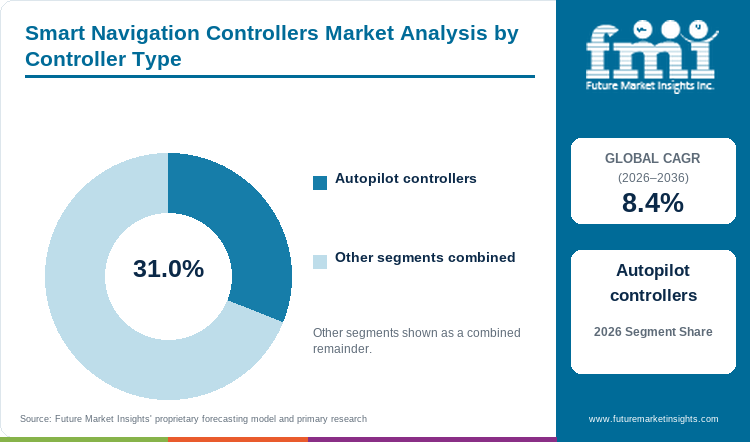
- Based on controller type, autopilot controllers are projected to account for 31.0% in 2026, supported by heading execution as the core control task.
- By integration, standalone integration is estimated to hold 24.0% in 2026, driven by retrofit buyers adding control without replacing the complete helm.
- Recreational boats are projected to hold 33.0% share in 2026, driven by an installed owner-operated fleet that returns to dealers for repeated electronics upgrades.
- Network compatibility and assurance work can lengthen commissioning because steering interfaces and positioning inputs must behave predictably under degraded conditions.
- Some of the key players in this market include Garmin, Furuno, Raymarine / Teledyne FLIR, Navico Group, Simrad, B&G, Kongsberg Maritime, Wärtsilä, TimeZero, and Nobeltec.
Analyst Perspective
"Controller value rises when a captain can add automation without losing an understandable path back to direct helm control. Commercial suppliers also need integration evidence that explains how navigation data and steering commands behave during faults or remote operation."
- Nikhil Kaitwade, Principal Consultant, Future Market Insights
How is the smart navigation controllers market segmented?
By Controller Type, Integration, Vessel Type, Function and Sales Channel.
The smart navigation controllers market is segmented by controller type, integration, vessel type, function and sales channel. Controller type covers autopilot, integrated helm, route optimization, joystick navigation and AI-assisted controllers used for distinct steering tasks. Integration includes standalone, MFD-integrated, cloud-connected, NMEA 2000 networked and fleet-platform configurations for different installation routes. Vessel type covers recreational boats, yachts, fishing vessels, workboats and ferries with different duty cycles. Functions span course control, waypoint navigation, dynamic positioning aid, fuel-efficient routing and remote route upload during navigation. Sales channels include marine electronics dealers, boat OEMs, retrofit installers and direct platform subscription for newbuild and retrofit purchases.
What operating condition supports autopilot controller demand within the controller type category?
Autopilot controllers translate heading or track commands into steering actions that operators can observe and override directly. Commercial bridge systems also use this layer as the execution point beneath route-planning functions. Kongsberg Maritime describes K-Bridge Autopilot as a self-adapting track and heading controller that accepts commands from an operator panel, ECDIS or radar station. That architecture matters because the controller must interpret navigation instructions and pass steering commands to vessel equipment without hiding the handoff from the bridge team. Adjacent marine electronics increasingly depend on the same networked heading and sensor inputs.
- By controller type, autopilot controllers are estimated to hold 31.0% in 2026, owing to their direct role in routine heading and track execution.
- Operators qualify these controllers against steering response and takeover behavior because higher-level routing depends on predictable low-level course control.
How does standalone integration secure its position within the integration category?
Standalone controllers suit retrofit projects where owners want a distinct control function while retaining displays and sensors that remain serviceable on the same vessel. Garmin introduced the APK 10 Autopilot Keypad in January 2025 for new or existing Reactor 40 installations. Garmin specified one NMEA 2000 connection that supplies the keypad with network integration and power during installation. That deployment route keeps the hardware purchase separate from a full helm replacement while preserving network connectivity. The same retrofit logic appears in adjacent boat control systems where installed interfaces influence upgrade scope and technician time before customer handover.
- Standalone integration is set to lead the integration category with 24.0% share in 2026, because staged electronics upgrades remain common in installed boats.
- Installers can isolate controller replacement from unrelated display changes when existing sensors and steering interfaces meet the required network specifications.
What supports recreational boats within the vessel type category?
Recreational boats create a broad aftermarket because owners replace navigation electronics on vessels that stay in service for many seasons. National Marine Manufacturers Association data published in March 2026 recorded 215,237 new boat retail sales during 2025. New-unit sales were lower than the previous year but the continuing installed fleet still supports dealer service and electronics replacement. Owners usually evaluate ease of use and manual override before accepting more advanced navigation functions. Related recreational boating activity therefore gives controller suppliers repeated access to refit decisions without depending only on factory installation.
- In 2026, recreational boats are expected to lead vessel type with 33.0% share, supported by owner-led refits that sustain a large replacement pool.
- Marine electronics specialists remain important because steering compatibility and commissioning determine whether an aftermarket controller performs correctly on the existing vessel.
What makes course control central within the function category?
Course control provides the operating layer that converts a chosen heading or track into repeated steering commands during normal navigation. Raymarine added real-time route synchronization between its Axiom chartplotters and the Orca navigation app in May 2025. The company states that a shared Orca route can be followed on Axiom and then used with a Raymarine autopilot. That linkage demonstrates why route intelligence still needs a dependable course-execution layer before it can alter vessel motion. The same dependency shapes autonomous marine navigation where supervised control must connect planning with steering behavior.
- By function, course control is forecast to represent 32.0% in 2026, driven by its direct and testable navigation outcome.
- Operators can assess heading stability and override response before adding waypoint automation or remote-route functions that require more system integration.
What supports marine electronics dealers within the sales channel category?
Marine electronics dealers remain central because controller performance depends on installation quality as much as the hardware selected. The National Marine Electronics Association requires its Master Dealers to maintain troubleshooting facilities and employ certified marine electronics technicians. Its advanced installer training specifically covers autopilot installations alongside data networks and heading sensors. That service structure matters during refits because technicians must reconcile power, steering and network interfaces before final commissioning and customer handover. Adjacent marine communication systems create similar installation dependencies at the helm and reinforce the value of trained local support.
- The marine electronics dealer channel is likely to capture 38.0% share in 2026, supported by controller selection that requires installation and calibration support.
- Certified technicians reduce commissioning risk by checking network behavior and steering compatibility before owners rely on automated course functions during normal operation.
What are the drivers, restraints and opportunities in the Smart Navigation Controllers Market?
Supervised navigation automation expands controller demand while cyber and positioning assurance slow approval, and operational S-100 data opens a route toward richer course-aware control.
- Driver: Formal autonomous-shipping rules are defining how navigation control can move toward supervised route execution.
- Restraint: Cyber resilience and dependable positioning add qualification work before advanced control functions enter service.
- Opportunity: Operational S-100 navigation products can supply controllers with richer route and under-keel information for supervised decisions.
Autonomous-shipping rules make supervised control requirements more concrete
The International Maritime Organization adopted the non-mandatory MASS Code in May 2026 for autonomous cargo ships operating under progressive automation. The code addresses navigation, connectivity, remote operations, cybersecurity and human oversight within one operating framework for shipboard and shore-side roles. Controller suppliers can use that common vocabulary to design documented modes for supervised route execution and clear transfer back to human control. Commercial adoption will depend on proving those states during vessel approval before operators accept wider automated control. This direction also raises the relevance of marine ADAS systems that combine sensing with bounded operator assistance before full autonomy becomes acceptable.
Cyber and positioning assurance increase the work required before commissioning
Commercial controllers increasingly sit inside vessel networks that combine steering interfaces with heading and position data during routine operation. ClassNK updated its IACS UR E26 and UR E27 implementation guidance in August 2025 for new ships and onboard equipment. UR E26 applies cyber resilience at ship level while UR E27 addresses onboard systems and equipment. Navigation controllers therefore need documented network behavior in addition to correct steering performance before a newbuild or major retrofit receives approval. The burden rises further where operators face interference risk from marine GNSS modules because degraded position inputs can affect automation even when the controller itself remains functional.
Operational S-100 products widen the data available to course-aware controllers
The Finnish Transport and Communications Agency reported in April 2025 that Finland was preparing S-101 electronic navigational charts and S-102 bathymetric products for early 2026. Those datasets can give bridge systems more structured route and depth context than legacy chart layers alone. Controller suppliers can convert richer navigation information into supervised recommendations when interfaces preserve clear alarm states and operator authority. Hardware makers need stable data exchange with the onboard control layer while software providers need predictable command boundaries. The opportunity is therefore strongest where additional navigation context shortens a real operating decision instead of adding another display without changing vessel control.
Which country CAGRs are profiled in the Smart Navigation Controllers Market?
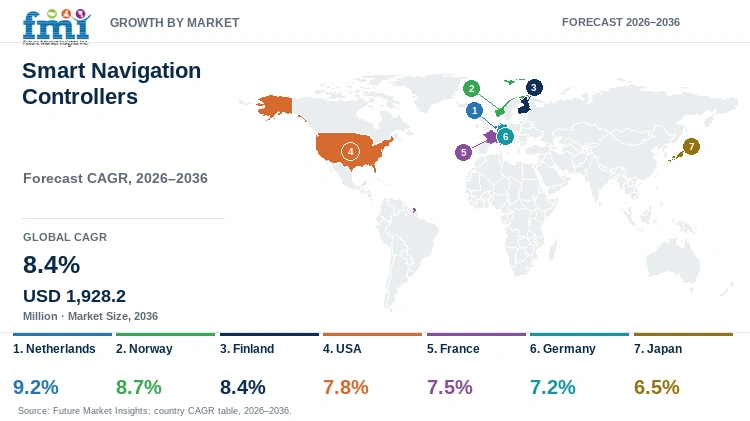
| Country | CAGR |
|---|---|
| Netherlands | 9.2% |
| Norway | 8.7% |
| Finland | 8.4% |
| USA | 7.8% |
| France | 7.5% |
| Germany | 7.2% |
| Japan | 6.5% |
How do country-level CAGRs compare in the Smart Navigation Controllers Market?
The CAGRs span 6.5% to 9.2% from 2026 to 2036. Netherlands, Norway and Finland form the upper group because each has active digital-navigation or remote-operation work. USA and France occupy the middle range before Germany and Japan. These rates describe forecast pace and do not measure current country size or absolute installed-controller revenue.
- Norway is advancing autonomous navigation through regulatory initiatives focused on remote-operation centers and the certification of unmanned vessel operations.
- In Finland, expanding digital-navigation capabilities are being matched by growing demand for resilient positioning technologies that can operate during GNSS disruptions.
- The USA’s large recreational-vessel fleet provides a substantial installed base for navigation-electronics upgrades and smart-controller replacements.
- France’s diverse commercial fleet, spanning transport and service vessels, creates demand for navigation-control solutions tailored to varied operating requirements.
- Germany’s digital-waterway modernization programs are providing real-world operating environments for automated navigation technologies across ports and inland waterways.
Comparable CAGRs can still produce different buying conditions because vessel mix and approval routes alter installation work. The full report provides country-level CAGR analysis across North America, Latin America, Western Europe, Eastern Europe, East Asia, South Asia and Pacific, and the Middle East and Africa.
Country-wise Analysis
- Dutch inland operators already use automated track control as a routine efficiency tool on working waterways. By 2036, Netherlands is projected to grow at 9.2% CAGR, supported by proven trackpilot use that lowers the barrier to further controller upgrades. Rijkswaterstaat reported in May 2026 that about 1,900 inland vessels use trackpilots and measured average fuel consumption 4.8% below comparable voyages without the aid. Buyers still need reliable low-speed steering plus interfaces that fit older vessel electronics already installed on working craft. Suppliers that document retrofit compatibility can address the installed inland fleet without requiring operators to replace every marine radar system or bridge display during one project.
- Norwegian commercial operators are moving remote vessel control from trials toward certified service on selected craft. Norway's smart navigation controllers outlook is anticipated to advance at 8.7% CAGR over the assessment period, driven by remote-operation projects that require clear navigation states and accountable ship-to-shore control. The Norwegian Maritime Authority reported in March 2026 that it commissioned a jurisdiction study for remote operation centers under the Law of the Sea. Cross-border control still raises responsibility and documentation questions when the control center sits outside the flag state. Suppliers need auditable handover logic and secure communication links before a navigation controller can support routine marine OTA platforms or remote operating workflows.
- Finnish navigation authorities are moving official charting toward S-100 products that place richer route and depth data inside bridge systems. Smart navigation controller demand in Finland is forecast to rise at 8.4% CAGR over the forecast period, supported by official S-100 chart deployment that increases the value of structured navigation data. Traficom reported in November 2025 that S-101 products were planned for all Finnish sea areas before the end of 2026 with S-102 releases beginning on major fairways during the same year. Controllers still need predictable behavior when data quality or position inputs degrade. Suppliers must pair richer digital inputs with clear alarms and bounded fallback control before operators rely on more automated coastal navigation.
- USA controller purchases are shaped by a recreational fleet where pre-owned boats dominate annual transactions and regularly return to dealers for electronics work. Adoption of smart navigation controllers in the USA is estimated to expand at 7.8% CAGR through 2036, supported by retrofit demand that extends beyond factory installations on new boats. NMMA reported in July 2026 that pre-owned boats represented 79.7% of total USA boat unit sales during 2025. That transaction mix gives installers repeated opportunities to replace controls on mixed-generation helms without changing the complete vessel. Suppliers need clear compatibility rules so yacht electronics and recreational controllers can be commissioned without unnecessary sensor replacement or extensive rewiring.
- French commercial buyers operate a mixed national fleet that includes transport vessels and maritime-service craft with different bridge requirements. In France, smart navigation controller demand is predicted to advance at 7.5% CAGR through 2036, driven by upgrades across transport and service vessels with different bridge requirements. The French maritime ministry reported in June 2026 that 464 French-flag commercial vessels above 100 gross tons were in service on January 1, including 231 transport vessels and 233 service vessels. A single controller architecture cannot satisfy every duty cycle and bridge configuration found in that mixed fleet. Suppliers need scalable integration and documentation that lets operators match course control with each vessel’s bridge equipment and operating authorization.
- German buyers test automated navigation against physical waterway infrastructure because onboard control must interact with ports and shore systems. Germany is estimated to post 7.2% CAGR over the forecast period, supported by federal test fields that connect vessel automation with inland routes. The Federal Ministry for Transport stated in June 2026 that digital-waterway programs include 5G connectivity and practical test environments for automated and connected shipping. Real waterways expose controllers to bridges and shore systems that laboratory testing cannot reproduce completely. Suppliers need open interfaces and field-validation support before professional operators accept more automated course functions on regular inland services.
- Japanese adoption is moving through formal safety and inspection work before autonomous functions enter routine commercial service. Smart navigation controller sales in Japan are forecast to expand at 6.5% CAGR by 2036, driven by formal safety and inspection work that defines how system behavior and human responsibility are assessed. MLIT stated in May 2025 that its autonomous-ship committee was working toward full commercial operations around 2030 and reviewing safety standards plus inspection methods. That regulatory process places documented system behavior ahead of feature count during controller selection for commercial service.
Who are the notable companies in the Smart Navigation Controllers Market?
Garmin, Furuno, Raymarine / Teledyne FLIR, Navico Group, Simrad, B&G, Kongsberg Maritime, Wärtsilä, TimeZero, and Nobeltec serve the smart navigation controllers market.
Competition separates between dedicated autopilot hardware, integrated helm platforms, commercial bridge control and navigation software. Entry barriers rise where a supplier must prove steering integration plus network behavior under marine safety requirements. Software firms compete on route planning and connected navigation because their products do not provide direct steering hardware.
- Garmin, Raymarine / Teledyne FLIR, Simrad, and B&G concentrate on recreational or mixed-use helm electronics with documented autopilot integration.
- Furuno and Kongsberg Maritime address commercial navigation systems where course control and bridge integration require stronger assurance and service support.
- Navico Group coordinates marine electronics brands while Wärtsilä, TimeZero, and Nobeltec focus more heavily on digital navigation or fleet-software functions after Wärtsilä divested ANCS.
Competitive Benchmarking: Smart Navigation Controllers Market
| Company | Dedicated Control Hardware | Onboard Integration Depth | Route and Remote Control | Geographic Reach |
|---|---|---|---|---|
| Garmin | High | High | Medium | Multi-region recreational marine channels |
| Furuno | High | High | High | Global commercial and recreational marine channels |
| Raymarine / Teledyne FLIR | High | High | Medium | Multi-region recreational and professional marine channels |
| Navico Group | Medium | High | High | Global marine electronics portfolio |
| Simrad | High | High | High | Global recreational and commercial marine channels |
| B&G | High | High | Medium | Global sailing-electronics channels |
| Kongsberg Maritime | High | High | High | Global commercial maritime and offshore channels |
| Wärtsilä | Low | Medium | High | Global commercial fleet digital channels |
| TimeZero | Low | Medium | Medium | Europe, North America and international software channels |
| Nobeltec | Low | Medium | Medium | North America and international navigation-software channels |
Scoring basis: High dedicated-control hardware requires a current direct autopilot or vessel-control offer from the named company. Medium covers control capability delivered mainly through an integrated platform while Low applies where the verified offer centers on software. High integration requires multiple documented onboard interfaces while Medium identifies a narrower software or system connection. High route and remote control requires direct route execution or remote-operation capability while Medium covers planning or autopilot-linked functions with narrower control depth.
Key Developments in the Smart Navigation Controllers Market
- In March 2026, Raymarine launched the RCU-1 wireless remote with handheld point-and-go control for Evolution autopilot systems on power and sailing vessels.
- In January 2026, Furuno reported IACS UR E27 certification from multiple classification societies for marine equipment covered by the cyber-resilience requirement.
- In October 2025, Simrad launched AutoCaptain with automated docking and short-distance maneuvering using dedicated displays plus integrated cameras and Mercury propulsion control.
Key Players in the Smart Navigation Controllers Market
Recreational Helm and Autopilot Systems
- Garmin
- Raymarine / Teledyne FLIR
- Simrad
- B&G
Commercial Navigation and Vessel Control
- Furuno
- Kongsberg Maritime
Marine Digital Platforms and Fleet Software
- Navico Group
- Wärtsilä
- TimeZero
- Nobeltec
Smart Navigation Controllers Market - Report Scope
| Coverage field | Report scope |
|---|---|
| Market breakdown | By controller type, integration, vessel type, function, sales channel and region. |
| Quantitative Units | USD million. |
| Market Definition | Revenue from marine smart navigation controller hardware and directly associated control software used for course, waypoint, positioning-aid, route-optimization or remote-route functions. |
| Regions Covered | North America, Latin America, Western Europe, Eastern Europe, East Asia, South Asia and Pacific, and Middle East and Africa. |
| Countries Covered | Netherlands, Norway, Finland, USA, France, Germany, Japan, and 30+ countries included in the full report. |
| Key Companies Profiled | Garmin, Furuno, Raymarine / Teledyne FLIR, Navico Group, Simrad, B&G, Kongsberg Maritime, Wärtsilä, TimeZero, and Nobeltec. |
| Forecast Period | 2026 to 2036. |
| Approach | Primary and secondary research with market triangulation. |
Smart Navigation Controllers Market - Research Methodology
| Method | Approach |
|---|---|
| Primary Research | FMI analysts gathered input from manufacturers, service providers, technology developers, distributors, end users, procurement teams, and subject-matter experts. Interviews examined purchasing decisions, product or service evaluation, adoption barriers, approval requirements, pricing considerations, and expectations for technical or commercial support. Respondents were also asked what evidence is required before a trial, pilot, or initial order develops into regular purchasing. |
| Desk Research | Desk research covered government statistics, regulatory publications, trade data, industry associations, technical literature, standards, company filings, product information, and official corporate announcements. Sources were reviewed for relevance, publication date, geographic coverage, and consistency with the defined market scope. Claims relating to performance, applications, approvals, capacity, investment, and commercial activity were retained only when supported by credible public evidence. |
| Market Sizing and Forecasting | The market model combined the baseline value with historical performance, segment structure, pricing and volume indicators, adoption levels, company participation, and country-level demand conditions. Forecast assumptions considered economic activity, investment trends, regulatory developments, technology adoption, purchasing cycles, supply availability, and barriers to wider market use. Segment and regional estimates were reconciled before the final market total was calculated. |
| Data Validation | Estimates were checked against multiple independent indicators, including public data, company activity, trade patterns, industry developments, and findings from primary interviews. Validation also tested whether products, services, applications, and company revenues fell within the defined market boundaries. Adjacent categories, unsupported claims, overlapping revenues, and activities without direct market relevance were excluded to reduce double counting and maintain consistency across segments and countries. |
Smart Navigation Controllers Market by Segments
Smart Navigation Controllers Market segmented by Controller Type:
- Autopilot controllers
- Integrated helm controllers
- Route optimization controllers
- Joystick navigation controllers
- AI-assisted controllers
Smart Navigation Controllers Market segmented by Integration:
- Standalone
- MFD-integrated
- Cloud-connected
- NMEA 2000 networked
- Fleet platform integrated
Smart Navigation Controllers Market segmented by Vessel Type:
- Recreational boats
- Yachts
- Fishing vessels
- Workboats
- Ferries
Smart Navigation Controllers Market segmented by Function:
- Course control
- Waypoint navigation
- Dynamic positioning aid
- Fuel-efficient routing
- Remote route upload
Smart Navigation Controllers Market segmented by Sales Channel:
- Marine electronics dealers
- Boat OEMs
- Retrofit installers
- Direct platform subscription
Smart Navigation Controllers Market by Region:
- North America
- United States
- Canada
- Latin America
- Brazil
- Mexico
- Argentina
- Chile
- Western Europe
- Germany
- France
- United Kingdom
- Italy
- Spain
- Benelux
- Nordics
- Eastern Europe
- Poland
- Czech Republic
- Romania
- Hungary
- East Asia
- China
- Japan
- South Korea
- South Asia and Pacific
- India
- ASEAN
- Australia and New Zealand
- Middle East and Africa
- GCC Countries
- South Africa
- Türkiye
- Israel
Research Sources and Bibliography
- International Hydrographic Organization. (2026, March 10). The S-100 framework is now operational.
- USA Coast Guard. (2025, June 24). Recreational Boating Statistics 2024.
- Kongsberg Maritime. (2026). K-Bridge Autopilot: optimal steering control in all conditions. Retrieved September 16, 2026.
- Garmin. (2025, January 16). Garmin introduces the APK 10 Autopilot Keypad for simplified control.
- National Marine Manufacturers Association. (2026, March 11). Latest NMMA Data Shows Retail Boat Sales Softened in 2025.
- Raymarine. (2025, May 27). Raymarine Links with Orca Navigation App for Real-Time Route Sharing.
- National Marine Electronics Association. (2026). Master Dealers. Retrieved September 16, 2026.
- International Maritime Organization. (2026, May 22). IMO adopts first global Code for autonomous ships.
- ClassNK. (2025, August 29). IACS UR E26/27 cyber resilience guidance and implementation overview.
- Finnish Transport and Communications Agency Traficom. (2025, April 2). New S-100 standards guide the work towards new generation digital navigation products.
- Rijkswaterstaat Water, Verkeer en Leefomgeving. (2026, May 21). Kwantificatie brandstofbesparing trackpilots: een verkenning om de binnenvaart verder te verduurzamen met behulp van smart shipping.
- Norwegian Maritime Authority. (2026, March 30). Study on jurisdiction for Remote Operation Centres.
- Finnish Transport and Communications Agency Traficom. (2025, November 20). A new era in navigation is approaching - the implementation of the S-100 standards begins in early 2026.
- National Marine Manufacturers Association. (2026, July 6). USA Recreational Marine Spending Reached $54 Billion in 2025.
- French Ministry for Ecological Transition. (2026, June 5). La marine marchande en France.
- Federal Ministry for Transport, Germany. (2026, June 18). Digitale Wasserstraßen.
- Ministry of Land, Infrastructure, Transport and Tourism, Japan. (2025, May 30). 第5回「自動運航船検討会」を開催します.
- Raymarine. (2026, March 24). Raymarine Unveils RCU-1.
- Furuno. (2026, January 8). Furuno achieves IACS UR E27 certification from multiple classification societies.
- Simrad Marine Electronics. (2025, October 7). Simrad Marine Electronics Unveils Simrad AutoCaptain.
- Furuno. (2026, August 31). VR Navigation System VNS-100.
- B&G. (2026, January 16). B&G Expands the Nemesis Lineup with New 7-inch Sailing Display.
- B&G. (2026, May 14). B&G Technology Powers New Life Saving Jon Buoy Smart Release System in Partnership with Ocean Safety.
- Furuno. (2026, April 24). Four demonstration vessels obtain Japanese government certification as autonomous ships in MEGURI2040 Stage 2.
- Wärtsilä. (2025, April 7). Wärtsilä ANCS installs first NACOS Connect remote mimics application on Princess Cruises newest ship Sun Princess.
- Garmin. (2026, September 1). Garmin launches innovative SmartDrive autopilot for sailboats and catamarans.
- Furuno. (2026, March 31). World’s first commercial operation of autonomous container ship with level 4 capability.
- Raymarine. (2025, January). LightHouse 4 Software Updates for Axiom Chartplotter Displays.
- Navico Group. (2025, February 12). Simrad Yachting Debuts New NSS 4 Delivering a Sleeker, Faster and Smarter Multifunction Display.
- Simrad Yachting. (2025, July 7). Simrad Yachting Introduces AutoTrack Feature for Simrad HALO 2000 & HALO 3000 Radars.
- B&G. (2025, February 12). Discover a Smoother, Faster Sailing Experience with the New B&G Zeus SR Chartplotter.
- Kongsberg Maritime. (2025, September 24). Delivering two more Uncrewed Vessels to REACH Subsea.
- Wärtsilä. (2025, September 30). Summary of the Q3 2025 pre-silent call.
- Wärtsilä. (2026). Fleet optimisation and voyage management solutions. Retrieved September 16, 2026.
- TIMEZERO. (2026, March 25). Discover The Bahamas with New BathyVision Data on TZ MAPS.
- TIMEZERO. (2026, June 5). What Is the Best Marine Navigation App for Android? TZ iBoat Is Now in the Conversation.
- Nobeltec, Inc. (2026). TZ iBoat - Marine Navigation. Google Play. Retrieved September 16, 2026.
This bibliography is provided for reader reference and is not exhaustive. The full report contains the complete reference list and detailed citations.
This Report Answers
- How large is the smart navigation controllers market in 2026 and 2036?
- Which operating changes are expanding demand for supervised navigation control systems?
- Why do autopilot controllers hold the principal controller type share?
- How does standalone integration affect retrofit controller purchasing and commissioning?
- Why do recreational boats account for the largest vessel type share?
- How do national operating conditions change smart controller growth rates?
- Which companies supply controller hardware and navigation software in this market?
- What integration and assurance requirements can slow smart navigation controller adoption?
- How are richer S-100 navigation datasets changing controller development priorities?
Frequently Asked Questions
How big is the smart navigation controllers market in 2026?
The smart navigation controllers market is valued at USD 860.7 million in 2026 and is projected to reach USD 1,928.2 million by 2036. Growth depends on supervised automation that integrates navigation data with predictable steering control.
What is the CAGR of the smart navigation controllers market from 2026 to 2036?
The smart navigation controllers market is projected to grow at an 8.4% CAGR between 2026 and 2036. Expansion follows wider use of integrated course control alongside digital navigation and remote-operation functions.
Which controller type leads the smart navigation controllers market?
The autopilot controllers segment is projected to account for 31.0% of controller type demand in 2026. Operators use this control layer to execute heading and track commands before adding higher-level route functions.
Which countries record the highest profiled growth rates in the market?
Netherlands is forecast at 9.2% CAGR followed by Norway at 8.7% and Finland at 8.4% through 2036. Their operating conditions differ but each has active work involving automated or digital navigation.
Which companies are active in the smart navigation controllers market?
Key companies include Garmin, Furuno, Raymarine / Teledyne FLIR, Navico Group, Simrad, B&G, Kongsberg Maritime, Wärtsilä, TimeZero, and Nobeltec. Their roles span direct control hardware, integrated helm systems and navigation software.
Preview the report firsthand - request a free sample
Get SampleGet the brochure for pricing and purchase details.
Get PDFTable of Content
- Key Takeaways
- Market Size and CAGR
- Top Growth Driver
- Fastest Growing Segment
- Leading Region
- Key Companies
- Emerging Opportunities
- Executive Summary
- Global Market Outlook
- Demand-side Trends
- Supply-side Trends
- Technology Roadmap Analysis
- Analysis and Recommendations
- Analyst Perspective (What is happening? Why now? What should investors know?)
- Key Questions Answered
- How large is the market?
- What is the CAGR?
- What are key trends?
- Which region dominates?
- Who are the leaders?
- Market Overview
- Market Coverage / Taxonomy
- Market Definition / Scope / Limitations
- Research Methodology
- Chapter Orientation
- Analytical Lens and Working Hypotheses
- Market Structure, Signals, and Trend Drivers
- Benchmarking and Cross-market Comparability
- Market Sizing, Forecasting, and Opportunity Mapping
- Research Design and Evidence Framework
- Desk Research Programme (Secondary Evidence)
- Expert Input and Fieldwork (Primary Evidence)
- Tooling, Models, and Reference Databases
- Data Engineering and Model Build
- Quality Assurance and Audit Trail
- Market Background
- Market Dynamics (Drivers, Restraints, Opportunity, Trends)
- Scenario Forecast (Optimistic, Likely, Conservative)
- Impact Analysis
- AI Impact
- Sustainability Impact
- Regulatory Impact
- Technology Impact
- Consumer / Buyer Analysis
- Purchase Drivers
- Adoption Barriers
- Buyer Journey
- Opportunity Map Analysis
- Product Life Cycle Analysis
- Supply Chain Analysis
- Investment Feasibility Matrix
- Value Chain Analysis
- PESTLE and Porter's Analysis
- Regulatory Landscape
- Regional Parent Market Outlook
- Production and Consumption Statistics
- Import and Export Statistics
- Global Market Analysis and Forecast, 2021 to 2036
- Historical Market Size Value (USD Million) Analysis, 2021 to 2025
- Current and Future Market Size Value (USD Million) Projections, 2026 to 2036
- Y-o-Y Growth Trend Analysis
- Absolute $ Opportunity Analysis
- Global Market Pricing Analysis, 2021 to 2036
- Global Market Analysis and Forecast, By Controller Type, 2021 to 2036
- Introduction / Key Findings
- Historical Market Size Value (USD Million) Analysis By Controller Type, 2021 to 2025
- Current and Future Market Size Value (USD Million) Analysis and Forecast By Controller Type, 2026 to 2036
- Autopilot controllers
- Integrated helm controllers
- Route optimization controllers
- Joystick navigation controllers
- AI-assisted controllers
- Y-o-Y Growth Trend Analysis By Controller Type, 2021 to 2025
- Absolute $ Opportunity Analysis By Controller Type, 2026 to 2036
- Global Market Analysis and Forecast, By Integration, 2021 to 2036
- Introduction / Key Findings
- Historical Market Size Value (USD Million) Analysis By Integration, 2021 to 2025
- Current and Future Market Size Value (USD Million) Analysis and Forecast By Integration, 2026 to 2036
- Standalone
- MFD-integrated
- Cloud-connected
- NMEA 2000 networked
- Fleet platform integrated
- Y-o-Y Growth Trend Analysis By Integration, 2021 to 2025
- Absolute $ Opportunity Analysis By Integration, 2026 to 2036
- Global Market Analysis and Forecast, By Vessel Type, 2021 to 2036
- Introduction / Key Findings
- Historical Market Size Value (USD Million) Analysis By Vessel Type, 2021 to 2025
- Current and Future Market Size Value (USD Million) Analysis and Forecast By Vessel Type, 2026 to 2036
- Recreational boats
- Yachts
- Fishing vessels
- Workboats
- Ferries
- Y-o-Y Growth Trend Analysis By Vessel Type, 2021 to 2025
- Absolute $ Opportunity Analysis By Vessel Type, 2026 to 2036
- Global Market Analysis and Forecast, By Function, 2021 to 2036
- Introduction / Key Findings
- Historical Market Size Value (USD Million) Analysis By Function, 2021 to 2025
- Current and Future Market Size Value (USD Million) Analysis and Forecast By Function, 2026 to 2036
- Course control
- Waypoint navigation
- Dynamic positioning aid
- Fuel-efficient routing
- Remote route upload
- Y-o-Y Growth Trend Analysis By Function, 2021 to 2025
- Absolute $ Opportunity Analysis By Function, 2026 to 2036
- Global Market Analysis and Forecast, By Sales Channel, 2021 to 2036
- Introduction / Key Findings
- Historical Market Size Value (USD Million) Analysis By Sales Channel, 2021 to 2025
- Current and Future Market Size Value (USD Million) Analysis and Forecast By Sales Channel, 2026 to 2036
- Marine electronics dealers
- Boat OEMs
- Retrofit installers
- Direct platform subscription
- Y-o-Y Growth Trend Analysis By Sales Channel, 2021 to 2025
- Absolute $ Opportunity Analysis By Sales Channel, 2026 to 2036
- Global Market Analysis and Forecast, By Region, 2021 to 2036
- Introduction
- Historical Market Size Value (USD Million) Analysis By Region, 2021 to 2025
- Current Market Size Value (USD Million) Analysis and Forecast By Region, 2026 to 2036
- North America
- Latin America
- Western Europe
- Eastern Europe
- East Asia
- South Asia and Pacific
- Middle East and Africa
- Market Attractiveness Analysis By Region
- North America Market Analysis and Forecast, By Country, 2021 to 2036
- Historical Market Size Value (USD Million) Trend Analysis By Market Taxonomy, 2021 to 2025
- Market Size Value (USD Million) Forecast By Market Taxonomy, 2026 to 2036
- By Country
- United States
- Canada
- By Controller Type
- By Integration
- By Vessel Type
- By Function
- By Sales Channel
- By Country
- Market Attractiveness Analysis
- By Country
- By Controller Type
- By Integration
- By Vessel Type
- By Function
- By Sales Channel
- Key Takeaways
- Latin America Market Analysis and Forecast, By Country
- Historical Market Size Value (USD Million) Trend Analysis By Market Taxonomy, 2021 to 2025
- Market Size Value (USD Million) Forecast By Market Taxonomy, 2026 to 2036
- By Country
- Brazil
- Mexico
- Argentina
- Chile
- By Controller Type
- By Integration
- By Vessel Type
- By Function
- By Sales Channel
- By Country
- Market Attractiveness Analysis
- By Country
- By Controller Type
- By Integration
- By Vessel Type
- By Function
- By Sales Channel
- Key Takeaways
- Western Europe Market Analysis and Forecast, By Country
- Historical Market Size Value (USD Million) Trend Analysis By Market Taxonomy, 2021 to 2025
- Market Size Value (USD Million) Forecast By Market Taxonomy, 2026 to 2036
- By Country
- Germany
- France
- United Kingdom
- Italy
- Spain
- Benelux
- Nordics
- By Controller Type
- By Integration
- By Vessel Type
- By Function
- By Sales Channel
- By Country
- Market Attractiveness Analysis
- By Country
- By Controller Type
- By Integration
- By Vessel Type
- By Function
- By Sales Channel
- Key Takeaways
- Eastern Europe Market Analysis and Forecast, By Country
- Historical Market Size Value (USD Million) Trend Analysis By Market Taxonomy, 2021 to 2025
- Market Size Value (USD Million) Forecast By Market Taxonomy, 2026 to 2036
- By Country
- Poland
- Czech Republic
- Romania
- Hungary
- By Controller Type
- By Integration
- By Vessel Type
- By Function
- By Sales Channel
- By Country
- Market Attractiveness Analysis
- By Country
- By Controller Type
- By Integration
- By Vessel Type
- By Function
- By Sales Channel
- Key Takeaways
- East Asia Market Analysis and Forecast, By Country
- Historical Market Size Value (USD Million) Trend Analysis By Market Taxonomy, 2021 to 2025
- Market Size Value (USD Million) Forecast By Market Taxonomy, 2026 to 2036
- By Country
- China
- Japan
- South Korea
- By Controller Type
- By Integration
- By Vessel Type
- By Function
- By Sales Channel
- By Country
- Market Attractiveness Analysis
- By Country
- By Controller Type
- By Integration
- By Vessel Type
- By Function
- By Sales Channel
- Key Takeaways
- South Asia and Pacific Market Analysis and Forecast, By Country
- Historical Market Size Value (USD Million) Trend Analysis By Market Taxonomy, 2021 to 2025
- Market Size Value (USD Million) Forecast By Market Taxonomy, 2026 to 2036
- By Country
- India
- ASEAN
- Australia and New Zealand
- By Controller Type
- By Integration
- By Vessel Type
- By Function
- By Sales Channel
- By Country
- Market Attractiveness Analysis
- By Country
- By Controller Type
- By Integration
- By Vessel Type
- By Function
- By Sales Channel
- Key Takeaways
- Middle East and Africa Market Analysis and Forecast, By Country
- Historical Market Size Value (USD Million) Trend Analysis By Market Taxonomy, 2021 to 2025
- Market Size Value (USD Million) Forecast By Market Taxonomy, 2026 to 2036
- By Country
- GCC Countries
- South Africa
- Türkiye
- Israel
- By Controller Type
- By Integration
- By Vessel Type
- By Function
- By Sales Channel
- By Country
- Market Attractiveness Analysis
- By Country
- By Controller Type
- By Integration
- By Vessel Type
- By Function
- By Sales Channel
- Key Takeaways
- Key Countries Market Analysis
- United States
- Pricing Analysis
- Market Share Analysis, 2025
- By Controller Type
- By Integration
- By Vessel Type
- By Function
- By Sales Channel
- Canada
- Pricing Analysis
- Market Share Analysis, 2025
- By Controller Type
- By Integration
- By Vessel Type
- By Function
- By Sales Channel
- Mexico
- Pricing Analysis
- Market Share Analysis, 2025
- By Controller Type
- By Integration
- By Vessel Type
- By Function
- By Sales Channel
- Brazil
- Pricing Analysis
- Market Share Analysis, 2025
- By Controller Type
- By Integration
- By Vessel Type
- By Function
- By Sales Channel
- Chile
- Pricing Analysis
- Market Share Analysis, 2025
- By Controller Type
- By Integration
- By Vessel Type
- By Function
- By Sales Channel
- Germany
- Pricing Analysis
- Market Share Analysis, 2025
- By Controller Type
- By Integration
- By Vessel Type
- By Function
- By Sales Channel
- United Kingdom
- Pricing Analysis
- Market Share Analysis, 2025
- By Controller Type
- By Integration
- By Vessel Type
- By Function
- By Sales Channel
- Italy
- Pricing Analysis
- Market Share Analysis, 2025
- By Controller Type
- By Integration
- By Vessel Type
- By Function
- By Sales Channel
- Spain
- Pricing Analysis
- Market Share Analysis, 2025
- By Controller Type
- By Integration
- By Vessel Type
- By Function
- By Sales Channel
- France
- Pricing Analysis
- Market Share Analysis, 2025
- By Controller Type
- By Integration
- By Vessel Type
- By Function
- By Sales Channel
- India
- Pricing Analysis
- Market Share Analysis, 2025
- By Controller Type
- By Integration
- By Vessel Type
- By Function
- By Sales Channel
- ASEAN
- Pricing Analysis
- Market Share Analysis, 2025
- By Controller Type
- By Integration
- By Vessel Type
- By Function
- By Sales Channel
- Australia and New Zealand
- Pricing Analysis
- Market Share Analysis, 2025
- By Controller Type
- By Integration
- By Vessel Type
- By Function
- By Sales Channel
- China
- Pricing Analysis
- Market Share Analysis, 2025
- By Controller Type
- By Integration
- By Vessel Type
- By Function
- By Sales Channel
- Japan
- Pricing Analysis
- Market Share Analysis, 2025
- By Controller Type
- By Integration
- By Vessel Type
- By Function
- By Sales Channel
- South Korea
- Pricing Analysis
- Market Share Analysis, 2025
- By Controller Type
- By Integration
- By Vessel Type
- By Function
- By Sales Channel
- Poland
- Pricing Analysis
- Market Share Analysis, 2025
- By Controller Type
- By Integration
- By Vessel Type
- By Function
- By Sales Channel
- Hungary
- Pricing Analysis
- Market Share Analysis, 2025
- By Controller Type
- By Integration
- By Vessel Type
- By Function
- By Sales Channel
- Türkiye
- Pricing Analysis
- Market Share Analysis, 2025
- By Controller Type
- By Integration
- By Vessel Type
- By Function
- By Sales Channel
- South Africa
- Pricing Analysis
- Market Share Analysis, 2025
- By Controller Type
- By Integration
- By Vessel Type
- By Function
- By Sales Channel
- Netherlands
- Pricing Analysis
- Market Share Analysis, 2025
- By Controller Type
- By Integration
- By Vessel Type
- By Function
- By Sales Channel
- Norway
- Pricing Analysis
- Market Share Analysis, 2025
- By Controller Type
- By Integration
- By Vessel Type
- By Function
- By Sales Channel
- Finland
- Pricing Analysis
- Market Share Analysis, 2025
- By Controller Type
- By Integration
- By Vessel Type
- By Function
- By Sales Channel
- United States
- Market Structure Analysis
- Competition Dashboard
- Competition Benchmarking
- Market Share Analysis of Top Players
- By Regional
- By Controller Type
- By Integration
- By Vessel Type
- By Function
- By Sales Channel
- Emerging Startups
- Innovation Benchmarking
- Competition Analysis
- Competition Deep Dive
- Garmin
- Overview
- Product Portfolio
- Profitability by Market Segments
- Sales Footprint
- Strategy Overview
- Marketing Strategy
- Product Strategy
- Channel Strategy
- Furuno
- Raymarine / Teledyne FLIR
- Navico Group
- Simrad
- B&G
- Kongsberg Maritime
- Wärtsilä
- TimeZero
- Nobeltec
- Garmin
- Case Studies
- Success Stories
- Recent Developments
- Competition Deep Dive
- Assumptions & Acronyms Used


