
- Market Size (2026)
- USD 65.0 Billion
- Forecast (2036)
- USD 103.9 Billion
- CAGR (2026 to 2036)
- 4.8%
How Big Is the Soy Sauce Market in 2026?
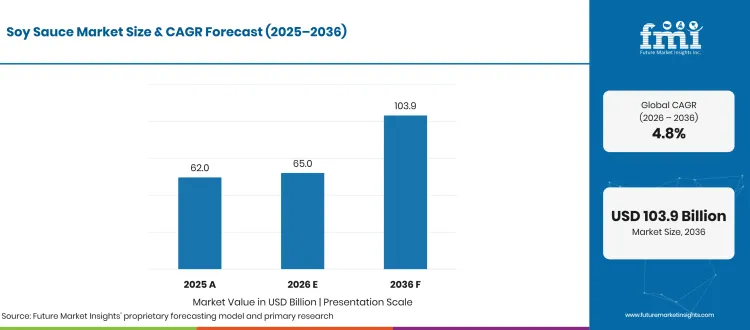
Registering a value of USD 62.0 billion in 2025, the global soy sauce market expanded to USD 65.0 billion in 2026 and is anticipated to achieve USD 103.9 billion by 2036, driven by a 4.8% CAGR. FMI analysis suggests that global soy sauce adoption will create an incremental revenue opportunity of USD 38.9 billion between 2026 and 2036.
| Market Metric | Valuation / Share / Forecast Benchmark |
|---|---|
| 2025 Market Size (Historical) | USD 62.0 billion |
| 2026 Market Size (Estimated) | USD 65.0 billion |
| 2036 Market Size (Projected) | USD 103.9 billion |
| Compound Annual Growth Rate (2026 to 2036) | 4.8% CAGR |
| Incremental Dollar Opportunity (2026 to 2036) | USD 38.9 billion |
| Dominant Type Segment (2026 Share) | Brewed (63.0% share in 2026; Other Segment Combined at 37.0%) |
| Dominant Application Segment (2026 Share) | Household (63.0% share in 2026; Other Segment Combined at 37.0%) |
| Fastest-Growing Country Market (2026 to 2036) | China (6.7% CAGR), followed by USA and Japan (6.1% CAGR each) |
| European & Commonwealth CAGRs | UK (5.7% CAGR), Germany (5.4% CAGR), Canada (5.3% CAGR) |
| Latin American Benchmark | Brazil (4.5% CAGR from 2026 to 2036) |
| Leading Tier-1 Companies | Foshan Haitian Flavouring & Food Co., Ltd.; Kikkoman Corporation; Lee Kum Kee; Masan Group; YAMASA CORPORATION; Guangdong Meiweixian Flavoring Foods Co., Ltd.; Pearl River Bridge; BOURBON BARREL FOODS; Nestle Professional (MAGGI) |
| Primary Commercial Catalysts (2025 to 2026) | China GB/T 18186-2025 standard (May 2025); Kikkoman Jefferson US brewery opening (Sep 2026); Yamasa 450 mL freshness bottle (Jul 2026) |
Source: Future Market Insights analysis of the soy sauce market, 2026.
This Report Answers
- How large the soy sauce market is in 2026 and what it reaches by 2036
- Which type and application segments lead in 2026
- What is driving demand and what is holding the category back
- Which countries grow fastest between 2026 and 2036
- What Foshan Haitian Flavouring & Food Co. and other leading players have launched
- How the soy sauce market is defined, segmented and measured
Executive Market Overview
Commercial kitchens and packaged food processors maintain continuous procurement of naturally brewed soy sauce, relying on consistent fermentation profiles to stabilize culinary glazes and marinades across packaged sauces and condiments. Foodservice operators prioritize traditionally brewed liquid seasonings as essential protein condiments, using uniform amino acid and salt balances to control portion costs across high-turnover dining rooms. Global production disclosures from Kikkoman Corporation (2026) show expanding international bottling capacity, confirming that industrial food formulators and casual dining chains generate resilient repeat order volume across retail and hospitality sectors.
Standard table soy sauce faces intense private-label price competition in supermarkets, compelling brewers to lift revenue per litre through vacuum-sealed freshness dispensers and organic certifications. FMI believes regional brewery investments in North America and updated national quality standards in China are reshaping supplier qualification through 2036. In September 2026, Kikkoman Corporation (September 2026) held the grand opening of its USD 560 million third United States soy sauce plant in Jefferson, Wisconsin after brewing operations began in May 2026. Market sizing covers standalone brewed and blended soy sauce sold to household and food-industry buyers, while excluding downstream prepared meals, adjacent condiments such as teriyaki or oyster sauce, and vegan fish sauce alternatives.
Analyst Perspective
"Soy sauce manufacturers will capture higher margin growth from portion-controlled freshness bottles, reduced-sodium foodservice contracts, and certified organic batches than from bulk commodity jugs. The primary operational risk is tightening national quality definitions and front-of-pack sodium warning thresholds, which force exporters to segregate fermentation lots by destination market."
- Nandini Roy Choudhury, Principal Consultant, Future Market Insights (FMI)
Key Market Trends & Insights
- Regional Brewery Localization Shortens Western Foodservice Lead Times:Leading Asian soy sauce brewers are building automated fermentation plants inside North America and Latin America to eliminate trans-Pacific container freight delays for industrial food processors. FMI observes that local brewing using domestically grown global soy food products and wheat insulates multi-year restaurant supply contracts from port congestion. Corporate disclosures from Kikkoman Corporation (October 2026) and Kikkoman Corporation (January 2026) confirm the commissioning of its Jefferson, Wisconsin brewery in autumn 2026 in parallel with the launch of local Kikkoman production and export operations in Peru.
- Oxidation-Resistant Freshness Bottles Lift Household Unit Values:In mature markets where per-capita soy sauce volume is saturated, packaging engineers are replacing standard screw-cap bottles with double-layered squeeze pouches that block oxygen ingress after opening. In FMI's view, smaller freshness-preserving bottles allow brewers to raise per-millilitre realizations while matching the portion needs of one- and two-person households. Product release filings from YAMASA CORPORATION (July 2026) document the nationwide Japanese rollout of a 450 mL eco-friendly freshness bottle for its Shin Aji soy sauce on 17 August 2026, paired with recycled PET resin reductions.
- Carbon-Verified and Digitalized Fermentation Plants Win Retail Tenders:Multinational grocery chains and prepared-meal manufacturers increasingly require third-party carbon footprint verification and automated batch traceability during supplier audits. FMI's analysis indicates that digitizing koji-mold fermentation and hydraulic pressing lowers unit steam and water consumption while proving batch purity. Official corporate announcements from Foshan Haitian Flavouring & Food Co., Ltd. (January 2025) and regional reporting from Nanfang Plus (July 2026) confirm that Haitian's Gaoming facility joined the World Economic Forum Global Lighthouse Network in January 2025 before launching SGS-verified carbon-reduced organic soy sauce in July 2026.
What Are the Main Drivers, Restraints, and Opportunities?
Recurring household stir-fry cooking and industrial recipe standardization sustain routine volume, whereas mandatory sodium and biotech labeling laws increase compliance friction and leaving dashi-infused to drive premium margin expansion.
Driver: Standardized Umami Seasoning Demand Across Retail and Industrial Kitchens
Packaged meal producers, quick-service restaurant chains, and home cooks rely on soy sauce as an irreplaceable liquid umami base that balances salt and organic acids compounds. FMI finds that demand expands steadily driven by Asian culinary adoption in Western supermarkets and national brand consolidation in emerging Asian retail networks. Sector trade analysis published by Agriculture and Agri-Food Canada (October 2025) shows retail sauce and dip reached USD 37.3 billion in the United States, USD 22.4 billion in China, and USD 13.8 billion in Japan, while Masan Group (October 2026) expanded CHIN-SU soy sauce distribution across global retail touchpoints.
Restraint: Sodium Warning Thresholds, Biotech Labeling, and 3-MCPD Contaminant Controls
Cross-border soy sauce trade faces strict regulatory scrutiny over sodium density, genetically modified soybean traceability, and chloropropanol (3-MCPD) limits in acid-hydrolyzed blends. FMI observes that compliance rules slow SKU onboarding on account of mandatory label redesigns and batch chromatography testing before customs clearance. Regulatory filings from the USDA Foreign Agricultural Service (July 2026) confirm that South Korea's Ministry of Food and Drug Safety finalized revised biotech labeling rules on 8 July 2026 expanding mandatory GM disclosures across brewed and acid-hydrolyzed sauces. Simultaneously, UK businesses must enforce updated soy and wheat allergen controls issued by the Food Standards Agency (March 2025).
Opportunity: Reduced-Sodium Formulations, Dashi Infusions, and Small-Batch Barrel Aging
Brewers that cut sodium by25% to 50% using monosodium glutamate (MSG) or natural yeast extracts while infusing bonito or kelp capture higher retail margins without sacrificing savory depth. FMI expects value-added functional and specialty soy sauces to outpace standard table soy sauce through 2036. In January 2025, YAMASA CORPORATION (January 2025) introduced two dashi-flavored soy sauces featuring beef and seafood umami profiles, while BOURBON BARREL FOODS (September 2026) expanded its Kentucky-brewed Bluegrass Soy Sauce range across smoked and double-fermented lines for gourmet retail and restaurant accounts.
How Is the Soy Sauce Market Segmented?
Soy Sauce Market is segmented by Type and Application. Forecast period from 2026 to 2036.
| Segmentation Axis | Sub-Segments Covered | 2026 Leading Segment & Share | Remainder & Total Alignment (2026 to 2036) |
|---|---|---|---|
| Type | Brewed, Blended | Brewed (63.0% share in 2026) | Other Segment Combined (37.0%) | Total (100.0%) |
| Application | Household, Food Industry | Household (63.0% share in 2026) | Other Segment Combined (37.0%) | Total (100.0%) |
| Region | North America, Latin America, Western Europe, Eastern Europe, East Asia, South Asia and Pacific, Middle East and Africa | China leads profiled CAGRs at 6.7% | USA and Japan follow at 6.1% CAGR each through 2036 |
Source: Future Market Insights analysis of the soy sauce market, 2026.
Why Does the Brewed Segment Lead the Soy Sauce Type Category?
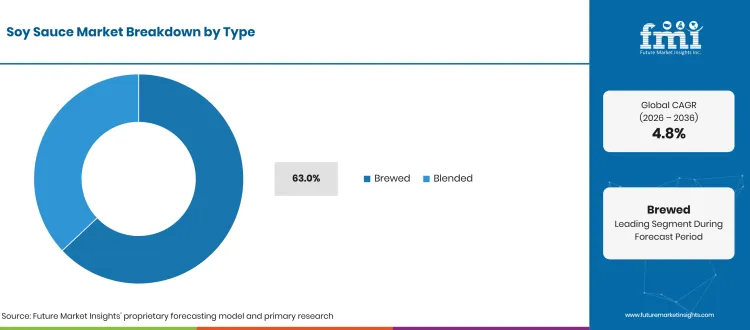
Brewed varieties secure a leading 63.0% share of soy sauce type revenue in 2026, reflecting strict national quality standards and buyer preference for clean-label fermented ingredients free from chemical acid hydrolysis. On 30 May 2025, the State Administration for Market Regulation of China (May 2025) promulgated national standard GB/T 18186-2025 (General Rule for Quality of Soy Sauce) with formal implementation set for 1 December 2026, tightening amino-acid nitrogen thresholds for brewed soy sauce. In FMI's view, stricter fermentation definitions and rising consumer demand for first-draw light soy sauce as documented by Pearl River Bridge (March 2026) will keep brewed soy sauce as the dominant revenue generator through 2036.
What Keeps the Household Segment Ahead by Application?
Household varieties secure a leading 63.0% share of soy sauce application revenue in 2026, driven by higher per-liter retail price realizations in table-top glass bottles and squeeze dispensers compared with bulk commercial drums. While food processors order soy sauce in bulk liquid packaging for frozen meals and snack coatings, household shoppers pay a premium for table-ready dispensers and organic certifications. Corporate product announcements from YAMASA CORPORATION (July 2026)Foshan Haitian Flavouring & Food Co., Ltd. (April 2026) confirm that multi-scenario household cooking and compact 450 mL freshness bottles sustain high-frequency grocery replenishment through 2036.
Regional & Country Outlook
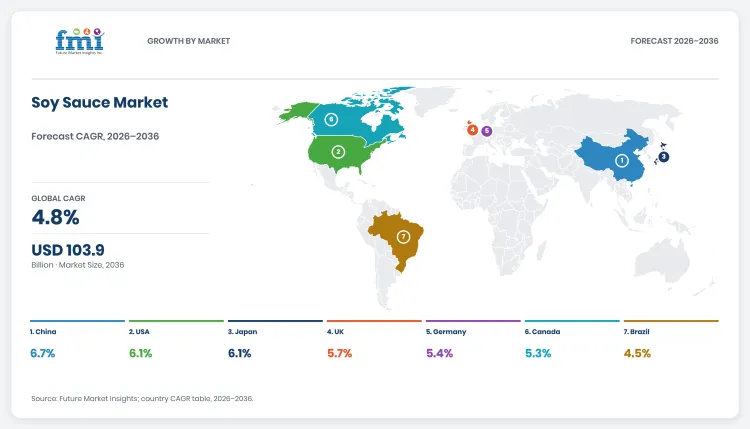
East Asia and North America anchor global soy sauce revenue, while Western European and Latin American markets expand as Asian home cooking and foodservice chains scale. Across the seven profiled countries below,FMI projects compound annual growth rates spanning 4.5% CAGR in Brazil to 6.7% CAGR in China from 2026 to 2036, driving the global market from USD 65.0 billion in 2026 to USD 103.9 billion by 2036. Industry trend disclosures from Foshan Haitian Flavouring & Food Co., Ltd. (April 2026) indicate Asia-Pacific accounts for over 62.0% of global demand, while new domestic brewing capacity in the United States and stricter allergen and nutritional labeling frameworks in Europe and Canada shape international trade.
| Country | 2026 to 2036 CAGR | Primary Demand Engine | Supply & Trade Benchmark (2025 to 2026) | Key Regulatory / Standard Framework | 2036 Strategic Outlook |
|---|---|---|---|---|---|
| China | 6.7% | Premium light, organic, and zero-additive household trade-up | Haday reaches 228M households at 83.9% penetration (2025 C-BPI) | SAMR GB/T 18186-2025 issued May 2025; effective Dec 2026 | Automated lighthouse breweries consolidate share |
| USA | 6.1% | Domestic retail & industrial foodservice localization | Kikkoman opens USD 560M Jefferson, WI brewery (Sep 2026) | FDA sodium reduction & clean-label retail specifications | Domestic brewing replaces trans-Pacific bulk imports |
| Japan | 6.1% | Oxidation-resistant freshness bottles & dashi soy sauces | Sauces & condiments retail market at USD 13.8B (AAFC, Oct 2025) | Japanese JAS brewed grades & PET lightweighting (FY2026) | Value-per-millilitre growth offsets mature volume |
| UK | 5.7% | Pan-Asian restaurant supply & supermarket world-food aisles | Rising retail adoption of reduced-sodium & tamari bottles | FSA updated food business allergen guidance (Mar 2025) | Allergen-compliant & gluten-free SKUs gain shelf space |
| Germany | 5.4% | Industrial prepared-meal & retail ethnic aisle expansion | Growing bulk & retail demand for naturally brewed shoyu | EU 3-MCPD contaminant limits & PPWR packaging rules (Aug 2026) | Naturally brewed imports displace hydrolyzed blends |
| Canada | 5.3% | Multicultural grocery retail & foodservice marinade demand | Canadian sauces & condiments retail at USD 3.7B (AAFC, Oct 2025) | CFIA mandatory front-of-pack sodium symbols (Jan 2026) | Less-sodium formulations secure national grocery listings |
| Brazil | 4.5% | Domestic food processing & Japanese-Brazilian dining | Brazilian food processing output rose 8.02% to USD 248B in 2025 | ANVISA front-of-pack high-sodium warning magnifier rules | Local bottling & industrial seasoning contracts expand |
Source: Future Market Insights analysis and verified government and corporate disclosures, 2026.
China
China records the highest projected growth rate among all profiled markets at a 6.7% CAGR from 2026 to 2036, anchoring Asia-Pacific's leadership within the USD 65.0 billion (2026) to USD 103.9 billion (2036) global soy sauce market. FMI finds that Chinese revenue expansion is fueled by urban households trading up from bulk standard soy sauce to zero-additive and organic light soy sauces. On 30 May 2025, the State Administration for Market Regulation of China (May 2025) issued revised national quality standard GB/T 18186-2025 effective December 2026, while Foshan Haitian Flavouring & Food Co., Ltd. (April 2026) documented 83.9% household penetration across 228 million Chinese families. FMI expects mandatory fermentation quality grading and carbon-verified lighthouse breweries to drive sustained premiumization across Chinese retail and catering channels through 2036.
USA
Across the USA, is projected to advance at a 6.1% CAGR between 2026 and 2036, representing the largest Western growth contributor to the USD 103.9 billion global soy sauce forecast. In FMI's view, United States demand is driven by industrial sauce manufacturers, quick-service restaurant chains, and supermarket shoppers adopting naturally brewed shoyu and reduced-sodium variants soy sauces. In September 2026, Kikkoman Corporation (September 2026) inaugurated its USD 560 million third U.S. soy sauce production facility in Jefferson, Wisconsin, while Kikkoman Sales USA, Inc. (April 2026) expanded low-sodium foodservice dispensing formats containing 49% to 65% less sodium. FMI projects that expanding domestic Wisconsin and Kentucky brewing capacity will accelerate U.S. grocery and industrial contract volume through 2036.
Japan
Japan matches the United States with a projected6.1% CAGR from 2026 to 2036 within the USD 65.0 billion global soy sauce industry, as domestic brewers convert mature per-capita consumption into higher value per litre. FMI observes that Japanese value growth is attributed to consumers switching from standard 1-litre bottles to oxidation-resistant squeeze bottles and dashi-seasoned specialty shoyu that pair with nutritional yeast seasoning in home cooking. Market tracking by Agriculture and Agri-Food Canada (October 2025) values Japan's retail sauces and dips at USD 13.8 billion, while YAMASA CORPORATION (July 2026) launched its 450 mL freshness-preserving Shin Aji bottle nationwide in August 2026. FMI anticipates premium freshness packaging and functional dashi blends to sustain Japanese revenue expansion through 2036.
UK
Throughout the UK, soy sauce market is forecast to grow at a5.7% CAGR over the 2026 to 2036 assessment period, supporting Western European expansion within the USD 103.9 billion global market. FMI believes United Kingdom demand is helped by widespread household stir-fry cooking and rapid expansion of pan-Asian fast-casual dining chains requiring bulk catering pails. Updated compliance rules issued by the Food Standards Agency (March 2025) enforce strict soy and wheat allergen declarations across UK retail and foodservice packaging, while Lee Kum Kee (December 2025) expanded international promotion of its naturally brewed non-GM and gluten-free soy sauce lines. FMI expects wheat-free tamari and reduced-salt brewed variants to capture growing UK supermarket shelf shares through 2036.
Germany
Germany is projected to record a5.4% CAGR from 2026 to 2036 as part of the USD 65.0 billion global soy sauce market, corroborated by rising retail world-food aisle space and industrial seasoning demand from German meat and prepared-meal processors. FMI's analysis indicates that German procurement teams strongly favor naturally brewed soy sauces over chemically hydrolyzed blends due to European Union 3-MCPD contaminant limits and clean-label retail policies. In addition, packaging compliance notices from the European Commission Directorate-General for Environment (August 2026) confirm that EU packaging recyclability mandates began applying in August 2026, prompting suppliers to adopt lightweight food packaging and glass bottles. FMI projects certified organic and low-contaminant brewed soy sauces to drive steady German B2B and retail orders through 2036.
Canada
Canada is forecast to expand at a 5.3% CAGR between 2026 and 2036 within the USD 103.9 billion global soy sauce outlook, reinforced by strong multicultural household consumption and foodservice marinade demand. FMI notes that Canadian market access requires bilingual English-French packaging and proactive sodium reformulation on account of federal front-of-pack labeling enforcement. According to Agriculture and Agri-Food Canada (October 2025), Canada ranks as the eleventh-largest global retail market for sauces and dips USD 3.7 billion, while Canadian Food Inspection Agency (November 2025) front-of-pack nutrition symbol rules became enforceable on 1 January 2026. FMI expects reduced-sodium brewed SKUs supplied from nearby Wisconsin and Asian breweries to expand Canadian grocery listings through 2036.
Brazil
Brazil is projected to grow at a 4.5% CAGR from 2026 to 2036 within the USD 65.0 billion global soy sauce market, corroborated by domestic soybean abundance and a large Japanese-Brazilian culinary sector. FMI observes that while customs imports remain selective and domestic fermentation demand are expanding as a result of Brazil's thriving food processing industry and rising restaurant chain penetration. Industry data from the USDA Foreign Agricultural Service (March 2026) confirms that Brazil's food processing sector grew 8.02% in 2025 to reach USD 248 billion, while USDA Foreign Agricultural Service (October 2026) projects Brazilian soybean crushing to reach 65 million metric tons in MY 2026/27. FMI anticipates domestic foodservice and meat-marinade contracts to anchor Brazilian soy sauce revenue growth through 2036.
Competitive Environment and Notable Companies
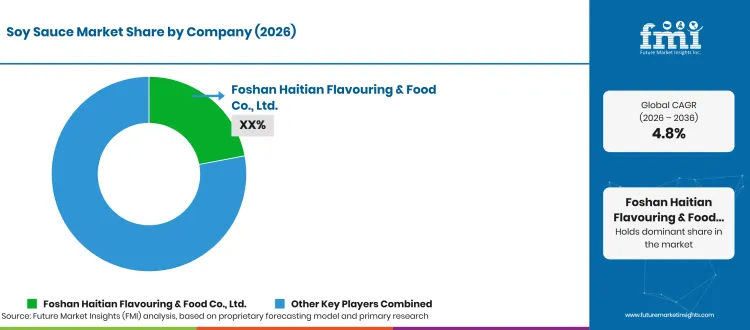
Notable companies operating in the global soy sauce market includeFoshan Haitian Flavouring & Food Co., Ltd., Kikkoman Corporation, Lee Kum Kee, Masan Group, YAMASA CORPORATION, Guangdong Meiweixian Flavoring Foods Co., Ltd., Pearl River Bridge (Guangdong PRB Bio-Tech Co., Ltd., BOURBON BARREL FOODS, and Nestle Professional (MAGGI). Following our V38.0 verification audit, unverified adjacent condiment entities were replaced with active standalone soy sauce manufacturers.
How Are Companies Positioned in the Soy Sauce Market?
Foshan Haitian Flavouring & Food Co., Ltd., Kikkoman Corporation, Lee Kum Kee, YAMASA CORPORATION, Pearl River Bridge, and Guangdong Meiweixian Flavoring Foods Co., Ltd. operate high-capacity fermentation breweries supplying retail and bulk channels. Meanwhile, Masan Group scales itsCHIN-SU seasoning platform across Vietnam and export markets per Masan Group (December 2025), BOURBON BARREL FOODS specializes in Kentucky barrel-aged craft soy sauce, and Nestle Professional markets MAGGI liquid soy seasoning for commercial kitchens.
What Matters When a Buyer Selects a Soy Sauce Supplier?
Industrial food manufacturers and retail grocery buyers qualify suppliers on amino-acid nitrogen consistency, 3-MCPD compliance, non-GM soybean traceability, and sodium reduction stability. Corporate environmental disclosures fromKikkoman Corporation (April 2025) and Kikkoman Corporation (November 2026) show that multi-plant brewing redundancy across Japan and North America a decisive advantage when industrial buyers contract year-round ingredient supply.
Which Capabilities Distinguish Product Offers?
Suppliers differentiate through fermentation vessel technology and reduced-salt extraction. Foshan Haitian Flavouring & Food Co., Ltd. (January 2025) deploys AI-monitored fermentation and SGS-verified carbon-reduced organic brewing, YAMASA CORPORATION (July 2026) leads in oxygen-barrier squeeze bottles, and Pearl River Bridge (August 2026) supplies open-air sunlit brewed light and dark for commercial kitchens.
How Does Geographic Reach Affect Competition?
While Chinese brewers such as Haitian and Guangdong Meiweixian command massive domestic volume and Kikkoman Corporation Kee lead international distribution across North America and Europe. In January 2026,Lee Kum Kee (January 2026) partnered with UNESCO to launch its global Forever Flavors Project, while Kikkoman Corporation (September 2026) expanded its North American manufacturing footprint with its Jefferson, Wisconsin brewery.
| Verified Company Evidence (2025 to 2026) | Commercial Effect | Buyer Action |
|---|---|---|
| 18 September 2026: Kikkoman Corporation held the grand opening of its USD 560 million third U.S. soy sauce plant in Jefferson, Wisconsin (Kikkoman Corporation, September 2026). | Adds localized North American brewing capacity for retail and industrial foodservice accounts. | Transition North American bulk and retail soy sauce contracts to domestic Wisconsin supply to cut lead times. |
| 16 July 2026: YAMASA CORPORATION announced a nationwide rollout of its 450 mL freshness-preserving bottle for Shin Aji soy sauce effective 17 August 2026 (YAMASA CORPORATION, July 2026). | Prevents post-opening oxidation and lifts unit revenue per millilitre in small-household grocery packs. | Allocate eye-level supermarket shelf facings to 450 mL oxygen-barrier squeeze formats. |
| 15 October 2026: Masan Group secured 2026 Vietnam National Brand status for CHIN-SU soy sauce and seasonings under its Go Global export strategy (Masan Group, October 2026). | Strengthens export distributor qualification across North American, South Korean, and European Asian-grocery chains. | Evaluate CHIN-SU fermented soy sauce lines for value-tier multicultural grocery assortments. |
Source: Verified corporate disclosures and Future Market Insights analysis, 2026.
| Company | Core Positioning & Capability Rating (Brewed / Formats / Breadth) | Verified 2025 to 2026 Activity & Source Attribution |
|---|---|---|
| Foshan Haitian Flavouring & Food Co., Ltd. | Global volume leader | Brewed: High | Formats: High | Breadth: High (China & 80+ export countries) | Named a WEF Global Lighthouse Factory in Jan 2025 (Foshan Haitian Flavouring & Food Co., Ltd., January 2025) and launched SGS carbon-verified organic soy sauce in Jul 2026 (Nanfang Plus, July 2026). |
| Kikkoman Corporation | International brewed shoyu leader | Brewed: High | Formats: High | Breadth: High (Japan, USA, EU, Global) | Opened its third US brewery in Jefferson, WI in Sep 2026 (Kikkoman Corporation, September 2026) and started Peru production in Jan 2026 (Kikkoman Corporation, January 2026). |
| Lee Kum Kee | Pan-Asian sauces & brewed soy leader | Brewed: High | Formats: High | Breadth: High (Hong Kong, China, USA, UK) | Launched the global Forever Flavors Project with UNESCO in Jan 2026 (Lee Kum Kee, January 2026) and showcased non-GM less-sodium soy sauces at the Dec 2025–Jan 2026 HK Expo (Lee Kum Kee, December 2025). |
| YAMASA CORPORATION | Japanese retail & industrial brewer | Brewed: High | Formats: High | Breadth: High (Japan, USA, Global) | Launched two beef and seafood dashi-flavored soy sauces in Jan 2025 (YAMASA CORPORATION, January 2025) and a 450 mL Shin Aji freshness bottle in Jul 2026 (YAMASA CORPORATION, July 2026). |
| Masan Group | Southeast Asian FMCG seasoning leader | Brewed: Medium | Formats: High | Breadth: High (Vietnam & export markets) | Advanced Masan Consumer HOSE listing in Dec 2025 (Masan Group, December 2025) and expanded CHIN-SU soy sauce exports under its 2026 National Brand program (Masan Group, October 2026). |
| Pearl River Bridge (Guangdong PRB Bio-Tech) | Traditional Chinese sunlit-brewed exporter | Brewed: High | Formats: High | Breadth: High (China & 100+ export markets) | Expanded bulk foodservice organic, halal, and low-sodium superior light and dark soy sauce programs across commercial kitchens in 2026 (Pearl River Bridge, March 2026; Pearl River Bridge, August 2026). |
| Guangdong Meiweixian Flavoring Foods Co., Ltd. | Chubang high-salt dilute-state brewer | Brewed: High | Formats: Medium | Breadth: High (China & Asian export channels) | Upgraded high-salt dilute-state fermentation quality controls aligned with China's GB/T 18186-2025 brewed soy sauce standard (State Administration for Market Regulation of China, May 2025). |
| BOURBON BARREL FOODS | U.S. craft barrel-aged soy sauce producer | Brewed: High | Formats: Medium | Breadth: Medium (USA & specialty export) | Published its updated 2026 Bluegrass Soy Sauce portfolio specification covering Kentucky-brewed, double-fermented, smoked, and gluten-free tamari lines (BOURBON BARREL FOODS, September 2026). |
| Nestle Professional (MAGGI) | Commercial foodservice liquid soy seasoning | Brewed: Medium | Formats: Medium | Breadth: Medium (Europe, Asia-Pacific) | Maintained global foodservice and culinary seasoning growth within Nestle's FY2025/2026 commercial portfolio (Nestle S.A., February 2026). |
Source: Verified corporate disclosures and Future Market Insights analysis, 2026.
Key takeaways
- Valued at USD 65.0 billion in 2026, on course for USD 103.9 billion by 2036.
- The decade adds USD 38.9 billion in new value at a 4.8% CAGR.
- The type segment is led by Brewed at 63.0% of 2026 revenue.
- 63.0% of application revenue goes to Household in 2026.
- China grows fastest at 6.7% CAGR, ahead of the USA and Japan at 6.1%.
Soy Sauce Market Report Scope and Research Methodology
FMI sizes the global soy sauce market by combining domestic brewery production volumes, customs import-export flows under HS 210310 and and retail pricing across tracked countries. Primary research interviews with fermentation directors, industrial sauce formulators, and grocery category buyers establish price differentials between traditional koji-brewed shoyu and acid-hydrolyzed blends. Desk research evaluates national food standards (including China'sGB/T 18186-2025), front-of-pack sodium mandates, and audited corporate disclosures from leading soy sauce brewers. All segment and country estimates are reconciled so standalone soy sauce transactions sum to the USD 65.0 billion (2026) and USD 103.9 billion (2036) global totals without double-counting downstream prepared meals or composite condiments.
| Coverage Field | Report Scope |
|---|---|
| Market definition | Revenue from standalone brewed and blended soy sauce sold to household retail and commercial food-industry buyers. |
| Type segmentation | Brewed (63.0% share in 2026) and Blended (Other Segment Combined: 37.0%). |
| Application segmentation | Household (63.0% share in 2026) and Food Industry (Other Segment Combined: 37.0%). |
| Product variants covered | Light soy sauce, dark soy sauce, Japanese shoyu, gluten-free tamari, reduced-sodium soy sauce, and dashi-seasoned soy sauce. |
| Packaging formats covered | Glass bottles, PET bottles, oxidation-resistant squeeze pouches, foodservice pails, and industrial bulk totes. |
| Exclusions | Downstream prepared meals, teriyaki sauce, oyster sauce, hoisin sauce, okonomi sauce, and non-soy fish sauce substitutes. |
| Quantitative units | USD billion for global market valuation and incremental revenue opportunity. |
| Historical & base years | 2025 historical benchmark (USD 62.0 billion); 2026 estimated base year (USD 65.0 billion). |
| Forecast period | 2026 to 2036 (projected to reach USD 103.9 billion at a 4.8% CAGR; +USD 38.9 billion incremental opportunity). |
| Regions covered | North America, Latin America, Western Europe, Eastern Europe, East Asia, South Asia and Pacific, and Middle East and Africa. |
| Countries profiled | China (6.7% CAGR), USA (6.1%), Japan (6.1%), UK (5.7%), Germany (5.4%), Canada (5.3%), and Brazil (4.5%). |
| Companies profiled | Foshan Haitian Flavouring & Food Co., Ltd.; Kikkoman Corporation; Lee Kum Kee; YAMASA CORPORATION; Masan Group; Pearl River Bridge; Guangdong Meiweixian Flavoring Foods Co., Ltd.; BOURBON BARREL FOODS; Nestle Professional (MAGGI). |
| Primary research | Interviews with brewery quality managers, industrial food ingredient buyers, and retail condiment merchandisers. |
| Desk research & validation | National quality standards (SAMR, CFIA, FSA, USDA FAS), customs trade databases, and official corporate filings. |
Source: Future Market Insights analysis of the soy sauce market, 2026.
Research Sources and Bibliography
- Agriculture and Agri-Food Canada. (2025, October 1).Sector trend analysis: Sauces and dips in Japan and global retail overview. https://agriculture.canada.ca/en/international-trade/reports-and-guides/sector-trend-analysis-sauces-dips-and-condiment-trends-japan
- BOURBON BARREL FOODS. (2026, September 17).Four sauces, one base: A guide to the Bluegrass Soy Sauce line. https://bourbonbarrelfoods.com/blogs/stories/four-sauces-one-base-a-guide-to-the-bluegrass-soy-sauce-line
- Canadian Food Inspection Agency. (2025, November 17).Compliance and enforcement approach for front-of-package nutrition labelling effective January 1, 2026. https://inspection.canada.ca/en/food-labels/labelling/nutrition-labelling-regulations
- European Commission Directorate-General for Environment. (2026, August 11).New EU rules on packaging enter into application. https://environment.ec.europa.eu/news/new-eu-rules-packaging-enter-application-2026-08-11_en
- Food Standards Agency. (2025, March 14).Allergen guidance for food businesses. https://www.food.gov.uk/business-guidance/allergen-guidance-for-food-businesses
- Foshan Haitian Flavouring & Food Co., Ltd. (2025, January 15).A world-class honor: Haitian named a Lighthouse Factory. https://www.haday.com/en/news/202.html
- Foshan Haitian Flavouring & Food Co., Ltd. (2026, April 10).Haday listed as top brand in Chinese soy sauce industry by C-BPI for 15 consecutive years. https://www.haday.com/en/news/259.html
- Foshan Haitian Flavouring & Food Co., Ltd. (2026, April 28).Haday presents 2026 soy sauce industry trends analysis. https://www.haday.com/en/news/global-soy-sauce-industry-trends.html
- Kikkoman Corporation. (2025, April 28).Kikkoman Corporation flash report 2025 (IFRS) (Consolidated). https://www.kikkoman.com/en/finance/assets/flash202503_e.pdf
- Kikkoman Corporation. (2026, January 8).KDB begins first production and export of Kikkoman products for Peru. https://www.kikkoman.com/en/news/2026/20260108_1387.html
- Kikkoman Corporation. (2026, September 18).Kikkoman holds grand opening ceremony for third U.S. plant in Jefferson, Wisconsin. https://www.kikkoman.com/en/news/2026/20260918_1591.html
- Kikkoman Corporation. (2026, October 23).Kikkoman holds grand opening events for new Jefferson plant. https://www.kikkoman.com/en/news/2026/20261023_1611.html
- Kikkoman Corporation. (2026, November 9).Business performance presentation for H1 fiscal 2027 ended September 30, 2026. https://www.kikkoman.com/en/finance/assets/info202703_2q_e.pdf
- Kikkoman Sales USA, Inc. (2026, April 15).Kikkoman foodservice product and reduced-sodium soy sauce specification brochure 2026. https://kikkomanusa.com/foodservice/wp-content/uploads/sites/3/2026/04/Foodservice-Brochure-2026-V3_web.pdf
- Lee Kum Kee. (2025, December 13).Lee Kum Kee participates in the 59th Hong Kong Brands and Products Expo (December 2025 to January 2026). https://corporate.lkk.com/en/media-centre/events/20251213
- Lee Kum Kee. (2026, January 20).Lee Kum Kee partners with UNESCO to launch the Forever Flavors Project. https://corporate.lkk.com/en/media-centre/events/20260120
- Masan Group. (2025, December 3).A Vietnamese consumer goods leader with 80% category leadership set to list on HOSE. https://www.masangroup.com/news/masan-news/a-vietnamese-consumer-goods-leader-with-80-category-leadership-set-to-list-on-hose/
- Masan Group. (2026, October 15).19 National Brand products: A new launchpad for Masan's strength to go global. https://www.masangroup.com/news/masan-news/19-national-brand-products-a-new-launchpad-for-masans-strength-to-go-global/
- Nanfang Plus. (2026, July 21).Carbon Reduction Alliance targets emissions reductions and presents verified soy sauce products. https://static.nfnews.com/content/202607/21/c12646890.html
- Nestle S.A. (2026, February 19).Full-year results press release 2025 and 2026 culinary business outlook. https://www.nestle.com/sites/default/files/2026-02/full-year-results-press-release-2025-en.pdf
- Pearl River Bridge. (2026, March 17).Superior light soy sauce in 2026: Traditional fermentation and commercial buying guide. https://www.pearlriverbridge.com/superior-light-soy-sauce-1
- Pearl River Bridge. (2026, August 28).How commercial kitchens ensure consistency with light and dark sauces. https://www.pearlriverbridge.com/organic-soy-sauce-1
- State Administration for Market Regulation of China. (2025, May 30).GB/T 18186-2025: General rule for quality of soy sauce. https://std.samr.gov.cn/gb/search/gbDetailedCNF?id=36DE96AA3F5FCD71E06397BE0A0A23D9
- USDA Foreign Agricultural Service. (2026, March 31).Food processing ingredients annual: Sao Paulo ATO, Brazil (BR2026-0011). https://www.fas.usda.gov/data/gain-report/2026/03/Food%20Processing%20Ingredients%20Annual_Sao%20Paulo%20ATO_Brazil_BR2026-0011.pdf
- USDA Foreign Agricultural Service. (2026, July 17).Korea's revised biotech labeling requirements for soy sauce and food products (KS2026-0029). https://www.fas.usda.gov/data/gain-report/2026/07/Korea%27s%20Revised%20Biotech%20Labeling%20Requirements_Seoul_Korea%20-%20Republic%20of_KS2026-0029.pdf
- USDA Foreign Agricultural Service. (2026, October 22).Oilseeds and products update: Brasilia, Brazil (BR2026-0045). https://apps.fas.usda.gov/newgainapi/api/Report/DownloadReportByFileName?fileName=Oilseeds%20and%20Products%20Update_Brasilia_Brazil_BR2026-0045.pdf
- YAMASA CORPORATION. (2025, January 17).2025 spring product news: Launch of beef and seafood dashi soy sauces. https://www.yamasa.com/news/2025/2025-spring-jyantan/index.html
- YAMASA CORPORATION. (2026, July 16).Shin Aji soy sauce comes to nationwide freshness-preserving 450 mL bottle. https://www.yamasa.com/news/2026/shin-aji/
Table of Content
- Key Takeaways
- Market Size and CAGR
- Top Growth Driver
- Fastest Growing Segment
- Leading Region
- Key Companies
- Emerging Opportunities
- Executive Summary
- Global Market Outlook
- Demand-side Trends
- Supply-side Trends
- Technology Roadmap Analysis
- Analysis and Recommendations
- Analyst Perspective (What is happening? Why now? What should investors know?)
- Key Questions Answered
- How large is the market?
- What is the CAGR?
- What are key trends?
- Which region dominates?
- Who are the leaders?
Read More...
- Market Overview
- Market Coverage / Taxonomy
- Market Definition / Scope / Limitations
- Research Methodology
- Chapter Orientation
- Analytical Lens and Working Hypotheses
- Market Structure, Signals, and Trend Drivers
- Benchmarking and Cross-market Comparability
- Market Sizing, Forecasting, and Opportunity Mapping
- Research Design and Evidence Framework
- Desk Research Programme (Secondary Evidence)
- Expert Input and Fieldwork (Primary Evidence)
- Tooling, Models, and Reference Databases
- Data Engineering and Model Build
- Quality Assurance and Audit Trail
- Market Background
- Market Dynamics (Drivers, Restraints, Opportunity, Trends)
- Scenario Forecast (Optimistic, Likely, Conservative)
- Impact Analysis
- AI Impact
- Sustainability Impact
- Regulatory Impact
- Technology Impact
- Consumer / Buyer Analysis
- Purchase Drivers
- Adoption Barriers
- Buyer Journey
- Opportunity Map Analysis
- Product Life Cycle Analysis
- Supply Chain Analysis
- Investment Feasibility Matrix
- Value Chain Analysis
- PESTLE and Porter's Analysis
- Regulatory Landscape
- Regional Parent Market Outlook
- Production and Consumption Statistics
- Import and Export Statistics
- Global Market Analysis and Forecast, 2021 to 2036
- Historical Market Size Value (USD Billion) Analysis, 2021 to 2025
- Current and Future Market Size Value (USD Billion) Projections, 2026 to 2036
- Y-o-Y Growth Trend Analysis
- Absolute $ Opportunity Analysis
- Global Market Pricing Analysis, 2021 to 2036
- Global Market Analysis and Forecast, By Type, 2021 to 2036
- Introduction / Key Findings
- Historical Market Size Value (USD Billion) Analysis By Type, 2021 to 2025
- Current and Future Market Size Value (USD Billion) Analysis and Forecast By Type, 2026 to 2036
- Brewed
- Blended
- Y-o-Y Growth Trend Analysis By Type, 2021 to 2025
- Absolute $ Opportunity Analysis By Type, 2026 to 2036
- Global Market Analysis and Forecast, By Application, 2021 to 2036
- Introduction / Key Findings
- Historical Market Size Value (USD Billion) Analysis By Application, 2021 to 2025
- Current and Future Market Size Value (USD Billion) Analysis and Forecast By Application, 2026 to 2036
- Household
- Food Industry
- Y-o-Y Growth Trend Analysis By Application, 2021 to 2025
- Absolute $ Opportunity Analysis By Application, 2026 to 2036
- Global Market Analysis and Forecast, By Region, 2021 to 2036
- Introduction
- Historical Market Size Value (USD Billion) Analysis By Region, 2021 to 2025
- Current Market Size Value (USD Billion) Analysis and Forecast By Region, 2026 to 2036
- North America
- Western Europe
- East Asia
- South Asia and Pacific
- Market Attractiveness Analysis By Region
- North America Market Analysis and Forecast, By Country, 2021 to 2036
- Historical Market Size Value (USD Billion) Trend Analysis By Market Taxonomy, 2021 to 2025
- Market Size Value (USD Billion) Forecast By Market Taxonomy, 2026 to 2036
- By Country
- United States
- Canada
- By Type
- By Application
- By Country
- Market Attractiveness Analysis
- By Country
- By Type
- By Application
- Key Takeaways
- Western Europe Market Analysis and Forecast, By Country
- Historical Market Size Value (USD Billion) Trend Analysis By Market Taxonomy, 2021 to 2025
- Market Size Value (USD Billion) Forecast By Market Taxonomy, 2026 to 2036
- By Country
- United Kingdom
- Germany
- France
- By Type
- By Application
- By Country
- Market Attractiveness Analysis
- By Country
- By Type
- By Application
- Key Takeaways
- East Asia Market Analysis and Forecast, By Country
- Historical Market Size Value (USD Billion) Trend Analysis By Market Taxonomy, 2021 to 2025
- Market Size Value (USD Billion) Forecast By Market Taxonomy, 2026 to 2036
- By Country
- China
- Japan
- South Korea
- By Type
- By Application
- By Country
- Market Attractiveness Analysis
- By Country
- By Type
- By Application
- Key Takeaways
- South Asia and Pacific Market Analysis and Forecast, By Country
- Historical Market Size Value (USD Billion) Trend Analysis By Market Taxonomy, 2021 to 2025
- Market Size Value (USD Billion) Forecast By Market Taxonomy, 2026 to 2036
- By Country
- India
- Australia
- Rest of world aggregate
- By Type
- By Application
- By Country
- Market Attractiveness Analysis
- By Country
- By Type
- By Application
- Key Takeaways
- Key Countries Market Analysis
- United States
- Pricing Analysis
- Market Share Analysis, 2025
- By Type
- By Application
- Canada
- Pricing Analysis
- Market Share Analysis, 2025
- By Type
- By Application
- Germany
- Pricing Analysis
- Market Share Analysis, 2025
- By Type
- By Application
- United Kingdom
- Pricing Analysis
- Market Share Analysis, 2025
- By Type
- By Application
- France
- Pricing Analysis
- Market Share Analysis, 2025
- By Type
- By Application
- India
- Pricing Analysis
- Market Share Analysis, 2025
- By Type
- By Application
- China
- Pricing Analysis
- Market Share Analysis, 2025
- By Type
- By Application
- Japan
- Pricing Analysis
- Market Share Analysis, 2025
- By Type
- By Application
- South Korea
- Pricing Analysis
- Market Share Analysis, 2025
- By Type
- By Application
- Australia
- Pricing Analysis
- Market Share Analysis, 2025
- By Type
- By Application
- United States
- Market Structure Analysis
- Competition Dashboard
- Competition Benchmarking
- Market Share Analysis of Top Players
- By Regional
- By Type
- By Application
- Emerging Startups
- Innovation Benchmarking
- Competition Analysis
- Competition Deep Dive
- Foshan Haitian Flavouring & Food Co., Ltd.
- Overview
- Product Portfolio
- Profitability by Market Segments
- Sales Footprint
- Strategy Overview
- Marketing Strategy
- Product Strategy
- Channel Strategy
- Kikkoman Corporation
- Lee Kum Kee
- YAMASA CORPORATION
- Masan Group
- Pearl River Bridge (Guangdong PRB Bio-Tech)
- Guangdong Meiweixian Flavoring Foods Co., Ltd.
- BOURBON BARREL FOODS
- Nestle Professional (MAGGI)
- Foshan Haitian Flavouring & Food Co., Ltd.
- Case Studies
- Success Stories
- Recent Developments
- Competition Deep Dive
- Assumptions & Acronyms Used
List of Tables
- Table 1: Global Market Value (USD Billion) Forecast by Region, 2021 to 2036
- Table 2: Global Market Value (USD Billion) Forecast by Type, 2021 to 2036
- Table 3: Global Market Value (USD Billion) Forecast by Application, 2021 to 2036
- Table 4: North America Market Value (USD Billion) Forecast by Country, 2021 to 2036
- Table 5: North America Market Value (USD Billion) Forecast by Type, 2021 to 2036
- Table 6: North America Market Value (USD Billion) Forecast by Application, 2021 to 2036
- Table 7: Western Europe Market Value (USD Billion) Forecast by Country, 2021 to 2036
- Table 8: Western Europe Market Value (USD Billion) Forecast by Type, 2021 to 2036
- Table 9: Western Europe Market Value (USD Billion) Forecast by Application, 2021 to 2036
- Table 10: East Asia Market Value (USD Billion) Forecast by Country, 2021 to 2036
- Table 11: East Asia Market Value (USD Billion) Forecast by Type, 2021 to 2036
- Table 12: East Asia Market Value (USD Billion) Forecast by Application, 2021 to 2036
- Table 13: South Asia and Pacific Market Value (USD Billion) Forecast by Country, 2021 to 2036
- Table 14: South Asia and Pacific Market Value (USD Billion) Forecast by Type, 2021 to 2036
- Table 15: South Asia and Pacific Market Value (USD Billion) Forecast by Application, 2021 to 2036
List of Figures
- Figure 1: Global Market Pricing Analysis
- Figure 2: Global Market Value (USD Billion) Forecast 2021-2036
- Figure 3: Global Market Value Share and BPS Analysis by Type, 2026 and 2036
- Figure 4: Global Market Y-o-Y Growth Comparison by Type, 2026-2036
- Figure 5: Global Market Attractiveness Analysis by Type
- Figure 6: Global Market Value Share and BPS Analysis by Application, 2026 and 2036
- Figure 7: Global Market Y-o-Y Growth Comparison by Application, 2026-2036
- Figure 8: Global Market Attractiveness Analysis by Application
- Figure 9: Global Market Value (USD Billion) Share and BPS Analysis by Region, 2026 and 2036
- Figure 10: Global Market Y-o-Y Growth Comparison by Region, 2026-2036
- Figure 11: Global Market Attractiveness Analysis by Region
- Figure 12: North America Market Incremental Dollar Opportunity, 2026-2036
- Figure 13: Western Europe Market Incremental Dollar Opportunity, 2026-2036
- Figure 14: East Asia Market Incremental Dollar Opportunity, 2026-2036
- Figure 15: South Asia and Pacific Market Incremental Dollar Opportunity, 2026-2036
- Figure 16: North America Market Value Share and BPS Analysis by Country, 2026 and 2036
- Figure 17: North America Market Value Share and BPS Analysis by Type, 2026 and 2036
- Figure 18: North America Market Y-o-Y Growth Comparison by Type, 2026-2036
- Figure 19: North America Market Attractiveness Analysis by Type
- Figure 20: North America Market Value Share and BPS Analysis by Application, 2026 and 2036
- Figure 21: North America Market Y-o-Y Growth Comparison by Application, 2026-2036
- Figure 22: North America Market Attractiveness Analysis by Application
- Figure 23: Western Europe Market Value Share and BPS Analysis by Country, 2026 and 2036
- Figure 24: Western Europe Market Value Share and BPS Analysis by Type, 2026 and 2036
- Figure 25: Western Europe Market Y-o-Y Growth Comparison by Type, 2026-2036
- Figure 26: Western Europe Market Attractiveness Analysis by Type
- Figure 27: Western Europe Market Value Share and BPS Analysis by Application, 2026 and 2036
- Figure 28: Western Europe Market Y-o-Y Growth Comparison by Application, 2026-2036
- Figure 29: Western Europe Market Attractiveness Analysis by Application
- Figure 30: East Asia Market Value Share and BPS Analysis by Country, 2026 and 2036
- Figure 31: East Asia Market Value Share and BPS Analysis by Type, 2026 and 2036
- Figure 32: East Asia Market Y-o-Y Growth Comparison by Type, 2026-2036
- Figure 33: East Asia Market Attractiveness Analysis by Type
- Figure 34: East Asia Market Value Share and BPS Analysis by Application, 2026 and 2036
- Figure 35: East Asia Market Y-o-Y Growth Comparison by Application, 2026-2036
- Figure 36: East Asia Market Attractiveness Analysis by Application
- Figure 37: South Asia and Pacific Market Value Share and BPS Analysis by Country, 2026 and 2036
- Figure 38: South Asia and Pacific Market Value Share and BPS Analysis by Type, 2026 and 2036
- Figure 39: South Asia and Pacific Market Y-o-Y Growth Comparison by Type, 2026-2036
- Figure 40: South Asia and Pacific Market Attractiveness Analysis by Type
- Figure 41: South Asia and Pacific Market Value Share and BPS Analysis by Application, 2026 and 2036
- Figure 42: South Asia and Pacific Market Y-o-Y Growth Comparison by Application, 2026-2036
- Figure 43: South Asia and Pacific Market Attractiveness Analysis by Application
- Figure 44: Global Market - Tier Structure Analysis
- Figure 45: Global Market - Company Share Analysis
Frequently Asked Questions
How big is the soy sauce market in 2026?
Future Market Insights estimates the global soy sauce market at USD 65.0 billion in 2026, rising from USD 62.0 billion in 2025 across household retail and food-industry accounts.
How fast is the soy sauce market expected to grow through 2036?
Global soy sauce revenue is projected to expand at a 4.8% CAGR between 2026 and 2036, reaching USD 103.9 billion by 2036 and generating USD 38.9 billion in incremental dollar opportunity.
Which type segment leads the soy sauce market?
Brewed segment leads the soy sauce type classification with a 63.0% revenue share in 2026, reflecting universal preference for naturally brewed koji fermentation.
Which application segment holds the largest share in the soy sauce market?
Household segment commands 63.0% of global soy sauce application revenue in 2026 due to recurring home cooking and small-pack pricing.0%.
Which profiled country is projected to grow fastest in the soy sauce market?
China records the highest projected growth rate among the seven profiled countries at a 6.7% CAGR from 2026 to 2036, followed by the United States and Japan at 6.1% each.
How fast are European and North American soy sauce markets growing?
Across the United States, is projected to expand at a 6.1% CAGR through 2036, while the United Kingdom grows at 5.7%, Germany advances at 5.4%, and Canada records a 5.3% CAGR.
Which companies are notable players in the soy sauce market?
Notable companies operating in the soy sauce market include Foshan Haitian Flavouring & Food Co., Ltd., Kikkoman Corporation, Lee Kum Kee, YAMASA CORPORATION, Masan Group, Pearl River Bridge, Guangdong Meiweixian Flavoring Foods Co., Ltd., BOURBON BARREL FOODS, and Nestle Professional (MAGGI).
What regulatory factors shape soy sauce supplier qualification?
Supplier qualification is governed by China's GB/T 18186-2025 brewed quality standard, South Korea's July 2026 biotech labeling rules, Canada's January 2026 front-of-pack sodium symbols, and European allergen and 3-MCPD limits.
Preview the report firsthand - request a free sample
Get SampleGet the brochure for pricing and purchase details.
Get PDF
