
- Market Size (2026)
- USD 2.4 Bn
- Forecast (2036)
- USD 4.6 Bn
- CAGR (2026 to 2036)
- 6.6%
How Big Is the Ponzu Sauce Market in 2026?
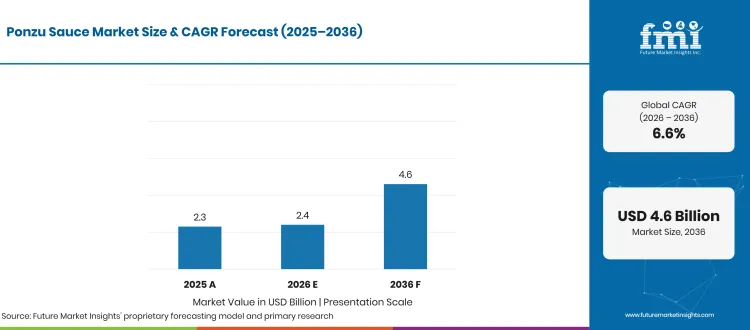
Starting from USD 2.3 billion in 2025, global ponzu sauce market valuation reached USD 2.4 billion in 2026 and is on course to touch USD 4.6 billion by 2036, advancing at a steady 6.6% CAGR over the decade. Steady consumer adoption across global dining formats generates an incremental market opportunity of USD 2.2 billion. Commercial kitchens and household pantries anchor this recurring sales momentum through year-round dipping and seasoning applications.
| Market Metric | Valuation / Share / Forecast Benchmark |
|---|---|
| 2025 Market Size (Historical) | USD 2.3 billion |
| 2026 Market Size (Estimated) | USD 2.4 billion |
| 2036 Market Size (Projected) | USD 4.6 billion |
| Compound Annual Growth Rate (2026 to 2036) | 6.6% CAGR |
| Incremental Dollar Opportunity (2026 to 2036) | USD 2.2 billion |
| Dominant Flavor Segment (2026 Share) | Traditional (38.0% share in 2026) | Other Segment Combined (62.0%) |
| Leading Nature Segment (2026 Share) | Conventional (63.0% share in 2026) | Other Segment Combined (37.0%) |
| Leading End-Use Segment (2026 Share) | Foodservice (38.0% share in 2026) | Other Segment Combined (62.0%) |
| Leading Packaging Format (2026 Share) | PET Bottle (63.0% share in 2026) | Other Segment Combined (37.0%) |
| Fastest-Growing Country Markets (2026 to 2036) | Japan (8.7% CAGR), South Korea (8.2% CAGR), India (7.8% CAGR) |
| Leading Tier-1 Companies | Kikkoman Corporation, Mizkan Holdings Co., Ltd., YAMASA CORPORATION, Morita Co., Ltd. |
Source: Future Market Insights analysis of the ponzu sauce market, 2026.
Executive Market Overview
Commercial kitchens and dining chains are actively switching from daily scratch preparation to bottled citrus-soy seasonings, aiming to control kitchen prep labor and maintain flavor consistency across locations. Squeezing fresh fruit and brewing dashi every morning creates operational bottlenecks, which explains why dining operators increasingly prioritize ready-to-pour bottles for table dipping and meat glazes. Looking at broader dining adoption, official survey figures released by the Ministry of Agriculture, Forestry and Fisheries of Japan (November 2025) confirm approximately 181,000 Japanese dining establishments operating outside Japan in 2025. Rising international interest in pan-Asian cuisine encourages chefs to pair bottled citrus seasonings with versatile soy food products across everyday appetizers and entree bowls. Steady menu adoption across Western and Asian dining markets establishes an expanding commercial buyer base for high-volume wholesale suppliers.
Retail brand owners encounter intense shelf competition across supermarket aisles, where generic citrus seasonings face downward pricing pressure unless manufacturers highlight genuine fruit provenance and functional packaging. Margin expansion depends on introducing premium yuzu and sudachi varieties that command higher retail prices within everyday culinary sauces and specialty sauces and condiments. Packaging updates also influence household turnover; Mizkan Holdings Co., Ltd. (April 2026) renewed its 190 ml bottle designs for Ajipon and Kaori no Kura Marushibori Yuzu at a reference price of JPY 370, specifically catering to smaller households wanting lightweight, easy-pour bottles. Market sizing tracks commercial revenues from retail bottles and bulk foodservice drums, while excluding table-service meals and unblended bulk vinegar.
This Report Answers
- How large the ponzu sauce market is in 2026 and what it reaches by 2036
- Which flavor, nature, end-use and packaging segments lead in 2026
- What is driving demand and what is holding the category back
- Which countries grow fastest between 2026 and 2036
- What Kikkoman Corporation and other leading players have launched
- How the ponzu sauce market is defined, segmented and measured
Analyst Perspective
"Ponzu sauce manufacturers will capture higher margin growth by locking in domestic yuzu and sudachi fruit supply while tailoring bottle ergonomics and acidity levels to specific meat and hot-pot occasions. The primary commercial risk is citrus harvest volatility and stricter allergen labeling enforcement in export markets, which can delay distributor qualification."
- Nandini Roy Choudhury, Principal Consultant, Future Market Insights (FMI)
Key Market Trends & Insights
- Upstream Citrus Farm Integration Secures Aromatic Fruit Supply: Japanese sauce makers are acquiring orchards directly to prevent regional citrus crop shortages from disrupting annual bottling runs. Securing dedicated multi-year harvests gives branded processors greater aroma stability and price protection over blenders that buy spot-market citrus extracts and synthetic food acidulants. Official prefecture records from the Tokushima Prefectural Government (September 2026) confirm that Mizkan Group founded Mizkan Farm in Mima on 1 August 2026, scheduling initial yuzu sapling planting for March 2027 to stabilize long-term fruit supply. Direct agricultural investment ensures steady raw material volume while insulating processors from seasonal price spikes.
- Acidity Calibration Widens Household and Convenience Meal Occasions: Condiment formulators are introducing milder kelp-infused recipes for families in addition to bolder, tart formulations for grilled meats. Calibrating acidity expands consumption beyond traditional winter hot pots into everyday salad dressings and pan-frying sauces. Product developments reflect this trend; Yamasa Corporation (July 2025) renewed its Kombu Ponzu Super Mild in 360 ml and 500 ml bottles featuring reduced acidity, while Mizkan Holdings Co., Ltd. (September 2026) collaborated with FamilyMart across 16,500 stores in September 2026 to launch Ajipon-seasoned fried chicken. Convenience partnerships and softened flavor profiles recruit younger consumers into the category.
- Cross-Category Brand Licensing and Beverage Extensions Expand Trial: Traditional Japanese condiment makers are expanding recognized citrus profiles into ready-to-drink alcoholic sours and snack seasonings to engage younger demographics. Co-branded convenience items boost grocery recognition and drive casual trial among shoppers who rarely buy specialty sauces. Corporate disclosures from Mizkan Holdings Co., Ltd. (June 2026) indicate that the Ajipon brand achieved 94% consumer recognition with over 2.5 billion cumulative bottles sold, while Mizkan Holdings Co., Ltd. (May 2025) introduced canned Ponzu Sour beverages across national supermarkets. Extending legacy sauce profiles into lifestyle snacking formats expands category visibility across diverse retail aisles.
What Are the Main Drivers, Restraints, and Opportunities?
Global expansion of Asian dining outlets and multi-use menu applications drive core condiment orders, whereas allergen labeling compliance and regional restaurant closures restrain unverified imports, leaving named-citrus and foodservice bulk formats as the primary growth opportunity.
Driver: Multi-Application Menu Versatility and International Japanese Dining Growth
Commercial kitchens purchase bottled ponzu because a single citrus-soy seasoning eliminates separate prep times for fresh citrus juice and seasoned soup stock. Standardized sweetness and umami balance shorten ticket times while delivering shelf-stable functional flavors that remain fresh during heavy lunch rushes. Commercial adoption gains proof from trade data from the Ministry of Agriculture, Forestry and Fisheries of Japan (November 2025), which shows Japanese dining outlets expanding by roughly 20% in Latin America (adding 2,400 venues) and 10% in Oceania during 2025. Rapid dining expansion creates steady wholesale demand for Otafuku Foods (2026) 63.9 fl oz commercial containers across international restaurant accounts.
Restraint: Mandatory Allergen Declarations and Regional Restaurant Rationalization
Exporting citrus-soy sauces requires rigorous compliance with foreign allergen regulations while managing elevated freight rates for glass-bottled liquids. Food authorities mandate prominent declarations for soy and wheat allergens, requiring exporters to adjust labeling layouts and audit their handling of specialty food ingredients. Regulatory guidance published by the U.S. Food and Drug Administration (January 2025) reinforces mandatory allergen cross-contact controls for imported seasonings, raising verification expenses for Asian exporters. Sudden dining downturns or local restaurant closures can also strand high-value finished inventory in overseas bonded warehouses.
Opportunity: Named-Citrus Provenance and Industrial Drum Supply for Prepared Foods
Condiment processors can capture premium profit margins by supplying single-origin citrus seasonings and bulk processing drums to prepared-meal manufacturers. Commercial buyers increasingly demand clean-label marinades formulated with pure citrus extracts and authentic natural flavors rather than artificial additives. Industrial food brands including Mizkan Holdings Co., Ltd. (2026) and Otafuku Foods (2026) incorporate bulk ponzu into meal kits and frozen noodle entrees to deliver distinctive umami profiles using verified clean label ingredients. Sourcing agreements with local citrus cooperatives enable processors to secure lucrative supply contracts with institutional commissaries seeking traceable regional ingredients.
How Is the Ponzu Sauce Market Segmented?
Ponzu Sauce Market is segmented by Flavor and Nature profiles as well as End-use and Packaging as well as Regional markets. Forecast period from 2026 to 2036.
| Segmentation Axis | Sub-Segments Covered | 2026 Leading Segment & Share | Other Segment Combined & Total |
|---|---|---|---|
| Flavor | Traditional, Yuzu Ponzu, Sudachi Ponzu, Kabosu Ponzu, Others | Traditional (38.0% share in 2026) | Other Segment Combined (62.0%) | Total (100.0%) |
| Nature | Conventional, Organic | Conventional (63.0% share in 2026) | Other Segment Combined (37.0%) | Total (100.0%) |
| End-use | Foodservice, Industry, Retail, Hypermarkets & Supermarkets, Convenience Stores | Foodservice (38.0% share in 2026) | Other Segment Combined (62.0%) | Total (100.0%) |
| Packaging | PET Bottle, Glass Bottle | PET Bottle (63.0% share in 2026) | Other Segment Combined (37.0%) | Total (100.0%) |
| Region | North America, Latin America, Western Europe, Eastern Europe, East Asia, South Asia and Pacific, Middle East and Africa | East Asia (led by Japan at 8.7% CAGR) | Global Coverage Across 7 Core Countries (100.0%) |
Source: Future Market Insights analysis of the ponzu sauce market, 2026.
Why Does the Traditional Segment Lead by Flavor?
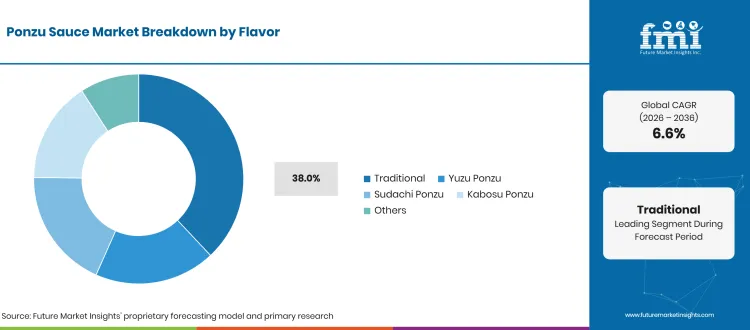
Traditional recipes capture a leading 38.0% share of Flavor revenue in 2026, reflecting steady household and restaurant preference for balanced citrus-soy seasoning that complements dining dishes without overpowering subtle meat textures. Families and commercial kitchens regard this classic formulation as an essential staple condiment, giving it dependable reorder volume throughout the year. Product guidelines from Kikkoman Corporation (2026) highlight that genuine citrus-seasoned soy sauce delivers unmatched versatility across daily cooking, while marketing initiatives by Mizkan Holdings Co., Ltd. (October 2026) promote traditional citrus blends for family dinners. Deep consumer familiarity and universal kitchen utility will keep Traditional recipes at the forefront of category sales through 2036.
What Keeps the Conventional Segment Ahead Within Nature?
Conventional sourcing secures a dominant 63.0% revenue share in 2026, outpacing certified organic options because accessible raw ingredient supplies keep retail prices attractive for everyday shoppers. High-volume restaurant chains favor conventional soy and citrus components to protect plate margins while purchasing large volumes. Industrial formulators combine conventional brewed soy bases with fermented foods and beverages to guarantee consistent flavor across extensive manufacturing batches. While specialty brands like Gold Mine Natural Foods (2026) distribute organic MUSO From Japan bottles for natural grocers, conventional products dominate high-volume distribution channels. Favorable procurement economics and stable bulk supplies will ensure Conventional lines lead overall production volume through 2036.
How Does the Foodservice Segment Shape End-use Demand?
Foodservice accounts for 38.0% of End-use demand in 2026, anchoring category sales as multi-unit restaurant operators buy ready-made citrus dressings to speed up table service. Kitchen operators avoid time-consuming fruit squeezing and dashi preparation by utilizing consistent bottled seasonings across dipping bowls and grilled specialties. Commercial packaging sheets from Otafuku Foods (2026) detailing 1.8 L and 63.9 fl oz containers demonstrate how manufacturers engineer durable jugs for fast-paced commercial kitchens. Expanding Asian dining concepts and sustained restaurant patronage will drive steady commercial shipments across hospitality networks through 2036.
Why Is the PET Bottle Segment the Leading Packaging Format?
PET Bottle formats capture 63.0% of packaging sales in 2026, leading shipping volumes because lightweight plastic reduces container weight and prevents transit breakage during intercontinental distribution. Everyday consumers appreciate squeeze dispensing that eliminates messy drips, while industrial shippers combine lightweight bottles with cubitainer packaging for bulk logistics. Packaging announcements from Mizkan Holdings Co., Ltd. (April 2026) presenting 190 ml bottle designs highlight ongoing efforts to optimize container ergonomics while preserving delicate citrus aromas. Lower distribution expenses and superior shelf durability will secure PET Bottle leadership across retail and foodservice sectors through 2036.
Regional & Country Outlook
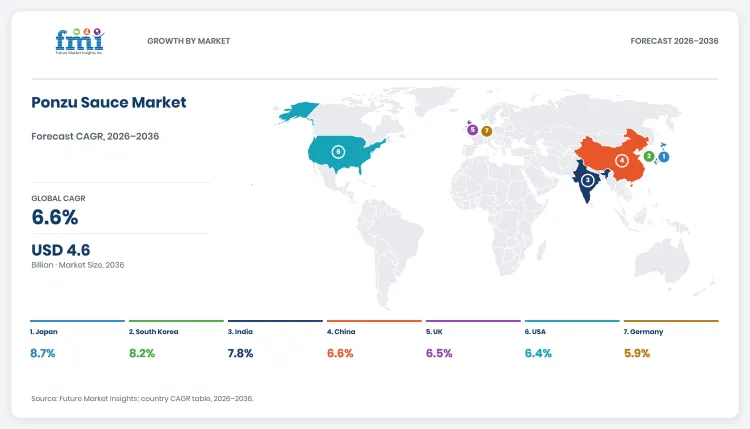
East Asia and North America anchor global ponzu sauce revenue, while South Asia and Western Europe post rapid percentage gains as Japanese dining and specialty retail assortments widen.FMI projects Japan to lead national growth rates at an 8.7% CAGR from 2026 to 2036, followed closely by South Korea at 8.2% and India at 7.8%. China expands at 6.6%, the UK at 6.5%, the USA at 6.4%, and Germany at 5.9%, creating a 2.8 percentage point spread across the seven profiled markets as suppliers align pack sizes and allergen labels with local distribution channels.
| Country | 2026 Revenue | 2036 Revenue | 10-Year Addition | 2026 to 2036 CAGR | Global Share (2026 -> 2036) |
|---|---|---|---|---|---|
| Japan | USD 840.0 million | USD 1,934.5 million | +USD 1,094.5 million | 8.7% | 35.0% -> 42.1% |
| South Korea | USD 264.0 million | USD 580.6 million | +USD 316.6 million | 8.2% | 11.0% -> 12.6% |
| India | USD 72.0 million | USD 152.6 million | +USD 80.6 million | 7.8% | 3.0% -> 3.3% |
| China | USD 360.0 million | USD 682.1 million | +USD 322.1 million | 6.6% | 15.0% -> 14.8% |
| UK | USD 120.0 million | USD 225.2 million | +USD 105.2 million | 6.5% | 5.0% -> 4.9% |
| USA | USD 432.0 million | USD 803.3 million | +USD 371.3 million | 6.4% | 18.0% -> 17.5% |
| Germany | USD 96.0 million | USD 170.3 million | +USD 74.3 million | 5.9% | 4.0% -> 3.7% |
Source: Future Market Insights analysis of the ponzu sauce market, 2026.
Japan
Demand for ponzu sauce across Japan is projected to rise from USD 840.0 million in 2026 to USD 1,934.5 million by 2036, advancing at an 8.7% CAGR and adding USD 1,094.5 million in new category value. Domestic sales growth outpaces unit volume as household cooks trade up to unpasteurized seasonal juices like Kikkoman Corporation (2026) Freshly Squeezed Raw Ponzu and regional fruit blends from Morita Co., Ltd. (2026). Official prefecture records from the Tokushima Prefectural Government (September 2026) confirm that Mizkan established dedicated orchards in Mima to stabilize regional yuzu sourcing for future sauce manufacturing. Vertical agricultural integration and premium tabletop bottles will support higher revenue generation across Japanese grocery stores through 2036.
South Korea
Buyer adoption of ponzu sauce throughout South Korea is estimated to expand from USD 264.0 million in 2026 to USD 580.6 million by 2036, spurred by an 8.2% CAGR that contributes USD 316.6 million in expansion revenue. Expanding networks of shabu-shabu restaurants and casual seafood bars generate continuous wholesale demand for citrus-infused soy condiments. Official restaurant surveys from the Ministry of Agriculture, Forestry and Fisheries of Japan (November 2025) recorded roughly 19,800 Japanese dining venues across South Korea in 2025, adding 1,590 locations over earlier survey counts. Sustained restaurant growth and supermarket promotions for home hot-pot cooking will support repeat commercial orders across South Korea through 2036.
India
Ponzu sauce industry across India is set to scale from USD 72.0 million in 2026 to USD 152.6 million by 2036, driven by a 7.8% CAGR and generating USD 80.6 million in incremental sales. Culinary adoption expands through metropolitan Asian fine-dining restaurants and rapid grocery delivery apps introducing Japanese flavorings to urban households. Trade monitoring from the Ministry of Agriculture, Forestry and Fisheries of Japan (November 2025) identified approximately 630 Japanese dining outlets across India in 2025, showing an increase of 220 venues. Regulatory rules from the Food Safety and Standards Authority of India (2026) require clear vegetarian certification labels on imported containers, favoring seaweed-seasoned citrus formulas in major culinary hubs through 2036.
China
Sales of ponzu sauce throughout China are projected to increase from USD 360.0 million in 2026 to USD 682.1 million by 2036, progressing at a 6.6% CAGR and creating USD 322.1 million in commercial revenue. Sauce suppliers are shifting commercial focus from formal standalone dining venues toward retail supermarket shelves and regional casual chains. Market surveys from the Ministry of Agriculture, Forestry and Fisheries of Japan (November 2025) counted approximately 63,500 Japanese restaurants across China in 2025 as unprofitable venues exited the market. Condiment makers offering cost-effective family bottles and bulk catering packs will capture reliable sales growth across Chinese urban centers through 2036.
UK
Consumption of ponzu sauce within the UK is estimated to climb from USD 120.0 million in 2026 to USD 225.2 million by 2036, reflecting a 6.5% CAGR that adds USD 105.2 million in market value. Category growth benefits from expanding supermarket world-food aisles and local contract bottling operations catering to commercial restaurant chains. Industry reports from the Ministry of Agriculture, Forestry and Fisheries of Japan (November 2025) noted roughly 1,820 Japanese dining locations across the UK in 2025, reflecting an addition of 560 locations. Retail distribution from Kikkoman UK (2026) marketing table bottles paired with custom culinary compounding by Shoda Sauces Europe Company Limited (2026) will sustain steady UK buyer demand through 2036.
USA
Revenue generated by ponzu sauce suppliers across the USA is forecast to expand from USD 432.0 million in 2026 to USD 803.3 million by 2036, anchored by a 6.4% CAGR and creating USD 371.3 million in new business. Broad adoption across sushi bars, poke eateries, and fusion barbecue menus provides a solid volume base for domestic sauce makers. Data from the Ministry of Agriculture, Forestry and Fisheries of Japan (November 2025) identified roughly 26,360 Japanese dining venues across the USA in 2025, while Kikkoman Corporation (2026) expanded regional manufacturing with its Jefferson facility. Expanding localized bottling operations and commercial drum distribution will reinforce American restaurant and supermarket adoption through 2036.
Germany
Buyer procurement of ponzu sauce within Germany is tracking from USD 96.0 million in 2026 to USD 170.3 million by 2036, exhibiting a 5.9% CAGR that contributes USD 74.3 million to national value. German volume growth centers on urban sushi venues and specialty food importers seeking shelf-stable dressings compliant with European food law. Official records from the Ministry of Agriculture, Forestry and Fisheries of Japan (November 2025) recorded 1,510 Japanese restaurants across Germany in 2025, showing a gain of 290 dining spots. Mandatory European Commission (2026) ingredient labeling guidelines govern imported soy products, encouraging compliant Asian sauce exporters to expand their German distribution through 2036.
Competitive Environment and Notable Companies
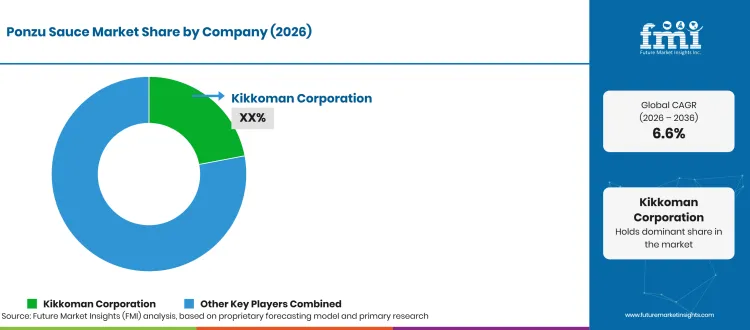
Notable companies operating in the global ponzu sauce market includeKikkoman Corporation, Mizkan Holdings Co., Ltd., YAMASA CORPORATION, Morita Co., Ltd., Gold Mine Natural Foods, Lee Kum Kee, Shoda Sauces Europe Company Limited, Marukan Vinegar (U.S.A) Inc., Otafuku Foods, and Yamasan Ltd. Competition spans three commercial tiers across Japanese branded citrus-soy formulators, North American and European foodservice and industrial sauce manufacturers, and specialty organic or export-oriented distributors.
How Are Companies Positioned in the Ponzu Sauce Market?
Japanese heritage brewers including Kikkoman Corporation, Mizkan Holdings Co., Ltd., YAMASA CORPORATION, andMorita Co., Ltd. (2026) anchor domestic retail and culinary positioning through multi-citrus and sudachi citrus product lines. In North America and Europe, Marukan Vinegar (U.S.A) Inc. (2026), Otafuku Foods (2026), Lee Kum Kee, and Shoda Sauces Europe Company Limited supply localized retail bottles, restaurant jugs, and industrial drums, while Gold Mine Natural Foods and Yamasan Ltd. (2026) target organic and specialty export channels.
What Matters When a Buyer Selects a Ponzu Sauce Supplier?
Procurement teams evaluate suppliers on citrus aroma retention across shelf life, batch-to-batch pH and salt uniformity, verified soy and wheat allergen documentation, and landed cost per serving. Multi-unit restaurant buyers prioritize1.8 L and 63.9 fl oz shatterproof PET containers from Otafuku Foods and Kikkoman Corporation to minimize kitchen waste, whereas industrial prepared-meal processors require bulk specification sheets and audit compliance under U.S. Food and Drug Administration (January 2025) and Food Safety and Standards Authority of India (2026) import frameworks.
Which Capabilities Distinguish Product Offers?
Product differentiation centers on named fruit varieties, thermal processing controls, and dietary certifications.Mizkan Asia Pacific (2026) highlights whole-pressed Kochi yuzu in its Kaori no Kura line, while Kikkoman Corporation markets unheated Freshly Squeezed Raw Ponzu made with four domestic citrus fruits. Otafuku Sauce Co., Ltd. (2026) formulates a vegan-certified three-citrus retail sauce (yuzu and sudachi citrus), and Gold Mine Natural Foods distributes USDA-organic certified MUSO From Japan ponzu without artificial preservatives.
How Does Geographic Reach Affect Competition?
Suppliers with local manufacturing or bottling footprints avoid ocean freight surcharges and adapt label declarations faster to national regulations. Kikkoman Corporation operates North American soy and seasoning plants in Wisconsin and California with UK distribution, while Otafuku Foods manufactures foodservice ponzu in the United States and Shoda Sauces Europe Company Limited operates production facilities in the United Kingdom. Smaller Japanese exporters such as Yamasan Ltd. rely on cross-border e-commerce and specialty wholesalers to reach overseas chefs.
| Verified Company Evidence (2025 to 2026) | Commercial Effect | Buyer Action |
|---|---|---|
| September 2026: Mizkan Holdings Co., Ltd. established Mizkan Farm in Mima, Tokushima (August 2026) with yuzu planting scheduled for March 2027 (Tokushima Prefectural Government, September 2026). | Secures long-term domestic processing-yuzu fruit supply for Kaori no Kura and citrus-soy lines. | Evaluate multi-year supply stability when contracting named-citrus yuzu ponzu SKUs. |
| September 2026: Mizkan Holdings Co., Ltd. collaborated with FamilyMart across 16,500 stores in Japan to launch Famikara Ajipon-flavored fried chicken (Mizkan Holdings Co., Ltd., September 2026). | Demonstrates citrus-soy seasoning performance in hot fried foodservice and convenience applications. | Test concentrated citrus-soy marinades and glazes across hot-deli and quick-service poultry menus. |
| July 2025: Yamasa Corporation reformulated its Kombu Ponzu Super Mild in 360 ml and 500 ml bottles with adjusted citrus juice and milder acidity (Yamasa Corporation, July 2025). | Broadens household appeal among families and children sensitive to sharp vinegar acidity. | Stock mild kelp-citrus variants with standard ponzu to capture family grocery baskets. |
Source: Verified corporate disclosures and Future Market Insights analysis, 2026.
| Company | Core Positioning | Verified Activity & Source Attribution |
|---|---|---|
| Kikkoman Corporation | Retail and foodservice citrus-soy ponzu; multi-citrus raw ponzu | Expanded North American production with its Jefferson, Wisconsin plant opening in 2026; markets Freshly Squeezed Raw Ponzu and UK Lemon Ponzu (Kikkoman Corporation, 2026). |
| Mizkan Holdings Co., Ltd. | Ajipon and Kaori no Kura yuzu ponzu; upstream yuzu cultivation | Renewed 190 ml Ajipon and Kaori no Kura bottles in April 2026; established Mizkan Farm in Tokushima in 2026 (Mizkan Holdings Co., Ltd., April 2026). |
| YAMASA CORPORATION | Kombu-infused household ponzu in 360 ml and 500 ml PET bottles | Reformulated Kombu Ponzu Super Mild in July 2025 for nationwide shipment starting August 2025 (Yamasa Corporation, July 2025). |
| Morita Co., Ltd. | Sudachi-flavored and traditional brewed soy ponzu sauces | Supplies Tokushima sudachi-flavored ponzu and brewed soy condiments for domestic and export channels (Morita Co., Ltd., 2026). |
| Gold Mine Natural Foods | United States specialty distributor of organic Japanese ponzu | Distributes certified-organic MUSO From Japan Organic Ponzu in 8.5 fl oz glass bottles (Gold Mine Natural Foods, 2026). |
| Lee Kum Kee | Industrial and commercial Asian sauce manufacturer | Supplies Ponzu Sauce in 55-gallon drums for North American industrial food processors (Lee Kum Kee, 2026). |
| Shoda Sauces Europe Company Limited | United Kingdom custom sauce formulator and manufacturer | Produces commercial ponzu, dressings, and marinades for UK and European foodservice and B2B clients (Shoda Sauces Europe Company Limited, 2026). |
| Marukan Vinegar (U.S.A) Inc. | United States brewer of yuzu and sudachi ponzu dressings | Markets Yuzu Ponzu and Sudachi Ponzu premium soy dressing variants across US retail channels (Marukan Vinegar (U.S.A) Inc., 2026). |
| Otafuku Foods | US foodservice and Japanese retail vegan citrus-blend ponzu | Produces 63.9 fl oz US foodservice ponzu and 1.8 L wholesale / 300 ml vegan three-citrus retail sauces (Otafuku Foods, 2026). |
| Yamasan Ltd. | Kyoto-based international exporter of yuzu-blend ponzu | Markets Yuzu Blend Ponzu Sauce directly to international culinary and retail buyers (Yamasan Ltd., 2026). |
Source: Verified corporate disclosures and Future Market Insights analysis, 2026.
Key takeaways
- Valued at USD 2.4 billion in 2026, on course for USD 4.6 billion by 2036.
- The decade adds USD 2.2 billion in new value at a 6.6% CAGR.
- The flavor segment is led by Traditional at 38.0% of 2026 revenue.
- 63.0% of nature revenue goes to Conventional in 2026.
- Japan grows fastest at 8.7% CAGR, ahead of South Korea at 8.2%.
Ponzu Sauce Market Report Scope and Research Methodology
FMI analysts size the global ponzu sauce market through primary interviews with condiment manufacturers, foodservice distributors, restaurant procurement managers, and retail category buyers, combined with desk research across ministry restaurant surveys, customs records, allergen regulations, and corporate filings. core 2025 and 2026 valuations reconcile bottled retail sales, foodservice jugs, and industrial drum shipments across all seven tracked countries and regional clusters. Segment shares across Flavor and Nature axes as well as End-use and Packaging are reconciled with verified SKU portfolios and commercial pack specifications, while excluding finished restaurant dishes, unseasoned soy sauce, plain vinegar, and empty containers to prevent double counting.
| Coverage Field | Report Scope |
|---|---|
| Market Definition | Revenue from packaged, foodservice, and industrial ponzu sauce formulations sold as citrus-seasoned soy or citrus-vinegar condiments. |
| Flavor Segments | Traditional, Yuzu Ponzu, Sudachi Ponzu, Kabosu Ponzu, and Others. |
| Nature Segments | Conventional and Organic. |
| End-Use Segments | Foodservice, Industry, Retail, Hypermarkets & Supermarkets, and Convenience Stores. |
| Packaging Formats | PET Bottle and Glass Bottle (plus bulk foodservice and industrial drums within commercial supply). |
| Exclusions | Finished restaurant dishes, downstream prepared meals, plain soy sauce, unblended vinegar, and empty packaging containers. |
| Quantitative Units | USD Billion for global market sizing; USD Million for country-level breakdowns. |
| Historical & Base Years | 2025 (Historical) and 2026 (Estimated Base Year). |
| Forecast Period | 2026 to 2036 (10-Year Projection Window). |
| Regions Covered | North America, Latin America, Western Europe, Eastern Europe, East Asia, South Asia and Pacific, and Middle East and Africa. |
| Countries Profiled | Japan, South Korea, India, China, UK, USA, and Germany. |
| Companies Covered | Kikkoman Corporation, Mizkan Holdings Co., Ltd., YAMASA CORPORATION, Morita Co., Ltd., Gold Mine Natural Foods, Lee Kum Kee, Shoda Sauces Europe Company Limited, Marukan Vinegar (U.S.A) Inc., Otafuku Foods, and Yamasan Ltd. |
| Research Approach | Primary buyer and manufacturer interviews combined with secondary regulatory, trade, and corporate disclosure triangulation. |
Source: Future Market Insights analysis of the ponzu sauce market, 2026.
Research Sources and Bibliography
- European Commission. (2026).Food Information to Consumers: Legislation. https://food.ec.europa.eu/food-safety/labelling-and-nutrition/food-information-consumers-legislation_en
- Food Safety and Standards Authority of India. (2026).Food Safety and Standards (Import) Regulation: Amendments. https://fssai.gov.in/food-law/regulations/amendments/import
- Food Safety and Standards Authority of India. (2026).Food Safety and Standards (Labelling and Display) Regulations: Amendments. https://www.fssai.gov.in/food-law/regulations/amendments/labelling-display
- Gold Mine Natural Foods. (2026).MUSO From Japan Organic Ponzu, 8.5 fl oz. https://www.goldminenaturalfoods.com/products/1105-1008
- Kikkoman Corporation. (2026).Freshly Squeezed Raw Ponzu: Product Information. https://www.kikkoman.co.jp/products/K15/detail/K152540.html
- Kikkoman Corporation. (2026).Ponzu Sauce: Seasoning Glossary. https://www.kikkoman.com/en/cookbook/glossary/ponzu.html
- Kikkoman Corporation. (2026).Soy Sauce Business and North American Production Facilities. https://www.kikkoman.com/en/corporate/business/soysauce/
- Kikkoman UK. (2026).Ponzu Citrus Seasoned Soy Sauce, Lemon. https://www.kikkoman.co.uk/products/detail/kikkoman-ponzu-citrus-seasoned-soy-sauce-lemon
- Lee Kum Kee. (2026).Ponzu Sauce for Industrial Applications. https://usa.lkk.com/en/industrial/products/ponzu-sauce
- Marukan Vinegar (U.S.A) Inc.. (2026).Ponzu Product Range: Yuzu and Sudachi Dressings. https://www.marukan-usa.com/our-products/ponzu/
- Ministry of Agriculture, Forestry and Fisheries of Japan. (2025, November 28).2025 Survey of Japanese Restaurants Overseas. https://www.maff.go.jp/j/press/yusyutu_kokusai/kaitaku/251128.html
- Ministry of Agriculture, Forestry and Fisheries of Japan. (2025, November 28).Japanese Restaurant Counts by Country and Region, 2025. https://www.maff.go.jp/j/press/yusyutu_kokusai/kaitaku/attach/pdf/251128-2.pdf
- Mizkan Asia Pacific. (2026).Kaori no Kura Premium Yuzu Ponzu: Product Information. https://mizkan.asia/features/premium-yuzu-ponzu-kaorinokura
- Mizkan Holdings Co., Ltd.. (2025, May 13).Nationwide Rollout of Ponzu Sour Citrus Beverage. https://www.mizkan.co.jp/file.jsp?id=2021_Renewal/files/pdf/company/newsrelease/detail/newsrelease-250513-70.pdf
- Mizkan Holdings Co., Ltd.. (2026, April 17).190 ml Bottle Renewal for Ajipon and Kaori no Kura Marushibori Yuzu. https://www.mizkan.co.jp/file.jsp?id=2021_Renewal/files/pdf/company/newsrelease/detail/newsrelease-260417-70.pdf
- Mizkan Holdings Co., Ltd.. (2026, June 10).Ajipon Brand 62nd Anniversary and Licensing Expansion Beyond 2.5 Billion Bottles. https://www.mizkan.co.jp/file.jsp?id=2021_Renewal/files/pdf/company/newsrelease/detail/newsrelease-260610-70.pdf
- Mizkan Holdings Co., Ltd.. (2026, September 1).Ajipon and FamilyMart Collaboration on Famikara Ajipon Flavor Across 16,500 Stores. https://www.mizkan.co.jp/file.jsp?id=2021_Renewal/files/pdf/company/newsrelease/detail/newsrelease-260901-72-B.pdf
- Mizkan Holdings Co., Ltd.. (2026, October 29).Ajipon and Shime-Nabe Nationwide Retail Snack Collaboration. https://www.mizkan.co.jp/file.jsp?id=2021_Renewal/files/pdf/company/newsrelease/detail/newsrelease-261029-70.pdf
- Mizkan Holdings Co., Ltd.. (2026, November 10).Ponmatsuri FES 2026 Campaign for Ajipon Day. https://www.mizkan.co.jp/file.jsp?id=2021_Renewal/files/pdf/company/newsrelease/detail/newsrelease-261110-70.pdf
- Morita Co., Ltd.. (2026).Japanese Ponzu and Sauces Portfolio. https://moritakk.com/en/products/sauce/
- Morita Co., Ltd.. (2026).Sudachi-Flavored Ponzu Product Information. https://moritakk.com/products/tare/ponzu
- Otafuku Foods. (2026).About Otafuku Foods and US Operations. https://otafukufoods.com/pages/about-us
- Otafuku Foods. (2026).Ponzu Sauce 63.9 fl oz: Foodservice Product. https://otafukufoods.com/collections/sushi/products/ponzu-sauce
- Otafuku Sauce Co., Ltd.. (2026).Ponzu: Retail Product Information. https://www.otafukusauce.com/e/products/retail/018.html
- Otafuku Sauce Co., Ltd.. (2026).Ponzu: Wholesale 1.8 L Product Information. https://www.otafukusauce.com/e/products/wholesale/013.html
- Shoda Sauces Europe Company Limited. (2026).Sauces, Dressings and Marinades Manufacturing. https://shodasauceseu.com/sauces-dressing-and-marinades/
- Tokushima Prefectural Government. (2026, September 17).Mizkan Group Establishes Agricultural Operation Mizkan Farm in Mima. https://www.pref.tokushima.lg.jp/ippannokata/sangyo/nogyo/7316441/
- U.S. Food and Drug Administration. (2025, January 6).Frequently Asked Questions: Food Allergen Labeling Guidance for Industry. https://www.fda.gov/food/food-allergensgluten-free-guidance-documents-regulatory-information/frequently-asked-questions-food-allergen-labeling-guidance-industry
- Yamasa Corporation. (2025, July 18).Kombu Ponzu Super Mild Reformulation Announcement. https://www.yamasa.com/news/2025/konbuponzu-2/index.html
- Yamasan Ltd.. (2026).Ponzu Sauce (Yuzu Blend) Product Specification. https://www.kyotoyamasan.com/product/ponzu-sauce-yuzu-blend/
Table of Content
- Key Takeaways
- Market Size and CAGR
- Top Growth Driver
- Fastest Growing Segment
- Leading Region
- Key Companies
- Emerging Opportunities
- Executive Summary
- Global Market Outlook
- Demand-side Trends
- Supply-side Trends
- Technology Roadmap Analysis
- Analysis and Recommendations
- Analyst Perspective (What is happening? Why now? What should investors know?)
- Key Questions Answered
- How large is the market?
- What is the CAGR?
- What are key trends?
- Which region dominates?
- Who are the leaders?
Read More...
- Market Overview
- Market Coverage / Taxonomy
- Market Definition / Scope / Limitations
- Research Methodology
- Chapter Orientation
- Analytical Lens and Working Hypotheses
- Market Structure, Signals, and Trend Drivers
- Benchmarking and Cross-market Comparability
- Market Sizing, Forecasting, and Opportunity Mapping
- Research Design and Evidence Framework
- Desk Research Programme (Secondary Evidence)
- Expert Input and Fieldwork (Primary Evidence)
- Tooling, Models, and Reference Databases
- Data Engineering and Model Build
- Quality Assurance and Audit Trail
- Market Background
- Market Dynamics (Drivers, Restraints, Opportunity, Trends)
- Scenario Forecast (Optimistic, Likely, Conservative)
- Impact Analysis
- AI Impact
- Sustainability Impact
- Regulatory Impact
- Technology Impact
- Consumer / Buyer Analysis
- Purchase Drivers
- Adoption Barriers
- Buyer Journey
- Opportunity Map Analysis
- Product Life Cycle Analysis
- Supply Chain Analysis
- Investment Feasibility Matrix
- Value Chain Analysis
- PESTLE and Porter's Analysis
- Regulatory Landscape
- Regional Parent Market Outlook
- Production and Consumption Statistics
- Import and Export Statistics
- Global Market Analysis and Forecast, 2021 to 2036
- Historical Market Size Value (USD Billion) Analysis, 2021 to 2025
- Current and Future Market Size Value (USD Billion) Projections, 2026 to 2036
- Y-o-Y Growth Trend Analysis
- Absolute $ Opportunity Analysis
- Global Market Pricing Analysis, 2021 to 2036
- Global Market Analysis and Forecast, By Flavor, 2021 to 2036
- Introduction / Key Findings
- Historical Market Size Value (USD Billion) Analysis By Flavor, 2021 to 2025
- Current and Future Market Size Value (USD Billion) Analysis and Forecast By Flavor, 2026 to 2036
- Traditional
- Yuzu Ponzu
- Sudachi Ponzu
- Kabosu Ponzu
- Others
- Y-o-Y Growth Trend Analysis By Flavor, 2021 to 2025
- Absolute $ Opportunity Analysis By Flavor, 2026 to 2036
- Global Market Analysis and Forecast, By Nature, 2021 to 2036
- Introduction / Key Findings
- Historical Market Size Value (USD Billion) Analysis By Nature, 2021 to 2025
- Current and Future Market Size Value (USD Billion) Analysis and Forecast By Nature, 2026 to 2036
- Conventional
- Organic
- Y-o-Y Growth Trend Analysis By Nature, 2021 to 2025
- Absolute $ Opportunity Analysis By Nature, 2026 to 2036
- Global Market Analysis and Forecast, By End-use, 2021 to 2036
- Introduction / Key Findings
- Historical Market Size Value (USD Billion) Analysis By End-use, 2021 to 2025
- Current and Future Market Size Value (USD Billion) Analysis and Forecast By End-use, 2026 to 2036
- Foodservice
- Industry
- Retail
- Hypermarkets & Supermarkets
- Convenience Stores
- Y-o-Y Growth Trend Analysis By End-use, 2021 to 2025
- Absolute $ Opportunity Analysis By End-use, 2026 to 2036
- Global Market Analysis and Forecast, By Packaging, 2021 to 2036
- Introduction / Key Findings
- Historical Market Size Value (USD Billion) Analysis By Packaging, 2021 to 2025
- Current and Future Market Size Value (USD Billion) Analysis and Forecast By Packaging, 2026 to 2036
- PET Bottle
- Glass Bottle
- Y-o-Y Growth Trend Analysis By Packaging, 2021 to 2025
- Absolute $ Opportunity Analysis By Packaging, 2026 to 2036
- Global Market Analysis and Forecast, By Region, 2021 to 2036
- Introduction
- Historical Market Size Value (USD Billion) Analysis By Region, 2021 to 2025
- Current Market Size Value (USD Billion) Analysis and Forecast By Region, 2026 to 2036
- North America
- Western Europe
- East Asia
- South Asia and Pacific
- Market Attractiveness Analysis By Region
- North America Market Analysis and Forecast, By Country, 2021 to 2036
- Historical Market Size Value (USD Billion) Trend Analysis By Market Taxonomy, 2021 to 2025
- Market Size Value (USD Billion) Forecast By Market Taxonomy, 2026 to 2036
- By Country
- United States
- Canada
- By Flavor
- By Nature
- By End-use
- By Packaging
- By Country
- Market Attractiveness Analysis
- By Country
- By Flavor
- By Nature
- By End-use
- By Packaging
- Key Takeaways
- Western Europe Market Analysis and Forecast, By Country
- Historical Market Size Value (USD Billion) Trend Analysis By Market Taxonomy, 2021 to 2025
- Market Size Value (USD Billion) Forecast By Market Taxonomy, 2026 to 2036
- By Country
- United Kingdom
- Germany
- France
- By Flavor
- By Nature
- By End-use
- By Packaging
- By Country
- Market Attractiveness Analysis
- By Country
- By Flavor
- By Nature
- By End-use
- By Packaging
- Key Takeaways
- East Asia Market Analysis and Forecast, By Country
- Historical Market Size Value (USD Billion) Trend Analysis By Market Taxonomy, 2021 to 2025
- Market Size Value (USD Billion) Forecast By Market Taxonomy, 2026 to 2036
- By Country
- China
- Japan
- South Korea
- By Flavor
- By Nature
- By End-use
- By Packaging
- By Country
- Market Attractiveness Analysis
- By Country
- By Flavor
- By Nature
- By End-use
- By Packaging
- Key Takeaways
- South Asia and Pacific Market Analysis and Forecast, By Country
- Historical Market Size Value (USD Billion) Trend Analysis By Market Taxonomy, 2021 to 2025
- Market Size Value (USD Billion) Forecast By Market Taxonomy, 2026 to 2036
- By Country
- India
- Australia
- Rest of world aggregate
- By Flavor
- By Nature
- By End-use
- By Packaging
- By Country
- Market Attractiveness Analysis
- By Country
- By Flavor
- By Nature
- By End-use
- By Packaging
- Key Takeaways
- Key Countries Market Analysis
- United States
- Pricing Analysis
- Market Share Analysis, 2025
- By Flavor
- By Nature
- By End-use
- By Packaging
- Canada
- Pricing Analysis
- Market Share Analysis, 2025
- By Flavor
- By Nature
- By End-use
- By Packaging
- Germany
- Pricing Analysis
- Market Share Analysis, 2025
- By Flavor
- By Nature
- By End-use
- By Packaging
- United Kingdom
- Pricing Analysis
- Market Share Analysis, 2025
- By Flavor
- By Nature
- By End-use
- By Packaging
- France
- Pricing Analysis
- Market Share Analysis, 2025
- By Flavor
- By Nature
- By End-use
- By Packaging
- India
- Pricing Analysis
- Market Share Analysis, 2025
- By Flavor
- By Nature
- By End-use
- By Packaging
- China
- Pricing Analysis
- Market Share Analysis, 2025
- By Flavor
- By Nature
- By End-use
- By Packaging
- Japan
- Pricing Analysis
- Market Share Analysis, 2025
- By Flavor
- By Nature
- By End-use
- By Packaging
- South Korea
- Pricing Analysis
- Market Share Analysis, 2025
- By Flavor
- By Nature
- By End-use
- By Packaging
- Australia
- Pricing Analysis
- Market Share Analysis, 2025
- By Flavor
- By Nature
- By End-use
- By Packaging
- United States
- Market Structure Analysis
- Competition Dashboard
- Competition Benchmarking
- Market Share Analysis of Top Players
- By Regional
- By Flavor
- By Nature
- By End-use
- By Packaging
- Emerging Startups
- Innovation Benchmarking
- Competition Analysis
- Competition Deep Dive
- Kikkoman Corporation
- Overview
- Product Portfolio
- Profitability by Market Segments
- Sales Footprint
- Strategy Overview
- Marketing Strategy
- Product Strategy
- Channel Strategy
- Mizkan Holdings Co., Ltd.
- YAMASA CORPORATION
- Morita Co., Ltd.
- Gold Mine Natural Foods
- Lee Kum Kee
- Shoda Sauces Europe Company Limited
- Marukan Vinegar (U.S.A) Inc.
- Otafuku Foods
- Yamasan Ltd.
- Kikkoman Corporation
- Case Studies
- Success Stories
- Recent Developments
- Competition Deep Dive
- Assumptions & Acronyms Used
List of Tables
- Table 1: Global Market Value (USD Billion) Forecast by Region, 2021 to 2036
- Table 2: Global Market Value (USD Billion) Forecast by Flavor, 2021 to 2036
- Table 3: Global Market Value (USD Billion) Forecast by Nature, 2021 to 2036
- Table 4: Global Market Value (USD Billion) Forecast by End-use, 2021 to 2036
- Table 5: Global Market Value (USD Billion) Forecast by Packaging, 2021 to 2036
- Table 6: North America Market Value (USD Billion) Forecast by Country, 2021 to 2036
- Table 7: North America Market Value (USD Billion) Forecast by Flavor, 2021 to 2036
- Table 8: North America Market Value (USD Billion) Forecast by Nature, 2021 to 2036
- Table 9: North America Market Value (USD Billion) Forecast by End-use, 2021 to 2036
- Table 10: North America Market Value (USD Billion) Forecast by Packaging, 2021 to 2036
- Table 11: Western Europe Market Value (USD Billion) Forecast by Country, 2021 to 2036
- Table 12: Western Europe Market Value (USD Billion) Forecast by Flavor, 2021 to 2036
- Table 13: Western Europe Market Value (USD Billion) Forecast by Nature, 2021 to 2036
- Table 14: Western Europe Market Value (USD Billion) Forecast by End-use, 2021 to 2036
- Table 15: Western Europe Market Value (USD Billion) Forecast by Packaging, 2021 to 2036
- Table 16: East Asia Market Value (USD Billion) Forecast by Country, 2021 to 2036
- Table 17: East Asia Market Value (USD Billion) Forecast by Flavor, 2021 to 2036
- Table 18: East Asia Market Value (USD Billion) Forecast by Nature, 2021 to 2036
- Table 19: East Asia Market Value (USD Billion) Forecast by End-use, 2021 to 2036
- Table 20: East Asia Market Value (USD Billion) Forecast by Packaging, 2021 to 2036
- Table 21: South Asia and Pacific Market Value (USD Billion) Forecast by Country, 2021 to 2036
- Table 22: South Asia and Pacific Market Value (USD Billion) Forecast by Flavor, 2021 to 2036
- Table 23: South Asia and Pacific Market Value (USD Billion) Forecast by Nature, 2021 to 2036
- Table 24: South Asia and Pacific Market Value (USD Billion) Forecast by End-use, 2021 to 2036
- Table 25: South Asia and Pacific Market Value (USD Billion) Forecast by Packaging, 2021 to 2036
List of Figures
- Figure 1: Global Market Pricing Analysis
- Figure 2: Global Market Value (USD Billion) Forecast 2021-2036
- Figure 3: Global Market Value Share and BPS Analysis by Flavor, 2026 and 2036
- Figure 4: Global Market Y-o-Y Growth Comparison by Flavor, 2026-2036
- Figure 5: Global Market Attractiveness Analysis by Flavor
- Figure 6: Global Market Value Share and BPS Analysis by Nature, 2026 and 2036
- Figure 7: Global Market Y-o-Y Growth Comparison by Nature, 2026-2036
- Figure 8: Global Market Attractiveness Analysis by Nature
- Figure 9: Global Market Value Share and BPS Analysis by End-use, 2026 and 2036
- Figure 10: Global Market Y-o-Y Growth Comparison by End-use, 2026-2036
- Figure 11: Global Market Attractiveness Analysis by End-use
- Figure 12: Global Market Value Share and BPS Analysis by Packaging, 2026 and 2036
- Figure 13: Global Market Y-o-Y Growth Comparison by Packaging, 2026-2036
- Figure 14: Global Market Attractiveness Analysis by Packaging
- Figure 15: Global Market Value (USD Billion) Share and BPS Analysis by Region, 2026 and 2036
- Figure 16: Global Market Y-o-Y Growth Comparison by Region, 2026-2036
- Figure 17: Global Market Attractiveness Analysis by Region
- Figure 18: North America Market Incremental Dollar Opportunity, 2026-2036
- Figure 19: Western Europe Market Incremental Dollar Opportunity, 2026-2036
- Figure 20: East Asia Market Incremental Dollar Opportunity, 2026-2036
- Figure 21: South Asia and Pacific Market Incremental Dollar Opportunity, 2026-2036
- Figure 22: North America Market Value Share and BPS Analysis by Country, 2026 and 2036
- Figure 23: North America Market Value Share and BPS Analysis by Flavor, 2026 and 2036
- Figure 24: North America Market Y-o-Y Growth Comparison by Flavor, 2026-2036
- Figure 25: North America Market Attractiveness Analysis by Flavor
- Figure 26: North America Market Value Share and BPS Analysis by Nature, 2026 and 2036
- Figure 27: North America Market Y-o-Y Growth Comparison by Nature, 2026-2036
- Figure 28: North America Market Attractiveness Analysis by Nature
- Figure 29: North America Market Value Share and BPS Analysis by End-use, 2026 and 2036
- Figure 30: North America Market Y-o-Y Growth Comparison by End-use, 2026-2036
- Figure 31: North America Market Attractiveness Analysis by End-use
- Figure 32: North America Market Value Share and BPS Analysis by Packaging, 2026 and 2036
- Figure 33: North America Market Y-o-Y Growth Comparison by Packaging, 2026-2036
- Figure 34: North America Market Attractiveness Analysis by Packaging
- Figure 35: Western Europe Market Value Share and BPS Analysis by Country, 2026 and 2036
- Figure 36: Western Europe Market Value Share and BPS Analysis by Flavor, 2026 and 2036
- Figure 37: Western Europe Market Y-o-Y Growth Comparison by Flavor, 2026-2036
- Figure 38: Western Europe Market Attractiveness Analysis by Flavor
- Figure 39: Western Europe Market Value Share and BPS Analysis by Nature, 2026 and 2036
- Figure 40: Western Europe Market Y-o-Y Growth Comparison by Nature, 2026-2036
- Figure 41: Western Europe Market Attractiveness Analysis by Nature
- Figure 42: Western Europe Market Value Share and BPS Analysis by End-use, 2026 and 2036
- Figure 43: Western Europe Market Y-o-Y Growth Comparison by End-use, 2026-2036
- Figure 44: Western Europe Market Attractiveness Analysis by End-use
- Figure 45: Western Europe Market Value Share and BPS Analysis by Packaging, 2026 and 2036
- Figure 46: Western Europe Market Y-o-Y Growth Comparison by Packaging, 2026-2036
- Figure 47: Western Europe Market Attractiveness Analysis by Packaging
- Figure 48: East Asia Market Value Share and BPS Analysis by Country, 2026 and 2036
- Figure 49: East Asia Market Value Share and BPS Analysis by Flavor, 2026 and 2036
- Figure 50: East Asia Market Y-o-Y Growth Comparison by Flavor, 2026-2036
- Figure 51: East Asia Market Attractiveness Analysis by Flavor
- Figure 52: East Asia Market Value Share and BPS Analysis by Nature, 2026 and 2036
- Figure 53: East Asia Market Y-o-Y Growth Comparison by Nature, 2026-2036
- Figure 54: East Asia Market Attractiveness Analysis by Nature
- Figure 55: East Asia Market Value Share and BPS Analysis by End-use, 2026 and 2036
- Figure 56: East Asia Market Y-o-Y Growth Comparison by End-use, 2026-2036
- Figure 57: East Asia Market Attractiveness Analysis by End-use
- Figure 58: East Asia Market Value Share and BPS Analysis by Packaging, 2026 and 2036
- Figure 59: East Asia Market Y-o-Y Growth Comparison by Packaging, 2026-2036
- Figure 60: East Asia Market Attractiveness Analysis by Packaging
- Figure 61: South Asia and Pacific Market Value Share and BPS Analysis by Country, 2026 and 2036
- Figure 62: South Asia and Pacific Market Value Share and BPS Analysis by Flavor, 2026 and 2036
- Figure 63: South Asia and Pacific Market Y-o-Y Growth Comparison by Flavor, 2026-2036
- Figure 64: South Asia and Pacific Market Attractiveness Analysis by Flavor
- Figure 65: South Asia and Pacific Market Value Share and BPS Analysis by Nature, 2026 and 2036
- Figure 66: South Asia and Pacific Market Y-o-Y Growth Comparison by Nature, 2026-2036
- Figure 67: South Asia and Pacific Market Attractiveness Analysis by Nature
- Figure 68: South Asia and Pacific Market Value Share and BPS Analysis by End-use, 2026 and 2036
- Figure 69: South Asia and Pacific Market Y-o-Y Growth Comparison by End-use, 2026-2036
- Figure 70: South Asia and Pacific Market Attractiveness Analysis by End-use
- Figure 71: South Asia and Pacific Market Value Share and BPS Analysis by Packaging, 2026 and 2036
- Figure 72: South Asia and Pacific Market Y-o-Y Growth Comparison by Packaging, 2026-2036
- Figure 73: South Asia and Pacific Market Attractiveness Analysis by Packaging
- Figure 74: Global Market - Tier Structure Analysis
- Figure 75: Global Market - Company Share Analysis
Frequently Asked Questions
How big is the ponzu sauce market in 2026?
Future Market Insights estimates the global ponzu sauce market valuation at USD 2.4 billion in 2026, advancing from USD 2.3 billion in 2025 as restaurant and grocery adoption widens.
What is the projected size and CAGR of the ponzu sauce market through 2036?
Global ponzu sauce sales are projected to reach USD 4.6 billion by 2036, expanding at a 6.6% CAGR from 2026 to 2036 and generating USD 2.2 billion in incremental revenue.
Which Flavor segment leads the ponzu sauce market in 2026?
Traditional ponzu leads the Flavor axis with a 38.0% revenue share in 2026, outpacing specialty yuzu and sudachi blends.
Which Nature segment captures the largest share of ponzu sauce sales?
Conventional formulations hold 63.0% of Nature revenue in 2026 due to mainstream ingredient sourcing and foodservice price compatibility, representing the primary commercial volume across retail grocers and restaurant commissaries.
How much share does Foodservice hold in the ponzu sauce market?
Foodservice accounts for 38.0% of End-use revenue in 2026 as commercial kitchens use bulk citrus-soy packs across dipping and marinade stations.
Why does PET Bottle lead ponzu sauce packaging formats?
PET Bottle packaging captures 63.0% of 2026 revenue because lightweight polymer containers reduce transit breakage and provide convenient squeeze dispensing in kitchens and households.
Which countries are projected to grow fastest in the ponzu sauce market?
Japan leads national growth at an 8.7% CAGR from 2026 to 2036, followed by South Korea at 8.2% and India at 7.8% as specialty citrus varieties and Asian dining expand.
Which companies are profiled as key players in the ponzu sauce market?
Key profiled companies include Kikkoman Corporation, Mizkan Holdings Co., Ltd., YAMASA CORPORATION, Morita Co., Ltd., Gold Mine Natural Foods, Lee Kum Kee, Shoda Sauces Europe Company Limited, Marukan Vinegar (U.S.A) Inc., Otafuku Foods, and Yamasan Ltd.
Preview the report firsthand - request a free sample
Get SampleGet the brochure for pricing and purchase details.
Get PDF
