

- Market Size (2026)
- USD 19.8 Mn
- Forecast (2036)
- USD 60.4 Mn
- CAGR (2026 to 2036)
- 11.8%
How big is Stem Water Potential Psychrometers Market in 2026?
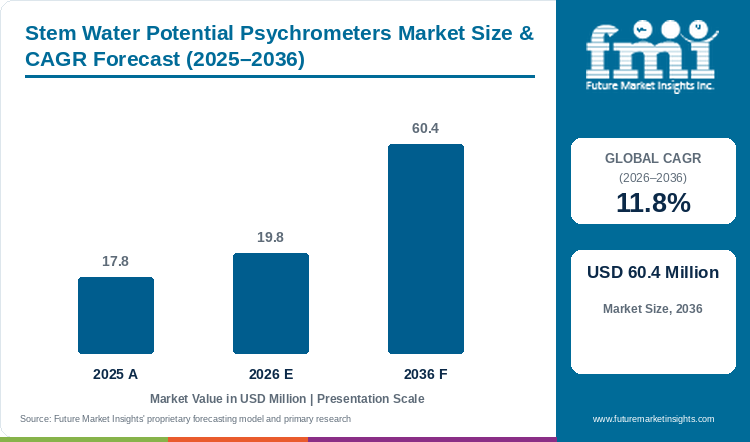
Worldwide stem water potential psychrometers industry valuation moves from USD 17.8 million during 2025 to a projected USD 19.8 million across 2026 before hitting USD 60.4 million in 2036 on an 11.8% ten-year compound pace.
Manual Scholander pressure-chamber checks require field crews to wrap leaves in foil bags before solar noon and excise foliage into pressurized nitrogen cylinders, which yields only a single midday snapshot and damages experimental vines. After recording USD 17.8 million during 2025, worldwide stem water potential psychrometers valuation totals a projected USD 19.8 million across 2026 and is slated to attain USD 60.4 million come 2036 at an 11.8% CAGR, creating a net USD 40.6 million gain in annual industry size. In November 2025, ecophysiologists at IRNAS-CSIC in Seville and the University of Tasmania demonstrated in Plant Physiology that continuous in-situ stem psychrometers track apoplastic xylem tension directly across extreme drought in grapevine and tomato where excised leaf-disc and pressure-chamber readings diverge below -1.72 MPa [1]. Peltier-Cooled Spanner Wet-Bulb Depression Psychrometer chambers account for 66.8% of projected 2026 principle market value as nut and wine estates link xylem tension feeds to micro irrigation systems, although resin exudation and radial cambial wound healing still require periodic chamber cleaning.
Key Market Trends & Insights
- By thermocouple psychrometric principle: Peltier-Cooled Spanner Wet-Bulb Depression Psychrometer chambers hold 66.8% of projected 2026 principle market value by virtue of reverse-polarity thermoelectric cooling pulses that condense microscopic dew on 25-micrometer junctions.
- By plant attachment location: Exposed Sapwood Xylem Stem Psychrometer (PSY1 Class) assemblies capture 62.4% of estimated 2026 location valuation through direct thermal equilibration against debarked woody xylem vessels.
- By end-use crop: Premium Wine Grapes, Almonds, Pistachios & Walnuts account for 58.0% of expected 2026 crop valuation prompted by regulated deficit irrigation protocols that control berry phenolics and nut kernel fill.
Regional Highlights
- Andean and Southern European viticulture leadership: Chilean wine and tree-nut valleys head the five profiled national markets on a 13.3% projected CAGR to 2036, while Italian DOCG vineyards and orchards advance at a forecast 12.7% annual clip.
- Oceania and Northern Hemisphere orchard uptake: Australian almond and Shiraz corridors register an anticipated 11.6% compound rate through 2036, outpacing United States specialty tree-nut groves at 11.4% and Spanish pistachio and olive estates at 11.1%.
Market Size & Forecast
Table 1: Stem Water Potential Psychrometers Market Size Schedule, 2025 to 2036
| Valuation Metric | Benchmark Figure |
|---|---|
| 2025 Historical Market Valuation | USD 17.8 million |
| 2026 Estimated Market Size | USD 19.8 million |
| 2036 Forecast Industry Valuation | USD 60.4 million |
| Compound Annual Growth Rate (2026-2036) | 11.8% |
| Ten-Year Added Annual Market Value | USD 40.6 million |
Severe atmospheric vapor deficits and soil drying cause apoplastic solute accumulation and xylem cavitation that break the equilibrium assumption used in standard bagged-leaf pressure-chamber measurements. In December 2025, a physiological commentary in Plant Physiology by researchers at Universidade de Vigo highlighted that pressure-chamber readings deviate sharply from direct stem thermocouple psychrometer measurements once water potentials approach the air-entry threshold Pe and 50% conductivity loss P50 [2]. Consequently, commercial orchard agronomists integrating smart agriculture telemetry increasingly favor direct sapwood psychrometers and solid-state trunk tensiometers that record nocturnal rehydration recovery together with midday stress peaks.
Installed Sapwood Chamber and Microvolt Datalogger Sizing
Table 2: Installed Sapwood Psychrometer Chambers and Unit Price Bands
| Operational Indicator | 2025 | 2026 | 2036 |
|---|---|---|---|
| Sector valuation (USD million) | 17.8 | 19.8 | 60.4 |
| Annual psychrometer chamber & logger units (units) | 4,600 to 5,050 | 5,100 to 5,600 | 14,800 to 16,300 |
| Exposed sapwood PSY1-class stem units (units) | 2,850 to 3,120 | 3,180 to 3,490 | 9,250 to 10,150 |
| Average realized system valuation (USD per unit) | 3,520 to 3,870 | 3,540 to 3,890 | 3,700 to 4,080 |
Technical boundary note: Installed unit ranges encompass chromium-plated brass stem psychrometer chambers paired with nanovolt-resolution microvoltmeters as well as chilled-mirror dew-point potentiometers and peer trunk micro-tensiometers.
Accurate measurement of relative humidity between 93% and 99.99% inside a sealed sapwood chamber requires resolving wet-bulb temperature depression to within 0.001 degrees Celsius while compensating for ambient thermal gradients along the woody stem. ICT International Pty Ltd engineers its PSY1 Stem Psychrometer with dual welded chromel-constantan thermocouples inside a high-thermal-mass chromium-plated brass chamber and a 24-bit analog-to-digital converter that logs water potentials from -0.1 to -10 MPa at 0.01 MPa resolution [3]. While postharvest quality labs utilize benchtop water activity meters for dried nuts and grains, orchard physiologists rely on insulated in-situ stem chambers to monitor live vascular tension.
Perennial Orchard Estate and Ecophysiology Laboratory Benchmarks
Table 3: Perennial Orchard Estate and Demographic Benchmarks for Stem Psychrometers
| Benchmark Indicator | 2025 | 2026 | 2036 |
|---|---|---|---|
| World population (billion) | 8.23 | 8.30 | 8.95 |
| Valuation per 1,000 people (USD) | 2.16 | 2.39 | 6.75 |
| Annual valuation per instrumented orchard estate (USD) | 4,100 to 4,550 | 4,500 to 4,980 | 12,400 to 13,800 |
| Annual chamber cleaning & NaCl calibration solution kit (USD) | 240 to 310 | 250 to 325 | 320 to 410 |
Table 4: Psychrometric Principle and Crop Valuation Breakdown in 2026
| Allocation Category | 2026 Valuation | Segment Share Basis |
|---|---|---|
| Global stem water potential psychrometers market size | USD 19.8 million | Total 2026 sector baseline |
| Peltier-cooled Spanner wet-bulb depression valuation | USD 13.2 million | 66.8% psychrometric principle share |
| Exposed sapwood xylem stem psychrometer valuation | USD 12.4 million | 62.4% attachment location share |
| Premium wine grapes, almonds, pistachios & walnuts | USD 11.5 million | 58.0% end-use crop share |
When desert shrubs or severely droughted orchard rootstocks drop below the -10 MPa limit of Peltier thermocouple junctions, ecophysiology laboratories turn to chilled-mirror dew-point hygrometry. METER Group, Inc. supplies the ASTM D6836-compliant WP4C Dewpoint PotentiaMeter that measures water potential from 0 to -300 MPa in five minutes by optically detecting condensation on a temperature-controlled mirror with 0.001 degrees Celsius precision [4]. Direct coupling of continuous stem psychrometer traces with localized weather forecasting services allows vineyard managers to trigger deficit irrigation pulses before afternoon heat spikes induce xylem embolism.
Analyst Perspective
"High-value wine-grape and tree-nut estates can no longer afford the labor burden or single-point blind spots of manual midday pressure-chamber crews. Suppliers that combine dual-junction Peltier thermal compensation with solar SDI-12 telemetry and anti-fouling sapwood seals are turning research psychrometers into operational irrigation controllers."
- Nikhil Kaitwade, Principal Consultant, Future Market Insights.
How is the stem water potential psychrometers market segmented?
The stem water potential psychrometers market is segmented by thermocouple psychrometric principle, plant attachment location, end-use crop, and region. In 2026, Peltier-Cooled Spanner Wet-Bulb Depression Psychrometer leads at an estimated 66.8%, Exposed Sapwood Xylem Stem Psychrometer (PSY1 Class) at 62.4%, and Premium Wine Grapes, Almonds, Pistachios & Walnuts at 58.0%.
By thermocouple psychrometric principle: Peltier-Cooled Spanner Wet-Bulb Depression Psychrometer (66.8%) and Richards Dew-Point Hygrometric Stem Chamber (33.2%).
By plant attachment location: Exposed Sapwood Xylem Stem Psychrometer (PSY1 Class) (62.4%) and In-Situ Leaf & Root Water-Potential Chamber (37.6%).
By end-use crop: Premium Wine Grapes, Almonds, Pistachios & Walnuts (58.0%), Avocado, Citrus & High-Density Apple Orchards (24.5%), and Forestry & Desert Ecophysiology Research (17.5%).
Why Do Peltier-Cooled Spanner Wet-Bulb Depression Psychrometers Command Two-Thirds of Principle Value?
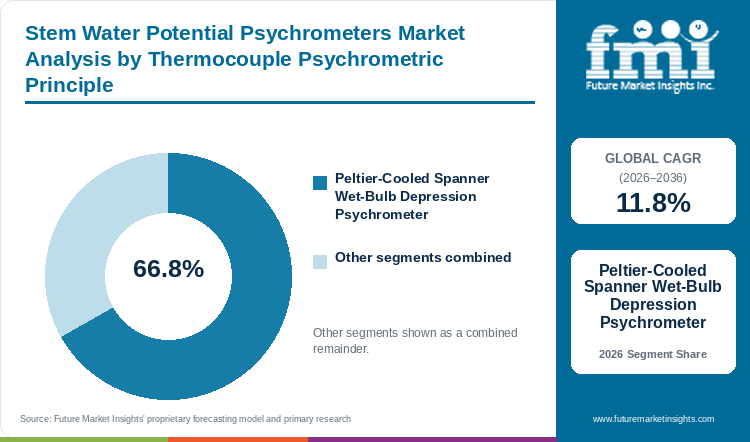
Automated Peltier cooling pulses and nanovolt wet-bulb evaporation curves give Peltier-Cooled Spanner Wet-Bulb Depression Psychrometer systems 66.8% of projected 2026 principle valuation.
Table 5: Thermocouple Psychrometric Principle Allocation for 2026
| Thermocouple Psychrometric Principle | Share (2026) |
|---|---|
| Peltier-Cooled Spanner Wet-Bulb Depression Psychrometer | 66.8% |
| Richards Dew-Point Hygrometric Stem Chamber | 33.2%* |
| Total | 100.0% |
*Note: Richards dew-point hygrometric stem and sample chambers account for the remaining 33.2% of 2026 principle market valuation.
Table 6: Top Psychrometric Principle and Global Forecast Pace
| Benchmark Parameter | Recorded Figure |
|---|---|
| Global CAGR (2026 to 2036) | 11.8% |
| Leading Psychrometric Principle | Peltier-Cooled Spanner Wet-Bulb Depression Psychrometer |
Spanner-principle thermocouple psychrometers pass a controlled cooling current of 3 to 8 milliamperes through a fine chromel-constantan junction to depress the junction below the dew point of the sealed sapwood airspace, then measure the microvolt electromotive force generated as the condensed water film evaporates. Because this self-wetting Peltier cycle requires no manual potassium chloride droplet loading in the field, autonomous stem loggers operate unattended for weeks across orchards running sensor-based fertilization and drip-irrigation schedules. Richards Dew-Point Hygrometric Stem Chambers capture the remaining 33.2% share where laboratory chambers maintain continuous electronic feedback at the dew-point temperature.
- Peltier-Cooled Spanner Wet-Bulb Depression Psychrometer designs represent an estimated 66.8% of 2026 psychrometric principle market size due to autonomous self-wetting field operation.
- Wescor, Inc. (ELITechGroup) manufactures the C-52 Sample Chamber and PST-55 psychrometer transducers capable of operating in either Spanner wet-bulb depression or dew-point hygrometric readout modes with PSYPRO and CR-7 microvolt dataloggers [5].
How Do Exposed Sapwood Xylem Stem Psychrometers Retain 62.4% of Attachment Location Value?
Direct clamping onto debarked woody xylem vessels gives Exposed Sapwood Xylem Stem Psychrometer (PSY1 Class) installations 62.4% of projected 2026 attachment location market size.
Direct attachment of a thermally insulated brass psychrometer chamber against exposed outer sapwood eliminates the transpiration-induced water potential drop between stem xylem and sunlit leaf blades. Exposed Sapwood Xylem Stem Psychrometer (PSY1 Class) units therefore provide a continuous 24-hour record of whole-plant hydraulic tension across woody vines and nut trees plus forest timber species. In-Situ Leaf & Root Water-Potential Chambers hold the remaining 37.6% of attachment location valuation, supported by herbaceous crop breeders and controlled-environment researchers testing hydroponic root enhancers on non-woody cereal grasses and delicate root segments.
- Exposed Sapwood Xylem Stem Psychrometer (PSY1 Class) configurations secure 62.4% of estimated 2026 attachment location valuation across perennial tree and vine crops.
- Wescor, Inc. (ELITechGroup) supplies the 100-gram L-51 and grass-configured L-51A in-situ leaf psychrometer chambers with a 2 mm lateral leaf slot and copper-constantan temperature compensation covering -0.05 to -7 MPa [6].
What Drives Premium Wine Grapes, Almonds, Pistachios & Walnuts to Lead End-Use Crop Valuation?
Regulated deficit irrigation across vineyards and nut groves gives Premium Wine Grapes, Almonds, Pistachios & Walnuts a 58.0% share of 2026 crop market size.
Cabernet Sauvignon and Shiraz vineyards together with almond and pistachio orchards depend on regulated deficit irrigation between veraison or hull-split and harvest to concentrate berry anthocyanins and prevent hull rot without triggering xylem cavitation. Premium Wine Grapes, Almonds, Pistachios & Walnuts consequently secure 58.0% of 2026 crop valuation. Avocado, Citrus & High-Density Apple Orchards along with Forestry & Desert Ecophysiology Research make up the other 42.0% of crop market size as rootstock breeders combine hydraulic tension monitoring with seed nutrient carriers to improve seedling establishment in arid soils.
- Premium Wine Grapes, Almonds, Pistachios & Walnuts represent 58.0% of anticipated 2026 crop market value because narrow -0.8 to -1.5 MPa stem water potential windows govern crop quality and water savings.
- In May 2025, a 30-day water-withholding study in BMC Plant Biology across seven clonal Pistacia hybrids including UCB1 showed that drought-tolerant hybrid C9-4 lowered osmotic potential to -1.61 MPa while sensitive C8-3 reached -4.43 MPa leaf water potential [7].
What are the drivers, restraints, and opportunities in the stem water potential psychrometers market?
Multi-year groundwater pumping limits and mountainous orchard water deficits accelerate automated stem psychrometer installations through 2036, even as sapwood resin wound responses and thermal solar gradients require periodic probe maintenance.
- Driver: Strict basin water-extraction caps across Mediterranean and Western Hemisphere tree-nut and wine regions mandate precision stem water potential thresholds to save irrigation water without yield loss.
- Restraint: Sapwood wound compartmentalization, resin fouling of 25-micrometer thermocouple wires, and ambient trunk thermal gradients require periodic chamber relocation and skilled installation.
- Opportunity: Deployment of continuous stem psychrometers and embedded trunk micro-tensiometers with cloud LoRaWAN or cellular irrigation valves enables subscription-backed commercial orchard management.
Growth Analysis and Future Potential: Qualitative Demand Catalysts
Perennial nut and fruit growers facing severe surface-water curtailments must maintain midday stem water potential above species-specific cavitation thresholds while cutting total seasonal water application by 20% to 35%. In June 2025, a three-year deficit-irrigation trial by IFAPA researchers in Granada and Seville published in Plants on Chandler and Cisco walnuts demonstrated that sustained deficit irrigation at 75% ETc saved 1,681 m3 ha-1 of water while proving that stem water potential must remain above -1.4 MPa to prevent xylem cavitation and kernel shriveling [8]. Joint deployment of trunk-mounted psychrometers with soil health nano-sensors allows orchardists to verify that deficit irrigation does not push trees past hydraulic recovery limits.
Risk Assessment of the Stem Water Potential Psychrometers Market: Installation and Biological Friction
Sustained vapor-tight isothermal contact between an external brass chamber and sapwood across a six-month season remains the primary operational challenge for thermocouple stem psychrometers. Wounded trees compartmentalize bark incisions by depositing tyloses and gums plus callose around the exposed xylem window within four to eight weeks, while rapid morning trunk heating creates zero-offset microvolt drift unless insulated thermal shields are fitted. In August 2025, researchers at Chapman University and UC Davis monitoring 96 Hass and Fuerte avocado trees in AoB Plants documented midday stem water potentials reaching -1.8 to -2.3 MPa during drought while sapwood starch-to-sugar ratios shifted by 40% to 47% [9]. Growers applying foliar nano fertilizers must therefore clean thermocouple chambers with distilled water and relocate sapwood mounts mid-season.
Commercial Opportunity Analysis: Subtropical Orchard Expansion and Automated Telemetry
High-density avocado and citrus estates together with pome-fruit orchards are rapidly adopting continuous plant water-potential logging to prevent early fruitlet drop and optimize commercial fruit size grades under variable spring rainfall. In February 2026, a multi-season New Zealand trial in Horticulturae on Hass avocado trees showed that maintaining stem water potential between -0.40 and -0.50 MPa prevented water-deficit suppression of initial fruit growth rates and protected mature fruit size independent of crop load [10]. Instrument suppliers that integrate stem psychrometer and micro-tensiometer feeds into AI for hydroponic farming and orchard fertigation controllers are capturing recurring multi-block hardware upgrades.
Stem Water Potential Psychrometers Market by Country (2026 to 2036)
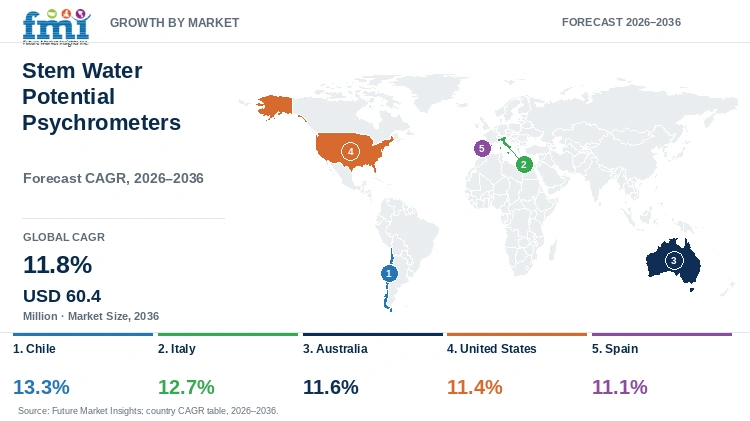
Among the five profiled stem psychrometer nations, Chilean perennial estates post the fastest ten-year expansion at an anticipated 13.3% CAGR through 2036, outpacing Italian vineyards (12.7%) and Australian orchards (11.6%). At the same time, United States tree-nut ranches expand at 11.4% annually and Spanish olive and pistachio groves progress at 11.1% under river-basin irrigation quotas.
Table 7: Five-Country Stem Psychrometer CAGR Schedule and Hydraulic Levers
| Country | CAGR (2026 to 2036) | Primary Hydraulic & Agronomic Growth Lever |
|---|---|---|
| Chile | 13.3% | Coquimbo, Maipo, and Maule wine-grape, walnut, and avocado drought telemetry under megadrought deficits |
| Italy | 12.7% | Tuscany, Piedmont, and Puglia vineyard and sweet-cherry stem water potential automation |
| Australia | 11.6% | Domestic PSY1 stem psychrometer manufacturing in Armidale and Murray-Darling almond/Shiraz deployments |
| United States | 11.4% | California SGMA almond/pistachio irrigation compliance and domestic Utah/Washington sensor production |
| Spain | 11.1% | Castilla-La Mancha and Andalusian pistachio, walnut, and olive regulated deficit irrigation trials |
Source: Future Market Insights analysis
Chile Stem Water Potential Psychrometers Market Outlook (2026 to 2036)
Over a decade of structural rainfall deficits across Coquimbo and Valparaiso plus the Central Valley propels Chilean stem water potential psychrometers demand at a projected 13.3% yearly clip through 2036. In June 2026, researchers from Universidad de La Serena and Universidad de Chile together with INIA published a multi-provenance Vitis vinifera study in Agriculture characterizing stem water potential thresholds for 12% and 50% as well as 88% stomatal conductance loss under water deficit [11]. Chilean export wine estates and Petorca avocado hills together with walnut groves increasingly install continuous stem psychrometers to prevent hydraulic failure. However, steep Andean hillside topography requires solar LoRaWAN repeaters to relay microvolt logger data.
Key takeaway: In Chile, prolonged Central Valley megadrought pressures across export vineyards and walnut estates fuel a 13.3% projected yearly expansion to 2036.
Italy Stem Water Potential Psychrometers Market Outlook (2026 to 2036)
Summer heat anomalies across Po Valley fruit orchards and Tuscan hillsides together with Apulian olive groves lift Italian stem water potential psychrometers valuation by a forecast 12.7% annually from 2026 to 2036. In August 2026, a ten-paper peer-reviewed synthesis of continuous stem water potential sensing reported two-season Italian sweet-cherry (Prunus avium) and olive trials confirming strong correlation (R2 = 0.72 to 0.81) against manual pressure chambers across -0.3 to -3.5 MPa [12]. Italian viticultural consortia and high-density apple cooperatives in Trentino-Alto Adige rely on automated xylem tension traces to time micro-sprinkler pulses. Even so, strict DOCG non-irrigation rules in select heritage wine zones limit sensor use to canopy stress auditing.
Key takeaway: In Italy, precision irrigation scheduling across cherry and olive groves plus northern fruit orchards underpins a forecast 12.7% annual valuation increase to 2036.
Australia Stem Water Potential Psychrometers Market Outlook (2026 to 2036)
Centered around export hardware manufacturer ICT International Pty Ltd in Armidale within New South Wales, Australian stem water potential psychrometers valuation is slated to climb 11.6% per annum through 2036. In November 2025, University of Tasmania and IRNAS-CSIC plant physiologists published multi-week validation trials in Plant Physiology using the Australian-built PSY1 stem psychrometer logged every 15 minutes to capture real-time xylem water potential during severe drying cycles [13]. Commercial almond hull-split operations along the Murray River and Barossa Valley Shiraz estate vineyards deploy solar-powered PSY1 nodes to optimize costly megaliter water allocations. Nonetheless, extreme ambient diurnal temperature swings in inland orchards require multi-layer reflective foam insulation around every sapwood chamber.
Key takeaway: In Australia, Armidale PSY1 stem psychrometer manufacturing and Murray-Darling almond water auditing support an anticipated 11.6% yearly gain through 2036.
United States Stem Water Potential Psychrometers Market Outlook (2026 to 2036)
Mandatory groundwater pumping allocations under California's Sustainable Groundwater Management Act (SGMA) across more than one million hectares of Central Valley almonds and pistachios plus wine grapes propel United States stem water potential psychrometers demand at a projected 11.4% yearly rate to 2036. Domestic instrumentation producers in Utah and Washington State together with California supply both thermocouple psychrometers and solid-state water-potential dataloggers, led by Campbell Scientific's March 2026 update to its 229 Matric Potential Sensor and CR6/CR1000X excitation architecture [14]. Western tree-nut ranches and Washington apple estates increasingly replace manual pressure-bomb crews with continuous trunk-mounted sensors. However, autumn almond trunk shaker harvesting requires ruggedized housings or seasonal sensor removal.
Key takeaway: In the United States, California SGMA groundwater compliance across almond and pistachio ranches sustains a projected 11.4% annual market advance to 2036.
Spain Stem Water Potential Psychrometers Market Outlook (2026 to 2036)
Rapid growth of irrigated pistachio and almond acreage across Castilla-La Mancha and Andalusia together with Rioja and Ribera del Duero vineyards expands Spanish stem water potential psychrometers market size by a forecast 11.1% annually through 2036. In March 2026, researchers at ITACyL in Valladolid and CSIC published a multi-year field study in Agronomy on Kerman pistachio trees grafted onto UCB1 rootstock in Central Spain, tracking midday stem water potential and gas exchange across three deficit-irrigation regimes from 2023 to 2025 [15]. Spanish hydrological confederation water meters force perennial estates to schedule drip pulses strictly by plant water potential. Even so, summer sapwood resin exudation in pistachio trunks requires monthly chamber inspection.
Key takeaway: In Spain, Castilla-La Mancha pistachio orchard conversions and basin irrigation quotas guide a forecast 11.1% annual market growth rate until 2036.
Full report country CAGRs cover: North America; Latin America; Western Europe; Eastern Europe; East Asia; South Asia and Pacific; Middle East and Africa.
Who are the notable companies in the stem water potential psychrometers market?
ICT International Pty Ltd (PSY1 Stem Psychrometer), METER Group, Inc. (WP4C / Dewpoint PotentiaMeter), Wescor / ELITechGroup (Psychrometric Chambers), FloraPulse (Micro-Tensiometer Stem Water Potential Peer), and Campbell Scientific, Inc. are the notable companies in the stem water potential psychrometers market.
Supplier competition across plant water-potential instrumentation brings together specialized sapwood thermocouple psychrometer manufacturers and chilled-mirror dew-point hygrometer leaders along with trunk micro-tensiometer innovators and microvolt datalogger providers. ICT International Pty Ltd and Wescor / ELITechGroup manufacture welded chromel-constantan stem and leaf psychrometer chambers that resolve wet-bulb depression to microvolt accuracy. METER Group Inc. leads laboratory and field-lab chilled-mirror dew-point water potential measurement, whereas FloraPulse supplies Cornell-patented trunk micro-tensiometer peers and Campbell Scientific Inc. provides the 24-bit nanovolt dataloggers that drive multi-sensor orchard networks.
- In-Situ Sapwood & Leaf Thermocouple Psychrometer Specialists: ICT International Pty Ltd (PSY1 Stem Psychrometer) and Wescor / ELITechGroup (Psychrometric Chambers) manufacture Peltier-cooled Spanner and dew-point chambers for continuous stem and leaf plus root water-potential logging.
- Chilled-Mirror Dew-Point & Trunk Micro-Tensiometer Peer Innovators: METER Group, Inc. (WP4C / Dewpoint PotentiaMeter) and FloraPulse (Micro-Tensiometer Stem Water Potential Peer) deliver wide-range chilled-mirror hygrometers and embedded nanoporous ceramic xylem tensiometers.
- High-Resolution Microvolt Excitation & Telemetry Datalogger Leaders: Campbell Scientific, Inc. engineers 24-bit differential microvolt dataloggers and current-excitation modules required to interrogate thermocouple psychrometer arrays.
Competitive Benchmarking: Stem Water Potential Psychrometers Market
Table 8: Stem Water Potential Vendor Benchmarking Ratings
| Company | In-Situ Stem Capability | MPa Operating Range | Telemetry & Datalogging | Orchard & Research Reach |
|---|---|---|---|---|
| ICT International Pty Ltd (PSY1 Stem Psychrometer) | High | High | High | High |
| METER Group, Inc. (WP4C / Dewpoint PotentiaMeter) | Medium | High | High | High |
| Wescor / ELITechGroup (Psychrometric Chambers) | High | High | Medium | High |
| FloraPulse (Micro-Tensiometer Stem Water Potential Peer) | High | Medium | High | High |
| Campbell Scientific, Inc. | High | High | High | High |
Scoring basis: In-Situ Stem Capability and MPa Operating Range assess continuous non-destructive sapwood attachment together with measurement span from near-saturated -0.05 MPa down to -10 MPa (or -300 MPa in chilled-mirror chambers). Telemetry & Datalogging and Orchard & Research Reach evaluate SDI-12/LoRaWAN cloud connectivity and global viticulture and ecophysiology support.
Key Developments in the Stem Water Potential Psychrometers Market
- In August 2026, Campbell Scientific Inc. released Operating System v9.0.0 (following v8.5.1 in April 2026 and v8.5.0 in February 2026) for its 24-bit CR1000X and CR1000Xe dataloggers with enhanced MQTT command-and-control and sequential measurement semaphore locks for thermocouple excitation [16].
- In 2026, FloraPulse expanded commercial deployment of its Cornell-developed nanoporous ceramic trunk micro-tensiometer and solar cellular mote across 35+ countries and 9 validated tree and vine crops, delivering 20-minute cloud stem water potential updates down to -2.5 MPa (-25 bar) [17].
- In April 2026, Andean ecophysiology researchers partnered with sapwood instrumentation suppliers to benchmark hydraulic safety margins and carbon-assimilation recovery across 302 woody individuals from 11 sclerophyllous species following Central Chile's 35% precipitation-deficit megadrought [18].
Key Players in the Stem Water Potential Psychrometers Market
In-Situ Sapwood & Leaf Thermocouple Psychrometer Specialists
- ICT International Pty Ltd (PSY1 Stem Psychrometer)
- Wescor / ELITechGroup (Psychrometric Chambers)
Chilled-Mirror Dew-Point & Trunk Micro-Tensiometer Peer Innovators
- METER Group, Inc. (WP4C / Dewpoint PotentiaMeter)
- FloraPulse (Micro-Tensiometer Stem Water Potential Peer)
High-Resolution Microvolt Excitation & Telemetry Datalogger Leaders
- Campbell Scientific, Inc.
Stem Water Potential Psychrometers Market - Report Scope
Table 9: Sapwood Psychrometry Coverage Parameters and Technical Exclusions
| Scope Dimension | Report scope |
|---|---|
| Segmentation Axes | Thermocouple Psychrometric Principle; Plant Attachment Location; End-Use Crop; Region |
| Quantitative Units | USD Million |
| Product Scope & Category Note | Covers Peltier-cooled Spanner wet-bulb depression stem and leaf psychrometers, Richards dew-point hygrometric plant chambers, chilled-mirror dew-point potentiometers, peer trunk micro-tensiometers, and dedicated microvolt excitation dataloggers. Category Scope Note: Excludes manual compressed-nitrogen Scholander pressure bombs, heat-pulse sap-flow needles, and bulk soil capacitance probes. |
| Geographic Regions | North America; Latin America; Western Europe; Eastern Europe; East Asia; South Asia and Pacific; Middle East and Africa |
| Profiled Country Markets | Chile, Italy, Australia, United States, Spain, plus regional aggregates |
| Representative Manufacturers | ICT International Pty Ltd (PSY1 Stem Psychrometer); METER Group, Inc. (WP4C / Dewpoint PotentiaMeter); Wescor / ELITechGroup (Psychrometric Chambers); FloraPulse (Micro-Tensiometer Stem Water Potential Peer); Campbell Scientific, Inc. |
| Assessment Horizon | 2026 to 2036 (with 2025 historical baseline) |
| Validation Protocol | Primary interviews with plant hydraulic engineers and orchard managers triangulated against peer-reviewed trials. |
Stem Water Potential Psychrometers Market - Research Methodology
Table 10: Plant Hydraulics Econometric Modeling and Validation Protocol
| Research Stage | Methodological Implementation |
|---|---|
| Primary Field & Vendor Interviews | Direct consultations with thermocouple psychrometer designers, chilled-mirror hygrometer engineers, California and Chilean viticulture irrigation directors, and tree-nut extension specialists. |
| Literature & Standard Verification | Audit of peer-reviewed plant hydraulic studies in Plant Physiology, Annals of Botany, AoB Plants, Agronomy, and Plants together with ASTM D6836 dew-point specifications. |
| Bottom-Up Hardware Reconciliation | Triangulation of annual sapwood psychrometer chamber shipments, chilled-mirror laboratory benchtop units, trunk micro-tensiometer subscriptions, and 24-bit microvolt datalogger channels. |
| Category Purity Verification | Removal of standalone soil moisture capacitance probes, leaf gas-exchange porometers, and manual Scholander pressure vessels from market size totals. |
| National Growth Rate Modeling | Country CAGRs for Chile (13.3%), Italy (12.7%), Australia (11.6%), the United States (11.4%), and Spain (11.1%) calibrated against irrigated wine-grape and tree-nut acreage and groundwater extraction caps. |
| Realized Unit Price Benchmarking | System realization bands (USD 3,520 to USD 4,080 per unit/channel) cross-checked against distributor quotes for PSY1, WP4C, C-52/L-51, FloraPulse, and CR1000X configurations. |
Stem Water Potential Psychrometers Market by Segments
Stem Water Potential Psychrometers Market segmented by Thermocouple Psychrometric Principle:
- Peltier-Cooled Spanner Wet-Bulb Depression Psychrometer
- Richards Dew-Point Hygrometric Stem Chamber
Stem Water Potential Psychrometers Market segmented by Plant Attachment Location:
- Exposed Sapwood Xylem Stem Psychrometer (PSY1 Class)
- In-Situ Leaf & Root Water-Potential Chamber
Stem Water Potential Psychrometers Market segmented by End-Use Crop:
- Premium Wine Grapes, Almonds, Pistachios & Walnuts
- Avocado, Citrus & High-Density Apple Orchards
- Forestry & Desert Ecophysiology Research
Stem Water Potential Psychrometers Market by Region
- North America
- United States
- Canada
- Latin America
- Chile
- Argentina
- Brazil
- Mexico
- Peru
- Western Europe
- Italy
- Spain
- France
- Germany
- Portugal
- Eastern Europe
- Poland
- Hungary
- Romania
- East Asia
- China
- Japan
- South Korea
- South Asia and Pacific
- Australia
- New Zealand
- India
- Middle East and Africa
- South Africa
- Israel
- Morocco
Research Sources and Bibliography
- [1] Rodriguez-Dominguez, C. M., Carins-Murphy, M. R., Sebastian-Azcona, J., & Brodribb, T. J. (2025, November 26). Stem water potential measurements obtained using standard methodologies diverge under extreme drought in tomato and grapevine. Plant Physiology (PubMed PMID 41240360).
- [2] Fernandez-de-Una, L. (2025, December 07). Don't add pressure to stress: Measured water potentials differ by method under severe drought. Plant Physiology (PubMed Central PMC12851117).
- [3] ICT International Pty Ltd. (2026, January 12). Psychrometer PSY1 for Plant Water Potential and Water Stress. ICT International Plant Water Relations.
- [4] METER Group, Inc. (2026, February 05). WP4C - METER Group. METER Group Lab Water Potential Instruments.
- [5] Wescor, Inc. (ELITechGroup). (2026, January 19). C-52 - Wescor Inc. An Elitech Company - ELITechGroup. ELITechGroup Water Potential Products.
- [6] Wescor, Inc. (ELITechGroup). (2026, January 22). L-51 and L-51A - Wescor Inc. An Elitech Company. ELITechGroup In-Situ Leaf Psychrometers.
- [7] Osku, M., Roozban, M. R., Sarikhani, S., Arab, M. M., Akbari, M., & Vahdati, K. (2025, May 02). Revealing drought tolerance strategies in pistachio clonal hybrids: role of osmotic adjustment. BMC Plant Biology (PubMed Central PMC12049070).
- [8] Duran Zuazo, V. H., Carceles Rodriguez, B., Sendra, E., Carbonell-Barrachina, A. A., Lipan, L., Hernandez, F., Galvez Ruiz, B., & Garcia-Tejero, I. F. (2025, June 10). Yield and Quality of Walnuts Subjected to Deficit Irrigation in Mountainous Water-Starved Environments. Plants (PubMed Central PMC12197118).
- [9] Valverdi, N. A., Guzman-Delgado, P., Goldsmith, G. R., & Avila-Lovera, E. (2025, August 23). Does green stem photosynthesis affect plant drought tolerance and recovery in avocado?. AoB Plants (PubMed Central PMC12448719).
- [10] Kaneko, T., Gould, N., Campbell, D., & Clearwater, M. J. (2026, February 12). Irrigation, Water Deficit and Crop Load Effects on 'Hass' Avocado Fruit Size Under New Zealand Growing Conditions. Horticulturae (MDPI Open Access).
- [11] Garrido-Salinas, M., Puelles, A., Peralta-Scholz, M. J., Villalobos-Soublett, E., Opazo, I., Verdugo-Vasquez, N., Corradini, F., & Faundez, C. (2026, June 09). Preliminary Assessment of Stomatal Regulation in Vitis vinifera L. cv. Pais from Contrasting Provenances Under Water Deficit. Agriculture (MDPI Open Access).
- [12] FloraPulse. (2026, August 18). What ten new papers say about microtensiometers - FloraPulse. FloraPulse Scientific Research Roundup.
- [13] Rodriguez-Dominguez, C. M., Carins-Murphy, M. R., Sebastian-Azcona, J., & Brodribb, T. J. (2025, November 15). Stem water potential measurements obtained using standard methodologies diverge under extreme drought in tomato and grapevine (Full Text). Plant Physiology (PubMed Central PMC12663718).
- [14] Campbell Scientific, Inc. (2026, March 15). 229 | Products | Campbell Scientific. Campbell Scientific Water Potential Sensors.
- [15] Nunez, L., Martin, H., Miras-Avalos, J. M., & Alvarez, S. (2026, March 29). Effects of Irrigation Dose on the Water Relations, Yield, and Nut Quality of Pistachio (cv. Kerman) in Central Spain. Agronomy (MDPI Open Access).
- [16] Campbell Scientific, Inc. (2026, August 27). CR1000X(e) OS | Software and OS | Resources | Campbell Scientific. Campbell Scientific Resource Center.
- [17] FloraPulse. (2026, March 10). How FloraPulse Works - Microtensiometer Technology Explained - FloraPulse. FloraPulse Orchard Sensor Documentation.
- [18] Piper, F. I., Paula, S., & Urrutia-Jalabert, R. (2026, April 24). Tight stomatal regulation and high intrinsic capacity of carbon assimilation inferred from isotopic composition negatively correlate with drought-driven decline in sclerophyllous species. Annals of Botany (PubMed Central PMC13454689).
- [19] Miras-Avalos, J. M., & Silva Araujo, E. (2025, May 20). Relationships Between Midday Stem Water Potential and Soil Water Content in Grapevines and Peach and Pear Trees. Agronomy (MDPI Open Access).
- [20] Ruiz-de-Gauna, J., Arazuri, S., Viela, P., Velaz, M., Leon-Ecay, S., Jaren, C., & Lopez-Maestresalas, A. (2026, April 29). Monitoring Water Stress in Grapevine (Vitis vinifera L.) Using Proximal Hyperspectral Imaging. Plants (MDPI Open Access).
- [21] Campbell Scientific, Inc. (2026, September 01). CR1000X | Products | Campbell Scientific. Campbell Scientific Measurement and Control Dataloggers.
This bibliography is provided for reader reference and is not exhaustive. The full report contains the complete reference list and detailed citations.
This Report Answers
- What is the 2026 market size and 2036 valuation forecast for stem water potential psychrometers?
- Why are wine-grape and tree-nut estates replacing manual pressure bombs with continuous stem psychrometers?
- Why do Peltier-Cooled Spanner Wet-Bulb Depression Psychrometer systems command 66.8% of principle value?
- How do Exposed Sapwood Xylem Stem Psychrometers compare against In-Situ Leaf & Root Chambers?
- Why does Chile lead national growth at a 13.3% CAGR ahead of Italy (12.7%) and Australia (11.6%)?
- Which companies supply sapwood thermocouple psychrometers, dew-point potentiometers, and microvolt loggers?
- How do sapwood wound compartmentalization and thermal gradients affect multi-month field accuracy?
- What nanovolt excitation and thermal-shielding criteria govern commercial orchard psychrometer selection?
Frequently Asked Questions
How big is the stem water potential psychrometers market in 2026, and what is forecast for 2036?
Stem water potential psychrometers market value totals an estimated USD 19.8 million during 2026 compared with USD 17.8 million in 2025, while 2036 industry valuation is slated to attain USD 60.4 million across perennial orchard and ecophysiology users.
What is the CAGR for the stem water potential psychrometers market from 2026 to 2036?
Across the ten-year window from 2026 to 2036, stem water potential psychrometers industry size is anticipated to climb at an 11.8% CAGR and create a net USD 40.6 million gain in annual valuation.
Which thermocouple psychrometric principle leads the market?
Peltier-Cooled Spanner Wet-Bulb Depression Psychrometer systems capture a projected 66.8% of 2026 principle market value because reverse-polarity thermoelectric cooling pulses automate wet-bulb condensation in the field.
Which plant attachment location segment accounts for the largest share?
Exposed Sapwood Xylem Stem Psychrometer (PSY1 Class) installations secure 62.4% of projected 2026 attachment location market size due to continuous 15-minute xylem tension logging on woody trunks and canes.
Which country records the fastest growth trajectory through 2036?
Chilean wine and nut valleys lead the five profiled nations at an anticipated 13.3% yearly clip through 2036, ahead of Italian orchards (12.7%) and Australian estates (11.6%) as growers automate deficit irrigation.
Who are the key players in the stem water potential psychrometers market?
Notable participants include ICT International Pty Ltd (PSY1 Stem Psychrometer), METER Group, Inc. (WP4C / Dewpoint PotentiaMeter), Wescor / ELITechGroup (Psychrometric Chambers), FloraPulse (Micro-Tensiometer Stem Water Potential Peer), and Campbell Scientific, Inc.
Preview the report firsthand - request a free sample
Get SampleGet the brochure for pricing and purchase details.
Get PDFTable of Content
- Key Takeaways
- Market Size and CAGR
- Top Growth Driver
- Fastest Growing Segment
- Leading Region
- Key Companies
- Emerging Opportunities
- Executive Summary
- Global Market Outlook
- Demand-side Trends
- Supply-side Trends
- Technology Roadmap Analysis
- Analysis and Recommendations
- Analyst Perspective (What is happening? Why now? What should investors know?)
- Key Questions Answered
- How large is the market?
- What is the CAGR?
- What are key trends?
- Which region dominates?
- Who are the leaders?
- Market Overview
- Market Coverage / Taxonomy
- Market Definition / Scope / Limitations
- Research Methodology
- Chapter Orientation
- Analytical Lens and Working Hypotheses
- Market Structure, Signals, and Trend Drivers
- Benchmarking and Cross-market Comparability
- Market Sizing, Forecasting, and Opportunity Mapping
- Research Design and Evidence Framework
- Desk Research Programme (Secondary Evidence)
- Expert Input and Fieldwork (Primary Evidence)
- Tooling, Models, and Reference Databases
- Data Engineering and Model Build
- Quality Assurance and Audit Trail
- Market Background
- Market Dynamics (Drivers, Restraints, Opportunity, Trends)
- Scenario Forecast (Optimistic, Likely, Conservative)
- Impact Analysis
- AI Impact
- Sustainability Impact
- Regulatory Impact
- Technology Impact
- Consumer / Buyer Analysis
- Purchase Drivers
- Adoption Barriers
- Buyer Journey
- Opportunity Map Analysis
- Product Life Cycle Analysis
- Supply Chain Analysis
- Investment Feasibility Matrix
- Value Chain Analysis
- PESTLE and Porter's Analysis
- Regulatory Landscape
- Regional Parent Market Outlook
- Production and Consumption Statistics
- Import and Export Statistics
- Global Market Analysis and Forecast, 2021 to 2036
- Historical Market Size Value (USD Million) Analysis, 2021 to 2025
- Current and Future Market Size Value (USD Million) Projections, 2026 to 2036
- Y-o-Y Growth Trend Analysis
- Absolute $ Opportunity Analysis
- Global Market Pricing Analysis, 2021 to 2036
- Global Market Analysis and Forecast, By Thermocouple Psychrometric Principle, 2021 to 2036
- Introduction / Key Findings
- Historical Market Size Value (USD Million) Analysis By Thermocouple Psychrometric Principle, 2021 to 2025
- Current and Future Market Size Value (USD Million) Analysis and Forecast By Thermocouple Psychrometric Principle, 2026 to 2036
- Peltier-Cooled Spanner Wet-Bulb Depression Psychrometer
- Richards Dew-Point Hygrometric Stem Chamber
- Y-o-Y Growth Trend Analysis By Thermocouple Psychrometric Principle, 2021 to 2025
- Absolute $ Opportunity Analysis By Thermocouple Psychrometric Principle, 2026 to 2036
- Global Market Analysis and Forecast, By Plant Attachment Location, 2021 to 2036
- Introduction / Key Findings
- Historical Market Size Value (USD Million) Analysis By Plant Attachment Location, 2021 to 2025
- Current and Future Market Size Value (USD Million) Analysis and Forecast By Plant Attachment Location, 2026 to 2036
- Exposed Sapwood Xylem Stem Psychrometer (PSY1 Class)
- In-Situ Leaf & Root Water-Potential Chamber
- Y-o-Y Growth Trend Analysis By Plant Attachment Location, 2021 to 2025
- Absolute $ Opportunity Analysis By Plant Attachment Location, 2026 to 2036
- Global Market Analysis and Forecast, By End-Use Crop, 2021 to 2036
- Introduction / Key Findings
- Historical Market Size Value (USD Million) Analysis By End-Use Crop, 2021 to 2025
- Current and Future Market Size Value (USD Million) Analysis and Forecast By End-Use Crop, 2026 to 2036
- Premium Wine Grapes, Almonds, Pistachios & Walnuts
- Avocado, Citrus & High-Density Apple Orchards
- Forestry & Desert Ecophysiology Research
- Y-o-Y Growth Trend Analysis By End-Use Crop, 2021 to 2025
- Absolute $ Opportunity Analysis By End-Use Crop, 2026 to 2036
- Global Market Analysis and Forecast, By Region, 2021 to 2036
- Introduction
- Historical Market Size Value (USD Million) Analysis By Region, 2021 to 2025
- Current Market Size Value (USD Million) Analysis and Forecast By Region, 2026 to 2036
- North America
- Latin America
- Western Europe
- Eastern Europe
- East Asia
- South Asia and Pacific
- Middle East and Africa
- Market Attractiveness Analysis By Region
- North America Market Analysis and Forecast, By Country, 2021 to 2036
- Historical Market Size Value (USD Million) Trend Analysis By Market Taxonomy, 2021 to 2025
- Market Size Value (USD Million) Forecast By Market Taxonomy, 2026 to 2036
- By Country
- United States
- Canada
- By Thermocouple Psychrometric Principle
- By Plant Attachment Location
- By End-Use Crop
- By Country
- Market Attractiveness Analysis
- By Country
- By Thermocouple Psychrometric Principle
- By Plant Attachment Location
- By End-Use Crop
- Key Takeaways
- Latin America Market Analysis and Forecast, By Country
- Historical Market Size Value (USD Million) Trend Analysis By Market Taxonomy, 2021 to 2025
- Market Size Value (USD Million) Forecast By Market Taxonomy, 2026 to 2036
- By Country
- Chile
- Argentina
- Brazil
- Mexico
- Peru
- By Thermocouple Psychrometric Principle
- By Plant Attachment Location
- By End-Use Crop
- By Country
- Market Attractiveness Analysis
- By Country
- By Thermocouple Psychrometric Principle
- By Plant Attachment Location
- By End-Use Crop
- Key Takeaways
- Western Europe Market Analysis and Forecast, By Country
- Historical Market Size Value (USD Million) Trend Analysis By Market Taxonomy, 2021 to 2025
- Market Size Value (USD Million) Forecast By Market Taxonomy, 2026 to 2036
- By Country
- Italy
- Spain
- France
- Germany
- Portugal
- By Thermocouple Psychrometric Principle
- By Plant Attachment Location
- By End-Use Crop
- By Country
- Market Attractiveness Analysis
- By Country
- By Thermocouple Psychrometric Principle
- By Plant Attachment Location
- By End-Use Crop
- Key Takeaways
- Eastern Europe Market Analysis and Forecast, By Country
- Historical Market Size Value (USD Million) Trend Analysis By Market Taxonomy, 2021 to 2025
- Market Size Value (USD Million) Forecast By Market Taxonomy, 2026 to 2036
- By Country
- Poland
- Hungary
- Romania
- By Thermocouple Psychrometric Principle
- By Plant Attachment Location
- By End-Use Crop
- By Country
- Market Attractiveness Analysis
- By Country
- By Thermocouple Psychrometric Principle
- By Plant Attachment Location
- By End-Use Crop
- Key Takeaways
- East Asia Market Analysis and Forecast, By Country
- Historical Market Size Value (USD Million) Trend Analysis By Market Taxonomy, 2021 to 2025
- Market Size Value (USD Million) Forecast By Market Taxonomy, 2026 to 2036
- By Country
- China
- Japan
- South Korea
- By Thermocouple Psychrometric Principle
- By Plant Attachment Location
- By End-Use Crop
- By Country
- Market Attractiveness Analysis
- By Country
- By Thermocouple Psychrometric Principle
- By Plant Attachment Location
- By End-Use Crop
- Key Takeaways
- South Asia and Pacific Market Analysis and Forecast, By Country
- Historical Market Size Value (USD Million) Trend Analysis By Market Taxonomy, 2021 to 2025
- Market Size Value (USD Million) Forecast By Market Taxonomy, 2026 to 2036
- By Country
- Australia
- New Zealand
- India
- By Thermocouple Psychrometric Principle
- By Plant Attachment Location
- By End-Use Crop
- By Country
- Market Attractiveness Analysis
- By Country
- By Thermocouple Psychrometric Principle
- By Plant Attachment Location
- By End-Use Crop
- Key Takeaways
- Middle East and Africa Market Analysis and Forecast, By Country
- Historical Market Size Value (USD Million) Trend Analysis By Market Taxonomy, 2021 to 2025
- Market Size Value (USD Million) Forecast By Market Taxonomy, 2026 to 2036
- By Country
- South Africa
- Israel
- Morocco
- By Thermocouple Psychrometric Principle
- By Plant Attachment Location
- By End-Use Crop
- By Country
- Market Attractiveness Analysis
- By Country
- By Thermocouple Psychrometric Principle
- By Plant Attachment Location
- By End-Use Crop
- Key Takeaways
- Key Countries Market Analysis
- United States
- Pricing Analysis
- Market Share Analysis, 2025
- By Thermocouple Psychrometric Principle
- By Plant Attachment Location
- By End-Use Crop
- Canada
- Pricing Analysis
- Market Share Analysis, 2025
- By Thermocouple Psychrometric Principle
- By Plant Attachment Location
- By End-Use Crop
- Mexico
- Pricing Analysis
- Market Share Analysis, 2025
- By Thermocouple Psychrometric Principle
- By Plant Attachment Location
- By End-Use Crop
- Brazil
- Pricing Analysis
- Market Share Analysis, 2025
- By Thermocouple Psychrometric Principle
- By Plant Attachment Location
- By End-Use Crop
- Chile
- Pricing Analysis
- Market Share Analysis, 2025
- By Thermocouple Psychrometric Principle
- By Plant Attachment Location
- By End-Use Crop
- Germany
- Pricing Analysis
- Market Share Analysis, 2025
- By Thermocouple Psychrometric Principle
- By Plant Attachment Location
- By End-Use Crop
- Italy
- Pricing Analysis
- Market Share Analysis, 2025
- By Thermocouple Psychrometric Principle
- By Plant Attachment Location
- By End-Use Crop
- Spain
- Pricing Analysis
- Market Share Analysis, 2025
- By Thermocouple Psychrometric Principle
- By Plant Attachment Location
- By End-Use Crop
- France
- Pricing Analysis
- Market Share Analysis, 2025
- By Thermocouple Psychrometric Principle
- By Plant Attachment Location
- By End-Use Crop
- India
- Pricing Analysis
- Market Share Analysis, 2025
- By Thermocouple Psychrometric Principle
- By Plant Attachment Location
- By End-Use Crop
- China
- Pricing Analysis
- Market Share Analysis, 2025
- By Thermocouple Psychrometric Principle
- By Plant Attachment Location
- By End-Use Crop
- Japan
- Pricing Analysis
- Market Share Analysis, 2025
- By Thermocouple Psychrometric Principle
- By Plant Attachment Location
- By End-Use Crop
- South Korea
- Pricing Analysis
- Market Share Analysis, 2025
- By Thermocouple Psychrometric Principle
- By Plant Attachment Location
- By End-Use Crop
- Poland
- Pricing Analysis
- Market Share Analysis, 2025
- By Thermocouple Psychrometric Principle
- By Plant Attachment Location
- By End-Use Crop
- Hungary
- Pricing Analysis
- Market Share Analysis, 2025
- By Thermocouple Psychrometric Principle
- By Plant Attachment Location
- By End-Use Crop
- South Africa
- Pricing Analysis
- Market Share Analysis, 2025
- By Thermocouple Psychrometric Principle
- By Plant Attachment Location
- By End-Use Crop
- Australia
- Pricing Analysis
- Market Share Analysis, 2025
- By Thermocouple Psychrometric Principle
- By Plant Attachment Location
- By End-Use Crop
- United States
- Market Structure Analysis
- Competition Dashboard
- Competition Benchmarking
- Market Share Analysis of Top Players
- By Regional
- By Thermocouple Psychrometric Principle
- By Plant Attachment Location
- By End-Use Crop
- Emerging Startups
- Innovation Benchmarking
- Competition Analysis
- Competition Deep Dive
- ICT International Pty Ltd (PSY1 Stem Psychrometer)
- Overview
- Product Portfolio
- Profitability by Market Segments
- Sales Footprint
- Strategy Overview
- Marketing Strategy
- Product Strategy
- Channel Strategy
- METER Group, Inc. (WP4C / Dewpoint PotentiaMeter)
- Wescor / ELITechGroup (Psychrometric Chambers)
- FloraPulse (Micro-Tensiometer Stem Water Potential Peer)
- Campbell Scientific, Inc.
- ICT International Pty Ltd (PSY1 Stem Psychrometer)
- Case Studies
- Success Stories
- Recent Developments
- Competition Deep Dive
- Assumptions & Acronyms Used


