

- Industry Size (2026)
- USD 2.09 Bn
- Forecast (2036)
- USD 3.31 Bn
- CAGR (2026 to 2036)
- 4.70%
Super Barrier Coated Film Market size, market forecast and outlook by FMI
The super barrier coated film market was valued at USD 2.00 billion in 2025, projected to reach USD 2.09 billion in 2026, and is forecast to expand to USD 3.31 billion by 2036 at a 4.70% CAGR. Based on Future Market Insights analysis, the market is set to add an incremental opportunity worth USD 1.22 billion over the forecast period. As per FMI, the procurement landscape for super barrier coated film is being reshaped by evolving specification requirements, regional capacity investments, and shifting end-use formulation preferences across established and emerging buyer segments.
Three demand forces are operating simultaneously across the super barrier coated film supply chain. First, the EU Packaging and Packaging Waste Regulation is accelerating the transition from aluminum foil laminate structures to mono-material barrier films that can enter existing PP or PET recycling streams, creating a regulatory-driven substitution cycle across food and pharmaceutical packaging. Second, vacuum deposition coating capacity remains concentrated among fewer than twenty global facilities capable of producing commercial-grade silicon oxide coated films at scale, creating supply bottleneck pricing that benefits early capacity investors. Third, the convergence of packaging and electronics barrier requirements is allowing film producers to amortize capital-intensive coating equipment across multiple end-use sectors, improving asset utilization rates that pure-packaging-focused competitors cannot match.
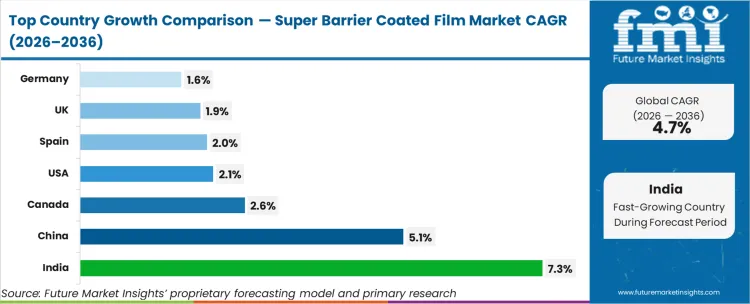
Across all major markets, India sets the pace at 7.30% CAGR, reflecting localized demand acceleration factors. China follows at 5.10%. Canada follows at 2.60%. USA follows at 2.10%. Spain follows at 2.00%. UK follows at 1.90%. Germany follows at 1.60%.
Summary of Super Barrier Coated Film Market
- Super Barrier Coated Film Market definition
- Super barrier coated films are flexible packaging substrates, typically polypropylene or polyester base films, coated with inorganic layers such as silicon oxide or aluminum oxide through vacuum deposition processes, engineered to achieve oxygen and moisture transmission rates orders of magnitude below conventional barrier films for food, pharmaceutical, and electronics packaging applications.
- Demand drivers in the market
- Pharmaceutical blister packaging specifications are tightening moisture ingress limits for hygroscopic drug formulations, forcing converters to upgrade from standard metallized films to silicon oxide and aluminum oxide coated substrates that maintain barrier integrity without opacity.
- Flexible food packaging sustainability mandates in the EU are driving adoption of mono-material recyclable structures where inorganic barrier coatings on PP or PET replace non-recyclable multi-layer aluminum foil laminates.
- Display and electronics manufacturers require transparent ultra-barrier films for OLED encapsulation and flexible solar cell protection, creating a high-margin industrial application channel alongside traditional packaging end uses.
- Key segments analyzed in the FMI report
- PP material: 40.0% share in 2026, reflecting established procurement specifications and supply chain infrastructure favoring this variant.
- Silicon oxide coating type: 48.5% share in 2026, driven by end-use formulation requirements in the primary application channels.
- India: 7.30% compound growth, supported by domestic capacity expansion and rising consumption patterns.
- Analyst opinion at FMI
- Super barrier coated film sits at the intersection of two regulatory megatrends: recyclability mandates in packaging and performance specifications in pharmaceutical and electronics encapsulation. The companies that will capture the largest share of incremental demand are those that have already invested in vacuum deposition capacity and can offer both silicon oxide and aluminum oxide coating options across PP and PET substrates. The risk is capital intensity: each new coating line requires investment thresholds that exclude smaller converters from competing, concentrating market power among a handful of integrated film producers.
- Strategic implications / executive takeaways
- Film converters must evaluate vacuum deposition coating capacity investments now, because lead times for equipment procurement and commissioning extend beyond 24 months and demand from recyclability mandates will accelerate before new capacity comes online.
- Packaging procurement directors should qualify at least two super barrier coated film suppliers per application to avoid single-source dependency in a market where coating capacity is structurally constrained.
- R&D teams in pharmaceutical packaging should specify silicon oxide coated films for transparent blister applications where product visibility is a regulatory or marketing requirement that metallized alternatives cannot satisfy.
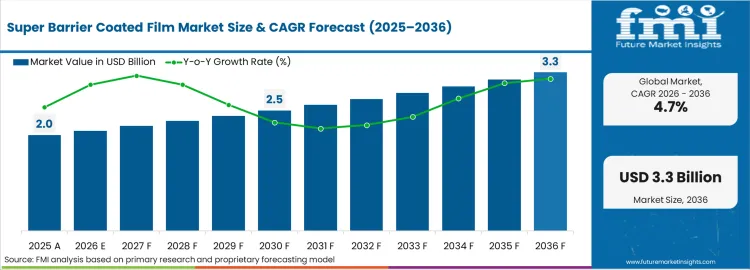
Super Barrier Coated Film Market key takeaways
| Metric | Details |
|---|---|
| Industry Size (2026) | USD 2.09 billion |
| Industry Value (2036) | USD 3.31 billion |
| CAGR (2026 to 2036) | 4.70% |
Source: Future Market Insights, 2026
Super Barrier Coated Film Market definition
Super barrier coated film represents a category of high-performance flexible packaging material where base polymer substrates receive ultra-thin inorganic barrier coatings through physical or chemical vapor deposition. The resulting films deliver oxygen transmission rates below 0.01 cc/m2/day and water vapor transmission rates below 0.01 g/m2/day, meeting the stringent protection requirements of moisture-sensitive and oxygen-sensitive packaged goods.
Super Barrier Coated Film Market inclusions
Market scope includes all commercially traded super barrier coated films segmented by material (PP, PET, BOPP, others) and coating type (silicon oxide, aluminum oxide, hybrid coatings). Revenue sizing spans the 2026 to 2036 forecast period with regional and country-level assessments.
Super Barrier Coated Film Market exclusions
The scope excludes standard metallized films without inorganic oxide barrier coatings, rigid barrier packaging (glass, metal cans), and conventional multi-layer laminate structures that achieve barrier properties through polymer-only construction. Barrier coatings applied to rigid substrates such as glass or metal are outside the defined boundary.
Super Barrier Coated Film Market research methodology
- Primary research: FMI analysts conducted interviews with procurement directors, product development leads, and supply chain managers across key super barrier coated film manufacturing and distribution organizations to map decision gates and sourcing specifications.
- Desk research: Data collection phases aggregated regulatory filings, trade association publications, standards body documentation, and company annual reports to establish verifiable baseline parameters.
- Market sizing and forecasting: Baseline values derive from a bottom-up aggregation of super barrier coated film transaction volumes, applying region-specific adoption curves and pricing indices to project forward demand through 2036.
- Data validation and update cycle: Projections are tested against publicly reported procurement volumes, trade flow statistics, and company financial disclosures on a quarterly refresh schedule.
Key Industry Highlights
E-Commerce Expansion Accelerates Demand for High-Performance Barrier Films
The e-commerce industry has experienced flourishing growth over the past few years caused by the development of internet access and smartphone ownership. The population across the globe is leaning towards e-commerce due to its convenience of shopping online at any time, from anywhere, and without the need to leave home.
The International Trade Administration, USA Department of Commerce stated that the global B2B commerce market has risen steadily over the past decade and is expected to reach USD 36 trillion by 2026.
This growth has led to increased orders via several online platforms for pharmaceuticals, personal care & cosmetics, electronics and electrical products. B2B commerce sometimes also involves longer transit times because of bulk shipments. This translates to high-performance packaging to ensure protection from moisture, oxygen, and contaminants during transit and storage.
The ability of super barrier coated films to protect the products leads to minimizing product spoilage, damage and returns, enhancing customer satisfaction and reducing waste. Also, the films are versatile for compatible with diverse packaging products which include pouches, bags, wraps, and other creative packaging formats, catering to numerous product types from diverse end-use industries.
These abilities of super barrier coated films aligning the necessary packaging requirements from the e-commerce industry are expected to propel their demand over the assessment period.
Global Pharmaceutical Industry Growth to Drive the Market
People across all generations have shifted towards the consumption of packaged foods due to busy lifestyles and convenience. This increased consumption has also resulted in soaring number of cases related to food-borne illness due to consumption of spoiled, contaminated and damaged foods. Around 600 million people lose their lives annually due to consuming unsafe food, this is by the data from the United Nations.
To prevent such cases of food-borne illness the demand for secured packaging solutions has risen. Super barrier coated films offer superior performance, durability, and barrier resistance towards moisture, heat, and cold making them the most suitable for all types of food packaging applications.
These films when combined with various packaging solutions like pouches and bags hold out against fluctuating temperatures, preventing moisture from contaminating the foodstuffs. The daily growth of the packaged food industry and rising cases of food-borne illnesses are some of the major reasons that are driving the super barrier-coated films market across all the regions over the globe.
High Production Costs and Complexity in Manufacturing May Restrict Super Barrier Coated Films Growth
The manufacturing of super barrier coated films requires higher production costs associated with high investments in complex manufacturing processes like vacuum deposition or plasma-enhanced chemical vapor deposition. These production techniques need specialized equipment, and controlled environments, leading to an increase price of these films.
This high price may create a sense of hesitation among price-sensitive markets and SMEs that have limited availability of financial resources, consequently struggling to achieve economies of scale. This also increases the price of the end product that utilize super barrier-coated films in making several packaging products, which can deter their adoption.
These factors collectively impact the growth of the super barrier coated films market and may hamper the growth in the upcoming years.
2021 to 2026 Global Super Barrier Coated Film Sales Outlook Compared to Demand Forecast from 2024 to 2034
The global super barrier coated film market recorded a CAGR of 4.3% during the historical period between 2019 and 2023. Market growth of super barrier coated film was positive as it reached a value of USD 1.8 billion in 2023 from USD 1.5 billion in 2019.
The super barrier coated film market exhibited an incremental growth opportunity of USD 300 million from 2019 to 2023 due to its increased utilization in making a wide range of packaging products like pouches, bags, lids, wraps from food & beverage, pharmaceuticals, personal care & cosmetics, electrical & electronics and automotive. The market is expected to showcase uniform growth and generate a valuation of up to USD 3.0 billion by 2034.
These films are made from several materials, coated with multiple coating types with various thickness ranges as per the requirement of the end user. Polypropylene is being used more often for manufacturing super barrier coated films, capturing a high market share of 37.2% in the assessment period. This is because of its superior mechanical properties and sufficient thermal stability.
North American region is dominating the super barrier coated films market across the globe with a market share of 24.6% attributed to their expanding manufacturing industries and demand for efficient packaging products offering safety during transport and storage for longer periods.
These beneficial characteristics are encouraging super barrier coated film manufacturers to innovate films with improved features for additional benefits. The rise in demand for safe packaging options from several end users is expected to create numerous opportunities for the market.
Market Concentration
Tier 1 companies comprise market leaders with a market revenue of above USD 50 million capturing significant market share of 10% to 15% in global market. These market leaders are characterized by high production capacity and a wide product portfolio.
These market leaders are distinguished by their extensive expertise in manufacturing across multiple packaging formats and a broad geographical reach, underpinned by a robust consumer base. They provide a wide range of series including recycling and manufacturing utilizing the latest technology and meeting the regulatory standards providing the highest quality.
Prominent companies within tier 1 include Toray Plastics (America), Inc. (Toray Industries Inc.), Vibac Group S.p.a., Tekni-Plex, Inc., UFlex Limited and Cosmo Films.
Tier 2 companies include mid-size players with revenue of USD 5 to USD 50 million having presence in specific regions and highly influencing the local market. These are characterized by a strong presence overseas and strong market knowledge. These market players have good technology and ensure regulatory compliance but may not have advanced technology and wide global reach.
Prominent companies in tier 2 include JPFL Films Private Limited, Chiripal Poly Films Limited, Sigma Technologies Int'l, LLC, Celplast Metallized Products, DUNMORE and TOPPAN USA Inc.
Tier 3 includes the majority of small-scale companies operating at the local presence and serving niche markets having revenue below USD 5 million. These companies are notably oriented towards fulfilling local market demands and are consequently classified within the tier 3 share segment.
They are small-scale players and have limited geographical reach. Tier 3, within this context, is recognized as an unorganized market, denoting a sector characterized by a lack of extensive structure and formalization when compared to organized competitors.
Country-wise Insights
The section below covers the future forecast for the super barrier coated film market in terms of countries. Information on key countries in several parts of the globe, including North America, Latin America, East Asia, South Asia and Pacific, Western Europe, Eastern Europe and MEA is provided.
Canada is anticipated to remain at the forefront in North America, with a CAGR of 2.6% through 2036. In South Asia and Pacific, India is projected to witness a CAGR of 7.3% by 2036.
.webp "Top Country Growth Comparison Super Barrier Coated Film Market Cagr (2026 2036)")
| Countries | Value CAGR (2026 to 2036) |
|---|---|
| USA | 2.1% |
| Germany | 1.6% |
| China | 5.1% |
| UK | 1.9% |
| Spain | 2.0% |
| India | 7.3% |
| Canada | 2.6% |
High Demand for Secured Packaging Products with Growing Pharmaceutical Exports in India
The super barrier coated film industry in India is projected to grow at a CAGR of 7.3% compared to other countries in the South Asia and Pacific region by 2036 due to growing flexible packaging industry and major export activities related of pharmaceutical products.
India is recognized as one of the primary producer and supplier of pharmaceutical products, including liquid medications, granules, powders, and pharmaceutical equipment and components. The nation exports pharmaceuticals and related goods to over 200 nations in the Middle East, Asia, Latin America & Caribbean, Africa, Europe, ASEAN, and other European regions.
Drugs and medicines exported from India have generated a valuation of USD 25.4 billion in 2023, according to the India Brand Equity Foundation.
Super barrier coated films are paired with different packaging materials because of their appropriate qualities to shield the inert products from external contaminants such as dust, dirt, moisture, gases, sunlight and other contaminating factors, as well as to ensure that these products arrive safely and retain the necessary efficacy and stability.
Rising USA Flexible Packaging Fuels Super Barrier Film Demand
The growth of flexible packaging industry in USA offers a lot of opportunities for the super barrier coated films market. The country is anticipated to record a CAGR of 2.1% during the evaluation period due to their ability to meet evolving market demands for protection.
The shift towards flexible packaging solutions in the USA due to their lightweight, inexpensive and convenient nature has ultimately led to high demand for upper barrier coated films. The flexible packaging industry in the USA recorded for sales of around USD 41.5 billion in 2022, as per the study by the Flexible Packaging Association.
Super barrier-coated films are very crucial in the majority of flexible packaging solutions to offer exceptional protection against moisture, oxygen, and contaminants. Super barrier-coated films are versatile and used in a range of flexible packaging formats like pouches, sachets, and wraps, increasing their market opportunities.
These films are often designed with recyclable or reduced environmental impact features and align with sustainability goals, boosting their demand in the flexible packaging market. Thus, the booming flexible packaging industry in the USA and major utilization of these films are expected to gain impetus demand for super barrier coated films.
Category-wise Insights
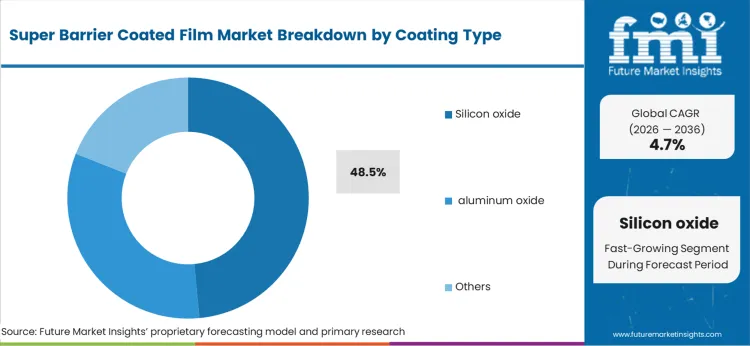
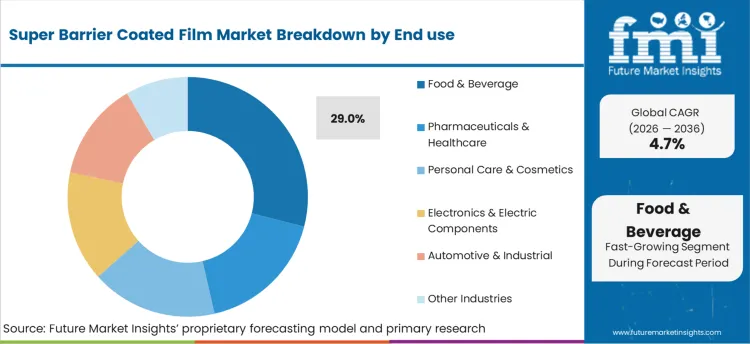
The section contains information about the leading segments in the industry. In terms of coating type, silicon oxide (SiOx) coating is estimated to account for a share of 48.5% by 2036. By end use, the food segment is projected to dominate by holding a share of 38.0% by the end 2036.
Preference for Silicon Oxide Coatings Attributed to Optimal Barrier Protection and Environmental Benefits
| Coating Type | Silicon Oxide (SiOx) Coating |
|---|---|
| Value CAGR (2036) | 4.1% |
Several coating types are used for in super barrier coated film market, among those silicon oxide (SiOx) coating is expected to dominate the super barrier coated film market during the forecast period. Silicon oxide (SiOx) coating is anticipated to rise at a CAGR of 4.1%, and hold for 48.5% of the total market share till the end of 2036.
Films are used in a variety of packaging solutions to provide a strong barrier and provide protection against external factors. To increase the barrier properties these films are coated with a wide range of coatings. Among different coating types, silicon oxide is preferred more due to its excellent barrier properties such as an oxygen transmission rate below 0.1 cc/m²/day and a very low water vapor transmission rate of 0.5 g/m²/day.
Silicon oxide coatings don't alter the transparency of the base films, making it suitable for food packaging solutions where customers choose products with packaging solutions that allow them to visually check the quality of the product at the time of purchasing.
Additionally, these coatings utilize less material and energy compared to other coatings and can be easily removed during the recycling process, contributing efficiently to the sustainability aspect of the packaging materials and products.
Films with silicon oxide coating possess exceptional thermal stability to withstand temperatures up to 600°C without degrading. Due to these factors, silicon oxide (SiOx) coating is favored as compared to other coating types, consequently pushing the demand for super barrier-coated films in upcoming years.
Surging Demand for Flexible, Lightweight Super Barrier Coated Films in Food & Beverage Packaging
| End Use | Food & Beverage |
|---|---|
| Value CAGR (2036) | 4.3% |
The food & beverage segment among other end users like pharmaceuticals, cosmetics personal care and other industries is estimated to lead the super barrier coated film market with a growth rate of 4.3% till 2036.
Although supper barrier coated films have applications in various end-use industries, the food & beverage sector utilizes these films on a large scale in a wide range of packaging solutions. This is due to several factors such as their ability to extend the shelf life of perishable foods by preventing spoilage by oxidation and moisture, also crucial for packaged foods like snacks, dairy products, and ready-to-eat meals.
It also helps in retaining the original flavor and aroma by intercepting the ingress of oxygen and other harmful gases for products like coffee, tea, and spices.
Packaging products with super barrier coated films are considerably lightweight rather than traditional rigid packaging solutions, offering cost-effective to transport, handle and store, at the same time the flexibility of these films allows for creative and diverse packaging formats, including pouches, bags, and wrappers, catering to the needs of modern food consumers.
The combined factors are anticipated to showcase a surging demand for super barrier coated films for packaging products like pouches, lidding films, flow wraps, bottle and liquid carton liners, etc. from the food & beverage industry.
Competitive Landscape
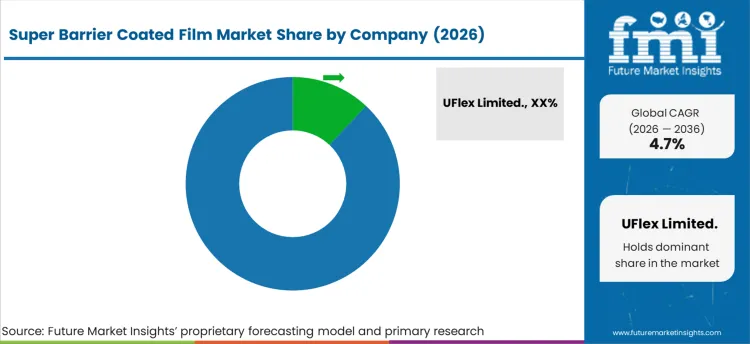
Key leader in the super barrier coated film industry are focusing on innovative product launch, and incorporating new production technologies for improved production pace to meet the growing consumer demands. They are integrating with different firms and extending their geographical presence. Few of them are also collaborating and partnering with local brands and start-up companies for new product development.
Key Developments in Super Barrier Coated Film Market
- In May 2024, Uflex launched a barrier metalized BOPP film namely “B-UUB-M” with oxygen barrier and moisture-resistant features suitable for dry fruits, beverages, chips, snacks, biscuits, cookies, and other confectionery and chocolate items.
- In January 2024, DUNMORE launched a new sustainable and printable PET film DUN-GREEN with printable topcoat made from 75% post-consumer recycled material.
- In December 2023, Cosmo Films introduced new metalized electrical grade BOPP films for manufacturing of various types of AC and DC capacitors used in electronic appliances, automotive, electric vehicles, etc.
Scope of the report
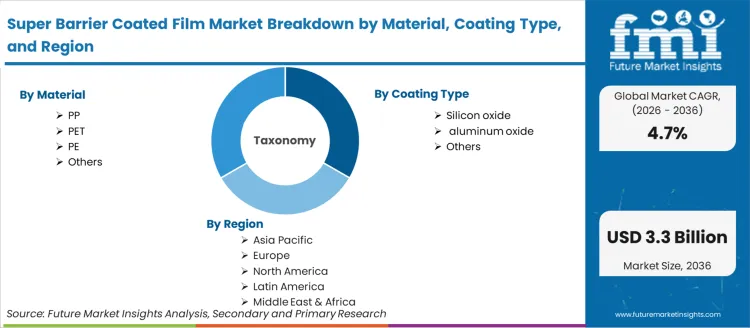
| Metric | Value |
|---|---|
| Quantitative Units | USD 2.09 billion to USD 3.31 billion, at a CAGR of 4.70% |
| Market Definition | Super barrier coated films are flexible packaging substrates, typically polypropylene or polyester base films, coated with inorganic layers such as silicon oxide or aluminum oxide through vacuum deposition processes, engineered to achieve oxygen and moisture transmission rates orders of magnitude below conventional barrier films for food, pharmaceutical, and electronics packaging applications. |
| Segmentation | Material (PP), Coating Type (Silicon oxide) |
| Regions Covered | North America, Latin America, Europe, East Asia, South Asia, Oceania, Middle East and Africa |
| Countries Covered | India, China, USA, Canada, UK, Germany, Japan, and 40 plus countries |
| Key Companies Profiled | UFlex Limited., Tekni-Plex, Inc., Cosmo Films, Sigma Technologies Int'l, LLC, Vibac Group S.p.a., Syensqo, DUNMORE, TOPPAN USA Inc., Shijiazhuang Dajia New materials Technology Co.,Ltd, Qingdao Cloud film Packaging materials Co., Ltd. |
| Forecast Period | 2026 to 2036 |
| Approach | Forecasting models apply a hybrid bottom-up and top-down methodology starting with verified super barrier coated film transaction data and projecting adoption velocity across defined segments and regions. |
Super Barrier Coated Film Market Segmentation
By Material Type:
Materials used for making super barrier coated films include polyethylene terephthalate (PET), polypropylene (PP), polyamide (PA), polyethylene (PE), and others (EVOH, PVDC, etc.)
By Thickness:
Super barrier coated film is available in variety of thickness range including less than 20 microns, 21 to 60 microns and 60 microns and above.
By Coting Type:
Various coating types in the super barrier coated films are silicon oxide (SiOx) coating, aluminum oxide (AlOx) coating, and others (acrylic, PVDC, etc.)
By End Use:
Some of end users related to super barrier coated film include food and beverage, pharmaceuticals, personal care and cosmetics, electronics, automotive and other industries.
By Region:
Key countries of North America, Latin America, East Asia, South Asia and Pacific, Western Europe, Eastern Europe, Middle East and Africa are covered.
Bibliography
- European Commission. (2024). Packaging and Packaging Waste Regulation (PPWR). European Commission, Directorate-General for Environment.
- United States Food and Drug Administration. (2024). Guidance for Industry: Use of Recycled Plastics in Food Packaging. U.S. FDA.
- Organisation for Economic Co-operation and Development. (2024). Extended Producer Responsibility: Updated Guidance for Efficient Waste Management. OECD.
- International Organization for Standardization. (2024). ISO 15106: Plastics, Film and Sheeting, Determination of Water Vapour Transmission Rate. ISO.
- European Aluminium Association. (2024). Aluminium Packaging Recyclability Assessment Framework. European Aluminium.
- Society of Vacuum Coaters. (2024). Proceedings: Advances in Barrier Coating Technologies for Flexible Substrates. SVC.
This bibliography is provided for reader reference. The full FMI report contains the complete reference list with primary research documentation.
This report addresses
- Market sizing and quantitative forecast metrics detailing the precise expenditure on super barrier coated film across major industry verticals through 2036.
- Segmentation analysis mapping the adoption velocity of specific material variants and evaluating the structural drivers behind format preference shifts.
- Regional deployment intelligence comparing growth trajectories across Asia Pacific, Europe, North America, Latin America, and Middle East and Africa.
- Regulatory compliance assessment analyzing how evolving standards and labeling mandates shape procurement specifications across target geographies.
- Competitive posture evaluation tracking consolidation activity, capacity investments, and strategic partnerships among leading market participants.
- Capital project strategic guidance defining the procurement parameters and supply chain configurations required for super barrier coated film sourcing through the forecast period.
- Supply chain vulnerability analysis identifying concentration risks, raw material dependencies, and logistics bottlenecks affecting cost structures.
- Custom data delivery formats encompassing interactive dashboards, raw Excel datasets, and comprehensive PDF narrative reports.
Frequently Asked Questions
How large is the demand for Super Barrier Coated Film in the global market in 2026?
Demand for super barrier coated film in the global market is estimated to be valued at USD 2.09 billion in 2026.
What will be the market size of Super Barrier Coated Film in the global market by 2036?
Market size for super barrier coated film is projected to reach USD 3.31 billion by 2036.
What is the expected demand growth for Super Barrier Coated Film in the global market between 2026 and 2036?
Demand for super barrier coated film is expected to grow at a CAGR of 4.70% between 2026 and 2036.
Which Material is poised to lead global sales by 2026?
PP accounts for 40.0% in 2026, reflecting established procurement specifications and supply chain readiness across primary buyer channels.
How is Silicon oxide driving Super Barrier Coated Film adoption in 2026?
Silicon oxide represents 48.5% of segment demand as end-use formulation requirements continue to favor this category.
What is driving demand in India?
India registers a 7.30% CAGR through 2036, propelled by domestic capacity expansion and rising end-use consumption.
What does Super Barrier Coated Film Market definition mean in this report?
Super barrier coated films are flexible packaging substrates, typically polypropylene or polyester base films, coated with inorganic layers such as silicon oxide or aluminum oxide through vacuum deposition processes, engineered to achieve oxygen and moisture transmission rates orders of magnitude below conventional barrier films for food, pharmaceutical, and electronics packaging applications.
How does FMI build and validate the Super Barrier Coated Film forecast?
Forecasting models apply a hybrid bottom-up methodology starting with verified transaction data, cross-validated against publicly reported procurement volumes and company financial disclosures on a quarterly refresh schedule.
Preview the report firsthand - request a free sample
Get SampleGet the brochure for pricing and purchase details.
Get PDFTable of Content
- Executive Summary
- Global Market Outlook
- Demand-side Trends
- Supply-side Trends
- Technology Roadmap Analysis
- Analysis and Recommendations
- Market Overview
- Market Coverage / Taxonomy
- Market Definition / Scope / Limitations
- Research Methodology
- Chapter Orientation
- Analytical Lens and Working Hypotheses
- Market Structure, Signals, and Trend Drivers
- Benchmarking and Cross-market Comparability
- Market Sizing, Forecasting, and Opportunity Mapping
- Research Design and Evidence Framework
- Desk Research Programme (Secondary Evidence)
- Company Annual and Sustainability Reports
- Peer-reviewed Journals and Academic Literature
- Corporate Websites, Product Literature, and Technical Notes
- Earnings Decks and Investor Briefings
- Statutory Filings and Regulatory Disclosures
- Technical White Papers and Standards Notes
- Trade Journals, Industry Magazines, and Analyst Briefs
- Conference Proceedings, Webinars, and Seminar Materials
- Government Statistics Portals and Public Data Releases
- Press Releases and Reputable Media Coverage
- Specialist Newsletters and Curated Briefings
- Sector Databases and Reference Repositories
- FMI Internal Proprietary Databases and Historical Market Datasets
- Subscription Datasets and Paid Sources
- Social Channels, Communities, and Digital Listening Inputs
- Additional Desk Sources
- Expert Input and Fieldwork (Primary Evidence)
- Primary Modes
- Qualitative Interviews and Expert Elicitation
- Quantitative Surveys and Structured Data Capture
- Blended Approach
- Why Primary Evidence is Used
- Field Techniques
- Interviews
- Surveys
- Focus Groups
- Observational and In-context Research
- Social and Community Interactions
- Stakeholder Universe Engaged
- C-suite Leaders
- Board Members
- Presidents and Vice Presidents
- R&D and Innovation Heads
- Technical Specialists
- Domain Subject-matter Experts
- Scientists
- Physicians and Other Healthcare Professionals
- Governance, Ethics, and Data Stewardship
- Research Ethics
- Data Integrity and Handling
- Primary Modes
- Tooling, Models, and Reference Databases
- Desk Research Programme (Secondary Evidence)
- Data Engineering and Model Build
- Data Acquisition and Ingestion
- Cleaning, Normalisation, and Verification
- Synthesis, Triangulation, and Analysis
- Quality Assurance and Audit Trail
- Market Background
- Market Dynamics
- Drivers
- Restraints
- Opportunity
- Trends
- Scenario Forecast
- Demand in Optimistic Scenario
- Demand in Likely Scenario
- Demand in Conservative Scenario
- Opportunity Map Analysis
- Product Life Cycle Analysis
- Supply Chain Analysis
- Investment Feasibility Matrix
- Value Chain Analysis
- PESTLE and Porter’s Analysis
- Regulatory Landscape
- Regional Parent Market Outlook
- Production and Consumption Statistics
- Import and Export Statistics
- Market Dynamics
- Global Market Analysis 2021 to 2025 and Forecast, 2026 to 2036
- Historical Market Size Value (USD Million) Analysis, 2021 to 2025
- Current and Future Market Size Value (USD Million) Projections, 2026 to 2036
- Y-o-Y Growth Trend Analysis
- Absolute $ Opportunity Analysis
- Global Market Pricing Analysis 2021 to 2025 and Forecast 2026 to 2036
- Global Market Analysis 2021 to 2025 and Forecast 2026 to 2036, By Material
- Introduction / Key Findings
- Historical Market Size Value (USD Million) Analysis By Material , 2021 to 2025
- Current and Future Market Size Value (USD Million) Analysis and Forecast By Material , 2026 to 2036
- PP
- PET
- PE
- Others
- PP
- Y-o-Y Growth Trend Analysis By Material , 2021 to 2025
- Absolute $ Opportunity Analysis By Material , 2026 to 2036
- Global Market Analysis 2021 to 2025 and Forecast 2026 to 2036, By Coating Type
- Introduction / Key Findings
- Historical Market Size Value (USD Million) Analysis By Coating Type, 2021 to 2025
- Current and Future Market Size Value (USD Million) Analysis and Forecast By Coating Type, 2026 to 2036
- Silicon oxide
- aluminum oxide
- Others
- Silicon oxide
- Y-o-Y Growth Trend Analysis By Coating Type, 2021 to 2025
- Absolute $ Opportunity Analysis By Coating Type, 2026 to 2036
- Global Market Analysis 2021 to 2025 and Forecast 2026 to 2036, By Thickness
- Introduction / Key Findings
- Historical Market Size Value (USD Million) Analysis By Thickness, 2021 to 2025
- Current and Future Market Size Value (USD Million) Analysis and Forecast By Thickness, 2026 to 2036
- 20 microns
- 21 to 60 microns
- 60 microns and above
- 20 microns
- Y-o-Y Growth Trend Analysis By Thickness, 2021 to 2025
- Absolute $ Opportunity Analysis By Thickness, 2026 to 2036
- Global Market Analysis 2021 to 2025 and Forecast 2026 to 2036, By End use
- Introduction / Key Findings
- Historical Market Size Value (USD Million) Analysis By End use, 2021 to 2025
- Current and Future Market Size Value (USD Million) Analysis and Forecast By End use, 2026 to 2036
- Food & Beverage
- Pharmaceuticals & Healthcare
- Personal Care & Cosmetics
- Electronics & Electric Components
- Automotive & Industrial
- Other Industries
- Food & Beverage
- Y-o-Y Growth Trend Analysis By End use, 2021 to 2025
- Absolute $ Opportunity Analysis By End use, 2026 to 2036
- Global Market Analysis 2021 to 2025 and Forecast 2026 to 2036, By Region
- Introduction
- Historical Market Size Value (USD Million) Analysis By Region, 2021 to 2025
- Current Market Size Value (USD Million) Analysis and Forecast By Region, 2026 to 2036
- North America
- Latin America
- Western Europe
- Eastern Europe
- East Asia
- South Asia and Pacific
- Middle East & Africa
- Market Attractiveness Analysis By Region
- North America Market Analysis 2021 to 2025 and Forecast 2026 to 2036, By Country
- Historical Market Size Value (USD Million) Trend Analysis By Market Taxonomy, 2021 to 2025
- Market Size Value (USD Million) Forecast By Market Taxonomy, 2026 to 2036
- By Country
- USA
- Canada
- Mexico
- By Material
- By Coating Type
- By Thickness
- By End use
- By Country
- Market Attractiveness Analysis
- By Country
- By Material
- By Coating Type
- By Thickness
- By End use
- Key Takeaways
- Latin America Market Analysis 2021 to 2025 and Forecast 2026 to 2036, By Country
- Historical Market Size Value (USD Million) Trend Analysis By Market Taxonomy, 2021 to 2025
- Market Size Value (USD Million) Forecast By Market Taxonomy, 2026 to 2036
- By Country
- Brazil
- Chile
- Rest of Latin America
- By Material
- By Coating Type
- By Thickness
- By End use
- By Country
- Market Attractiveness Analysis
- By Country
- By Material
- By Coating Type
- By Thickness
- By End use
- Key Takeaways
- Western Europe Market Analysis 2021 to 2025 and Forecast 2026 to 2036, By Country
- Historical Market Size Value (USD Million) Trend Analysis By Market Taxonomy, 2021 to 2025
- Market Size Value (USD Million) Forecast By Market Taxonomy, 2026 to 2036
- By Country
- Germany
- UK
- Italy
- Spain
- France
- Nordic
- BENELUX
- Rest of Western Europe
- By Material
- By Coating Type
- By Thickness
- By End use
- By Country
- Market Attractiveness Analysis
- By Country
- By Material
- By Coating Type
- By Thickness
- By End use
- Key Takeaways
- Eastern Europe Market Analysis 2021 to 2025 and Forecast 2026 to 2036, By Country
- Historical Market Size Value (USD Million) Trend Analysis By Market Taxonomy, 2021 to 2025
- Market Size Value (USD Million) Forecast By Market Taxonomy, 2026 to 2036
- By Country
- Russia
- Poland
- Hungary
- Balkan & Baltic
- Rest of Eastern Europe
- By Material
- By Coating Type
- By Thickness
- By End use
- By Country
- Market Attractiveness Analysis
- By Country
- By Material
- By Coating Type
- By Thickness
- By End use
- Key Takeaways
- East Asia Market Analysis 2021 to 2025 and Forecast 2026 to 2036, By Country
- Historical Market Size Value (USD Million) Trend Analysis By Market Taxonomy, 2021 to 2025
- Market Size Value (USD Million) Forecast By Market Taxonomy, 2026 to 2036
- By Country
- China
- Japan
- South Korea
- By Material
- By Coating Type
- By Thickness
- By End use
- By Country
- Market Attractiveness Analysis
- By Country
- By Material
- By Coating Type
- By Thickness
- By End use
- Key Takeaways
- South Asia and Pacific Market Analysis 2021 to 2025 and Forecast 2026 to 2036, By Country
- Historical Market Size Value (USD Million) Trend Analysis By Market Taxonomy, 2021 to 2025
- Market Size Value (USD Million) Forecast By Market Taxonomy, 2026 to 2036
- By Country
- India
- ASEAN
- Australia & New Zealand
- Rest of South Asia and Pacific
- By Material
- By Coating Type
- By Thickness
- By End use
- By Country
- Market Attractiveness Analysis
- By Country
- By Material
- By Coating Type
- By Thickness
- By End use
- Key Takeaways
- Middle East & Africa Market Analysis 2021 to 2025 and Forecast 2026 to 2036, By Country
- Historical Market Size Value (USD Million) Trend Analysis By Market Taxonomy, 2021 to 2025
- Market Size Value (USD Million) Forecast By Market Taxonomy, 2026 to 2036
- By Country
- Kingdom of Saudi Arabia
- Other GCC Countries
- Turkiye
- South Africa
- Other African Union
- Rest of Middle East & Africa
- By Material
- By Coating Type
- By Thickness
- By End use
- By Country
- Market Attractiveness Analysis
- By Country
- By Material
- By Coating Type
- By Thickness
- By End use
- Key Takeaways
- Key Countries Market Analysis
- USA
- Pricing Analysis
- Market Share Analysis, 2025
- By Material
- By Coating Type
- By Thickness
- By End use
- Canada
- Pricing Analysis
- Market Share Analysis, 2025
- By Material
- By Coating Type
- By Thickness
- By End use
- Mexico
- Pricing Analysis
- Market Share Analysis, 2025
- By Material
- By Coating Type
- By Thickness
- By End use
- Brazil
- Pricing Analysis
- Market Share Analysis, 2025
- By Material
- By Coating Type
- By Thickness
- By End use
- Chile
- Pricing Analysis
- Market Share Analysis, 2025
- By Material
- By Coating Type
- By Thickness
- By End use
- Germany
- Pricing Analysis
- Market Share Analysis, 2025
- By Material
- By Coating Type
- By Thickness
- By End use
- UK
- Pricing Analysis
- Market Share Analysis, 2025
- By Material
- By Coating Type
- By Thickness
- By End use
- Italy
- Pricing Analysis
- Market Share Analysis, 2025
- By Material
- By Coating Type
- By Thickness
- By End use
- Spain
- Pricing Analysis
- Market Share Analysis, 2025
- By Material
- By Coating Type
- By Thickness
- By End use
- France
- Pricing Analysis
- Market Share Analysis, 2025
- By Material
- By Coating Type
- By Thickness
- By End use
- India
- Pricing Analysis
- Market Share Analysis, 2025
- By Material
- By Coating Type
- By Thickness
- By End use
- ASEAN
- Pricing Analysis
- Market Share Analysis, 2025
- By Material
- By Coating Type
- By Thickness
- By End use
- Australia & New Zealand
- Pricing Analysis
- Market Share Analysis, 2025
- By Material
- By Coating Type
- By Thickness
- By End use
- China
- Pricing Analysis
- Market Share Analysis, 2025
- By Material
- By Coating Type
- By Thickness
- By End use
- Japan
- Pricing Analysis
- Market Share Analysis, 2025
- By Material
- By Coating Type
- By Thickness
- By End use
- South Korea
- Pricing Analysis
- Market Share Analysis, 2025
- By Material
- By Coating Type
- By Thickness
- By End use
- Russia
- Pricing Analysis
- Market Share Analysis, 2025
- By Material
- By Coating Type
- By Thickness
- By End use
- Poland
- Pricing Analysis
- Market Share Analysis, 2025
- By Material
- By Coating Type
- By Thickness
- By End use
- Hungary
- Pricing Analysis
- Market Share Analysis, 2025
- By Material
- By Coating Type
- By Thickness
- By End use
- Kingdom of Saudi Arabia
- Pricing Analysis
- Market Share Analysis, 2025
- By Material
- By Coating Type
- By Thickness
- By End use
- Turkiye
- Pricing Analysis
- Market Share Analysis, 2025
- By Material
- By Coating Type
- By Thickness
- By End use
- South Africa
- Pricing Analysis
- Market Share Analysis, 2025
- By Material
- By Coating Type
- By Thickness
- By End use
- USA
- Market Structure Analysis
- Competition Dashboard
- Competition Benchmarking
- Market Share Analysis of Top Players
- By Regional
- By Material
- By Coating Type
- By Thickness
- By End use
- Competition Analysis
- Competition Deep Dive
- UFlex Limited.
- Overview
- Product Portfolio
- Profitability by Market Segments (Product/Age /Sales Channel/Region)
- Sales Footprint
- Strategy Overview
- Marketing Strategy
- Product Strategy
- Channel Strategy
- Tekni-Plex, Inc.
- Cosmo Films
- Sigma Technologies Int'l, LLC
- Vibac Group S.p.a.
- Syensqo
- DUNMORE
- TOPPAN USA Inc.
- Shijiazhuang Dajia New materials Technology Co.,Ltd
- Qingdao Cloud film Packaging materials Co., Ltd.
- Toray Plastics (America), Inc. (Toray Industries Inc.)
- JPFL Films Private Limited
- Qingdao Kingchuan Packaging
- Chiripal Poly Films Limited
- Celplast Metallized Products
- UFlex Limited.
- Competition Deep Dive
- Assumptions & Acronyms Used


