

- Market Size (2026)
- USD 132.1 Mn
- Forecast (2036)
- USD 205.1 Mn
- CAGR (2026 to 2036)
- 4.5%
How big is Susceptor Sleeves Market in 2026?
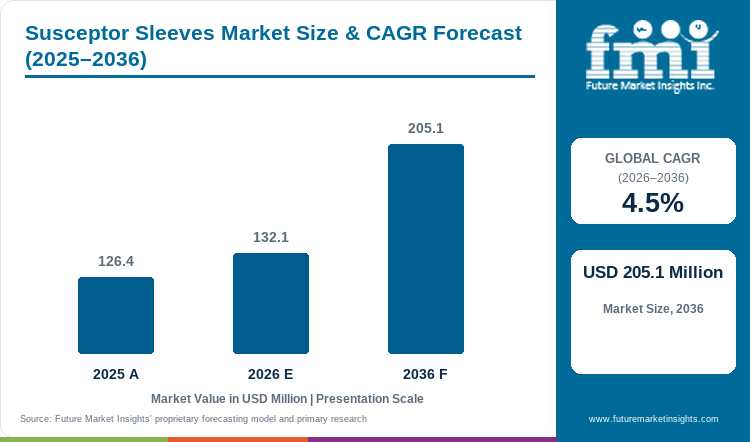
USD 132.1 million in 2026 and USD 205.1 million by 2036 at a 4.5% CAGR.
Sales in the susceptor sleeves market are projected to grow at 4.5% CAGR through 2036, climbing from USD 126.4 million in 2025 to USD 132.1 million in 2026 before driving valuation to USD 205.1 million by 2036. Prepared-food manufacturers use an active sleeve when rapid microwave heating must recover browning or crispness that passive packaging cannot produce. Graphic Packaging documented in April 2026 that Qwik Crisp susceptors serve bread and dough-based foods in cartons and sleeves.
National packaging rules also change how quickly an approved design can move between markets. Germany applies the PPWR and its Packaging Law Implementation Act from August 12, 2026. The USA follows a separate federal food-contact authorization route for materials used in microwave applications. Germany's environment ministry states that the new framework adds recycling requirements and manufacturer obligations to the existing packaging system. A converter serving both countries must therefore qualify the same sleeve against different material records and end-of-life requirements before a common commercial specification can support repeat orders.
Key Takeaways
- Prepared-food manufacturers specify susceptor sleeves when microwave reheating must restore surface browning or crispness without adding oven time.
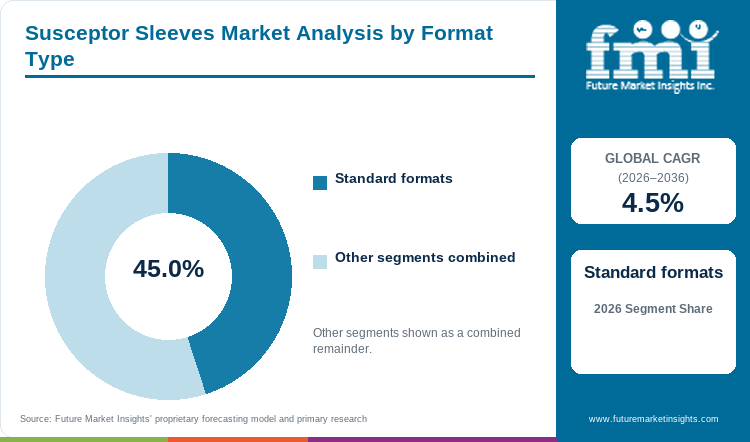
- Standard formats are projected to hold 45.0% share in 2026, supported by familiar geometries that reduce conversion work after thermal approval.
- Paperboard is likely to capture 29.0% share in 2026, supported by printability and compatibility with laminated active layers used in susceptor structures.
- Standard meal formats are set to lead the format size category with 41.0% share in 2026, driven by common portions that simplify active-area control.
- Food-specific thermal qualification and composite-material recovery requirements can delay routine purchasing after an initial sleeve trial.
- Some of the key players in this market include Sirane (Coppice Alupack Ltd), Genpak LLC, Pactiv Evergreen (a Novolex company), Dart Container Corporation, Detmold Group, Novolex, Graphic Packaging International, Amcor plc, Duni Group, and Huhtamäki Oyj.
Analyst Perspective
"A susceptor sleeve earns repeat orders only when the food, active layer and microwave instruction perform as one controlled system. Packaging teams therefore compare crisping performance with food-contact documentation and material recovery before expanding a trial into regular production."
- Nandini Roy Choudhury, Principal Consultant, Future Market Insights
How is the susceptor sleeves market segmented?
The susceptor sleeves market is segmented by format type, material, format size, end use, sales channel and region.
Format Type includes Standard formats, Recyclable-optimized formats, Premium & branded formats, and Custom-engineered formats. Material includes Paperboard, Molded fiber & bagasse, rPET & PP, Compostable polymers, and Aluminium. Format Size includes Standard meal, Single-serve, and Family & catering. End Use includes Delivery platforms, QSR chains, Coffee & beverage, Institutional catering, and Retail deli. Sales Channel includes Broadline foodservice distributors, Direct chain contracts, Packaging distributors, and Online.
What makes standard formats central to the format type category?
Prepared-food teams use standard sleeve geometries to limit tooling changes after a thermal pattern passes product testing. Common die lines also simplify case packing for recurring ready meals packaging programs serving multiple operating locations. Sirane lists board and sleeve formats alongside wraps and flow-wrap film within its microwave-susceptor range. The same range includes U-cards and shaped boards for prepared-food applications requiring controlled microwave contact. Sirane states that the susceptor must touch the product and that packaging is designed around the food. Standard formats therefore reduce structural conversion work without removing the food-specific contact and heating checks required before repeat production.
- Based on Format Type, Standard formats are projected to account for 45.0% in 2026 because repeatable geometries shorten routine conversion work after food-specific thermal approval.
- Converters can change print and heating-zone placement after the base geometry passes handling and microwave checks for the intended food.
Why does paperboard hold the largest material share?
Paperboard gives converters a printable structural carrier that can position an active susceptor layer close to the food surface. The same carrier also fits established folding and sleeve conversion used in paperboard packaging for branded prepared foods. Graphic Packaging International states that Qwik Crisp susceptor film supports cartons and sleeves for active microwave applications. The same product range includes discs and trays for applications requiring microwave browning or crisping. Sirane separately documents susceptor film laminated to board and offers printed board and sleeves. Those capabilities explain why paperboard can combine graphics and structure with a separately qualified active layer.
- By Material, Paperboard is estimated to hold 29.0% in 2026 because printability and laminate compatibility keep the carrier practical for branded microwave-ready sleeves.
- Packaging engineers still evaluate the complete laminate because coatings and active layers determine food-contact and recovery requirements.
How does standard meal size shape format size demand?
Standard meal sleeves provide enough contact area for active heating around a prepared-food portion without requiring the wider geometry of family formats. The footprint also aligns with portioning routines used in ready-to-eat food packaging for retail and foodservice programs. Huhtamäki Oyj describes its Fresh fiber-based ready-meal trays as microwaveable and ovenable for prepared-food applications. That tray is not a susceptor sleeve, but it reflects the same buyer requirement for heat-ready single-meal packaging. An active sleeve adds a separate qualification step because the heating zone must match the actual food surface and microwave instruction.
- In 2026, Standard meal formats are expected to lead Format Size with 41.0% share because common portion dimensions simplify active-area control during thermal qualification.
- Single-serve and family formats require different heat distribution because food mass and active contact area change with portion geometry.
Why do delivery platforms support end-use demand?
Delivery separates initial cooking from the final eating occasion and can leave fried or toasted foods needing texture recovery after transit. A susceptor sleeve can provide controlled reheating without requiring separate cookware after the delivery arrives. Genpak LLC lists reusable microwavable polypropylene products and microwavable Harvest Fiber containers for restaurant and take-out foodservice applications. Genpak LLC does not describe those containers as susceptors, but they document the same off-premise reheating requirement. That route connects susceptor demand with convenience food programs where package performance remains part of the final preparation instruction after delivery.
- By End Use, Delivery platforms are forecast to represent 28.0% in 2026 because off-premise meal workflows can require controlled reheating after transit.
- Food brands use active sleeves where the reheating instruction can restore surface texture without disrupting the delivery pack's handling sequence.
What supports broadline foodservice distributors within the sales channel category?
Broadline distributors can replenish sleeves beside food and other operating supplies after a restaurant group approves one standard package specification. Routine case ordering matters because a missing sleeve can change the stated reheating method even when the food remains available. Novolex states that its operations serve foodservice and grocery markets alongside retail and beverage customers. Its network includes more than 100 facilities across the United States and Canada plus Mexico and Europe. The company also documents food packaging capabilities spanning resin and paper plus molded fiber and aluminum. That official network evidence supports the commercial replenishment mechanism without implying that every Novolex format is a susceptor sleeve.
- The Sales Channel category is forecast to be led by Broadline foodservice distributors at 39.0% share in 2026 because route density supports routine case replenishment.
- Direct chain contracts become more important when proprietary printing or active patterns require dedicated production and tighter specification control.
What are the drivers, restraints and opportunities in the Susceptor Sleeves Market?
Prepared-food reheating supports demand, food-specific thermal validation delays conversion, and lower-material constructions provide a practical design opening.
- Driver: Prepared-food teams need microwave reheating that restores a crisp or browned surface without extending final preparation time.
- Restraint: High-temperature food-contact performance must remain valid for the intended food and heating cycle before routine purchasing begins.
- Opportunity: Converters can reduce material burden while preserving active heating performance and clear end-of-life instructions.
Prepared-food reheating makes the package part of the final cooking instruction for texture-sensitive meals.
Operators using food tray formats already manage portion geometry and microwave handling before a meal reaches the consumer. Graphic Packaging International's Qwik Crisp portfolio includes susceptor film for cartons and sleeves used in prepared-food applications. The same portfolio includes discs and trays for products requiring microwave browning or crisping. Its April 2026 microwave-packaging article describes product-specific engineering and rigorous testing before commercial use. The active susceptor converts microwave energy into localized heat at the food surface instead of acting as a passive container. Prepared-food manufacturers therefore purchase the sleeve when a validated heating pattern delivers the required surface result within the intended microwave instruction.
Food-contact validation can delay commercial conversion after a successful heating trial reaches formal package approval.
FDA Food Contact Notification 2486 became effective on March 17, 2026 and permits a defined EVOH coating on paper or paperboard under conditions that include microwave susceptor applications. That federal authorization illustrates why flexible plastic packaging layers and coatings cannot be treated as interchangeable during food-contact review. The finished sleeve must remain within the applicable contact and heating conditions for the intended food use. A converter that changes a coating or active-film construction after qualification may need new documentation or testing before a customer approves routine production. The restraint therefore falls on specification control and requalification effort rather than on microwave demand itself.
Lower-material heat-ready packaging gives converters a practical design route for programs facing tighter recovery requirements.
Duni Group launched its Vista take-away series in June 2025 using recyclable polypropylene with microwave-safe functionality. The company also documents anti-fog lids and adjustable vents with availability from July 1, 2025. Vista is not an active susceptor sleeve, but it documents the same foodservice buyer requirement for microwave-ready packaging. The development shows that heat-ready foodservice buyers can require microwave performance and a clearer material route within one packaging decision. Sleeve designers can address the same procurement condition in sustainable packaging by limiting nonessential laminate material while preserving the active area needed for crisping. Commercial adoption still depends on food-specific thermal qualification before buyers move the finished sleeve into recurring production.
Which country CAGRs are profiled in the Susceptor Sleeves Market?
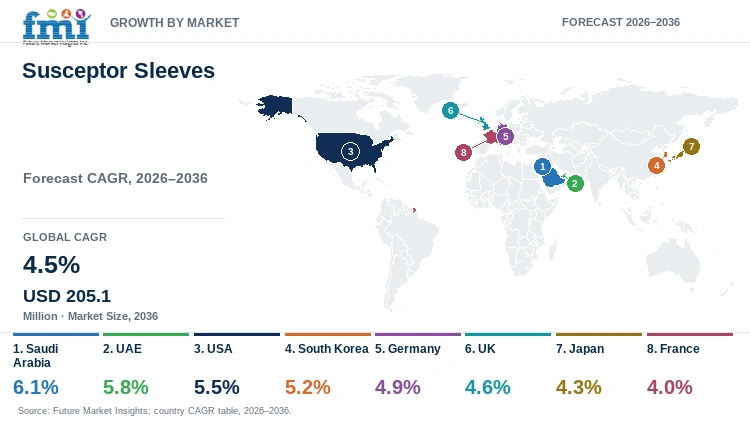
| Country | CAGR |
|---|---|
| Saudi Arabia | 6.1% |
| UAE | 5.8% |
| USA | 5.5% |
| South Korea | 5.2% |
| Germany | 4.9% |
| UK | 4.6% |
| Japan | 4.3% |
| France | 4.0% |
How do country-level CAGRs compare in the Susceptor Sleeves Market?
The forecasts span 2.1 percentage points from Saudi Arabia at 6.1% to France at 4.0%. Saudi Arabia and the UAE join the USA in the upper group of the displayed forecast range. South Korea and Germany occupy the middle of that range with different material-control requirements. The UK and Japan join France at lower rates even though CAGR alone does not establish absolute market size or supplier position.
- Saudi Arabia's rate places regional case availability and importer-ready documentation under greater pressure as specialized formats move into repeat purchasing.
- UAE buyers must preserve needed microwave functionality while reducing avoidable material in foodservice formats affected by changing single-use rules.
- USA chains can standardize qualified sleeve specifications over large account networks once food-contact and heating requirements are fixed.
- South Korean prepared-food programs gain consistency when material declarations remain unchanged between qualification and multi-site production.
- German buyers compare paperboard-led structures partly on whether the complete laminate fits established recovery and food-contact requirements.
- UK converters need clear substance records because a small active layer can carry restrictions that affect the finished food-contact construction.
- Japanese programs benefit from stable resin formulations because positive-list changes can force new material review before production continues.
- French programs place extra value on unambiguous reheating instructions because the package must state whether microwave use is permitted.
Comparable CAGRs can therefore create different entry conditions because material review, account structure and service requirements change the cost of commercial conversion.
The full report provides country-level CAGR analysis across North America, Latin America, Western Europe, Eastern Europe, East Asia, South Asia and Pacific, and the Middle East and Africa.
Country-wise Analysis
- Saudi food-packaging programs pass through a national standards gate before specialized microwave formats can enter routine commercial supply. By 2036, Saudi Arabia is projected to grow at 6.1% CAGR because national packaging standards define the compliance route for commercial food packs. The Saudi Food and Drug Authority identifies SFDA.FD/GSO 839 for general food-package requirements and SFDA.FD/GSO 1863 for plastic-package requirements. Those standards govern the package even though the active susceptor function needs separate application testing. Converters that keep material declarations complete and regional case supply stable can reduce rework when customers repeat an approved sleeve specification nationwide.
- UAE foodservice operators now review material choice against national restrictions that remove selected single-use plastic products from ordinary commercial circulation. The UAE's susceptor sleeves outlook is anticipated to advance at 5.8% CAGR over the assessment period because phase-two restrictions change material choices for affected foodservice formats. Emirates News Agency reported that the second phase began on January 1, 2026 and covers selected consumer plastic products including Styrofoam food boxes. The measure does not prohibit every microwaveable package or active layer used in foodservice applications. Suppliers can preserve necessary heating performance by removing avoidable material and clearly classifying the finished sleeve.
- USA prepared-food programs can use a defined federal authorization route when a sleeve contains a regulated food-contact coating intended for microwave use. Susceptor sleeve demand in the USA is forecast to rise at 5.5% CAGR over the forecast period because federal food-contact authorizations shape material qualification for specified microwave applications. FDA Food Contact Notification 2486 became effective on March 17, 2026 and permits a specified EVOH coating on paper or paperboard for microwave susceptor applications. That authorization gives converters a precise use boundary before they test the full food and heating cycle. Some programs may also compare fiber carriers with molded fiber pulp packaging before approving the final active construction.
- South Korean converters work under national standards that define material and performance requirements for utensils, containers and packages used with food. Adoption of susceptor sleeves in South Korea is estimated to expand at 5.2% CAGR through 2036 because national package standards provide a common compliance reference during qualification. The Ministry of Food and Drug Safety published its revised English version of the national packaging standards on June 27, 2025. Manufacturers therefore have a national reference point for package construction before adding the product-specific microwave test. Prepared-food buyers favor converters that keep carrier and active-layer declarations consistent when a sleeve moves between plants or production lots.
- German converters evaluate paperboard food-contact safety through national recommendations that address migration from materials used with food. The German susceptor sleeves sector is projected to record 4.9% CAGR during the assessment period because material-specific controls shape paper and cardboard food-contact qualification. The German Federal Institute for Risk Assessment updated its food-contact recommendations guidance on June 20, 2025 and includes paper and cardboard among covered materials. The national guidance requires converters to consider material-specific substances and the intended conditions of food-contact use. Suppliers can reduce approval friction by keeping the paperboard carrier and active-layer composition traceable before a customer changes an established microwave-ready format.
- UK packaging teams use an official electronic register when assessing regulated plastic substances contained in food-contact structures. In the UK, susceptor sleeve demand is predicted to advance at 4.6% CAGR through 2036 because official substance records shape food-contact material approval. The Food Standards Agency states that its register became the official public list for plastic food-contact authorizations on April 1, 2025. Individual entries can include restrictions and compliance notes that affect the permitted use of a substance. Converters therefore need reliable records for active films and coatings before a successful heating trial can progress into regular purchasing across recurring programs.
- Japanese packaging programs must reconcile microwave performance with the national positive-list system for synthetic resins used in food-contact articles. Japan is estimated to post 4.3% CAGR over the forecast period because the positive-list system narrows resin selection before microwave testing. The Consumer Affairs Agency states that the transition period ended on May 31, 2025 and covered synthetic resins may use only listed substances. The positive-list requirement therefore narrows material choices before a converter begins food-specific microwave testing for a new sleeve. Suppliers that map active-layer chemistry to the positive list can keep the material bill stable while customers validate the intended heating cycle.s
- French buyers place visible weight on the stated microwave-use instruction before accepting food packaging for reheating applications. Susceptor sleeve sales in France are forecast to expand at 4.0% CAGR by 2036 because national guidance requires clear package instructions before microwave reheating. DGCCRF guidance dated February 18, 2026 tells users not to cook or reheat food directly in its packaging unless the instructions expressly authorize that use. The package therefore needs a tested microwave condition that the brand can communicate without ambiguity. Programs considering alternative recovery routes may also review compostable foodservice packaging where material choices affect the final specification during national rollout.
Who are the notable companies in the Susceptor Sleeves Market?
Sirane (Coppice Alupack Ltd), Genpak LLC, Pactiv Evergreen (a Novolex company), Dart Container Corporation, Detmold Group, Novolex, Graphic Packaging International, Amcor plc, Duni Group, and Huhtamäki Oyj are profiled from company-published susceptor or microwave-ready prepared-food packaging evidence.
Competition separates direct active-microwave specialists from broader prepared-food packaging suppliers serving the same commercial buyers. Sirane and Graphic Packaging International publish direct susceptor technologies for microwave browning or crisping applications. The remaining profiled companies serve microwave-ready or heat-ready prepared-food packaging routes for comparable buyers. Those formats share the same purchasing route without being presented as direct substitutes for active susceptor sleeves.
- Sirane publishes Sira-Crisp board and sleeve formats alongside wraps and susceptor films for microwave crisping. Graphic Packaging International publishes Qwik Crisp susceptor film for cartons and sleeves plus discs and trays.
- Genpak LLC and Pactiv Evergreen (a Novolex company) publish microwaveable prepared-food containers for reheating and hot-case applications. Dart Container Corporation and Detmold Group also document microwave-compatible foodservice formats for prepared meals and take-away service. Novolex publishes Blaze microwave-safe hot-food containers for meals on the go through its company product portfolio.
- Amcor plc and Duni Group publish microwaveable ready-meal or take-away formats for prepared-food buyers. Huhtamäki Oyj publishes microwaveable ready-meal trays and flexible packaging options for prepared-meal applications across multiple markets.
Competitive Benchmarking: Susceptor Sleeves Market
| Company | Microwave Performance Evidence | Prepared-Food Format Evidence | Foodservice Route Evidence | Published Geographic Reach |
|---|---|---|---|---|
| Sirane (Coppice Alupack Ltd) | High | High | High | Customers in 100+ countries |
| Genpak LLC | Medium | High | High | USA and Canada |
| Pactiv Evergreen (a Novolex company) | Medium | High | Medium | Novolex: USA, Canada, Mexico and Europe |
| Dart Container Corporation | Medium | High | High | 30+ facilities across USA, Canada and Mexico |
| Detmold Group | Medium | High | High | Detpak sells in 45 countries |
| Novolex | Medium | Medium | High | 100+ facilities across USA, Canada, Mexico and Europe |
| Graphic Packaging International | High | High | High | Locations across North America, Europe and other regions |
| Amcor plc | Medium | Medium | Medium | Presence in 40+ countries |
| Duni Group | Medium | High | High | Products represented in 50+ markets |
| Huhtamäki Oyj | Medium | High | Medium | 35 countries and 106 operating locations |
Scoring basis: High microwave performance requires a company-published page documenting active susceptor technology for prepared-food applications. Medium microwave performance requires a company-published microwave-safe or microwaveable prepared-food package for a comparable buyer route. Low microwave performance is reserved for companies without published evidence of a microwave-ready packaging route. High prepared-food format evidence requires at least two distinct documented formats or material routes. Medium format evidence requires one documented prepared-food packaging route serving the relevant buyer group. High foodservice route evidence requires a restaurant or QSR route alongside catering or take-away applications. Medium foodservice evidence reflects a prepared-meal route without the same explicit commercial foodservice breadth across customers.
Key Developments in the Susceptor Sleeves Market
- In May 2025, Dart Container Corporation announced APR Design for Recyclability Recognition for new clear microwaveable hinged containers. The recognition also covered square plastic bowls and clear polypropylene cups designed for the same foodservice portfolio. The same company update reported TÜV Austria home-compostability certification for Dart-designed molded-fiber products across its foodservice range.
- In February 2025, Genpak LLC published its Grab-A-Bowl two-piece bowl and lid line for on-premise and off-premise dining. The polypropylene bowls and lids are microwavable and reusable for restaurant and foodservice operations serving hot or cold meals. The line is also dishwasher-safe and leak-resistant during routine transport and handling across take-away applications.
Key Players in the Susceptor Sleeves Market
Direct Active Microwave and Susceptor Engineering
- Sirane (Coppice Alupack Ltd)
- Graphic Packaging International
Prepared-Food Packaging Platforms
- Genpak LLC
- Pactiv Evergreen (a Novolex company)
- Dart Container Corporation
- Detmold Group
- Novolex
Diversified Heat-Ready Material Platforms
- Amcor plc
- Duni Group
- Huhtamäki Oyj
Susceptor Sleeves Market - Report Scope
| Coverage field | Report scope |
|---|---|
| Market breakdown | By format type, material, format size, end use, sales channel and region. |
| Quantitative Units | USD million. |
| Market Definition | Revenue from finished susceptor sleeve assemblies integrating an active microwave-heating layer with a structural carrier for food reheating. |
| Regions Covered | North America, Latin America, Western Europe, Eastern Europe, East Asia, South Asia and Pacific, and Middle East and Africa. |
| Countries Covered | Saudi Arabia, UAE, USA, South Korea, Germany, UK, Japan, France, and 20+ countries included in the full report. |
| Key Companies Profiled | Sirane (Coppice Alupack Ltd), Genpak LLC, Pactiv Evergreen (a Novolex company), Dart Container Corporation, Detmold Group, Novolex, Graphic Packaging International, Amcor plc, Duni Group, and Huhtamäki Oyj. |
| Forecast Period | 2026 to 2036. |
| Approach | Primary and secondary research with market triangulation. |
Susceptor Sleeves Market - Research Methodology
| Method | Approach |
|---|---|
| Primary Research | Primary research framework covers treatment-line requirements, buying criteria, adoption barriers, approval needs, pricing logic, and technical support expectations. Direct industry input is incorporated only when documented and reconciled with the market definition and quantitative model. |
| Desk Research | Desk research covers government statistics, regulatory publications, industry associations, technical literature, standards, company filings, current product documentation, and official corporate announcements. Sources are screened for date, geography, title fit, and consistency with the defined market scope before factual claims are retained. |
| Market Sizing and Forecasting | The market model combines the authorized baseline with segment structure, pricing and volume indicators, adoption conditions, company participation, and country demand factors. Forecast assumptions account for treatment adoption, biological stability, crop programs, channel access, supply availability, and barriers to wider commercial use. |
| Data Validation | Estimates are checked against public data, company activity, national treatment requirements, model values, and current company evidence. Validation also tests whether products, functions, channels, and company activities fall inside the defined market boundary. Adjacent categories and unsupported claims are excluded before segment and country estimates are reconciled. |
Susceptor Sleeves Market by Segments
Susceptor Sleeves Market segmented by Format Type:
- Standard formats
- Recyclable-optimized formats
- Premium & branded formats
- Custom-engineered formats
Susceptor Sleeves Market segmented by Material:
- Paperboard
- Molded fiber & bagasse
- rPET & PP
- Compostable polymers
- Aluminium
Susceptor Sleeves Market segmented by Format Size:
- Standard meal
- Single-serve
- Family & catering
Susceptor Sleeves Market segmented by End Use:
- Delivery platforms
- QSR chains
- Coffee & beverage
- Institutional catering
- Retail deli
Susceptor Sleeves Market segmented by Sales Channel:
- Broadline foodservice distributors
- Direct chain contracts
- Packaging distributors
- Online
Susceptor Sleeves Market by Region:
- North America
- United States
- Canada
- Latin America
- Brazil
- Mexico
- Argentina
- Chile
- Western Europe
- Germany
- France
- United Kingdom
- Italy
- Spain
- Benelux
- Nordics
- Eastern Europe
- Poland
- Czech Republic
- Romania
- Hungary
- East Asia
- China
- Japan
- South Korea
- South Asia and Pacific
- India
- ASEAN
- Australia and New Zealand
- Middle East and Africa
- GCC Countries
- South Africa
- Türkiye
- Israel
Research Sources and Bibliography
- Amcor plc. (n.d.). About us: Global innovators for packaging solutions. Retrieved September 16, 2026.
- Amcor plc. (2025, April 30). Amcor completes combination with Berry Global; Positioned to significantly enhance value for customers and shareholders.
- Amcor plc. (2025, June 24). Amcor and Cofigeo partner to create multi-compartment tray designed for convenience and sustainability.
- Consumer Affairs Agency, Government of Japan. (n.d.). 食品用器具・容器包装のポジティブリスト制度について(2025年6月1日以降). Retrieved September 16, 2026.
- Dart Container Corporation. (n.d.). Locations. Retrieved September 16, 2026.
- Dart Container Corporation. (2025, May 12). Dart products earn sustainability recognition.
- Detmold Group. (2026, July 20). Detpak opens USA manufacturing facility in Spartanburg, South Carolina.
- Detpak. (n.d.). Medium Hot Food Box. Retrieved September 16, 2026.
- Detpak. (n.d.). Sugarcane Takeaway Containers and Lids. Retrieved September 16, 2026.
- Direction générale de la concurrence, de la consommation et de la répression des fraudes. (2026, February 18). Les règles à respecter pour les matériaux, emballages, ustensiles et contenants au contact des aliments.
- Duni Group. (2025, June 4). Duni launches new take-away series with improved recyclability and enhanced functionality.
- Duni Group. (2026, July 7). Duni Group strengthens recyclability across the Duniform range.
- Emirates News Agency. (2025, December 16). Second phase of nationwide ban on import, trade of single-use consumer plastic products, bags begins.
- Federal Ministry for the Environment, Climate Action, Nature Conservation and Nuclear Safety. (2026, August 12). Europäische Verpackungsverordnung ab heute wirksam.
- Food Standards Agency. (2025, October 13). Food contact material authorisations.
- Genpak LLC. (n.d.). Manufacturing in the USA. Retrieved September 16, 2026.
- Genpak LLC. (n.d.). Microwave Safe Containers. Retrieved September 16, 2026.
- Genpak LLC. (2025, February 20). Grab-A-Bowl Two-Piece Bowl/Lid Combo from Genpak.
- German Federal Institute for Risk Assessment. (2025, June 20). Detailed explanation: BfR recommendations on food contact materials.
- Graphic Packaging International. (n.d.). Our Locations. Retrieved September 16, 2026.
- Graphic Packaging International. (n.d.). Qwik Crisp Susceptor Film. Retrieved September 16, 2026.
- Graphic Packaging International. (2025, November 5). Graphic Packaging Launches Advanced Recycled Paperboard Facility in Waco, Texas.
- Graphic Packaging International. (2026, April 21). The Everyday Appliance (and the Packaging Behind It) That Quietly Reshaped Modern Life.
- Huhtamäki Oyj. (n.d.). Fresh Launch with Saarioinen. Retrieved September 16, 2026.
- Huhtamäki Oyj. (2026, March 3). Huhtamaki in brief.
- Ministry of Food and Drug Safety, Republic of Korea. (2025, June 27). Standards and Specifications for Utensils, Containers and Packages (No. 2024-29).
- Novolex. (n.d.). Food Packaging Containers. Retrieved September 16, 2026.
- Novolex. (n.d.). Operations at Novolex. Retrieved September 16, 2026.
- Novolex. (2025, April 1). Novolex and Pactiv Evergreen Inc. Complete Combination, Creating a Leading Manufacturer in Food, Beverage and Specialty Packaging.
- Pactiv Evergreen. (n.d.). Clearview MicroMax 12 oz. Oval Casserole Container. Retrieved September 16, 2026.
- Pactiv Evergreen. (n.d.). MealMaster 8.1 x 6.5 in. 16 oz. MFPP Container. Retrieved September 16, 2026.
- Saudi Food and Drug Authority. (2024, February 20). What are the requirements of food product packaging?
- Sirane (Coppice Alupack Ltd). (n.d.). Microwave susceptor packaging. Retrieved September 16, 2026.
- Sirane (Coppice Alupack Ltd). (n.d.). Sirane Group (UK). Retrieved September 16, 2026.
- USA Food and Drug Administration. (2026, June 30). FCN No. 2486.
This bibliography is provided for reader reference and is not exhaustive. The full report contains the complete reference list and detailed citations.
This Report Answers
- How large is the susceptor sleeves market in 2026?
- Why do standard formats account for the largest format type share?
- Which material conditions support paperboard's 29.0% share during the base year?
- How do delivery platforms change the required reheating performance of sleeves?
- Which national rules shape country-level qualification and material selection decisions?
- Which companies publish direct active-microwave or susceptor packaging capabilities today?
- What prevents successful thermal trials from becoming regular commercial packaging orders?
- How do recovery requirements influence active-layer and structural carrier design choices?
- Which recent company actions are changing heat-ready food packaging supply routes?
Frequently Asked Questions
How big is the susceptor sleeves market in 2026?
The susceptor sleeves market is valued at USD 132.1 million in 2026 and is forecast to reach USD 205.1 million by 2036. Prepared-food reheating supports purchases where passive microwave packaging cannot restore the required surface texture.
What CAGR is forecast for the susceptor sleeves market through 2036?
The susceptor sleeves market is projected to expand at a 4.5% CAGR between 2026 and 2036. Commercial growth depends on active heating performance that can pass food-specific qualification and remain repeatable during routine production.
Which format type holds the largest share in 2026?
Standard formats are projected to account for 45.0% of format type demand in the susceptor sleeves market during 2026. Familiar sleeve geometries reduce conversion work once the active pattern and food-specific heating instruction have passed qualification.
Which material holds the largest share in 2026?
Paperboard is estimated to hold 29.0% of material demand in the susceptor sleeves market during 2026. Converters use it as a printable structural carrier for a thin active layer while retaining established folding and sleeve-making operations.
Which profiled countries record the highest forecast CAGRs?
Saudi Arabia is forecast at 6.1% CAGR and the UAE at 5.8% through 2036. Their commercial routes differ because Saudi programs emphasize packaging standards while UAE programs face changing restrictions on selected single-use plastic products.
Which companies are active in the susceptor sleeves market?
Key companies include Sirane (Coppice Alupack Ltd), Genpak LLC, Pactiv Evergreen (a Novolex company), Dart Container Corporation, Detmold Group, Novolex, Graphic Packaging International, Amcor plc, Duni Group, and Huhtamäki Oyj. Sirane and Graphic Packaging International publish direct susceptor capabilities, while the remaining companies publish related microwave-ready prepared-food packaging for comparable buyers.
Preview the report firsthand - request a free sample
Get SampleGet the brochure for pricing and purchase details.
Get PDFTable of Content
- Key Takeaways
- Market Size and CAGR
- Top Growth Driver
- Fastest Growing Segment
- Leading Region
- Key Companies
- Emerging Opportunities
- Executive Summary
- Global Market Outlook
- Demand-side Trends
- Supply-side Trends
- Technology Roadmap Analysis
- Analysis and Recommendations
- Analyst Perspective (What is happening? Why now? What should investors know?)
- Key Questions Answered
- How large is the market?
- What is the CAGR?
- What are key trends?
- Which region dominates?
- Who are the leaders?
- Market Overview
- Market Coverage / Taxonomy
- Market Definition / Scope / Limitations
- Research Methodology
- Chapter Orientation
- Analytical Lens and Working Hypotheses
- Market Structure, Signals, and Trend Drivers
- Benchmarking and Cross-market Comparability
- Market Sizing, Forecasting, and Opportunity Mapping
- Research Design and Evidence Framework
- Desk Research Programme (Secondary Evidence)
- Expert Input and Fieldwork (Primary Evidence)
- Tooling, Models, and Reference Databases
- Data Engineering and Model Build
- Quality Assurance and Audit Trail
- Market Background
- Market Dynamics (Drivers, Restraints, Opportunity, Trends)
- Scenario Forecast (Optimistic, Likely, Conservative)
- Impact Analysis
- AI Impact
- Sustainability Impact
- Regulatory Impact
- Technology Impact
- Consumer / Buyer Analysis
- Purchase Drivers
- Adoption Barriers
- Buyer Journey
- Opportunity Map Analysis
- Product Life Cycle Analysis
- Supply Chain Analysis
- Investment Feasibility Matrix
- Value Chain Analysis
- PESTLE and Porter's Analysis
- Regulatory Landscape
- Regional Parent Market Outlook
- Production and Consumption Statistics
- Import and Export Statistics
- Global Market Analysis and Forecast, 2021 to 2036
- Historical Market Size Value (USD Million) Analysis, 2021 to 2025
- Current and Future Market Size Value (USD Million) Projections, 2026 to 2036
- Y-o-Y Growth Trend Analysis
- Absolute $ Opportunity Analysis
- Global Market Pricing Analysis, 2021 to 2036
- Global Market Analysis and Forecast, By Format Type, 2021 to 2036
- Introduction / Key Findings
- Historical Market Size Value (USD Million) Analysis By Format Type, 2021 to 2025
- Current and Future Market Size Value (USD Million) Analysis and Forecast By Format Type, 2026 to 2036
- Standard formats
- Recyclable-optimized formats
- Premium & branded formats
- Custom-engineered formats
- Y-o-Y Growth Trend Analysis By Format Type, 2021 to 2025
- Absolute $ Opportunity Analysis By Format Type, 2026 to 2036
- Global Market Analysis and Forecast, By Material, 2021 to 2036
- Introduction / Key Findings
- Historical Market Size Value (USD Million) Analysis By Material, 2021 to 2025
- Current and Future Market Size Value (USD Million) Analysis and Forecast By Material, 2026 to 2036
- Paperboard
- Molded fiber & bagasse
- rPET & PP
- Compostable polymers
- Aluminium
- Y-o-Y Growth Trend Analysis By Material, 2021 to 2025
- Absolute $ Opportunity Analysis By Material, 2026 to 2036
- Global Market Analysis and Forecast, By Format Size, 2021 to 2036
- Introduction / Key Findings
- Historical Market Size Value (USD Million) Analysis By Format Size, 2021 to 2025
- Current and Future Market Size Value (USD Million) Analysis and Forecast By Format Size, 2026 to 2036
- Standard meal
- Single-serve
- Family & catering
- Y-o-Y Growth Trend Analysis By Format Size, 2021 to 2025
- Absolute $ Opportunity Analysis By Format Size, 2026 to 2036
- Global Market Analysis and Forecast, By End Use, 2021 to 2036
- Introduction / Key Findings
- Historical Market Size Value (USD Million) Analysis By End Use, 2021 to 2025
- Current and Future Market Size Value (USD Million) Analysis and Forecast By End Use, 2026 to 2036
- Delivery platforms
- QSR chains
- Coffee & beverage
- Institutional catering
- Retail deli
- Y-o-Y Growth Trend Analysis By End Use, 2021 to 2025
- Absolute $ Opportunity Analysis By End Use, 2026 to 2036
- Global Market Analysis and Forecast, By Sales Channel, 2021 to 2036
- Introduction / Key Findings
- Historical Market Size Value (USD Million) Analysis By Sales Channel, 2021 to 2025
- Current and Future Market Size Value (USD Million) Analysis and Forecast By Sales Channel, 2026 to 2036
- Broadline foodservice distributors
- Direct chain contracts
- Packaging distributors
- Online
- Y-o-Y Growth Trend Analysis By Sales Channel, 2021 to 2025
- Absolute $ Opportunity Analysis By Sales Channel, 2026 to 2036
- Global Market Analysis and Forecast, By Region, 2021 to 2036
- Introduction
- Historical Market Size Value (USD Million) Analysis By Region, 2021 to 2025
- Current Market Size Value (USD Million) Analysis and Forecast By Region, 2026 to 2036
- North America
- Latin America
- Western Europe
- Eastern Europe
- East Asia
- South Asia and Pacific
- Middle East and Africa
- Market Attractiveness Analysis By Region
- North America Market Analysis and Forecast, By Country, 2021 to 2036
- Historical Market Size Value (USD Million) Trend Analysis By Market Taxonomy, 2021 to 2025
- Market Size Value (USD Million) Forecast By Market Taxonomy, 2026 to 2036
- By Country
- United States
- Canada
- By Format Type
- By Material
- By Format Size
- By End Use
- By Sales Channel
- By Country
- Market Attractiveness Analysis
- By Country
- By Format Type
- By Material
- By Format Size
- By End Use
- By Sales Channel
- Key Takeaways
- Latin America Market Analysis and Forecast, By Country
- Historical Market Size Value (USD Million) Trend Analysis By Market Taxonomy, 2021 to 2025
- Market Size Value (USD Million) Forecast By Market Taxonomy, 2026 to 2036
- By Country
- Brazil
- Mexico
- Argentina
- Chile
- By Format Type
- By Material
- By Format Size
- By End Use
- By Sales Channel
- By Country
- Market Attractiveness Analysis
- By Country
- By Format Type
- By Material
- By Format Size
- By End Use
- By Sales Channel
- Key Takeaways
- Western Europe Market Analysis and Forecast, By Country
- Historical Market Size Value (USD Million) Trend Analysis By Market Taxonomy, 2021 to 2025
- Market Size Value (USD Million) Forecast By Market Taxonomy, 2026 to 2036
- By Country
- Germany
- France
- United Kingdom
- Italy
- Spain
- Benelux
- Nordics
- By Format Type
- By Material
- By Format Size
- By End Use
- By Sales Channel
- By Country
- Market Attractiveness Analysis
- By Country
- By Format Type
- By Material
- By Format Size
- By End Use
- By Sales Channel
- Key Takeaways
- Eastern Europe Market Analysis and Forecast, By Country
- Historical Market Size Value (USD Million) Trend Analysis By Market Taxonomy, 2021 to 2025
- Market Size Value (USD Million) Forecast By Market Taxonomy, 2026 to 2036
- By Country
- Poland
- Czech Republic
- Romania
- Hungary
- By Format Type
- By Material
- By Format Size
- By End Use
- By Sales Channel
- By Country
- Market Attractiveness Analysis
- By Country
- By Format Type
- By Material
- By Format Size
- By End Use
- By Sales Channel
- Key Takeaways
- East Asia Market Analysis and Forecast, By Country
- Historical Market Size Value (USD Million) Trend Analysis By Market Taxonomy, 2021 to 2025
- Market Size Value (USD Million) Forecast By Market Taxonomy, 2026 to 2036
- By Country
- China
- Japan
- South Korea
- By Format Type
- By Material
- By Format Size
- By End Use
- By Sales Channel
- By Country
- Market Attractiveness Analysis
- By Country
- By Format Type
- By Material
- By Format Size
- By End Use
- By Sales Channel
- Key Takeaways
- South Asia and Pacific Market Analysis and Forecast, By Country
- Historical Market Size Value (USD Million) Trend Analysis By Market Taxonomy, 2021 to 2025
- Market Size Value (USD Million) Forecast By Market Taxonomy, 2026 to 2036
- By Country
- India
- ASEAN
- Australia and New Zealand
- By Format Type
- By Material
- By Format Size
- By End Use
- By Sales Channel
- By Country
- Market Attractiveness Analysis
- By Country
- By Format Type
- By Material
- By Format Size
- By End Use
- By Sales Channel
- Key Takeaways
- Middle East and Africa Market Analysis and Forecast, By Country
- Historical Market Size Value (USD Million) Trend Analysis By Market Taxonomy, 2021 to 2025
- Market Size Value (USD Million) Forecast By Market Taxonomy, 2026 to 2036
- By Country
- GCC Countries
- South Africa
- Türkiye
- Israel
- By Format Type
- By Material
- By Format Size
- By End Use
- By Sales Channel
- By Country
- Market Attractiveness Analysis
- By Country
- By Format Type
- By Material
- By Format Size
- By End Use
- By Sales Channel
- Key Takeaways
- Key Countries Market Analysis
- United States
- Pricing Analysis
- Market Share Analysis, 2025
- By Format Type
- By Material
- By Format Size
- By End Use
- By Sales Channel
- Canada
- Pricing Analysis
- Market Share Analysis, 2025
- By Format Type
- By Material
- By Format Size
- By End Use
- By Sales Channel
- Mexico
- Pricing Analysis
- Market Share Analysis, 2025
- By Format Type
- By Material
- By Format Size
- By End Use
- By Sales Channel
- Brazil
- Pricing Analysis
- Market Share Analysis, 2025
- By Format Type
- By Material
- By Format Size
- By End Use
- By Sales Channel
- Chile
- Pricing Analysis
- Market Share Analysis, 2025
- By Format Type
- By Material
- By Format Size
- By End Use
- By Sales Channel
- Germany
- Pricing Analysis
- Market Share Analysis, 2025
- By Format Type
- By Material
- By Format Size
- By End Use
- By Sales Channel
- United Kingdom
- Pricing Analysis
- Market Share Analysis, 2025
- By Format Type
- By Material
- By Format Size
- By End Use
- By Sales Channel
- Italy
- Pricing Analysis
- Market Share Analysis, 2025
- By Format Type
- By Material
- By Format Size
- By End Use
- By Sales Channel
- Spain
- Pricing Analysis
- Market Share Analysis, 2025
- By Format Type
- By Material
- By Format Size
- By End Use
- By Sales Channel
- France
- Pricing Analysis
- Market Share Analysis, 2025
- By Format Type
- By Material
- By Format Size
- By End Use
- By Sales Channel
- India
- Pricing Analysis
- Market Share Analysis, 2025
- By Format Type
- By Material
- By Format Size
- By End Use
- By Sales Channel
- ASEAN
- Pricing Analysis
- Market Share Analysis, 2025
- By Format Type
- By Material
- By Format Size
- By End Use
- By Sales Channel
- Australia and New Zealand
- Pricing Analysis
- Market Share Analysis, 2025
- By Format Type
- By Material
- By Format Size
- By End Use
- By Sales Channel
- China
- Pricing Analysis
- Market Share Analysis, 2025
- By Format Type
- By Material
- By Format Size
- By End Use
- By Sales Channel
- Japan
- Pricing Analysis
- Market Share Analysis, 2025
- By Format Type
- By Material
- By Format Size
- By End Use
- By Sales Channel
- South Korea
- Pricing Analysis
- Market Share Analysis, 2025
- By Format Type
- By Material
- By Format Size
- By End Use
- By Sales Channel
- Poland
- Pricing Analysis
- Market Share Analysis, 2025
- By Format Type
- By Material
- By Format Size
- By End Use
- By Sales Channel
- Hungary
- Pricing Analysis
- Market Share Analysis, 2025
- By Format Type
- By Material
- By Format Size
- By End Use
- By Sales Channel
- Türkiye
- Pricing Analysis
- Market Share Analysis, 2025
- By Format Type
- By Material
- By Format Size
- By End Use
- By Sales Channel
- South Africa
- Pricing Analysis
- Market Share Analysis, 2025
- By Format Type
- By Material
- By Format Size
- By End Use
- By Sales Channel
- Saudi Arabia
- Pricing Analysis
- Market Share Analysis, 2025
- By Format Type
- By Material
- By Format Size
- By End Use
- By Sales Channel
- UAE
- Pricing Analysis
- Market Share Analysis, 2025
- By Format Type
- By Material
- By Format Size
- By End Use
- By Sales Channel
- United States
- Market Structure Analysis
- Competition Dashboard
- Competition Benchmarking
- Market Share Analysis of Top Players
- By Regional
- By Format Type
- By Material
- By Format Size
- By End Use
- By Sales Channel
- Emerging Startups
- Innovation Benchmarking
- Competition Analysis
- Competition Deep Dive
- Sirane (Coppice Alupack Ltd)
- Overview
- Product Portfolio
- Profitability by Market Segments
- Sales Footprint
- Strategy Overview
- Marketing Strategy
- Product Strategy
- Channel Strategy
- Genpak LLC
- Pactiv Evergreen (a Novolex company)
- Dart Container Corporation
- Detmold Group
- Novolex
- Graphic Packaging International
- Amcor plc
- Duni Group
- Huhtamäki Oyj
- Sirane (Coppice Alupack Ltd)
- Case Studies
- Success Stories
- Recent Developments
- Competition Deep Dive
- Assumptions & Acronyms Used


