

- Market Size (2026)
- USD 2.9 Bn
- Forecast (2036)
- USD 8.8 Bn
- CAGR (2026 to 2036)
- 11.8%
How big is Sustainable Alt-Protein Taste & Texture Solutions Market in 2026?
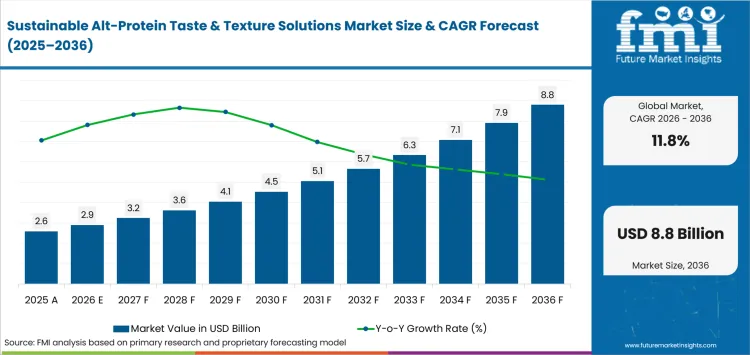
USD 2.9 billion in 2026 and USD 8.8 billion by 2036 at an 11.8% CAGR.
The sustainable alt-protein taste & texture solutions market is projected to rise from USD 2.9 billion in 2026 to USD 8.8 billion by 2036 at an 11.8% CAGR. Formulation spending follows sensory gaps that remain after protein processing and therefore persists across renovation cycles. The Good Food Institute reported that meat analogs matching conventional taste and texture represented more than 90% of category sales in 2025. That concentration keeps protein flavor masking and plant-based food formulations tied to repeat-purchase performance rather than protein volume alone.
Commercial routes differ as newer protein platforms enter regulated food systems and established plant formats face routine renovation. EFSA reported in December 2025 that more than 200 novel foods had already been approved for sale across the European Union. That approval base gives alternative protein ingredients a defined access route, yet formulation teams still need taste systems that remain stable after authorization and scale-up.
Key Takeaways of Sustainable Alt-Protein Taste & Texture Solutions Market
- Food manufacturers spend on sensory correction when alternative proteins leave bitterness or astringency plus weak juiciness and unstable mouthfeel after processing.
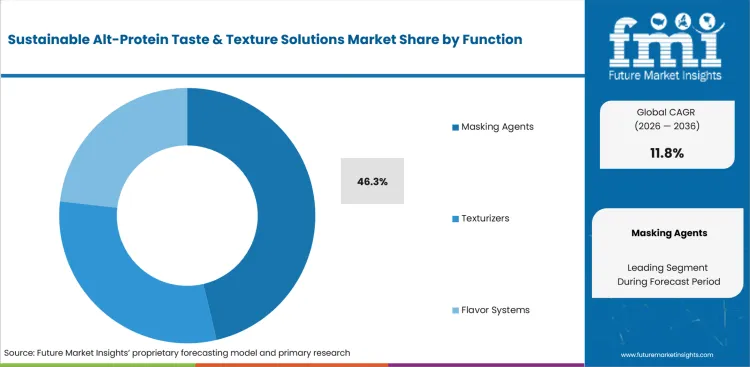
- Masking agents are estimated to account for 46.3% of function demand in 2026 because off-note control often precedes positive flavor design.
- Plant is projected to represent 47.8% of protein type demand in 2026 due to its broad formulation base and recurring sensory correction needs.
- Meat alt is anticipated to capture 59.2% of application demand in 2026 because each formulation must coordinate flavor and bite with juiciness and cooking performance.
- Qualification can slow adoption because a sensory improvement still needs process compatibility and labeling fit plus regulatory clearance for the underlying protein system.
- Givaudan and IFF join Kerry and Symrise alongside dsm-firmenich and Ingredion plus Roquette and ADM are some of the notable companies in the sector.
Analyst Perspective
“Commercial value depends on whether a taste or texture system remains repeatable after extrusion, heating and full-scale ingredient substitution. Teams should compare cost-in-use with sensory performance because fewer corrective steps can shorten qualification without weakening the finished eating experience.”
- Nandini Roy Choudhury, Principal Consultant, Future Market Insights
How is the Sustainable Alt-Protein Taste & Texture Solutions Market segmented?
The market is segmented by Function, Protein Type and Application, with Region used for geographic analysis.
Function separates masking agents from texturizers and flavor systems according to the sensory job each ingredient system performs. Protein type covers plant alongside fermentation and cultivated inputs because each source presents different native flavor and process behavior. Application divides meat alt from dairy alt based on distinct sensory benchmarks for bite and juiciness plus creaminess and melt.
What makes masking agents central to the function category?
Masking agents address bitter and beany notes plus earthy or astringent character before manufacturers build the intended flavor profile. Symrise reported in June 2025 that its Bridge2Food demonstrations covered plant-based yogurt and cheese alongside milk drinks and vegan meat alternatives.
- Masking agents are estimated to account for 46.3% of function demand in 2026 because off-note control protects later flavor work across varied protein bases.
- Formulators also assess clean-label flavors against each exact protein matrix because maskers perform differently across pea or soy and fermentation-derived inputs while careful matching reduces repeated scale-up trials during commercial production.
Why does plant lead the protein type category?
Plant proteins already sit inside established meat and dairy formulations that require repeated sensory adjustment as protein loading or processing conditions change. Roquette launched textured wheat and pea proteins in June 2025 for plant-based recipes requiring retained bite and juiciness after cooking.
- Plant is projected to represent 47.8% of protein type demand in 2026 because its installed formulation base spans several mainstream food formats.
- Pea protein development increasingly starts with cleaner native taste and functional structure to reduce corrective work while preserving room for application-specific flavor design and later masker selection across commercial production lines.
What supports meat alt in the application category?
Meat alt formulations must coordinate aroma and savory character with moisture retention and fibrous structure inside the same cooking cycle. The Good Food Institute highlighted an April 2025 sensory program covering 122 plant-based meat products across 14 categories from more than 50 brands.
- Meat alt is anticipated to capture 59.2% of application demand in 2026 because products must satisfy several sensory benchmarks during one eating experience.
- Plant-based meals create recurring reformulation work as manufacturers adjust protein sources and cooking behavior without losing expected bite or juiciness while texture changes alter flavor release under repeated factory conditions.
What are the drivers, restraints and opportunities in the Sustainable Alt-Protein Taste & Texture Solutions Market?
Sensory parity remains the main spending trigger, qualification work limits conversion speed and integrated ingredient systems create the clearest route to simpler formulations.
- Driver: Taste and texture gaps turn sensory correction into recurring formulation spend whenever protein bases change or consumer benchmarks remain unmet.
- Restraint: Regulatory review and process qualification extend development cycles for newer proteins that require additional evidence before commercial use.
- Opportunity: Integrated protein, masking and texturing systems can reduce downstream corrective steps while giving application teams fewer variables to validate.
Repeat-Purchase Sensory Gaps Sustain Formulation Work
Repeat purchase depends on a finished eating experience that stays acceptable after commercial processing and routine storage. The Good Food Institute reported that meat analogs contributed 54% of USA plant-based protein foodservice pound sales during 2025. That concentration makes plant-based protein sensory performance commercially relevant because restaurants need repeatable taste and texture across recurring orders and varied kitchen service settings.
Qualification Requirements Slow Newer Protein Systems
New sensory ingredients do not remove the approval burden carried by novel protein platforms entering regulated food markets. The UK Food Standards Agency reported in September 2025 that two cell-cultivated product applications had completed validation and advanced into formal risk assessment. Developers therefore need formulation evidence that remains useful throughout regulatory review instead of changing the sensory system late in qualification.
Integrated Correction Can Reduce Recipe Complexity
Moving sensory correction closer to protein processing can remove downstream ingredients and simplify later application trials. dsm-firmenich launched Vertis Textured Vegetable Proteins with integrated ModulaSENSE masking in April 2026 to reduce bitterness and characteristic pea off-notes during extrusion. Food texturing agents paired with upstream masking give manufacturers a clearer route to validating fewer interacting components across full commercial production lines.
Which country CAGRs are profiled in the Sustainable Alt-Protein Taste & Texture Solutions Market?
| Country | CAGR |
|---|---|
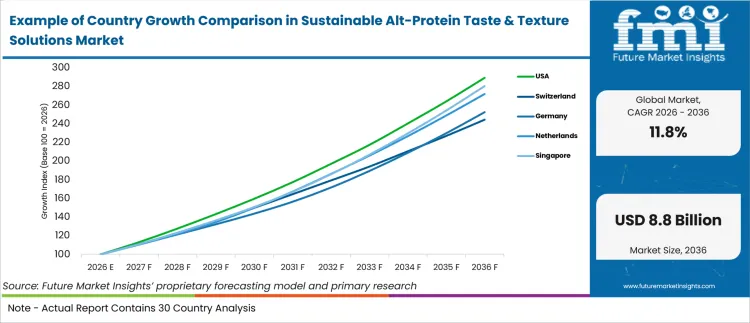
| USA | 11.2% |
| Singapore | 10.9% |
| Netherlands | 10.5% |
| Germany | 9.7% |
| Switzerland | 9.3% |
How do country-level CAGRs compare in the Sustainable Alt-Protein Taste & Texture Solutions Market?
The five-country spread measures 1.9 percentage points and places USA with Singapore above a closely grouped European set. Netherlands occupies the transition position while Germany and Switzerland remain below 10.0%. The narrow range makes regulatory sequencing and local formulation infrastructure more informative than small differences in forecast pace.
- USA links branded-food development with labeling discipline that rewards documented sensory gains.
- Singapore concentrates future-food research beside regulatory expertise inside a compact formulation network.
- Netherlands connects fermentation pilots with approval rules separating sensory trials from authorization.
- Germany uses established meat-alternative manufacturing capacity to prioritize renovation economics and repeat-purchase performance.
- Switzerland rewards early regulator contact because novel-food rules govern qualifying protein inputs.
Comparable forecast rates still produce different entry conditions because approval routes and manufacturing depth differ. The full report provides country-level CAGR analysis across North America, Latin America, Europe, East Asia, South Asia, Oceania and the Middle East and Africa.
Country-wise Analysis
- Food manufacturers in the USA qualify sensory systems against labeling and cost targets plus processing behavior before formulas reach scaled supply across established retail and foodservice channels serving varied consumer formats. Demand for sustainable alt-protein taste & texture solutions in the USA is forecast to expand at 11.2% CAGR through 2036 as product renovation keeps laboratories active across meat alternatives and plant-based milk formulations nationwide. FDA issued draft guidance in January 2025 recommending descriptive names for plant-based alternatives and that clearer route helps brands preserve product identity while sensory teams manage off-notes without avoidable relabeling work during reformulation for brands.
- Singapore combines pilot-scale food research with a regulator that engages novel-food developers inside a compact technical network and gives ingredient teams access to local application partners without long service distances between laboratories. Sustainable alt-protein taste & texture solution sales in Singapore are forecast to expand at 10.9% CAGR by 2036 as local programs connect processing science with commercial product design across newer protein formats. The Singapore Food Agency awarded 11 future-food and food-safety projects in November 2025 including alternative-protein flavor work and that research access remains balanced by a demanding safety-evidence burden for novel ingredients entering commercial review at scale.
- Dutch alternative-protein developers work near fermentation pilots and European commercialization partners that test sensory performance before full market entry while local co-development networks give ingredient suppliers early access to formulation programs and technical feedback. Adoption of sustainable alt-protein taste & texture solutions in Netherlands is estimated to expand at 10.5% CAGR through 2036 as close technical collaboration shortens iteration between protein developers and sensory specialists. The Dutch government published a fermentation tasting code in November 2025 for controlled pre-approval trials and those tastings create useful learning while EU authorization remains a separate commercial gate for final product sales at scale.
- Germany provides a mature meat-substitute manufacturing base where ingredient systems compete on repeatable performance and cost-in-use instead of novelty while experienced processors test reformulations against established factory conditions and retailer expectations. The Germany sustainable alt-protein taste & texture solutions sector is projected to record 9.7% CAGR during the assessment period as existing manufacturers continue product renovation and seek better sensory economics. Destatis reported in May 2026 that German meat-substitute production reached 124900 metric tons during 2025 and that operating base gives suppliers scale while exposing weak formulations to strict price pressure and repeat-purchase tests in mature categories across retail channels.
- Swiss developers face a separate national market-access route for novel inputs even after sensory work is technically ready for product testing and nearby scientific expertise gives companies strong support during dossier preparation and regulatory discussions. Switzerland is estimated to post 9.3% CAGR over the forecast period as specialized food companies evaluate fermentation and cultivated ingredients under detailed authorization rules that shape development timing. FSVO updated its novel-food materials in July 2026 and requires a technical safety dossier for qualifying products while pre-submission contact reduces uncertainty before companies commit resources to final formulation and commercial launch work within planned timelines.
Who are the notable companies in the Sustainable Alt-Protein Taste & Texture Solutions Market?
Givaudan, IFF, Kerry, Symrise, dsm-firmenich, Ingredion, Roquette and ADM are the notable companies profiled in this market.
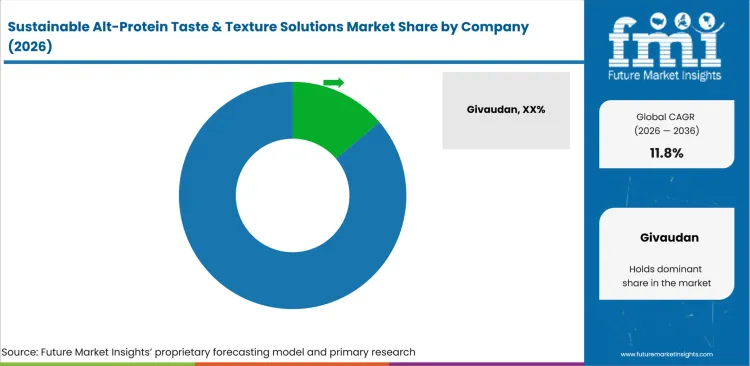
Competition spans global flavor houses and integrated ingredient groups plus protein specialists that address different sensory tasks. Givaudan and Symrise focus on taste modulation while IFF and Kerry pair flavor work with texture science. Ingredion and dsm-firmenich add mouthfeel tools while Roquette and ADM work closer to the protein base.
- Givaudan and Symrise join Kerry in applying natural food flavors and masking expertise across meat and dairy alternative development.
- IFF and Ingredion join dsm-firmenich in combining taste expertise with texture or mouthfeel tools for multi-sensory formulation work.
- Roquette and ADM compete closer to the protein base by reducing native taste or structure problems before downstream correction.
Competitive Benchmarking: Sustainable Alt-Protein Taste & Texture Solutions Market
| Company | Off-Note Masking & Taste Modulation | Texture & Mouthfeel Engineering | Meat and Dairy Alternative Coverage | Geographic Reach |
|---|---|---|---|---|
| Givaudan | High | High | High | Global sensory and application network |
| IFF | High | High | High | Global food and beverage network |
| Kerry | High | High | High | Global taste and nutrition footprint |
| Symrise | High | Medium | High | Global taste network; European plant-based support |
| dsm-firmenich | High | High | High | Global; operations in almost 60 countries |
| Ingredion | Medium | High | High | Global ingredient and application network |
| Roquette | Medium | High | Medium | Europe, North America and international protein sales |
| ADM | High | High | High | Global nutrition and ingredient network |
Key Developments in the Sustainable Alt-Protein Taste & Texture Solutions Market
- In May 2026, ADM launched eight soy and pea protein products across North America and Europe with clean-taste or texture functions for meat and dairy alternatives.
- In February 2026, Roquette launched NUTRALYS Pea 850F to provide a cleaner neutral taste for plant-based formulations and reduce downstream flavor correction.
- In July 2025, dsm-firmenich launched new ModulaSENSE maskers for Vertis CanolaPRO to target bitterness and astringency plus licorice-like notes in protein applications.
Key Players in the Sustainable Alt-Protein Taste & Texture Solutions Market
Taste Modulation and Flavor Platforms
- Givaudan
- Kerry
- Symrise
Integrated Taste and Texture Platforms
- IFF
- dsm-firmenich
- Ingredion
Protein-Focused Formulation Platforms
- Roquette
- ADM
Sustainable Alt-Protein Taste & Texture Solutions Market - Report Scope
| Coverage field | Report scope |
|---|---|
| Market breakdown | By function, protein type, application and region. |
| Quantitative Units | Revenue in USD billion and CAGR in %. |
| Market Definition | Commercial masking agents, texturizers and flavor systems used to correct taste or texture in plant, fermentation or cultivated alternative-protein foods. |
| Regions Covered | North America, Latin America, Europe, East Asia, South Asia and Pacific and Middle East and Africa. |
| Countries Covered | USA, Singapore, Netherlands, Germany, Switzerland, and 20+ countries included in the full report. |
| Key Companies Profiled | Givaudan, IFF, Kerry, Symrise, dsm-firmenich, Ingredion, Roquette, ADM. |
| Forecast Period | 2026 to 2036. |
| Approach | Primary and secondary research with market triangulation. |
Sustainable Alt-Protein Taste & Texture Solutions Market - Research Methodology
| Method | Approach |
|---|---|
| Primary Research | FMI analysts gathered input from manufacturers, service providers, technology developers, distributors, end users, procurement teams, and subject-matter experts. Interviews examined purchasing decisions, product or service evaluation, adoption barriers, approval requirements, pricing considerations, and expectations for technical or commercial support. Respondents were also asked what evidence is required before a trial, pilot, or initial order develops into regular purchasing. |
| Desk Research | Desk research covered government statistics, regulatory publications, trade data, industry associations, technical literature, standards, company filings, product information, and official corporate announcements. Sources were reviewed for relevance, publication date, geographic coverage, and consistency with the defined market scope. Claims relating to performance, applications, approvals, capacity, investment, and commercial activity were retained only when supported by credible public evidence. |
| Market Sizing and Forecasting | The market model combined the baseline value with historical performance, segment structure, pricing and volume indicators, adoption levels, company participation, and country-level demand conditions. Forecast assumptions considered economic activity, investment trends, regulatory developments, technology adoption, purchasing cycles, supply availability, and barriers to wider market use. Segment and regional estimates were reconciled before the final market total was calculated. |
| Data Validation | Estimates were checked against multiple independent indicators, including public data, company activity, trade patterns, industry developments, and findings from primary interviews. Validation also tested whether products, services, applications, and company revenues fell within the defined market boundaries. Adjacent categories, unsupported claims, overlapping revenues, and activities without direct market relevance were excluded to reduce double counting and maintain consistency across segments and countries. |
Sustainable Alt-Protein Taste & Texture Solutions Market by Segments
Sustainable Alt-Protein Taste & Texture Solutions Market segmented by Function:
- Masking Agents
- Texturizers
- Flavor Systems
Sustainable Alt-Protein Taste & Texture Solutions Market segmented by Protein Type:
- Plant
- Fermentation
- Cultivated
Sustainable Alt-Protein Taste & Texture Solutions Market segmented by Application:
- Meat Alt
- Dairy Alt
Sustainable Alt-Protein Taste & Texture Solutions Market by Region:
- North America
- United States
- Canada
- Latin America
- Brazil
- Mexico
- Chile
- Rest of Latin America
- Western Europe
- Germany
- United Kingdom
- Italy
- Spain
- France
- Nordics
- Benelux
- Rest of Western Europe
- Eastern Europe
- Russia
- Poland
- Hungary
- Balkan and Baltic States
- Rest of Eastern Europe
- East Asia
- China
- Japan
- South Korea
- South Asia and Pacific
- India
- ASEAN
- Australia and New Zealand
- Rest of South Asia and Pacific
- Middle East and Africa
- Kingdom of Saudi Arabia
- Other GCC Countries
- Türkiye
- South Africa
- Other African Union Countries
- Rest of Middle East and Africa
Research Sources and Bibliography
- The Good Food Institute. (2026). Analyzing plant-based meat & seafood sales. Retrieved August 13, 2026.
- European Food Safety Authority. (2025, December 17). Novel food.
- Symrise. (2025, June 2). Symrise showcases future-forward taste solutions for plant-based products at Bridge2Food Course & Summit Europe 2025.
- Roquette. (2025, June 17). Roquette Grows NUTRALYS® Plant Protein Portfolio with Addition of New Textured Wheat and Pea Proteins.
- The Good Food Institute. (2025, April 15). The Business of Alt Protein: Consumer taste preferences in plant-based meat.
- The Good Food Institute. (2026). USA foodservice market insights for plant-based foods. Retrieved August 13, 2026.
- Food Standards Agency. (2025, September 5). CCP Sandbox Progress Report.
- dsm-firmenich. (2026, April 8). dsm-firmenich advances plant-based performance with next generation Vertis™ TVPs with integrated ModulaSENSE® taste modulation technology.
- USA Food and Drug Administration. (2025, January). Draft Guidance for Industry: Labeling of Plant-Based Alternatives to Animal-Derived Foods.
- Singapore Food Agency. (2025, November 4). SFA COMMITS $42 MILLION TO DRIVE BREAKTHROUGHS IN FUTURE FOODS AND FOOD SAFETY.
- Government of the Netherlands. (2025, November 24). Code of Practice for Safely Conducting Tastings of innovative fermentation-based food Prior to EU Approval.
- Statistisches Bundesamt (Destatis). (2026, May 18). Nach jahrelangem Anstieg: Fleischersatz-Produktion sinkt 2025 um 1,2 % gegenüber dem Vorjahr.
- Federal Food Safety and Veterinary Office. (2026, July 23). Authorisation of novel foods.
- Givaudan. (2026). Consumer and sensory insights (CSI) for plant-based food experiences. Retrieved August 13, 2026.
- IFF. (2026). IFF 2025 Sustainability Report.
- Kerry Group. (2026). Kerry Group - Annual Report 2025.
- Ingredion. (2025, October 3). How texture, taste and price are shaping dairy alternatives.
- ADM. (2026, May 20). ADM Advances Protein Innovation with New Ingredient Solutions.
- Roquette. (2026, February 23). Launch of Breakthrough Clean-Tasting Pea Protein Isolate.
- dsm-firmenich. (2025, July 10). dsm-firmenich launches new ModulaSENSE® maskers: unlocking the full potential of Vertis™ CanolaPRO® in ready-to-mix drinks and protein bars.
This bibliography is provided for reader reference and is not exhaustive. The full report contains the complete reference list and detailed citations
This Report Answers
- How large is the sustainable alt-protein taste & texture solutions market in 2026 and 2036?
- Which sensory gaps create recurring formulation demand in alternative proteins?
- Why do masking agents lead function demand in 2026?
- Why does plant lead protein type demand in 2026?
- Why does meat alt lead application demand in 2026?
- How do qualification rules affect newer protein formulation timelines?
- How do profiled country CAGRs translate into different entry conditions?
- Which supplier capabilities matter most during competitive evaluation?
Frequently Asked Questions
How big is the Sustainable Alt-Protein Taste & Texture Solutions Market in 2026?
The sustainable alt-protein taste & texture solutions market is expected to be valued at USD 2.9 billion in 2026 and reach USD 8.8 billion by 2036. Sensory correction supports growth as commercial foods require stable taste and texture during repeated processing.
What is the CAGR of the Sustainable Alt-Protein Taste & Texture Solutions Market from 2026 to 2036?
The sustainable alt-protein taste & texture solutions market is projected to expand at an 11.8% CAGR from 2026 to 2036. Growth reflects recurring reformulation for off-note control and stable texture across varied commercial production lines.
Which function segment is projected to account for 46.3% of the Sustainable Alt-Protein Taste & Texture Solutions Market?
The masking agents segment is estimated to account for 46.3% of function demand in the sustainable alt-protein taste & texture solutions market during 2026. Its position reflects protein off-notes that manufacturers must neutralize before building the desired flavor profile.
Which protein type segment is projected to account for 47.8% of the Sustainable Alt-Protein Taste & Texture Solutions Market?
The plant segment is projected to represent 47.8% of protein type demand in the sustainable alt-protein taste & texture solutions market during 2026. Its broad formulation base creates recurring masking and mouthfeel work across varied commercial food applications.
Which companies are active in the Sustainable Alt-Protein Taste & Texture Solutions Market?
The sustainable alt-protein taste & texture solutions market includes Givaudan and IFF alongside Kerry and Symrise. dsm-firmenich and Ingredion join Roquette and ADM across taste modulation plus texture engineering and protein-focused formulation support.
Preview the report firsthand - request a free sample
Get SampleGet the brochure for pricing and purchase details.
Get PDFTable of Content
- Key Takeaways
- Market Size and CAGR
- Top Growth Driver
- Fastest Growing Segment
- Leading Region
- Key Companies
- Emerging Opportunities
- Executive Summary
- Global Market Outlook
- Demand-side Trends
- Supply-side Trends
- Technology Roadmap Analysis
- Analysis and Recommendations
- Analyst Perspective (What is happening? Why now? What should investors know?)
- Key Questions Answered
- How large is the market?
- What is the CAGR?
- What are key trends?
- Which region dominates?
- Who are the leaders?
- Market Overview
- Market Coverage / Taxonomy
- Market Definition / Scope / Limitations
- Research Methodology
- Chapter Orientation
- Analytical Lens and Working Hypotheses
- Market Structure, Signals, and Trend Drivers
- Benchmarking and Cross-market Comparability
- Market Sizing, Forecasting, and Opportunity Mapping
- Research Design and Evidence Framework
- Desk Research Programme (Secondary Evidence)
- Expert Input and Fieldwork (Primary Evidence)
- Tooling, Models, and Reference Databases
- Data Engineering and Model Build
- Quality Assurance and Audit Trail
- Market Background
- Market Dynamics (Drivers, Restraints, Opportunity, Trends)
- Scenario Forecast (Optimistic, Likely, Conservative)
- Impact Analysis
- AI Impact
- Sustainability Impact
- Regulatory Impact
- Technology Impact
- Consumer / Buyer Analysis
- Purchase Drivers
- Adoption Barriers
- Buyer Journey
- Opportunity Map Analysis
- Product Life Cycle Analysis
- Supply Chain Analysis
- Investment Feasibility Matrix
- Value Chain Analysis
- PESTLE and Porter's Analysis
- Regulatory Landscape
- Regional Parent Market Outlook
- Production and Consumption Statistics
- Import and Export Statistics
- Global Market Analysis and Forecast, 2021 to 2036
- Historical Market Size Value (USD Billion) Analysis, 2021 to 2025
- Current and Future Market Size Value (USD Billion) Projections, 2026 to 2036
- Y-o-Y Growth Trend Analysis
- Absolute $ Opportunity Analysis
- Global Market Pricing Analysis, 2021 to 2036
- Global Market Analysis and Forecast, By Function, 2021 to 2036
- Introduction / Key Findings
- Historical Market Size Value (USD Billion) Analysis By Function, 2021 to 2025
- Current and Future Market Size Value (USD Billion) Analysis and Forecast By Function, 2026 to 2036
- Masking Agents
- Texturizers
- Flavor Systems
- Masking Agents
- Y-o-Y Growth Trend Analysis By Function, 2021 to 2025
- Absolute $ Opportunity Analysis By Function, 2026 to 2036
- Global Market Analysis and Forecast, By Protein Type, 2021 to 2036
- Introduction / Key Findings
- Historical Market Size Value (USD Billion) Analysis By Protein Type, 2021 to 2025
- Current and Future Market Size Value (USD Billion) Analysis and Forecast By Protein Type, 2026 to 2036
- Plant
- Fermentation
- Cultivated
- Plant
- Y-o-Y Growth Trend Analysis By Protein Type, 2021 to 2025
- Absolute $ Opportunity Analysis By Protein Type, 2026 to 2036
- Global Market Analysis and Forecast, By Application, 2021 to 2036
- Introduction / Key Findings
- Historical Market Size Value (USD Billion) Analysis By Application, 2021 to 2025
- Current and Future Market Size Value (USD Billion) Analysis and Forecast By Application, 2026 to 2036
- Meat Alt
- Dairy Alt
- Meat Alt
- Y-o-Y Growth Trend Analysis By Application, 2021 to 2025
- Absolute $ Opportunity Analysis By Application, 2026 to 2036
- Global Market Analysis and Forecast, By Region, 2021 to 2036
- Introduction
- Historical Market Size Value (USD Billion) Analysis By Region, 2021 to 2025
- Current Market Size Value (USD Billion) Analysis and Forecast By Region, 2026 to 2036
- North America
- Latin America
- Western Europe
- Eastern Europe
- East Asia
- South Asia and Pacific
- Middle East & Africa
- Market Attractiveness Analysis By Region
- North America Market Analysis and Forecast, By Country, 2021 to 2036
- Historical Market Size Value (USD Billion) Trend Analysis By Market Taxonomy, 2021 to 2025
- Market Size Value (USD Billion) Forecast By Market Taxonomy, 2026 to 2036
- By Country
- USA
- Canada
- By Function
- By Protein Type
- By Application
- By Country
- Market Attractiveness Analysis
- By Country
- By Function
- By Protein Type
- By Application
- Key Takeaways
- Latin America Market Analysis and Forecast, By Country
- Historical Market Size Value (USD Billion) Trend Analysis By Market Taxonomy, 2021 to 2025
- Market Size Value (USD Billion) Forecast By Market Taxonomy, 2026 to 2036
- By Country
- Brazil
- Mexico
- Chile
- Rest of Latin America
- By Function
- By Protein Type
- By Application
- By Country
- Market Attractiveness Analysis
- By Country
- By Function
- By Protein Type
- By Application
- Key Takeaways
- Western Europe Market Analysis and Forecast, By Country
- Historical Market Size Value (USD Billion) Trend Analysis By Market Taxonomy, 2021 to 2025
- Market Size Value (USD Billion) Forecast By Market Taxonomy, 2026 to 2036
- By Country
- Germany
- UK
- Italy
- Spain
- France
- Nordic
- BENELUX
- Rest of Western Europe
- By Function
- By Protein Type
- By Application
- By Country
- Market Attractiveness Analysis
- By Country
- By Function
- By Protein Type
- By Application
- Key Takeaways
- Eastern Europe Market Analysis and Forecast, By Country
- Historical Market Size Value (USD Billion) Trend Analysis By Market Taxonomy, 2021 to 2025
- Market Size Value (USD Billion) Forecast By Market Taxonomy, 2026 to 2036
- By Country
- Russia
- Poland
- Hungary
- Balkan & Baltic
- Rest of Eastern Europe
- By Function
- By Protein Type
- By Application
- By Country
- Market Attractiveness Analysis
- By Country
- By Function
- By Protein Type
- By Application
- Key Takeaways
- East Asia Market Analysis and Forecast, By Country
- Historical Market Size Value (USD Billion) Trend Analysis By Market Taxonomy, 2021 to 2025
- Market Size Value (USD Billion) Forecast By Market Taxonomy, 2026 to 2036
- By Country
- China
- Japan
- South Korea
- By Function
- By Protein Type
- By Application
- By Country
- Market Attractiveness Analysis
- By Country
- By Function
- By Protein Type
- By Application
- Key Takeaways
- South Asia and Pacific Market Analysis and Forecast, By Country
- Historical Market Size Value (USD Billion) Trend Analysis By Market Taxonomy, 2021 to 2025
- Market Size Value (USD Billion) Forecast By Market Taxonomy, 2026 to 2036
- By Country
- India
- ASEAN
- Australia & New Zealand
- Rest of South Asia and Pacific
- By Function
- By Protein Type
- By Application
- By Country
- Market Attractiveness Analysis
- By Country
- By Function
- By Protein Type
- By Application
- Key Takeaways
- Middle East & Africa Market Analysis and Forecast, By Country
- Historical Market Size Value (USD Billion) Trend Analysis By Market Taxonomy, 2021 to 2025
- Market Size Value (USD Billion) Forecast By Market Taxonomy, 2026 to 2036
- By Country
- Kingdom of Saudi Arabia
- Other GCC Countries
- Türkiye
- South Africa
- Other African Union
- Rest of Middle East & Africa
- By Function
- By Protein Type
- By Application
- By Country
- Market Attractiveness Analysis
- By Country
- By Function
- By Protein Type
- By Application
- Key Takeaways
- Key Countries Market Analysis
- USA
- Pricing Analysis
- Market Share Analysis, 2025
- By Function
- By Protein Type
- By Application
- Canada
- Pricing Analysis
- Market Share Analysis, 2025
- By Function
- By Protein Type
- By Application
- Mexico
- Pricing Analysis
- Market Share Analysis, 2025
- By Function
- By Protein Type
- By Application
- Brazil
- Pricing Analysis
- Market Share Analysis, 2025
- By Function
- By Protein Type
- By Application
- Chile
- Pricing Analysis
- Market Share Analysis, 2025
- By Function
- By Protein Type
- By Application
- Germany
- Pricing Analysis
- Market Share Analysis, 2025
- By Function
- By Protein Type
- By Application
- UK
- Pricing Analysis
- Market Share Analysis, 2025
- By Function
- By Protein Type
- By Application
- Italy
- Pricing Analysis
- Market Share Analysis, 2025
- By Function
- By Protein Type
- By Application
- Spain
- Pricing Analysis
- Market Share Analysis, 2025
- By Function
- By Protein Type
- By Application
- France
- Pricing Analysis
- Market Share Analysis, 2025
- By Function
- By Protein Type
- By Application
- India
- Pricing Analysis
- Market Share Analysis, 2025
- By Function
- By Protein Type
- By Application
- ASEAN
- Pricing Analysis
- Market Share Analysis, 2025
- By Function
- By Protein Type
- By Application
- Australia & New Zealand
- Pricing Analysis
- Market Share Analysis, 2025
- By Function
- By Protein Type
- By Application
- China
- Pricing Analysis
- Market Share Analysis, 2025
- By Function
- By Protein Type
- By Application
- Japan
- Pricing Analysis
- Market Share Analysis, 2025
- By Function
- By Protein Type
- By Application
- South Korea
- Pricing Analysis
- Market Share Analysis, 2025
- By Function
- By Protein Type
- By Application
- Russia
- Pricing Analysis
- Market Share Analysis, 2025
- By Function
- By Protein Type
- By Application
- Poland
- Pricing Analysis
- Market Share Analysis, 2025
- By Function
- By Protein Type
- By Application
- Hungary
- Pricing Analysis
- Market Share Analysis, 2025
- By Function
- By Protein Type
- By Application
- Kingdom of Saudi Arabia
- Pricing Analysis
- Market Share Analysis, 2025
- By Function
- By Protein Type
- By Application
- Türkiye
- Pricing Analysis
- Market Share Analysis, 2025
- By Function
- By Protein Type
- By Application
- South Africa
- Pricing Analysis
- Market Share Analysis, 2025
- By Function
- By Protein Type
- By Application
- USA
- Market Structure Analysis
- Competition Dashboard
- Competition Benchmarking
- Market Share Analysis of Top Players
- By Regional
- By Function
- By Protein Type
- By Application
- Emerging Startups
- Innovation Benchmarking
- Competition Analysis
- Competition Deep Dive
- Givaudan
- Overview
- Product Portfolio
- Profitability by Market Segments
- Sales Footprint
- Strategy Overview
- Marketing Strategy
- Product Strategy
- Channel Strategy
- IFF
- Kerry
- Symrise
- Firmenich (dsm-firmenich)
- MycoTechnology
- Motif FoodWorks
- Fooditive
- Givaudan
- Case Studies
- Success Stories
- Recent Developments
- Competition Deep Dive
- Assumptions & Acronyms Used


