

- Market Size (2026)
- USD 3.9 Bn
- Forecast (2036)
- USD 7.4 Bn
- CAGR (2026 to 2036)
- 6.7%
How big is Thin Stone Veneers Market in 2026?
USD 3.9 billion in 2026 and USD 7.4 billion by 2036 at a 6.7% CAGR.
Sales of thin stone veneers are estimated to rise at 6.7% CAGR through 2036, increasing valuation from USD 3.9 billion in 2026 to USD 7.4 billion by 2036. Architects specify lighter formats to preserve stone character on walls that cannot carry full-bed masonry loads. CMHA addressed installation risk in March 2026 through a fundamentals course covering substrate preparation, mortar placement and drainage throughout installation. Structured training supports reliable facade systems across exposed walls with complex openings and mixed-cladding transitions. Construction chemicals secure bonding and sealing across uneven substrates exposed to repeated moisture, temperature changes and service conditions.
Country adoption follows approval and service routes despite a shared need for lighter finishes across renovation projects. European specifications require product information during technical review of regulated wall assemblies on documentation-led German projects. The European Commission announced in January 2025 that new construction-product rules introduced digital performance and safety information requirements. Product records give complete submittals greater commercial weight during technical review and product approval stages. North American contractors rely on regional building materials channels that support local code interpretation during projects. Australian teams compare moisture routes across rainscreen cladding systems during pricing for exposed exterior walls and outdoor spaces.
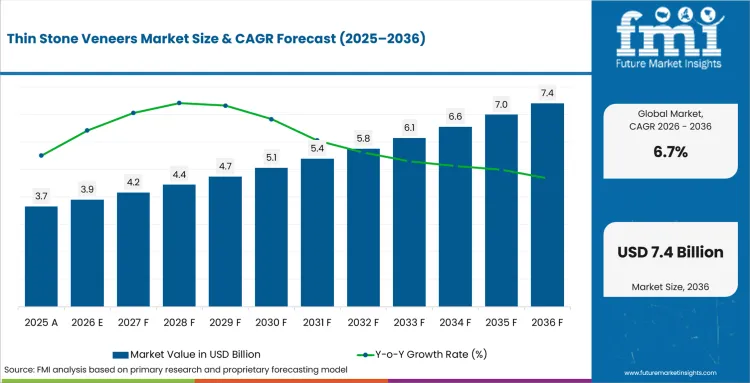
Key Takeaways of Thin Stone Veneers Market
- Designers use thin veneer to preserve authentic stone character without adding full-bed masonry weight to constrained walls.
- Natural thin stone veneer is expected to capture 39.0% share in 2026, supported by geological variation and custom fabrication across project-specific elevations.
- By stone type, limestone is projected to represent 21.0% share in 2026 driven by neutral palettes and familiar cutting practices across mixed-material facades.
- The 1-1.5 inch profile is anticipated to capture 49.0% share in 2026, owing to balanced relief and practical handling around openings and corners.
- Exterior performance requires coordinated drainage details and trained masonry crews across substrates with different moisture exposure.
- Key players such as Cultured Stone and Eldorado Stone are focusing on repeatable profiles; Kafka Granite and Fond du Lac Natural Stone emphasize quarry range and custom fabrication.
Analyst Perspective
“Thin stone veneer earns specification space by preserving depth without full-bed masonry weight on constrained walls. Drainage details and matching corners determine whether approved samples translate into reliable field conditions during installation. Manufacturers pairing calibrated profiles with regional stock and substrate guidance preserve color continuity and limit delays across phased facades, remodeling projects and later repairs.”
- Nikhil Kaitwade, Principal Analyst, Future Market Insights
How is the Thin Stone Veneers Market segmented?
The market is segmented by product type, stone type, thickness, application, end use, sales channel, and region.
Product type separates natural veneer from manufactured profiles and accessories used across wall assemblies. Stone type covers limestone and sandstone alongside slate, granite, travertine, marble and concrete-based alternatives. Thickness separates shallow and standard profiles from deeper pieces that affect handling and shadow depth. Application covers exterior facades and interior features with fireplaces, outdoor living areas and commercial cladding. End use spans remodeling and new residential construction plus commercial buildings and hospitality or retail projects. Sales channels include stone yards, material distributors, home centers and direct fabricators. Regional analysis compares construction practices with green building materials selection across climates and approvals.
What makes natural thin stone veneer central to the product type category?
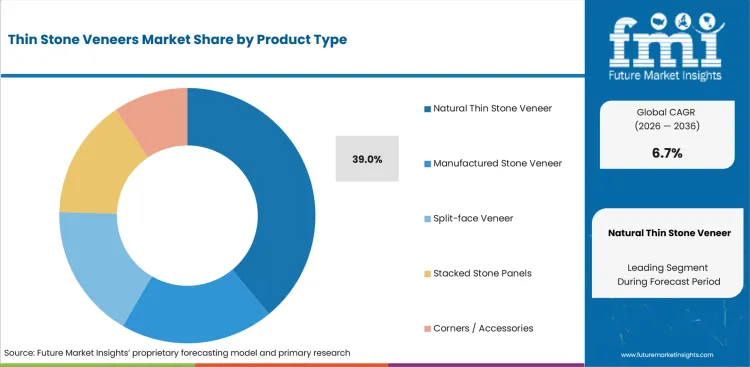
Natural veneer preserves geological variation while reducing installed wall weight across renovation and facade projects. Architects need calibrated depth and matching corners to approve substrate details across complete elevations confidently. Kafka Granite stated in April 2026 that thin veneer under two inches remains nonstructural cladding. The boundary helps compare natural stone with fiber cement without confusing appearance with structural support.
- Natural thin stone veneer is projected to hold 39.0% share in 2026 owing to authentic mineral variation. Custom cutting and calibrated corners reduce estimating uncertainty across design approval and phased installation work.
- Architects adopt natural veneer for elevations requiring geological variation across broad visible surfaces on completed buildings. Reliable quarry supply and calibrated fabrication preserve color continuity through phased orders and later repairs.
Why does limestone influence purchasing within the stone type category?
Neutral colors and fabrication suit limestone to facades combining stone with wood or metal finishes. Architects need representative samples across quarry lots to approve phased elevations and protect visual continuity. Natural Stone Institute listed an April 2026 thin veneer course covering production and product variations. Better sample planning reduces visual disputes and supports later repairs across visible wall sections reliably.
- By stone type, limestone is estimated to hold 21.0% share in 2026 owing to familiar cutting practices and neutral colors. Muted palettes coordinate with brick and timber across established masonry workflows and mixed-material facade designs.
- Stone yards use limestone samples to assess finish consistency across complete project quantities prior to ordering. Clear quarry identification and dependable delivery schedules reduce disputes across separate elevations or repair phases.
How do contractors evaluate the 1-1.5 inch thickness category?
A 1-1.5 inch profile provides visible relief without approaching full-bed stone weight across wall applications. Contractors assess packaging and cutting needs around corners with substrate transitions and complex exterior openings. CMHA explained in May 2025 that manufactured veneer uses varied dimensions across residential and commercial projects. The middle range permits routine field adjustment without excessive breakage across varied exterior installation conditions.
- The thickness category is forecast to be led by the 1-1.5 inch profile at 49.0% share in 2026 due to balanced relief. Familiar cutting methods reduce handling difficulty around detailed exterior openings and across mixed wall substrates onsite.
- Masonry contractors prefer the middle depth range for field adjustment without excessive breakage across larger wall surfaces. Standardized corners simplify opening transitions and support consistent mortar coverage throughout phased exterior facade programs.
What supports demand for exterior facades within the application category?
Exterior facades expose veneer systems to wind-driven rain and require drainage throughout the wall assembly. Specification teams must resolve barriers and opening transitions during technical review of each stone profile. CMHA stated in May 2025 that local jurisdictions apply different rainscreen requirements to exterior walls. Regional rule differences make submittals essential alongside waterproofing admixtures and adjoining facade materials throughout projects.
- The exterior facades segment is likely to capture 32.0% share in 2026 attributable to visible renovation and mixed-cladding design. Approved drainage and opening details determine practical wall performance throughout construction and long-term maintenance cycles.
- Builders adopt thin veneer on exterior walls requiring masonry character without foundation changes associated with full-bed stone. Coordinated flashing supports reliable installation, but limited crew experience can delay exterior wall assembly approval.
What drives residential remodeling within the end use category?
Residential remodeling draws demand from owners seeking visible upgrades without rebuilding structural masonry around occupied homes. Active renovation pipelines favor finishes that fit existing wall conditions and practical schedules for residents. NAHB reported in July 2026 that its Remodeling Market Index remained above the neutral threshold at 61, although local labor availability and financing determine which approved projects advance into installation.
- Based on end use, residential remodeling is projected to account for 30.0% share in 2026 due to visible upgrades across occupied homes. Lighter veneer and matching corners support phased installation without complete structural reconstruction across existing walls.
- Remodeling contractors favor clear substrate instructions and dependable replacement stock for walls with uncertain existing conditions. Local samples shorten approval, and qualified masons coordinate drainage with hearth transitions throughout renovation schedules.
How do stone yards shape demand within the sales channel category?
Stone yards let homeowners and contractors compare color and texture during selection for project orders. Dealer staff explain substrate needs together with delivery schedules and available stock for later repairs. Westlake Royal announced in February 2026 that its IBS display would feature several stone brands. Trade-show samples support comparison with aluminum cladding; local inventory covers urgent additions across regional projects.
- Stone yards are set to lead the sales channel category with 33.0% share in 2026 due to hands-on selection. Staff compare sample boards with matching corners, and local delivery supports phased projects or urgent additions.
- Fabricators and installers use stone yards for replacement pieces and short-notice additions unavailable through direct shipping; visible inventory and trained staff reduce schedule risk across regional substrate conditions.
What are the drivers, restraints, and opportunities in the thin Thin Stone Veneers Market?
Reduced wall weight supports adoption whereas installation precision limits conversion and integrated technical service supports repeat purchasing.
- Driver: Lower installed weight expands stone finishes across renovations that cannot support full-bed masonry without structural changes.
- Restraint: Exterior performance requires trained masonry labor and coordinated moisture details across substrates with different exposure.
- Opportunity: Integrated submittals and local stock help manufacturers convert approved samples into repeat dealer and contractor orders.
Lower installed weight lets remodeling teams add stone finishes without rebuilding structural support around homes. The purchasing case strengthens whenever the visible upgrade fits a contained installation scope and budget. CMHA reported in November 2025 that manufactured stone veneer returned 206% of project cost nationally. Reported payback supports veneer as a building envelope upgrade with defined substrate and drainage work.
Exterior performance depends on the complete wall assembly rather than the selected profile during service. Field crews need documented inspection points around wall openings throughout barrier and flashing installation work onsite. CMHA explained in April 2025 that specifications must address rainscreens, structural height limits and fireplace exposure. Early technical coordination under those design limits prevents water intrusion, weak bonds and later repair work.
Manufacturers gain a practical sales route by pairing technical submittals with local stock and installer support across jurisdictions. CMHA reported in March 2026 that its technical subcommittee approved substantial installation-guide updates aligned with current codes. Shared guidance improves dealer training, and replacement stock limits schedule risk across phased facade work with later additions.
Which country CAGRs are profiled in the thin Thin Stone Veneers Market?
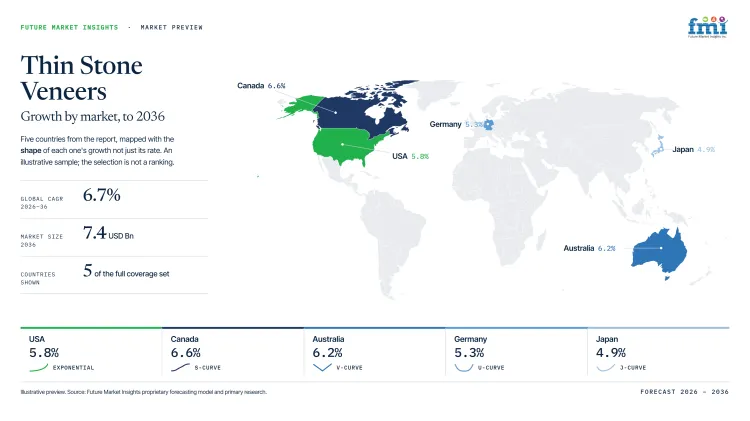
| Country | CAGR |
|---|---|
| United States | 5.8% |
| Germany | 5.3% |
| Japan | 4.9% |
| Canada | 6.6% |
| Australia | 6.2% |
How do country-level CAGRs compare in the Thin Stone Veneers Market?
The five profiled markets form a concentrated outlook across a 1.7 percentage-point range with distinct conversion conditions. Canada and Australia share renovation demand but differ in freight exposure and seasonal access to trained masonry labor. United States channels broaden access across varied codes whereas German projects rely on documented performance and Japanese teams reward compact assemblies with precise workmanship.
- Canada depends on regional stone-yard access; service distance and seasonal installation windows extend residential project schedules.
- Australian dealers need climate-suitable samples and coordinated freight across state markets with uneven masonry labor availability.
- United States distributors gain reach through broad dealer networks although local code interpretation produces uneven approval timing.
- German conversion depends on complete declarations and coordinated details during architect release of exterior wall packages.
- Japanese projects favor compact assemblies and precise workmanship which raises the value of calibrated pieces and dependable corners.
The full report provides country-level CAGR analysis across North America, Latin America, Europe, East Asia, South Asia, Oceania and the Middle East and Africa.
Country-wise Analysis
- United States projects rely on national stone brands and regional masonry contractors across jurisdictions with different exterior-wall requirements. Thin stone veneer demand in the United States is forecast to rise at 5.8% CAGR over the forecast period, supported by remodeling and mixed-cladding design. Westlake Royal presented integrated exterior solutions at the AIA conference in June 2026 with several architectural stone brands. National dealer coverage supports sample access, although code interpretation and installer availability produce uneven approval timing.
- German purchases begin with technical declarations that support architect review across regulated exterior wall assemblies. The German thin stone veneers sector is projected to record 5.3% CAGR during the assessment period, influenced by documentation-led purchasing. DIBt published the 2025/1 Model Administrative Provisions - Technical Building Rules in May 2025 for state implementation. The edition gives project teams a current basis for construction-product review, although state adoption and delivery planning remain material frictions.
- Japanese housing projects often use compact wall assemblies and value precise workmanship across visible finishes. Adoption of thin stone veneers in Japan is estimated to expand at 4.9% CAGR through 2036, reinforced by durable housing specifications. MLIT reported 165,271 long-life housing certifications for fiscal 2025 in July 2026 across new homes. Service-life priorities increase the value of documented materials and calibrated samples, although import logistics constrain availability outside major metropolitan markets.
- Canadian projects combine detached-home remodeling with freeze-thaw exposure and long service distances outside major cities. Canada is estimated to post 6.6% CAGR over the forecast period, enabled by established stone-yard access. The National Research Council published the National Building Code of Canada 2025 in December 2025 for national model-code review. The code gives regional dealers a current review basis, although provincial adoption and seasonal installation windows continue to shape timing.
- Australian demand reflects state building requirements and materials suited to exposed outdoor living areas throughout coastal markets. Thin stone veneer sales in Australia are forecast to expand at 6.2% CAGR by 2036, aided by renovation and facade upgrades. The Australian Building Codes Board listed NCC 2022 Amendment 2 as adopted on July 29, 2025 across the national code framework. National code provisions support climate-suitable wall review, although freight distance and uneven masonry labor constrain project schedules.
Who are the notable companies in the Thin Stone Veneers Market?
Westlake Royal Building Products and its Cultured Stone, Eldorado Stone, StoneCraft Industries, and Dutch Quality Stone brands; Coronado Stone Products; Kafka Granite; Realstone Systems; Norstone; and Fond du Lac Natural Stone are notable companies and brands profiled in this market.
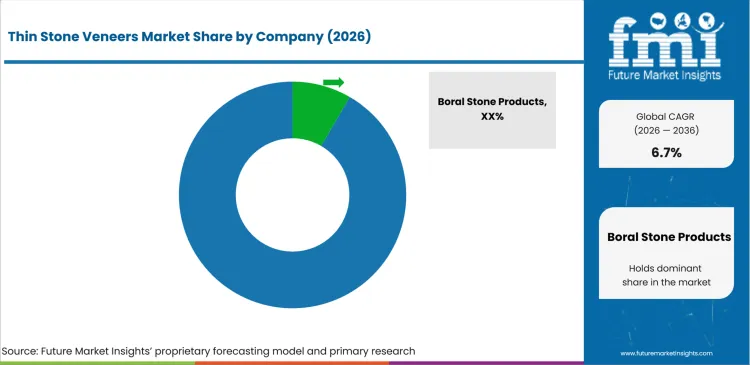
The field remains fragmented between national manufactured-veneer brands and regional natural-stone fabricators with specialized assortments. Regional cutters enter through consistent quarry supply, although nationwide expansion requires dealer coverage and documentation. Manufactured brands compete through repeatable profiles; natural specialists emphasize geological range and project-specific custom cutting. Panel specialists target standardized modules and faster pattern planning; dependable replacement availability determines repeat specifications.
- Westlake Royal’s manufactured portfolio includes Cultured Stone and Eldorado Stone alongside StoneCraft Industries and Dutch Quality Stone. Coronado Stone Products adds molded profiles through regional networks, and these brands compete through repeatable colors with documented installation resources.
- Natural-stone competition centers on Kafka Granite and Fond du Lac Natural Stone through quarried colors and custom fabrication. Calibrated sections support matching corners, and reliable production lots protect visual continuity during additions and repairs.
- Panel specialists include Realstone Systems and Norstone through modular natural-stone formats supporting faster pattern planning. Calibrated pieces and regional samples help architects compare panel systems with loose veneer during design and contractor pricing.
Competitive Benchmarking: Thin Stone Veneers Market
| Company | Product Breadth | Natural Stone Capability | Technical Support | Geographic Reach |
|---|---|---|---|---|
| Cultured Stone | High | Low | High | North America |
| Eldorado Stone | High | Low | High | North America |
| Coronado Stone Products | High | Low | High | United States |
| Dutch Quality Stone | High | Low | Medium | United States |
| Kafka Granite | Medium | High | Medium | North America |
| Realstone Systems | High | High | High | North America |
| Norstone | Medium | High | High | North America and selected exports |
| Fond du Lac Natural Stone | High | High | Medium | United States and Canada |
Key Developments in the Thin Stone Veneers Market
- In February 2025, StoneCraft Industries introduced Silver Summit together with Mineral Ridge and Steel Valley across established veneer profiles. The additions expanded neutral palettes without changing the installation system used by crews familiar with those formats. Updated dealer displays helped coordinate stone with adjoining finishes; contractors retained established handling and mortar practices across residential and light commercial projects including renovations.
- In February 2025, Eldorado Stone introduced Ranchers Ridge for RoughCut and Fieldledge with Nordic Peak for Cliffstone. The colors broadened warm western and pale neutral choices within established families and gave architects more facade combinations without major training changes. Dealer displays supported staged approvals through familiar dimensions and routine mortar practices across regional installations, later additions and later repair work.
- In May 2025, Cultured Stone added Salt Flat to its Cobblefield profile for residential and commercial applications. The light gray and warm white palette extended softer neutral options across interior features and exterior elevations. Familiar dimensions limited installation changes; dealer samples helped design teams coordinate adjoining finishes and convert approved selections into project orders across phased construction and repair work.
- In June 2025, Westlake Royal Building Products presented expanded stone solutions at the AIA Conference on Architecture and Design. The display combined Eldorado Stone and Cultured Stone colors with Versetta Stone additions across distinct installation formats. Architects compared coordinated exterior materials during detailed project review; contractors separated mortared veneer from panelized systems for pricing, installation planning and regional project scheduling.
Thin Stone Veneers Market - Report Scope
| Coverage field | Report scope |
|---|---|
| Market breakdown | product type; stone type; thickness; application; end use; sales channel; and region |
| Quantitative Units | Revenue in USD Billion and CAGR in %. |
| Market Definition | Revenue from natural and manufactured thin stone veneer products and related veneer systems purchased for interior or exterior wall applications. |
| Regions Covered | North America, Latin America, Western Europe, Eastern Europe, East Asia, South Asia and Pacific, Middle East and Africa |
| Countries Covered | United States; Germany; Japan; Canada; Australia; and more than 25 additional countries in the full report |
| Key Companies Profiled | Westlake Royal Building Products (Cultured Stone; Eldorado Stone; StoneCraft Industries; Dutch Quality Stone); Coronado Stone Products; Kafka Granite; Realstone Systems; Norstone; Fond du Lac Natural Stone |
| Forecast Period | 2026 to 2036 |
| Approach | Market estimates combine product-level demand with regional construction activity, channel structure, pricing, and adoption conditions. |
Thin Stone Veneers Market - Research Methodology
| Method | Approach |
|---|---|
| Primary Research | FMI analysts gathered input from manufacturers, service providers, technology developers, distributors, end users, procurement teams, and subject-matter experts. Interviews examined purchasing decisions, product or service evaluation, adoption barriers, approval requirements, pricing considerations, and expectations for technical or commercial support. Respondents were also asked what evidence is required before a trial, pilot, or initial order develops into regular purchasing. |
| Desk Research | Desk research covered government statistics, regulatory publications, trade data, industry associations, technical literature, standards, company filings, product information, and official corporate announcements. Sources were reviewed for relevance, publication date, geographic coverage, and consistency with the defined market scope. Claims relating to performance, applications, approvals, capacity, investment, and commercial activity were retained only when supported by credible public evidence. |
| Market Sizing and Forecasting | The market model combined the baseline value with historical performance, segment structure, pricing and volume indicators, adoption levels, company participation, and country-level demand conditions. Forecast assumptions considered economic activity, investment trends, regulatory developments, technology adoption, purchasing cycles, supply availability, and barriers to wider market use. Segment and regional estimates were reconciled before the final market total was calculated. |
| Data Validation | Estimates were checked against multiple independent indicators, including public data, company activity, trade patterns, industry developments, and findings from primary interviews. Validation also tested whether products, services, applications, and company revenues fell within the defined market boundaries. Adjacent categories, unsupported claims, overlapping revenues, and activities without direct market relevance were excluded to reduce double counting and maintain consistency across segments and countries. |
Thin Stone Veneers Market by Segments
Thin Stone Veneers Market segmented by Product Type:
- Natural Thin Stone Veneer
- Manufactured Stone Veneer
- Split-face Veneer
- Stacked Stone Panels
- Corners / Accessories
Thin Stone Veneers Market segmented by Stone Type:
- Limestone
- Sandstone
- Slate
- Granite
- Travertine / Marble
- Concrete-based Veneer
Thin Stone Veneers Market segmented by Thickness:
- 1-1.5 inch
- <1 inch
- >1.5 inch
Thin Stone Veneers Market segmented by Application:
- Exterior Facades
- Interior Feature Walls
- Fireplaces
- Landscaping / Outdoor Living
- Commercial Cladding
Thin Stone Veneers Market segmented by End Use:
- Residential Remodeling
- Residential New Build
- Commercial Buildings
- Hospitality / Retail
Thin Stone Veneers Market segmented by Sales Channel:
- Stone Yards
- Building Material Distributors
- Retail / Home Centers
- Direct Fabricator
Thin Stone Veneers Market by Region:
- North America
- United States
- Canada
- Latin America
- Brazil
- Mexico
- Argentina
- Western Europe
- Germany
- France
- United Kingdom
- Italy
- Spain
- Eastern Europe
- Poland
- Russia
- Rest of Eastern Europe
- East Asia
- China
- Japan
- South Korea
- South Asia and Pacific
- India
- Australia
- New Zealand
- ASEAN
- Middle East and Africa
- GCC Countries
- South Africa
- Israel
- Rest of Middle East and Africa
Research Sources and Bibliography
- Australian Building Codes Board. (2025, July 29). Editions of the National Construction Code.
- Concrete Masonry and Hardscapes Association. (2025, May 1). Rainscreens and water resistive barriers behind manufactured stone veneer.
- Concrete Masonry and Hardscapes Association. (2025, May 17). A pro’s guide to manufactured stone veneer.
- Concrete Masonry and Hardscapes Association. (2025, November 13). Manufactured stone veneer offers 206% return on investment.
- Concrete Masonry and Hardscapes Association. (2026, March 3). 2026 annual meeting recap.
- Concrete Masonry and Hardscapes Association. (2026, March 3). CMHA launches new on-demand manufactured stone veneer (MSV) fundamentals course.
- Concrete Masonry and Hardscapes Association. (2025, April 17). What architects should know about manufactured stone veneer.
- European Commission. (2025, January 7). New EU rules on the safety and sustainability of construction products mark a new step for the sector’s competitiveness.
- Deutsches Institut für Bautechnik. (2025, May 20). Technical Building Rules.
- Kafka Granite. (2026, April 20). What are the weight and structural considerations of thin stone veneer?
- Ministry of Land, Infrastructure, Transport and Tourism. (2026, July 17).[Share of long-life quality housing certifications reaches about half of new detached housing starts].
- National Association of Home Builders. (2026, July 9). Remodeling market sentiment remains in positive territory in second quarter.
- National Research Council Canada. (2025, December 22). National Building Code of Canada 2025.
- Natural Stone Institute. (2026, April 30). Natural stone thin veneer: The basics.
- Norstone. (2026). How to install stacked stone veneer wall tiles.
- Realstone Systems. (2026). Technical documents: CAD & Revit.
- Westlake Royal Building Products. (2026, June 15). Westlake Royal Building Products™ introduced integrated exterior solutions at the AIA Conference on Architecture & Design 2026.
- Westlake Royal Building Products. (2025, February 25). Eldorado Stone® announces two new colorways, Ranchers Ridge™ and Nordic Peak™, debuting at the International Builders’ Show.
- Westlake Royal Building Products. (2025, February 25). StoneCraft™ debuts three new colorways for Ledgestone, Fieldstone, and Laurel Cavern Ledge profiles.
- Westlake Royal Building Products. (2025, May 15). Cultured Stone® expands Cobblefield® profile with serene new color, Salt Flat™.
- Westlake Royal Building Products. (2025, June 4). Westlake Royal Building Products™ brings high-performance, design-forward solutions to the AIA Conference on Architecture & Design 2025 (AIA25).
- Westlake Royal Building Products. (2026, February 2). Westlake Royal Building Products™ brings new innovations and design trends to the 2026 NAHB International Builders’ Show®.
This bibliography is provided for reader reference and is not exhaustive. The full report contains the complete reference list and detailed citations.
This Report Answers
- How large is the market during 2026 and 2036?
- Which operating conditions support lightweight veneer demand?
- Why does natural thin stone veneer retain product type share?
- How do stone type and thickness affect project selection?
- What separates facade and remodeling purchase routes?
- How do country growth conditions differ?
- Which companies supply manufactured and natural veneer?
Frequently Asked Questions
How big is the Thin Stone Veneers Market in 2026?
The thin stone veneers market is valued at USD 3.9 billion in 2026 and is forecast to reach USD 7.4 billion by 2036. Growth is supported by architects specifying lighter stone formats that preserve authentic character on walls unable to carry full-bed masonry loads.
What is the CAGR of the Thin Stone Veneers Market from 2026 to 2036?
The thin stone veneers market grows at a CAGR of 6.7% between 2026 and 2036, supported by renovation and mixed-cladding projects adopting calibrated veneer profiles once approved samples translate into reliable drainage details and consistent field installation across facades and remodeling programs.
Which product type leads the Thin Stone Veneers Market?
Natural thin stone veneer accounts for 39.0% of the thin stone veneers market by product type in 2026, driven by geological variation and custom fabrication that let architects preserve authentic mineral character and color continuity across broad, project-specific facade elevations.
How much will the Thin Stone Veneers Market add between 2026 and 2036?
The thin stone veneers market is set to add USD 3.5 billion between 2026 and 2036, growing from USD 3.9 billion to USD 7.4 billion as lighter veneer formats expand across renovation, remodeling, and mixed-cladding facade projects worldwide.
Who are the leading companies in the Thin Stone Veneers Market?
Six companies lead the thin stone veneers market, including Westlake Royal Building Products, Coronado Stone Products, Kafka Granite, Realstone Systems, and Norstone, competing through manufactured profiles, quarried natural stone, and modular panel formats across residential, commercial, and exterior facade installation projects worldwide.
Preview the report firsthand - request a free sample
Get SampleGet the brochure for pricing and purchase details.
Get PDFTable of Content
- Key Takeaways
- Market Size and CAGR
- Top Growth Driver
- Fastest Growing Segment
- Leading Region
- Key Companies
- Emerging Opportunities
- Executive Summary
- Global Market Outlook
- Demand-side Trends
- Supply-side Trends
- Technology Roadmap Analysis
- Analysis and Recommendations
- Analyst Perspective (What is happening? Why now? What should investors know?)
- Key Questions Answered
- How large is the market?
- What is the CAGR?
- What are key trends?
- Which region dominates?
- Who are the leaders?
- Market Overview
- Market Coverage / Taxonomy
- Market Definition / Scope / Limitations
- Research Methodology
- Chapter Orientation
- Analytical Lens and Working Hypotheses
- Market Structure, Signals, and Trend Drivers
- Benchmarking and Cross-market Comparability
- Market Sizing, Forecasting, and Opportunity Mapping
- Research Design and Evidence Framework
- Desk Research Programme (Secondary Evidence)
- Expert Input and Fieldwork (Primary Evidence)
- Tooling, Models, and Reference Databases
- Data Engineering and Model Build
- Quality Assurance and Audit Trail
- Market Background
- Market Dynamics (Drivers, Restraints, Opportunity, Trends)
- Scenario Forecast (Optimistic, Likely, Conservative)
- Impact Analysis
- AI Impact
- Sustainability Impact
- Regulatory Impact
- Technology Impact
- Consumer / Buyer Analysis
- Purchase Drivers
- Adoption Barriers
- Buyer Journey
- Opportunity Map Analysis
- Product Life Cycle Analysis
- Supply Chain Analysis
- Investment Feasibility Matrix
- Value Chain Analysis
- PESTLE and Porter's Analysis
- Regulatory Landscape
- Regional Parent Market Outlook
- Production and Consumption Statistics
- Import and Export Statistics
- Global Market Analysis and Forecast, 2021 to 2036
- Historical Market Size Value (USD Billion) Analysis, 2021 to 2025
- Current and Future Market Size Value (USD Billion) Projections, 2026 to 2036
- Y-o-Y Growth Trend Analysis
- Absolute $ Opportunity Analysis
- Global Market Pricing Analysis, 2021 to 2036
- Global Market Analysis and Forecast, By Product Type, 2021 to 2036
- Introduction / Key Findings
- Historical Market Size Value (USD Billion) Analysis By Product Type, 2021 to 2025
- Current and Future Market Size Value (USD Billion) Analysis and Forecast By Product Type, 2026 to 2036
- Natural Thin Stone Veneer
- Manufactured Stone Veneer
- Split-face Veneer
- Stacked Stone Panels
- Corners / Accessories
- Natural Thin Stone Veneer
- Y-o-Y Growth Trend Analysis By Product Type, 2021 to 2025
- Absolute $ Opportunity Analysis By Product Type, 2026 to 2036
- Global Market Analysis and Forecast, By Stone Type, 2021 to 2036
- Introduction / Key Findings
- Historical Market Size Value (USD Billion) Analysis By Stone Type, 2021 to 2025
- Current and Future Market Size Value (USD Billion) Analysis and Forecast By Stone Type, 2026 to 2036
- Limestone
- Sandstone
- Slate
- Granite
- Travertine / Marble
- Concrete-based Veneer
- Limestone
- Y-o-Y Growth Trend Analysis By Stone Type, 2021 to 2025
- Absolute $ Opportunity Analysis By Stone Type, 2026 to 2036
- Global Market Analysis and Forecast, By Thickness, 2021 to 2036
- Introduction / Key Findings
- Historical Market Size Value (USD Billion) Analysis By Thickness, 2021 to 2025
- Current and Future Market Size Value (USD Billion) Analysis and Forecast By Thickness, 2026 to 2036
- 1–1.5 inch
- <1 inch
- >1.5 inch
- 1–1.5 inch
- Y-o-Y Growth Trend Analysis By Thickness, 2021 to 2025
- Absolute $ Opportunity Analysis By Thickness, 2026 to 2036
- Global Market Analysis and Forecast, By Application, 2021 to 2036
- Introduction / Key Findings
- Historical Market Size Value (USD Billion) Analysis By Application, 2021 to 2025
- Current and Future Market Size Value (USD Billion) Analysis and Forecast By Application, 2026 to 2036
- Exterior Facades
- Interior Feature Walls
- Fireplaces
- Landscaping / Outdoor Living
- Commercial Cladding
- Exterior Facades
- Y-o-Y Growth Trend Analysis By Application, 2021 to 2025
- Absolute $ Opportunity Analysis By Application, 2026 to 2036
- Global Market Analysis and Forecast, By End Use, 2021 to 2036
- Introduction / Key Findings
- Historical Market Size Value (USD Billion) Analysis By End Use, 2021 to 2025
- Current and Future Market Size Value (USD Billion) Analysis and Forecast By End Use, 2026 to 2036
- Residential Remodeling
- Residential New Build
- Commercial Buildings
- Hospitality / Retail
- Residential Remodeling
- Y-o-Y Growth Trend Analysis By End Use, 2021 to 2025
- Absolute $ Opportunity Analysis By End Use, 2026 to 2036
- Global Market Analysis and Forecast, By Sales Channel
- Introduction / Key Findings
- Historical Market Size Value (USD Billion) Analysis By Sales Channel, 2021 to 2025
- Current and Future Market Size Value (USD Billion) Analysis and Forecast By Sales Channel, 2026 to 2036
- Stone Yards
- Building Material Distributors
- Retail / Home Centers
- Direct Fabricator
- Stone Yards
- Y-o-Y Growth Trend Analysis By Sales Channel, 2021 to 2025
- Absolute $ Opportunity Analysis By Sales Channel, 2026 to 2036
- Global Market Analysis and Forecast, By Region, 2021 to 2036
- Introduction
- Historical Market Size Value (USD Billion) Analysis By Region, 2021 to 2025
- Current Market Size Value (USD Billion) Analysis and Forecast By Region, 2026 to 2036
- North America
- Latin America
- Western Europe
- Eastern Europe
- East Asia
- South Asia and Pacific
- Middle East & Africa
- Market Attractiveness Analysis By Region
- North America Market Analysis and Forecast, By Country, 2021 to 2036
- Historical Market Size Value (USD Billion) Trend Analysis By Market Taxonomy, 2021 to 2025
- Market Size Value (USD Billion) Forecast By Market Taxonomy, 2026 to 2036
- By Country
- USA
- Canada
- By Product Type
- By Stone Type
- By Thickness
- By Application
- By End Use
- By Sales Channel
- By Country
- Market Attractiveness Analysis
- By Country
- By Product Type
- By Stone Type
- By Thickness
- By Application
- By End Use
- By Sales Channel
- Key Takeaways
- Latin America Market Analysis and Forecast, By Country
- Historical Market Size Value (USD Billion) Trend Analysis By Market Taxonomy, 2021 to 2025
- Market Size Value (USD Billion) Forecast By Market Taxonomy, 2026 to 2036
- By Country
- Brazil
- Mexico
- Chile
- Rest of Latin America
- By Product Type
- By Stone Type
- By Thickness
- By Application
- By End Use
- By Sales Channel
- By Country
- Market Attractiveness Analysis
- By Country
- By Product Type
- By Stone Type
- By Thickness
- By Application
- By End Use
- By Sales Channel
- Key Takeaways
- Western Europe Market Analysis and Forecast, By Country
- Historical Market Size Value (USD Billion) Trend Analysis By Market Taxonomy, 2021 to 2025
- Market Size Value (USD Billion) Forecast By Market Taxonomy, 2026 to 2036
- By Country
- Germany
- UK
- Italy
- Spain
- France
- Nordic
- BENELUX
- Rest of Western Europe
- By Product Type
- By Stone Type
- By Thickness
- By Application
- By End Use
- By Sales Channel
- By Country
- Market Attractiveness Analysis
- By Country
- By Product Type
- By Stone Type
- By Thickness
- By Application
- By End Use
- By Sales Channel
- Key Takeaways
- Eastern Europe Market Analysis and Forecast, By Country
- Historical Market Size Value (USD Billion) Trend Analysis By Market Taxonomy, 2021 to 2025
- Market Size Value (USD Billion) Forecast By Market Taxonomy, 2026 to 2036
- By Country
- Russia
- Poland
- Hungary
- Balkan & Baltic
- Rest of Eastern Europe
- By Product Type
- By Stone Type
- By Thickness
- By Application
- By End Use
- By Sales Channel
- By Country
- Market Attractiveness Analysis
- By Country
- By Product Type
- By Stone Type
- By Thickness
- By Application
- By End Use
- By Sales Channel
- Key Takeaways
- East Asia Market Analysis and Forecast, By Country
- Historical Market Size Value (USD Billion) Trend Analysis By Market Taxonomy, 2021 to 2025
- Market Size Value (USD Billion) Forecast By Market Taxonomy, 2026 to 2036
- By Country
- China
- Japan
- South Korea
- By Product Type
- By Stone Type
- By Thickness
- By Application
- By End Use
- By Sales Channel
- By Country
- Market Attractiveness Analysis
- By Country
- By Product Type
- By Stone Type
- By Thickness
- By Application
- By End Use
- By Sales Channel
- Key Takeaways
- South Asia and Pacific Market Analysis and Forecast, By Country
- Historical Market Size Value (USD Billion) Trend Analysis By Market Taxonomy, 2021 to 2025
- Market Size Value (USD Billion) Forecast By Market Taxonomy, 2026 to 2036
- By Country
- India
- ASEAN
- Australia & New Zealand
- Rest of South Asia and Pacific
- By Product Type
- By Stone Type
- By Thickness
- By Application
- By End Use
- By Sales Channel
- By Country
- Market Attractiveness Analysis
- By Country
- By Product Type
- By Stone Type
- By Thickness
- By Application
- By End Use
- By Sales Channel
- Key Takeaways
- Middle East & Africa Market Analysis and Forecast, By Country
- Historical Market Size Value (USD Billion) Trend Analysis By Market Taxonomy, 2021 to 2025
- Market Size Value (USD Billion) Forecast By Market Taxonomy, 2026 to 2036
- By Country
- Kingdom of Saudi Arabia
- Other GCC Countries
- Türkiye
- South Africa
- Other African Union
- Rest of Middle East & Africa
- By Product Type
- By Stone Type
- By Thickness
- By Application
- By End Use
- By Sales Channel
- By Country
- Market Attractiveness Analysis
- By Country
- By Product Type
- By Stone Type
- By Thickness
- By Application
- By End Use
- By Sales Channel
- Key Takeaways
- Key Countries Market Analysis
- USA
- Pricing Analysis
- Market Share Analysis, 2025
- By Product Type
- By Stone Type
- By Thickness
- By Application
- By End Use
- By Sales Channel
- Canada
- Pricing Analysis
- Market Share Analysis, 2025
- By Product Type
- By Stone Type
- By Thickness
- By Application
- By End Use
- By Sales Channel
- Mexico
- Pricing Analysis
- Market Share Analysis, 2025
- By Product Type
- By Stone Type
- By Thickness
- By Application
- By End Use
- By Sales Channel
- Brazil
- Pricing Analysis
- Market Share Analysis, 2025
- By Product Type
- By Stone Type
- By Thickness
- By Application
- By End Use
- By Sales Channel
- Chile
- Pricing Analysis
- Market Share Analysis, 2025
- By Product Type
- By Stone Type
- By Thickness
- By Application
- By End Use
- By Sales Channel
- Germany
- Pricing Analysis
- Market Share Analysis, 2025
- By Product Type
- By Stone Type
- By Thickness
- By Application
- By End Use
- By Sales Channel
- UK
- Pricing Analysis
- Market Share Analysis, 2025
- By Product Type
- By Stone Type
- By Thickness
- By Application
- By End Use
- By Sales Channel
- Italy
- Pricing Analysis
- Market Share Analysis, 2025
- By Product Type
- By Stone Type
- By Thickness
- By Application
- By End Use
- By Sales Channel
- Spain
- Pricing Analysis
- Market Share Analysis, 2025
- By Product Type
- By Stone Type
- By Thickness
- By Application
- By End Use
- By Sales Channel
- France
- Pricing Analysis
- Market Share Analysis, 2025
- By Product Type
- By Stone Type
- By Thickness
- By Application
- By End Use
- By Sales Channel
- India
- Pricing Analysis
- Market Share Analysis, 2025
- By Product Type
- By Stone Type
- By Thickness
- By Application
- By End Use
- By Sales Channel
- ASEAN
- Pricing Analysis
- Market Share Analysis, 2025
- By Product Type
- By Stone Type
- By Thickness
- By Application
- By End Use
- By Sales Channel
- Australia & New Zealand
- Pricing Analysis
- Market Share Analysis, 2025
- By Product Type
- By Stone Type
- By Thickness
- By Application
- By End Use
- By Sales Channel
- China
- Pricing Analysis
- Market Share Analysis, 2025
- By Product Type
- By Stone Type
- By Thickness
- By Application
- By End Use
- By Sales Channel
- Japan
- Pricing Analysis
- Market Share Analysis, 2025
- By Product Type
- By Stone Type
- By Thickness
- By Application
- By End Use
- By Sales Channel
- South Korea
- Pricing Analysis
- Market Share Analysis, 2025
- By Product Type
- By Stone Type
- By Thickness
- By Application
- By End Use
- By Sales Channel
- Russia
- Pricing Analysis
- Market Share Analysis, 2025
- By Product Type
- By Stone Type
- By Thickness
- By Application
- By End Use
- By Sales Channel
- Poland
- Pricing Analysis
- Market Share Analysis, 2025
- By Product Type
- By Stone Type
- By Thickness
- By Application
- By End Use
- By Sales Channel
- Hungary
- Pricing Analysis
- Market Share Analysis, 2025
- By Product Type
- By Stone Type
- By Thickness
- By Application
- By End Use
- By Sales Channel
- Kingdom of Saudi Arabia
- Pricing Analysis
- Market Share Analysis, 2025
- By Product Type
- By Stone Type
- By Thickness
- By Application
- By End Use
- By Sales Channel
- Türkiye
- Pricing Analysis
- Market Share Analysis, 2025
- By Product Type
- By Stone Type
- By Thickness
- By Application
- By End Use
- By Sales Channel
- South Africa
- Pricing Analysis
- Market Share Analysis, 2025
- By Product Type
- By Stone Type
- By Thickness
- By Application
- By End Use
- By Sales Channel
- USA
- Market Structure Analysis
- Competition Dashboard
- Competition Benchmarking
- Market Share Analysis of Top Players
- By Regional
- By Product Type
- By Stone Type
- By Thickness
- By Application
- By End Use
- By Sales Channel
- Emerging Startups
- Innovation Benchmarking
- Competition Analysis
- Competition Deep Dive
- Boral Stone Products
- Overview
- Product Portfolio
- Profitability by Market Segments
- Sales Footprint
- Strategy Overview
- Marketing Strategy
- Product Strategy
- Channel Strategy
- Cultured Stone
- Eldorado Stone
- Coronado Stone Products
- Natural Stone Veneers International
- Kafka Granite
- Realstone Systems
- Norstone
- Fond du Lac Natural Stone
- StoneCraft
- Boral Stone Products
- Case Studies
- Success Stories
- Recent Developments
- Competition Deep Dive
- Assumptions & Acronyms Used


