

- Market Size (2026)
- USD 1.7 Bn
- Forecast (2036)
- USD 3.1 Bn
- CAGR (2026 to 2036)
- 6.2%
How big is Transparent Masterbatch Market in 2026?
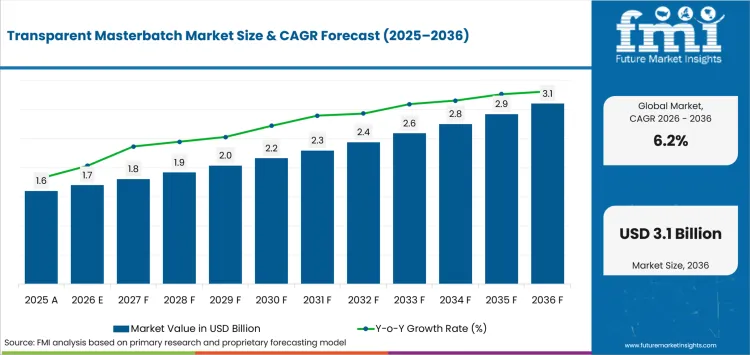
USD 1.7 billion in 2026 and USD 3.1 billion by 2036 at a 6.2% CAGR.
Demand for transparent masterbatch is projected to expand at 6.2% CAGR between 2026 and 2036, raising valuation from USD 1.7 billion to USD 3.1 billion. Packaging processors use clear concentrates to protect product visibility without replacing established transparent plastic packaging resin or molding routes. PET packaging formats make that requirement more demanding as recycled resin changes haze and color behavior during commercial production. Avient’s July 2025 Oxyloop-1 launch linked clear PET bottles with full scavenging performance and bottle clarity at up to 100% rPET content.
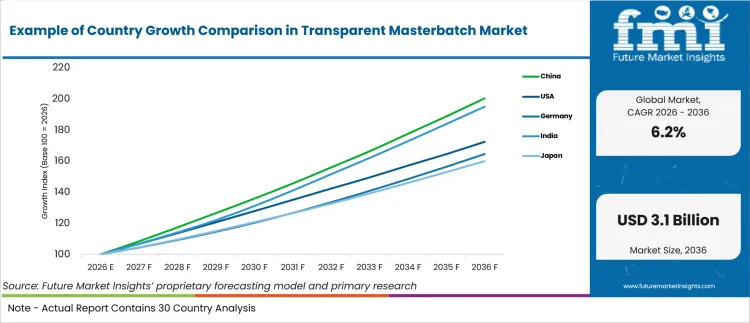
Country growth paths differ as packaging processors face separate resin-cost and qualification conditions across the plastic conversion base. Thailand is forecast at 5.8% CAGR while the United States and Germany are projected at 5.6% and 5.1%. The Office of Industrial Economics reported rubber and plastic product output rose 5.53% year over year for June 2026. Thailand’s active production base gives local processors more trial volume, whereas USA food-contact controls and German recyclability documentation impose separate approval work.
Key Takeaways of Transparent Masterbatch Market
- Transparent masterbatch demand rises as packaging processors need visible color or clarity improvements that preserve established resin processing and product-display requirements.
- Transparent color masterbatch is set to lead the masterbatch type category with 28.0% share in 2026 due to controlled tinting that preserves product visibility in clear plastic applications.
- By carrier resin, PE carrier is forecast to represent 34.0% in 2026 driven by familiar polyethylene handling across high-volume extrusion and molding routes.
- The application category is forecast to be led by films & sheets at 31.0% share in 2026 due to broad surfaces exposing haze and dispersion defects quickly.
- Qualification slows switching as PCR variability combines with resin-compatibility checks and end-use documentation to turn a color change into a line-validation exercise.
- Avient, Ampacet, Gabriel-Chemie, Tosaf, Americhem, Plastika Kritis, Sukano and Penn Color are the profiled companies serving the transparent masterbatch market.
Analyst Perspective
"Packaging processors should compare transparent masterbatch on haze stability at the intended let-down ratio and on color repeatability across virgin and recycled resin lots. A formulation earns repeat business when the same optical target survives commercial line conditions without extending food-contact or recyclability qualification."
- Nikhil Kaitwade, Principal Consultant, Future Market Insights
How is the Transparent Masterbatch Market segmented?
The market is assessed by masterbatch type, carrier resin, application, function and sales channel.
Masterbatch type includes clarifying masterbatch, transparent color masterbatch, nucleating masterbatch, anti-haze masterbatch and functional transparent masterbatch. Carrier resin covers PP carrier, PE carrier, PET carrier, PS / ABS carrier and universal carrier. Application includes rigid packaging, films & sheets, housewares, medical / labware and consumer goods. Function covers clarity improvement, coloring without opacity, haze reduction, gloss enhancement and processing improvement. Sales channel includes plastic converters, direct OEM / brand approved, distributors and resin producer channel.
Why do films & sheets lead the application category?
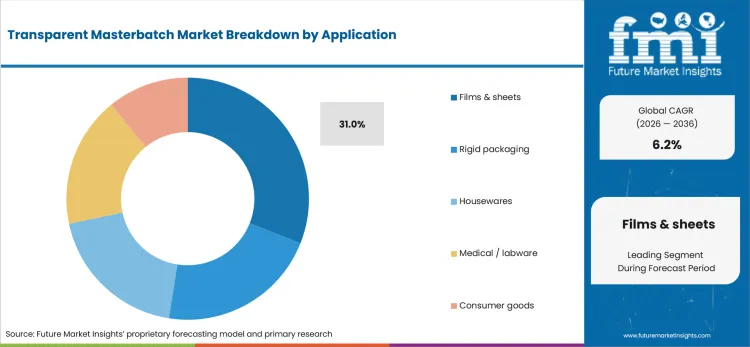
Flexible plastic packaging makes haze and dispersion defects visible across broad web surfaces at commercial speed, so formulation errors can repeat across long production rolls.
- In 2026, films & sheets are expected to lead application with 31.0% share because broad processed surfaces make optical defects immediately visible during conversion.
- Film processors qualify concentrates on running stability and visual uniformity so a local optical defect does not repeat across continuous rolls at full production speed. Sukano’s October 2025 BOPLA development paired masterbatch processing support with improved optical and barrier performance for compostable film packaging during conversion.
Why does transparent color masterbatch lead the masterbatch type category?
Within specialty masterbatch formulations, transparent color systems let packaging processors add tint or pearlescent effects and preserve the light transmission expected from clear articles. Ampacet introduced HyperLustre in November 2025 for semi-translucent PET colorants used in blow molding and injection stretch blow molding.
- Based on masterbatch type, transparent color masterbatch is projected to account for 28.0% in 2026 due to clear-product designs requiring controlled tint without lost light transmission.
- Packaging processors qualify these concentrates against color matching and haze targets so the visual effect survives resin processing without making a clear article visibly opaque.
Why does PE carrier lead the carrier resin category?
Gabriel-Chemie’s May 2026 PFAS-free PPA release used polyethylene and polypropylene carriers and reported improved transparency during commercial blown-film trials. In plastic additive systems, carrier selection matters at extrusion temperatures because clean dispersion must preserve film clarity and surface stability. Carrier compatibility reduces avoidable haze while keeping the base polyethylene processing route familiar to film manufacturers.
- By carrier resin, PE carrier is estimated to hold 34.0% in 2026 owing to polyethylene compatibility across high-volume film and packaging processes.
- Stable melt behavior makes PE carrier matching valuable to film manufacturers by reducing dosing adjustments and protecting optical performance during repeat-volume approval on packaging lines.
Why does coloring without opacity lead the function category?
Across polypropylene processing, coloring without opacity is judged on controlled tint at the target let-down ratio instead of color intensity alone. Clear-article applications add a separate haze limit that must remain stable across repeat commercial production. Plastika Kritis illustrated in April 2025 how its KRITILEN masterbatch formulations maintain consistent color across film and injection-molding routes, drawing on seasonal color trends published in the Global Colors Vibes Spring/Summer 2025 newsletter.
- Coloring without opacity is projected to hold 31.0% share in 2026 owing to clear plastic applications needing identification and styling without losing product visibility.
- Packaging processors approve these formulations once color and haze remain stable at the intended let-down ratio across repeated production runs and customer-specific line conditions.
What are the drivers, restraints and opportunities in the Transparent Masterbatch Market?
Clear packaging and recycled-resin reformulation sustain demand while qualification work slows formulation changes and nearby application laboratories shorten trial cycles for recurring orders.
- Driver: Packaging redesign increases masterbatch use for processors that need clarity or color adjustments without replacing qualified resin and production routes.
- Restraint: Food-contact eligibility and resin compatibility checks extend approval cycles when a masterbatch changes a validated packaging formulation.
- Opportunity: Regional application laboratories shorten color matching and line troubleshooting for recycled-content or non-PFAS reformulation programs that need repeat orders.
Recyclability Rules Raise the Value of Optical Compatibility
Packaging teams need color and clarity packages that stay compatible with recycling requirements as recycled plastic packaging specifications become more demanding. Germany’s ZSVR published its 2025 minimum standard in August 2025 and set a 2030 target for packaging to be at least 70% recyclable. Transparent masterbatch formulations therefore face an added design test: optical improvement must preserve polymer compatibility and the recyclability evidence required during packaging redesign.
Qualification Requirements Extend Formulation Switching Cycles
Food-contact packaging turns a visual formulation change into a material-eligibility decision once the masterbatch becomes part of an approved resin recipe. A new color package requires fresh additive records and traceability across production lots, which gives existing formulations switching value. Japan’s Consumer Affairs Agency ended the positive-list transition on May 31 2025, making listed substances the basis for synthetic-resin food-contact materials from June.
Local Application Support Converts Reformulation Work
Regional application laboratories place color matching and line troubleshooting near packaging plants handling recycled-content changes and variable resin lots. Close support lets formulation teams correct resin-specific optical problems on the intended production line during qualification. A shorter feedback loop reduces repeat trial work before packaging plants approve regular masterbatch volume. Tosaf’s April 2026 Olkusz announcement included an application laboratory for faster color matching and local product development.
Which country CAGRs are profiled in the Transparent Masterbatch Market?
| Country | CAGR |
|---|---|
| Thailand | 5.8% |
| United States | 5.6% |
| Brazil | 5.4% |
| Germany | 5.1% |
| Japan | 4.8% |
How do country-level CAGRs compare in the Transparent Masterbatch Market?
A 1.0 percentage-point span places the five countries inside a narrow forecast band despite different qualification routes. Thailand and the United States form the upper pair as conversion and recycled-resin programs generate formulation work. Brazil alongside Germany and Japan remain close as recycled-content rules and food-contact controls change approvals.
- Thailand’s local resin inventories shorten trial response as plastic pellet prices shift.
- USA food-contact reviews require recycled-polypropylene records tied to each intended packaging use.
- Brazil’s recycled-content mandate adds PCR color-control work to national packaging planning nationwide.
- Germany’s recyclability documentation makes polymer compatibility part of PPWR packaging redesign work.
- Japan’s positive-list controls tie additive eligibility to documented food-contact formulations during commercial material approval.
CAGR differences describe forecast pace and do not establish current market size. The full report provides country-level CAGR analysis across North America, Latin America, Europe, East Asia, South Asia, Oceania and the Middle East and Africa.
Country-wise Analysis
- Thai packaging plants balance clear-film and molded-pack trials against volatile resin costs across household and personal-care packaging plus high-volume food-container programs nationwide across export lines. Transparent masterbatch sales in Thailand are forecast to expand at 5.8% CAGR by 2036, aided by nearby inventories and faster color matching during resin changes. The Royal Thai Government reported in April 2026 that regional energy disruption had raised plastic pellet prices and strained petrochemical supply across domestic processing networks. Feedstock shifts can alter haze and tint between lots, so local formulation teams earn repeat orders by reproducing optical targets without extending line-validation work nationwide.
- USA packaging teams separate recycled-polypropylene qualification by feedstock history and intended food-contact use across national film and container programs. The FDA listed a favorable Topure recycled-PP submission on June 15 2026 under defined food-contact conditions that make formulation records use-specific. Adoption of transparent masterbatch in the United States is estimated to expand at 5.6% CAGR through 2036, shaped by recycled-content packaging programs. Color and haze can vary between PCR lots, which gives validated recipes switching value during commercial line trials. Formulation teams that tolerate resin variation and maintain package-specific records can reduce rework across national food and household packaging accounts.
- Brazilian packaging programs pair PCR color control with reverse-logistics planning as large manufacturers prepare household and personal-care packs for national compliance across national brand portfolios. The Brazilian transparent masterbatch sector is projected to record 5.4% CAGR during the assessment period, reinforced by routine recycled-content planning across consumer packaging nationwide. PCR variation can shift haze between production lots, so application support and controlled dosing trials become decisive as repeat orders expand across regional converting networks. Brazil’s October 2025 Decree 12,688 makes that routine planning requirement measurable by setting a 22% recycled-content target for 2026 across national covered plastic packaging.
- German packaging engineers bring recyclability into material selection before transparent additives reach commercial line trials for high-volume consumer packs. German design reviews make sortability and polymer compatibility explicit across brand programs requiring documented packaging evidence under PPWR preparation. UBA reported in January 2026 that roughly 5.5 million tonnes of dual-system packaging waste were recovered during 2024 across Germany. Germany is estimated to post 5.1% CAGR over the forecast period, influenced by documentation work tied to recyclability and resin compatibility. Masterbatch formulators with measured clarity data and controlled dosing guidance can shorten qualification without weakening the packaging evidence required by large brand programs.
- Small additive shifts can disturb validated color consistency, so Japanese packaging processors apply tight change controls to clear-film and container recipes. In Japan, transparent masterbatch demand is predicted to advance at 4.8% CAGR through 2036 owing to traceable formulations that reduce adjustment work. Material eligibility remains a firm approval condition for food-contact uses and can slow changes to established additive recipes. METI reported in May 2026 that plastic-products output rose 3.9% year over year during March with films and containers among contributing items. Active production does not remove food-contact eligibility checks, so formulation teams compete by reproducing optical results without forcing packaging plants to repeat established approval controls.
Who are the notable companies in the Transparent Masterbatch Market?
Avient, Ampacet, Gabriel-Chemie, Tosaf, Americhem, Plastika Kritis, Sukano and Penn Color are the notable companies profiled in this market.
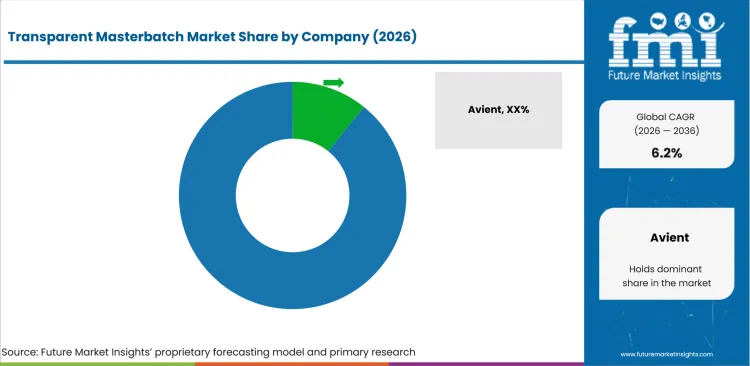
Competition in transparent masterbatch is fragmented across global color platforms, custom formulation houses and PET or film application specialists. Entry depends on repeatable optical performance at commercial line speed plus documentation for regulated plastic uses. Regional technical laboratories shorten qualification cycles and specialist formulators compete on resin matching and response time. Company scale alone does not determine access as packaging processors validate each formulation against resin compatibility and finished-part appearance.
- Avient, Ampacet and Tosaf combine broad masterbatch platforms with packaging-oriented color, additive and technical-service capability.
- Gabriel-Chemie, Americhem and Plastika Kritis compete through customized polymer matching plus regulated or appearance-critical application support.
- Sukano and Penn Color emphasize film and PET programs where optical consistency depends on application-specific formulation work.
Competitive Benchmarking: Transparent Masterbatch Market
| Company | Optical Formulation Breadth | Functional Packaging Integration | Application Qualification Support | Geographic Reach |
|---|---|---|---|---|
| Avient | High | High | High | Global |
| Ampacet | High | High | High | Global |
| Gabriel-Chemie | Medium | High | High | Europe, Middle East, Africa and Asia |
| Tosaf | High | High | High | Europe, Middle East, Asia and the Americas |
| Americhem | Medium | High | High | North America, Europe and Asia |
| Plastika Kritis | Medium | Medium | Medium | Europe, Asia and international sales |
| Sukano | Medium | High | High | Europe, North America and Asia |
| Penn Color | High | Medium | High | North America and Europe with international sales |
Key Developments in the Transparent Masterbatch Market
- In November 2025, Penn Color documented a PET food-packaging masterbatch reformulation that widened the operating window and reduced visible swirling across varied production lines.
- In October 2025, Gabriel-Chemie opened its expanded Nyíregyháza masterbatch site with production capacity planned to rise from ten extruder lines to as many as nineteen.
- In February 2025, Avient launched ColorMatrix Amosorb 4020L for PET packaging with bottle clarity and compatibility with recycled PET content up to 100%.
Key Players in the Transparent Masterbatch Market
Global Optical and Packaging Masterbatch Platforms
- Avient
- Ampacet
- Tosaf
Custom Color and Regulated Formulation Specialists
- Gabriel-Chemie
- Americhem
- Plastika Kritis
Film and PET Application Specialists
- Sukano
- Penn Color
Transparent Masterbatch Market - Report Scope
| Coverage field | Report scope |
|---|---|
| Market breakdown | By masterbatch type, carrier resin, application, function, sales channel and region. |
| Quantitative Units | Revenue in USD million and CAGR in %. |
| Market Definition | Commercial transparent or translucency-preserving masterbatch concentrates used to color or modify plastics without creating an opaque finished article, covering the listed masterbatch types, carriers, applications, functions and sales channels. |
| Regions Covered | North America, Latin America, Europe, East Asia, South Asia and Pacific and Middle East and Africa. |
| Countries Covered | Thailand, United States, Brazil, Germany, Japan, and 20+ countries included in the full report. |
| Key Companies Profiled | Avient, Ampacet, Gabriel-Chemie, Tosaf, Americhem, Plastika Kritis, Sukano and Penn Color. |
| Forecast Period | 2026 to 2036. |
| Approach | Primary and secondary research with market triangulation. |
Transparent Masterbatch Market - Research Methodology
| Method | Approach |
|---|---|
| Primary Research | FMI analysts gathered input from manufacturers, service providers, technology developers, distributors, end users, procurement teams, and subject-matter experts. Interviews examined purchasing decisions, product or service evaluation, adoption barriers, approval requirements, pricing considerations, and expectations for technical or commercial support. Respondents were also asked what evidence is required before a trial, pilot, or initial order develops into regular purchasing. |
| Desk Research | Desk research covered government statistics, regulatory publications, trade data, industry associations, technical literature, standards, company filings, product information, and official corporate announcements. Sources were reviewed for relevance, publication date, geographic coverage, and consistency with the defined market scope. Claims relating to performance, applications, approvals, capacity, investment, and commercial activity were retained only when supported by credible public evidence. |
| Market Sizing and Forecasting | The market model combined the baseline value with historical performance, segment structure, pricing and volume indicators, adoption levels, company participation, and country-level demand conditions. Forecast assumptions considered economic activity, investment trends, regulatory developments, technology adoption, purchasing cycles, supply availability, and barriers to wider market use. Segment and regional estimates were reconciled before the final market total was calculated. |
| Data Validation | Estimates were checked against multiple independent indicators, including public data, company activity, trade patterns, industry developments, and findings from primary interviews. Validation also tested whether products, services, applications, and company revenues fell within the defined market boundaries. Adjacent categories, unsupported claims, overlapping revenues, and activities without direct market relevance were excluded to reduce double counting and maintain consistency across segments and countries. |
Transparent Masterbatch Market by Segments
Transparent Masterbatch Market segmented by Masterbatch Type:
- Clarifying masterbatch
- Transparent color masterbatch
- Nucleating masterbatch
- Anti-haze masterbatch
- Functional transparent masterbatch
Transparent Masterbatch Market segmented by Carrier Resin:
- PP carrier
- PE carrier
- PET carrier
- PS / ABS carrier
- Universal carrier
Transparent Masterbatch Market segmented by Application:
- Rigid packaging
- Films & sheets
- Housewares
- Medical / labware
- Consumer goods
Transparent Masterbatch Market segmented by Function:
- Clarity improvement
- Coloring without opacity
- Haze reduction
- Gloss enhancement
- Processing improvement
Transparent Masterbatch Market segmented by Sales Channel:
- Plastic converters
- Direct OEM / brand approved
- Distributors
- Resin producer channel
Transparent Masterbatch Market by Region:
- North America
- United States
- Canada
- Latin America
- Brazil
- Mexico
- Chile
- Rest of Latin America
- Western Europe
- Germany
- United Kingdom
- Italy
- Spain
- France
- Nordics
- Benelux
- Rest of Western Europe
- Eastern Europe
- Russia
- Poland
- Hungary
- Balkan and Baltic States
- Rest of Eastern Europe
- East Asia
- China
- Japan
- South Korea
- South Asia and Pacific
- India
- ASEAN
- Australia and New Zealand
- Rest of South Asia and Pacific
- Middle East and Africa
- Kingdom of Saudi Arabia
- Other GCC Countries
- Türkiye
- South Africa
- Other African Union Countries
- Rest of Middle East and Africa
Research Sources and Bibliography
- Avient Corporation. (2025, July 10). Avient Introduces ColorMatrix™ Amosorb™ Oxyloop™: A New Oxygen Scavenging Additive to Enhance Recyclability.
- Office of Industrial Economics. (2026, July 27). Industrial production index June 2026.
- Ampacet Corporation. (2025, November 17). Ampacet Introduces HyperLustre Collection: Enhancing Packaging with Subtle Luminosity.
- Gabriel-Chemie Group. (2026, May 28). PFAS-FREE PPA.
- Sukano AG. (2025, October 2). Sukano Launches Breakthrough BOPLA Masterbatch Technology to Enable Barrier Properties for Compostable Plastic Packaging.
- Plastika Kritis S.A. (2025, April 28). Elevating Plastics Aesthetics with Masterbatch-Driven Color Trends: Spring/Summer 2025 Insights.
- Zentrale Stelle Verpackungsregister. (2025, August 29). 2025 minimum standard published - initial touchstone for companies preparing for the EU Packaging and Packaging Waste Regulation (PPWR).
- Consumer Affairs Agency. (2025).
- Tosaf. (2026, April 16). Tosaf Expands Its European Footprint with a New Masterbatch Facility in Poland.
- Royal Thai Government. (2026, April 6). PM reveals Govt’s approaches to address impact of Middle East crisis on Thailand and people.
- USA Food and Drug Administration. (2026, July 6). Submissions on Post-Consumer Recycled (PCR) Plastics for Food-Contact Articles.
- Presidência da República. (2025, October 21). DECRETO Nº 12.688, DE 21 DE OUTUBRO DE 2025.
- Umweltbundesamt. (2026, January 27). Facts against myths: Packaging waste recycling in Germany is working.
- Ministry of Economy, Trade and Industry. (2026, May 19).
- Americhem. (2026, January 13). Americhem to Spotlight New Materials Addressing PFAS, Traceability, and Performance Demands in Medical Devices at Pharmapack and MD&M West 2026.
- Penn Color. (2025, November 17). Elimination of Swirling in PET Food Packaging.
- Gabriel-Chemie Group. (2025, October 9). Opening of the expanded site in Hungary.
- Avient Corporation. (2025, February 14). Avient Unveils ColorMatrix™ Amosorb™ 4020L: New Shelf Life Extender Oxygen Scavenging Additive for PET Packaging.
This bibliography is provided for reader reference and is not exhaustive. The full report contains the complete reference list and detailed citations.
This Report Answers
- How large is the transparent masterbatch market in 2026 and what value is projected by 2036?
- Which optical and processing conditions support transparent masterbatch demand across packaging and molded applications?
- Why do transparent color masterbatch, PE carrier and films & sheets hold the specified 2026 shares?
- How do carrier compatibility and line trials affect transparent masterbatch qualification?
- Where do recyclability and food-contact rules create the strongest formulation friction?
- Why do growth conditions differ across Thailand, the United States, Brazil, Germany and Japan?
- How do the eight profiled companies differ in optical formulation, application support and geographic reach?
Frequently Asked Questions
How big is the Transparent Masterbatch Market in 2026?
The transparent masterbatch market is valued at USD 1.7 billion in 2026 and is projected to reach USD 3.1 billion by 2036. Growth is driven by rising demand for optical clarity, color enhancement, and performance additives in packaging and plastic processing applications.
What is the CAGR of the Transparent Masterbatch Market from 2026 to 2036?
The transparent masterbatch market is projected to grow at a CAGR of 6.2% between 2026 and 2036. Expansion is supported by increasing packaging reformulation activities and demand for transparent solutions compatible with recycled resin content.
Which masterbatch type leads the Transparent Masterbatch Market?
Transparent color masterbatch is projected to account for 28.0% of the market in 2026. Its leading share is driven by demand for transparent coloration and visual effects that maintain light transmission in clear plastic products.
How much value will the Transparent Masterbatch Market add between 2026 and 2036?
The transparent masterbatch market is expected to add USD 1386.4 million in value between 2026 and 2036. Growth reflects increasing adoption across packaging, films, and PET applications that require consistent optical performance.
Which companies are active in the Transparent Masterbatch Market?
Key companies operating in the market include Avient, Ampacet, Gabriel-Chemie, Tosaf, Americhem, Plastika Kritis, Sukano, and Penn Color. These companies compete through optical formulation expertise, application support, and specialized solutions for packaging and transparent plastic applications.
Preview the report firsthand - request a free sample
Get SampleGet the brochure for pricing and purchase details.
Get PDFTable of Content
- Key Takeaways
- Market Size and CAGR
- Top Growth Driver
- Fastest Growing Segment
- Leading Region
- Key Companies
- Emerging Opportunities
- Executive Summary
- Global Market Outlook
- Demand-side Trends
- Supply-side Trends
- Technology Roadmap Analysis
- Analysis and Recommendations
- Analyst Perspective (What is happening? Why now? What should investors know?)
- Key Questions Answered
- How large is the market?
- What is the CAGR?
- What are key trends?
- Which region dominates?
- Who are the leaders?
- Market Overview
- Market Coverage / Taxonomy
- Market Definition / Scope / Limitations
- Research Methodology
- Chapter Orientation
- Analytical Lens and Working Hypotheses
- Market Structure, Signals, and Trend Drivers
- Benchmarking and Cross-market Comparability
- Market Sizing, Forecasting, and Opportunity Mapping
- Research Design and Evidence Framework
- Desk Research Programme (Secondary Evidence)
- Expert Input and Fieldwork (Primary Evidence)
- Tooling, Models, and Reference Databases
- Data Engineering and Model Build
- Quality Assurance and Audit Trail
- Market Background
- Market Dynamics (Drivers, Restraints, Opportunity, Trends)
- Scenario Forecast (Optimistic, Likely, Conservative)
- Impact Analysis
- AI Impact
- Sustainability Impact
- Regulatory Impact
- Technology Impact
- Consumer / Buyer Analysis
- Purchase Drivers
- Adoption Barriers
- Buyer Journey
- Opportunity Map Analysis
- Product Life Cycle Analysis
- Supply Chain Analysis
- Investment Feasibility Matrix
- Value Chain Analysis
- PESTLE and Porter's Analysis
- Regulatory Landscape
- Regional Parent Market Outlook
- Production and Consumption Statistics
- Import and Export Statistics
- Global Market Analysis and Forecast, 2021 to 2036
- Historical Market Size Value (USD Million) Analysis, 2021 to 2025
- Current and Future Market Size Value (USD Million) Projections, 2026 to 2036
- Y-o-Y Growth Trend Analysis
- Absolute $ Opportunity Analysis
- Global Market Pricing Analysis, 2021 to 2036
- Global Market Analysis and Forecast, By Product Type, 2021 to 2036
- Introduction / Key Findings
- Historical Market Size Value (USD Million) Analysis By Product Type, 2021 to 2025
- Current and Future Market Size Value (USD Million) Analysis and Forecast By Product Type, 2026 to 2036
- Clarifying masterbatch
- Transparent color masterbatch
- Nucleating masterbatch
- Anti-haze masterbatch
- Functional transparent masterbatch
- Clarifying masterbatch
- Y-o-Y Growth Trend Analysis By Product Type, 2021 to 2025
- Absolute $ Opportunity Analysis By Product Type, 2026 to 2036
- Global Market Analysis and Forecast, By Carrier Resin, 2021 to 2036
- Introduction / Key Findings
- Historical Market Size Value (USD Million) Analysis By Carrier Resin, 2021 to 2025
- Current and Future Market Size Value (USD Million) Analysis and Forecast By Carrier Resin, 2026 to 2036
- PP carrier
- PE carrier
- PET carrier
- PS or ABS carrier
- Universal carrier
- PP carrier
- Y-o-Y Growth Trend Analysis By Carrier Resin, 2021 to 2025
- Absolute $ Opportunity Analysis By Carrier Resin, 2026 to 2036
- Global Market Analysis and Forecast, By Application, 2021 to 2036
- Introduction / Key Findings
- Historical Market Size Value (USD Million) Analysis By Application, 2021 to 2025
- Current and Future Market Size Value (USD Million) Analysis and Forecast By Application, 2026 to 2036
- Rigid packaging
- Films & sheets
- Housewares
- Medical or labware
- Consumer goods
- Rigid packaging
- Y-o-Y Growth Trend Analysis By Application, 2021 to 2025
- Absolute $ Opportunity Analysis By Application, 2026 to 2036
- Global Market Analysis and Forecast, By Function, 2021 to 2036
- Introduction / Key Findings
- Historical Market Size Value (USD Million) Analysis By Function, 2021 to 2025
- Current and Future Market Size Value (USD Million) Analysis and Forecast By Function, 2026 to 2036
- Clarity improvement
- Coloring without opacity
- Haze reduction
- Gloss enhancement
- Processing improvement
- Clarity improvement
- Y-o-Y Growth Trend Analysis By Function, 2021 to 2025
- Absolute $ Opportunity Analysis By Function, 2026 to 2036
- Global Market Analysis and Forecast, By Sales Channel, 2021 to 2036
- Introduction / Key Findings
- Historical Market Size Value (USD Million) Analysis By Sales Channel, 2021 to 2025
- Current and Future Market Size Value (USD Million) Analysis and Forecast By Sales Channel, 2026 to 2036
- Plastic converters
- Direct OEM or brand approved
- Distributors
- Resin producer channel
- Plastic converters
- Y-o-Y Growth Trend Analysis By Sales Channel, 2021 to 2025
- Absolute $ Opportunity Analysis By Sales Channel, 2026 to 2036
- Global Market Analysis and Forecast, By Region, 2021 to 2036
- Introduction
- Historical Market Size Value (USD Million) Analysis By Region, 2021 to 2025
- Current Market Size Value (USD Million) Analysis and Forecast By Region, 2026 to 2036
- North America
- Latin America
- Western Europe
- Eastern Europe
- East Asia
- South Asia and Pacific
- Middle East & Africa
- Market Attractiveness Analysis By Region
- North America Market Analysis and Forecast, By Country, 2021 to 2036
- Historical Market Size Value (USD Million) Trend Analysis By Market Taxonomy, 2021 to 2025
- Market Size Value (USD Million) Forecast By Market Taxonomy, 2026 to 2036
- By Country
- USA
- Canada
- By Product Type
- By Carrier Resin
- By Application
- By Function
- By Sales Channel
- By Country
- Market Attractiveness Analysis
- By Country
- By Product Type
- By Carrier Resin
- By Application
- By Function
- By Sales Channel
- Key Takeaways
- Latin America Market Analysis and Forecast, By Country
- Historical Market Size Value (USD Million) Trend Analysis By Market Taxonomy, 2021 to 2025
- Market Size Value (USD Million) Forecast By Market Taxonomy, 2026 to 2036
- By Country
- Brazil
- Mexico
- Chile
- Rest of Latin America
- By Product Type
- By Carrier Resin
- By Application
- By Function
- By Sales Channel
- By Country
- Market Attractiveness Analysis
- By Country
- By Product Type
- By Carrier Resin
- By Application
- By Function
- By Sales Channel
- Key Takeaways
- Western Europe Market Analysis and Forecast, By Country
- Historical Market Size Value (USD Million) Trend Analysis By Market Taxonomy, 2021 to 2025
- Market Size Value (USD Million) Forecast By Market Taxonomy, 2026 to 2036
- By Country
- Germany
- UK
- Italy
- Spain
- France
- Nordic
- BENELUX
- Rest of Western Europe
- By Product Type
- By Carrier Resin
- By Application
- By Function
- By Sales Channel
- By Country
- Market Attractiveness Analysis
- By Country
- By Product Type
- By Carrier Resin
- By Application
- By Function
- By Sales Channel
- Key Takeaways
- Eastern Europe Market Analysis and Forecast, By Country
- Historical Market Size Value (USD Million) Trend Analysis By Market Taxonomy, 2021 to 2025
- Market Size Value (USD Million) Forecast By Market Taxonomy, 2026 to 2036
- By Country
- Russia
- Poland
- Hungary
- Balkan & Baltic
- Rest of Eastern Europe
- By Product Type
- By Carrier Resin
- By Application
- By Function
- By Sales Channel
- By Country
- Market Attractiveness Analysis
- By Country
- By Product Type
- By Carrier Resin
- By Application
- By Function
- By Sales Channel
- Key Takeaways
- East Asia Market Analysis and Forecast, By Country
- Historical Market Size Value (USD Million) Trend Analysis By Market Taxonomy, 2021 to 2025
- Market Size Value (USD Million) Forecast By Market Taxonomy, 2026 to 2036
- By Country
- China
- Japan
- South Korea
- By Product Type
- By Carrier Resin
- By Application
- By Function
- By Sales Channel
- By Country
- Market Attractiveness Analysis
- By Country
- By Product Type
- By Carrier Resin
- By Application
- By Function
- By Sales Channel
- Key Takeaways
- South Asia and Pacific Market Analysis and Forecast, By Country
- Historical Market Size Value (USD Million) Trend Analysis By Market Taxonomy, 2021 to 2025
- Market Size Value (USD Million) Forecast By Market Taxonomy, 2026 to 2036
- By Country
- India
- ASEAN
- Australia & New Zealand
- Rest of South Asia and Pacific
- By Product Type
- By Carrier Resin
- By Application
- By Function
- By Sales Channel
- By Country
- Market Attractiveness Analysis
- By Country
- By Product Type
- By Carrier Resin
- By Application
- By Function
- By Sales Channel
- Key Takeaways
- Middle East & Africa Market Analysis and Forecast, By Country
- Historical Market Size Value (USD Million) Trend Analysis By Market Taxonomy, 2021 to 2025
- Market Size Value (USD Million) Forecast By Market Taxonomy, 2026 to 2036
- By Country
- Kingdom of Saudi Arabia
- Other GCC Countries
- Türkiye
- South Africa
- Other African Union
- Rest of Middle East & Africa
- By Product Type
- By Carrier Resin
- By Application
- By Function
- By Sales Channel
- By Country
- Market Attractiveness Analysis
- By Country
- By Product Type
- By Carrier Resin
- By Application
- By Function
- By Sales Channel
- Key Takeaways
- Key Countries Market Analysis
- USA
- Pricing Analysis
- Market Share Analysis, 2025
- By Product Type
- By Carrier Resin
- By Application
- By Function
- By Sales Channel
- Canada
- Pricing Analysis
- Market Share Analysis, 2025
- By Product Type
- By Carrier Resin
- By Application
- By Function
- By Sales Channel
- Mexico
- Pricing Analysis
- Market Share Analysis, 2025
- By Product Type
- By Carrier Resin
- By Application
- By Function
- By Sales Channel
- Brazil
- Pricing Analysis
- Market Share Analysis, 2025
- By Product Type
- By Carrier Resin
- By Application
- By Function
- By Sales Channel
- Chile
- Pricing Analysis
- Market Share Analysis, 2025
- By Product Type
- By Carrier Resin
- By Application
- By Function
- By Sales Channel
- Germany
- Pricing Analysis
- Market Share Analysis, 2025
- By Product Type
- By Carrier Resin
- By Application
- By Function
- By Sales Channel
- UK
- Pricing Analysis
- Market Share Analysis, 2025
- By Product Type
- By Carrier Resin
- By Application
- By Function
- By Sales Channel
- Italy
- Pricing Analysis
- Market Share Analysis, 2025
- By Product Type
- By Carrier Resin
- By Application
- By Function
- By Sales Channel
- Spain
- Pricing Analysis
- Market Share Analysis, 2025
- By Product Type
- By Carrier Resin
- By Application
- By Function
- By Sales Channel
- France
- Pricing Analysis
- Market Share Analysis, 2025
- By Product Type
- By Carrier Resin
- By Application
- By Function
- By Sales Channel
- India
- Pricing Analysis
- Market Share Analysis, 2025
- By Product Type
- By Carrier Resin
- By Application
- By Function
- By Sales Channel
- ASEAN
- Pricing Analysis
- Market Share Analysis, 2025
- By Product Type
- By Carrier Resin
- By Application
- By Function
- By Sales Channel
- Australia & New Zealand
- Pricing Analysis
- Market Share Analysis, 2025
- By Product Type
- By Carrier Resin
- By Application
- By Function
- By Sales Channel
- China
- Pricing Analysis
- Market Share Analysis, 2025
- By Product Type
- By Carrier Resin
- By Application
- By Function
- By Sales Channel
- Japan
- Pricing Analysis
- Market Share Analysis, 2025
- By Product Type
- By Carrier Resin
- By Application
- By Function
- By Sales Channel
- South Korea
- Pricing Analysis
- Market Share Analysis, 2025
- By Product Type
- By Carrier Resin
- By Application
- By Function
- By Sales Channel
- Russia
- Pricing Analysis
- Market Share Analysis, 2025
- By Product Type
- By Carrier Resin
- By Application
- By Function
- By Sales Channel
- Poland
- Pricing Analysis
- Market Share Analysis, 2025
- By Product Type
- By Carrier Resin
- By Application
- By Function
- By Sales Channel
- Hungary
- Pricing Analysis
- Market Share Analysis, 2025
- By Product Type
- By Carrier Resin
- By Application
- By Function
- By Sales Channel
- Kingdom of Saudi Arabia
- Pricing Analysis
- Market Share Analysis, 2025
- By Product Type
- By Carrier Resin
- By Application
- By Function
- By Sales Channel
- Türkiye
- Pricing Analysis
- Market Share Analysis, 2025
- By Product Type
- By Carrier Resin
- By Application
- By Function
- By Sales Channel
- South Africa
- Pricing Analysis
- Market Share Analysis, 2025
- By Product Type
- By Carrier Resin
- By Application
- By Function
- By Sales Channel
- USA
- Market Structure Analysis
- Competition Dashboard
- Competition Benchmarking
- Market Share Analysis of Top Players
- By Regional
- By Product Type
- By Carrier Resin
- By Application
- By Function
- By Sales Channel
- Emerging Startups
- Innovation Benchmarking
- Competition Analysis
- Competition Deep Dive
- Avient
- Overview
- Product Portfolio
- Profitability by Market Segments
- Sales Footprint
- Strategy Overview
- Marketing Strategy
- Product Strategy
- Channel Strategy
- Ampacet
- Gabriel-Chemie
- Tosaf
- Clariant
- Americhem
- Plastika Kritis
- JJ Plastalloy
- Alok Masterbatches
- Avient
- Case Studies
- Success Stories
- Recent Developments
- Competition Deep Dive
- Assumptions & Acronyms Used


