

- Market Size (2026)
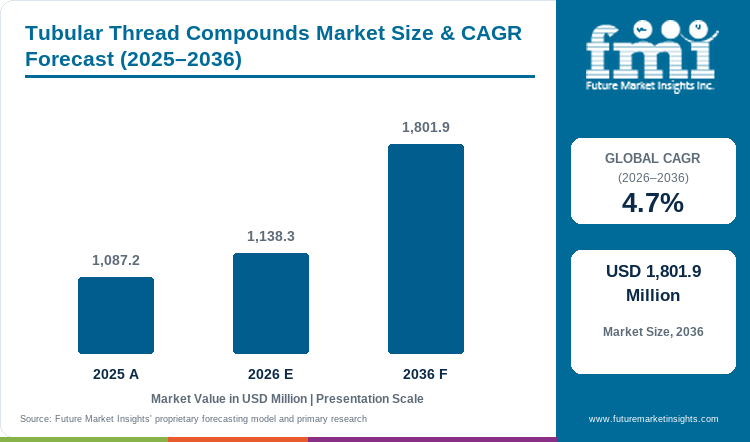
- USD 1138.3 Mn
- Forecast (2036)
- USD 1801.9 Mn
- CAGR (2026 to 2036)
- 4.7%
How big is Tubular Thread Compounds Market in 2026?
USD 1,138.3 million in 2026 and USD 1,801.9 million by 2036 at a 4.7% CAGR.
Demand in the tubular thread compounds market is anticipated to expand at a 4.7% CAGR over the forecast period, building from USD 1,087.2 million in 2025 to USD 1,138.3 million in 2026, before pushing valuation to USD 1,801.9 million by 2036. Connection makeup is keeping compound selection tied to torque control because friction factor determines final positioning during installation. Tenaris Revision 39 assigns different torque factors to named compounds for documented premium connection families.
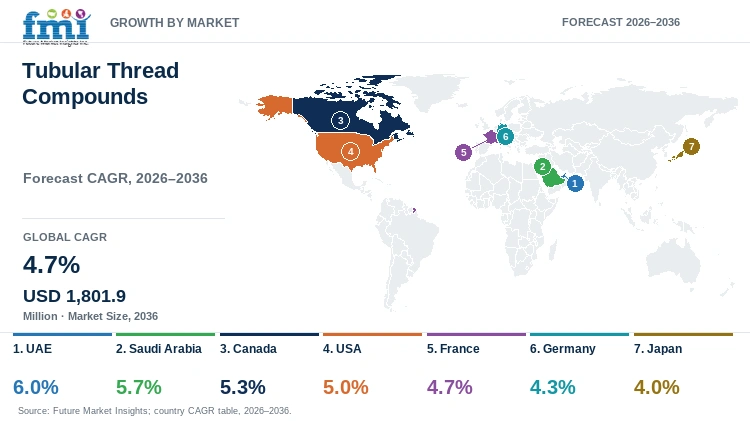
Country forecasts separate project-led expansion from efficiency-led replacement demand in mature tubular systems. UAE is projected to grow at 6.0% CAGR and Saudi Arabia at 5.7% CAGR. USA is expected to record 5.0% CAGR under a mature production model that places more value on connection reliability. The USA Energy Information Administration reported record 2025 crude production of 13.6 million barrels per day despite five percent fewer Lower 48 rigs. Higher output from fewer rigs is raising the cost of connection rework during casing and tubing installation. Gulf expansion programs are adding new-well volume because unconventional projects require repeated qualified tubular handling.
Key Takeaways
- Repeated casing and tubing makeup supports current demand by keeping friction control and anti-galling protection inside installation procedures.
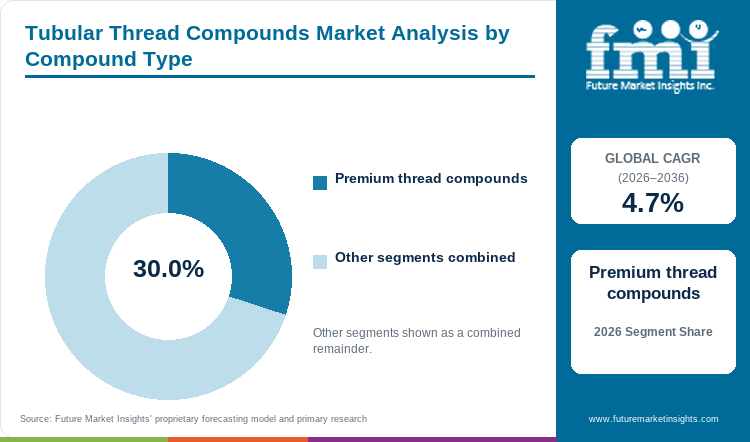
- Based on compound type, premium thread compounds are projected to account for 30.0% in 2026. Their position is supported by tighter torque windows that require documented compatibility.
- By application, casing connections are estimated to hold 31.0% in 2026. Their share is attributable to long strings that require repeated controlled makeup during well construction.
- In 2026, graphite-based formulations are expected to lead base material demand with 26.0% share. Their position is influenced by solid-lubricant performance under heavy contact pressure.
- Dope-free connection coatings restrain field-applied compound demand by replacing running and storage dope on selected premium strings.
- Some of the key players in this market include Jet-Lube, BESTOLIFE Premium Compounds, Topco Oilsite Products, FUCHS SE, Shell plc, TotalEnergies SE, Tenaris S.A., Vallourec S.A., Hunting PLC, and Nippon Steel Corporation.
Analyst Perspective
"Connection engineers are selecting thread compounds against torque-factor requirements because an error can invalidate an otherwise acceptable formulation. Suppliers are protecting repeat orders by pairing documented approval with field availability and clear handling guidance."
- Nikhil Kaitwade, Principal Consultant, Future Market Insights
How is the tubular thread compounds market segmented?
The tubular thread compounds market is segmented by compound type, application, base material, end use, sales channel and region.
The tubular thread compounds market is segmented by compound type, application, base material, end use, sales channel and region. Compound type includes premium, API modified, metal-free, copper-based and high-pressure sealing compounds for the defined market. Application analysis covers casing connections, tubing connections, drill pipe, premium connections and offshore tubulars as separate use cases. Base material categories include graphite-based, copper-based, zinc-based, PTFE - synthetic and metal-free blends used in qualified formulations. End use covers oil and gas drilling, workover operations, offshore wells, geothermal wells and storage wells. Sales channels comprise oilfield service companies, tubular distributors, direct operator contracts and MRO distributors.
How do narrow torque windows shape premium thread compound selection?
Premium connections allow less friction variation because thread geometry and sealing surfaces must reach a defined final position. Nippon Steel's January 2026 NSMAX list names approved makeup compounds for designated connection families. Rig crews are selecting compounds against documented connection approvals during pre-run preparation.
- In 2026, premium thread compounds are expected to lead the compound type category with 30.0% share. Connection-specific torque and sealing limits reinforce their position.
- Connection engineers are comparing torque factor and seal behavior during qualification of oil country tubular goods connections.
How do casing programs turn connection count into recurring application demand?
Casing strings place many threaded joints into one well-integrity system so friction drift can create rework at each makeup. Tenaris Revision 39 assigns connection-specific compound options and torque factors for documented premium connection families. Approved formulation records are reducing field substitution during scheduled casing-running operations.
- Casing connections are likely to capture 31.0% of application demand in 2026. Their position is driven by repeated controlled makeup on long tubular strings.
- Casing crews are aligning compound choice with well casing procedures during pre-run preparation for each tubular string.
How do graphite-based formulations support base material selection under heavy contact pressure?
Graphite provides solid lubrication under heavy contact pressure without requiring a single metallic formulation route. Jet-Lube explained in May 2025 that nonmetallic thread-compound solids can include graphite and PTFE for OCTG use. Formulators are validating friction factor because graphite content alone does not establish makeup torque.
- By base material, graphite-based formulations are forecast to represent 26.0% in 2026. Their position is reinforced by solid-lubricant performance under heavy contact pressure.
- Formulators are qualifying graphite-based specialty lubricants through connection tests that confirm the required torque response.
How does oil and gas drilling sustain repeat use of thread compounds?
Oil and gas drilling repeatedly exposes casing and tubing threads to makeup plus handling and occasional breakout. Hunting published a March 2026 connection matrix that identifies approved thread compounds for multiple premium connection families. The current matrix ties compound selection to each connection's approved formulation list instead of general wellsite grease availability.
- Oil and gas drilling is projected to hold 44.0% of end-use demand in 2026. Its position is attributable to repeated tubular handling during well construction.
- Rig crews are coordinating approved compounds with drilling tools and tubular-running equipment to maintain controlled torque during repeated connection work.
How do oilfield service channels control approved compound availability at the rig?
Field availability determines which approved formulation crews can apply during tubular running operations at the rig. Vallourec documented a February 2026 offshore CLEANWELL run that reduced preparation and handling steps with compound-free connections. Conventional strings that still specify dope require approved compounds beside tubular-running equipment during makeup.
- Oilfield service companies are set to lead the sales channel category with 35.0% share in 2026. Field execution influences their control over approved compound availability.
- Oilfield services are stocking approved compounds with running equipment and technical support used during tubular installation.
What are the drivers, restraints and opportunities in the Tubular Thread Compounds Market?
Connection-control requirements support recurring use while dope-free coatings reduce consumption and metal-free approved formulations protect a qualified growth route.
- Driver: Connection qualification keeps approved compounds inside casing and tubing running procedures for premium and API threaded connections.
- Restraint: Factory-applied dope-free connection systems can remove field-applied running and storage compound from selected tubular strings.
- Opportunity: Connection-approved metal-free formulations can gain repeat orders without sacrificing the torque response required by premium connections.
Connection Qualification Keeps Compounds Inside the Running Procedure
Hunting's March 2026 approved-compound matrix documents formulation restrictions for multiple premium connection families. Friction-factor changes can alter makeup torque and final shoulder position so drilling programs cannot switch formulations on price alone. Running procedures are retaining approved compounds as specified consumables because documented friction behavior controls final positioning. Premium casing and corrosion-resistant alloys require compatible oilfield chemicals during controlled running. Reliable stocking is protecting repeat orders by reducing the risk of an unqualified field substitute.
Dope-Free Connection Systems Remove a Defined Consumption Point
Tenaris reported in June 2025 that Dopeless technology expanded to weld-on connectors in Brazil and removed running plus storage dope. Eligible dry-coated strings remove one field-applied compound purchase from the tubular running procedure. Conventional connections still require approved dope under running instructions that specify field lubrication. Premium programs using factory-applied dry coatings face greater displacement of field-applied compounds. Conventional well construction continues to use drilling and completion fluids alongside tubular strings that still require field lubrication.
Metal-Free Approval Creates a Qualified Formulation Route
Tenaris Revision 39 lists several metal-free options for named premium connections with specified torque factors. The approval record places lower-metal chemistry inside premium tubular work under connection-specific test limits. Formulators are preserving seal behavior and torque response within each approved operating window. Offshore and corrosion-resistant strings impose stricter limits because unstable makeup can damage high-value connections. Documented metal-free products are addressing restricted-chemistry requirements while retaining controls needed for repeat purchasing.
Which country CAGRs are profiled in the Tubular Thread Compounds Market?
| Country | CAGR |
|---|---|
| UAE | 6.0% |
| Saudi Arabia | 5.7% |
| Canada | 5.3% |
| USA | 5.0% |
| France | 4.7% |
| Germany | 4.3% |
| Japan | 4.0% |
How do country-level CAGRs compare in the Tubular Thread Compounds Market?
The country CAGR range runs from UAE at 6.0% to Japan at 4.0% with Gulf programs forming the upper group. Canada and USA occupy the middle under mature production systems. France, Germany and Japan depend more on geothermal timing or replacement demand.
- UAE growth is tied to unconventional well programs that increase tubular-running activity and local service requirements.
- Saudi Arabia converts large gas programs into repeat casing demand under centralized technical approval requirements.
- Remote Canadian drilling makes nearby inventory more valuable because missed qualified deliveries carry higher operating costs.
- USA operators are emphasizing execution efficiency because leaner drilling fleets sustain high production from productive wells.
- French geothermal demand is supported by certified drilling contractors operating under formal national qualification requirements for shallow projects.
- Federal approval reform is accelerating German geothermal permitting but subsurface uncertainty still limits predictable drilling volumes.
- Japan's national geothermal support is advancing projects but early resource uncertainty still limits repeat order visibility.
Project timing and qualification routes create different stocking patterns despite similar country CAGRs. The full report provides country-level CAGR analysis across North America, Latin America, Western Europe, Eastern Europe, East Asia, South Asia and Pacific, and the Middle East and Africa.
Country-wise Analysis
- UAE drilling activity combines a large national rig base with faster well delivery in onshore programs. By 2036, UAE is projected to grow at 6.0% CAGR. The outlook is driven by repeated casing and tubing work from higher well throughput. ADNOC Drilling recorded 824 wells during 2025 on its official operating measures page. Running teams are stocking approved compounds and pairing them with completion tools for repeated tubular work.
- Saudi gas development places large casing and tubing programs under centralized technical specifications for qualified connections. Tubular thread compound demand in Saudi Arabia is forecast to rise at 5.7% CAGR over the forecast period. The outlook is attributable to Jafurah development and the planned expansion of sales-gas capacity. Saudi Press Agency reported in February 2026 that Jafurah production had started and sales-gas capacity is planned to rise about 80% by 2030 from 2021. Operators are coordinating compound approvals with casing pipe schedules so repeat field orders reach the rig with matching connection documentation.
- Western Canadian drilling concentrates demand in remote operating areas that penalize missed deliveries and cold-weather handling. Canada's tubular thread compounds outlook is anticipated to advance at 5.3% CAGR over the assessment period. The forecast is supported by record national production and sustained tubular work. The Canada Energy Regulator reported that 2025 crude oil and equivalent production averaged 5.35 million barrels per day. Remote programs rely on onshore drilling fluids and low-temperature tubular handling so suppliers are qualifying brushability and connection compatibility for the same operating window.
- USA drilling teams are prioritizing connection reliability because productivity improvements increase the value of each completed well. Adoption of tubular thread compounds in USA is estimated to expand at 5.0% CAGR through 2036. The outlook is influenced by high output from a leaner rig fleet. The USA Energy Information Administration reported 13.6 million barrels per day of crude production in 2025 despite five percent fewer Lower 48 rigs. Suppliers are maintaining verified torque factors and basin-level technical coverage because connection rework carries higher costs in a leaner drilling fleet.
- French geothermal drilling now requires documented contractor competence for specified shallow-geothermal work under national certification rules. Tubular thread compound sales in France are forecast to expand at 4.7% CAGR by 2036. The outlook is reinforced by geothermal and storage well activity under formal drilling requirements. France's ecological transition ministry states that CertiForage became mandatory on July 1 2025 for specified shallow-geothermal drilling services. Project volumes remain uneven so suppliers are targeting certified contractors with high-temperature formulations and application guidance.
- German geothermal development now operates under a federal law designed to simplify project approvals. Germany is estimated to post 4.3% CAGR over the forecast period. The outlook is shaped by faster geothermal permitting and a larger pipeline of qualified drilling work. Germany's Geothermal Energy Acceleration Act took effect on December 23 2025 and establishes a national framework for faster development. Suppliers are qualifying project-specific temperature performance in smaller lots because subsurface uncertainty still limits predictable drilling volumes.
- Japanese geothermal projects are progressing gradually because developers are assessing exploration risk ahead of repeated well programs. In Japan, tubular thread compound demand is predicted to advance at 4.0% CAGR through 2036. The outlook is aided by public geothermal support and gradual resource development. Japan's Agency for Natural Resources and Energy opened a national geothermal understanding-support grant round in June 2026 for communities near planned development sites. Suppliers are offering flexible batch sizes and documented high-temperature performance because project timing remains fragmented during exploratory drilling.
Who are the notable companies in the Tubular Thread Compounds Market?
Jet-Lube, BESTOLIFE Premium Compounds, Topco Oilsite Products, FUCHS SE, Shell plc, TotalEnergies SE, Tenaris S.A., Vallourec S.A., Hunting PLC, and Nippon Steel Corporation are the notable companies serving this market.
Competition centers on formulation approval and connection-specific field performance instead of commodity grease volume. Direct suppliers are competing with lubricant groups through formulation performance and documented field support. Connection manufacturers are controlling approved lists and dry-coated alternatives that determine which formulation reaches premium tubular operations. Entry requires documented friction behavior and reliable field supply for each connection family.
- Jet-Lube, BESTOLIFE Premium Compounds and Topco Oilsite Products are focusing on dedicated thread-compound formulations. FUCHS SE, Shell plc and TotalEnergies SE are serving the market through diversified lubricant portfolios.
- Tenaris S.A., Vallourec S.A. and Nippon Steel Corporation are shaping compound selection through connection approvals and mill-applied compound-free systems.
- Hunting PLC is setting a separate qualification point by publishing connection-specific compound approvals and detailed tubular running procedures.
Competitive Benchmarking: Tubular Thread Compounds Market
| Company | Approved Compound Coverage | Lower-Metal or Dope-Free Route | Field Connection Support | Geographic Reach |
|---|---|---|---|---|
| Jet-Lube | High | High | Medium | Global |
| BESTOLIFE Premium Compounds | High | High | Medium | Global |
| Topco Oilsite Products | High | High | Medium | North America and international |
| FUCHS SE | Medium | Medium | Medium | Global |
| Shell plc | Medium | Medium | Low | Global |
| TotalEnergies SE | Medium | High | Medium | Global |
| Tenaris S.A. | High | High | High | Global |
| Vallourec S.A. | High | High | High | Global |
| Hunting PLC | High | Medium | High | Global |
| Nippon Steel Corporation | High | High | High | Japan and international |
Scoring basis: High requires evidence across multiple named connection families or approved routes. Medium requires one narrower documented route and Low one limited qualified use. For field support, High requires published controls for multiple families. Medium covers one narrower route and Low covers product supply without documented field-procedure control.
Key Developments in the Tubular Thread Compounds Market
- In March 2026, Hunting PLC published an approved thread-compound matrix that matched named compounds with multiple Hunting premium connection families and material conditions.
- In January 2026, Nippon Steel Corporation issued its NSMAX compounds list with approved makeup compounds and recommended storage compounds for designated connection families.
- In June 2025, Tenaris S.A. reported a Brazil deployment of Dopeless weld-on connectors that removed running and storage dope from selected tubular strings.
Key Players in the Tubular Thread Compounds Market
Direct Thread Compound and Specialty Lubrication Suppliers
- Jet-Lube
- BESTOLIFE Premium Compounds
- Topco Oilsite Products
- FUCHS SE
- Shell plc
- TotalEnergies SE
Connection Qualification and Compound-Free System Providers
- Tenaris S.A.
- Vallourec S.A.
- Nippon Steel Corporation
Connection Technology and Field Procedure Provider
- Hunting PLC
Tubular Thread Compounds Market - Report Scope
| Coverage field | Report scope |
|---|---|
| Market breakdown | By compound type, application, base material, end use, sales channel and region. |
| Quantitative Units | USD million. |
| Market Definition | Revenue from formulated compounds sold for threaded casing, tubing, line pipe, drill-stem, premium-connection, offshore, geothermal, workover and storage-well applications. Dry factory-applied dope-free coatings and general-purpose lubricants are excluded. |
| Regions Covered | North America, Latin America, Western Europe, Eastern Europe, East Asia, South Asia and Pacific, and Middle East and Africa. |
| Countries Covered | UAE, Saudi Arabia, Canada, USA, France, Germany, Japan, and 30+ countries included in the full report. |
| Key Companies Profiled | Jet-Lube, BESTOLIFE Premium Compounds, Topco Oilsite Products, FUCHS SE, Shell plc, TotalEnergies SE, Tenaris S.A., Vallourec S.A., Hunting PLC, and Nippon Steel Corporation. |
| Forecast Period | 2026 to 2036. |
| Approach | Primary and secondary research with market triangulation. |
Tubular Thread Compounds Market - Research Methodology
| Method | Approach |
|---|---|
| Primary Research | FMI analysts gathered input from manufacturers, service providers, technology developers, distributors, end users, procurement teams, and subject-matter experts. Interviews examined purchasing decisions, product or service evaluation, adoption barriers, approval requirements, pricing considerations, and expectations for technical or commercial support. Respondents were also asked what evidence is required before a trial, pilot, or initial order develops into regular purchasing. |
| Desk Research | Desk research covered government statistics, regulatory publications, trade data, industry associations, technical literature, standards, company filings, product information, and official corporate announcements. Sources were reviewed for relevance, publication date, geographic coverage, and consistency with the defined market scope. Claims relating to performance, applications, approvals, capacity, investment, and commercial activity were retained only when supported by credible public evidence. |
| Market Sizing and Forecasting | The market model combined the baseline value with historical performance, segment structure, pricing and volume indicators, adoption levels, company participation, and country-level demand conditions. Forecast assumptions considered economic activity, investment trends, regulatory developments, technology adoption, purchasing cycles, supply availability, and barriers to wider market use. Segment and regional estimates were reconciled before the final market total was calculated. |
| Data Validation | Estimates were checked against multiple independent indicators, including public data, company activity, trade patterns, industry developments, and findings from primary interviews. Validation also tested whether products, services, applications, and company revenues fell within the defined market boundaries. Adjacent categories, unsupported claims, overlapping revenues, and activities without direct market relevance were excluded to reduce double counting and maintain consistency across segments and countries. |
Tubular Thread Compounds Market by Segments
Tubular Thread Compounds Market segmented by Compound Type:
- Premium thread compounds
- API modified compounds
- Metal-free compounds
- Copper-based compounds
- High-pressure sealing compounds
Tubular Thread Compounds Market segmented by Application:
- Casing connections
- Tubing connections
- Drill pipe
- Premium connections
- Offshore tubulars
Tubular Thread Compounds Market segmented by Base Material:
- Graphite-based
- Copper-based
- Zinc-based
- PTFE - synthetic
- Metal-free blends
Tubular Thread Compounds Market segmented by End Use:
- Oil and gas drilling
- Workover operations
- Offshore wells
- Geothermal wells
- Storage wells
Tubular Thread Compounds Market segmented by Sales Channel:
- Oilfield service companies
- Tubular distributors
- Direct operator contracts
- MRO distributors
Tubular Thread Compounds Market by Region:
- North America
- United States
- Canada
- Latin America
- Brazil
- Mexico
- Chile
- Rest of Latin America
- Western Europe
- Germany
- United Kingdom
- Italy
- Spain
- France
- Nordics
- Benelux
- Rest of Western Europe
- Eastern Europe
- Russia
- Poland
- Hungary
- Balkan and Baltic States
- Rest of Eastern Europe
- East Asia
- China
- Japan
- South Korea
- South Asia and Pacific
- India
- ASEAN
- Australia and New Zealand
- Rest of South Asia and Pacific
- Middle East and Africa
- Kingdom of Saudi Arabia
- Other GCC Countries
- Türkiye
- South Africa
- Other African Union Countries
- Rest of Middle East and Africa
Research Sources and Bibliography
- Tenaris. (2025, April 8). Premium Connections Approved Thread Compounds, Revision 39.
- Nippon Steel Corporation. (2026, January 1). TM Compounds List for NSMAX Connections.
- Jet-Lube. (2025, May 13). The Critical Role of Thread Compounds.
- Hunting PLC. (2026, March). Hunting-Approved Thread Compounds.
- Tenaris. (2025, June 16). Dopeless technology for weld-on connectors debuts in Brazil, completing Tenaris's dope-free offering for the entire well.
- USA Energy Information Administration. (2026, March 31). USA crude oil production rose in 2025, setting new record.
- ADNOC Drilling. (2026). Integrated Report 2025 and non-financial operating measures.
- Saudi Press Agency. (2026, February 26). Aramco's Gas Strategy Builds Momentum with Major Progress Towards Growth Target.
- Canada Energy Regulator. (2026, June 17). Market Snapshot: Canada sets new record in crude oil production in 2025.
- Ministères Transition écologique, Aménagement du Territoire, Transports, Ville et Logement. (2025, May 23; updated 2026, April 27). Géothermie de minime importance : les organismes de certification accrédités.
- Federal Ministry of Justice. (2025, December 22). Geothermie-Beschleunigungsgesetz (GeoBG).
- Agency for Natural Resources and Energy, Japan. (2026, June 5). 令和8年度第2回「地熱発電理解促進事業費補助金」に係る補助事業者の公募について.
- Vallourec. (2025, November 4). Vallourec Secures Multi-Year OCTG Supply Contract with Major North Sea Operator.
- Vallourec. (2026, February 18). Running in the Gulf of America: Setting a New Standard for Offshore Efficiency.
- Topco Oilsite Products. (n.d.). Thread compounds: pipe dope, casing, tubing. Retrieved September 16, 2026.
- BESTOLIFE Corporation. (n.d.). BESTOLIFE Metal Free. Retrieved September 16, 2026.
- FUCHS. (n.d.). RENOLIT CX-TC 1. Retrieved September 16, 2026.
- TotalEnergies Lubricants. (n.d.). TIFORA PG. Retrieved September 16, 2026.
- Jet-Lube. (n.d.). OCTG Compounds. Retrieved September 16, 2026.
- Tenaris. (2026, March 26). Tenaris acquires the oilfield division of AllTorque, a leader in tubular running technology.
- Nippon Steel Corporation. (2026, June 1). NSMAX Compounds List - Download Area update.
- Vallourec. (2025, September 24). Petrobras selects Vallourec for major USD 1 billion offshore OCTG contract.
- Hunting PLC. (2026). Semi-Premium Connection Running Procedure.
This bibliography is provided for reader reference and is not exhaustive. The full report contains the complete reference list and detailed citations.
This Report Answers
- How large is the tubular thread compounds market in 2026 and 2036?
- Which connection requirements sustain repeat tubular thread compound demand?
- Why do premium thread compounds lead compound type demand?
- Why do casing connections lead application demand?
- Why do graphite-based formulations lead base material demand?
- How do growth rates differ among the seven profiled countries?
- Which companies supply compounds or control connection qualification?
- How do dope-free systems displace field-applied compound demand?
Frequently Asked Questions
How big is the Tubular Thread Compounds Market in 2026?
The tubular thread compounds market is estimated at USD 1,138.3 million in 2026 and USD 1,801.9 million by 2036. Connection qualification sustains approved-compound demand during routine tubular installation.
What is the CAGR of the Tubular Thread Compounds Market from 2026 to 2036?
The tubular thread compounds market is projected to grow at 4.7% CAGR between 2026 and 2036. Repeated casing and tubing makeup keeps friction control inside specified procedures.
Which compound type leads the Tubular Thread Compounds Market?
Premium thread compounds are projected to account for 30.0% of compound type demand in 2026. Tight torque and sealing windows require documented compatibility during routine use.
Which application leads the Tubular Thread Compounds Market?
Casing connections are estimated to hold 31.0% of application demand in 2026. Long casing strings require controlled friction and galling protection during repeated makeup.
Which countries are projected to record the highest growth in this market?
By 2036, UAE is projected to grow at 6.0% CAGR. Saudi Arabia is expected to record 5.7% and Canada 5.3% under different upstream operating conditions.
Which companies are active in the Tubular Thread Compounds Market?
Active companies include Jet-Lube, BESTOLIFE Premium Compounds, Topco Oilsite Products, FUCHS SE, Shell plc, TotalEnergies SE, Tenaris S.A., Vallourec S.A., Hunting PLC, and Nippon Steel Corporation. Their roles span formulation supply, qualification and compound-free premium systems.
Preview the report firsthand - request a free sample
Get SampleGet the brochure for pricing and purchase details.
Get PDFTable of Content
- Key Takeaways
- Market Size and CAGR
- Top Growth Driver
- Fastest Growing Segment
- Leading Region
- Key Companies
- Emerging Opportunities
- Executive Summary
- Global Market Outlook
- Demand-side Trends
- Supply-side Trends
- Technology Roadmap Analysis
- Analysis and Recommendations
- Analyst Perspective (What is happening? Why now? What should investors know?)
- Key Questions Answered
- How large is the market?
- What is the CAGR?
- What are key trends?
- Which region dominates?
- Who are the leaders?
- Market Overview
- Market Coverage / Taxonomy
- Market Definition / Scope / Limitations
- Research Methodology
- Chapter Orientation
- Analytical Lens and Working Hypotheses
- Market Structure, Signals, and Trend Drivers
- Benchmarking and Cross-market Comparability
- Market Sizing, Forecasting, and Opportunity Mapping
- Research Design and Evidence Framework
- Desk Research Programme (Secondary Evidence)
- Expert Input and Fieldwork (Primary Evidence)
- Tooling, Models, and Reference Databases
- Data Engineering and Model Build
- Quality Assurance and Audit Trail
- Market Background
- Market Dynamics (Drivers, Restraints, Opportunity, Trends)
- Scenario Forecast (Optimistic, Likely, Conservative)
- Impact Analysis
- AI Impact
- Sustainability Impact
- Regulatory Impact
- Technology Impact
- Consumer / Buyer Analysis
- Purchase Drivers
- Adoption Barriers
- Buyer Journey
- Opportunity Map Analysis
- Product Life Cycle Analysis
- Supply Chain Analysis
- Investment Feasibility Matrix
- Value Chain Analysis
- PESTLE and Porter's Analysis
- Regulatory Landscape
- Regional Parent Market Outlook
- Production and Consumption Statistics
- Import and Export Statistics
- Global Market Analysis and Forecast, 2021 to 2036
- Historical Market Size Value (USD Million) Analysis, 2021 to 2025
- Current and Future Market Size Value (USD Million) Projections, 2026 to 2036
- Y-o-Y Growth Trend Analysis
- Absolute $ Opportunity Analysis
- Global Market Pricing Analysis, 2021 to 2036
- Global Market Analysis and Forecast, By Compound Type, 2021 to 2036
- Introduction / Key Findings
- Historical Market Size Value (USD Million) Analysis By Compound Type, 2021 to 2025
- Current and Future Market Size Value (USD Million) Analysis and Forecast By Compound Type, 2026 to 2036
- Premium thread compounds
- API modified compounds
- Metal-free compounds
- Copper-based compounds
- High-pressure sealing compounds
- Y-o-Y Growth Trend Analysis By Compound Type, 2021 to 2025
- Absolute $ Opportunity Analysis By Compound Type, 2026 to 2036
- Global Market Analysis and Forecast, By Application, 2021 to 2036
- Introduction / Key Findings
- Historical Market Size Value (USD Million) Analysis By Application, 2021 to 2025
- Current and Future Market Size Value (USD Million) Analysis and Forecast By Application, 2026 to 2036
- Casing connections
- Tubing connections
- Drill pipe
- Premium connections
- Offshore tubulars
- Y-o-Y Growth Trend Analysis By Application, 2021 to 2025
- Absolute $ Opportunity Analysis By Application, 2026 to 2036
- Global Market Analysis and Forecast, By Base Material, 2021 to 2036
- Introduction / Key Findings
- Historical Market Size Value (USD Million) Analysis By Base Material, 2021 to 2025
- Current and Future Market Size Value (USD Million) Analysis and Forecast By Base Material, 2026 to 2036
- Graphite-based
- Copper-based
- Zinc-based
- PTFE - synthetic
- Metal-free blends
- Y-o-Y Growth Trend Analysis By Base Material, 2021 to 2025
- Absolute $ Opportunity Analysis By Base Material, 2026 to 2036
- Global Market Analysis and Forecast, By End Use, 2021 to 2036
- Introduction / Key Findings
- Historical Market Size Value (USD Million) Analysis By End Use, 2021 to 2025
- Current and Future Market Size Value (USD Million) Analysis and Forecast By End Use, 2026 to 2036
- Oil and gas drilling
- Workover operations
- Offshore wells
- Geothermal wells
- Storage wells
- Y-o-Y Growth Trend Analysis By End Use, 2021 to 2025
- Absolute $ Opportunity Analysis By End Use, 2026 to 2036
- Global Market Analysis and Forecast, By Sales Channel, 2021 to 2036
- Introduction / Key Findings
- Historical Market Size Value (USD Million) Analysis By Sales Channel, 2021 to 2025
- Current and Future Market Size Value (USD Million) Analysis and Forecast By Sales Channel, 2026 to 2036
- Oilfield service companies
- Tubular distributors
- Direct operator contracts
- MRO distributors
- Y-o-Y Growth Trend Analysis By Sales Channel, 2021 to 2025
- Absolute $ Opportunity Analysis By Sales Channel, 2026 to 2036
- Global Market Analysis and Forecast, By Region, 2021 to 2036
- Introduction
- Historical Market Size Value (USD Million) Analysis By Region, 2021 to 2025
- Current Market Size Value (USD Million) Analysis and Forecast By Region, 2026 to 2036
- North America
- Latin America
- Western Europe
- Eastern Europe
- East Asia
- South Asia and Pacific
- Middle East and Africa
- Market Attractiveness Analysis By Region
- North America Market Analysis and Forecast, By Country, 2021 to 2036
- Historical Market Size Value (USD Million) Trend Analysis By Market Taxonomy, 2021 to 2025
- Market Size Value (USD Million) Forecast By Market Taxonomy, 2026 to 2036
- By Country
- United States
- Canada
- By Compound Type
- By Application
- By Base Material
- By End Use
- By Sales Channel
- By Country
- Market Attractiveness Analysis
- By Country
- By Compound Type
- By Application
- By Base Material
- By End Use
- By Sales Channel
- Key Takeaways
- Latin America Market Analysis and Forecast, By Country
- Historical Market Size Value (USD Million) Trend Analysis By Market Taxonomy, 2021 to 2025
- Market Size Value (USD Million) Forecast By Market Taxonomy, 2026 to 2036
- By Country
- Brazil
- Mexico
- Chile
- Rest of Latin America
- By Compound Type
- By Application
- By Base Material
- By End Use
- By Sales Channel
- By Country
- Market Attractiveness Analysis
- By Country
- By Compound Type
- By Application
- By Base Material
- By End Use
- By Sales Channel
- Key Takeaways
- Western Europe Market Analysis and Forecast, By Country
- Historical Market Size Value (USD Million) Trend Analysis By Market Taxonomy, 2021 to 2025
- Market Size Value (USD Million) Forecast By Market Taxonomy, 2026 to 2036
- By Country
- Germany
- United Kingdom
- Italy
- Spain
- France
- Nordics
- Benelux
- Rest of Western Europe
- By Compound Type
- By Application
- By Base Material
- By End Use
- By Sales Channel
- By Country
- Market Attractiveness Analysis
- By Country
- By Compound Type
- By Application
- By Base Material
- By End Use
- By Sales Channel
- Key Takeaways
- Eastern Europe Market Analysis and Forecast, By Country
- Historical Market Size Value (USD Million) Trend Analysis By Market Taxonomy, 2021 to 2025
- Market Size Value (USD Million) Forecast By Market Taxonomy, 2026 to 2036
- By Country
- Russia
- Poland
- Hungary
- Balkan and Baltic States
- Rest of Eastern Europe
- By Compound Type
- By Application
- By Base Material
- By End Use
- By Sales Channel
- By Country
- Market Attractiveness Analysis
- By Country
- By Compound Type
- By Application
- By Base Material
- By End Use
- By Sales Channel
- Key Takeaways
- East Asia Market Analysis and Forecast, By Country
- Historical Market Size Value (USD Million) Trend Analysis By Market Taxonomy, 2021 to 2025
- Market Size Value (USD Million) Forecast By Market Taxonomy, 2026 to 2036
- By Country
- China
- Japan
- South Korea
- By Compound Type
- By Application
- By Base Material
- By End Use
- By Sales Channel
- By Country
- Market Attractiveness Analysis
- By Country
- By Compound Type
- By Application
- By Base Material
- By End Use
- By Sales Channel
- Key Takeaways
- South Asia and Pacific Market Analysis and Forecast, By Country
- Historical Market Size Value (USD Million) Trend Analysis By Market Taxonomy, 2021 to 2025
- Market Size Value (USD Million) Forecast By Market Taxonomy, 2026 to 2036
- By Country
- India
- ASEAN
- Australia and New Zealand
- Rest of South Asia and Pacific
- By Compound Type
- By Application
- By Base Material
- By End Use
- By Sales Channel
- By Country
- Market Attractiveness Analysis
- By Country
- By Compound Type
- By Application
- By Base Material
- By End Use
- By Sales Channel
- Key Takeaways
- Middle East and Africa Market Analysis and Forecast, By Country
- Historical Market Size Value (USD Million) Trend Analysis By Market Taxonomy, 2021 to 2025
- Market Size Value (USD Million) Forecast By Market Taxonomy, 2026 to 2036
- By Country
- Kingdom of Saudi Arabia
- Other GCC Countries
- Türkiye
- South Africa
- Other African Union Countries
- Rest of Middle East and Africa
- By Compound Type
- By Application
- By Base Material
- By End Use
- By Sales Channel
- By Country
- Market Attractiveness Analysis
- By Country
- By Compound Type
- By Application
- By Base Material
- By End Use
- By Sales Channel
- Key Takeaways
- Key Countries Market Analysis
- United States
- Pricing Analysis
- Market Share Analysis, 2025
- By Compound Type
- By Application
- By Base Material
- By End Use
- By Sales Channel
- Canada
- Pricing Analysis
- Market Share Analysis, 2025
- By Compound Type
- By Application
- By Base Material
- By End Use
- By Sales Channel
- Mexico
- Pricing Analysis
- Market Share Analysis, 2025
- By Compound Type
- By Application
- By Base Material
- By End Use
- By Sales Channel
- Brazil
- Pricing Analysis
- Market Share Analysis, 2025
- By Compound Type
- By Application
- By Base Material
- By End Use
- By Sales Channel
- Chile
- Pricing Analysis
- Market Share Analysis, 2025
- By Compound Type
- By Application
- By Base Material
- By End Use
- By Sales Channel
- Germany
- Pricing Analysis
- Market Share Analysis, 2025
- By Compound Type
- By Application
- By Base Material
- By End Use
- By Sales Channel
- United Kingdom
- Pricing Analysis
- Market Share Analysis, 2025
- By Compound Type
- By Application
- By Base Material
- By End Use
- By Sales Channel
- Italy
- Pricing Analysis
- Market Share Analysis, 2025
- By Compound Type
- By Application
- By Base Material
- By End Use
- By Sales Channel
- Spain
- Pricing Analysis
- Market Share Analysis, 2025
- By Compound Type
- By Application
- By Base Material
- By End Use
- By Sales Channel
- France
- Pricing Analysis
- Market Share Analysis, 2025
- By Compound Type
- By Application
- By Base Material
- By End Use
- By Sales Channel
- India
- Pricing Analysis
- Market Share Analysis, 2025
- By Compound Type
- By Application
- By Base Material
- By End Use
- By Sales Channel
- ASEAN
- Pricing Analysis
- Market Share Analysis, 2025
- By Compound Type
- By Application
- By Base Material
- By End Use
- By Sales Channel
- Australia and New Zealand
- Pricing Analysis
- Market Share Analysis, 2025
- By Compound Type
- By Application
- By Base Material
- By End Use
- By Sales Channel
- China
- Pricing Analysis
- Market Share Analysis, 2025
- By Compound Type
- By Application
- By Base Material
- By End Use
- By Sales Channel
- Japan
- Pricing Analysis
- Market Share Analysis, 2025
- By Compound Type
- By Application
- By Base Material
- By End Use
- By Sales Channel
- South Korea
- Pricing Analysis
- Market Share Analysis, 2025
- By Compound Type
- By Application
- By Base Material
- By End Use
- By Sales Channel
- Russia
- Pricing Analysis
- Market Share Analysis, 2025
- By Compound Type
- By Application
- By Base Material
- By End Use
- By Sales Channel
- Poland
- Pricing Analysis
- Market Share Analysis, 2025
- By Compound Type
- By Application
- By Base Material
- By End Use
- By Sales Channel
- Hungary
- Pricing Analysis
- Market Share Analysis, 2025
- By Compound Type
- By Application
- By Base Material
- By End Use
- By Sales Channel
- Kingdom of Saudi Arabia
- Pricing Analysis
- Market Share Analysis, 2025
- By Compound Type
- By Application
- By Base Material
- By End Use
- By Sales Channel
- Türkiye
- Pricing Analysis
- Market Share Analysis, 2025
- By Compound Type
- By Application
- By Base Material
- By End Use
- By Sales Channel
- South Africa
- Pricing Analysis
- Market Share Analysis, 2025
- By Compound Type
- By Application
- By Base Material
- By End Use
- By Sales Channel
- UAE
- Pricing Analysis
- Market Share Analysis, 2025
- By Compound Type
- By Application
- By Base Material
- By End Use
- By Sales Channel
- United States
- Market Structure Analysis
- Competition Dashboard
- Competition Benchmarking
- Market Share Analysis of Top Players
- By Regional
- By Compound Type
- By Application
- By Base Material
- By End Use
- By Sales Channel
- Emerging Startups
- Innovation Benchmarking
- Competition Analysis
- Competition Deep Dive
- Jet-Lube
- Overview
- Product Portfolio
- Profitability by Market Segments
- Sales Footprint
- Strategy Overview
- Marketing Strategy
- Product Strategy
- Channel Strategy
- BESTOLIFE Premium Compounds
- Topco Oilsite Products
- FUCHS SE
- Shell plc
- TotalEnergies SE
- Tenaris S.A.
- Vallourec S.A.
- Hunting PLC
- Nippon Steel Corporation
- Jet-Lube
- Case Studies
- Success Stories
- Recent Developments
- Competition Deep Dive
- Assumptions & Acronyms Used


