

- Market Size (2026)
- USD 1.02 Mn
- Forecast (2036)
- USD 1.63 Mn
- CAGR (2026 to 2036)
- 4.8%
Tuna Peptides Market Size, Market Forecast and Outlook By FMI
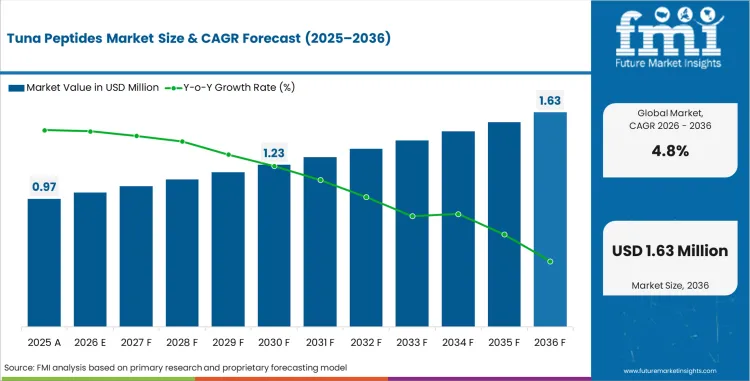
The tuna peptides market was valued at USD 1.0 million in 2025. The market is set to reach USD 1.0 million by 2026-end and grow at a CAGR of 4.8% between 2026-2036 to reach USD 1.6 million by 2036. Powder will dominate with a 60.0% share, while Nutraceuticals will lead with a 50.0% share.
Summary of the Tuna Peptides Market
- Demand and Growth Drivers
- Growing consumer interest in marine-derived bioactive peptides for anti-aging, joint health, and skin health applications is expanding the nutraceutical use case beyond traditional collagen supplements.
- Tuna processing by-product valorization is increasing raw material availability as seafood processors invest in peptide extraction technology to generate higher-value ingredients from waste streams.
- Functional food and beverage manufacturers are incorporating tuna peptides into protein drinks, fortified snacks, and health-oriented product formulations, broadening the application base beyond pure supplements.
- Product and Segment View
- Powder is expected to continue leading the product segment with 60% share owing to the existing demand and procurement patterns.
- The application segment of nutraceuticals is expected to hold 50% owing to buyer preference & usage pattern.
- Adults is projected to lead the end use segment with 55% share during the forecast period.
- Geography and Competitive Outlook
- China is likely to remain a key market at 6.48% CAGR, supported by strong demand fundamentals and expanding adoption.
- India is likely to sustain growth at 6% CAGR owing to rising spending and expanding distribution infrastructure.
- Companies with broad product portfolios and multi-channel distribution capabilities are likely to gain traction during the forecast period.
- Analyst Opinion
- The tuna peptides market is evolving from a fragmented space into a more defined commercial category with clear segment leaders and established distribution patterns.
- Adoption is increasing due to rising consumer awareness, expanding retail infrastructure, and growing influence of specialized distribution channels on purchase behavior.
- Demand is further supported by premiumization trends, where buyers are trading up to higher-quality products with functional and performance differentiation.
- Companies that can improve cost competitiveness while delivering consistent quality across key segments are likely to strengthen their position over the forecast period.
Key Takeaways, Market Size, and Forecast
- The tuna peptides market was valued at USD 0.97 million in 2025.
- By 2036, the Tuna Peptides Market is expected to be worth USD 1.63 million.
- From 2026 to 2036, the market is projected to expand at a CAGR of 4.8%.
- The market is projected to create an incremental opportunity of USD 0.61 million between 2026 and 2036.
- The demand for shelf-stable and versatile peptide formats in nutraceutical manufacturing and supplement formulation is expected to drive the powder segment to account for 60% of the product segment in 2026.
- China (6.48%) and India (6%) are two of the fastest growing markets in the world.
Tuna Peptides Market Definition
The tuna peptides market encompasses commercially traded bioactive peptides derived from tuna processing by-products including skin, bone, and muscle tissue. Product categories include powder, liquid, and capsule and tablet formats used across nutraceutical, food and beverage, cosmetics, and animal nutrition applications.
Tuna Peptides Market Inclusions
Market scope covers all commercially traded tuna peptide products categorized by product (powder, liquid, capsules and tablets), application (nutraceuticals, food and beverage, cosmetics and personal care, animal nutrition), end use (adults, geriatric population, sports nutrition consumers), distribution channel (online retail, offline retail), formulation (hydrolyzed peptides, blended formulations), source (tuna skin derived, tuna bone derived, tuna muscle derived), and pricing tier (mid range, economy, premium). The revenue range spans from 2026 to 2036.
Tuna Peptides Market Exclusions
The scope does not include whole tuna products for direct consumption, tuna oil supplements without peptide content, or synthetic collagen peptides not derived from marine sources.
Tuna Peptides Market Research Methodology
- Primary Research: FMI analysts conducted interviews with marine ingredient manufacturers, nutraceutical formulators, cosmetics ingredient buyers, and functional food producers in the key markets.
- Desk Research: Combined data from marine ingredient industry associations, nutraceutical market databases and manufacturer production reports.
- Market sizing and forecasting: Bottom-up aggregation across application categories and end-user segments, with regional supply curves adjusted for volumes of tuna processing and peptide extraction capacity.
- Data validation: Compared quarterly with marine ingredient production data and trade statistics.
Why is the Tuna Peptides Market Growing?
- Increasing consumer preference for marine-derived bioactive peptides for anti-aging, joint health.
- Seafood processors are investing in peptide extraction technology to create higher-value ingredients from waste streams, increasing the availability of raw material through the valorization of tuna processing by-products.
- Tuna peptides are being added by protein drinks, fortified snacks, functional food and beverage manufacturers.
Tuna peptides market is growing as demand for marine bioactive ingredients rises and tuna processors invest in by-product valorization. The leading 60.0% share of the product segment was held by powder formats. Pure peptide powder and blended powder are used for applications in nutraceutical and food manufacturing. The formulation segment is majorly dominated by hydrolyzed peptides which constitute 70.0% of the formulation segment as enzymatic hydrolysis results in bioavailable peptides suitable for use in dietary supplement and functional food applications.
Nutraceutical applications account for 50.0% of demand, and most of the supply is used in dietary supplements and functional nutrition products. End-user Demand by Age Adults represent 55.0% of end-user demand, with health-conscious and beauty-focused consumers being the key buyer segments. Online retail accounts for 55.0% of distribution, with e-commerce platforms and subscription services as the main channels for consumer-facing tuna peptide products.
Market Segmentation Analysis
- Product segment is dominated by powder with 60% which is a reflection of established demand patterns and buyer preferences.
- Supported by channel availability, Adults dominates the end use segment with 55% share.
The tuna peptides market is categorized by Product, Application, End Use, Distribution Channel, Formulation, Source and Pricing Tier. Each segment represents different buyer behaviour, pricing behaviour and distribution behaviour in the value chain.
Insights into the Powder Product Segment
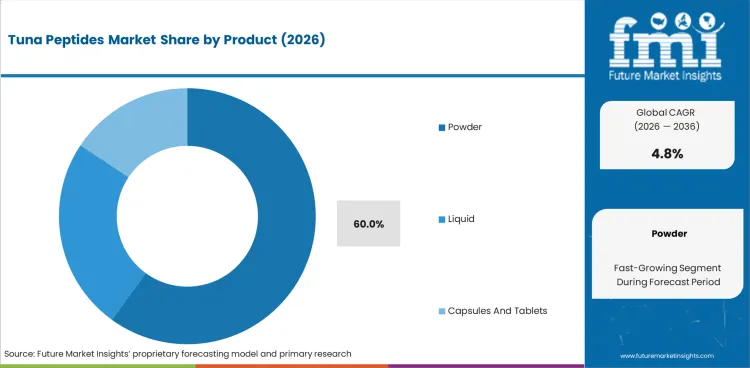
Powder formats are expected to represent 60.0% of the product segment in 2026. Format of pure peptide powder and hydrolyzed tuna peptide provide ingredient inputs to nutraceutical manufacturers. Blended powder including collagen peptide blends and protein enriched blends target consumer supplement markets. Powder form has the advantages of longer shelf life, accurate dosing and the ability to be formulated into capsules, drinks and food products.
Insights into the Nutraceuticals Application Segment
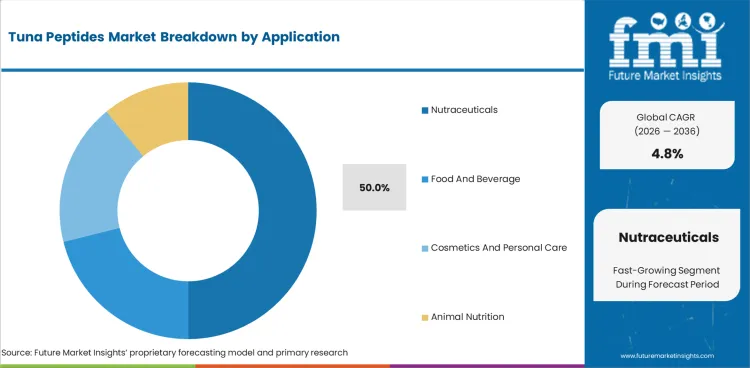
The application segment is divided into Nutraceuticals 50.0%. The biggest product categories are dietary supplements for anti-aging, joint health and skin health. The use cases of functional nutrition products such as daily health supplements and immune support formulations are on the rise. The consumer willingness to pay for bioavailability claims of marine derived peptides supports a higher ingredient price than plant based alternatives.
Tuna Peptides Market Drivers, Restraints, and Opportunities
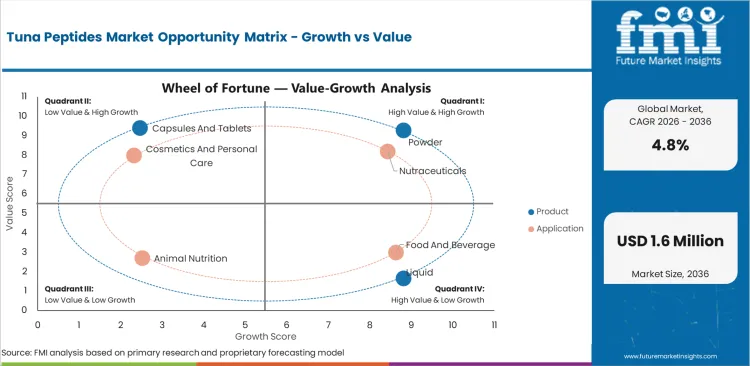
- Marine Collagen and Bioactive is developing structured demand in key end-user segments.
- Limited Scale and High is hampering the adoption velocity in price sensitive segments.
A mix of demand-side drivers and supply-side constraints are shaping the tuna peptides market, with differences across regions, segments and price points.
Marine Collagen and Bioactive Peptide Demand
Consumer interest in marine-derived bioactive ingredients for skin health, joint support and anti-aging applications drives demand. The bioavailability benefits of tuna peptides over bovine and plant derived alternatives bode well for premium positioning of tuna peptides in the nutraceutical ingredient market.
Tuna By-Product Valorization and Supply Expansion
The growth is driven by tuna processors investing in enzymatic extraction technology that can convert skin, bone and muscle by-products into high-value peptide ingredients. This development on the supply side is making raw materials more available and decreasing ingredient costs.
Limited Scale and High Extraction Costs
The uptake is hindered by the fact that the volume of tuna peptides produced is much smaller than that of bovine- and plant-derived collagens. The cost of enzymatic extraction is still high and it’s hard to compete on price in the commodity supplement segments.
Cosmetics and Personal Care Integration
Growth is being driven by cosmetics manufacturers adding tuna-derived peptides to anti-aging creams, moisturizers and hair care products. The marine-origin positioning resonates with consumers seeking natural and sustainable sources of ingredients in the personal care sphere.
Analysis of Tuna Peptides Market By Key Countries
.webp "Top Country Growth Comparison Tuna Peptides Market Cagr (2026 2036)")
| Country | CAGR |
|---|---|
| China | 6.48% |
| India | 6% |
| Germany | 5.52% |
| Brazil | 5.04% |
| USA | 4.56% |
| UK | 4.08% |
| Japan | 3.6% |
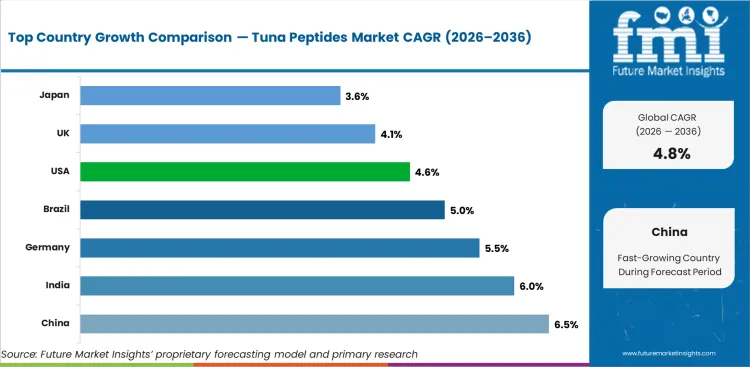
- Leading China at 6.48% CAGR, supported by largest demand base and growing adoption.
- India at 6% has solid demand driven by higher spending, distribution growth.
- Germany (5.52%) and Brazil (5.04%) are still growing thanks to the developing market.
Global Tuna Peptides Market is projected to grow at a CAGR of 4.8% during the forecast period 2026 to 2036. The study includes 30+ countries with key markets described below.
Sales Analysis of Tuna Peptides Market in China
China is ahead at 6.48% through 2036. China’s tuna processing industry is extensive, which provides a large supply of by-products for peptide extraction. As consumer interest in functional health products grows, domestic nutraceutical and cosmetics manufacturers are looking to marine peptide ingredients.
- Large tuna processing industry provides consistent by-product supply for peptide extraction.
- Nutraceutical market growth drives demand for marine-derived bioactive ingredients.
- Cosmetics manufacturers are incorporating marine peptides into anti-aging product lines.
Demand Outlook for Tuna Peptides Market in India
India is growing at 6.0% out to 2036. Increasing nutraceutical consumption and growing health supplement awareness among urban consumers are creating market entry opportunities. The domestic fish processing infrastructure is developing capabilities for peptide extraction.
- Growing health supplement consumption among urban consumers expands the addressable market.
- Domestic fish processing industry is developing peptide extraction capabilities.
- E-commerce platforms serve as the primary distribution channel for marine supplement products.
In-depth Analysis of Tuna Peptides Market in Germany
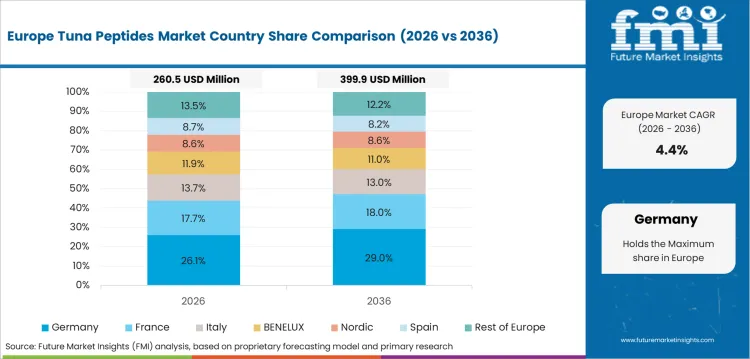
Germany is expanding 5.52% through 2036. In the European Union (EU), there are regulations governing novel food ingredients and supplements that are in great demand by consumers for clinical validation. German nutraceutical manufacturers are emphasizing on the traceability of ingredients and sustainability certifications.
- EU novel food regulations provide a structured framework for marine peptide ingredient approval.
- Consumer demand for clinically validated supplements supports premium pricing.
- Sustainability and traceability certifications are baseline requirements for ingredient procurement.
Opportunity Analysis of Tuna Peptides Market in Brazil
Brazil will expand 5.04% until 2036. A domestic supply base of by-products is available from the Brazilian tuna fishing and processing industry. The demand for sea-sourced ingredients is increasing due to the growing use of health and beauty supplements.
- Domestic tuna processing industry provides by-product supply for local peptide extraction.
- Health and beauty supplement market growth supports marine ingredient adoption.
- E-commerce distribution is expanding access to specialty supplement products.
Future Outlook for Tuna Peptides Market in the United States
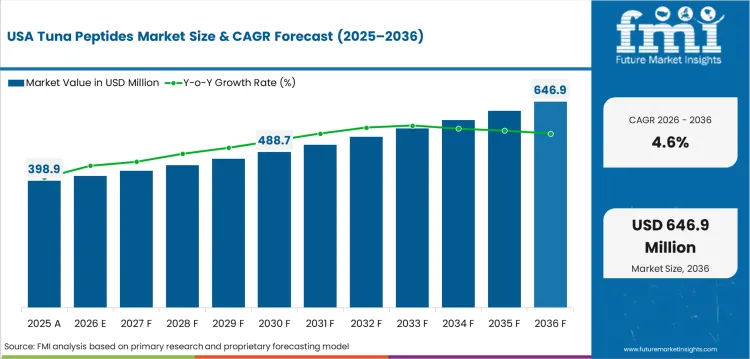
USA 4.56% growth through 2036. The market is supported by a well-established nutraceutical infrastructure and the acceptance of marine collagen products among consumers. Premium brands like Vital Proteins have made it acceptable to consume marine-derived supplements.
- Established nutraceutical infrastructure supports ingredient procurement and product formulation.
- Consumer acceptance of marine collagen products has normalized marine peptide supplementation.
- Functional food and beverage manufacturers are expanding tuna peptide incorporation into product lines.
In-depth Analysis of Tuna Peptides Market in the United Kingdom
The UK is growing at 4.08 per cent to 2036. The market is driven by the post-Brexit regulatory landscape and the consumer demand for clean label supplements. UK consumers want ingredients from the sea and sustainability-certified ingredients.
- Clean-label and sustainability-certified ingredients are preferred by UK supplement consumers.
- Post-Brexit regulatory alignment with EU novel food standards maintains product quality requirements.
- Online retail channels dominate distribution for specialty marine supplement products.
Demand Outlook for Tuna Peptides Market in Japan
Japan to grow at 3.6% through 2036. Established marine ingredient heritage and functional food culture in Japan offer favorable market environment. There is a substantial supply of by-product available from domestic tuna processing and Japanese consumers have a high acceptance of health products derived from marine sources.
- Marine ingredient heritage provides strong consumer acceptance for tuna-derived supplements.
- Domestic tuna processing industry generates consistent by-product supply.
- Functional food regulations support incorporation of bioactive peptides into food products.
Competitive Landscape and Strategic Positioning
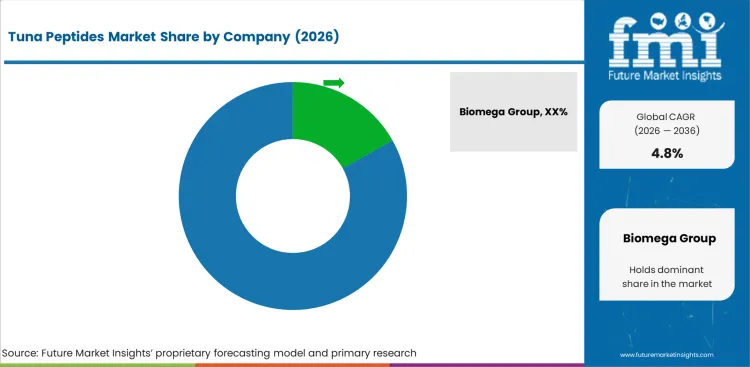
- Biomega Group 16.9% The leader in integrated tuna processing and peptide extraction, with well-established supply relationships in nutraceutical and cosmetics ingredient markets.
- Symrise AG and Sopropeche compete in ingredient innovation and formulation expertise, providing tailored marine peptide blends to functional food and cosmetics manufacturers.
- Global ingredient companies like Lonza Group, Glanbia Nutritionals and Cargill provide distribution scale and formulation support, though marine peptides make up a smaller part of their overall ingredient portfolios.
The competitive landscape comprises global leaders with broad portfolios and regional specialists with niche capabilities. Scale advantages in production and distribution represent barriers to entry.
Key Companies in the Tuna Peptides Market
Key global companies leading the tuna peptides market include:
- Biomega Group (Norway), Sopropeche (France), and Symrise AG (Germany) lead through marine ingredient processing expertise, integrated extraction capabilities, and established relationships with nutraceutical and cosmetics manufacturers.
- Lonza Group (Switzerland), Glanbia Nutritionals (Ireland), and Cargill Incorporated (USA) provide global distribution scale and ingredient formulation support across functional food and supplement applications.
- Seagarden AS (Norway), Hofseth BioCare ASA (Norway), Aker BioMarine Antarctic AS (Norway), and Copalis Sea Solutions (France) are expanding through marine bioactive specialization and sustainable sourcing certification.
Competitive Benchmarking: Tuna Peptides Market
| Company | Extraction Capability | Product Range | Supply Network | Market Reach |
|---|---|---|---|---|
| Biomega Group | Very High | High | Strong | Europe, Asia |
| Sopropeche | High | Medium | Moderate | Europe |
| Symrise AG | Medium | High | Strong | Global |
| Lonza Group | Medium | High | Strong | Global |
| Glanbia Nutritionals | Low | High | Strong | Global |
| Cargill | Low | Medium | Very Strong | Global |
| Seagarden AS | High | Medium | Moderate | Europe |
| Hofseth BioCare ASA | High | Medium | Moderate | Europe |
| Vital Proteins LLC | Low | Medium | Strong | N. America |
| Copalis Sea Solutions | High | Medium | Moderate | Europe |
Source: Future Market Insights competitive analysis, 2026.
Key Developments in Tuna Peptides Market
- In 2025, Biomega Group continued to expand its marine peptide portfolio, focusing on sustainable sourcing and enzymatic hydrolysis technologies, primarily from salmon by-products, while strengthening its position in nutraceutical and functional food ingredients.
- In 2025, Symrise AG maintained a strong presence in the marine-derived peptide segment through its pet nutrition and human health divisions, leveraging partnerships and existing capabilities in functional marine ingredients rather than launching a major new tuna-specific peptide range.
Key Players in the Tuna Peptides Market
Major Global Players
- Biomega Group
- Sopropeche
- Symrise AG
- Lonza Group
- Glanbia Nutritionals
- Cargill, Incorporated
Emerging Players/Startups
- Seagarden AS
- Hofseth BioCare ASA
- Aker BioMarine Antarctic AS
- Copalis Sea Solutions
- Vital Proteins LLC
- Waitaki Biosciences
- Bolognani Srl
Report Scope and Coverage
| Parameter | Details |
|---|---|
| Quantitative Units | USD 1.02 million to USD 1.63 million, at a CAGR of 4.8% |
| Market Definition | The tuna peptides market encompasses commercially traded bioactive peptides derived from tuna processing by-products including skin, bone, and muscle tissue. Product categories include powder, liquid, and capsule and tablet formats used across nutraceutical, food and beverage, cosmetics, and animal nutrition applications. |
| Regions Covered | North America, Latin America, Europe, East Asia, South Asia and Pacific, Middle East and Africa |
| Countries Covered | China, India, Germany, Brazil, USA, UK, Japan, 30 plus countries |
| Key Companies Profiled | Biomega Group, Sopropeche, Symrise AG, Lonza Group, Glanbia Nutritionals, Cargill, Incorporated, Seagarden AS, Hofseth BioCare ASA, Aker BioMarine Antarctic AS |
| Forecast Period | 2026 to 2036 |
| Approach | Hybrid bottom-up and top-down methodology starting with verified transaction data, projecting adoption velocity across segments and regions. |
Market Segmentation Analysis
Tuna Peptides Market Segmented by Product:
- Powder
- Pure Peptide Powder
- Hydrolyzed Tuna Peptides
- High Purity Peptides
- Blended Powder
- Collagen Peptide Blends
- Protein Enriched Blends
- Pure Peptide Powder
- Liquid
- Ready To Drink
- Functional Beverages
- Nutritional Shots
- Liquid Concentrates
- Bulk Liquid Extracts
- Dropper Formats
- Ready To Drink
- Capsules And Tablets
- Capsules
- Gelatin Capsules
- Vegetarian Capsules
- Tablets
- Compressed Tablets
- Coated Tablets
- Capsules
Tuna Peptides Market Segmented by Application:
- Nutraceuticals
- Dietary Supplements
- Protein Supplements
- Anti Aging Supplements
- Functional Nutrition
- Daily Health Supplements
- Immune Support Products
- Dietary Supplements
- Food And Beverage
- Functional Foods
- Protein Bars
- Fortified Snacks
- Beverages
- Protein Drinks
- Energy Drinks
- Functional Foods
- Cosmetics And Personal Care
- Skin Care
- Anti Aging Creams
- Moisturizing Products
- Hair Care
- Hair Strengthening Products
- Scalp Care Products
- Skin Care
- Animal Nutrition
- Pet Nutrition
- Pet Supplements
- Functional Pet Food
- Aquaculture Feed
- Fish Feed Additives
- Growth Promoters
- Pet Nutrition
Tuna Peptides Market Segmented by End Use:
- Adults
- Health Conscious Consumers
- Fitness Enthusiasts
- Beauty Focused Consumers
- General Consumers
- Daily Nutrition Users
- Preventive Healthcare Users
- Health Conscious Consumers
- Geriatric Population
- Aging Support Users
- Joint Health
- Skin Health
- Aging Support Users
- Sports Nutrition Consumers
- Athletes
- Professional Athletes
- Recreational Users
- Athletes
Tuna Peptides Market Segmented by Distribution Channel:
- Online Retail
- E Commerce Platforms
- Third Party Marketplaces
- Brand Owned Websites
- Subscription Services
- Auto Replenishment Plans
- Personalized Nutrition Plans
- E Commerce Platforms
- Offline Retail
- Pharmacies
- Chain Pharmacies
- Independent Pharmacies
- Health And Wellness Stores
- Specialty Stores
- Nutrition Stores
- Supermarkets And Hypermarkets
- Large Format Stores
- Urban Retail Chains
- Pharmacies
Tuna Peptides Market Segmented by Formulation:
- Hydrolyzed Peptides
- Enzymatic Hydrolysis
- Low Molecular Weight Peptides
- High Bioavailability Peptides
- Enzymatic Hydrolysis
- Blended Formulations
- Peptides With Collagen
- Marine Collagen Blends
- Multi Protein Blends
- Peptides With Functional Ingredients
- Vitamin Enriched
- Mineral Enriched
- Peptides With Collagen
Tuna Peptides Market Segmented by Source:
- Tuna Skin Derived
- Enzymatic Extraction
- High Yield Extraction
- Refined Processing
- Enzymatic Extraction
- Tuna Bone Derived
- Mineral Rich Extraction
- Calcium Rich Peptides
- Structural Protein Extraction
- Mineral Rich Extraction
- Tuna Muscle Derived
- Protein Extraction
- High Purity Protein
- Food Grade Peptides
- Protein Extraction
Tuna Peptides Market Segmented by Pricing Tier:
- Mid Range
- Branded Products
- Standard Quality Supplements
- Branded Products
- Economy
- Bulk Peptide Products
- Industrial Grade Products
- Bulk Peptide Products
- Premium
- High Purity Peptides
- Clinical Grade Products
- Specialized Nutrition Products
- High Purity Peptides
Tuna Peptides Market by Region:
- North America
- USA
- Canada
- Mexico
- Latin America
- Brazil
- Chile
- Rest of Latin America
- Western Europe
- Germany
- UK
- Italy
- Spain
- France
- Nordic
- BENELUX
- Rest of Western Europe
- Eastern Europe
- Russia
- Poland
- Hungary
- Balkan & Baltic
- Rest of Eastern Europe
- East Asia
- China
- Japan
- South Korea
- South Asia and Pacific
- India
- ASEAN
- Australia & New Zealand
- Rest of South Asia and Pacific
- Middle East & Africa
- Kingdom of Saudi Arabia
- Other GCC Countries
- Turkiye
- South Africa
- Other African Union
- Rest of Middle East & Africa
Research Sources and Bibliography
- 1. Food and Agriculture Organization. (2025). FAO Fisheries and Aquaculture Technical Paper: Marine By-Product Utilization. FAO.
- 2. European Food Safety Authority. (2024). EFSA Scientific Opinion on Novel Food Applications. EFSA.
- 3. National Institutes of Health. (2024). NIH Office of Dietary Supplements: Marine Peptide Research Review. NIH.
- 4. International Society for Nutraceuticals and Functional Foods. (2025). ISNFF Marine Bioactives Report. ISNFF.
- 5. World Health Organization. (2024). WHO Technical Report on Food-Derived Bioactive Peptides. WHO.
This bibliography is provided for reader reference.
This Report Answers
- Estimating the market size and revenue generation from 2026 to 2036.
- Segmenting by product, application, end use, distribution channel, formulation, source, and pricing tier.
- Providing regional insights across more than 30 markets.
- Analyzing supply chain dynamics across tuna processing and peptide extraction.
- Assessing the competitive landscape across marine ingredient suppliers.
- Identifying investment opportunities in nutraceutical and cosmetics applications.
- Tracking extraction technology and by-product valorization trends.
- Delivering data in PDF and Excel formats.
Frequently Asked Questions
How big is the tuna peptides market in 2026?
The global tuna peptides market is estimated to be valued at USD 1.02 million in 2026.
What will be the size of tuna peptides market in 2036?
The market size for the tuna peptides market is projected to reach USD 1.63 million by 2036.
How much will be the tuna peptides market growth between 2026 and 2036?
The tuna peptides market is expected to grow at a 4.8% CAGR between 2026 and 2036.
What are the key product types in the tuna peptides market?
The key product types in tuna peptides market are powder, liquid and capsules and tablets.
Which application segment is expected to contribute significant share in the tuna peptides market in 2026?
In terms of application, nutraceuticals segment is expected to command 50.0% share in the tuna peptides market in 2026.
Preview the report firsthand - request a free sample
Get SampleGet the brochure for pricing and purchase details.
Get PDFTable of Content
- Executive Summary
- Global Market Outlook
- Demand-side Trends
- Supply-side Trends
- Technology Roadmap Analysis
- Analysis and Recommendations
- Market Overview
- Market Coverage / Taxonomy
- Market Definition / Scope / Limitations
- Research Methodology
- Chapter Orientation
- Analytical Lens and Working Hypotheses
- Market Structure, Signals, and Trend Drivers
- Benchmarking and Cross-market Comparability
- Market Sizing, Forecasting, and Opportunity Mapping
- Research Design and Evidence Framework
- Desk Research Programme (Secondary Evidence)
- Company Annual and Sustainability Reports
- Peer-reviewed Journals and Academic Literature
- Corporate Websites, Product Literature, and Technical Notes
- Earnings Decks and Investor Briefings
- Statutory Filings and Regulatory Disclosures
- Technical White Papers and Standards Notes
- Trade Journals, Industry Magazines, and Analyst Briefs
- Conference Proceedings, Webinars, and Seminar Materials
- Government Statistics Portals and Public Data Releases
- Press Releases and Reputable Media Coverage
- Specialist Newsletters and Curated Briefings
- Sector Databases and Reference Repositories
- FMI Internal Proprietary Databases and Historical Market Datasets
- Subscription Datasets and Paid Sources
- Social Channels, Communities, and Digital Listening Inputs
- Additional Desk Sources
- Expert Input and Fieldwork (Primary Evidence)
- Primary Modes
- Qualitative Interviews and Expert Elicitation
- Quantitative Surveys and Structured Data Capture
- Blended Approach
- Why Primary Evidence is Used
- Field Techniques
- Interviews
- Surveys
- Focus Groups
- Observational and In-context Research
- Social and Community Interactions
- Stakeholder Universe Engaged
- C-suite Leaders
- Board Members
- Presidents and Vice Presidents
- R&D and Innovation Heads
- Technical Specialists
- Domain Subject-matter Experts
- Scientists
- Physicians and Other Healthcare Professionals
- Governance, Ethics, and Data Stewardship
- Research Ethics
- Data Integrity and Handling
- Primary Modes
- Tooling, Models, and Reference Databases
- Desk Research Programme (Secondary Evidence)
- Data Engineering and Model Build
- Data Acquisition and Ingestion
- Cleaning, Normalisation, and Verification
- Synthesis, Triangulation, and Analysis
- Quality Assurance and Audit Trail
- Market Background
- Market Dynamics
- Drivers
- Restraints
- Opportunity
- Trends
- Scenario Forecast
- Demand in Optimistic Scenario
- Demand in Likely Scenario
- Demand in Conservative Scenario
- Opportunity Map Analysis
- Product Life Cycle Analysis
- Supply Chain Analysis
- Investment Feasibility Matrix
- Value Chain Analysis
- PESTLE and Porter’s Analysis
- Regulatory Landscape
- Regional Parent Market Outlook
- Production and Consumption Statistics
- Import and Export Statistics
- Market Dynamics
- Global Market Analysis 2021 to 2025 and Forecast, 2026 to 2036
- Historical Market Size Value (USD Million) Analysis, 2021 to 2025
- Current and Future Market Size Value (USD Million) Projections, 2026 to 2036
- Y-o-Y Growth Trend Analysis
- Absolute $ Opportunity Analysis
- Global Market Pricing Analysis 2021 to 2025 and Forecast 2026 to 2036
- Global Market Analysis 2021 to 2025 and Forecast 2026 to 2036, By Product
- Introduction / Key Findings
- Historical Market Size Value (USD Million) Analysis By Product , 2021 to 2025
- Current and Future Market Size Value (USD Million) Analysis and Forecast By Product , 2026 to 2036
- Powder
- Pure Peptide Powder
- Hydrolyzed Tuna Peptides
- High Purity Peptides
- Blended Powder
- Collagen Peptide Blends
- Protein Enriched Blends
- Liquid
- Ready To Drink
- Functional Beverages
- Nutritional Shots
- Liquid Concentrates
- Bulk Liquid Extracts
- Capsules And Tablets
- Capsules
- Gelatin Capsules
- Vegetarian Capsules
- Tablets
- Compressed Tablets
- Powder
- Y-o-Y Growth Trend Analysis By Product , 2021 to 2025
- Absolute $ Opportunity Analysis By Product , 2026 to 2036
- Global Market Analysis 2021 to 2025 and Forecast 2026 to 2036, By Application
- Introduction / Key Findings
- Historical Market Size Value (USD Million) Analysis By Application, 2021 to 2025
- Current and Future Market Size Value (USD Million) Analysis and Forecast By Application, 2026 to 2036
- Nutraceuticals
- Dietary Supplements
- Protein Supplements
- Anti Aging Supplements
- Functional Nutrition
- Daily Health Supplements
- Immune Support Products
- Food And Beverage
- Functional Foods
- Protein Bars
- Fortified Snacks
- Beverages
- Protein Drinks
- Cosmetics And Personal Care
- Skin Care
- Anti Aging Creams
- Moisturizing Products
- Hair Care
- Hair Strengthening Products
- Animal Nutrition
- Pet Nutrition
- Pet Supplements
- Functional Pet Food
- Aquaculture Feed
- Fish Feed Additives
- Nutraceuticals
- Y-o-Y Growth Trend Analysis By Application, 2021 to 2025
- Absolute $ Opportunity Analysis By Application, 2026 to 2036
- Global Market Analysis 2021 to 2025 and Forecast 2026 to 2036, By End Use
- Introduction / Key Findings
- Historical Market Size Value (USD Million) Analysis By End Use, 2021 to 2025
- Current and Future Market Size Value (USD Million) Analysis and Forecast By End Use, 2026 to 2036
- Adults
- Health Conscious Consumers
- Fitness Enthusiasts
- Beauty Focused Consumers
- General Consumers
- Daily Nutrition Users
- Preventive Healthcare Users
- Geriatric Population
- Aging Support Users
- Joint Health
- Skin Health
- Sports Nutrition Consumers
- Athletes
- Professional Athletes
- Recreational Users
- Adults
- Y-o-Y Growth Trend Analysis By End Use, 2021 to 2025
- Absolute $ Opportunity Analysis By End Use, 2026 to 2036
- Global Market Analysis 2021 to 2025 and Forecast 2026 to 2036, By Distribution Channel
- Introduction / Key Findings
- Historical Market Size Value (USD Million) Analysis By Distribution Channel, 2021 to 2025
- Current and Future Market Size Value (USD Million) Analysis and Forecast By Distribution Channel, 2026 to 2036
- Online Retail
- E Commerce Platforms
- Third Party Marketplaces
- Brand Owned Websites
- Subscription Services
- Auto Replenishment Plans
- Personalized Nutrition Plans
- Offline Retail
- Pharmacies
- Chain Pharmacies
- Independent Pharmacies
- Health And Wellness Stores
- Specialty Stores
- Online Retail
- Y-o-Y Growth Trend Analysis By Distribution Channel, 2021 to 2025
- Absolute $ Opportunity Analysis By Distribution Channel, 2026 to 2036
- Global Market Analysis 2021 to 2025 and Forecast 2026 to 2036, By Formulation
- Introduction / Key Findings
- Historical Market Size Value (USD Million) Analysis By Formulation, 2021 to 2025
- Current and Future Market Size Value (USD Million) Analysis and Forecast By Formulation, 2026 to 2036
- Hydrolyzed Peptides
- Enzymatic Hydrolysis
- Low Molecular Weight Peptides
- High Bioavailability Peptides
- Blended Formulations
- Peptides With Collagen
- Marine Collagen Blends
- Multi Protein Blends
- Peptides With Functional Ingredients
- Vitamin Enriched
- Hydrolyzed Peptides
- Y-o-Y Growth Trend Analysis By Formulation, 2021 to 2025
- Absolute $ Opportunity Analysis By Formulation, 2026 to 2036
- Global Market Analysis 2021 to 2025 and Forecast 2026 to 2036, By Source
- Introduction / Key Findings
- Historical Market Size Value (USD Million) Analysis By Source, 2021 to 2025
- Current and Future Market Size Value (USD Million) Analysis and Forecast By Source, 2026 to 2036
- Tuna Skin Derived
- Enzymatic Extraction
- High Yield Extraction
- Refined Processing
- Tuna Bone Derived
- Mineral Rich Extraction
- Calcium Rich Peptides
- Structural Protein Extraction
- Tuna Muscle Derived
- Protein Extraction
- High Purity Protein
- Food Grade Peptides
- Tuna Skin Derived
- Y-o-Y Growth Trend Analysis By Source, 2021 to 2025
- Absolute $ Opportunity Analysis By Source, 2026 to 2036
- Global Market Analysis 2021 to 2025 and Forecast 2026 to 2036, By Pricing Tier
- Introduction / Key Findings
- Historical Market Size Value (USD Million) Analysis By Pricing Tier, 2021 to 2025
- Current and Future Market Size Value (USD Million) Analysis and Forecast By Pricing Tier, 2026 to 2036
- Mid Range
- Branded Products
- Standard Quality Supplements
- Economy
- Bulk Peptide Products
- Industrial Grade Products
- Premium
- High Purity Peptides
- Clinical Grade Products
- Specialized Nutrition Products
- Mid Range
- Y-o-Y Growth Trend Analysis By Pricing Tier, 2021 to 2025
- Absolute $ Opportunity Analysis By Pricing Tier, 2026 to 2036
- Global Market Analysis 2021 to 2025 and Forecast 2026 to 2036, By Region
- Introduction
- Historical Market Size Value (USD Million) Analysis By Region, 2021 to 2025
- Current Market Size Value (USD Million) Analysis and Forecast By Region, 2026 to 2036
- North America
- Latin America
- Western Europe
- Eastern Europe
- East Asia
- South Asia and Pacific
- Middle East & Africa
- Market Attractiveness Analysis By Region
- North America Market Analysis 2021 to 2025 and Forecast 2026 to 2036, By Country
- Historical Market Size Value (USD Million) Trend Analysis By Market Taxonomy, 2021 to 2025
- Market Size Value (USD Million) Forecast By Market Taxonomy, 2026 to 2036
- By Country
- USA
- Canada
- Mexico
- By Product
- By Application
- By End Use
- By Distribution Channel
- By Formulation
- By Source
- By Pricing Tier
- By Country
- Market Attractiveness Analysis
- By Country
- By Product
- By Application
- By End Use
- By Distribution Channel
- By Formulation
- By Source
- By Pricing Tier
- Key Takeaways
- Latin America Market Analysis 2021 to 2025 and Forecast 2026 to 2036, By Country
- Historical Market Size Value (USD Million) Trend Analysis By Market Taxonomy, 2021 to 2025
- Market Size Value (USD Million) Forecast By Market Taxonomy, 2026 to 2036
- By Country
- Brazil
- Chile
- Rest of Latin America
- By Product
- By Application
- By End Use
- By Distribution Channel
- By Formulation
- By Source
- By Pricing Tier
- By Country
- Market Attractiveness Analysis
- By Country
- By Product
- By Application
- By End Use
- By Distribution Channel
- By Formulation
- By Source
- By Pricing Tier
- Key Takeaways
- Western Europe Market Analysis 2021 to 2025 and Forecast 2026 to 2036, By Country
- Historical Market Size Value (USD Million) Trend Analysis By Market Taxonomy, 2021 to 2025
- Market Size Value (USD Million) Forecast By Market Taxonomy, 2026 to 2036
- By Country
- Germany
- UK
- Italy
- Spain
- France
- Nordic
- BENELUX
- Rest of Western Europe
- By Product
- By Application
- By End Use
- By Distribution Channel
- By Formulation
- By Source
- By Pricing Tier
- By Country
- Market Attractiveness Analysis
- By Country
- By Product
- By Application
- By End Use
- By Distribution Channel
- By Formulation
- By Source
- By Pricing Tier
- Key Takeaways
- Eastern Europe Market Analysis 2021 to 2025 and Forecast 2026 to 2036, By Country
- Historical Market Size Value (USD Million) Trend Analysis By Market Taxonomy, 2021 to 2025
- Market Size Value (USD Million) Forecast By Market Taxonomy, 2026 to 2036
- By Country
- Russia
- Poland
- Hungary
- Balkan & Baltic
- Rest of Eastern Europe
- By Product
- By Application
- By End Use
- By Distribution Channel
- By Formulation
- By Source
- By Pricing Tier
- By Country
- Market Attractiveness Analysis
- By Country
- By Product
- By Application
- By End Use
- By Distribution Channel
- By Formulation
- By Source
- By Pricing Tier
- Key Takeaways
- East Asia Market Analysis 2021 to 2025 and Forecast 2026 to 2036, By Country
- Historical Market Size Value (USD Million) Trend Analysis By Market Taxonomy, 2021 to 2025
- Market Size Value (USD Million) Forecast By Market Taxonomy, 2026 to 2036
- By Country
- China
- Japan
- South Korea
- By Product
- By Application
- By End Use
- By Distribution Channel
- By Formulation
- By Source
- By Pricing Tier
- By Country
- Market Attractiveness Analysis
- By Country
- By Product
- By Application
- By End Use
- By Distribution Channel
- By Formulation
- By Source
- By Pricing Tier
- Key Takeaways
- South Asia and Pacific Market Analysis 2021 to 2025 and Forecast 2026 to 2036, By Country
- Historical Market Size Value (USD Million) Trend Analysis By Market Taxonomy, 2021 to 2025
- Market Size Value (USD Million) Forecast By Market Taxonomy, 2026 to 2036
- By Country
- India
- ASEAN
- Australia & New Zealand
- Rest of South Asia and Pacific
- By Product
- By Application
- By End Use
- By Distribution Channel
- By Formulation
- By Source
- By Pricing Tier
- By Country
- Market Attractiveness Analysis
- By Country
- By Product
- By Application
- By End Use
- By Distribution Channel
- By Formulation
- By Source
- By Pricing Tier
- Key Takeaways
- Middle East & Africa Market Analysis 2021 to 2025 and Forecast 2026 to 2036, By Country
- Historical Market Size Value (USD Million) Trend Analysis By Market Taxonomy, 2021 to 2025
- Market Size Value (USD Million) Forecast By Market Taxonomy, 2026 to 2036
- By Country
- Kingdom of Saudi Arabia
- Other GCC Countries
- Turkiye
- South Africa
- Other African Union
- Rest of Middle East & Africa
- By Product
- By Application
- By End Use
- By Distribution Channel
- By Formulation
- By Source
- By Pricing Tier
- By Country
- Market Attractiveness Analysis
- By Country
- By Product
- By Application
- By End Use
- By Distribution Channel
- By Formulation
- By Source
- By Pricing Tier
- Key Takeaways
- Key Countries Market Analysis
- USA
- Pricing Analysis
- Market Share Analysis, 2025
- By Product
- By Application
- By End Use
- By Distribution Channel
- By Formulation
- By Source
- By Pricing Tier
- Canada
- Pricing Analysis
- Market Share Analysis, 2025
- By Product
- By Application
- By End Use
- By Distribution Channel
- By Formulation
- By Source
- By Pricing Tier
- Mexico
- Pricing Analysis
- Market Share Analysis, 2025
- By Product
- By Application
- By End Use
- By Distribution Channel
- By Formulation
- By Source
- By Pricing Tier
- Brazil
- Pricing Analysis
- Market Share Analysis, 2025
- By Product
- By Application
- By End Use
- By Distribution Channel
- By Formulation
- By Source
- By Pricing Tier
- Chile
- Pricing Analysis
- Market Share Analysis, 2025
- By Product
- By Application
- By End Use
- By Distribution Channel
- By Formulation
- By Source
- By Pricing Tier
- Germany
- Pricing Analysis
- Market Share Analysis, 2025
- By Product
- By Application
- By End Use
- By Distribution Channel
- By Formulation
- By Source
- By Pricing Tier
- UK
- Pricing Analysis
- Market Share Analysis, 2025
- By Product
- By Application
- By End Use
- By Distribution Channel
- By Formulation
- By Source
- By Pricing Tier
- Italy
- Pricing Analysis
- Market Share Analysis, 2025
- By Product
- By Application
- By End Use
- By Distribution Channel
- By Formulation
- By Source
- By Pricing Tier
- Spain
- Pricing Analysis
- Market Share Analysis, 2025
- By Product
- By Application
- By End Use
- By Distribution Channel
- By Formulation
- By Source
- By Pricing Tier
- France
- Pricing Analysis
- Market Share Analysis, 2025
- By Product
- By Application
- By End Use
- By Distribution Channel
- By Formulation
- By Source
- By Pricing Tier
- India
- Pricing Analysis
- Market Share Analysis, 2025
- By Product
- By Application
- By End Use
- By Distribution Channel
- By Formulation
- By Source
- By Pricing Tier
- ASEAN
- Pricing Analysis
- Market Share Analysis, 2025
- By Product
- By Application
- By End Use
- By Distribution Channel
- By Formulation
- By Source
- By Pricing Tier
- Australia & New Zealand
- Pricing Analysis
- Market Share Analysis, 2025
- By Product
- By Application
- By End Use
- By Distribution Channel
- By Formulation
- By Source
- By Pricing Tier
- China
- Pricing Analysis
- Market Share Analysis, 2025
- By Product
- By Application
- By End Use
- By Distribution Channel
- By Formulation
- By Source
- By Pricing Tier
- Japan
- Pricing Analysis
- Market Share Analysis, 2025
- By Product
- By Application
- By End Use
- By Distribution Channel
- By Formulation
- By Source
- By Pricing Tier
- South Korea
- Pricing Analysis
- Market Share Analysis, 2025
- By Product
- By Application
- By End Use
- By Distribution Channel
- By Formulation
- By Source
- By Pricing Tier
- Russia
- Pricing Analysis
- Market Share Analysis, 2025
- By Product
- By Application
- By End Use
- By Distribution Channel
- By Formulation
- By Source
- By Pricing Tier
- Poland
- Pricing Analysis
- Market Share Analysis, 2025
- By Product
- By Application
- By End Use
- By Distribution Channel
- By Formulation
- By Source
- By Pricing Tier
- Hungary
- Pricing Analysis
- Market Share Analysis, 2025
- By Product
- By Application
- By End Use
- By Distribution Channel
- By Formulation
- By Source
- By Pricing Tier
- Kingdom of Saudi Arabia
- Pricing Analysis
- Market Share Analysis, 2025
- By Product
- By Application
- By End Use
- By Distribution Channel
- By Formulation
- By Source
- By Pricing Tier
- Turkiye
- Pricing Analysis
- Market Share Analysis, 2025
- By Product
- By Application
- By End Use
- By Distribution Channel
- By Formulation
- By Source
- By Pricing Tier
- South Africa
- Pricing Analysis
- Market Share Analysis, 2025
- By Product
- By Application
- By End Use
- By Distribution Channel
- By Formulation
- By Source
- By Pricing Tier
- USA
- Market Structure Analysis
- Competition Dashboard
- Competition Benchmarking
- Market Share Analysis of Top Players
- By Regional
- By Product
- By Application
- By End Use
- By Distribution Channel
- By Formulation
- By Source
- By Pricing Tier
- Competition Analysis
- Competition Deep Dive
- Biomega Group
- Overview
- Product Portfolio
- Profitability by Market Segments (Product/Age /Sales Channel/Region)
- Sales Footprint
- Strategy Overview
- Marketing Strategy
- Product Strategy
- Channel Strategy
- Sopropeche
- Symrise AG
- Lonza Group
- Glanbia Nutritionals
- Cargill, Incorporated
- Seagarden AS
- Hofseth BioCare ASA
- Aker BioMarine Antarctic AS
- Copalis Sea Solutions
- Vital Proteins LLC
- Waitaki Biosciences
- Bolognani Srl
- Norvik Trawl AS
- Others
- Biomega Group
- Competition Deep Dive
- Assumptions & Acronyms Used


