

- Market Size (2026)
- USD 541.3 Mn
- Forecast (2036)
- USD 1821.3 Mn
- CAGR (2026 to 2036)
- 12.9%
How big is Ube & Natural Purple Botanical Ingredients Market in 2026?
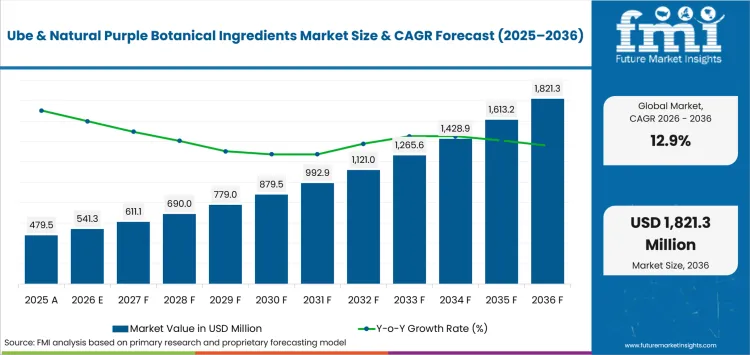
USD 541.3 million in 2026 and USD 1821.3 million by 2036 at a 12.9% CAGR.
Demand for ube and natural purple botanical ingredients is projected to expand at 12.9% CAGR between 2026 and 2036. Revenue is forecast to rise from USD 541.3 million in 2026 to USD 1821.3 million by 2036 as reformulation broadens projects for natural food colors. In April 2025 the FDA established a national transition timeline from petroleum-based dyes toward natural alternatives, turning color replacement into scheduled development work. Ingredient companies must match shade performance and documentation before food manufacturers approve replacement colors for routine production.
Philippine processors must organize crop supply while USA formulators face time-bound color conversion. Philippine plants therefore need raw-material coordination to standardize botanical extracts for recurring orders and export programs. In June 2026 the Department of Agriculture gathered 249 ube stakeholders across farming, processing and export channels to address uneven supply coordination. USA projects depend more on regulatory files and shade matching, so ingredient companies need different qualification support in the two markets.
Key Takeaways of Ube & Natural Purple Botanical Ingredients Market
- Food manufacturers are increasing natural purple ingredient trials as color reformulation and ube-branded products add new qualification work across applications.
- By product, ube powder/extract is estimated to hold 45.6% in 2026 owing to easier industrial handling and tighter specification control.
- In 2026, bakery is expected to lead application demand with 29.9% share due to visible differentiation and familiar ube flavor delivery.
- The remaining product formats are likely to capture 54.4% share in 2026 attributable to separate roles for purple yam, anthocyanin color and flavor preparations.
- Crop variation and matrix-sensitive anthocyanin behavior can extend technical qualification before food manufacturers approve recurring purchases from a botanical ingredient source.
- Sensient, GNT (EXBERRY), dsm-firmenich, Döhler, ADM, Kalsec, Oterra and Givaudan make up the eight companies profiled across the competitive sections.
Analyst Perspective
"Food developers should first test whether a named ube or purple botanical source keeps its target shade during heating and under the product's acidity and storage conditions. The stronger commercial offer pairs that proof with crop specifications and regulatory files so the same color and flavor can be repeated across seasons and production sites."
- Nandini Roy Choudhury, Principal Consultant, Future Market Insights
How is the Ube & Natural Purple Botanical Ingredients Market segmented?
The ube & natural purple botanical ingredients market is segmented by product, application and region.
The ube & natural purple botanical ingredients market is segmented by product, application and region. Product includes ube powder/extract, purple yam, anthocyanin color and flavor. Application includes bakery, confectionery, beverages, dairy and ice cream. Regional analysis covers North America, Latin America, Western Europe, Eastern Europe, East Asia, South Asia and Pacific and the Middle East and Africa.
Why does ube powder/extract lead demand within the product category?
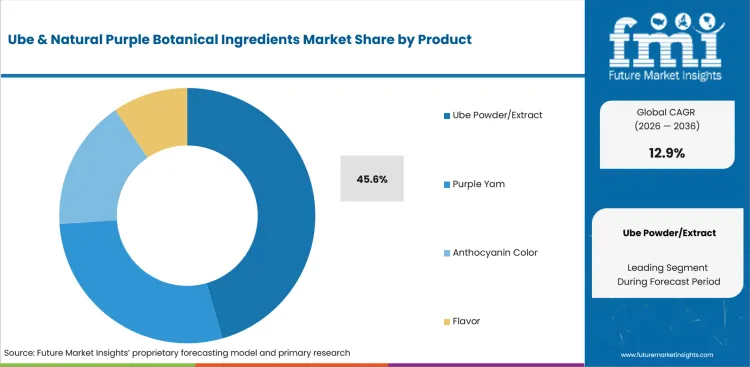
Ube powder/extract turns a seasonal root into botanical ingredients that food plants can store and dose against written specifications. The Philippine Information Agency documented an export route in August 2025 by reporting Quirino's first one-ton ube powder shipment to the United States.
- By product, ube powder/extract is estimated to hold 45.6% in 2026 owing to easier storage and tighter specification control across industrial food programs.
- Processors gain repeat orders as moisture and color strength remain consistent across crop seasons and customer trials. Standardized powder also reduces plant preparation before measured doses enter bakery or beverage formulations.
Why does bakery lead demand within the application category?
Bakery ingredients can carry ube flavor and a visible purple cue together, and Oterra's May 2025 USA headquarters added application laboratories that support baked-goods color work. Solid matrices also accept ingredient solids more readily than clear beverages during early formulation trials.
- Based on application, bakery is projected to account for 29.9% in 2026 due to visible differentiation and familiar ube flavor delivery.
- Baking can change anthocyanin shade across dough composition and process temperature, so commercial approval depends on heat-stability trials. Developers compare dosage with final crumb color before releasing a botanical color system to routine production.
What are the drivers, restraints and opportunities in the Ube & Natural Purple Botanical Ingredients Market?
Synthetic-dye reformulation expands qualification work while anthocyanin sensitivity lengthens validation and stronger crop coordination improves the route to repeat supply.
- Driver: USA synthetic-dye policy is moving natural-color replacement into scheduled reformulation programs that require documented shade and application performance.
- Restraint: Anthocyanin-rich purple colors need application-specific stability testing owing to shade changes under heat and acidity in processed foods.
- Opportunity: Better coordination between ube farms and processors can improve raw-material consistency enough to support specification-based industrial ingredient contracts.
Regulatory Deadlines Turn Color Replacement into Scheduled Work
Food manufacturers are moving color replacement into scheduled work as plant-based colors become a practical route for USA reformulation programs. Qualifying alternatives have to match a known shade inside the customer's recipe and production conditions. In February 2026 the FDA allowed qualifying products without petroleum-based colors to use “no artificial colors” claims, giving completed reformulations a visible label outcome.
Matrix Sensitivity Raises Validation Cost
GNT's June 2025 launch of a purple-sweet-potato concentrate for high-heat and low-pH foods confirms that anthocyanin performance depends on processing conditions across beverages plus dairy and confectionery. Food manufacturers therefore test food color systems in each matrix because a shade that works in bakery can shift in acidic drinks and heated fillings during commercial scale-up.
Supply Standardization Improves Repeatability
Ube farms and processing plants use common raw-material specifications to make food botanicals more repeatable across planned production seasons. In July 2026 the Philippine Department of Agriculture identified fragmented supply chains and inconsistent quality standards as ube-industry bottlenecks. Contracted varieties and defined moisture or color limits can make powder output easier to repeat across industrial customer orders and export schedules.
Which country CAGRs are profiled in the Ube & Natural Purple Botanical Ingredients Market?
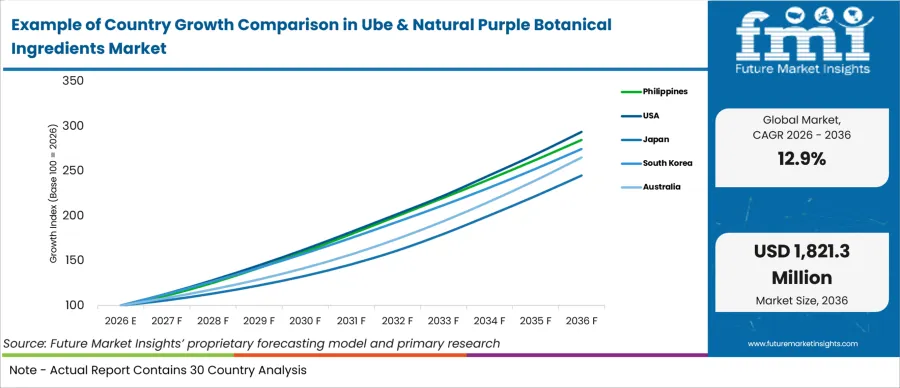
| Country | CAGR |
|---|---|
| USA | 11.4% |
| Philippines | 11.0% |
| South Korea | 10.6% |
| Australia | 10.2% |
| Japan | 9.4% |
How do country-level CAGRs compare in the Ube & Natural Purple Botanical Ingredients Market?
The 2.0-point spread separates into an upper pair, a middle pair and a lower Japanese position. USA reformulation schedules and Philippine crop coordination impose different qualification work within the group. South Korea and Australia require separate regulatory preparation despite similar forecasts. Japan adds established additive rules with tighter identity records.
- USA reformulation deadlines push natural shade replacement across established national food portfolios.
- Philippine growth depends on converting expanded ube cultivation into repeatable powder specifications.
- South Korean import certification makes local documentation part of purple sweet potato entry.
- Australian entrants resolve additive permission before unfamiliar botanical colors enter customer trials.
- Japanese additive rules emphasize ingredient identity and documented use during product qualification.
Similar forecasts therefore conceal different qualification costs and sourcing risks for companies selecting entry priorities.
The full report provides country-level CAGR analysis across North America, Latin America, Europe, East Asia, South Asia, Oceania and the Middle East and Africa.
Country-wise Analysis
- USA food manufacturers are rebuilding USA natural color specifications across established brands as the FDA's July 2025 gardenia blue approval added a fourth natural-source color within two months and widened the legal shade set for reformulation teams. Demand in the United States is forecast to rise at 11.4% CAGR over the forecast period, reinforced by regulatory pressure to replace petroleum-based dyes across bakery and beverage portfolios that already use established color targets. Formulation teams gain more approved alternatives but each replacement needs shade matching and matrix testing before national manufacturers can standardize one ingredient specification across multiple plants and commit recurring purchase volumes.
- Philippine processors operate close to ube-growing areas in Bohol and Leyte but recurring ingredient production depends on planting-material quality and consistent post-harvest handling across dispersed grower groups that feed powder and extract plants. The Department of Agriculture distributed more than 60,000 purple-yam planting materials to 900 farmers in June 2026 and expanded local crop access for processors managing moisture and color controls during industrial conversion. The Philippines is estimated to post 11.0% CAGR over the forecast period, supported by a broader sourcing base even as processors need written raw-material specifications to reserve capacity reliably for repeat export orders across seasons.
- South Korean processed-food companies qualify imported purple botanical colors within a product-specific additive and import-control system that makes Korean documentation part of routine ingredient approval before a foreign preparation reaches commercial food channels. In South Korea, ube and natural purple botanical ingredient demand is predicted to advance at 10.6% CAGR through 2036 as import certification provides a defined route for overseas purple sweet potato color preparations. The MFDS import portal recorded a PURPLE SWEET POTATO RED COLOR certificate on August 4 2025, linking legal entry to a named additive record while local distributor support remains necessary for repeated customer launches.
- Australian formulators must establish food-additive permission early for unfamiliar botanical colors that can require a Code amendment and delay customer validation or planned application trials. FSANZ reported in August 2025 that it receives around 30 Code-amendment applications each year across categories including food additives, making dossier quality and early regulatory screening material parts of the launch timetable for companies introducing unfamiliar sources. Adoption of ube and natural purple botanical ingredients in Australia is estimated to expand at 10.2% CAGR through 2036, supported by a defined application route but limited by extra evidence work and the cost of preparing local files before commercial distribution.
- Lawson introduced a purple-sweet-potato and pumpkin tart in October 2025, giving ingredient companies a current retail bakery route for purple botanical color and flavor across Japanese convenience-store product launches. Japanese food manufacturers work within an established additive framework that makes ingredient identity and documented use status central to qualification of imported purple botanical preparations across commercial processed-food portfolios and seasonal programs. The Japanese ube and natural purple botanical ingredients sector is projected to record 9.4% CAGR during the assessment period, shaped by familiar bakery use while batch documentation remains necessary for repeat food accounts and consistent ingredient qualification across Japanese production programs.
Who are the notable companies in the Ube & Natural Purple Botanical Ingredients Market?
Sensient, GNT (EXBERRY), dsm-firmenich, Döhler, ADM, Kalsec, Oterra and Givaudan are the notable companies profiled in this market.
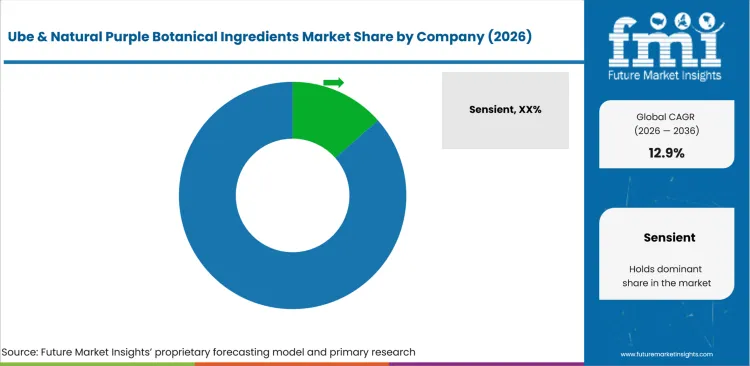
Competition is moderately fragmented between specialist natural-color companies and broader food flavor programs that combine color and sensory work in one brief. Natural flavor formats matter most in projects that develop ube taste and purple appearance together. Entry depends on documented botanical sources and repeatable shade performance under heat and acidity. Regional ube processors also need industrial specifications that turn crop access into a scalable ingredient offer.
- Sensient, GNT (EXBERRY) and Oterra compete as natural-color platforms with broad shade coverage and application support across several food matrices.
- ADM, Döhler, dsm-firmenich and Givaudan combine natural colors with flavor or botanical resources for wider reformulation and product-development briefs.
- Kalsec combines natural-color application expertise with taste resources across a focused food and beverage ingredient platform.
Competitive Benchmarking: Ube & Natural Purple Botanical Ingredients Market
| Company | Purple Botanical Source Breadth | Application Stability & Formulation Support | Flavor-Color Integration | Geographic Reach |
|---|---|---|---|---|
| Sensient | High | High | Medium | North America, Europe and Asia-Pacific |
| GNT (EXBERRY) | High | High | Low | Europe, North America, Asia and Middle East |
| dsm-firmenich | Medium | High | High | Global food and beverage markets |
| Döhler | High | High | High | Global with major North American and European operations |
| ADM | Medium | High | High | Global customer and manufacturing footprint |
| Kalsec | High | High | Medium | North America, Europe and Asia |
| Oterra | High | High | Low | Global natural-color operations |
| Givaudan | High | High | High | Global Taste & Wellbeing operations |
Key Developments in the Ube & Natural Purple Botanical Ingredients Market
- In March 2026, Sensient broke ground on a St. Louis expansion (Project Prism) dedicated to natural-color processing and related manufacturing capacity. The project adds 28,800 square feet to the site's existing 500,000-square-foot facility, backed by a planned investment of up to USD 250 million in natural-color capacity, supply chain and personnel.
- In January 2026, ADM announced a USD 26 million investment in its Erlanger facility for naturally derived color and flavor production. The expansion adds 3,600 square feet plus automation and capacity upgrades that improve supply consistency for customer reformulation programs.
- In March 2025, Döhler North America acquired Premier Juices and added blending plus quality-control and warehousing resources to its regional fruit platform. The transaction broadens operating support for customers combining natural fruit ingredients with color and flavor development.
Key Players in the Ube & Natural Purple Botanical Ingredients Market
Natural Color Platforms
- Sensient
- GNT (EXBERRY)
- Oterra
Integrated Color, Flavor and Botanical Systems
- ADM
- Döhler
- dsm-firmenich
- Givaudan
Natural Color and Taste Specialists
- Kalsec
Ube & Natural Purple Botanical Ingredients Market - Report Scope
| Coverage field | Report scope |
|---|---|
| Market breakdown | Product; Application |
| Quantitative Units | Revenue in USD million ans CAGR in %. |
| Market Definition | Revenue covers B2B sales of ube powders and extracts plus purple botanical color or flavor preparations used in the listed food and beverage applications. |
| Regions Covered | North America, Latin America, Europe, East Asia, South Asia and Pacific, and Middle East and Africa. |
| Countries Covered | United States, Philippines, South Korea, Australia, Japan, and 20+ countries included in the full report. |
| Key Companies Profiled | Sensient, GNT (EXBERRY), dsm-firmenich, Döhler, ADM, Kalsec, Oterra and Givaudan. |
| Forecast Period | 2026 to 2036. |
| Approach | Primary and secondary research with market triangulation. |
Ube & Natural Purple Botanical Ingredients Market - Research Methodology
| Method | Approach |
|---|---|
| Primary Research | FMI analysts gathered input from manufacturers, service providers, technology developers, distributors, end users, procurement teams, and subject-matter experts. Interviews examined purchasing decisions, product or service evaluation, adoption barriers, approval requirements, pricing considerations, and expectations for technical or commercial support. Respondents were also asked what evidence is required before a trial, pilot, or initial order develops into regular purchasing. |
| Desk Research | Desk research covered government statistics, regulatory publications, trade data, industry associations, technical literature, standards, company filings, product information, and official corporate announcements. Sources were reviewed for relevance, publication date, geographic coverage, and consistency with the defined market scope. Claims relating to performance, applications, approvals, capacity, investment, and commercial activity were retained only when supported by credible public evidence. |
| Market Sizing and Forecasting | The market model combined the baseline value with historical performance, segment structure, pricing and volume indicators, adoption levels, company participation, and country-level demand conditions. Forecast assumptions considered economic activity, investment trends, regulatory developments, technology adoption, purchasing cycles, supply availability, and barriers to wider market use. Segment and regional estimates were reconciled before the final market total was calculated. |
| Data Validation | Estimates were checked against multiple independent indicators, including public data, company activity, trade patterns, industry developments, and findings from primary interviews. Validation also tested whether products, services, applications, and company revenues fell within the defined market boundaries. Adjacent categories, unsupported claims, overlapping revenues, and activities without direct market relevance were excluded to reduce double counting and maintain consistency across segments and countries. |
Ube & Natural Purple Botanical Ingredients Market by Segments
Ube & Natural Purple Botanical Ingredients Market segmented by Product:
- Ube Powder/Extract
- Purple Yam
- Anthocyanin Color
- Flavor
Ube & Natural Purple Botanical Ingredients Market segmented by Application:
- Bakery
- Confectionery
- Beverages
- Dairy
- Ice Cream
Ube & Natural Purple Botanical Ingredients Market by Region:
- North America
- United States
- Canada
- Latin America
- Brazil
- Mexico
- Chile
- Rest of Latin America
- Western Europe
- Germany
- United Kingdom
- Italy
- Spain
- France
- Nordics
- Benelux
- Rest of Western Europe
- Eastern Europe
- Russia
- Poland
- Hungary
- Balkan and Baltic States
- Rest of Eastern Europe
- East Asia
- China
- Japan
- South Korea
- South Asia and Pacific
- India
- ASEAN
- Australia and New Zealand
- Rest of South Asia and Pacific
- Middle East and Africa
- Kingdom of Saudi Arabia
- Other GCC Countries
- Türkiye
- South Africa
- Other African Union Countries
- Rest of Middle East and Africa
Research Sources and Bibliography
- USA Food and Drug Administration. (2025, April 22). HHS, FDA to Phase Out Petroleum-Based Synthetic Dyes in Nation’s Food Supply.
- Department of Agriculture, Philippines. (2026, June 27). Philippines moves to structure booming ube export industry.
- Bicarme, T. (2025, August 21). Quirino province’s ube powder hits USA market.
- Oterra. (2025, May 8). Oterra opens new HQ in Mt. Pleasant to meet the demand for natural colors.
- USA Food and Drug Administration. (2026, February 5). FDA Takes New Approach to "No Artificial Colors" Claims.
- GNT Group. (2025, June 23). GNT expands certified organic EXBERRY® color range with new vibrant pink.
- Department of Agriculture, Philippines. (2026, July 5). DA maps export-driven roadmap for Philippine ube industry growth.
- USA Food and Drug Administration. (2025, July 14). FDA Approves Gardenia (Genipin) Blue Color Additive While Encouraging Faster Phase-Out of FD&C Red No. 3.
- Department of Agriculture, Philippines. (2026, June 23). Ube industry gets boost as DA-BPI distributes 60,000 planting materials.
- Ministry of Food and Drug Safety, Republic of Korea. (2025, August 4).
- Food Standards Australia New Zealand. (2025, August 7). Preparing an application? Tap into FSANZ support early.
- Lawson, Inc. (2025, October 28).
- Sensient. (2026, March 23). Breaking Ground to Expand the World’s Leading Natural Color Manufacturing Network.
- dsm-firmenich. (2025, December 8). Never say dye : in the race to replace azo dyes, we have a clear favorite.
- Döhler. (2025, March 28). Döhler North America Expands Fruit Solutions Portfolio with Premier Juices Acquisition.
- ADM. (2026, January 15). ADM’s $26M Investment in Erlanger Facility Strengthens Capabilities for Growing Reformulation Demand.
- Kalsec. (2026, June 24). Discover What’s Naturally Possible™ in Natural Color Solutions.
- Givaudan. (2025, May 9). US FDA approves new, natural Everzure™ Galdieria expanding Givaudan’s portfolio of blue colours.
This bibliography is provided for reader reference and is not exhaustive. The full report contains the complete reference list and detailed citations
This Report Answers
- How does the ube & natural purple botanical ingredients market value change between 2026 and 2036?
- Which reformulation and supply conditions convert natural purple concepts into recurring ingredient orders?
- Why does ube powder/extract hold the leading product share in 2026?
- Why does bakery account for the leading application share among the listed uses?
- How do local approval and supply routes change market entry across the five profiled countries?
- Which anthocyanin performance limits extend qualification work across processed food applications?
- How can crop standardization and processor coordination improve repeatability for ube ingredients?
- How do the eight profiled companies differ in source breadth and formulation support?
- Which recent capacity investments and acquisitions are changing natural-color production and customer support?
Frequently Asked Questions
How big is the Ube & Natural Purple Botanical Ingredients Market in 2026?
The Ube & Natural Purple Botanical Ingredients Market is valued at USD 541.3 million in 2026 and is projected to reach USD 1,821.3 million by 2036. Natural-color reformulation and ube product development increase ingredient qualification across food applications.
What is the CAGR of the Ube & Natural Purple Botanical Ingredients Market from 2026 to 2036?
The Ube & Natural Purple Botanical Ingredients Market is projected to expand at a 12.9% CAGR between 2026 and 2036. Growth reflects natural-color reformulation and demand for process-stable purple ingredients across food applications.
Which product type leads the Ube & Natural Purple Botanical Ingredients Market?
Ube powder/extract is projected to account for 45.6% of the Ube & Natural Purple Botanical Ingredients Market in 2026. Its leading share reflects easier storage and dosing for processors working with colored food formulations.
Which application dominates the Ube & Natural Purple Botanical Ingredients Market?
Bakery is projected to account for 29.9% of the Ube & Natural Purple Botanical Ingredients Market in 2026. Its leading position reflects demand for visible purple color and ube flavor in finished products.
Which companies are active in the Ube & Natural Purple Botanical Ingredients Market?
Active companies include Sensient, GNT (EXBERRY) and dsm-firmenich. Döhler, ADM and Kalsec work alongside Oterra and Givaudan through natural-color platforms, food formulation support and global application networks.
Preview the report firsthand - request a free sample
Get SampleGet the brochure for pricing and purchase details.
Get PDFTable of Content
- Key Takeaways
- Market Size and CAGR
- Top Growth Driver
- Fastest Growing Segment
- Leading Region
- Key Companies
- Emerging Opportunities
- Executive Summary
- Global Market Outlook
- Demand-side Trends
- Supply-side Trends
- Technology Roadmap Analysis
- Analysis and Recommendations
- Analyst Perspective (What is happening? Why now? What should investors know?)
- Key Questions Answered
- How large is the market?
- What is the CAGR?
- What are key trends?
- Which region dominates?
- Who are the leaders?
- Market Overview
- Market Coverage / Taxonomy
- Market Definition / Scope / Limitations
- Research Methodology
- Chapter Orientation
- Analytical Lens and Working Hypotheses
- Market Structure, Signals, and Trend Drivers
- Benchmarking and Cross-market Comparability
- Market Sizing, Forecasting, and Opportunity Mapping
- Research Design and Evidence Framework
- Desk Research Programme (Secondary Evidence)
- Expert Input and Fieldwork (Primary Evidence)
- Tooling, Models, and Reference Databases
- Data Engineering and Model Build
- Quality Assurance and Audit Trail
- Market Background
- Market Dynamics (Drivers, Restraints, Opportunity, Trends)
- Scenario Forecast (Optimistic, Likely, Conservative)
- Impact Analysis
- AI Impact
- Sustainability Impact
- Regulatory Impact
- Technology Impact
- Consumer / Buyer Analysis
- Purchase Drivers
- Adoption Barriers
- Buyer Journey
- Opportunity Map Analysis
- Product Life Cycle Analysis
- Supply Chain Analysis
- Investment Feasibility Matrix
- Value Chain Analysis
- PESTLE and Porter's Analysis
- Regulatory Landscape
- Regional Parent Market Outlook
- Production and Consumption Statistics
- Import and Export Statistics
- Global Market Analysis and Forecast, 2021 to 2036
- Historical Market Size Value (USD Million) Analysis, 2021 to 2025
- Current and Future Market Size Value (USD Million) Projections, 2026 to 2036
- Y-o-Y Growth Trend Analysis
- Absolute $ Opportunity Analysis
- Global Market Pricing Analysis, 2021 to 2036
- Global Market Analysis and Forecast, By Product, 2021 to 2036
- Introduction / Key Findings
- Historical Market Size Value (USD Million) Analysis By Product, 2021 to 2025
- Current and Future Market Size Value (USD Million) Analysis and Forecast By Product, 2026 to 2036
- Ube Powder/Extract
- Purple Yam
- Anthocyanin Color
- Flavor
- Ube Powder/Extract
- Y-o-Y Growth Trend Analysis By Product, 2021 to 2025
- Absolute $ Opportunity Analysis By Product, 2026 to 2036
- Global Market Analysis and Forecast, By Application, 2021 to 2036
- Introduction / Key Findings
- Historical Market Size Value (USD Million) Analysis By Application, 2021 to 2025
- Current and Future Market Size Value (USD Million) Analysis and Forecast By Application, 2026 to 2036
- Bakery
- Confectionery
- Beverages
- Dairy
- Ice Cream
- Bakery
- Y-o-Y Growth Trend Analysis By Application, 2021 to 2025
- Absolute $ Opportunity Analysis By Application, 2026 to 2036
- Global Market Analysis and Forecast, By Region, 2021 to 2036
- Introduction
- Historical Market Size Value (USD Million) Analysis By Region, 2021 to 2025
- Current Market Size Value (USD Million) Analysis and Forecast By Region, 2026 to 2036
- North America
- Latin America
- Western Europe
- Eastern Europe
- East Asia
- South Asia and Pacific
- Middle East & Africa
- Market Attractiveness Analysis By Region
- North America Market Analysis and Forecast, By Country, 2021 to 2036
- Historical Market Size Value (USD Million) Trend Analysis By Market Taxonomy, 2021 to 2025
- Market Size Value (USD Million) Forecast By Market Taxonomy, 2026 to 2036
- By Country
- USA
- Canada
- By Product
- By Application
- By Country
- Market Attractiveness Analysis
- By Country
- By Product
- By Application
- Key Takeaways
- Latin America Market Analysis and Forecast, By Country
- Historical Market Size Value (USD Million) Trend Analysis By Market Taxonomy, 2021 to 2025
- Market Size Value (USD Million) Forecast By Market Taxonomy, 2026 to 2036
- By Country
- Brazil
- Mexico
- Chile
- Rest of Latin America
- By Product
- By Application
- By Country
- Market Attractiveness Analysis
- By Country
- By Product
- By Application
- Key Takeaways
- Western Europe Market Analysis and Forecast, By Country
- Historical Market Size Value (USD Million) Trend Analysis By Market Taxonomy, 2021 to 2025
- Market Size Value (USD Million) Forecast By Market Taxonomy, 2026 to 2036
- By Country
- Germany
- UK
- Italy
- Spain
- France
- Nordic
- BENELUX
- Rest of Western Europe
- By Product
- By Application
- By Country
- Market Attractiveness Analysis
- By Country
- By Product
- By Application
- Key Takeaways
- Eastern Europe Market Analysis and Forecast, By Country
- Historical Market Size Value (USD Million) Trend Analysis By Market Taxonomy, 2021 to 2025
- Market Size Value (USD Million) Forecast By Market Taxonomy, 2026 to 2036
- By Country
- Russia
- Poland
- Hungary
- Balkan & Baltic
- Rest of Eastern Europe
- By Product
- By Application
- By Country
- Market Attractiveness Analysis
- By Country
- By Product
- By Application
- Key Takeaways
- East Asia Market Analysis and Forecast, By Country
- Historical Market Size Value (USD Million) Trend Analysis By Market Taxonomy, 2021 to 2025
- Market Size Value (USD Million) Forecast By Market Taxonomy, 2026 to 2036
- By Country
- China
- Japan
- South Korea
- By Product
- By Application
- By Country
- Market Attractiveness Analysis
- By Country
- By Product
- By Application
- Key Takeaways
- South Asia and Pacific Market Analysis and Forecast, By Country
- Historical Market Size Value (USD Million) Trend Analysis By Market Taxonomy, 2021 to 2025
- Market Size Value (USD Million) Forecast By Market Taxonomy, 2026 to 2036
- By Country
- India
- ASEAN
- Australia & New Zealand
- Rest of South Asia and Pacific
- By Product
- By Application
- By Country
- Market Attractiveness Analysis
- By Country
- By Product
- By Application
- Key Takeaways
- Middle East & Africa Market Analysis and Forecast, By Country
- Historical Market Size Value (USD Million) Trend Analysis By Market Taxonomy, 2021 to 2025
- Market Size Value (USD Million) Forecast By Market Taxonomy, 2026 to 2036
- By Country
- Kingdom of Saudi Arabia
- Other GCC Countries
- Türkiye
- South Africa
- Other African Union
- Rest of Middle East & Africa
- By Product
- By Application
- By Country
- Market Attractiveness Analysis
- By Country
- By Product
- By Application
- Key Takeaways
- Key Countries Market Analysis
- USA
- Pricing Analysis
- Market Share Analysis, 2025
- By Product
- By Application
- Canada
- Pricing Analysis
- Market Share Analysis, 2025
- By Product
- By Application
- Mexico
- Pricing Analysis
- Market Share Analysis, 2025
- By Product
- By Application
- Brazil
- Pricing Analysis
- Market Share Analysis, 2025
- By Product
- By Application
- Chile
- Pricing Analysis
- Market Share Analysis, 2025
- By Product
- By Application
- Germany
- Pricing Analysis
- Market Share Analysis, 2025
- By Product
- By Application
- UK
- Pricing Analysis
- Market Share Analysis, 2025
- By Product
- By Application
- Italy
- Pricing Analysis
- Market Share Analysis, 2025
- By Product
- By Application
- Spain
- Pricing Analysis
- Market Share Analysis, 2025
- By Product
- By Application
- France
- Pricing Analysis
- Market Share Analysis, 2025
- By Product
- By Application
- India
- Pricing Analysis
- Market Share Analysis, 2025
- By Product
- By Application
- ASEAN
- Pricing Analysis
- Market Share Analysis, 2025
- By Product
- By Application
- Australia & New Zealand
- Pricing Analysis
- Market Share Analysis, 2025
- By Product
- By Application
- China
- Pricing Analysis
- Market Share Analysis, 2025
- By Product
- By Application
- Japan
- Pricing Analysis
- Market Share Analysis, 2025
- By Product
- By Application
- South Korea
- Pricing Analysis
- Market Share Analysis, 2025
- By Product
- By Application
- Russia
- Pricing Analysis
- Market Share Analysis, 2025
- By Product
- By Application
- Poland
- Pricing Analysis
- Market Share Analysis, 2025
- By Product
- By Application
- Hungary
- Pricing Analysis
- Market Share Analysis, 2025
- By Product
- By Application
- Kingdom of Saudi Arabia
- Pricing Analysis
- Market Share Analysis, 2025
- By Product
- By Application
- Türkiye
- Pricing Analysis
- Market Share Analysis, 2025
- By Product
- By Application
- South Africa
- Pricing Analysis
- Market Share Analysis, 2025
- By Product
- By Application
- USA
- Market Structure Analysis
- Competition Dashboard
- Competition Benchmarking
- Market Share Analysis of Top Players
- By Regional
- By Product
- By Application
- Emerging Startups
- Innovation Benchmarking
- Competition Analysis
- Competition Deep Dive
- Sensient
- Overview
- Product Portfolio
- Profitability by Market Segments
- Sales Footprint
- Strategy Overview
- Marketing Strategy
- Product Strategy
- Channel Strategy
- GNT (EXBERRY)
- dsm-firmenich
- Döhler
- ADM
- Kalsec
- Suntava
- Sensient
- Case Studies
- Success Stories
- Recent Developments
- Competition Deep Dive
- Assumptions & Acronyms Used


