

- Market Size (2026)
- USD 106.7 Bn
- Forecast (2036)
- USD 243.5 Bn
- CAGR (2026 to 2036)
- 8.6%
How big is the United Kingdom outbound travel market in 2026?
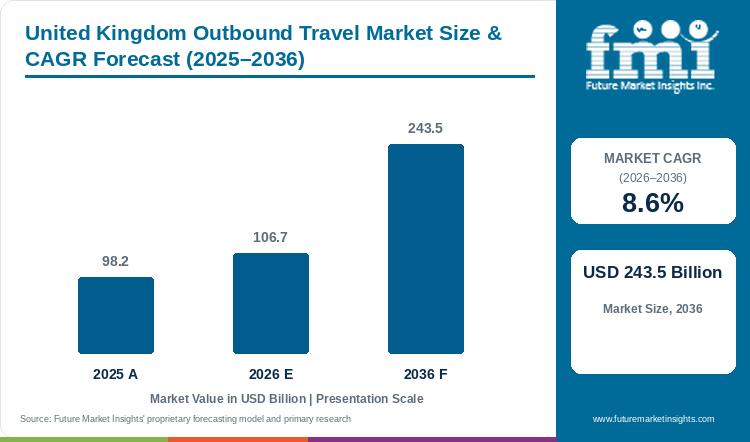
The market was valued at USD 98.2 billion in 2025 and is estimated to reach USD 106.7 billion in 2026. It is projected to grow at a CAGR of 8.6% from 2026 to 2036 and reach USD 243.5 billion by 2036.
Demand for outbound travel from the United Kingdom is broadening beyond the traditional package, with independent travel and online booking setting the pace. Conflict in the Middle East has pushed bookings towards Europe and towards travel professionals in 2026, and the market is expected to keep growing at high single-digit rates through 2036. The Office for National Statistics estimates that UK residents made 99.9 million visits abroad in 2025 and spent GBP 86.2 billion (USD 115.5 billion). [1] In a July 2026 survey by ABTA, 31% of UK adults said they were more likely than before the conflict to book with a travel professional. [2] The United Kingdom outbound travel market is estimated at USD 106.7 billion in 2026, up from USD 98.2 billion in 2025, and is projected to reach USD 243.5 billion by 2036 at an 8.6% CAGR.
Market Size & Forecast
Table 1: United Kingdom Outbound Travel Market Size and Forecast (USD billion and CAGR percentage), 2025 to 2036
| Market size and forecast | Value |
|---|---|
| 2025 Value | USD 98.2 billion |
| Estimated market size in 2026 | USD 106.7 billion |
| Projected market size by 2036 | USD 243.5 billion |
| CAGR (2026-2036) | 8.6% |
| Added revenue, 2026 to 2036 | USD 136.8 billion |
Between 2026 and 2036 the market is expected to add USD 136.8 billion. Visits abroad by Great Britain residents rose 5.0% in the third quarter of 2025 and 2.5% in the fourth, while spending fell 1.2% and then rose 0.8%, [1] so the next stage of growth depends as much on spending per visit as on the number of visits.
Demand and Booking Indicators
Table 2: Demand and Booking Indicators for the United Kingdom Outbound Travel Market (visits, pounds and percentages), 2025 to 2026
| Metric | Value |
|---|---|
| UK resident visits abroad, 2025 | 99.9 million [1] |
| UK resident spending abroad, 2025 | GBP 86.2 billion (USD 115.5 billion) [1] |
| UK adults more likely to use a travel professional, 2026 survey | 31% [2] |
| TUI booked revenue in the United Kingdom, summer 2026 | Down 8% [3] |
| Expedia Group booked room nights, second quarter 2026 | Up 6% [6] |
Key Market Trends & Insights
- By traveller type: Independent travellers are expected to account for 42.8% of the market in 2026, as travellers prefer flexibility and personalisation.
- Online booking is estimated to hold 64.5% by booking channel in 2026, since travellers compare fares and hotel options in real time.
- Day trips and local gateways are projected to make up 35.7% by type in 2026, helped by affordability and time efficiency.
Destination Highlights
- Spain was the most visited destination for Great Britain residents in 2025 with 19.1 million visits, followed by France with 9.1 million and Italy with 5.7 million. [1]
- Among UK adults planning an overseas holiday, 84% intend to travel within Europe, and Spain is the most popular destination at 38%, followed by Italy at 23% and France at 19%. [2]
Analyst Perspective
“UK travellers are still booking trips abroad, but they are booking later, closer to home in Europe and, since the Middle East conflict, more often through travel professionals. Operators that make the price, the protection and the terms for changing a booking clear are likely to hold the customers who continue to travel.”
- Ronak Shah, Principal Consultant, Future Market Insights.
How is the United Kingdom outbound travel market segmented?
The United Kingdom outbound travel market is segmented by type, traveller type, booking channel and age group. By type, the market is sub segmented into day trips and local gateways, museums, pilgrimages, religious and heritage tours, and others. By traveller type, it is sub segmented into independent traveller, tour group and package traveller, and by booking channel into online booking and offline booking. By age group, it is sub segmented into 0 to 20, 21 to 40, 41 to 60 and 60 above years.
Why are day trips and local gateways the leading segment by type?
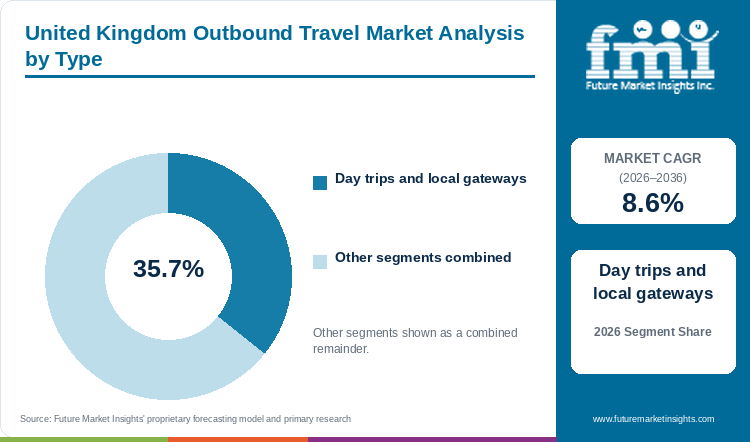
Day trips and local gateways are estimated to account for 35.7% by type in 2026.
Table 3: Type Leadership and Market Growth for the United Kingdom Outbound Travel Market (segment and CAGR percentage), 2026 to 2036
| Metric | Value |
|---|---|
| Market CAGR (2026 to 2036) | 8.6% |
| Leading segment | Day trips and local gateways (35.7% of the market in 2026) |
Short trips suit travellers with limited time, because the cost and planning effort are small and the decision can be made close to the date. Late booking is already common in 2026: among UK adults planning an overseas summer holiday, 30% intended to book two to four weeks before departure and a further 10% less than two weeks before. [2] A short trip abroad turns on how much of the stay remains after travel, so an operator that shows travel times alongside the planned stay helps the customer judge the value. Where the trip includes a scheduled visit, the arrival and departure need to fit around it. FMI finds that providers serve this segment best by selling the travel and the activity as one clear offer at a price that can be confirmed quickly.
Why are independent travellers the leading segment by traveller type?
Independent travellers are expected to hold 42.8% by traveller type in 2026.
An independent traveller chooses transport and accommodation separately and takes on the work of matching the suppliers and their conditions. That choice carries a difference in protection: UK government guidance defines a package as two or more distinct types of travel service combined for the same trip, and notes that linked travel arrangements, which are sold under separate contracts, carry fewer regulatory requirements. [4] Disruption may make customers value that protection more. In the ABTA survey, 27% of travellers said they were more likely to book a package than before the Middle East conflict, citing having everything taken care of (52%) and the right to a refund or replacement (48%). [2] For operators serving independent travellers, this means pricing each service separately, explaining which parts are protected and providing a coordinated package to customers who want one.
Why is online booking the leading segment by booking channel?
Online booking is anticipated to account for 64.5% by booking channel in 2026.
Online intermediaries let a traveller compare transport, accommodation and activities in one place and complete the reservation without a separate contact. Booking.com listed about 4.7 million accommodation properties on 30 June 2026, [7] and Expedia Group’s booked room nights grew 6% in the second quarter of 2026. [6] Online booking covers several routes: a customer can reserve directly with an airline or hotel, use an intermediary, or combine digital research with the advice of a travel agent. A flight amendment can affect an independently booked hotel, so access to booking details and clear service responsibilities matter after payment. FMI finds that intermediaries keep customers by showing the final price with the conditions attached and by saying which provider will handle a change.
How does age group shape outbound travel choices?
Age-group coverage includes travellers aged 0 to 20, 21 to 40, 41 to 60, and 60 above. Trip planning varies with the itinerary and the support required. Cruises and organised holidays can combine accommodation, transport and assistance in one booking for older travellers. Independent travellers can select individual services, while groups and package customers can have the arrangements coordinated by a provider.
What are the drivers, restraints and opportunities in the United Kingdom outbound travel market?
In the United Kingdom outbound travel market, a strong habit of holidays abroad and flexible booking support an 8.6% CAGR through 2036. At the same time, disruption to routes through the Middle East and late booking restrain faster expansion. [2][3]
Driver: Established holiday demand supports repeat outbound bookings. Holidays abroad remain a fixed part of household and retirement spending, so demand can hold even when conditions are uncertain. Saga’s holiday passenger numbers, for example, rose 11% to 60,800 in the year to 31 January 2026. [5]
Restraint: Route disruption delays bookings. Disruption to routes and uncertainty about safety make customers hesitate before they commit. TUI’s booked revenue for summer 2026 in the United Kingdom stood 8% below the previous year, [3] and many routes to or through the Middle East remained suspended in July 2026. [2]
Opportunity: Cruises support advance bookings. Long-lead cruise and older-traveller demand give operators a base for the next season. Saga’s ocean cruise bookings for 2026/27 stood at a 79% load factor in April 2026, with the per diem 13% ahead of a year earlier. [5]
How do destination forecasts compare?
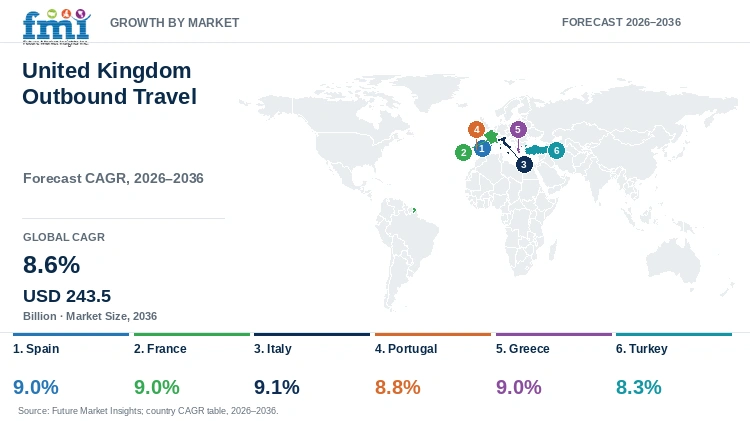
Table 4: Destination Growth Outlook for the United Kingdom Outbound Travel Market (CAGR percentage), 2026 to 2036 — FMI estimates
| Destination | CAGR (2026-2036) |
|---|---|
| Spain | 9.0% |
| France | 9.0% |
| Italy | 9.1% |
| Portugal | 8.8% |
| Greece | 9.0% |
| Turkey | 8.3% |
Source: Future Market Insights estimates.
UK-origin tourism expenditure is projected to grow across the six profiled destinations from 2026 to 2036. These destination forecasts are FMI estimates.
What is the outlook for travel from the United Kingdom to Spain?
UK-origin tourism expenditure in Spain is projected to grow at an estimated 9.0% CAGR from 2026 to 2036.
What is the outlook for travel from the United Kingdom to France?
UK-origin tourism expenditure in France is projected to grow at an estimated 9.0% CAGR from 2026 to 2036.
What is the outlook for travel from the United Kingdom to Italy?
UK-origin tourism expenditure in Italy is projected to grow at an estimated 9.1% CAGR from 2026 to 2036.
What is the outlook for travel from the United Kingdom to Portugal?
UK-origin tourism expenditure in Portugal is projected to grow at an estimated 8.8% CAGR from 2026 to 2036.
What is the outlook for travel from the United Kingdom to Greece?
UK-origin tourism expenditure in Greece is projected to grow at an estimated 9.0% CAGR from 2026 to 2036.
What is the outlook for travel from the United Kingdom to Turkey?
UK-origin tourism expenditure in Turkey is projected to grow at an estimated 8.3% CAGR from 2026 to 2036.
Who are the notable companies in the United Kingdom outbound travel market?
Online platforms, travel agencies, tour operators and direct suppliers compete at different stages of a trip. TUI, Saga, Expedia and Booking.com are the companies covered in this report; their offers range from complete packages and cruises to online marketplaces for flights and accommodation. A package organiser coordinates the included services, while an online platform gives the traveller wider choice and leaves more of the work of matching suppliers to the customer.
Key Developments in the United Kingdom Outbound Travel Market
- On 7 April 2025 the Department for Business and Trade opened a consultation on the package travel regulations, including options to limit the ways a linked travel arrangement can be created, and updated the page on 2 December 2025. [4]
- Saga reported results for the year to 31 January 2026 on 15 April 2026, with ocean cruise underlying profit before tax up 38% to GBP 67.3 million (USD 90 million). [5]
- Expedia Group reported second-quarter results on 5 August 2026, with business-to-business gross bookings up 21%. [6]
- TUI reported third-quarter results on 12 August 2026 and reaffirmed its FY26 underlying EBIT guidance. [3]
- The ONS published Travel trends: 2025 on 16 October 2026 and labelled the estimates official statistics in development. [1]
Key Players in the United Kingdom Outbound Travel Market
- TUI
- Saga
- Expedia
- Booking.com
This Report Answers
- How big is the United Kingdom outbound travel market in 2026?
- What value is forecast by 2036?
- What is the added revenue between 2026 and 2036?
- Which type leads the market?
- Which traveller type leads the market?
- Which booking channel leads the market?
United Kingdom Outbound Travel Market - Report Scope
Table 5: Report Scope for the United Kingdom Outbound Travel Market (coverage fields and definitions), 2026 to 2036
| Coverage field | Report scope |
|---|---|
| Market breakdown | Type (Day Trips & Local Gateways, Museums, Pilgrimages, Religious and Heritage Tours, Others); Traveler Type (Independent Traveller, Tour Group, Package Traveller); Booking Channel (Online Booking, Offline Booking); Age Group (0 to 20 Years, 21 to 40 Years, 41 to 60 Years, 60 Above) |
| Quantitative Units | Revenue in USD billion and CAGR from 2026 to 2036 |
| Market Definition | Outbound travel by United Kingdom residents to international destinations, by type, traveller type, booking channel and age group |
| Regions Covered | North America, Latin America, Western Europe, Eastern Europe, Balkan & Baltic Countries, Russia & Belarus, Central Asia, East Asia, South Asia & Pacific, Middle East & Africa |
| Key Companies Covered | TUI, Saga, Expedia and Booking.com |
| Forecast Period | 2026 to 2036 (with 2025 historical baseline) |
| Approach | Combined primary interviews, secondary literature analysis, and top-down data triangulation |
| Countries Covered | Spain, France, Italy, Portugal, Greece, Turkey |
| Geography Scope | United Kingdom is the origin market. The listed destination countries receive individual growth profiles; the overall market covers outbound travel to international destinations. |
United Kingdom Outbound Travel Market - Research Methodology
The market assessment combines primary interviews with industry participants and secondary research drawn from company disclosures, trade data and industry publications. Market size is built from supply-side and demand-side estimates and validated top-down, and segment shares and competitive positioning are checked through data triangulation before publication.
United Kingdom Outbound Travel Market by Segments
By Type
- Day trips and local gateways
- Museums
- Pilgrimages
- Religious and heritage tours
- Others
By Traveller Type
- Independent traveller
- Tour group
- Package traveller
By Booking Channel
- Online booking
- Offline booking
By Age Group
- 0 to 20 years
- 21 to 40 years
- 41 to 60 years
- 60 above
Research Sources and Bibliography
- [1] Office for National Statistics. Travel trends: 2025. 16 October 2026.
- [2] TravelMole. Middle East conflict drives travel agent bookings (ABTA survey). 13 July 2026.
- [3] TUI Group. Q3 FY2026 trading update: resilient Q3 underlying EBIT of EUR 234.6m at constant currency, FY26 guidance reaffirmed. 12 August 2026.
- [4] UK Government, Department for Business and Trade. Package travel: updating the framework, 2025. Updated 2 December 2025.
- [5] Saga plc. Preliminary results for the year ended 31 January 2026. 15 April 2026.
- [6] Expedia Group. Second Quarter 2026 Results. 5 August 2026.
- [7] Booking Holdings. Investor Relations overview, properties on the Booking.com platform as of 30 June 2026. October 2026.
Frequently Asked Questions
How big is the United Kingdom outbound travel market in 2026?
The market is estimated at USD 106.7 billion in 2026.
What value is forecast by 2036?
The market is projected to reach USD 243.5 billion by 2036 at an 8.6% CAGR from 2026 to 2036.
What is the added revenue between 2026 and 2036?
The market is projected to add USD 136.8 billion between 2026 and 2036.
Which type leads the market?
Day trips and local gateways are estimated to account for 35.7% of the market by type in 2026.
Which traveller type leads the market?
Independent travellers are expected to hold 42.8% of the market by traveller type in 2026.
Which booking channel leads the market?
Online booking is anticipated to account for 64.5% of the market by booking channel in 2026. Competitive Analysis of the United Kingdom Outbound Travel Market Key Players
Preview the report firsthand - request a free sample
Get SampleGet the brochure for pricing and purchase details.
Get PDFTable of Content
- Key Takeaways
- Market Size and CAGR
- Top Growth Driver
- Fastest Growing Segment
- Leading Region
- Key Companies
- Emerging Opportunities
- Executive Summary
- Global Market Outlook
- Demand-side Trends
- Supply-side Trends
- Technology Roadmap Analysis
- Analysis and Recommendations
- Analyst Perspective (What is happening? Why now? What should investors know?)
- Key Questions Answered
- How large is the market?
- What is the CAGR?
- What are key trends?
- Which region dominates?
- Who are the leaders?
- Market Overview
- Market Coverage / Taxonomy
- Market Definition / Scope / Limitations
- Research Methodology
- Chapter Orientation
- Analytical Lens and Working Hypotheses
- Market Structure, Signals, and Trend Drivers
- Benchmarking and Cross-market Comparability
- Market Sizing, Forecasting, and Opportunity Mapping
- Research Design and Evidence Framework
- Desk Research Programme (Secondary Evidence)
- Expert Input and Fieldwork (Primary Evidence)
- Tooling, Models, and Reference Databases
- Data Engineering and Model Build
- Quality Assurance and Audit Trail
- Market Background
- Market Dynamics (Drivers, Restraints, Opportunity, Trends)
- Scenario Forecast (Optimistic, Likely, Conservative)
- Impact Analysis
- AI Impact
- Sustainability Impact
- Regulatory Impact
- Technology Impact
- Consumer / Buyer Analysis
- Purchase Drivers
- Adoption Barriers
- Buyer Journey
- Opportunity Map Analysis
- Product Life Cycle Analysis
- Supply Chain Analysis
- Investment Feasibility Matrix
- Value Chain Analysis
- PESTLE and Porter's Analysis
- Regulatory Landscape
- Regional Parent Market Outlook
- Production and Consumption Statistics
- Import and Export Statistics
- Global Market Analysis and Forecast, 2021 to 2036
- Historical Market Size Value (USD Billion) Analysis, 2021 to 2025
- Current and Future Market Size Value (USD Billion) Projections, 2026 to 2036
- Y-o-Y Growth Trend Analysis
- Absolute $ Opportunity Analysis
- Global Market Pricing Analysis, 2021 to 2036
- Global Market Analysis and Forecast, By Type, 2021 to 2036
- Introduction / Key Findings
- Historical Market Size Value (USD Billion) Analysis By Type, 2021 to 2025
- Current and Future Market Size Value (USD Billion) Analysis and Forecast By Type, 2026 to 2036
- Day trips and local gateways
- Museums
- Pilgrimages
- Religious and heritage tours
- Others
- Y-o-Y Growth Trend Analysis By Type, 2021 to 2025
- Absolute $ Opportunity Analysis By Type, 2026 to 2036
- Global Market Analysis and Forecast, By Traveller Type, 2021 to 2036
- Introduction / Key Findings
- Historical Market Size Value (USD Billion) Analysis By Traveller Type, 2021 to 2025
- Current and Future Market Size Value (USD Billion) Analysis and Forecast By Traveller Type, 2026 to 2036
- Independent traveller
- Tour group
- Package traveller
- Y-o-Y Growth Trend Analysis By Traveller Type, 2021 to 2025
- Absolute $ Opportunity Analysis By Traveller Type, 2026 to 2036
- Global Market Analysis and Forecast, By Booking Channel, 2021 to 2036
- Introduction / Key Findings
- Historical Market Size Value (USD Billion) Analysis By Booking Channel, 2021 to 2025
- Current and Future Market Size Value (USD Billion) Analysis and Forecast By Booking Channel, 2026 to 2036
- Online booking
- Offline booking
- Y-o-Y Growth Trend Analysis By Booking Channel, 2021 to 2025
- Absolute $ Opportunity Analysis By Booking Channel, 2026 to 2036
- Global Market Analysis and Forecast, By Age Group, 2021 to 2036
- Introduction / Key Findings
- Historical Market Size Value (USD Billion) Analysis By Age Group, 2021 to 2025
- Current and Future Market Size Value (USD Billion) Analysis and Forecast By Age Group, 2026 to 2036
- 0 to 20 years
- 21 to 40 years
- 41 to 60 years
- 60 above
- Y-o-Y Growth Trend Analysis By Age Group, 2021 to 2025
- Absolute $ Opportunity Analysis By Age Group, 2026 to 2036
- Key Countries Market Analysis
- Spain
- Pricing Analysis
- Market Share Analysis, 2025
- By Type
- By Traveller Type
- By Booking Channel
- By Age Group
- France
- Pricing Analysis
- Market Share Analysis, 2025
- By Type
- By Traveller Type
- By Booking Channel
- By Age Group
- Italy
- Pricing Analysis
- Market Share Analysis, 2025
- By Type
- By Traveller Type
- By Booking Channel
- By Age Group
- Portugal
- Pricing Analysis
- Market Share Analysis, 2025
- By Type
- By Traveller Type
- By Booking Channel
- By Age Group
- Greece
- Pricing Analysis
- Market Share Analysis, 2025
- By Type
- By Traveller Type
- By Booking Channel
- By Age Group
- Turkey
- Pricing Analysis
- Market Share Analysis, 2025
- By Type
- By Traveller Type
- By Booking Channel
- By Age Group
- Spain
- Market Structure Analysis
- Competition Dashboard
- Competition Benchmarking
- Market Share Analysis of Top Players
- By Regional
- By Type
- By Traveller Type
- By Booking Channel
- By Age Group
- Emerging Startups
- Innovation Benchmarking
- Competition Analysis
- Competition Deep Dive
- TUI
- Overview
- Product Portfolio
- Profitability by Market Segments
- Sales Footprint
- Strategy Overview
- Marketing Strategy
- Product Strategy
- Channel Strategy
- Saga
- Expedia
- Booking.com
- TUI
- Case Studies
- Success Stories
- Recent Developments
- Competition Deep Dive
- Assumptions & Acronyms Used


