

- Industry Size (2026)
- USD 167.7 Bn
- Forecast (2036)
- USD 419.2 Bn
- CAGR (2026 to 2036)
- 9.6%
China Outbound Travel Market Forecast and Outlook 2026 to 2036
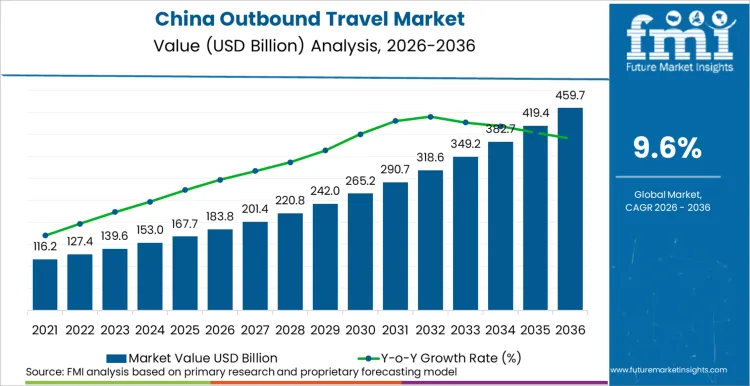
The China outbound travel sector is on track to achieve a valuation of USD 459.4 billion by 2036, expanding from USD 183.8 billion in 2026 at a CAGR of 9.6%. As per Future Market Insights, expansion is structurally underpinned by the recovery and expansion of Chinese middle-class disposable income, the rapid proliferation of visa-free travel arrangements between China and destination countries, and the integration of AI-powered travel planning into the booking workflow of China's dominant online travel agencies.
The China Tourism Academy reported that Chinese outbound trips reached 130 million in 2024, recovering to approximately 85% of the 2019 peak, with the trajectory pointing toward full recovery and growth beyond pre-pandemic levels by 2026. This recovery compels international destinations, airlines, and hospitality operators to rebuild and expand their China-facing marketing, language, and payment infrastructure. Simultaneously, the Chinese government has expanded visa-free arrangements to over 50 countries as of early 2026, reducing the primary friction point for outbound travel and creating a structural enabler for spontaneous and short-notice international trips.
Lydia Li, Deputy General Manager of Messe Berlin China, stated: 'The goal of the report is to help them better understand Chinese travel demand and industry dynamics, identify opportunities, stay in step with market shifts.' This confirms that international tourism industry bodies are investing in dedicated China market intelligence to capture the returning wave of Chinese travelers. FMI opines that the China outbound travel market is entering a new phase where traveler independence, digital booking sophistication, and experiential travel preferences replace the group-tour, shopping-focused model that dominated pre-pandemic Chinese outbound tourism.
The competitive and structural landscape in 2025 and 2026 has been defined by technology integration and diplomatic facilitation. Trip.com Group announced a leadership reshuffle in February 2025, appointing new CPO and division CEOs to pivot its core strategy toward AI-powered travel planning and intelligent customer service for the independent outbound traveler. Trip.com Group showcased a joint initiative with Google at the World Travel Market in November 2025, leveraging data insights and AI to map shifting motivations in the Chinese outbound market from 'escape-based' travel to 'connection-based' travel. He Yongqian, spokesperson for China's Ministry of Commerce, confirmed that by end of 2025, Chinese investors had established over 50,000 overseas enterprises across 190 countries, creating a business travel infrastructure that supports broader tourism flows.
The expansion of visa-free arrangements to Southeast Asia, Middle East, and select European destinations through 2025 directly reduced booking friction for outbound travelers. As per FMI, this convergence of AI travel technology, government diplomatic facilitation, and evolving traveler psychology confirms that the China outbound travel market is undergoing a structural transformation that will reshape global tourism demand patterns.
Key Takeaways
The China outbound travel market is controlled by a concentrated platform oligopoly where Trip.com Group (Ctrip), Alibaba's Fliggy, Meituan Travel, and Qunar collectively command the majority of outbound travel booking volume. FMI analysts observe that Trip.com Group's AI pivot positions it as the technology leader, while Fliggy leverages Alipay's 1.3 billion user ecosystem for payment-integrated booking, creating a two-platform dominance structure that emerging competitors struggle to challenge.
Pricing asymmetry in the China outbound travel market exists between budget outbound travel to Southeast Asian visa-free destinations (USD 500 to 1,500 per trip) and premium experiential travel to Europe, Japan, and luxury resort destinations (USD 5,000 to 20,000+ per trip). As per FMI, the premium segment is growing faster than budget travel as Chinese travelers increasingly prioritize unique experiences, cultural immersion, and personalized itineraries over shopping-focused group tours.
Sourcing fragility is concentrated in airline seat capacity and visa processing infrastructure. International seat capacity from Chinese airports has not fully recovered to 2019 levels, creating supply constraints on peak routes to Japan, Southeast Asia, and Europe. Visa processing backlogs for destinations without visa-free arrangements (USA, Canada, most of EU) continue to suppress demand below potential. FMI is of the opinion that every additional visa-free country agreement signed by China creates an immediate and measurable increase in outbound traffic to that destination.
Brand and compliance risks center on geopolitical tensions affecting travel sentiment and destination accessibility. Diplomatic relations between China and individual destination countries directly influence travel advisory issuance, airline route availability, and traveler confidence. The US-China relationship, in particular, continues to constrain Chinese outbound travel to North America well below pre-pandemic levels.
Geographic leverage in destination selection is shifting from traditional shopping destinations (Hong Kong, South Korea, Japan) toward experiential and cultural destinations (Southeast Asia, Middle East, Central Asia). Southeast Asia commands the largest share of Chinese outbound trips due to proximity, affordability, and widespread visa-free access. Japan remains the premium Asian destination. Europe is recovering but constrained by visa processing times. FMI analysts note that Middle East destinations (UAE, Saudi Arabia) are emerging as significant growth markets driven by visa liberalization and luxury positioning.
The executive reframing for the China outbound travel market is that the Chinese traveler is fundamentally different from 2019. FMI analysts emphasize that destination marketing organizations and hospitality operators must invest in Mandarin-language AI chatbots, WeChat/Alipay payment integration, and experiential product development rather than relying on group-tour operator partnerships that no longer match the independent, digitally-native Chinese traveler profile.
Summary of China Outbound Travel Market
What Is Growth Outlook for China Outbound Travel Market as per Future Market Insights Projection?
Future Market Insights projects the China outbound travel market to expand at a CAGR of 9.6% from 2026 to 2036, increasing from USD 183.8 Billion in 2026 to USD 459.4 Billion by 2036.
FMI Research Approach: FMI proprietary forecasting model based on China Tourism Academy outbound trip data, visa-free country expansion tracking, and disposable income growth projections.
How Do FMI Analysts Perceive China Outbound Travel Market to Evolve?
FMI analysts perceive the market evolving toward AI-assisted independent travel planning, experiential destination selection, and visa-free spontaneous booking where technology sophistication and diplomatic facilitation jointly determine market growth.
FMI Research Approach: Trip.com Group AI strategy disclosures and Chinese government visa-free agreement tracking.
Which Country Holds Largest Share in Global China Outbound Travel Market?
China is the sole origin country in this market scope, with Southeast Asia (Thailand, Japan, South Korea) receiving the largest share of Chinese outbound trips by volume.
FMI Research Approach: FMI destination-level revenue modeling by Chinese arrival statistics and per-trip spending data.
How Large Will China Outbound Travel Market Be by 2036?
The China outbound travel market is projected to reach USD 459.4 Billion by 2036.
FMI Research Approach: FMI long-term revenue forecast derived from Chinese middle-class income projections and outbound trip frequency modeling.
What Is Definition of China Outbound Travel Market?
The China outbound travel market includes revenue from international leisure, business, and experiential travel originating from mainland China, covering flights, accommodation, tours, activities, insurance, and destination spending by Chinese travelers abroad.
FMI Research Approach: FMI market taxonomy and inclusion-exclusion framework.
What Are Globally Unique Trends Shaping China Outbound Travel Market?
Globally unique trends include Trip.com's AI-powered travel planning integration, the Chinese government's expansion of visa-free arrangements to 50+ countries, and the structural shift from group-tour shopping to independent experiential travel.
FMI Research Approach: Trip.com Group leadership announcements and Chinese Ministry of Foreign Affairs visa policy tracking.
China Outbound Travel Market Key Takeaways
| Metric | Details |
|---|---|
| Industry Size (2026) | USD 183.8 Billion |
| Industry Value (2036) | USD 459.4 Billion |
| CAGR (2026 to 2036) | 9.6% |
Source: Future Market Insights (FMI) analysis, based on proprietary forecasting model and primary research
Semi-annual Market Update for the China Outbound Travel Market
The following chart compares the growth trends for the China outbound travel market between the base year of 2024 and 2025.
CAGR Values for China Outbound Travel Market (2024 to 2025)
It is anticipated that the China outbound travel market will see a CAGR of 8.5% in the first half of 2025, increasing slightly to 8.6% in the second half. This trend is expected to continue into 2026, with an increase to 9.2% in H1 2025, and further growth to 9.6% in H2 2026 as more Chinese travelers seek international vacations.
Market Definition
The China outbound travel market represents revenue generated from international travel originating from mainland China, covering leisure, business, and experiential tourism. The market measures total spending by Chinese outbound travelers including flights, accommodation, tours, activities, shopping, dining, and travel insurance purchased for international trips.
Inclusions cover international flight bookings from Chinese airports, overseas hotel and accommodation bookings, package tours and independent travel itineraries, destination activities and experiences, travel insurance, visa processing fees, and destination shopping and dining spending attributable to Chinese travelers. Online travel agency platform revenue from outbound bookings is included.
Exclusions include domestic Chinese tourism, Hong Kong, Macau, and Taiwan travel (counted separately in Chinese statistics), inbound tourism to China, international student education spending, and permanent emigration-related relocation costs. Business travel spending on conferences and exhibitions where the primary purpose is not tourism is outside the scope.
Footprint of the China Outbound Travel Industry in Asia (2026)
| Category | Details |
|---|---|
| Market Value | The China outbound travel industry is projected to generate USD 154.1 billion in 2026, accounting for 18% of the Asian outbound tourism market. |
| Domestic Market Share | Domestic outbound tourism accounts for 62%, with key destinations including Japan, Thailand, and South Korea. |
| International Market Share | Chinese travelers represent 38% of outbound tourism in Asia, with popular destinations such as Thailand, Japan, and Malaysia. |
| Key Destinations | Popular destinations include Tokyo (Japan), Bangkok (Thailand), Seoul (South Korea), and Kuala Lumpur (Malaysia). |
| Economic Impact | The industry contributes significantly to the Asian economies through tourism spending, especially on shopping, dining, and entertainment. |
| Key Trends | Increase in group tours for cultural experiences, growth of luxury shopping tourism, and rise in eco-tourism. |
| Top Travel Seasons | Peak travel times include Chinese New Year, Golden Week, and summer holidays. Popular destinations often offer unique cultural experiences or shopping opportunities. |
In 2024, the footprint of China's outbound travel industry in Asia is marked by significant growth. The market is projected to reach USD 35 billion, representing 18% of the region’s outbound tourism market. With Chinese tourists making up 38% of outbound travel to neighboring countries, destinations like Japan, Thailand, and South Korea continue to see high volumes of visitors. For instance, Tokyo and Kyoto in Japan are still popular for their combination of modern and traditional culture.
Bangkok, which is famous for its cultural attractions and luxury shopping malls, continues to be a favorite among Chinese tourists looking for retail and leisure activities. Others like Kuala Lumpur are also becoming increasingly popular for their cultural activities and affordability. These countries benefit from China’s growing middle class, eager to travel for luxury shopping, cultural exploration, and relaxation. Seasonal peaks during Chinese New Year and Golden Week are particularly notable, as Chinese tourists flock to these destinations for long breaks, contributing significantly to local economies through spending on shopping, hotels, and entertainment.
Recent Developments
| Date | Development & Details |
|---|---|
| Jan 2025 | Introduction of Customized Wellness Travel Packages -Several leading travel agencies like Ctrip are launching customized wellness travel packages, offering everything from spa retreats in Thailand to traditional Chinese medicine experiences in Bali. |
| Dec 2025 | Launch of Luxury Tours to Europe -Leading luxury tour operator, Abercrombie & Kent, expanded its offerings to Chinese tourists, creating bespoke itineraries to destinations like Switzerland, Italy, and France. |
| Nov 2025 | Direct Flights to Canada -Air China announced new direct flights from Beijing to Vancouver, catering to the rising number of travelers exploring North America for both leisure and business. |
| Oct 2025 | Tourism Growth to Australia and New Zealand -Major tour operators like China CYTS have introduced packages for family-oriented experiences in Australia, such as visits to the Great Barrier Reef and theme parks in Sydney. |
| Sept 2025 | Digital Nomad Packages -Travel brands like Traveloka began offering packages for Chinese digital nomads, targeting remote workers seeking destinations such as Bali and Lisbon, equipped with co-working spaces and local tours. |
An Analysis of China Outbound Travel Categories by Type and Traveller Type
% Share of Individual Categories by Type and Traveller Type in 2026
Day Trips & Local Gateways Lead the Segment
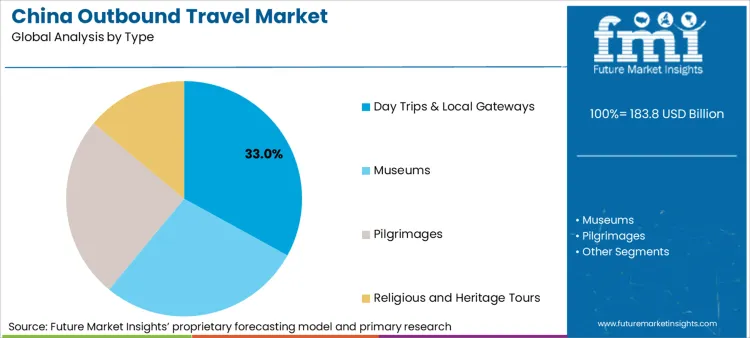
In 2026, Day Trips & Local Gateways are forecasted to constitute 33% of China’s outbound travel market, positioning them as a leading category. This segment is fueled by Chinese travelers' preference for quick, affordable trips to nearby countries or regions. Many of these trips are driven by the desire to take advantage of long weekends, public holidays, or short breaks, making local getaways a popular choice for those with limited vacation time. The proximity of Southeast Asia, especially destinations like Hong Kong, Macau, Taiwan, and Japan, plays a crucial role in the growth of this category, offering Chinese travelers the convenience of quick flights and minimal travel logistics.
For example, travelers from Shanghai often head to Taiwan for a weekend of cultural exploration, enjoying the island’s blend of natural beauty, vibrant cities, and rich traditions. Similarly, Hong Kong remains a top destination for quick getaways, offering shopping, food, and entertainment that attracts Chinese tourists seeking a brief yet engaging escape. With direct flights, hassle-free border formalities, and convenient hotels, these places are a compelling, hassle-free choice for tourists seeking a quick change of pace without having to go through elaborate travel planning.
The rapid expansion of budget airlines and easy visa processes in Asia further strengthens the Day Trips & Local Gateways segment. A growing number of Chinese tourists are choosing to visit countries like Thailand, South Korea, and Malaysia for short vacations, enjoying the benefit of shorter flight times and affordable accommodations. This also includes support in its growth category; growing mobile application usage and online platforms enabling the last-minute booking; hence, more flexibility for travelers to plan and go on a trip on impulse.
Independent Travelers Lead the Market
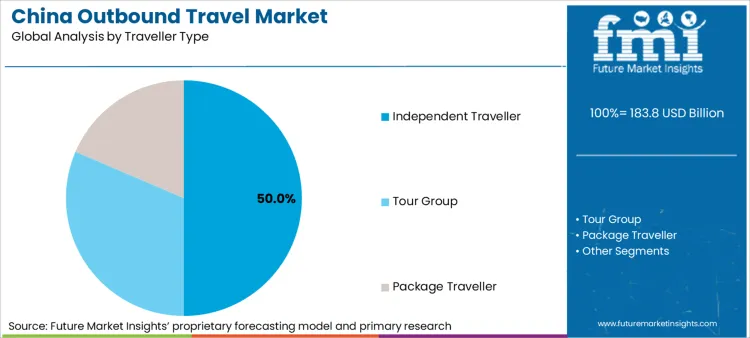
In 2026, independent travelers are set to represent 50% of China’s outbound tourism market, reflecting a shift towards more personalized, flexible, and self-guided travel experiences. This segment includes solo travelers, couples, and families who prefer the freedom to design their own itineraries, rather than following pre-arranged tours. For solo tourists, places in Southeast Asia, like Bali, Thailand, and Singapore, are especially attractive based on their rich cultures, convenient access, and nature-based activities. Solo tourists tend to enjoy indulging in native customs, learning about cultural festivals, or unwinding in peaceful surroundings, which are suitable for independent travels in these areas. Bali, with its yoga retreats and tranquil beaches, or Thailand’s bustling markets and temples, cater well to the desires of independent travelers seeking a mix of adventure, relaxation, and cultural discovery.
Couples and families are also embracing independent travel, seeking destinations where they can tailor their trips according to their specific interests. For example, a couple might choose Paris for its romantic ambiance, fine dining experiences, and world-class art museums. Similarly, families might opt for Rome to explore its historical landmarks such as the Colosseum, while enjoying family-friendly activities like cooking classes or guided city tours. These trips offer the ability to customize the experience to suit the tastes and preferences of each traveler, from luxury accommodations to specialized activities.
The rise of online booking platforms like Fliggy, Alibaba's travel platform, has further fueled this trend by allowing independent travelers to plan and book their entire trips-flights, hotels, activities, and more-directly. These platforms provide access to a wide range of options and personalized recommendations, empowering travelers to create their dream vacations. With features like user reviews, price comparisons, and tailor-made travel packages, travelers can focus on specific interests like shopping in Milan, culinary experiences in Tuscany, or sightseeing in New York, ensuring a highly personalized and rewarding travel experience.
Competitive Landscape
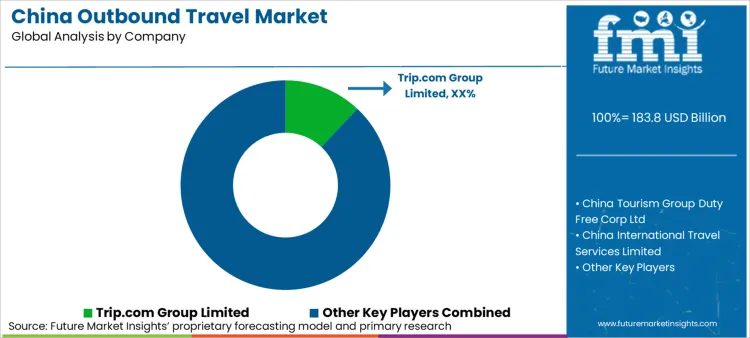
The China outbound travel industry is dominated by major online platforms and established travel agencies. Leading players include Trip.com Group Limited, China Tourism Group Duty Free Corp Ltd, and China International Travel Services Limited, who offer a wide range of options for all traveler types. Smaller, niche operators like LUXE Travel, specializing in luxury travel, and Klook, which focuses on day tours and activities, are also thriving by targeting high-net-worth individuals and specific tourism sectors. These specialized companies excel by offering unique experiences such as tailored cultural tours, culinary journeys, or luxury vacations.
2025 Market Share of China Outbound Travel Industry Players
In the China outbound travel industry, leading players include Trip.com Group Limited, China Tourism Group Duty Free Corp Ltd, and China International Travel Services Limited cater to luxury and tailored experiences, while smaller players focusing on adventure travel or cultural tourism make up 30% of the market.
Recent Developments
- In February 2025, Trip.com Group announced a leadership reshuffle including a new Chief Product Officer and division CEOs to pivot its core strategy toward AI-powered travel planning and intelligent customer service for independent outbound travelers.
- In November 2025, Trip.com Group showcased a joint initiative with Google at the World Travel Market, leveraging data insights and AI to map the shift in Chinese outbound travel motivations from escape-based to connection-based travel.
- Through 2025, the Chinese government expanded visa-free travel arrangements to over 50 countries, directly reducing booking friction and enabling spontaneous international travel for Chinese passport holders.
Scope of Report
| Items | Values |
|---|---|
| Quantitative Units (2026) | USD 183.8 Billion |
| Product Type | Leisure Travel, Business Travel, Experiential and Cultural Tourism, Luxury and Resort Travel, Adventure and Eco-Tourism, Medical and Wellness Tourism |
| Material Type | Group Tour Packages, FIT (Free Independent Travel), AI-Assisted Booking, OTA Platform Booking, Visa-Free Spontaneous Travel |
| End-Use / Channel | Trip.com Group (Ctrip), Fliggy (Alibaba), Meituan Travel, Qunar, Traditional Travel Agencies, Direct Booking |
| Regions Covered | Southeast Asia, East Asia (Japan, South Korea), Europe, Middle East, Oceania, North America |
| Countries Covered | Thailand, Japan, South Korea, Singapore, UAE, France, Australia, USA, and 50+ destinations |
| Key Companies Profiled | Trip.com Group, Fliggy (Alibaba), Meituan Travel, China International Travel Service (CITS), Spring Airlines, China Southern Airlines |
| Additional Attributes | Revenue analysis by destination and travel type, visa-free arrangement impact tracking, AI travel planning adoption rates, per-trip spending analysis, and airline seat capacity recovery monitoring |
Top Segments Studied in the China Outbound Travel Market Report
By Product Type:
- Leisure and Holiday Travel
- Business Travel
- Experiential and Cultural Tourism
- Luxury Resort Travel
- Adventure and Eco-Tourism
- Medical and Wellness Tourism
By Material Type:
- Group Tour Packages
- Free Independent Travel (FIT)
- AI-Assisted Itinerary Planning
- OTA Platform Direct Booking
- Visa-Free Spontaneous Travel
By Region:
- Southeast Asia
- East Asia (Japan, South Korea)
- Europe
- Middle East and Africa
- Oceania
- North America
Bibliography
- China Tourism Academy. (2025, January). 2024 Chinese outbound tourism statistics. CTA.
- Trip.com Group. (2025, February). Leadership restructuring and AI strategy announcement. Trip.com Group.
- Ministry of Commerce, People's Republic of China. (2026, January). Overseas enterprise establishment statistics. Gov.cn.
- Messe Berlin China. (2025, November). ITB China 2025-2026 Travel Trends Report. MICE in Asia.
Frequently Asked Questions
What is the current market size for China Outbound Travel?
The market is valued at USD 183.8 Billion in 2026, driven by visa-free expansion, AI-powered travel planning, and middle-class income growth.
What is the projected CAGR?
The market is projected to grow at a CAGR of 9.6% from 2026 to 2036.
Which destinations receive the most Chinese travelers?
Southeast Asia (Thailand, Singapore) leads by trip volume, Japan leads in premium travel spending, and the Middle East (UAE) is the fastest-growing destination category.
What are the primary market drivers?
Visa-free arrangement expansion, AI-integrated travel planning platforms, and the shift from group tours to independent experiential travel are the primary drivers.
Who are the leading platforms?
Trip.com Group, Fliggy, Meituan Travel, and Qunar are key players, differentiating through AI travel planning, payment ecosystem integration, and destination content depth.
Preview the report firsthand - request a free sample
Get SampleGet the brochure for pricing and purchase details.
Get PDFTable of Content
- Executive Summary
- Global Market Outlook
- Demand-side Trends
- Supply-side Trends
- Technology Roadmap Analysis
- Analysis and Recommendations
- Market Overview
- Market Coverage / Taxonomy
- Market Definition / Scope / Limitations
- Research Methodology
- Chapter Orientation
- Analytical Lens and Working Hypotheses
- Market Structure, Signals, and Trend Drivers
- Benchmarking and Cross-market Comparability
- Market Sizing, Forecasting, and Opportunity Mapping
- Research Design and Evidence Framework
- Desk Research Programme (Secondary Evidence)
- Company Annual and Sustainability Reports
- Peer-reviewed Journals and Academic Literature
- Corporate Websites, Product Literature, and Technical Notes
- Earnings Decks and Investor Briefings
- Statutory Filings and Regulatory Disclosures
- Technical White Papers and Standards Notes
- Trade Journals, Industry Magazines, and Analyst Briefs
- Conference Proceedings, Webinars, and Seminar Materials
- Government Statistics Portals and Public Data Releases
- Press Releases and Reputable Media Coverage
- Specialist Newsletters and Curated Briefings
- Sector Databases and Reference Repositories
- FMI Internal Proprietary Databases and Historical Market Datasets
- Subscription Datasets and Paid Sources
- Social Channels, Communities, and Digital Listening Inputs
- Additional Desk Sources
- Expert Input and Fieldwork (Primary Evidence)
- Primary Modes
- Qualitative Interviews and Expert Elicitation
- Quantitative Surveys and Structured Data Capture
- Blended Approach
- Why Primary Evidence is Used
- Field Techniques
- Interviews
- Surveys
- Focus Groups
- Observational and In-context Research
- Social and Community Interactions
- Stakeholder Universe Engaged
- C-suite Leaders
- Board Members
- Presidents and Vice Presidents
- R&D and Innovation Heads
- Technical Specialists
- Domain Subject-matter Experts
- Scientists
- Physicians and Other Healthcare Professionals
- Governance, Ethics, and Data Stewardship
- Research Ethics
- Data Integrity and Handling
- Primary Modes
- Tooling, Models, and Reference Databases
- Desk Research Programme (Secondary Evidence)
- Data Engineering and Model Build
- Data Acquisition and Ingestion
- Cleaning, Normalisation, and Verification
- Synthesis, Triangulation, and Analysis
- Quality Assurance and Audit Trail
- Market Background
- Market Dynamics
- Drivers
- Restraints
- Opportunity
- Trends
- Scenario Forecast
- Demand in Optimistic Scenario
- Demand in Likely Scenario
- Demand in Conservative Scenario
- Opportunity Map Analysis
- Product Life Cycle Analysis
- Supply Chain Analysis
- Investment Feasibility Matrix
- Value Chain Analysis
- PESTLE and Porter’s Analysis
- Regulatory Landscape
- Regional Parent Market Outlook
- Production and Consumption Statistics
- Import and Export Statistics
- Market Dynamics
- Global Market Analysis 2021 to 2025 and Forecast, 2026 to 2036
- Historical Market Size Value (USD Million) Analysis, 2021 to 2025
- Current and Future Market Size Value (USD Million) Projections, 2026 to 2036
- Y-o-Y Growth Trend Analysis
- Absolute $ Opportunity Analysis
- Global Market Pricing Analysis 2021 to 2025 and Forecast 2026 to 2036
- Global Market Analysis 2021 to 2025 and Forecast 2026 to 2036, By Type
- Introduction / Key Findings
- Historical Market Size Value (USD Million) Analysis By Type , 2021 to 2025
- Current and Future Market Size Value (USD Million) Analysis and Forecast By Type , 2026 to 2036
- Day Trips & Local Gateways
- Museums
- Pilgrimages
- Religious and Heritage Tours
- Day Trips & Local Gateways
- Y-o-Y Growth Trend Analysis By Type , 2021 to 2025
- Absolute $ Opportunity Analysis By Type , 2026 to 2036
- Global Market Analysis 2021 to 2025 and Forecast 2026 to 2036, By Traveller Type
- Introduction / Key Findings
- Historical Market Size Value (USD Million) Analysis By Traveller Type, 2021 to 2025
- Current and Future Market Size Value (USD Million) Analysis and Forecast By Traveller Type, 2026 to 2036
- Independent Traveller
- Tour Group
- Package Traveller
- Independent Traveller
- Y-o-Y Growth Trend Analysis By Traveller Type, 2021 to 2025
- Absolute $ Opportunity Analysis By Traveller Type, 2026 to 2036
- Global Market Analysis 2021 to 2025 and Forecast 2026 to 2036, By Region
- Introduction
- Historical Market Size Value (USD Million) Analysis By Region, 2021 to 2025
- Current Market Size Value (USD Million) Analysis and Forecast By Region, 2026 to 2036
- North America
- Latin America
- Western Europe
- Eastern Europe
- East Asia
- South Asia and Pacific
- Middle East & Africa
- Market Attractiveness Analysis By Region
- North America Market Analysis 2021 to 2025 and Forecast 2026 to 2036, By Country
- Historical Market Size Value (USD Million) Trend Analysis By Market Taxonomy, 2021 to 2025
- Market Size Value (USD Million) Forecast By Market Taxonomy, 2026 to 2036
- By Country
- USA
- Canada
- Mexico
- By Type
- By Traveller Type
- By Country
- Market Attractiveness Analysis
- By Country
- By Type
- By Traveller Type
- Key Takeaways
- Latin America Market Analysis 2021 to 2025 and Forecast 2026 to 2036, By Country
- Historical Market Size Value (USD Million) Trend Analysis By Market Taxonomy, 2021 to 2025
- Market Size Value (USD Million) Forecast By Market Taxonomy, 2026 to 2036
- By Country
- Brazil
- Chile
- Rest of Latin America
- By Type
- By Traveller Type
- By Country
- Market Attractiveness Analysis
- By Country
- By Type
- By Traveller Type
- Key Takeaways
- Western Europe Market Analysis 2021 to 2025 and Forecast 2026 to 2036, By Country
- Historical Market Size Value (USD Million) Trend Analysis By Market Taxonomy, 2021 to 2025
- Market Size Value (USD Million) Forecast By Market Taxonomy, 2026 to 2036
- By Country
- Germany
- UK
- Italy
- Spain
- France
- Nordic
- BENELUX
- Rest of Western Europe
- By Type
- By Traveller Type
- By Country
- Market Attractiveness Analysis
- By Country
- By Type
- By Traveller Type
- Key Takeaways
- Eastern Europe Market Analysis 2021 to 2025 and Forecast 2026 to 2036, By Country
- Historical Market Size Value (USD Million) Trend Analysis By Market Taxonomy, 2021 to 2025
- Market Size Value (USD Million) Forecast By Market Taxonomy, 2026 to 2036
- By Country
- Russia
- Poland
- Hungary
- Balkan & Baltic
- Rest of Eastern Europe
- By Type
- By Traveller Type
- By Country
- Market Attractiveness Analysis
- By Country
- By Type
- By Traveller Type
- Key Takeaways
- East Asia Market Analysis 2021 to 2025 and Forecast 2026 to 2036, By Country
- Historical Market Size Value (USD Million) Trend Analysis By Market Taxonomy, 2021 to 2025
- Market Size Value (USD Million) Forecast By Market Taxonomy, 2026 to 2036
- By Country
- China
- Japan
- South Korea
- By Type
- By Traveller Type
- By Country
- Market Attractiveness Analysis
- By Country
- By Type
- By Traveller Type
- Key Takeaways
- South Asia and Pacific Market Analysis 2021 to 2025 and Forecast 2026 to 2036, By Country
- Historical Market Size Value (USD Million) Trend Analysis By Market Taxonomy, 2021 to 2025
- Market Size Value (USD Million) Forecast By Market Taxonomy, 2026 to 2036
- By Country
- India
- ASEAN
- Australia & New Zealand
- Rest of South Asia and Pacific
- By Type
- By Traveller Type
- By Country
- Market Attractiveness Analysis
- By Country
- By Type
- By Traveller Type
- Key Takeaways
- Middle East & Africa Market Analysis 2021 to 2025 and Forecast 2026 to 2036, By Country
- Historical Market Size Value (USD Million) Trend Analysis By Market Taxonomy, 2021 to 2025
- Market Size Value (USD Million) Forecast By Market Taxonomy, 2026 to 2036
- By Country
- Kingdom of Saudi Arabia
- Other GCC Countries
- Turkiye
- South Africa
- Other African Union
- Rest of Middle East & Africa
- By Type
- By Traveller Type
- By Country
- Market Attractiveness Analysis
- By Country
- By Type
- By Traveller Type
- Key Takeaways
- Key Countries Market Analysis
- USA
- Pricing Analysis
- Market Share Analysis, 2025
- By Type
- By Traveller Type
- Canada
- Pricing Analysis
- Market Share Analysis, 2025
- By Type
- By Traveller Type
- Mexico
- Pricing Analysis
- Market Share Analysis, 2025
- By Type
- By Traveller Type
- Brazil
- Pricing Analysis
- Market Share Analysis, 2025
- By Type
- By Traveller Type
- Chile
- Pricing Analysis
- Market Share Analysis, 2025
- By Type
- By Traveller Type
- Germany
- Pricing Analysis
- Market Share Analysis, 2025
- By Type
- By Traveller Type
- UK
- Pricing Analysis
- Market Share Analysis, 2025
- By Type
- By Traveller Type
- Italy
- Pricing Analysis
- Market Share Analysis, 2025
- By Type
- By Traveller Type
- Spain
- Pricing Analysis
- Market Share Analysis, 2025
- By Type
- By Traveller Type
- France
- Pricing Analysis
- Market Share Analysis, 2025
- By Type
- By Traveller Type
- India
- Pricing Analysis
- Market Share Analysis, 2025
- By Type
- By Traveller Type
- ASEAN
- Pricing Analysis
- Market Share Analysis, 2025
- By Type
- By Traveller Type
- Australia & New Zealand
- Pricing Analysis
- Market Share Analysis, 2025
- By Type
- By Traveller Type
- China
- Pricing Analysis
- Market Share Analysis, 2025
- By Type
- By Traveller Type
- Japan
- Pricing Analysis
- Market Share Analysis, 2025
- By Type
- By Traveller Type
- South Korea
- Pricing Analysis
- Market Share Analysis, 2025
- By Type
- By Traveller Type
- Russia
- Pricing Analysis
- Market Share Analysis, 2025
- By Type
- By Traveller Type
- Poland
- Pricing Analysis
- Market Share Analysis, 2025
- By Type
- By Traveller Type
- Hungary
- Pricing Analysis
- Market Share Analysis, 2025
- By Type
- By Traveller Type
- Kingdom of Saudi Arabia
- Pricing Analysis
- Market Share Analysis, 2025
- By Type
- By Traveller Type
- Turkiye
- Pricing Analysis
- Market Share Analysis, 2025
- By Type
- By Traveller Type
- South Africa
- Pricing Analysis
- Market Share Analysis, 2025
- By Type
- By Traveller Type
- USA
- Market Structure Analysis
- Competition Dashboard
- Competition Benchmarking
- Market Share Analysis of Top Players
- By Regional
- By Type
- By Traveller Type
- Competition Analysis
- Competition Deep Dive
- Trip.com Group Limited
- Overview
- Product Portfolio
- Profitability by Market Segments (Product/Age /Sales Channel/Region)
- Sales Footprint
- Strategy Overview
- Marketing Strategy
- Product Strategy
- Channel Strategy
- China Tourism Group Duty Free Corp Ltd
- China International Travel Services Limited
- Tuniu Corporation
- Tongcheng Travel Holdings
- Qunar
- Fliggy
- Trip.com Group Limited
- Competition Deep Dive
- Assumptions & Acronyms Used


