

- Market Size (2026)
- USD 213.7 Mn
- Forecast (2036)
- USD 539.4 Mn
- CAGR (2026 to 2036)
- 9.7%
How big is UK Gluten-Free Bakery Market in 2026?
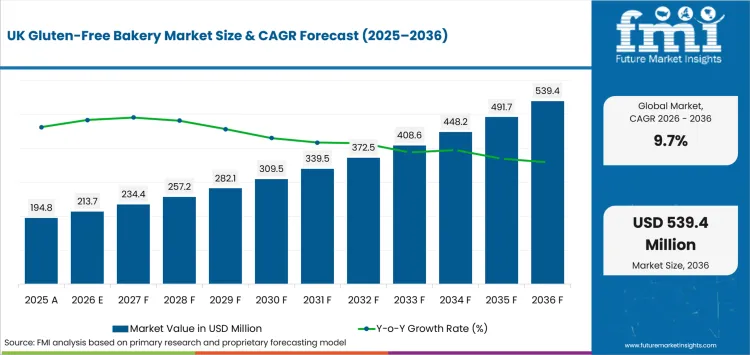
USD 213.7 million in 2026 and USD 539.4 million by 2036 at a 9.7% CAGR.
UK gluten-free bakery demand is projected to rise from USD 213.7 million in 2026 to USD 539.4 million by 2036 at 9.7% CAGR. Diagnosis underpins recurring staple demand because clinically confirmed coeliac disease requires lifelong gluten avoidance across bread and bakery occasions. Coeliac UK reported in May 2025 that 36% of people with coeliac disease were medically diagnosed in the UK and estimated about 500,000 remained undiagnosed. Broader adoption of gluten-free products expands retail exposure without changing the medically necessary core of repeat bakery demand.
Channel economics vary in the UK because NHS support for gluten-free staples differs across devolved health systems and local commissioners. Coeliac UK reported in February 2026 that 43% of England’s 42 Integrated Care Boards had fully withdrawn gluten-free prescriptions. Scotland and Wales retained broader national support arrangements in the same review. That divergence shifts more volume toward supermarkets and packaged bread purchases as prescription access becomes less consistent. Retail conversion therefore depends on price and pack size as well as reliable availability.
Key Takeaways
- Demand is supported by medically necessary gluten avoidance and wider free-from purchasing across routine bread and bakery occasions.
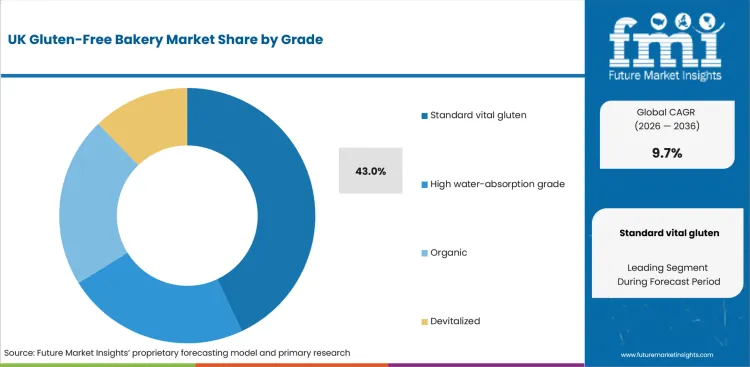
- Based on grade, standard vital gluten is projected to account for 43.0% in 2026 due to broader commercial availability and lower sourcing complexity than organic or specialty grades.
- By claim - nature, conventional is estimated to hold 54.0% in 2026 owing to wider formulation flexibility across mainstream price points and familiar bakery textures.
- In 2026, fresh is expected to lead format with 36.0% share because softness at purchase remains central to repeat household bread buying.
- Price premiums restrain repeat purchasing because specialist ingredients and protected production controls keep unit costs above conventional bakery alternatives.
- Some of the key players in this market include Warburtons, Genius Foods, Dr. Schär, Juvela, Promise Gluten Free, BFree Foods, Tesco, and Marks & Spencer.
Analyst Perspective
"UK gluten-free bakery ranges should be judged first on verified gluten control and eating quality instead of shelf price alone. Stronger repeat listings come from products that retain softness after opening while keeping pack size and waste within acceptable household economics."
- Nandini Roy Choudhury, Principal Consultant, Future Market Insights
How is the UK gluten-free bakery market segmented?
The market is segmented by grade, claim - nature, format, packaging format, sales channel and region.
Grade includes standard vital gluten, high water-absorption grade, organic, and devitalized. Claim - nature covers conventional, clean label, organic, gluten-free, and high-protein / fortified. Format includes fresh, frozen, ambient packaged, chilled, and par-baked / thaw-and-serve. Packaging format covers multipack, single-serve, family / loaf pack, and bulk foodservice. Sales channel includes supermarkets & hypermarkets, artisan & specialty bakeries, convenience & forecourt, online & DTC, and foodservice distributors.
Why does standard vital gluten lead the grade category?
Grade choices influence water absorption and sourcing conditions across bakery production. Finished gluten-free claims remain tied to verified product controls, so manufacturers must manage ingredient handling separately from claim validation.
- The standard vital gluten segment is likely to capture 43.0% share in 2026 attributable to more consistent sourcing than organic or high water-absorption grades.
- Labelling discipline remains necessary once manufacturers have completed formulation and release specifications for each product. In 2024/25 the Food Standards Agency tested 60 free-from retail products and found nine allergen-labelling issues, including four products using non-prescribed “free from gluten” wording.
Why does conventional lead the claim - nature category?
Conventional formulas give manufacturers ingredient choices while the gluten-free claim depends on finished-product control. This flexibility matters across loaves because baking ingredients must support texture improvement without pushing the price into a specialist-only tier.
- By claim - nature, conventional is forecast to represent 54.0% in 2026 driven by mainstream formulations that preserve broader price and texture flexibility.
- Nutrition and sensory requirements now sit beside gluten control as manufacturers renew bakery ranges for repeat buyers. Dr. Schär introduced its Quality Commitment in May 2025 and set optimal nutrition criteria for at least 95% of new Schär gluten-free products.
Why does fresh lead the format category?
Fresh formats compete on softness and immediate eating quality across bread-led supermarket and specialty-bakery occasions. Their shorter selling window raises waste exposure, so gluten-free bakery premixes and dough systems must perform consistently within tighter production schedules.
- Fresh is set to lead the format category with 36.0% share in 2026 due to immediate texture remaining central to repeat purchase for bread and rolls.
- Handling discipline becomes more important as fresh items enter service counters and café preparation areas. The Food Standards Agency reported in October 2025 on surveys covering 520 foodservice workers and 964 food-hypersensitive consumers during its non-prepacked allergen-information study.
Why do supermarkets & hypermarkets lead the sales channel category?
Supermarkets concentrate household purchasing because gluten-free loaves and morning goods sit inside the weekly grocery mission. National shelf presence gives UK allergen-free food brands a route to spread protected-production costs at scale.
- Supermarkets & hypermarkets are projected to hold 29.0% share in 2026 owing to recurring grocery traffic and broad pack comparison across national stores.
- Digital product checks reinforce supermarket shelf decisions by giving gluten-free shoppers a verification route before purchase. Coeliac UK reported in July 2025 that more than 185,000 products had been checked and restored to its Live Well Gluten Free app.
What are the drivers, restraints and opportunities in the UK Gluten-Free Bakery Market?
Medical need supports recurring staple demand, price premiums restrain purchase frequency, and qualified foodservice formats extend revenue beyond household retail occasions.
- Driver: Lifelong gluten avoidance creates recurring demand for bread and related bakery substitutes across routine eating occasions.
- Restraint: Gluten-free bread price premiums narrow household purchasing flexibility and raise the commercial penalty from slow-moving stock or waste.
- Opportunity: Accredited foodservice venues widen demand for portioned bakery formats that maintain gluten control during storage and final preparation.
Medical Need Anchors Recurring Staple Demand
Coeliac households need bakery substitutes repeatedly because bread and related staples recur across everyday meals and planned food routines. Hull University Teaching Hospitals NHS Trust stated in January 2025 that a strict lifelong gluten-free diet is the only treatment for coeliac disease. That clinical requirement gives gluten-free food demand a durable base, so manufacturers earn more from dependable core-loaf availability than occasional novelty launches.
Price Premiums Limit Repeat Purchase
Price remains the clearest barrier as specialist ingredients and protected production controls enter a lower-volume bakery category. Coeliac UK reported in February 2025 that gluten-free bread loaves cost 4.5 times more gram for gram than gluten-containing equivalents. That gap makes gluten-free flours selection and pack economics central to repeat purchase, while higher waste exposure increases the penalty from weak shelf throughput.
Qualified Foodservice Extends Revenue Routes
Foodservice offers a wider revenue route where operators can prove the controls required for customers with coeliac disease. Coeliac UK reported in January 2026 that more than 3,000 UK food venues held its Gluten Free Accreditation under defined standards and training. Ready-to-finish bakery products can reduce handling uncertainty in those outlets, provided the chosen formats retain texture after controlled storage and simplify final preparation.
Who are the notable companies in the UK Gluten-Free Bakery Market?
Warburtons, Genius Foods, Dr. Schär, Juvela, Promise Gluten Free, BFree Foods, Tesco, and Marks & Spencer
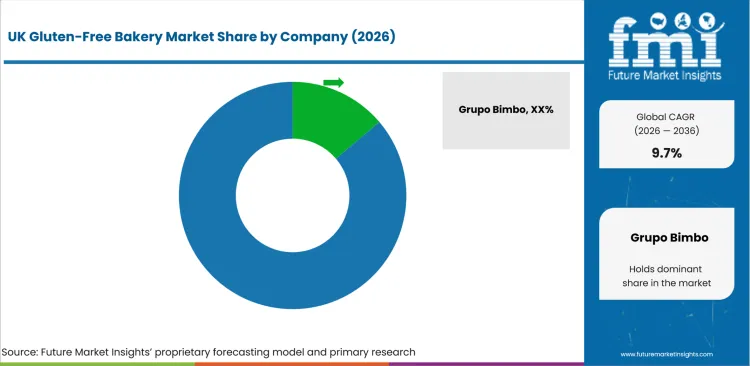
The competitive field separates dedicated gluten-free bakery brands from retailers using controlled own-brand production. Dedicated brands compete on range breadth and repeatable texture, while retailers use store access and bakery partners to scale successful products nationally. Protected production and dependable batch quality create the main entry barriers. UK bakery ingredients expertise alone does not establish the protected finished-product controls required for gluten-free bakery.
- Dedicated gluten-free bakery brands: Warburtons, Genius Foods, Dr. Schär, Juvela, Promise Gluten Free and BFree Foods compete on range breadth plus documented gluten controls.
- Retail own-brand platforms: Tesco and Marks & Spencer use national store networks and bakery partners to scale gluten-free products.
Competitive Benchmarking: UK Gluten-Free Bakery Market
| Company | Gluten-Free Bakery Breadth | UK Supply Presence | Gluten-Control Evidence | Geographic Reach |
|---|---|---|---|---|
| Warburtons | High | High | High | United Kingdom |
| Genius Foods | Medium | High | Medium | United Kingdom |
| Dr. Schär | High | High | High | United Kingdom and international markets |
| Juvela | Medium | Medium | High | United Kingdom |
| Promise Gluten Free | High | Medium | Medium | United Kingdom, Ireland and Canada |
| BFree Foods | High | Medium | Medium | United Kingdom, Ireland, United States and Australia |
| Tesco | Low | High | Low | United Kingdom |
| Marks & Spencer | Low | High | High | United Kingdom |
Scoring basis: High bakery breadth requires at least four documented gluten-free formats, while Medium covers two or three and Low identifies one. High UK supply presence requires national production or a national retail platform, while Medium reflects narrower documented access and Low reflects one route. High gluten-control evidence requires dedicated production or independent certification, while Medium reflects brand-wide controls and Low reflects one product-specific free-from line. Geographic reach records verified markets and does not affect capability ratings.
Key Developments in the UK Gluten-Free Bakery Market
- In February 2026, Marks & Spencer launched Gluten Free Colin the Caterpillar after Park Cakes invested £1.5 million in a segregated production line. The product reached more than 400 M&S stores and sold over 10,000 units within five days.
- In September 2025, Genius Foods moved pharmacy bread production onto newly installed bakery equipment. The company linked the investment to improved texture, reliability and production continuity.
- In February 2025, Tesco introduced Finest Free From Chocolate Orange Hot Cross Buns for Easter. The four-pack extended seasonal gluten-free bakery through Tesco’s national grocery network.
Key Players in the UK Gluten-Free Bakery Market
Dedicated Gluten-Free Bakery Brands
- Warburtons
- Genius Foods
- Dr. Schär
- Juvela
- Promise Gluten Free
- BFree Foods
Retail Own-Brand Bakery Platforms
- Tesco
- Marks & Spencer
UK Gluten-Free Bakery Market - Report Scope
| Coverage field | Report scope |
|---|---|
| Market breakdown | By grade, claim - nature, format, packaging format, sales channel and region. |
| Quantitative Units | USD million. |
| Market Definition | Revenue includes gluten-free bakery products sold within the defined grade, claim - nature, format, packaging format and sales channel universe in the United Kingdom. Downstream prepared meals and adjacent substitute-food categories are excluded. Grade labels are analytical classifications and do not override legal conditions for a gluten-free claim. |
| Regions Covered | North America, Latin America, Western Europe, Eastern Europe, East Asia, South Asia and Pacific, and Middle East and Africa. |
| Countries Covered | United Kingdom. |
| Key Companies Profiled | Warburtons, Genius Foods, Dr. Schär, Juvela, Promise Gluten Free, BFree Foods, Tesco, and Marks & Spencer. |
| Forecast Period | 2026 to 2036. |
| Approach | Primary and secondary research with market triangulation. |
UK Gluten-Free Bakery Market - Research Methodology
| Method | Approach |
|---|---|
| Primary Research | FMI analysts gathered input from manufacturers, service providers, technology developers, distributors, end users, procurement teams, and subject-matter experts. Interviews examined purchasing decisions, product or service evaluation, adoption barriers, approval requirements, pricing considerations, and expectations for technical or commercial support. Respondents were also asked what evidence is required before a trial, pilot, or initial order develops into regular purchasing. |
| Desk Research | Desk research covered government statistics, regulatory publications, trade data, industry associations, technical literature, standards, company filings, product information, and official corporate announcements. Sources were reviewed for relevance, publication date, geographic coverage, and consistency with the defined market scope. Claims relating to performance, applications, approvals, capacity, investment, and commercial activity were retained only when supported by credible public evidence. |
| Market Sizing and Forecasting | The market model combined the baseline value with historical performance, segment structure, pricing and volume indicators, adoption levels, company participation, and country-level demand conditions. Forecast assumptions considered economic activity, investment trends, regulatory developments, technology adoption, purchasing cycles, supply availability, and barriers to wider market use. Segment and regional estimates were reconciled before the final market total was calculated. |
| Data Validation | Estimates were checked against multiple independent indicators, including public data, company activity, trade patterns, industry developments, and findings from primary interviews. Validation also tested whether products, services, applications, and company revenues fell within the defined market boundaries. Adjacent categories, unsupported claims, overlapping revenues, and activities without direct market relevance were excluded to reduce double counting and maintain consistency across segments and countries. |
UK Gluten-Free Bakery Market by Segments
UK Gluten-Free Bakery Market segmented by Grade:
- Standard vital gluten
- High water-absorption grade
- Organic
- Devitalized
UK Gluten-Free Bakery Market segmented by Claim - nature:
- Conventional
- Clean label
- Organic
- Gluten-free
- High-protein / fortified
UK Gluten-Free Bakery Market segmented by Format:
- Fresh
- Frozen
- Ambient packaged
- Chilled
- Par-baked / thaw-and-serve
UK Gluten-Free Bakery Market segmented by Packaging Format:
- Multipack
- Single-serve
- Family / loaf pack
- Bulk foodservice
UK Gluten-Free Bakery Market segmented by Sales Channel:
- Supermarkets & hypermarkets
- Artisan & specialty bakeries
- Convenience & forecourt
- Online & DTC
- Foodservice distributors
Research Sources and Bibliography
- Coeliac UK. (2025, May 1). Coeliac Awareness Month 2025 is here!
- Coeliac UK. (2026, February 3). Healthcare bodies call for urgent review.
- Food Standards Agency, Scarrett, A., Cooke, S., & Bachelor, J. (2025, June 26). Retail Surveillance Sampling Programme 2024/25.
- Dr. Schär. (2025, May 14). International Coeliac Disease Awareness Day: Dr. Schär raises the bar for gluten-free quality.
- Food Standards Agency, Ipsos UK, & Opinium. (2025, October 7). Allergen Information for Non-Prepacked Foods: Key Findings From Consumers and Food Service Workers.
- Coeliac UK. (2025, July 31). Your Coeliac UK Food Information Service: August Update.
- Hull University Teaching Hospitals NHS Trust. (2025, January 9). Introductory Information after Diagnosis of Coeliac Disease in Paediatrics.
- Coeliac UK. (2025, February 10). New Coeliac UK report sheds light on cost, access & availability of gf food.
- Coeliac UK. (2026, January 22). Over 3,000 venues are now Gluten Free Accredited.
- Food Standards Agency, Scarrett, A., Cooke, S., & Bachelor, J. (2026, July 2). Retail Surveillance Survey Sampling Programme 2025/26.
- Warburtons. (2023, January 11). New Seeded Bagels, New Fruity Buns!
- Genius Foods. (2025, September 8). Genius breads available on prescription: bakery investment update.
- Dr. Schär. (2026, February 25). Our 2025: growing with vision, investing in the future.
- Juvela. Gluten Free Bread, Flour Mix | Gluten Free Foods. Retrieved August 17, 2026.
- Promise Gluten Free. (2026, June 17). Promise Gluten Free Celebrates Success at the Free From Food Awards UK.
- BFree Foods. BFree Foods | Premium Gluten Free Bread & Protein Wraps. Retrieved August 17, 2026.
- Tesco PLC. (2025, February 17). Tesco Unveils Delicious Hot Cross Bun Range for Easter 2025.
- Marks & Spencer. (2026, February 4). Inside M&S’ 80-Year Partnership With “Fortress” Factory Behind Latest Product Launch.
This Report Answers
- How large is the UK gluten-free bakery market in 2026 and 2036?
- Which medical and access conditions support recurring gluten-free bakery demand in the United Kingdom?
- Why does conventional hold 54.0% of the claim - nature category in 2026?
- How does standard vital gluten compare with specialty grades in the UK gluten-free bakery market?
- Why does fresh retain 36.0% of the format category in 2026?
- Which price and handling frictions limit repeat purchasing across retail and foodservice channels?
- How should the United Kingdom’s 10.0% country CAGR be read beside the 9.7% market forecast?
- Which companies have documented gluten-free bakery activity or controlled retail production in the United Kingdom?
Frequently Asked Questions
How big is the UK Gluten-Free Bakery Market in 2026?
The UK gluten-free bakery market is valued at USD 213.7 million in 2026 and is projected to reach USD 539.4 million by 2036. Growth is driven by medically necessary gluten-free diets and increasing consumer adoption of free-from bakery products.
What is the CAGR of the UK Gluten-Free Bakery Market from 2026 to 2036?
The UK gluten-free bakery market is projected to grow at a CAGR of 9.7% between 2026 and 2036. Expansion is supported by rising diagnosis rates of coeliac disease and growing availability of gluten-free bakery products across retail channels.
Which grade leads the UK Gluten-Free Bakery Market?
Standard vital gluten is projected to account for 43.0% of the market in 2026. Its leading share is supported by broader commercial availability and lower sourcing complexity compared with specialty and organic alternatives.
Which claim nature dominates the UK Gluten-Free Bakery Market?
Conventional products are projected to account for 54.0% of the market in 2026. Their dominance is driven by greater formulation flexibility and the ability to deliver familiar texture and taste at mainstream price points.
Which format leads the UK Gluten-Free Bakery Market?
Fresh products are projected to account for 36.0% of the market in 2026. Their leading share reflects strong consumer preference for softness, freshness, and immediate consumption across bread and bakery categories.
Which sales channel leads the UK Gluten-Free Bakery Market?
Supermarkets and hypermarkets are projected to account for 29.0% of the market in 2026. Their dominance is supported by broad product availability, frequent grocery purchases, and nationwide distribution networks.
Which companies are active in the UK Gluten-Free Bakery Market?
Key companies operating in the market include Warburtons, Genius Foods, Dr. Schär, Juvela, Promise Gluten Free, BFree Foods, Tesco, and Marks & Spencer. These companies compete through product innovation, gluten-control standards, retail reach, and category specialization.
Preview the report firsthand - request a free sample
Get SampleGet the brochure for pricing and purchase details.
Get PDFTable of Content
- Key Takeaways
- Market Size and CAGR
- Top Growth Driver
- Fastest Growing Segment
- Leading Region
- Key Companies
- Emerging Opportunities
- Executive Summary
- UK Market Outlook
- Demand-side Trends
- Supply-side Trends
- Technology Roadmap Analysis
- Analysis and Recommendations
- Analyst Perspective (What is happening? Why now? What should investors know?)
- Key Questions Answered
- How large is the market?
- What is the CAGR?
- What are key trends?
- Which region dominates?
- Who are the leaders?
- Market Overview
- Market Coverage / Taxonomy
- Market Definition / Scope / Limitations
- Research Methodology
- Chapter Orientation
- Analytical Lens and Working Hypotheses
- Market Structure, Signals, and Trend Drivers
- Benchmarking and Cross-market Comparability
- Market Sizing, Forecasting, and Opportunity Mapping
- Research Design and Evidence Framework
- Desk Research Programme (Secondary Evidence)
- Expert Input and Fieldwork (Primary Evidence)
- Tooling, Models, and Reference Databases
- Data Engineering and Model Build
- Quality Assurance and Audit Trail
- Market Background
- Market Dynamics (Drivers, Restraints, Opportunity, Trends)
- Scenario Forecast (Optimistic, Likely, Conservative)
- Impact Analysis
- AI Impact
- Sustainability Impact
- Regulatory Impact
- Technology Impact
- Consumer / Buyer Analysis
- Purchase Drivers
- Adoption Barriers
- Buyer Journey
- Opportunity Map Analysis
- Product Life Cycle Analysis
- Supply Chain Analysis
- Investment Feasibility Matrix
- Value Chain Analysis
- PESTLE and Porter's Analysis
- Regulatory Landscape
- Regional Parent Market Outlook
- Production and Consumption Statistics
- Import and Export Statistics
- UK Market Analysis and Forecast, 2021 to 2036
- Historical Market Size Value (USD Million) Analysis, 2021 to 2025
- Current and Future Market Size Value (USD Million) Projections, 2026 to 2036
- Y-o-Y Growth Trend Analysis
- Absolute $ Opportunity Analysis
- UK Market Pricing Analysis, 2021 to 2036
- UK Market Analysis and Forecast, By Grade, 2021 to 2036
- Introduction / Key Findings
- Historical Market Size Value (USD Million) Analysis By Grade, 2021 to 2025
- Current and Future Market Size Value (USD Million) Analysis and Forecast By Grade, 2026 to 2036
- Standard vital gluten
- High water-absorption grade
- Organic
- Devitalized
- Standard vital gluten
- Y-o-Y Growth Trend Analysis By Grade, 2021 to 2025
- Absolute $ Opportunity Analysis By Grade, 2026 to 2036
- UK Market Analysis and Forecast, By Claim / Nature, 2021 to 2036
- Introduction / Key Findings
- Historical Market Size Value (USD Million) Analysis By Claim / Nature, 2021 to 2025
- Current and Future Market Size Value (USD Million) Analysis and Forecast By Claim / Nature, 2026 to 2036
- Conventional
- Clean label
- Organic
- Gluten-free
- High-protein / fortified
- Conventional
- Y-o-Y Growth Trend Analysis By Claim / Nature, 2021 to 2025
- Absolute $ Opportunity Analysis By Claim / Nature, 2026 to 2036
- UK Market Analysis and Forecast, By Format, 2021 to 2036
- Introduction / Key Findings
- Historical Market Size Value (USD Million) Analysis By Format, 2021 to 2025
- Current and Future Market Size Value (USD Million) Analysis and Forecast By Format, 2026 to 2036
- Fresh
- Frozen
- Ambient packaged
- Chilled
- Par-baked / thaw-and-serve
- Fresh
- Y-o-Y Growth Trend Analysis By Format, 2021 to 2025
- Absolute $ Opportunity Analysis By Format, 2026 to 2036
- UK Market Analysis and Forecast, By Packaging Format, 2021 to 2036
- Introduction / Key Findings
- Historical Market Size Value (USD Million) Analysis By Packaging Format, 2021 to 2025
- Current and Future Market Size Value (USD Million) Analysis and Forecast By Packaging Format, 2026 to 2036
- Multipack
- Single-serve
- Family / loaf pack
- Bulk foodservice
- Multipack
- Y-o-Y Growth Trend Analysis By Packaging Format, 2021 to 2025
- Absolute $ Opportunity Analysis By Packaging Format, 2026 to 2036
- UK Market Analysis and Forecast, By Sales Channel, 2021 to 2036
- Introduction / Key Findings
- Historical Market Size Value (USD Million) Analysis By Sales Channel, 2021 to 2025
- Current and Future Market Size Value (USD Million) Analysis and Forecast By Sales Channel, 2026 to 2036
- Supermarkets & hypermarkets
- Artisan & specialty bakeries
- Convenience & forecourt
- Online & DTC
- Foodservice distributors
- Supermarkets & hypermarkets
- Y-o-Y Growth Trend Analysis By Sales Channel, 2021 to 2025
- Absolute $ Opportunity Analysis By Sales Channel, 2026 to 2036
- UK Market Analysis and Forecast, By Region, 2021 to 2036
- Introduction
- Historical Market Size Value (USD Million) Analysis By Region, 2021 to 2025
- Current Market Size Value (USD Million) Analysis and Forecast By Region, 2026 to 2036
- UK
- Market Attractiveness Analysis By Region
- UK Market Analysis and Forecast, By Country, 2021 to 2036
- Historical Market Size Value (USD Million) Trend Analysis By Market Taxonomy, 2021 to 2025
- Market Size Value (USD Million) Forecast By Market Taxonomy, 2026 to 2036
- By Country
- By Grade
- By Claim / Nature
- By Format
- By Packaging Format
- By Sales Channel
- By Country
- Market Attractiveness Analysis
- By Country
- By Grade
- By Claim / Nature
- By Format
- By Packaging Format
- By Sales Channel
- Key Takeaways
- Key Countries Market Analysis
- UK
- Pricing Analysis
- Market Share Analysis, 2025
- By Grade
- By Claim / Nature
- By Format
- By Packaging Format
- By Sales Channel
- UK
- Market Structure Analysis
- Competition Dashboard
- Competition Benchmarking
- Market Share Analysis of Top Players
- By Regional
- By Grade
- By Claim / Nature
- By Format
- By Packaging Format
- By Sales Channel
- Emerging Startups
- Innovation Benchmarking
- Competition Analysis
- Competition Deep Dive
- Grupo Bimbo
- Overview
- Product Portfolio
- Profitability by Market Segments
- Sales Footprint
- Strategy Overview
- Marketing Strategy
- Product Strategy
- Channel Strategy
- Flowers Foods
- Aryzta
- Lantmannen Unibake
- Vandemoortele
- Yamazaki Baking
- Warburtons
- King's Hawaiian
- Europastry
- St Pierre Groupe
- Grupo Bimbo
- Case Studies
- Success Stories
- Recent Developments
- Competition Deep Dive
- Assumptions & Acronyms Used


