

- Industry Size (2025)
- USD 52.6 Mn
- Forecast (2035)
- USD 148.3 Mn
- CAGR (2025 to 2035)
- 10.9%
Demand for Curcumin Food Color in USA 2025 to 2035
The demand for curcumin food color in the USA is set for strong expansion, with its value expected to rise from USD 52.6 million in 2025 to USD 148.3 million by 2035, registering an impressive CAGR of 10.9% throughout the forecast period. This notable growth outlook highlights the increasing preference for naturally derived food colorants among manufacturers aiming to meet evolving clean-label expectations. Curcumin, extracted from turmeric, has become a favored color ingredient due to its vivid yellow-orange hue and its association with positive wellness perception. Wide usage across packaged snacks, sauces, beverages, and dairy product innovations continues to elevate demand momentum. Brands are actively reformulating existing lines and developing new launches with turmeric-based color systems that offer stability under varying processing conditions. With expanding applications and rising consumer familiarity, the market is well-positioned to capture more presence in mainstream retail and foodservice channels over the coming years.
Quick Stats for USA Curcumin Food Color Demand
- USA Curcumin Food Color Sales Value (2025): USD 52.6 million
- USA Curcumin Food Color Forecast Value (2035): USD 148.3 million
- USA Curcumin Food Color Forecast CAGR (2025–2035): 10.9%
- Leading Form in USA Curcumin Food Color Demand: Paste
- Key Growth Regions in USA Curcumin Food Color Demand: West USA, South USA, Northeast USA
- Top Players in USA Curcumin Food Color Demand: Arjuna Natural Pvt Ltd, Sabinsa Corporation, Synthite Industries Ltd, Biomax Life Sciences Limited, Kancor Ingredients Limited
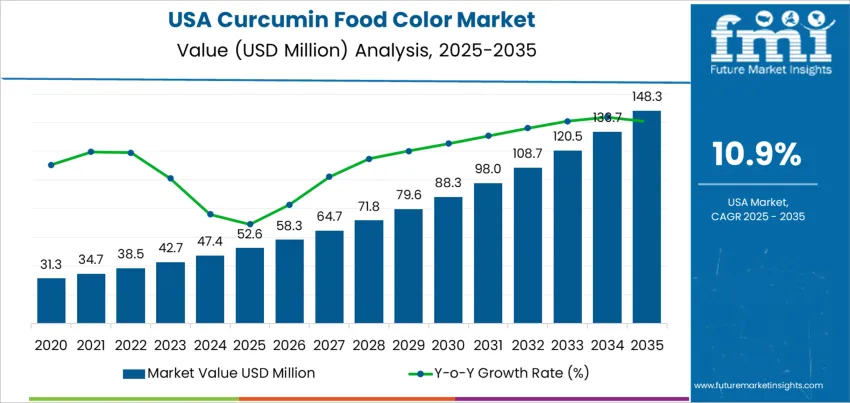
What is the Growth Forecast for Curcumin Food Color Industry in USA through 2035?
Demand for curcumin food color in the United States shows a moderate volatility profile influenced by regulatory scrutiny, pricing shifts in turmeric supply, and brand adoption cycles within natural food coloring. Early years of the period may experience sharper growth as food and beverage producers replace synthetic dyes with botanical pigments driven by clean-label positioning. Volatility increases when raw-material availability in turmeric-producing countries affects input cost and purchasing behavior in formulation industries.
Consumer preference for natural ingredients remains consistent, which reduces long-term fluctuations and supports stable structural demand. Growth becomes smoother in the mid-to-late period as supply chains strengthen and extraction technologies improve yield and purity levels. Demand diversification across bakery, snacks, ready meals, and nutraceutical beverages reduces sector concentration risk. Volatility is primarily linked to competition from alternative natural pigments such as beta-carotene and paprika. The growth rate volatility index suggests controlled but periodic fluctuations, driven by cost sensitivity and innovation cycles rather than demand instability.
USA Curcumin Food Color Key Takeaways
| Metric | Value |
|---|---|
| USA Curcumin Food Color Sales Value (2025) | USD 52.6 million |
| USA Curcumin Food Color Forecast Value (2035) | USD 148.3 million |
| USA Curcumin Food Color Forecast CAGR (2025-2035) | 10.9% |
Why is the Demand for Curcumin Food Color in the USA Growing?
Demand for curcumin food color in the USA is increasing because food and beverage manufacturers respond to growing consumer preference for natural ingredients and clean-label products. Curcumin, derived from turmeric, provides a yellow-orange pigment that replaces synthetic dyes which face regulatory scrutiny. Regulatory acceptance supports this shift; curcumin is recognized by U.S. regulators for general food coloring under appropriate manufacturing practices.
Producers of snacks, beverages, sauces, baked goods and dairy products adopt curcumin food color to meet demand from health-conscious buyers and parents avoiding artificial dyes. The trend toward organic, natural and minimally processed foods boosts use, especially in products aimed at children and families. Growth in ready-to-drink teas, functional drinks and ethnic foods further supports curcumin adoption because its color and flavor profile align well with global culinary trends.
Suppliers work to improve stability against heat and light to ensure consistent color retention during processing, which expands suitability across wide food categories. The shift by major food companies toward phasing out synthetic dyes accelerates replacement with natural colorants like curcumin. Constraints include curcumin’s lower stability compared with synthetic dyes under some processing conditions, potential cost premium over basic dyes, and limits in use for certain food categories where regulations restrict added color.
Which Forms and Applications Lead Demand for Curcumin Food Color in the United States?
Demand for curcumin-based food colorants in the United States is shaped by growing consumer preference for clean-label ingredients, plant-derived colorants, and improved allergen-free formulations. Manufacturers emphasize stability, heat resistance, and uniform dispersion across processed foods, while remaining compliant with FDA natural color regulations. Adoption is supported by reformulation in retail packaged foods and increased use in functional product lines featuring turmeric-associated wellness attributes.
By Form, Paste Holds the Largest Share
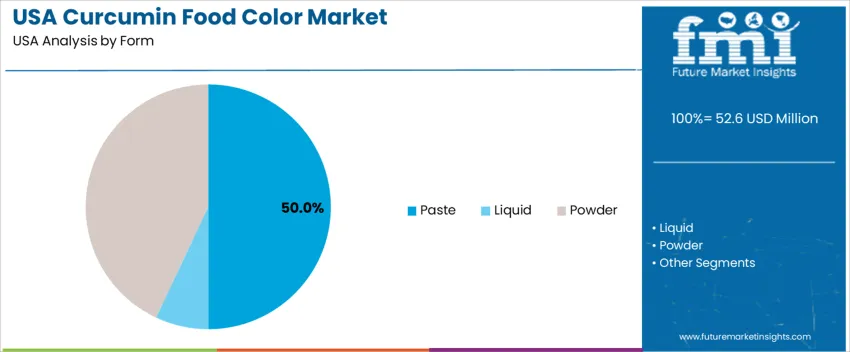
Paste form accounts for 50.0%, driven by ease of blending in high-moisture and high-viscosity food bases such as sauces, confectionery fillings, and ready-to-eat preparations. Powder form represents 43.0%, preferred for long shelf life, low transport weight, and flexibility in dry mix processing for snacks, bakery, and seasoning applications. Liquid curcumin color holds 7.0%, used primarily in beverages and dairy where rapid solubility and consistent opacity are essential. Form choice reflects processing compatibility, color intensity requirements, and dosing efficiency in large-scale food manufacturing environments.
Key Points:
- Pastes dominate high-viscosity applications and direct industrial dosing
- Powders align with dry blending efficiency and long-term storage
- Liquids serve quick-dispersion needs in beverage and dairy lines
By Application, Bakery and Confectionery Leads U.S. Usage
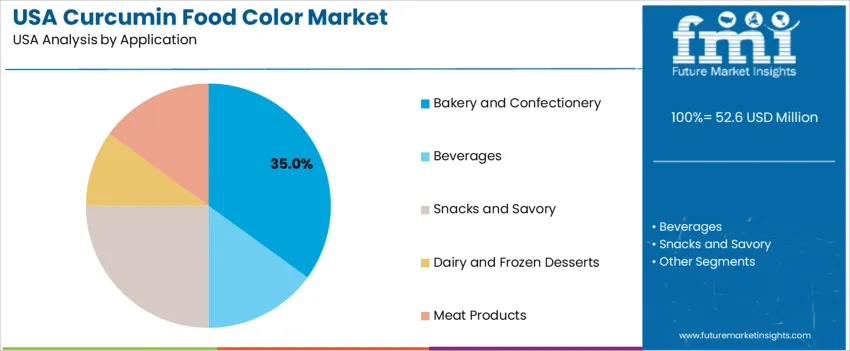
Bakery and confectionery applications contribute 35.0%, driven by the demand for natural yellow-orange hues in baked goods, fillings, candies, and decorative coatings. Snacks and savory products represent 25.0%, including chips, seasonings, and ready meals requiring thermal-stable coloring. Beverages and meat products each account for 15.0%, where natural color compliance and brand health-positioning drive use. Dairy and frozen desserts hold 10.0%, particularly in flavored yogurts and novelty frozen items. Application distribution reflects consumer preference for visually appealing, naturally colored processed foods across mainstream retail and foodservice channels.
Key Points:
- Bakery and confectionery drive the highest consumption
- Snacks demand heat-resistant curcumin pigments during frying and extrusion
- Beverages and meat products adopt clean-label reformulation strategies
What are the Drivers, Restraints, and Key Trends of the Demand for Curcumin Food Color in the USA?
Growth of clean label food production, rising preference for natural ingredients and increased reformulation away from synthetic dyes are driving demand.
In the United States, curcumin food color is gaining adoption in packaged food segments where manufacturers highlight natural and transparent ingredient lists. Children’s snacks, flavored yogurt, sauces and bakery products increasingly rely on natural yellow and orange coloring to meet retailer and consumer expectations for recognizable ingredients. Private label brands that position products as better-for-you incorporate curcumin to support marketing claims focused on wellness and plant origin. The expansion of dairy and dairy-alternative beverages encourages color use for visual consistency and flavor cues. Food manufacturers serving school lunch and institutional meals pursue natural replacements to align with nutrition standards and corporate responsibility goals. These changes in formulation strategies support consistent procurement of curcumin color across domestic food production networks.
Stability challenges, higher ingredient cost and slower adoption in highly processed segments restrain demand.
Curcumin is sensitive to light and heat during processing and storage, which requires careful formulation to preserve color strength. These technical requirements may increase production complexity and testing time for smaller brands. Synthetic dyes remain cheaper and provide stronger shade consistency in high-volume categories, leading value-oriented foods to maintain existing coloring systems. Some manufacturers reduce USAge or choose alternatives when bright color intensity must survive prolonged shelf life or extreme processing conditions. These cost and performance considerations moderate rapid conversion in mass-market lines.
Shift toward standardized, water-dispersible extracts, increased demand from organic and premium food categories and rising use in ready-to-eat meal formats define key trends.
Ingredient suppliers are developing curcumin forms with improved dispersibility designed for beverages, frozen meals and refrigerated sauces. Organic brands rely on turmeric-derived color to maintain certification requirements and reduce reliance on artificial additives. Meal-kit producers and food-delivery suppliers use natural colorants to improve presentation of prepared foods consumed at home or in workplaces. Product developers also combine curcumin with other natural pigments for tailored shade profiles. These developments indicate stable, formulation-driven demand growth for curcumin food color across the United States packaged and convenience-food sectors.
Analysis of the Demand for Curcumin Food Color in the USA by Region
Demand for curcumin food color in the United States is expanding as food and beverage producers shift toward natural coloring systems and clean-label product transparency. Growth reflects accelerated adoption in functional beverages, plant-based foods, bakery fillings, snacks, and dairy alternatives where synthetic colorants are being phased out. Regulatory confidence in turmeric-derived curcumin and rising consumer preference for antioxidant-rich natural ingredients reinforce USAge across branded goods. The West USA leads with 12.6% CAGR, followed by the South USA at 11.3%, the Northeast USA at 10.1%, and the Midwest USA at 8.7%. Manufacturers focus on formulation stability, brightness optimization, and heat/acid resistance to support broader processed-food integration.
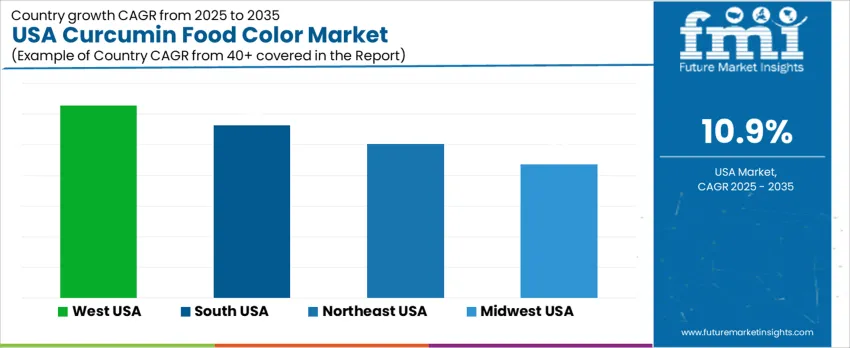
| Region | CAGR (2025-2035) |
|---|---|
| West USA | 12.6% |
| South USA | 11.3% |
| Northeast USA | 10.1% |
| Midwest USA | 8.7% |
How is the West USA driving demand for curcumin food color?
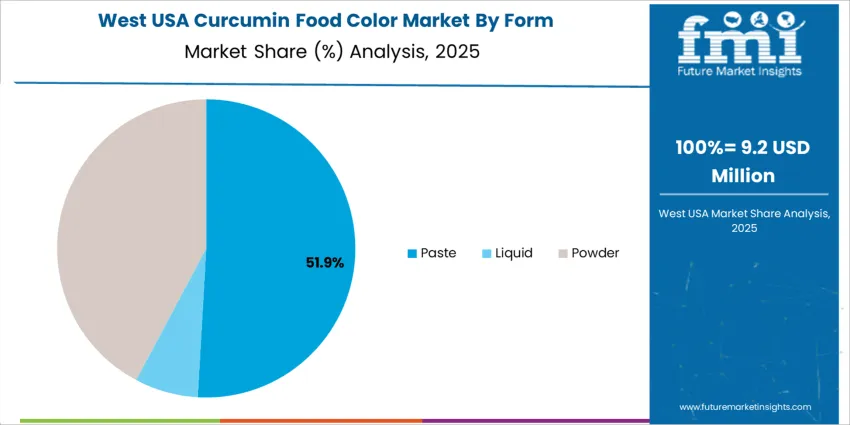
The West USA demonstrates the fastest national growth at 12.6% CAGR, supported by strong adoption of natural ingredients in beverages, plant-based categories, and health-oriented product portfolios across California, Washington, and Oregon. Brands in the region utilize curcumin formulations to achieve clean-label yellow and golden tones in juices, kombucha, protein drinks, and frozen desserts while promoting antioxidant-linked consumer benefits. Food-tech startups continue to reformulate around turmeric-based extracts to replace FD&C Yellow colorants in snack coatings and ready-to-eat meals. Contract manufacturers require batch-stable curcumin emulsions compatible with hot-fill, pasteurization, and bakery-mix environments. West Coast retail channels accelerate adoption through premium grocery chains that highlight naturally colored products with wellness associations.
- Clean-label beverages and plant-based foods driving volume
- Premium retail positioning improving visibility and pull-through
- Stability needs guiding emulsified-curcumin procurement
- Reformulation replacing synthetic yellow pigments in multiple SKUs
How is the South USA shaping procurement patterns?
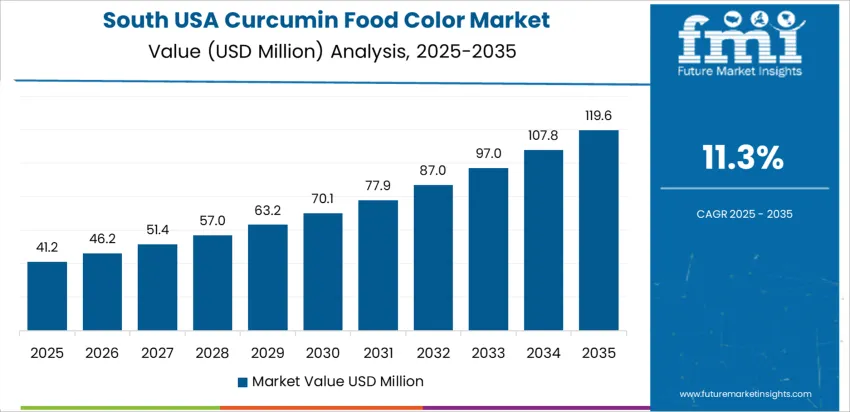
The South USA records 11.3% CAGR, supported by strong food-processing hubs in Texas, Florida, and Georgia. Curcumin food color is increasingly used in formulated beverages, confectionery, seasonings, and dairy snacks intended for high-consumption industries with rising interest in natural ingredient labeling. Regional manufacturers benefit from supply connectivity through Gulf logistics networks importing turmeric derivatives and oleoresins. Private-label food producers evaluate curcumin for affordability versus other botanical yellows while ensuring compliance with color retention needs in warmer-climate distribution environments. Multicultural cuisine influence also supports adoption in flavored snacks and marinades where golden tonality enhances appearance. Procurement teams prioritize shelf-life stability and cost-managed uniformity to integrate curcumin into scalable formulations.
- High-volume snack and beverage processing supporting demand
- Gulf Coast import infrastructure supplying colorant ingredients
- Value-driven purchasing supporting synthetic-free transitions
- Warm-climate distribution requiring strong light/heat stability
How is the Northeast USA supporting clean-label expansion?
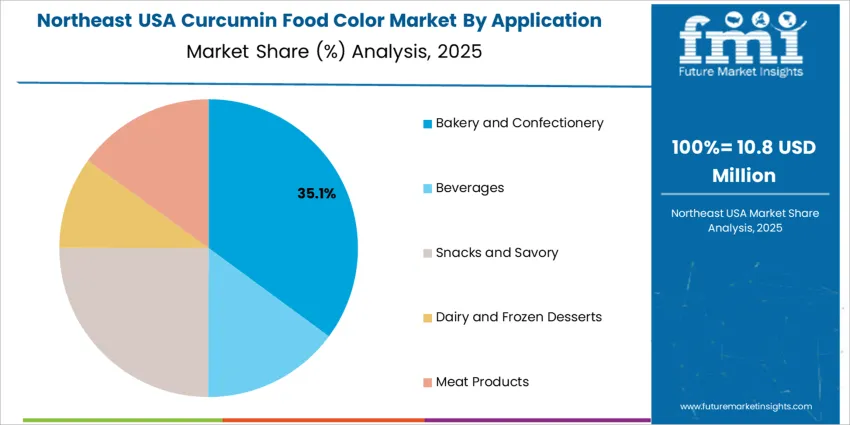
The Northeast USA grows at 10.1% CAGR, driven by clean-label reformulation across bakery, dairy alternatives, and functional drinks produced in New York, New Jersey, and Massachusetts. Curcumin food color is selected to meet compliance with retailer ingredient-screening policies that limit artificial additives. Nutritional beverage producers use water-dispersible curcumin for visual enhancement in immunity-focused SKUs promoted through urban retail and convenience channels. Compact-footprint manufacturing sites rely on ready-to-blend liquid concentrates to support efficient batching shifts. Strong food-safety assurance requirements drive interest in standardized, traceable supply sources. Seasonal tourism contributes to peak product rollout cycles, increasing short-term colorant demand for limited-edition beverages and packaged foods.
- Retail compliance driving synthetic-color replacement
- Immunity-driven beverage innovation influencing adoption
- Traceable supply and certifications required for procurement
- Efficient batching formats supporting flexible production
How is the Midwest USA maintaining steady utilization?
The Midwest USA posts 8.7% CAGR, reflecting growing inclusion of curcumin in mainstream bakery mixes, cheese analogues, and value-focused packaged snacks manufactured throughout Illinois, Ohio, Wisconsin, and Minnesota. Producers focus on cost-effective shifts away from tartrazine while maintaining consistent appearance across large-volume production runs. Curcumin is integrated within extrusion-based snack lines and seasoning applications where thermal-stable formats offer reliable yellow shades. Dairy processors apply fat-dispersible derivatives in spreads and sauces with tolerance to refrigeration cycling. Adoption expands gradually as procurement teams evaluate long-term price stability and compatibility with legacy batching equipment. Regional ingredient distributors strengthen stocking strategies to support predictable USAge rather than rapid reformulation turnover.
- Mainstream snack and bakery categories driving baseline uptake
- Thermal-stable curcumin formats improving color consistency
- Cost-conscious decisions guiding adoption pace
- Distributor stocking stability supporting continuous supply
What does the competitive structure for curcumin food-color demand in the United States show?
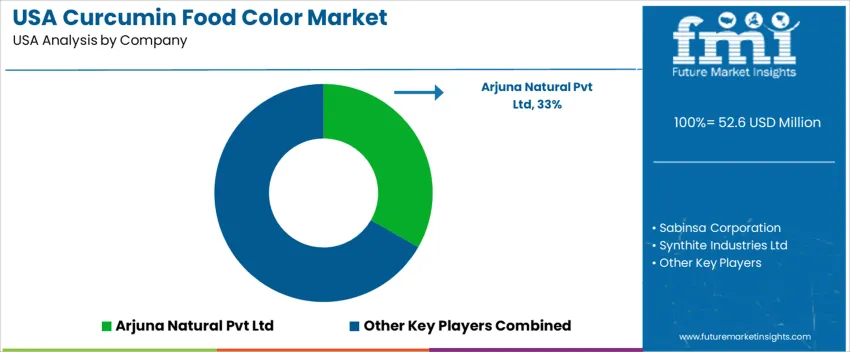
Curcumin food-color demand in the United States reflects preference for clean-label and plant-derived colorants in beverages, confectionery, dairy, and ready-to-eat categories. Purchasing decisions prioritize light-stability, thermal resistance, and particle-size control to minimize sedimentation in processed formats. Regulatory oversight under food-use color additive requirements focuses on verified purity, consistent curcuminoid content, and solvent-residue management, especially for high-acidity beverages and refrigerated products. U.S. buyers also expect traceability from turmeric-cultivation regions in India and Southeast Asia, together with container-handling standards suited to large-scale production. Arjuna Natural Pvt Ltd holds about 33.3% share in the United States. Its position reflects validated stability systems and supply reliability supporting broad use in packaged beverages and dairy alternatives.
Sabinsa Corporation maintains strong participation through standardized extracts integrated into wellness-aligned functional foods and nutraceutical-adjacent formulations. Synthite Industries competes in high-volume processing environments requiring controlled dispersion and extended shelf-life performance. Biomax Life Sciences addresses regional and mid-tier manufacturing where cost efficiency and assured documentation drive selection. Kancor Ingredients remains active in sauces and confectionery ranges requiring flavor-compatible turmeric profiles and consistent visual intensity. Competitive factors include transparent farming oversight, oxidative-stability enhancements for chilled distribution, and blending options with annatto and beta-carotene to achieve targeted yellow-to-amber profiles in U.S. product lines.
Key Players in USA Curcumin Food Color Demand
- Arjuna Natural Pvt Ltd
- Sabinsa Corporation
- Synthite Industries Ltd
- Biomax Life Sciences Limited
- Kancor Ingredients Limited
Scope of the Report
| Items | Values |
|---|---|
| Quantitative Units | USD million |
| Form | Paste, Liquid, Powder |
| Application | Bakery and Confectionery, Beverages, Snacks and Savory, Dairy and Frozen Desserts, Meat Products |
| Regions Covered | West USA, South USA, Northeast USA, Midwest USA |
| Key Companies Profiled | Arjuna Natural Pvt Ltd, Sabinsa Corporation, Synthite Industries Ltd, Biomax Life Sciences Limited, Kancor Ingredients Limited |
| Additional Attributes | Dollar sales by form categories and key food applications; regional consumption trends across West, South, Northeast, and Midwest USA; rising adoption of natural coloring solutions driven by clean-label claims; competition with artificial colorants and turmeric-sourced pigment efficiency; demand linked to health-oriented product launches in beverage, dairy, and snack applications; regulatory compliance and GRAS listings affecting product penetration. |
USA Curcumin Food Color Demand by Segments
Form:
- Paste
- Liquid
- Powder
Application:
- Bakery and Confectionery
- Beverages
- Snacks and Savory
- Dairy and Frozen Desserts
- Meat Products
Region:
- West USA
- South USA
- Northeast USA
- Midwest USA
Frequently Asked Questions
How big is the demand for curcumin food color in USA in 2025?
The demand for curcumin food color in USA is estimated to be valued at USD 52.6 million in 2025.
What will be the size of curcumin food color in USA in 2035?
The market size for the curcumin food color in USA is projected to reach USD 148.3 million by 2035.
How much will be the demand for curcumin food color in USA growth between 2025 and 2035?
The demand for curcumin food color in USA is expected to grow at a 10.9% CAGR between 2025 and 2035.
What are the key product types in the curcumin food color in USA?
The key product types in curcumin food color in USA are paste, liquid and powder.
Which application segment is expected to contribute significant share in the curcumin food color in USA in 2025?
In terms of application, bakery and confectionery segment is expected to command 35.0% share in the curcumin food color in USA in 2025.
Preview the report firsthand - request a free sample
Get SampleGet the brochure for pricing and purchase details.
Get PDFTable of Content
- Executive Summary
- USA Market Outlook
- Demand-side Trends
- Supply-side Trends
- Technology Roadmap Analysis
- Analysis and Recommendations
- Market Overview
- Market Coverage / Taxonomy
- Market Definition / Scope / Limitations
- Market Background
- Market Dynamics
- Drivers
- Restraints
- Opportunity
- Trends
- Scenario Forecast
- Demand in Optimistic Scenario
- Demand in Likely Scenario
- Demand in Conservative Scenario
- Opportunity Map Analysis
- Product Life Cycle Analysis
- Supply Chain Analysis
- Investment Feasibility Matrix
- Value Chain Analysis
- PESTLE and Porter’s Analysis
- Regulatory Landscape
- Regional Parent Market Outlook
- Production and Consumption Statistics
- Import and Export Statistics
- Market Dynamics
- USA Market Analysis 2020 to 2024 and Forecast, 2025 to 2035
- Historical Market Size Value (USD Million) Analysis, 2020 to 2024
- Current and Future Market Size Value (USD Million) Projections, 2025 to 2035
- Y-o-Y Growth Trend Analysis
- Absolute $ Opportunity Analysis
- USA Market Pricing Analysis 2020 to 2024 and Forecast 2025 to 2035
- USA Market Analysis 2020 to 2024 and Forecast 2025 to 2035, By Form
- Introduction / Key Findings
- Historical Market Size Value (USD Million) Analysis By Form , 2020 to 2024
- Current and Future Market Size Value (USD Million) Analysis and Forecast By Form , 2025 to 2035
- Paste
- Liquid
- Powder
- Y-o-Y Growth Trend Analysis By Form , 2020 to 2024
- Absolute $ Opportunity Analysis By Form , 2025 to 2035
- USA Market Analysis 2020 to 2024 and Forecast 2025 to 2035, By Application
- Introduction / Key Findings
- Historical Market Size Value (USD Million) Analysis By Application, 2020 to 2024
- Current and Future Market Size Value (USD Million) Analysis and Forecast By Application, 2025 to 2035
- Bakery and Confectionery
- Beverages
- Snacks and Savory
- Dairy and Frozen Desserts
- Meat Products
- Y-o-Y Growth Trend Analysis By Application, 2020 to 2024
- Absolute $ Opportunity Analysis By Application, 2025 to 2035
- Market Structure Analysis
- Competition Dashboard
- Competition Benchmarking
- Market Share Analysis of Top Players
- By Regional
- By Form
- By Application
- Competition Analysis
- Competition Deep Dive
- Arjuna Natural Pvt Ltd
- Overview
- Product Portfolio
- Profitability by Market Segments (Product/Age /Sales Channel/Region)
- Sales Footprint
- Strategy Overview
- Marketing Strategy
- Product Strategy
- Channel Strategy
- Sabinsa Corporation
- Synthite Industries Ltd
- Biomax Life Sciences Limited
- Kancor Ingredients Limited
- Arjuna Natural Pvt Ltd
- Competition Deep Dive
- Assumptions & Acronyms Used
- Research Methodology


