

- Industry Size (2025)
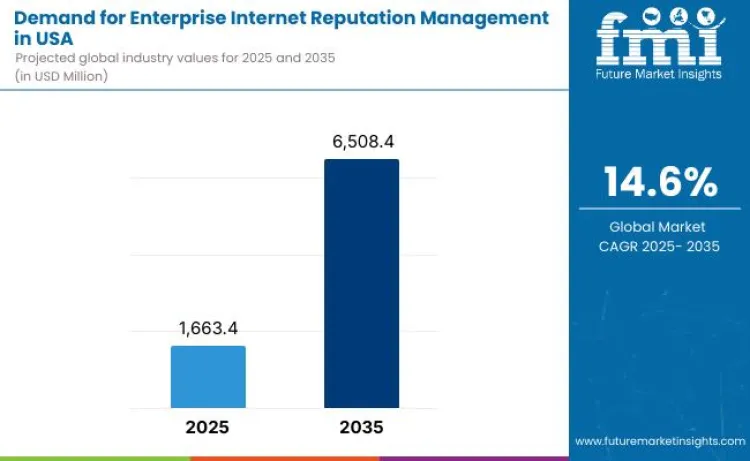
- USD 1663.4 Mn
- Forecast (2035)
- USD 6508.4 Mn
- CAGR (2025 to 2035)
- 14.6%
Demand for Enterprise Internet Reputation Management in USA 2025 to 2035
The demand for enterprise internet reputation management in the USA is valued at USD 1,663.4 million in 2025 and is forecast to reach USD 6,508.4 million by 2035, recording a CAGR of 14.6%. Growth is influenced by greater visibility into customer reviews, accelerated adoption of digital engagement channels, and heightened sensitivity to online reputation risks among large enterprises. Companies invest in reputation governance to mitigate brand damage, ensure accurate public representation, and safeguard customer trust across search engines, e-commerce platforms, and social media ecosystems.
Reputation-repair solutions lead demand. These offerings focus on suppressing negative content, improving sentiment profiles, and restoring credibility following adverse publicity. Service capabilities include review-management systems, crisis-response strategies, misinformation tracking, and continuous monitoring of brand mentions with high analytical precision. Enterprises apply these tools to protect revenue, preserve investor confidence, and maintain competitive positioning.
Quick Stats for USA Enterprise Internet Reputation Management Demand
- USA Enterprise Internet Reputation Management Sales Value (2025): USD 1,663.4 million
- USA Enterprise Internet Reputation Management Forecast Value (2035): USD 6,508.4 million
- USA Enterprise Internet Reputation Management Forecast CAGR (2025 to 2035): 14.6%
- Leading Solution in USA Enterprise Internet Reputation Management Demand: Reputation Repair
- Key Growth Regions in USA Enterprise Internet Reputation Management Demand: West USA, South USA, Northeast USA
- Top Players in USA Enterprise Internet Reputation Management Demand: Reputation.com, BrandYourself, Trustpilot, Hootsuite, Sprout Social
Demand is highest in the West, South, and Northeast due to concentrated digital-first enterprises, technology hubs, and sector diversity spanning retail, hospitality, healthcare, and professional services. Organizations in these regions pursue ongoing digital-reputation improvements linked to customer-acquisition strategies and long-term brand equity. Key providers include Reputation.com, BrandYourself, Trustpilot, Hootsuite, and Sprout Social. Their platforms emphasize scalable analytics, review authentication, automated sentiment insights, and response-workflow integration that supports enterprise reputation compliance and public-communication standards.
What is the Growth Forecast for Enterprise Internet Reputation Management Industry in USA through 2035?
Demand for enterprise internet reputation management in the United States shows strong contribution from sectors with high public-engagement exposure. Large enterprises contribute most because reputation risk directly influences contract wins, investor confidence, and regulatory interactions. This group allocates defined budgets for digital monitoring, crisis communication, and brand-protection systems, which raises its weight in overall demand contribution. Technology, financial services, healthcare, and consumer goods account for a major share due to frequent reputation threats, rapid information cycles, and close scrutiny from users and regulators. Growth also reflects increased use of data analytics tools that track sentiment patterns, misinformation, and online defamation affecting corporate value.
Service agreements linked to litigation support and compliance reinforce spending among governance-focused organizations. Mid-tier companies expand contribution at a faster rate because digital visibility rises with e-commerce adoption and multichannel communication. These firms invest in reputation services to protect hiring pipelines, customer acquisition, and stakeholder trust. Contribution from small enterprises remains lower but gradually improves as social reputation becomes an operational risk category. Demand distribution continues to shift toward sectors with measurable financial exposure to digital sentiment, forming a balanced mix across corporate size and regulatory environments.
USA Enterprise Internet Reputation Management Key Takeaways
| Metric | Value |
|---|---|
| USA Enterprise Internet Reputation Management Sales Value (2025) | USD 1,663.4 million |
| USA Enterprise Internet Reputation Management Forecast Value (2035) | USD 6,508.4 million |
| USA Enterprise Internet Reputation Management Forecast CAGR (2025 to 2035) | 14.6% |
Why is the Demand for Enterprise Internet Reputation Management in the USA Growing?
Demand for enterprise internet reputation management (IRM) in the USA is increasing because companies rely heavily on digital presence and brand image. Online reviews, social media mentions and search results influence customer trust and purchasing decisions. Enterprises seek IRM tools and services to monitor and manage their digital footprint, address negative content quickly and maintain a consistent brand narrative across platforms. Growth in corporate e-commerce, remote work, cloud services and online customer support raises the risk of publicized complaints, data-privacy incidents and reputation damage from cyberattacks. Reputation management solutions offer monitoring, alerting and remediation services to help companies respond promptly to risks, often integrating with public relations and cybersecurity teams.
Regulated industries such as financial services and healthcare increasingly adopt IRM to manage compliance and prevent reputational damage when security or privacy concerns arise. Mergers and acquisitions also drive demand, as enterprises assess public perception before acquisition and work to rebuild brand trust post-merger. Constraints include budget limitations for small businesses and concerns about transparency and authenticity when managing public perception. Rapid content sharing and viral social media trends can exceed prevention capabilities. Some companies may delay implementation until reputational issues emerge.
Which Deployment Models and Industries Lead Demand for Enterprise Internet Reputation Management in the USA?
Demand for enterprise internet reputation management in the United States is driven by heightened brand scrutiny, cybersecurity risks, and the importance of proactive monitoring across digital channels. USA organizations prioritize platforms that safeguard investor trust, regulatory compliance, and consumer confidence while preventing reputational loss from misinformation or cyber breaches. Growth trends reflect expanding social media oversight, review-platform tracking, and automated risk alerts integrated into enterprise data ecosystems. Adoption is strongest among sectors with high personal data exposure and regulated communication frameworks.
By Deployment Model, Cloud and SaaS Dominates Adoption
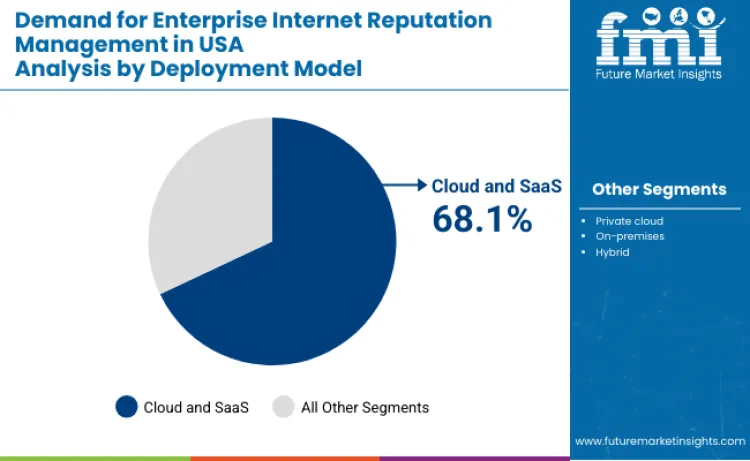
Cloud and SaaS segment account for 68.1%, reflecting strong enterprise preference for scalable, subscription-based access to digital reputation and monitoring platforms. Organizations favor cloud models for faster implementation, centralized dashboards, and continuous updates without internal infrastructure burden. SaaS platforms enable real-time brand monitoring, AI-driven sentiment analysis, and automated alerts across multiple digital channels. Adoption is especially strong among mid-size enterprises, agencies, and distributed organizations seeking flexibility and cost efficiency. Vendors emphasize robust security controls, data encryption, and compliance alignment to meet USA cybersecurity, privacy, and governance expectations.
Key Points:
- Cloud and SaaS dominate deployment preference
- Adoption driven by scalability and faster onboarding
- Growth supported by AI analytics and automated monitoring services
By Industry, Retail and E-Commerce Holds the Largest Share
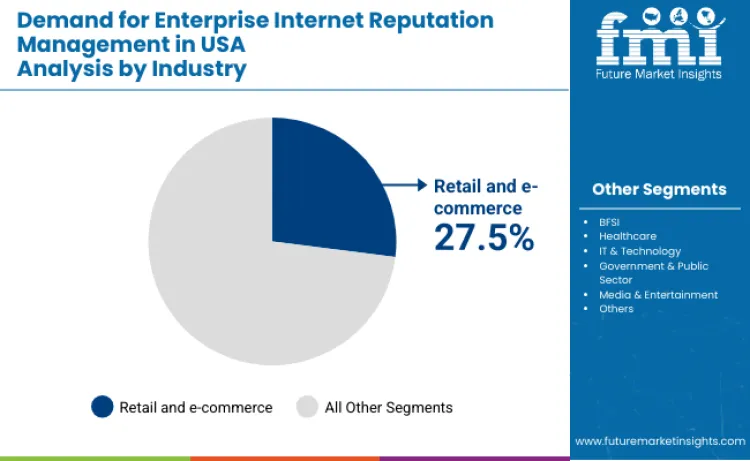
Retail and e-commerce account for 27.5%, reflecting high exposure to online reviews, price comparison platforms, and social media driven purchasing behavior. Brands actively monitor digital sentiment to manage customer trust, address service issues in real time, and protect product authenticity across marketplaces. Reputation risks tied to fake reviews, delivery performance, and post purchase experience drive sustained adoption. Platforms supporting automated review tracking, AI based sentiment analysis, and rapid response workflows see strong demand as retailers prioritize brand consistency and customer loyalty in competitive digital environments.
Key Points:
- Retail and e-commerce adoption driven by review visibility and customer trust
- High sensitivity to fake reviews and marketplace reputation risks
- Focus on real time monitoring and loyalty protection
What are the Drivers, Restraints, and Key Trends of the Demand for Enterprise Internet Reputation Management in USA?
Rising brand exposure across digital channels, increasing regulatory and compliance scrutiny, and growth of consumer review influence drive demand.
In the United States, more companies operate across social media, e-commerce platforms, review sites, and online news outlets creating many public touchpoints that influence brand image. Enterprises with national or multi-location footprints invest in Internet reputation management to monitor this exposure and ensure consistent, trustworthy brand presence. Industries such as healthcare, finance, hospitality, and retail face regulatory requirements and compliance standards that make reputational risk management essential. Growing reliance on online reviews and social feedback for consumer purchase decisions also leads enterprises to proactively manage online sentiment to maintain customer trust and protect sales channels. These factors support increased procurement of enterprise-grade reputation-management solutions among large firms and institutions.
Complexity of digital presence, high ongoing costs, and fragmented online review ecosystems restrain adoption.
Large enterprises often have decentralized operations across states and business lines, making unified reputation oversight complex and organizationally heavy. Effective Internet reputation management requires continuous monitoring, content moderation, and occasional legal or PR interventions, which carries significant recurring cost. The volume and diversity of online platforms from mainstream social media to niche forums and local review sites create a fragmented ecosystem where complete coverage can be difficult. Small or mid-size firms may lack resources to sustain enterprise-level reputation programs, restricting full-scale adoption even when risk is acknowledged.
Shift toward AI-powered monitoring platforms, growing integration with customer experience tools, and rising demand for proactive risk-intelligence define key trends.
Enterprise Internet reputation management solutions increasingly use artificial intelligence and machine learning to parse large volumes of online data and detect emerging sentiment shifts or potential crises in real time. Companies integrate reputation tools with customer-experience platforms to capture feedback, reviews, and social sentiment alongside operational metrics, enabling more comprehensive brand management. Demand is also rising for proactive risk-intelligence services that flag potential reputational threats such as misinformation, negative press, or regulatory complaints before they escalate. These innovations support a more data-driven, preventive approach to brand reputation management across USA enterprises.
Analysis of the Demand for Enterprise Internet Reputation Management in the USA by Region
Demand for enterprise internet reputation management in the United States is expanding as organizations prioritize digital perception, brand-risk mitigation, and proactive customer sentiment control across social and search platforms. Regulatory expectations for corporate transparency and rising exposure to viral consumer complaints strengthen investments in monitoring tools, analytics, and crisis-response automation. E-commerce growth and competitive service sectors accelerate online review management adoption. West USA leads at 15.8% CAGR, followed by South USA at 14.3%, Northeast USA at 15.1%, and Midwest USA at 12.7%. Growth varies with regional concentrations of digital-native businesses, cybersecurity integration, customer-experience programs, and media influence density.
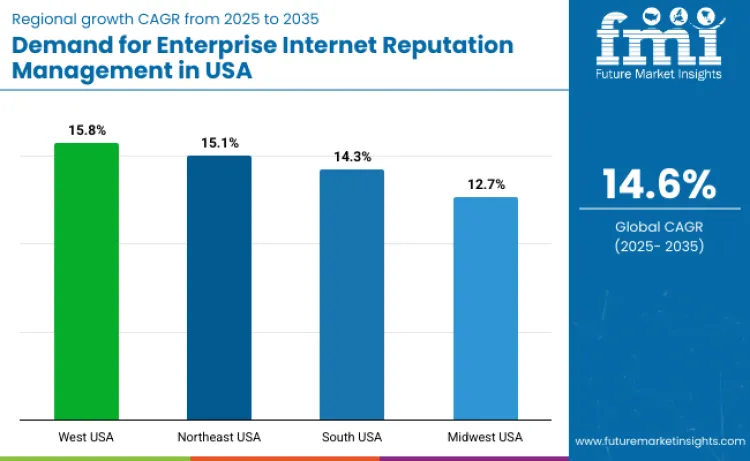
| Region | CAGR (2025-2035) |
|---|---|
| West USA | 15.8% |
| South USA | 14.3% |
| Northeast USA | 15.1% |
| Midwest USA | 12.7% |
How is the West USA driving demand for enterprise reputation management?
West USA reports 15.8% CAGR, supported by headquarters of digital-first corporations and technology innovators seeking advanced control over online brand visibility. Reputation analytics and social-monitoring platforms are integrated into broader marketing and cybersecurity stacks for continuous sentiment detection. Enterprises in California and Washington focus on mitigating misinformation and managing feedback from high-volume service channels including streaming, ride-sharing, and retail marketplaces. AI-based content classification enables rapid identification of harmful narratives. Third-party rating platforms and influencer ecosystems escalate stakes for real-time engagement. Procurement teams emphasize API-enabled platforms that align with CRM and compliance frameworks while supporting multilingual consumer interactions and automated escalation workflows.
- Tech-driven brand ecosystems fueling analytics adoption
- High review volumes increasing automation requirements
- API-integrated tools supporting CRM alignment
- Real-time misinformation controls guiding vendor selection
How is the South USA shaping enterprise adoption?
South USA grows at 14.3% CAGR, influenced by expanding corporate operations in Texas, Florida, and Georgia where hospitality, healthcare, and financial services rely heavily on public customer ratings. Enterprises invest in platforms capable of benchmarking multi-location performance and review equity across diverse demographics. Regional marketing hubs deploy sentiment dashboards for proactive recovery of dissatisfied customers before reputational damage spreads. Digital compliance policies require documented handling of complaints and data privacy assurance. Business-to-consumer firms view online trust as an essential conversion factor, driving procurement centered on scalability and automated outreach for review generation.
- Service-sector reliance on public ratings boosting USAge
- Multi-site management shaping analytics feature demand
- Compliance documentation influencing vendor standards
- Automated feedback loops aiding customer recovery
How is the Northeast USA impacting procurement patterns?
Northeast USA posts 15.1% CAGR, driven by regulated industries including finance, education, and health systems in New York, New Jersey, and Massachusetts. Enterprises align reputation-management policies with governance frameworks that emphasize data integrity. Institutions leverage monitoring platforms to address reputational risk tied to regulatory audits, customer fraud claims, or service-quality metrics. Urban consumers rely heavily on review signals, intensifying competition for positive digital credibility. Procurement prioritizes platforms delivering deep-learning analytics and long-term archival of sentiment trends for executive-reporting needs. Media-dense environments raise urgency for rapid digital-crisis intervention protocols.
- Regulated industries emphasizing governance compliance
- Archival reporting for executive oversight
- Media influence accelerating crisis-response requirements
- Fraud-related reputation risk shaping monitoring needs
How is the Midwest USA contributing to overall growth?
Midwest USA advances at 12.7% CAGR, reflecting consistent adoption among manufacturers, regional retailers, and healthcare groups with growing e-commerce dependence. Enterprises increasingly recognize online reputation as a differentiator for regional talent acquisition and B2B partnership validation. Reputation platforms support standardized messaging where customer interactions occur across distributed service locations. Procurement committees emphasize value optimization and vendor support reliability over experimental features. Integration with workforce-training programs helps ensure timely engagement with online feedback and standardized handling of customer concerns.
- E-commerce growth strengthening reputation priorities
- Brand credibility influencing workforce recruitment
- Distributed operations requiring consistent communication
- Cost-efficient platform selection guiding adoption
How is competitive positioning structured among enterprise internet reputation management providers in the United States?
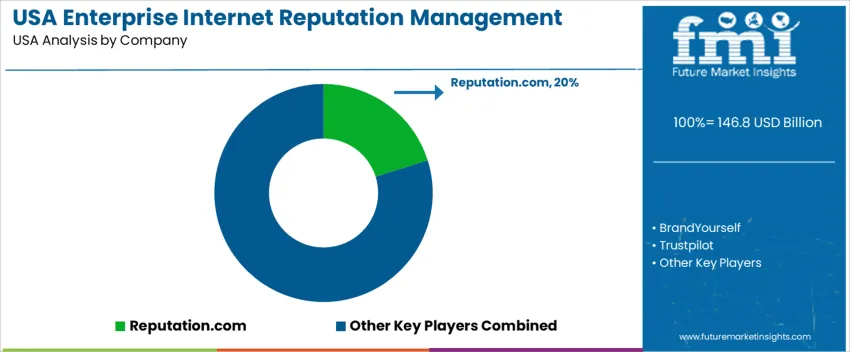
Competition in USA enterprise internet reputation management centers on capabilities for review monitoring, response workflow integration, and analytics tied to customer satisfaction improvement. Reputation.com holds an estimated 20.2%, supported by extensive review-site coverage and platform tools that connect directly with multi-location service providers. Its scale advantage reflects strong adoption across healthcare networks, retail chains, and automotive service providers.
BrandYourself emphasizes individualized reputation repair and profile management, gaining Usage in professional-services environments and organizations seeking direct control over search-result narratives. Its competitive presence links to custom remediation strategies rather than broad operational deployment. Trustpilot leverages a large review community and open platform model, strengthening adoption among consumer-product brands and e-commerce operators reliant on verified review visibility.
Hootsuite competes through social-listening and engagement management, aligning reputation stewardship with wider corporate communication functions. Its position reflects integration into enterprise social-media governance rather than solely ratings oversight. Sprout Social supports mid-size and enterprise organizations with customer-interaction analytics that help address service issues contributing to negative sentiment. Competitive strength increasingly depends on the ability to unify online review analysis, structured escalation workflows, and compliance-ready audit trails, while maintaining seamless integration with CRM and customer experience systems across the United States.
Key Players in USA Enterprise Internet Reputation Management Demand
- Reputation.com
- BrandYourself
- Trustpilot
- Hootsuite
- Sprout Social
Scope of the Report
| Items | Values |
|---|---|
| Quantitative Units | USD million |
| Deployment | Cloud / SaaS, Private Cloud, On-premises, Hybrid |
| Industry | BFSI, Healthcare, Retail & E-commerce, IT & Technology, Government & Public Sector, Media & Entertainment, Others |
| Regions Covered | West USA, South USA, Northeast USA, Midwest USA |
| Key Companies Profiled | Reputation.com, BrandYourself, Trustpilot, Hootsuite, Sprout Social |
| Additional Attributes | Dollar sales by solution and deployment modes; adoption across healthcare, BFSI, and retail ecosystems; insights into cloud-based dominance in enterprise social listening and sentiment analytics; regional Usage patterns driven by online branding compliance, review management, and crisis communication functions; competitive dynamics influenced by AI-enabled monitoring tools and integration with CRM and marketing automation platforms. |
USA Enterprise Internet Reputation Management Demand by Segments
Deployment:
- Cloud / SaaS
- Private cloud
- On-premises
- Hybrid
Industry:
- BFSI
- Healthcare
- Retail & E-commerce
- IT & Technology
- Government & Public Sector
- Media & Entertainment
- Others
Region:
- West USA
- South USA
- Northeast USA
- Midwest USA
Frequently Asked Questions
How big is the demand for enterprise internet reputation management in USA in 2025?
The demand for enterprise internet reputation management in USA is estimated to be valued at USD 1,663.4 billion in 2025.
What will be the size of enterprise internet reputation management in USA in 2035?
The market size for the enterprise internet reputation management in USA is projected to reach USD 6,508.4 billion by 2035.
How much will be the demand for enterprise internet reputation management in USA growth between 2025 and 2035?
The demand for enterprise internet reputation management in USA is expected to grow at a 14.6% CAGR between 2025 and 2035.
What are the key product types in the enterprise internet reputation management in USA?
The key product types in enterprise internet reputation management in USA are reputation repair, reputation monitoring, reputation analysis and others.
Which deployment segment is expected to contribute significant share in the enterprise internet reputation management in USA in 2025?
In terms of deployment, Cloud and SaaS segment is expected to command 68.1% share in the enterprise internet reputation management in USA in 2025.
Preview the report firsthand - request a free sample
Get SampleGet the brochure for pricing and purchase details.
Get PDFTable of Content
- Executive Summary
- USA Enterprise Internet Reputation Management Demand Overview
- Key Demand Drivers and Growth Outlook
- Key Takeaways and Strategic Insights
- Market Introduction
- Market Definition and Scope
- Study Assumptions and Limitations
- Research Methodology
- USA Enterprise Internet Reputation Management Demand Outlook (2026 to 2036)
- Market Value Analysis
- Year-on-Year Growth Analysis
- Forecast CAGR Assessment
- Market Dynamics
- Demand Drivers
- Demand Restraints
- Key Trends and Opportunities
- Demand Analysis by Deployment Model
- Cloud / SaaS
- Private Cloud
- On-Premises
- Hybrid
- Demand Analysis by Industry
- BFSI
- Healthcare
- Retail & E-commerce
- IT & Technology
- Government & Public Sector
- Media & Entertainment
- Others
- Regional Demand Analysis
- West USA
- South USA
- Northeast USA
- Midwest USA
- Competitive Landscape
- Market Share Analysis
- Competitive Positioning
- Strategic Developments
- Company Profiles
- Reputation.com
- BrandYourself
- Trustpilot
- Hootsuite
- Sprout Social
- Scope of the Report
- Frequently Asked Questions


