

- Industry Size (2026)
- USD 5.99 Bn
- Forecast (2036)
- USD 25.30 Bn
- CAGR (2026 to 2036)
- 15.5%
Enterprise Internet Reputation Management Market Size, Market Forecast and Outlook By FMI
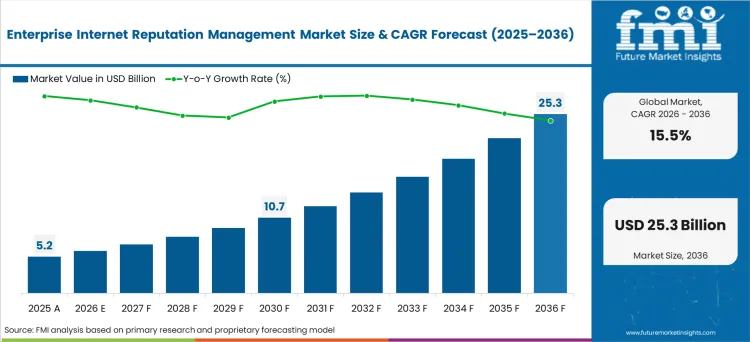
The enterprise internet reputation management market was valued at USD 5.19 billion in 2025, projected to reach USD 5.99 billion in 2026, and is forecast to expand to USD 25.30 billion by 2036 at a 15.5% CAGR. Expanding digital brand exposure, rising consumer reliance on online reviews for purchase decisions, and growing threat of coordinated disinformation campaigns are compelling enterprises to invest in reputation monitoring, analysis, and repair services. FMI is of the opinion that the convergence of AI-powered sentiment analysis, social media listening, and automated review response within unified reputation management platforms is the primary technology transition reshaping enterprise procurement specifications.
Summary of Enterprise Internet Reputation Management Market
- Market Overview
- The market is valued at USD 5.19 billion in 2025 and is projected to reach USD 25.30 billion by 2036.
- The industry is expected to grow at a 15.5% CAGR from 2026 to 2036, creating an incremental opportunity of USD 19.31 billion.
- The market is a digital marketing technology category where AI-powered sentiment analysis, multi-platform monitoring breadth, and automated response capability define competitive positioning.
- Demand and Growth Drivers
- Demand is accelerating as consumer purchase decisions increasingly depend on online reviews and social media sentiment that enterprises must actively monitor and manage.
- Multi-location enterprises face location-level reputation variation that requires automated monitoring and response systems exceeding manual management capacity.
- Coordinated disinformation and review manipulation threats are compelling enterprises to invest in AI-powered reputation monitoring and anomaly detection.
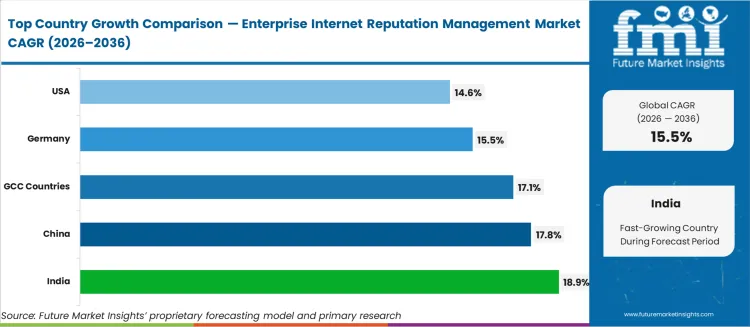
- Among countries, India (18.9% CAGR), China (17.8% CAGR), GCC Countries (17.1% CAGR), Germany (15.5% CAGR), USA (14.6% CAGR).
- Product and Segment View
- Software leads by Solution with 28.5% share in 2026.
- Cloud-based leads by Deployment with 17.4% share in 2026.
- BFSI is the leading Industry category in 2026.
- Geography and Competitive Outlook
- India and China are the fastest growing markets.
- Key players include Reputation.com, BrandYourself, Trustpilot, Hootsuite, Sprout Social, NetReputation, PR Newswire.
- Analyst Opinion at FMI
- Sudip saha, Principal Consultant for Technology observe that: 'In my analysis, I have observed that enterprise reputation management is transitioning from reactive crisis response toward continuous, AI-powered monitoring and engagement. Organizations that deploy reputation management platforms only after negative events face recovery costs that exceed annual proactive monitoring subscription fees. Multi-location enterprises including hospital systems, financial services chains, and hospitality groups are the fastest adopting segments because location-level reputation variation directly impacts revenue per site.'
- Strategic Implications / Executive Takeaways
- Reputation management platform vendors must integrate AI-powered sentiment analysis and automated review response capability to meet enterprise requirements for scalable, multi-location reputation monitoring.
- Multi-location enterprise operators should deploy continuous reputation monitoring platforms to detect negative sentiment shifts before they impact location-level revenue performance.
- Healthcare and financial services compliance teams need to implement reputation management workflows that align review response protocols with regulatory advertising and disclosure requirements.
Enterprise Internet Reputation Management Market Key Takeaways
| Metric | Details |
|---|---|
| Industry Size (2026) | USD 5.99 Billion |
| Industry Value (2036) | USD 25.30 Billion |
| CAGR (2026 to 2036) | 15.5% |
Source: Future Market Insights, 2026
The incremental opportunity of USD 19.31 billion between 2026 and 2036 reflects cumulative growth in enterprise digital footprint complexity, expanding social media and review platform monitoring requirements, and rising demand for proactive reputation management across regulated industries where online perception directly impacts business performance. Software solutions lead the solution segment at 28.5% because enterprises prioritize scalable, automated monitoring over manual reputation management approaches. Cloud-based deployment is the fastest growing configuration because multi-location enterprises require centralized reputation dashboards accessible across geographic operations without dedicated on-premises infrastructure.
All major regional markets reflect differentiated growth trajectories. India leads with a 18.9% CAGR, China follows at 17.8%, GCC Countries follows at 17.1%, Germany follows at 15.5%, and USA registers 14.6% growth. India's lead growth rate reflects its expanding digital commerce ecosystem and growing enterprise awareness of online reputation impact on customer acquisition. China's pace is supported by social commerce growth and platform review management requirements. GCC countries maintain high growth through hospitality and financial services sector reputation management investment. Germany and the USA contribute through regulatory compliance requirements for financial services review management and healthcare provider reputation monitoring.
Enterprise Internet Reputation Management Market Definition
The enterprise internet reputation management market encompasses software platforms and services that enable organizations to monitor, analyze, repair, and manage their online reputation across search engines, social media, review platforms, and news outlets. Solutions include reputation monitoring, reputation repair, reputation analysis, and integrated software platforms. Deployment options span cloud-based and on-premises configurations serving BFSI, healthcare, retail, IT, government, media, and other industry verticals.
Enterprise Internet Reputation Management Market Inclusions
Market scope includes reputation management software platforms and associated services sold across all deployment types and industry verticals. Global and regional market sizes, solution, deployment, and industry segment breakdowns, and forecast projections from 2026 to 2036 are covered.
Enterprise Internet Reputation Management Market Exclusions
The scope excludes personal reputation management services for individuals, standalone social media management platforms without reputation scoring capability, public relations agency retainer services, and basic online listing management tools.
Enterprise Internet Reputation Management Market Research Methodology
Primary Research
Analysts engaged with enterprise technology procurement directors, platform administrators, and industry domain specialists to map selection criteria, deployment preferences, and vendor evaluation frameworks.
Desk Research
Data collection aggregated published enterprise technology adoption surveys, regulatory compliance requirement databases, vendor product capability assessments, and industry association reports.
Market Sizing and Forecasting
Baseline values derive from a bottom up aggregation of platform deployments and service engagements by segment, applying regional pricing benchmarks and enterprise adoption rates to project market growth.
Data Validation and Update Cycle
Projections are tested against published vendor revenue disclosures, enterprise technology spending surveys, and regulatory compliance adoption statistics.
Key Industry Highlights
Surge in Digital Consumerism Demanding Proactive Brand Monitoring Across Online Platforms
With digital consumerism now the new buzzword, a huge shift has changed the way in which people interact with the brand. Moreover, purchasing decisions today largely depend on consumer reviews, ratings, social network interactions, and public feedbacks. One unfavorable review or hurting viral post heavily influences the bottom line and profits affecting your brand's overall reputation and income.
This increased reliance on digital platforms surges the demand for powerful reputation management tools that come with real-time monitoring, sentiment analysis, and crisis intervention capabilities. Companies that are proactive in investing in brand monitoring are able to ensure consumer trust, enhance visibility, and competitive advantage in the markets, thereby bolstering growth of the enterprise IRM market.
AI and Automation Enhancing Real-Time Analysis and Response to Reputation Crises
Technologies like AI and automation are changing the landscape of enterprise internet reputation management. Tools equipped with AI allow businesses to analyze sentiment in large volumes of data, pinpoint trends, and predict potential crises before they get out of hand.
Automation simplifies tasks like responding to customer reviews, setting alerts on negative mentions, and managing several platforms all at once. These capabilities cut response times, enhance decision-making, and better operational efficiency. Some remarkable AI-enabled inventions will drive this market due to the growing demand by firms to manage online reputation smarter and speedier.
Difficulty in Managing Multilingual and Cross-Cultural Brand Perceptions Across Global Markets
Large companies often have to address online reputations in many different linguistic and cultural areas. Sentiments and opinions of a brand can vary drastically between regions, making it difficult or even impossible to devise a unified approach to reputation management. In general, nuances of local languages and cultural contexts require tailored approaches, which can be resource-intensive and hard to scale.
Moreover, incorrect translation or misunderstanding of the same further exacerbate reputational issues rather than alleviate them. Companies need robust solutions that have multilingual sentiment analysis combined with cultural intelligence, but these are still evolving and thus create a barrier to effective global deployment.
2021 to 2025 Global Enterprise Internet Reputation Management Sales Outlook Compared to Demand Forecasts from 2026 to 2036
The IRM market for enterprises had a high growth rate from 2021 to 2025 because business digitization and the rise of consumer interactions over the Internet propelled the demand for reputation management solutions. Demand for IRM solutions increases with the growing use of e-commerce, social media platforms, and online review systems. Every organization wanted to protect its image on the web, especially in verticals such as hospitality, retail, and healthcare, since consumer perception had a direct impact on revenue.
AI-powered tools and automation took center stage in the market offerings, enabling real-time monitoring and effective crisis management. However, challenges such as high costs for advanced solutions and the fragmented nature of global markets hindered the adoption of comprehensive systems, especially among small and mid-sized businesses.
Advances in AI, machine learning, and predictive analytics are expected to fuel a sharp surge in the IRM market from 2026 through 2036. The presence of social media, the metaverse, and other virtual decentralized ecosystems increases the complexity associated with managing digital reputations and elevates demand within this marketplace.
With increased scrutiny across the world, especially concerning data privacy and ethics in the area of business, IRM solutions will be utilized as organizations seek to create, comply, and uphold confidence among the public. The markets of Asia-Pacific, Latin America, and the Middle East will experience faster growth in their move toward digital transformation. However, IRM vendors will be compelled to be continuously innovative given the challenge of emergent consumer expectations, integration complexities, and cultural diversity in world markets.
Market Concentration
Tier 1 companies are equipped with huge resources, state-of-the-art technologies, and a wide presence across various industries and geographies. These include companies like Google, Salesforce, and Adobe, which integrate advanced AI and automation into their IRM solutions.
These players focus on real-time monitoring, multilingual sentiment analysis, and predictive analytics to cater to large enterprises with complex reputation management needs. With the ability to provide scalable and customized solutions, besides strategic consulting services, they hold a dominant position in the marketplace. They represent about 35 to 40 percent of the marketplace.
Tier 2 companies are regional or niche players that supply tailored solutions for mid-sized enterprises and particular industries. These would include companies such as Reputation.com, Brandwatch, and Sprout Social, carving out a niche either by their high degree of industry-specific applications or value-for-money solutions for firms with less expensive budgets.
Although not being able to compete with the scale of Tier 1 organizations, usually, Tier 2 players are more agile in response to quick market demands and technological changes. In their approach, they emphasize strong customer relationships and flexible pricing models as a way to attract businesses in need of affordable yet robust reputation management tools. As such, this would translate to approximately 15-20% in terms of considering market size capture for Tier 2.
Tier 3 companies include startups or localized service providers, with a greater focus on small and micro-enterprises or even underserved markets. Normally, such IRM companies will only provide very basic solutions-for instance, review monitoring or social media management-which come at the lowest costs possible. Such companies' strong points are serving particular local or industry needs where challenges cannot be overcome by their bigger peers.
While their limited resources and technological capabilities restrict their ability to compete with Tier 1 and 2 firms, Tier 3 companies play a very important role in democratizing access to reputation management tools for smaller businesses. Startups and regional software providers servicing local markets would account for roughly 25-30% of the total market size.
Country-wise Insights
The section highlights the CAGRs of countries experiencing growth in the enterprise internet reputation management market, along with the latest advancements contributing to overall market development. Based on current estimates USA, India and China are expected to see steady growth during the forecast period.
.webp "Top Country Growth Comparison Enterprise Internet Reputation Management Market Cagr (2026 2036)")
| Countries | CAGR from 2026 to 2036 |
|---|---|
| India | 18.9% |
| China | 17.8% |
| Germany | 15.5% |
| GCC Countries | 17.1% |
| United States | 14.6% |
Major Vendors and Startups are Leveraging Digital Transformation for Rapid Growth in Internet Reputation Management
With the rapid digital transformation of businesses and sudden explosion in social media usage, the Enterprise IRM market is also experiencing fast growth in India. In the wake of 800-plus million internet subscribers in India, the businesses have huge investments in IRM tools so as to maintain good online reputation and for effective communication with digitally savvy consumer bases.
Notable investments include the expansion of Salesforce and Sprinklr in India, with both using AI-powered tools to serve local needs. Furthermore, venture capital investments have been attracted to India's thriving startup ecosystem, including platforms like RepUp and Konnect Insights, to develop affordable IRM solutions for small and mid-sized businesses.
Consumer-Centric Industries in USA are Driving Enterprise Reputation Management Leadership
The USA market dominates the Enterprise IRM market due to its highly developed technological infrastructure and excellent focus on brand management across industries such as retail, healthcare, and finance. American companies have been among the early adopters of using AI and analytics in reputation management, underpinned by deep venture capital investments in players like Reputation.com, which was able to secure USD 56 million in 2021.
Key players also continue their service portfolio expansion through acquisitions and R&D investments, as seen by Adobe and Hootsuite. This is also driven by the increasing prevalence of consumer reviews in sites like Yelp and Google Reviews, which further heightens the demand for sophisticated IRM solutions in the USA market.
Navigating a Complex Digital Ecosystem with AI-Powered Reputation Management Solutions in China
The rapid growth in China could be attributed to a very different digital environment-think all-encompassing platforms the likes of WeChat, Weibo, and Alibaba Reviews for molding consumer views. Chinese enterprises have therefore invested aggressively in IRM solutions to make sense of their complex digital environment and to work within the sometimes strict regulatory environment governments put in.
Companies like Tencent and Baidu now integrate AI into their IRM platforms featuring real-time monitoring and multilingual sentiment analysis. Moreover, e-commerce giants in China, such as JD.com, have joined hands with local IRM startups to handle the massive flow of online reviews, further boosting market growth. This investment landscape underlines the robust commitment of China to digital reputation management.
Category-wise Insights
The section provides detailed insights into key segments of the enterprise internet reputation management market. This section analyzes the growth and market share in the enterprise internet reputation management market among key segments.
Cloud-based Segment is Expected to Grow Rapidly for the Forecasting Period
Cloud-based IRM solutions can help organizations monitor and manage brand reputation across various platforms with ease, without actually investing in huge IT infrastructure. Companies like Reputation.com and Brandwatch have invested heavily in cloud offerings, with the USD 56 million funding of Reputation.com in 2021 further fueling its cloud-based tools.
The global COVID-19-accelerated shift to working from anywhere further accelerated this trend, with organizations leveraging AI and analytics for real-time monitoring. Besides that, cloud solutions attract SMBs by their flexible subscription models, making adoption widespread.
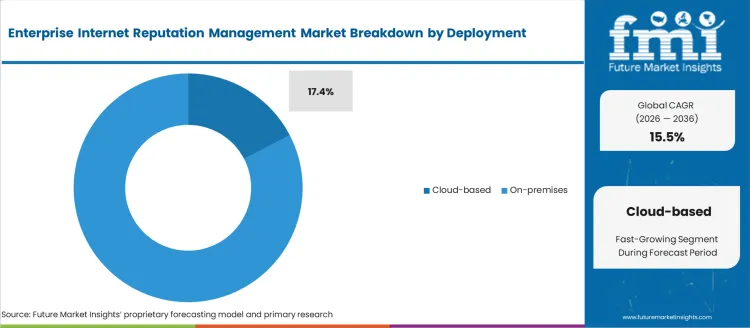
| Segment | CAGR (2026 to 2036) |
|---|---|
| Cloud-based (Deployment) | 17.4% |
Retail & E-commerce Industry Leads the Enterprise Internet Reputation Management Sector in terms of Share
The retail and e-commerce segment dominates the Enterprise Internet Reputation Management (IRM) market due to its heavy reliance on customer reviews, ratings, and social media engagement for driving sales. In this sector, reputation directly impacts purchasing decisions and customer loyalty. Investments in IRM tools by major players like Amazon and Walmart highlight the importance of monitoring customer feedback and managing crises effectively.
Startups such as Bazaarvoice, specializing in e-commerce review management, have secured significant funding, including $500 million for platform expansion. The growth of online shopping post-pandemic has intensified the need for robust IRM strategies to maintain consumer trust and competitive edge.
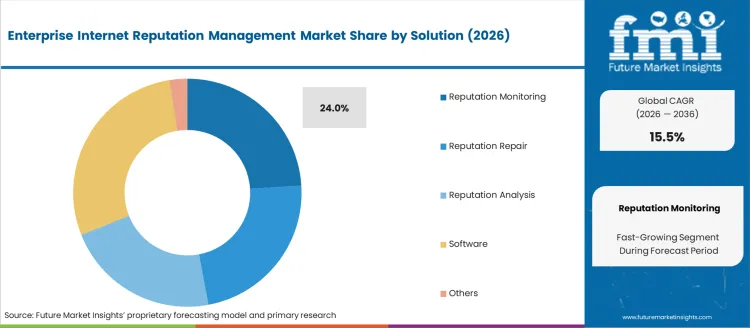
| Segment | Value Share (2026) |
|---|---|
| Software (Solution) | 24.0% |
Competition Outlook
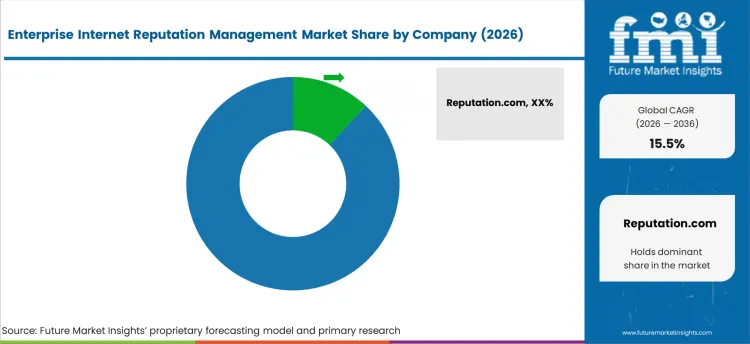
The competitive nature of the Enterprise Internet Reputation Management market is highly competitive, with players striving to innovate differentiators. Advanced technologies that include AI-powered sentiment analysis, multilingual monitoring, and real-time reporting have become the features that drive the competition. The market participants also invest in integrating their solutions with CRM and marketing tools to come up with end-to-end offerings.
The pricing strategies involve subscription-based models that can be afforded by enterprises of all scales. Other developments in the market include regional expansion and strategic partnerships to capture emerging opportunities in growing digital economies. Continuous investments in R&D ensure competitive advantage in this dynamic market.
Industry Update
- In December 2024, BHMarketer announced its advanced suite of services to help businesses build trust and thrive in the digital landscape. With a focus on authenticity, innovation, and strategic planning, BHMarketer enables brands to enhance credibility and reach their full potential.
- In December 2024, Brandwatch announced that it is redefining brand reputation management with the launch of its new AI-powered React Score. This industry-first advancement leverages automated AI to empower brands with unparalleled real-time insights, allowing for timelier, proactive action.
- In October 2024, WhiteBridge, an AI-powered platform specialising in online reputation management and digital footprint platform, raised $500,000 in a pre-seed funding round led by FIRSTPICK, with participation from Scalewolf, First Degree, and Nectolabs.
Scope of the Report
| Metric | Value |
|---|---|
| Quantitative Units | USD 5.99 Billion to USD 25.30 Billion, at a CAGR of 15.5% |
| Market Definition | The enterprise internet reputation management market encompasses software platforms and services that enable organizations to monitor, analyze, repair, and manage their online reputation across search... |
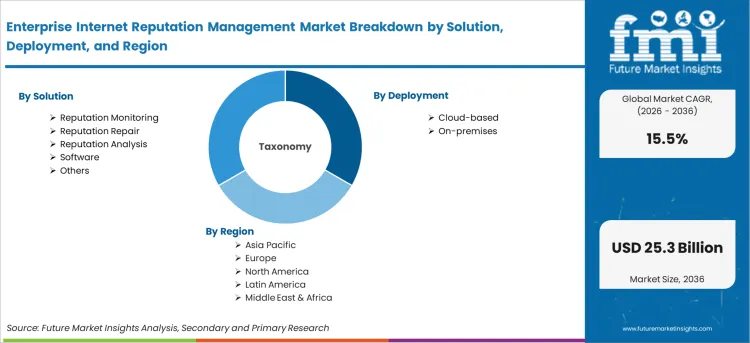
| Segmentation | Solution: Reputation Monitoring, Reputation Repair, Reputation Analysis, Software, Others; Deployment: Cloud-based, On-premises; Industry: BFSI, Healthcare, Retail & E-commerce, IT & Technology, Government & Public Sector, Media & Entertainment, Others |
| Regions Covered | North America, Latin America, Europe, East Asia, South Asia, Oceania, Middle East & Africa |
| Countries Covered | India, China, GCC Countries, Germany, USA, and 40 plus countries |
| Key Companies Profiled | Reputation.com, BrandYourself, Trustpilot, Hootsuite, Sprout Social, NetReputation, PR Newswire, Smartsheet, Yotpo, Bazaarvoice |
| Forecast Period | 2026 to 2036 |
| Approach | Hybrid bottom up methodology combining primary research, supply chain analysis, and proprietary forecasting models. |
Enterprise Internet Reputation Management Market Segmentation
By Solution:
In terms of solution, the segment is divided into Reputation Monitoring, Reputation Repair, Reputation Analysis and Others.
By Deployment:
In terms of deployment, the segment is segregated into Cloud-based and On-premises.
By Industry:
In terms of industry, the segment is segregated into BFSI, Healthcare, Retail & E-commerce, IT & Technology, Government & Public Sector, Media & Entertainment and Others.
By Region:
A regional analysis has been carried out in key countries of North America, Latin America, East Asia, South Asia & Pacific, Western Europe, Eastern Europe and Middle East and Africa (MEA).
Bibliography
- 1. Pew Research Center. (2024). Americans and online reviews: Consumer behavior survey. Pew Research.
- 2. Federal Trade Commission. (2024). Endorsement guides: Using consumer reviews in advertising. FTC.
- 3. European Commission. (2024). Digital services act: Platform transparency requirements. European Commission.
- 4. Organisation for Economic Co-operation and Development. (2024). Trust in the digital economy: Online reputation frameworks. OECD.
- 5. National Institute of Standards and Technology. (2024). Cybersecurity framework: Reputation risk management. NIST.
- 6. World Economic Forum. (2024). Global risks report: Digital reputation and misinformation. WEF.
This bibliography is provided for reader reference. The full Future Market Insights report contains the complete reference list with primary research documentation.
Frequently Asked Questions
How large is the demand for Enterprise Internet Reputation Management in the global market in 2026?
Demand for Enterprise Internet Reputation Management in the global market is estimated to be valued at USD 5.99 billion in 2026.
What will be the market size of Enterprise Internet Reputation Management by 2036?
Market size for Enterprise Internet Reputation Management is projected to reach USD 25.30 billion by 2036.
What is the expected demand growth between 2026 and 2036?
Demand for Enterprise Internet Reputation Management is expected to grow at a CAGR of 15.5% between 2026 and 2036.
Which Solution is poised to lead global sales by 2026?
Software accounts for 28.5% share in 2026.
How significant is Cloud-based in driving adoption in 2026?
Cloud-based represents 17.4% of segment share in 2026.
What is driving demand in India?
India leads with a 18.9% CAGR through 2036.
What is Enterprise Internet Reputation Management and what is it mainly used for?
The enterprise internet reputation management market encompasses software platforms and services that enable organizations to monitor, analyze, repair, and manage their online reputation across search.
What is included in the scope of this report?
Market scope includes reputation management software platforms and associated services sold across all deployment types and industry verticals. Global and regional market sizes, solution, deployment, and industry segment breakdowns, and forecast projections from 2026 to 2036 are covered.
Preview the report firsthand - request a free sample
Get SampleGet the brochure for pricing and purchase details.
Get PDFTable of Content
- Executive Summary
- Global Market Outlook
- Demand-side Trends
- Supply-side Trends
- Technology Roadmap Analysis
- Analysis and Recommendations
- Market Overview
- Market Coverage / Taxonomy
- Market Definition / Scope / Limitations
- Research Methodology
- Chapter Orientation
- Analytical Lens and Working Hypotheses
- Market Structure, Signals, and Trend Drivers
- Benchmarking and Cross-market Comparability
- Market Sizing, Forecasting, and Opportunity Mapping
- Research Design and Evidence Framework
- Desk Research Programme (Secondary Evidence)
- Company Annual and Sustainability Reports
- Peer-reviewed Journals and Academic Literature
- Corporate Websites, Product Literature, and Technical Notes
- Earnings Decks and Investor Briefings
- Statutory Filings and Regulatory Disclosures
- Technical White Papers and Standards Notes
- Trade Journals, Industry Magazines, and Analyst Briefs
- Conference Proceedings, Webinars, and Seminar Materials
- Government Statistics Portals and Public Data Releases
- Press Releases and Reputable Media Coverage
- Specialist Newsletters and Curated Briefings
- Sector Databases and Reference Repositories
- FMI Internal Proprietary Databases and Historical Market Datasets
- Subscription Datasets and Paid Sources
- Social Channels, Communities, and Digital Listening Inputs
- Additional Desk Sources
- Expert Input and Fieldwork (Primary Evidence)
- Primary Modes
- Qualitative Interviews and Expert Elicitation
- Quantitative Surveys and Structured Data Capture
- Blended Approach
- Why Primary Evidence is Used
- Field Techniques
- Interviews
- Surveys
- Focus Groups
- Observational and In-context Research
- Social and Community Interactions
- Stakeholder Universe Engaged
- C-suite Leaders
- Board Members
- Presidents and Vice Presidents
- R&D and Innovation Heads
- Technical Specialists
- Domain Subject-matter Experts
- Scientists
- Physicians and Other Healthcare Professionals
- Governance, Ethics, and Data Stewardship
- Research Ethics
- Data Integrity and Handling
- Primary Modes
- Tooling, Models, and Reference Databases
- Desk Research Programme (Secondary Evidence)
- Data Engineering and Model Build
- Data Acquisition and Ingestion
- Cleaning, Normalisation, and Verification
- Synthesis, Triangulation, and Analysis
- Quality Assurance and Audit Trail
- Market Background
- Market Dynamics
- Drivers
- Restraints
- Opportunity
- Trends
- Scenario Forecast
- Demand in Optimistic Scenario
- Demand in Likely Scenario
- Demand in Conservative Scenario
- Opportunity Map Analysis
- Product Life Cycle Analysis
- Supply Chain Analysis
- Investment Feasibility Matrix
- Value Chain Analysis
- PESTLE and Porter’s Analysis
- Regulatory Landscape
- Regional Parent Market Outlook
- Production and Consumption Statistics
- Import and Export Statistics
- Market Dynamics
- Global Market Analysis 2021 to 2025 and Forecast, 2026 to 2036
- Historical Market Size Value (USD Million) Analysis, 2021 to 2025
- Current and Future Market Size Value (USD Million) Projections, 2026 to 2036
- Y-o-Y Growth Trend Analysis
- Absolute $ Opportunity Analysis
- Global Market Pricing Analysis 2021 to 2025 and Forecast 2026 to 2036
- Global Market Analysis 2021 to 2025 and Forecast 2026 to 2036, By Solution
- Introduction / Key Findings
- Historical Market Size Value (USD Million) Analysis By Solution , 2021 to 2025
- Current and Future Market Size Value (USD Million) Analysis and Forecast By Solution , 2026 to 2036
- Reputation Monitoring
- Reputation Repair
- Reputation Analysis
- Software
- Others
- Reputation Monitoring
- Y-o-Y Growth Trend Analysis By Solution , 2021 to 2025
- Absolute $ Opportunity Analysis By Solution , 2026 to 2036
- Global Market Analysis 2021 to 2025 and Forecast 2026 to 2036, By Deployment
- Introduction / Key Findings
- Historical Market Size Value (USD Million) Analysis By Deployment, 2021 to 2025
- Current and Future Market Size Value (USD Million) Analysis and Forecast By Deployment, 2026 to 2036
- Cloud-based
- On-premises
- Cloud-based
- Y-o-Y Growth Trend Analysis By Deployment, 2021 to 2025
- Absolute $ Opportunity Analysis By Deployment, 2026 to 2036
- Global Market Analysis 2021 to 2025 and Forecast 2026 to 2036, By Industry
- Introduction / Key Findings
- Historical Market Size Value (USD Million) Analysis By Industry, 2021 to 2025
- Current and Future Market Size Value (USD Million) Analysis and Forecast By Industry, 2026 to 2036
- BFSI
- Healthcare
- Retail & E-commerce
- IT & Technology
- Government & Public Sector
- Media & Entertainment
- Others
- BFSI
- Y-o-Y Growth Trend Analysis By Industry, 2021 to 2025
- Absolute $ Opportunity Analysis By Industry, 2026 to 2036
- Global Market Analysis 2021 to 2025 and Forecast 2026 to 2036, By Region
- Introduction
- Historical Market Size Value (USD Million) Analysis By Region, 2021 to 2025
- Current Market Size Value (USD Million) Analysis and Forecast By Region, 2026 to 2036
- North America
- Latin America
- Western Europe
- Eastern Europe
- East Asia
- South Asia and Pacific
- Middle East & Africa
- Market Attractiveness Analysis By Region
- North America Market Analysis 2021 to 2025 and Forecast 2026 to 2036, By Country
- Historical Market Size Value (USD Million) Trend Analysis By Market Taxonomy, 2021 to 2025
- Market Size Value (USD Million) Forecast By Market Taxonomy, 2026 to 2036
- By Country
- USA
- Canada
- Mexico
- By Solution
- By Deployment
- By Industry
- By Country
- Market Attractiveness Analysis
- By Country
- By Solution
- By Deployment
- By Industry
- Key Takeaways
- Latin America Market Analysis 2021 to 2025 and Forecast 2026 to 2036, By Country
- Historical Market Size Value (USD Million) Trend Analysis By Market Taxonomy, 2021 to 2025
- Market Size Value (USD Million) Forecast By Market Taxonomy, 2026 to 2036
- By Country
- Brazil
- Chile
- Rest of Latin America
- By Solution
- By Deployment
- By Industry
- By Country
- Market Attractiveness Analysis
- By Country
- By Solution
- By Deployment
- By Industry
- Key Takeaways
- Western Europe Market Analysis 2021 to 2025 and Forecast 2026 to 2036, By Country
- Historical Market Size Value (USD Million) Trend Analysis By Market Taxonomy, 2021 to 2025
- Market Size Value (USD Million) Forecast By Market Taxonomy, 2026 to 2036
- By Country
- Germany
- UK
- Italy
- Spain
- France
- Nordic
- BENELUX
- Rest of Western Europe
- By Solution
- By Deployment
- By Industry
- By Country
- Market Attractiveness Analysis
- By Country
- By Solution
- By Deployment
- By Industry
- Key Takeaways
- Eastern Europe Market Analysis 2021 to 2025 and Forecast 2026 to 2036, By Country
- Historical Market Size Value (USD Million) Trend Analysis By Market Taxonomy, 2021 to 2025
- Market Size Value (USD Million) Forecast By Market Taxonomy, 2026 to 2036
- By Country
- Russia
- Poland
- Hungary
- Balkan & Baltic
- Rest of Eastern Europe
- By Solution
- By Deployment
- By Industry
- By Country
- Market Attractiveness Analysis
- By Country
- By Solution
- By Deployment
- By Industry
- Key Takeaways
- East Asia Market Analysis 2021 to 2025 and Forecast 2026 to 2036, By Country
- Historical Market Size Value (USD Million) Trend Analysis By Market Taxonomy, 2021 to 2025
- Market Size Value (USD Million) Forecast By Market Taxonomy, 2026 to 2036
- By Country
- China
- Japan
- South Korea
- By Solution
- By Deployment
- By Industry
- By Country
- Market Attractiveness Analysis
- By Country
- By Solution
- By Deployment
- By Industry
- Key Takeaways
- South Asia and Pacific Market Analysis 2021 to 2025 and Forecast 2026 to 2036, By Country
- Historical Market Size Value (USD Million) Trend Analysis By Market Taxonomy, 2021 to 2025
- Market Size Value (USD Million) Forecast By Market Taxonomy, 2026 to 2036
- By Country
- India
- ASEAN
- Australia & New Zealand
- Rest of South Asia and Pacific
- By Solution
- By Deployment
- By Industry
- By Country
- Market Attractiveness Analysis
- By Country
- By Solution
- By Deployment
- By Industry
- Key Takeaways
- Middle East & Africa Market Analysis 2021 to 2025 and Forecast 2026 to 2036, By Country
- Historical Market Size Value (USD Million) Trend Analysis By Market Taxonomy, 2021 to 2025
- Market Size Value (USD Million) Forecast By Market Taxonomy, 2026 to 2036
- By Country
- Kingdom of Saudi Arabia
- Other GCC Countries
- Turkiye
- South Africa
- Other African Union
- Rest of Middle East & Africa
- By Solution
- By Deployment
- By Industry
- By Country
- Market Attractiveness Analysis
- By Country
- By Solution
- By Deployment
- By Industry
- Key Takeaways
- Key Countries Market Analysis
- USA
- Pricing Analysis
- Market Share Analysis, 2025
- By Solution
- By Deployment
- By Industry
- Canada
- Pricing Analysis
- Market Share Analysis, 2025
- By Solution
- By Deployment
- By Industry
- Mexico
- Pricing Analysis
- Market Share Analysis, 2025
- By Solution
- By Deployment
- By Industry
- Brazil
- Pricing Analysis
- Market Share Analysis, 2025
- By Solution
- By Deployment
- By Industry
- Chile
- Pricing Analysis
- Market Share Analysis, 2025
- By Solution
- By Deployment
- By Industry
- Germany
- Pricing Analysis
- Market Share Analysis, 2025
- By Solution
- By Deployment
- By Industry
- UK
- Pricing Analysis
- Market Share Analysis, 2025
- By Solution
- By Deployment
- By Industry
- Italy
- Pricing Analysis
- Market Share Analysis, 2025
- By Solution
- By Deployment
- By Industry
- Spain
- Pricing Analysis
- Market Share Analysis, 2025
- By Solution
- By Deployment
- By Industry
- France
- Pricing Analysis
- Market Share Analysis, 2025
- By Solution
- By Deployment
- By Industry
- India
- Pricing Analysis
- Market Share Analysis, 2025
- By Solution
- By Deployment
- By Industry
- ASEAN
- Pricing Analysis
- Market Share Analysis, 2025
- By Solution
- By Deployment
- By Industry
- Australia & New Zealand
- Pricing Analysis
- Market Share Analysis, 2025
- By Solution
- By Deployment
- By Industry
- China
- Pricing Analysis
- Market Share Analysis, 2025
- By Solution
- By Deployment
- By Industry
- Japan
- Pricing Analysis
- Market Share Analysis, 2025
- By Solution
- By Deployment
- By Industry
- South Korea
- Pricing Analysis
- Market Share Analysis, 2025
- By Solution
- By Deployment
- By Industry
- Russia
- Pricing Analysis
- Market Share Analysis, 2025
- By Solution
- By Deployment
- By Industry
- Poland
- Pricing Analysis
- Market Share Analysis, 2025
- By Solution
- By Deployment
- By Industry
- Hungary
- Pricing Analysis
- Market Share Analysis, 2025
- By Solution
- By Deployment
- By Industry
- Kingdom of Saudi Arabia
- Pricing Analysis
- Market Share Analysis, 2025
- By Solution
- By Deployment
- By Industry
- Turkiye
- Pricing Analysis
- Market Share Analysis, 2025
- By Solution
- By Deployment
- By Industry
- South Africa
- Pricing Analysis
- Market Share Analysis, 2025
- By Solution
- By Deployment
- By Industry
- USA
- Market Structure Analysis
- Competition Dashboard
- Competition Benchmarking
- Market Share Analysis of Top Players
- By Regional
- By Solution
- By Deployment
- By Industry
- Competition Analysis
- Competition Deep Dive
- Reputation.com
- Overview
- Product Portfolio
- Profitability by Market Segments (Product/Age /Sales Channel/Region)
- Sales Footprint
- Strategy Overview
- Marketing Strategy
- Product Strategy
- Channel Strategy
- BrandYourself
- Trustpilot
- Hootsuite
- Sprout Social
- NetReputation
- PR Newswire
- Smartsheet
- Yotpo
- Bazaarvoice
- Reputation.com
- Competition Deep Dive
- Assumptions & Acronyms Used


