

- Industry Size (2025)
- USD 2.0 Bn
- Forecast (2035)
- USD 4.2 Bn
- CAGR (2025 to 2035)
- 7.9%
Demand for Enterprise Laboratory Informatics in USA Forecast and Outlook (2025–2035)
Demand for enterprise laboratory informatics in the USA is estimated at USD 2.0 billion in 2025 and is projected to reach USD 4.2 billion by 2035 at a CAGR of 7.9%. Early growth is anchored in the modernization of data workflows across pharmaceutical R&D, clinical diagnostics, and contract research organizations. Laboratories continue to replace fragmented legacy systems with unified platforms that combine LIMS, ELN, and scientific data management under centralized governance. Integration with regulatory reporting, quality control, and audit traceability remains a primary driver in highly regulated environments. Biopharma manufacturing sites and reference laboratories are the largest early adopters, as they require high data throughput while adhering to validation and documentation standards.
Beyond 2030, market expansion reflects a shift from system deployment toward enterprise-wide data orchestration. Demand rises from about USD 2.9 billion in 2030 toward USD 4.2 billion by 2035 as informatics platforms become core infrastructure for multi-site laboratory networks. Advanced analytics, workflow automation, and direct connectivity with manufacturing execution and ERP systems raise platform dependency across drug development and diagnostics chains. Academic medical centers and public health laboratories also increase adoption to support large-scale genomic and epidemiological data programs. Value growth in this phase is shaped more by higher software spend per institution than by new customer entry, as users expand module depth, data retention capacity, and cross-lab interoperability across the USA research ecosystem.
Quick Stats of the Demand for Enterprise Laboratory Informatics in USA:
- Demand for Enterprise Laboratory Informatics in USA Value (2025): USD 2.0 billion
- Demand for Enterprise Laboratory Informatics in USA Forecast Value (2035): USD 4.2 billion
- Demand for Enterprise Laboratory Informatics in USA Forecast CAGR (2025 to 2035): 7.9%
- Demand for Enterprise Laboratory Informatics in USA Leading Type: LIMS (38%)
- Demand for Enterprise Laboratory Informatics in USA Key Growth Regions: West, South, Northeast, Midwest
- Demand for Enterprise Laboratory Informatics in USA Top Players: LabWare, LabVantage Solutions, Agilent Technologies, Waters, LabLynx
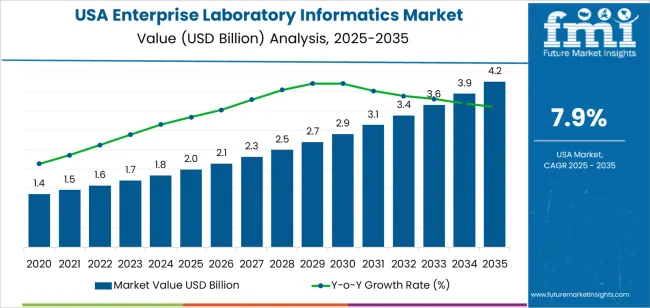
What is the Demand Forecast for Enterprise Laboratory Informatics in USA through 2035?
Unlike consumer-facing digital systems, enterprise laboratory informatics expands from the core of regulated scientific operations where data integrity, traceability, and audit control shape every purchasing decision. Demand in USA increases from USD 2.0 billion in 2025 to USD 2.9 billion by 2030, adding USD 0.9 billion in absolute value. This phase reflects structural modernization across pharmaceutical labs, clinical diagnostics, CROs, environmental testing, and industrial quality control. Growth is driven by replacement of fragmented legacy systems with unified LIMS, ELN, LES, and SDMS platforms. Regulatory pressure around data compliance, validation workflows, and inspection readiness makes informatics spending non-discretionary rather than optional during this period.
From 2030 to 2035, the market expands from USD 2.9 billion to USD 4.2 billion, adding a larger USD 1.3 billion within five years. This back weighted acceleration reflects the transition of laboratory informatics from record-keeping infrastructure into real-time execution and decision orchestration platforms. Advanced analytics, AI-assisted experiment design, automated compliance reporting, and direct integration with manufacturing execution systems raise value per deployment. Informatics shifts from passive data storage to active control of laboratory productivity and regulatory risk. As multi-site global trials, personalized medicine, and high-throughput testing expand, enterprise laboratory informatics becomes a core digital backbone rather than a supporting IT layer.
Enterprise Laboratory Informatics Industry in USA Key Takeaways
| Metric | Value |
|---|---|
| Industry Value (2025) | USD 2.0 billion |
| Forecast Value (2035) | USD 4.2 billion |
| Forecast CAGR (2025–2035) | 7.9% |
How Is the Enterprise Laboratory Informatics Sector Aligning with Scientific and Regulatory Needs in the USA?
The enterprise laboratory informatics sector in the USA expanded as laboratories across life sciences, diagnostics, environmental testing, and food and chemical industries sought to manage growing volumes of scientific data, regulatory paperwork, and workflow complexity. As laboratories scaled up testing throughput and diversified assays, traditional manual record-keeping and disparate spreadsheets became inadequate. Informatics platforms including laboratory information management systems (LIMS), electronic lab notebooks (ELN), scientific data management systems (SDMS), and laboratory execution systems (LES) offered unified data handling, audit trails, sample tracking, and instrument integration. Adoption rose sharply among pharmaceutical firms, contract research organizations, academic labs, and diagnostics providers, who needed to standardize processes, improve reproducibility, and ensure compliance across multiple studies and sites. Data integration from instruments, traceability of sample provenance, and digital documentation replaced paper logs, reducing error risk and accelerating throughput.
Looking ahead, demand for enterprise-grade laboratory informatics in the USA will be shaped by increasing complexity of R&D pipelines, regulatory scrutiny, and technological convergence. Growth in biologics, personalized medicine, genomic and proteomic research, and high-throughput screening requires systems capable of handling large datasets, cross-functional collaboration, and real-time analytics. Cloud-based informatics, AI-driven data analytics, and interconnectivity with ERP or manufacturing systems will expand use beyond pure research to quality control, environmental monitoring, and industrial applications. Regulatory tightening on data integrity, electronic signatures, and auditability will push labs toward validated informatics platforms. However, adoption may be constrained by costs of implementation, integration challenges with legacy systems, data security concerns, and shortage of skilled lab IT professionals. Market evolution will depend on balancing compliance, cost, and flexibility while managing scale and data complexity in scientific workflows.
How Are Type and Component Structuring the Demand for Enterprise Laboratory Informatics in USA?
The demand for enterprise laboratory informatics in the USA is structured by system type and component. Laboratory information management systems account for 38% of total demand, followed by electronic lab notebooks, chromatography data systems, scientific data management systems, and laboratory execution systems. By component, software represents 61.0% of total spending, followed by services focused on implementation, integration, validation, and support. Demand behavior is shaped by regulatory compliance pressure, rising data volumes, automation needs, and system interoperability requirements. These segments reflect how digital laboratory operations and data governance priorities define informatics investment across research, pharmaceutical, diagnostics, and industrial laboratories in the USA.
Why Does LIMS Lead the Enterprise Laboratory Informatics Type Demand in USA?
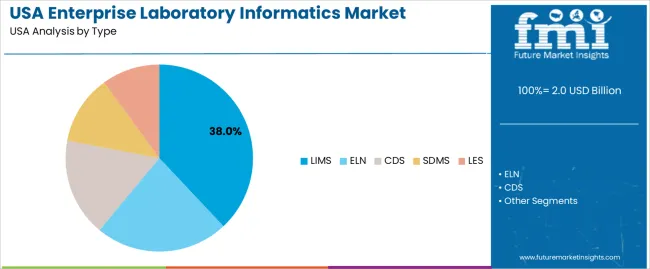
LIMS accounts for 38% of total enterprise laboratory informatics demand in the USA due to its central role in sample tracking, workflow control, and compliance documentation. Laboratories rely on LIMS to manage accessioning, testing workflows, result validation, and audit trails under regulated operating conditions. Pharmaceutical quality control labs, diagnostics centers, environmental testing facilities, and food safety laboratories depend on LIMS for standardized process execution and traceability across large sample volumes.
LIMS platforms also serve as the integration backbone between instruments, data repositories, and enterprise systems such as ERP and quality management platforms. Configuration flexibility allows adaptation to evolving testing protocols and regulatory updates. Replacement demand remains steady as legacy systems face end of support and cybersecurity risks. These compliance, integration, and operational control factors position LIMS as the leading system type in the USA enterprise laboratory informatics landscape.
Why Does Software Dominate the Component Demand for Enterprise Laboratory Informatics in USA?
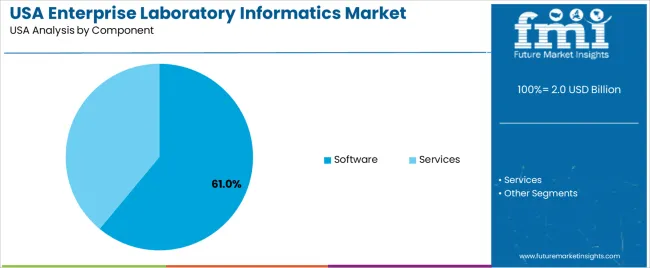
Software accounts for 61.0% of total enterprise laboratory informatics demand in the USA due to direct investment in licenses, subscriptions, and platform upgrades. Laboratories prioritize core informatics software to support data capture, workflow automation, compliance reporting, and analytics. Software spend increases with the expansion of instrument connectivity, cloud deployment, and cybersecurity safeguards embedded within informatics architectures.
Software platforms also require periodic upgrading to maintain regulatory alignment, security patching, and performance optimization. Multi-site organizations expand license volumes as laboratory networks grow through acquisition and capacity expansion. While services remain essential for validation and integration, software represents the primary recurring investment over the system lifecycle. These license driven revenue models, upgrade cycles, and scalability requirements position software as the dominant component within the USA enterprise laboratory informatics ecosystem.
What Forces Are Driving the Demand for Enterprise Laboratory Informatics in the USA?
Demand for enterprise laboratory informatics in the USA is driven by the scale, complexity, and compliance burden of modern laboratory operations across pharmaceuticals, clinical diagnostics, biotechnology, and contract research. Laboratories manage rising data volumes from high-throughput instruments, multi-site testing networks, and regulated workflows. Manual data handling creates audit risk, processing delays, and reproducibility concerns. Consolidation of healthcare systems and life science research networks also increases the need for unified data control. These operational pressures position enterprise informatics as infrastructure for data governance rather than optional productivity software.
How Do Clinical Diagnostics, Pharma R&D, and CRO Operations Shape Adoption?
In clinical diagnostics, informatics platforms manage specimen tracking, result validation, billing linkage, and regulatory reporting across high sample volumes. Pharmaceutical research uses these systems to control experimental workflows, compound libraries, and analytical data integrity. Contract research organizations depend on informatics to coordinate multi-sponsor studies, maintain chain of custody, and ensure audit-ready documentation. Centralized data environments also support collaboration between internal teams and external partners. These regulated, data-intensive environments require traceability, permission control, and structured workflows that drive sustained enterprise informatics demand.
What Cost, Integration, and Change-Management Barriers Limit Wider Deployment?
Enterprise laboratory informatics adoption in the USA is restrained by high implementation cost, complex system integration, and organizational resistance to workflow change. Legacy instruments often use proprietary data formats that complicate platform integration. Migration from paper or fragmented digital tools requires extensive data validation and staff retraining. Smaller laboratories struggle to justify investment against near-term budget constraints. Cybersecurity and patient data protection requirements also raise infrastructure cost. These financial and operational barriers slow uniform adoption across mid-tier labs despite clear efficiency and compliance advantages.
How Are Cloud Platforms, Automation, and Data Interoperability Reshaping Demand?
Enterprise laboratory informatics in the USA is shifting toward cloud-based architectures that allow multi-site access, elastic data storage, and faster system updates. Automation links informatics platforms with robotic sample handling, digital imaging, and real-time instrument feeds. Interoperability layers now connect laboratory data with hospital EHR systems and pharmaceutical analytics platforms. Advanced audit trails, role-based security, and predictive quality alerts strengthen compliance control. These trends show enterprise informatics evolving from standalone lab software into connected digital backbone systems for regulated scientific operations.
What is the Demand for Enterprise Laboratory Informatics in USA by Region?
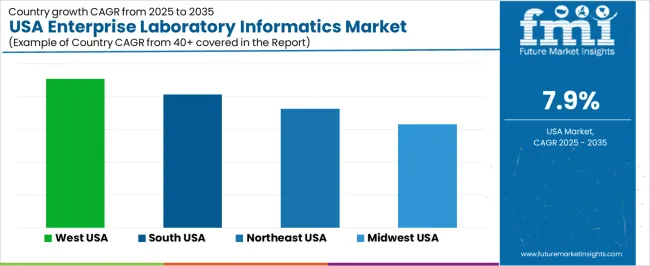
| Region | CAGR (%) |
|---|---|
| West | 9.1% |
| South | 8.1% |
| Northeast | 7.3% |
| Midwest | 6.3% |
The demand for enterprise laboratory informatics in the USA is growing steadily across all regions, with the West leading at a 9.1% CAGR. This growth is supported by strong presence of biotechnology firms, pharmaceutical R&D centers, and advanced clinical laboratories that rely on integrated data management systems. The South follows at 8.1%, driven by expanding healthcare networks, contract research organizations, and diagnostic laboratories seeking workflow automation. The Northeast records 7.3% growth, supported by dense concentration of academic research institutions, hospitals, and regulated laboratory environments. The Midwest shows comparatively moderate growth at 6.3%, reflecting steady adoption among manufacturing quality labs, food testing facilities, and regional healthcare providers transitioning toward digital laboratory management platforms.
What Is Driving Enterprise Laboratory Informatics Demand in the West Region of USA?
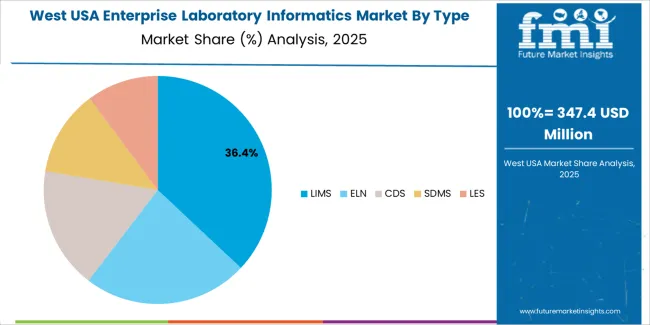
Expansion in the West reflects a CAGR of 9.1% through 2035 for enterprise laboratory informatics demand, supported by strong concentration of biotechnology firms, pharmaceutical research centers, and diagnostics laboratories. Genomics, proteomics, and clinical trial data management require integrated informatics platforms for workflow control and regulatory documentation. Digital health startups and contract research organizations continue to expand laboratory automation scope. Cloud deployment supports multi site data access across collaborative research networks. Demand remains research workflow driven rather than routine testing driven, with emphasis on data integrity, audit readiness, and real time analytical reporting across advanced life science clusters.
- Biotechnology research drives informatics platform expansion
- Contract research organizations support multi site deployments
- Cloud access enables collaborative data environments
- Regulatory documentation strengthens audit trail requirements
How Is the South Supporting Enterprise Laboratory Informatics Demand in USA?
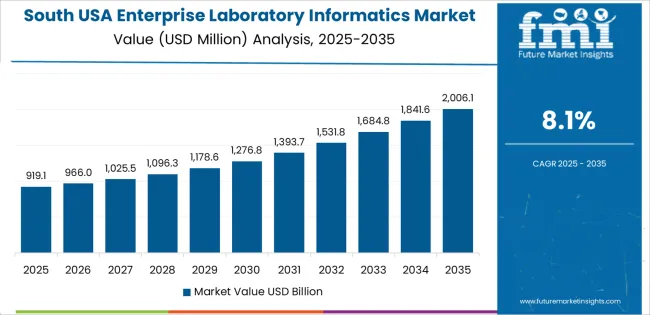
The South advances at a CAGR of 8.1% through 2035 for enterprise laboratory informatics demand, driven by growth in hospital laboratories, public health testing facilities, and pharmaceutical manufacturing quality control operations. Clinical diagnostics networks expand laboratory information systems to manage rising patient testing volumes. Vaccine production, biologics manufacturing, and environmental testing contribute steady industrial demand. Health system consolidation increases the need for unified laboratory data platforms. Demand remains operations driven, aligned with testing throughput growth and regulatory reporting requirements across healthcare, manufacturing, and public sector laboratory environments.
- Hospital laboratories anchor high volume system adoption
- Biologics manufacturing supports quality control informatics
- Public health testing sustains steady institutional demand
- Health system integration drives unified data platforms
Why Is Enterprise Laboratory Informatics Demand Rising Steadily in the Northeast Region of USA?
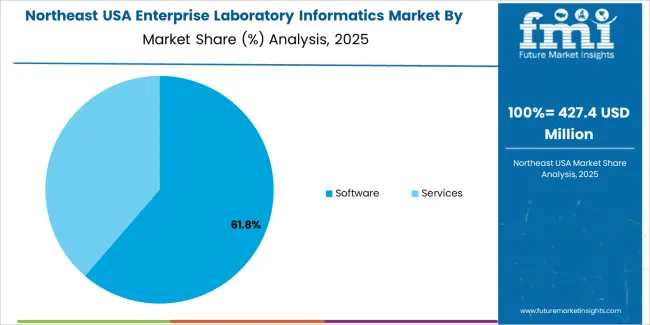
The Northeast records a CAGR of 7.3% through 2035 for enterprise laboratory informatics demand, shaped by academic medical centers, pharmaceutical research hubs, and clinical diagnostics networks. Teaching hospitals and university laboratories deploy informatics systems for research data governance and patient sample tracking. Drug discovery programs require structured laboratory execution systems for compliance documentation. Urban diagnostic service providers maintain high transaction volumes. Demand remains compliance and data governance driven, with upgrades focused on validation, cybersecurity, and interoperability across multi-vendor laboratory instrument environments.
- Academic medical centers support research informatics USAge
- Drug discovery laboratories require validated data systems
- Urban diagnostic testing drives transaction throughput
- Cybersecurity priorities influence system upgrade cycles
What Is Influencing Enterprise Laboratory Informatics Demand in the Midwest Region of USA?
The Midwest expands at a CAGR of 6.3% through 2035 for enterprise laboratory informatics demand, supported by manufacturing quality laboratories, agricultural testing centers, and regional hospital networks. Food safety testing, materials analysis, and environmental monitoring require structured sample tracking and reporting platforms. Industrial laboratories adopt informatics to support certification and compliance documentation. Cost sensitivity influences preference for modular system deployments. Demand remains function driven and predictable, aligned with steady industrial testing volumes, agricultural quality programs, and regional healthcare diagnostic operations rather than advanced research intensity.
- Food safety and materials testing anchor system USAge
- Industrial compliance drives documentation requirements
- Agricultural labs support routine analytical reporting
- Modular deployments align with cost focused purchasing
What Is Driving the Demand for Enterprise Laboratory Informatics in USA and Who Are the Key Players Shaping the Industry?
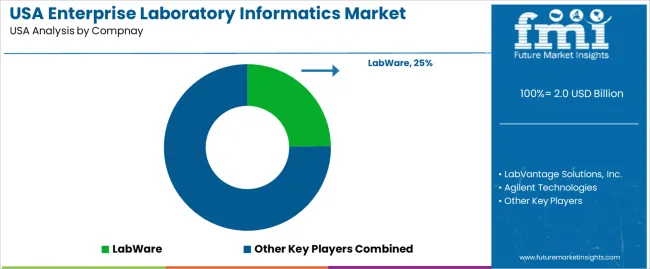
Demand for enterprise laboratory informatics in the USA is rising as laboratories confront growing volumes of data, increasing regulatory requirements, and the need for greater efficiency in research and quality control workflows. Laboratories in pharmaceuticals, biotech, environmental testing, and food and beverage sectors require robust systems to manage sample tracking, data integrity, reporting, and compliance. The expansion of high throughput screening, genomics, personalized medicine, and environmental regulation intensifies reliance on informatics platforms. Cloud native deployment, automation, and integration of lab equipment contribute to rising adoption. Facilities seek solutions that unify data across instruments, support audit trails, and enable remote access driving demand for comprehensive informatics suites.
Principal providers shaping the US market include LabWare, LabVantage Solutions, Inc., Agilent Technologies, Waters Corporation, and LabLynx. LabWare offers scalable Laboratory Information Management Systems (LIMS) used by pharmaceutical firms, environmental labs, and testing services. LabVantage supplies integrated LIMS, electronic lab notebook (ELN), scientific data management and analytics capabilities, appealing to biotech, CROs, and quality control operations. Agilent and Waters provide informatics linked to analytical and instrumentation platforms useful for analytical chemistry, quality control, and R&D labs. LabLynx serves smaller and specialized labs with flexible, cloud based LIMS solutions. Together these firms deliver a mix of enterprise grade, scalable, and modular solutions, shaping the informatics landscape across research, industrial, and regulatory laboratories.
Key Players in Enterprise Laboratory Informatics Industry in USA
- LabWare
- LabVantage Solutions, Inc.
- Agilent Technologies
- Waters
- LabLynx
Scope of the Report
| Items | Values |
|---|---|
| Quantitative Units (2025) | USD billion |
| Type | LIMS, ELN, CDS, SDMS, LES |
| Component | Software, Services |
| Delivery | Cloud, On-premise |
| Industry | Pharma, CRO, Biotech, CMO, Chemical, Oil, Agriculture, Gas |
| Region | Northeast USA, West USA, Midwest USA, South USA |
| Countries Covered | USA |
| Key Companies Profiled | LabWare, LabVantage Solutions, Agilent Technologies, Waters, LabLynx |
| Additional Attributes | Dollar by sales by type, Dollar by sales by component, Dollar by sales by delivery, Dollar by sales by industry, Regional CAGR, Cloud adoption trends, Regulatory compliance impact, Workflow automation integration, Multi-site deployment and scalability |
Enterprise Laboratory Informatics Industry in USA Segmentation
Type:
- LIMS
- ELN
- CDS
- SDMS
- LES
Component:
- Software
- Services
Delivery:
- Cloud
- On-premise
Industry:
- Pharma
- CRO
- Biotech
- CMO
- Chemical
- Oil
- Agriculture
- Gas
Region:
- Northeast USA
- West USA
- Midwest USA
- South USA
Frequently Asked Questions
How big is the demand for enterprise laboratory informatics in USA in 2025?
The demand for enterprise laboratory informatics in USA is estimated to be valued at USD 2.0 billion in 2025.
What will be the size of enterprise laboratory informatics in USA in 2035?
The market size for the enterprise laboratory informatics in USA is projected to reach USD 4.2 billion by 2035.
How much will be the demand for enterprise laboratory informatics in USA growth between 2025 and 2035?
The demand for enterprise laboratory informatics in USA is expected to grow at a 7.9% CAGR between 2025 and 2035.
What are the key product types in the enterprise laboratory informatics in USA?
The key product types in enterprise laboratory informatics in USA are lims, eln, cds, sdms and les.
Which component segment is expected to contribute significant share in the enterprise laboratory informatics in USA in 2025?
In terms of component, software segment is expected to command 61.0% share in the enterprise laboratory informatics in USA in 2025.
Preview the report firsthand - request a free sample
Get SampleGet the brochure for pricing and purchase details.
Get PDFTable of Content
- Executive Summary
- USA Market Outlook
- Demand-side Trends
- Supply-side Trends
- Technology Roadmap Analysis
- Analysis and Recommendations
- Market Overview
- Market Coverage / Taxonomy
- Market Definition / Scope / Limitations
- Market Background
- Market Dynamics
- Drivers
- Restraints
- Opportunity
- Trends
- Scenario Forecast
- Demand in Optimistic Scenario
- Demand in Likely Scenario
- Demand in Conservative Scenario
- Opportunity Map Analysis
- Product Life Cycle Analysis
- Supply Chain Analysis
- Investment Feasibility Matrix
- Value Chain Analysis
- PESTLE and Porter’s Analysis
- Regulatory Landscape
- Regional Parent Market Outlook
- Production and Consumption Statistics
- Import and Export Statistics
- Market Dynamics
- USA Market Analysis 2020 to 2024 and Forecast, 2025 to 2035
- Historical Market Size Value (USD Million) Analysis, 2020 to 2024
- Current and Future Market Size Value (USD Million) Projections, 2025 to 2035
- Y-o-Y Growth Trend Analysis
- Absolute $ Opportunity Analysis
- USA Market Pricing Analysis 2020 to 2024 and Forecast 2025 to 2035
- USA Market Analysis 2020 to 2024 and Forecast 2025 to 2035, By Type
- Introduction / Key Findings
- Historical Market Size Value (USD Million) Analysis By Type , 2020 to 2024
- Current and Future Market Size Value (USD Million) Analysis and Forecast By Type , 2025 to 2035
- LIMS
- ELN
- CDS
- SDMS
- LES
- Y-o-Y Growth Trend Analysis By Type , 2020 to 2024
- Absolute $ Opportunity Analysis By Type , 2025 to 2035
- USA Market Analysis 2020 to 2024 and Forecast 2025 to 2035, By Component
- Introduction / Key Findings
- Historical Market Size Value (USD Million) Analysis By Component, 2020 to 2024
- Current and Future Market Size Value (USD Million) Analysis and Forecast By Component, 2025 to 2035
- Software
- Services
- Y-o-Y Growth Trend Analysis By Component, 2020 to 2024
- Absolute $ Opportunity Analysis By Component, 2025 to 2035
- USA Market Analysis 2020 to 2024 and Forecast 2025 to 2035, By Delivery
- Introduction / Key Findings
- Historical Market Size Value (USD Million) Analysis By Delivery, 2020 to 2024
- Current and Future Market Size Value (USD Million) Analysis and Forecast By Delivery, 2025 to 2035
- Cloud
- On-premise
- Y-o-Y Growth Trend Analysis By Delivery, 2020 to 2024
- Absolute $ Opportunity Analysis By Delivery, 2025 to 2035
- USA Market Analysis 2020 to 2024 and Forecast 2025 to 2035, By Industry
- Introduction / Key Findings
- Historical Market Size Value (USD Million) Analysis By Industry, 2020 to 2024
- Current and Future Market Size Value (USD Million) Analysis and Forecast By Industry, 2025 to 2035
- Pharma
- CRO
- Biotech
- CMO
- Chemical
- Oil
- Agriculture
- Gas
- Y-o-Y Growth Trend Analysis By Industry, 2020 to 2024
- Absolute $ Opportunity Analysis By Industry, 2025 to 2035
- Market Structure Analysis
- Competition Dashboard
- Competition Benchmarking
- Market Share Analysis of Top Players
- By Regional
- By Type
- By Component
- By Delivery
- By Industry
- Competition Analysis
- Competition Deep Dive
- LabWare
- Overview
- Product Portfolio
- Profitability by Market Segments (Product/Age /Sales Channel/Region)
- Sales Footprint
- Strategy Overview
- Marketing Strategy
- Product Strategy
- Channel Strategy
- LabVantage Solutions, Inc.
- Agilent Technologies
- Waters
- LabLynx
- LabWare
- Competition Deep Dive
- Assumptions & Acronyms Used
- Research Methodology


