

- Market Size (2026)
- USD 156.2 Mn
- Forecast (2036)
- USD 254.4 Mn
- CAGR (2026 to 2036)
- 5.0%
How big is Vegan Lanolin Alternatives Market in 2026?
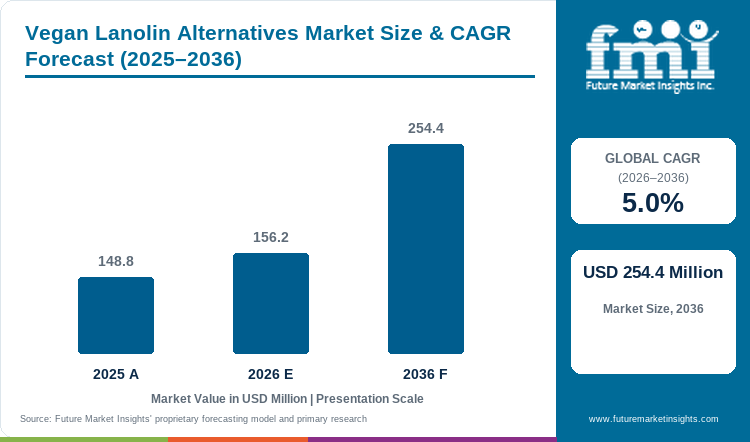
USD 156.2 million in 2026 and USD 254.4 million by 2036 at a 5.0% CAGR.
Demand for vegan lanolin alternatives is projected to expand at 5.0% CAGR between 2026 and 2036, growing from USD 148.8 million in 2025 to USD 156.2 million in 2026, and escalating to USD 254.4 million by 2036. Formulators replace wool-derived emollience when plant or biotechnology systems preserve spread and barrier feel inside established bases. Evonik introduced a vegan renewable emollient and plant-oil ceramide system in April 2025, giving formulators direct options for rebuilding those functions.
South Korea is projected at 6.1% CAGR against Germany at 4.2% CAGR through 2036 under materially different cosmetic commercialization rules. MFDS revised functional-cosmetics rules in December 2025 to permit conditional sale for qualifying products and widen selected evidence exemptions. Those changes can shorten defined review steps for wrinkle or whitening formats using barrier-supporting ingredients. Germany applies mature European ingredient restrictions that keep reformulation screening deliberate before commercial release.
Key Takeaways
- Animal-free formulation briefs increase demand for ingredients that reproduce lanolin-like emollience without excessive formula redevelopment.
- Standard grade is projected to hold 41.0% share in 2026, supported by practical formulation economics.
- Anti-aging is likely to capture 27.0% share in 2026, driven by barrier-support and visible-aging requirements.
- In 2026, facial skincare is expected to lead application with 39.0% share, attributable to leave-on sensory requirements.
- Replacement programs slow after formulators rebuild viscosity and occlusion before stability testing can confirm acceptable commercial performance.
- Some of the key players in this market include Evonik, Symrise, Givaudan, Croda, dsm-firmenich, Ashland, IFF, Lubrizol, BASF, and Clariant.
Analyst Perspective
“Ingredient origin attracts attention but formulation teams approve replacements only after sensory behavior and stability remain inside specification. Suppliers with application data and compliant documentation can shorten evaluation without asking brands to compromise formula performance.”
- Nikhil Kaitwade, Principal Consultant, Future Market Insights
How is the vegan lanolin alternatives market segmented?
By product type, function, application, grade, sales channel, and region.
The vegan lanolin alternatives market is segmented by product type, function, application, grade, sales channel, and region. Product type covers standard grade, high-purity - clinical grade, natural & certified grade, and customized systems, while function covers anti-aging, hydration & barrier, brightening, soothing & sensitive, and UV & protection. Application covers facial skincare, body care, haircare, color cosmetics, and suncare, while grade distinguishes standard cosmetic grade, COSMOS - natural certified, pharma & clinical grade, and organic certified. Sales channels include direct to brands, specialty distributors, contract manufacturers, and online B2B routes.
What supports standard grade within the product type category?
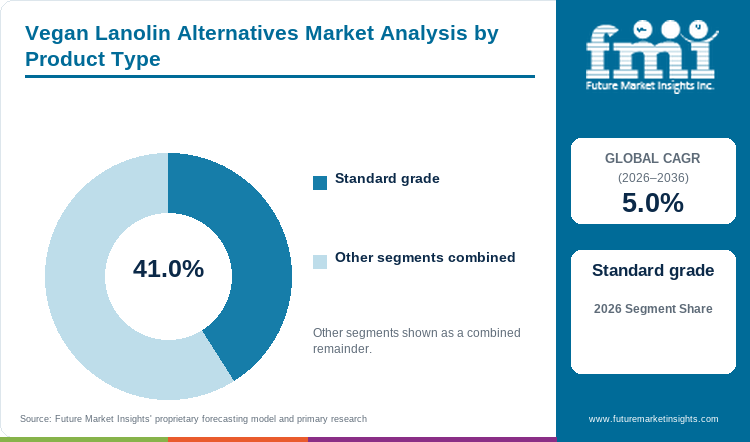
Standard grade gives formulators familiar processing behavior before they commit development time to a specialized replacement system, making the spread, slip, and compatibility associated with personal care emollients essential to its use in routine skincare bases.
- Based on product type, standard grade is projected to account for 41.0% in 2026, supported by repeatable handling and workable cost.
- Evonik expanded its Beauty & Personal Care portfolio in March 2026 with active ingredients plus delivery systems that support practical replacement screening inside routine skincare formulas.
How does anti-aging shape demand within the function category?
Anti-aging formulas depend on both texture management and barrier support, so lanolin replacements must reproduce the sensorial and biological performance expected across anti-aging skincare rather than simply substitute one occlusive ingredient.
- By function, anti-aging is estimated to hold 27.0% in 2026, driven by premium formulas pairing emollience with visible-aging claims.
- Symrise launched plant-derived Cellexora MD in March 2026 for premium skincare and documented formulation flexibility alongside skin-regeneration performance.
What makes facial skincare central to the application category?
Because consumers quickly notice changes in spread and absorption, facial creams often pair lanolin replacements with skin-barrier lipid complexes to restore emollience and barrier support within the same leave-on formula.
- By application, facial skincare is forecast to represent 39.0% in 2026, supported by the sensory demands of leave-on formats.
- Croda launched the botanical skincare active Malvallin in June 2026 for premium facial applications that place resilience and long-term skin quality inside the formulation brief.
How do formulators evaluate standard cosmetic grade?
Standard cosmetic grade suits formulation teams that need documented ingredient suitability without clinical or organic certification, while the restrictions governing cosmetic chemicals in each destination market determine whether a replacement system can progress to commercial use.
- The grade category is forecast to be led by standard cosmetic grade at 46.0% share in 2026, supported by mainstream specification needs.
- The Cosmetic Products (Restriction of Chemical Substances) Regulations 2025 entered into force on September 30 and added a restricted substance entry to Great Britain cosmetic rules.
Why does direct selling matter within the sales channel category?
Direct brand relationships clarify sensory targets and documentation requirements before stability testing begins, allowing suppliers of personal care ingredients to tailor support that moves a lanolin replacement from sampling to production qualification.
- Direct to brands is set to lead the sales channel with 51.0% share in 2026, attributable to supplier-formulator iteration before approval.
- Croda launched Beauty of Zero in May 2026 with transparent data and customer collaboration that support formulation and sourcing decisions.
What are the drivers, restraints and opportunities in the Vegan Lanolin Alternatives Market?
Animal-free formulation briefs expand demand, functional parity slows conversion, and validated replacement systems give suppliers a practical route to higher-value formulation work.
- Driver: Beauty brands are asking ingredient suppliers to pair animal-free positioning with measurable barrier and sensory performance during reformulation.
- Restraint: Replacing lanolin can change viscosity and occlusion enough to trigger fresh safety plus stability work before finished-formula validation.
- Opportunity: Suppliers can package complementary lipids with use guidance and compliance files so formulators test a replacement system instead of isolated ingredients.
The same formulation briefs driving the vegan cosmetics market now require animal-free ingredients to deliver measurable skin benefits and familiar sensory performance rather than rely on vegan positioning alone. Symrise introduced three cosmetic ingredients in April 2026, including a natural-origin barrier oil and plant-based product-protection technology. These additions give formulators more options for rebuilding barrier feel after wool-derived lanolin is removed from a skincare base.
When lanolin is replaced in natural cosmetics, changes in viscosity and occlusion can reopen safety and stability work because both the finished formula and its supporting safety record must be reassessed before release. UK guidance published in July 2025 requires a qualified safety assessment before a new cosmetic reaches consumers and notification to OPSS in Great Britain. Formulators therefore need replacement data that lets safety assessors evaluate the revised formula without repeated clarification.
In organic personal care formulations, suppliers can reduce trial work by combining compatible emollients, barrier lipids, defined use guidance, and documentation that supports ingredient approval. Symrise formed its Care & Wellness Division in March 2026 by combining cosmetic ingredients and health actives within one operating group. Integrated application teams can support higher-value substitution projects where formulators must rebuild several lanolin functions without testing unnecessary ingredient combinations.
Which country CAGRs are profiled in the Vegan Lanolin Alternatives Market?
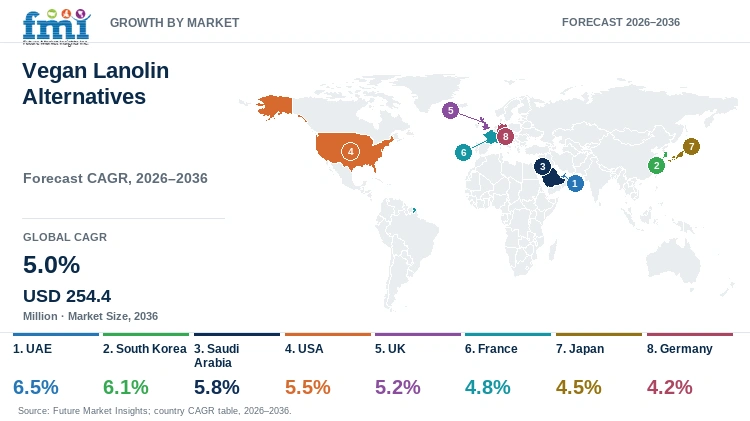
| Country | CAGR |
|---|---|
| UAE | 6.5% |
| South Korea | 6.1% |
| Saudi Arabia | 5.8% |
| USA | 5.5% |
| UK | 5.2% |
| France | 4.8% |
| Japan | 4.5% |
| Germany | 4.2% |
How do country-level CAGRs compare in the Vegan Lanolin Alternatives Market?
The displayed rates place the Gulf states and South Korea above the mature Western European group. The spacing reflects different commercialization conditions and reformulation speeds instead of current revenue scale.
- UAE combines import-heavy beauty channels with conformity labeling requirements that reward fast technical responses before finished products reach release.
- South Korea moves functional skincare concepts quickly because brands coordinate ingredient testing with claim-specific review work during short launch cycles.
- Saudi Arabia keeps product notification close to market access so consistent ingredient records reduce avoidable finished-product listing revisions.
- USA combines a very large registered cosmetics base with MoCRA listing duties that keep ingredient identity visible during formula changes.
- UK growth occurs within responsible-person and notification controls that require revised cosmetics to carry complete safety information before consumer sale.
- France supports premium formulation work while enforcement findings show smaller operators still need stronger product-information files before commercial scale.
- Japan places disciplined limits on highlighted ingredient claims so formulators must connect promotional wording with an objectively supported purpose.
- Germany applies mature European restriction screening that makes ingredient-compliance review routine before reformulated cosmetics move into commercial distribution.
Comparable CAGRs therefore produce different entry conditions because each country converts formulation change into approval through a distinct compliance route. The full report provides country-level CAGR analysis across North America, Latin America, Western Europe, Eastern Europe, East Asia, South Asia and Pacific, and the Middle East and Africa.
Country-wise Analysis
- US demand for vegan lanolin alternatives is forecast to rise at 5.5% CAGR through 2036 as MoCRA registration and product-listing duties keep formula records visible whenever ingredients change. FDA counted 16,398 active facility registrations and 1,298,361 active product listings on June 30 2026. Suppliers of specialty emollients can support this growth by providing identity and safety files that transfer directly into listing maintenance and keep replacement testing aligned with the responsible person’s finished-product records.
- South Korea's vegan lanolin alternatives market is anticipated to advance at 6.1% CAGR through 2036 as short innovation cycles place wrinkle and brightening formats within functional-cosmetics review. MFDS published national 2024 functional-cosmetics review statistics in January 2025 and continues tracking activity by claim category. Brands formulating with ceramide AS and related barrier systems therefore need repeatable performance evidence that supports the exact functional claim submitted for review and helps the finished product move toward commercial release.
- Saudi cosmetic suppliers operate within a national notification system that records listed products before routine commercial distribution. By 2036, Saudi Arabia is projected to grow at 5.8% CAGR, shaped by national cosmetics notification requirements. SFDA updated its cosmetics notification list in March 2025 with product details and responsible-company information. Ingredient suppliers can reduce avoidable filing work by providing stable specifications that transfer cleanly into finished-product records. Distributors gain a clearer launch path when replacement materials arrive with documentation prepared for notification review.
- The UAE uses federal conformity infrastructure that keeps imported products and supplier documentation inside a national quality system. Adoption of vegan lanolin alternatives in the UAE is estimated to expand at 6.5% CAGR through 2036, influenced by federal conformity requirements. MoIAT updated 12 national conformity marks in April 2025 and gave imported products six months to adopt the new labels. Suppliers with regional technical teams can resolve documentation questions before samples reach final formula approval. Faster responses reduce the risk that a technically acceptable replacement misses the customer’s planned conformity timetable.
- French cosmetic manufacturers face product-information-file duties that expose weak documentation before smaller brands can scale new formulas. The French vegan lanolin alternatives sector is projected to record 4.8% CAGR during the assessment period, shaped by product-information-file duties. DGCCRF checked 147 establishments and more than 200 product files during its national review of newer operators. Only 26 operators produced complete or nearly complete files during that national enforcement exercise. Replacement suppliers therefore need composition and application evidence that supports a defensible finished-product record before customer launch.
- UK brands must complete safety assessment and notification steps before new cosmetics reach consumers in Great Britain. In the UK, vegan lanolin alternatives demand is predicted to advance at 5.2% CAGR through 2036, shaped by safety assessment and notification requirements. OPSS published cosmetic-product safety notification data in July 2026 and described action against notified products containing banned chemicals. Suppliers can improve conversion by giving customers current composition records before product notification begins. Replacement candidates progress more smoothly when technical files let safety assessors evaluate revised formulas without repeated ingredient clarification.
- Japanese cosmetic marketers must connect highlighted ingredients with an objectively supported purpose inside product communication. Japan is estimated to post 4.5% CAGR over the forecast period, influenced by ingredient-display and claims requirements. MHLW revised its specific-ingredient display notice in March 2025 and required the formulation purpose to accompany highlighted ingredients. Suppliers should keep performance wording narrow enough for local review while giving formulators useful technical evidence. Claims that exceed supporting data can delay commercialization even after a replacement performs acceptably inside the finished formula.
- German formulators work inside mature European cosmetic rules where ingredient restrictions are screened before commercial distribution. Vegan lanolin alternatives sales in Germany are forecast to expand at 4.2% CAGR by 2036, influenced by European ingredient restrictions. Commission Regulation (EU) 2025/877 amended cosmetic restrictions for substances classified as CMR and applied from September 2025. European ingredient screening therefore remains part of every reformulation review before a revised cosmetic reaches sale. Suppliers need stable specifications plus regulatory support that reduce avoidable review work after sensory testing confirms performance.
Who are the notable companies in the Vegan Lanolin Alternatives Market?
Evonik, Symrise, Givaudan, Croda, dsm-firmenich, Ashland, IFF, Lubrizol, BASF, Clariant
Competition divides by the formulation function that disappears when lanolin is removed from an established skincare base. Evonik, Croda, Lubrizol, and BASF document emollient or lipid capabilities, while Symrise, Givaudan, dsm-firmenich, and Ashland document skin-active platforms. IFF and Clariant support broader reformulation programs with personal-care systems and natural-origin ingredient technologies.
- Evonik and Croda join Lubrizol and BASF in supplying emollient or lipid capabilities for barrier replacement work.
- Symrise and Givaudan join dsm-firmenich and Ashland where active performance forms part of the replacement brief.
- IFF and Clariant support reformulation projects that combine natural-origin objectives with finished-formula performance requirements.
Competitive Benchmarking: Vegan Lanolin Alternatives Market
| Company | Emollient/Lipid Replacement Relevance | Vegan/Natural Substantiation | Formulation Support Breadth | Geographic Reach |
|---|---|---|---|---|
| Evonik | High | High | High | Europe, Americas and Asia-Pacific |
| Symrise | Medium | High | High | Europe, Americas and Asia-Pacific |
| Givaudan | Medium | High | High | Europe, Americas and Asia-Pacific |
| Croda | High | High | High | North America, Europe and Asia-Pacific |
| dsm-firmenich | Medium | Medium | High | Global beauty-care reach |
| Ashland | Medium | High | High | Americas, Europe and Asia-Pacific |
| IFF | Medium | High | High | Americas, Europe and Asia-Pacific |
| Lubrizol | High | High | High | Americas, Europe and Asia-Pacific |
| BASF | High | High | High | Europe, Americas and Asia-Pacific |
| Clariant | Medium | High | High | Europe, Americas and Asia-Pacific |
Scoring basis: High requires broad current official evidence for the named criterion while Medium reflects narrower official evidence that still fits the defined replacement function. Low applies only where official evidence documents a limitation, and geographic reach describes operating coverage without implying company share or rank.
Key Developments in the Vegan Lanolin Alternatives Market
- In July 2026, BASF opened a Düsseldorf plant for specialty emollients used in skincare and sun-care formulations.
- In March 2026, Givaudan Active Beauty introduced VectorHyal for improved cosmetic-ingredient stability and controlled delivery.
- In March 2026, Ashland appointed IMCD as exclusive US distributor for its personal-care portfolio and biofunctional ingredients.
Key Players in the Vegan Lanolin Alternatives Market
Emollient and Lipid-System Suppliers
- Evonik
- Croda
- Lubrizol
- BASF
Bioactive and Skin-Function Platforms
- Symrise
- Givaudan
- dsm-firmenich
- Ashland
Personal-Care System Integrators
- IFF
- Clariant
Vegan Lanolin Alternatives Market - Report Scope
| Coverage field | Report scope |
|---|---|
| Market breakdown | By product type, function, application, grade, sales channel, and region. |
| Quantitative Units | USD million. |
| Market Definition | Revenue from non-animal ingredients or formulated ingredient systems sold for a lanolin-replacement role within the stated segmentation universe. Finished-product revenue and wool-derived lanolin are excluded. |
| Regions Covered | North America, Latin America, Western Europe, Eastern Europe, East Asia, South Asia and Pacific, and Middle East and Africa. |
| Countries Covered | UAE, South Korea, Saudi Arabia, USA, UK, France, Japan, Germany, and 20+ countries included in the full report. |
| Key Companies Profiled | Evonik, Symrise, Givaudan, Croda, dsm-firmenich, Ashland, IFF, Lubrizol, BASF, Clariant |
| Forecast Period | 2026 to 2036. |
| Approach | Primary and secondary research with market triangulation. |
Vegan Lanolin Alternatives Market - Research Methodology
| Method | Approach |
|---|---|
| Primary Research | FMI analysts gathered input from manufacturers, service providers, technology developers, distributors, end users, procurement teams, and subject-matter experts. Interviews examined purchasing decisions, product or service evaluation, adoption barriers, approval requirements, pricing considerations, and expectations for technical or commercial support. Respondents were also asked what evidence is required before a trial, pilot, or initial order develops into regular purchasing. |
| Desk Research | Desk research covered government statistics, regulatory publications, trade data, industry associations, technical literature, standards, company filings, product information, and official corporate announcements. Sources were reviewed for relevance, publication date, geographic coverage, and consistency with the defined market scope. Claims relating to performance, applications, approvals, capacity, investment, and commercial activity were retained only when supported by credible public evidence. |
| Market Sizing and Forecasting | The market model combined the baseline value with historical performance, segment structure, pricing and volume indicators, adoption levels, company participation, and country-level demand conditions. Forecast assumptions considered economic activity, investment trends, regulatory developments, technology adoption, purchasing cycles, supply availability, and barriers to wider market use. Segment and regional estimates were reconciled before the final market total was calculated. |
| Data Validation | Estimates were checked against multiple independent indicators, including public data, company activity, trade patterns, industry developments, and findings from primary interviews. Validation also tested whether products, services, applications, and company revenues fell within the defined market boundaries. Adjacent categories, unsupported claims, overlapping revenues, and activities without direct market relevance were excluded to reduce double counting and maintain consistency across segments and countries. |
Vegan Lanolin Alternatives Market by Segments
Vegan Lanolin Alternatives Market segmented by Product Type:
- Standard grade
- High-purity - clinical grade
- Natural & certified grade
- Customized systems
Vegan Lanolin Alternatives Market segmented by Function:
- Anti-aging
- Hydration & barrier
- Brightening
- Soothing & sensitive
- UV & protection
Vegan Lanolin Alternatives Market segmented by Application:
- Facial skincare
- Body care
- Haircare
- Color cosmetics
- Suncare
Vegan Lanolin Alternatives Market segmented by Grade:
- Standard cosmetic grade
- COSMOS - natural certified
- Pharma & clinical grade
- Organic certified
Vegan Lanolin Alternatives Market segmented by Sales Channel:
- Direct to brands
- Specialty distributors
- Contract manufacturers
- Online B2B
Vegan Lanolin Alternatives Market by Region:
- North America
- United States
- Canada
- Latin America
- Brazil
- Mexico
- Argentina
- Chile
- Western Europe
- Germany
- France
- United Kingdom
- Italy
- Spain
- Benelux
- Nordics
- Eastern Europe
- Poland
- Czech Republic
- Romania
- Hungary
- East Asia
- China
- Japan
- South Korea
- South Asia and Pacific
- India
- ASEAN
- Australia and New Zealand
- Middle East and Africa
- GCC Countries
- South Africa
- Türkiye
- Israel
Research Sources and Bibliography
- Evonik. (2025, April 8). in-cosmetics® global 2025: Evonik meets growing customer demand for high-performance, eco-friendly solutions.
- Ministry of Food and Drug Safety, Republic of Korea. (2025, December 16). 「기능성화장품 심사에 관한 규정」 일부개정고시.
- Evonik. (2026, March 12). PCHi 2026: Evonik goes beyond for the soul and science of beauty.
- Symrise. (2026, March 31). Symrise launches Cellexora™ MD, a pioneering healthspan ingredient for premium skincare.
- Croda International Plc. (2026, June 17). Croda strengthens premium beauty pipeline with next-generation skincare active Malvallin™.
- UK Secretary of State. (2025, March 27). The Cosmetic Products (Restriction of Chemical Substances) Regulations 2025.
- European Commission. (2025, May 12). Commission Regulation (EU) 2025/877 of 12 May 2025 amending Regulation (EC) No 1223/2009 of the European Parliament and of the Council as regards the use in cosmetic products of certain substances classified as carcinogenic, mutagenic or toxic for reproduction.
- Croda International Plc. (2026, May 21). Croda launches Beauty of Zero™ to advance sustainable innovation in personal care.
- Symrise. (2026, April 14). Symrise accelerates innovation and champions longevity and inner beauty at in-cosmetics global 2026.
- Office for Product Safety and Standards. (2025, July 10). Consumer products: cosmetics.
- Symrise. (2026, March 17). Symrise establishes a new Care & Wellness Division.
- USA Food and Drug Administration. (2026, September 9). Registration & Listing of Cosmetic Product Facilities and Products.
- Ministry of Food and Drug Safety, Republic of Korea. (2025, January 24). 식약처, 2024년 기능성화장품 심사 현황 통계 발표.
- Saudi Food and Drug Authority. (2025, March 5). List of Notification of Marketing for Cosmetic Products (Listed Products).
- Ministry of Industry and Advanced Technology, United Arab Emirates. (2025, April 9). MoIAT transforms conformity labels elevating Made in the UAE products globally.
- Direction générale de la concurrence, de la consommation et de la répression des fraudes. (2026, February 2). Cosmétiques : des TPE nouvelles dans le secteur qui méconnaissent trop souvent la réglementation.
- Office for Product Safety and Standards. (2026, July 17). New data on UK cosmetic product safety notifications.
- Ministry of Health, Labour and Welfare, Japan. (2025, March 10). 化粧品における特定成分の特記表示について.
- BASF. (2026, July 16). BASF inaugurates new production plant in Düsseldorf, Germany.
- Givaudan. (2026, March 17). Givaudan Active Beauty elevates its delivery systems technology with VectorHyal™.
- Ashland Inc. (2026, March 12). Ashland announces strategic partnership with IMCD for the exclusive distribution of personal and home care ingredients in the United States
- Evonik. (2026, April 8). in-cosmetics® Global 2026: Evonik brings new beauty identity to life with fairy tale innovation world.
- The Lubrizol Corporation. (2026, March 17). Lubrizol inaugurates its Beauty Research Institute in Brazil, Reinforcing the Country’s Position as a Global Beauty Innovation Hub.
- Symrise. (2026, August 4). Symrise expands natural-origin skincare portfolio with Dragosine® green for skin longevity.
- BASF. (2026, August 20). BASF and NEO Corporate Launch Strategic Partnership to Advance Innovation in Personal Care Solutions.
- Croda International Plc. (2026, April 21). Croda unveils Matrixyl® Neolide™, an iconic peptide with smarter delivery.
- Clariant. (2026, April 15). Lucas Meyer Cosmetics by Clariant to unveil game-changing beauty innovations at in-cosmetics 2026.
- Symrise. (2025, October 22). Symrise invests in Cellibre, a USA-based biotechnology company, to accelerate innovation for taste balancing and cosmetic actives markets.
- IFF. (2025, October 9). IFF teams up with influencers Chemist Confessions to raise awareness of osmolytes.
- Evonik. (2026, June 2). Evonik opens new Asia Beauty Science & Innovation Center in Shanghai.
- Symrise. (2025, March 26). Symrise introduces SymRelief® green for next-generation, natural-origin intensive skin soothing.
- Givaudan. (2025, March 19). Givaudan Active Beauty unveils Evernityl™, the pioneering active ingredient for timeless beauty.
- Croda International Plc. (2025, September 8). Celebrating our innovative ingredients: Zenakine™ - redefining neurocosmetic skincare possibilities.
- dsm-firmenich. (2025, April 4). dsm-firmenich and Inscripta Announce Strategic Partnership to Drive Biotech Innovations in Well-Aging Skincare.
- Ashland Inc. (2025, April 3). Ashland unveils collapeptyl™, a revolutionary biofunctional delivering superior performance for the collaverse™ ecosystem
- IFF. (2025, March 18). Xelestia Fantasy Beauty Formulations Brought to Life via Gaming.
- The Lubrizol Corporation. (2025, March 28). Lubrizol Partners with Suzano for Pre-Launch of Carbopol® BioSense in Brazil, Advancing Biodegradable Solutions.
- BASF. (2025, April 3). BASF launches natural-based innovations for personal care at in-cosmetics Global 2025.
- Clariant. (2025, April 7). “Clariant Beauty” launches new solutions for personal care.
This bibliography is provided for reader reference and is not exhaustive. The full report contains the complete reference list and detailed citations
This Report Answers
- What are the 2026 and 2036 vegan lanolin alternatives market values?
- Which formulation requirements make animal-free lanolin substitution a technical sourcing decision?
- Why does standard grade hold 41.0% of product type demand in 2026?
- Why does anti-aging hold 27.0% of function demand in 2026?
- Why does facial skincare hold 39.0% of application demand in 2026?
- Which compliance conditions slow lanolin-replacement reformulation during finished-formula testing?
- How do growth conditions differ across the eight profiled countries through 2036?
- Which companies supply capabilities relevant to lanolin replacement projects?
Frequently Asked Questions
What is the vegan lanolin alternatives market value in 2026 and 2036?
The vegan lanolin alternatives market is valued at USD 156.2 million in 2026 and is projected at USD 254.4 million by 2036. Growth depends on replacement systems preserving emollience and barrier feel without forcing excessive redevelopment of established cosmetic formulas.
What CAGR is projected for vegan lanolin alternatives from 2026 to 2036?
The vegan lanolin alternatives market is projected to grow at 5.0% CAGR between 2026 and 2036. Expansion follows animal-free formulation briefs that still require practical evidence on texture plus long-term finished-formula stability.
Which product type holds 41.0% of vegan lanolin alternatives demand in 2026?
The standard grade segment is expected to hold 41.0% of product type demand in 2026. Routine cosmetic formulations use this grade because familiar handling and workable economics support broad replacement screening.
Which profiled countries have the upper growth rates for vegan lanolin alternatives between 2026 and 2036?
UAE is projected to grow at 6.5% CAGR and South Korea at 6.1% through 2036. Their trajectories differ because conformity documentation and functional-cosmetics review shape commercialization through separate national routes.
Which companies are active in vegan lanolin alternatives and related formulation systems for current beauty applications?
Companies active in the vegan lanolin alternatives market include Evonik, Symrise, Givaudan, Croda, dsm-firmenich, Ashland, IFF, Lubrizol, BASF, and Clariant. Their current activities span emollients plus barrier lipids and skincare actives used during replacement development.
Preview the report firsthand - request a free sample
Get SampleGet the brochure for pricing and purchase details.
Get PDFTable of Content
- Key Takeaways
- Market Size and CAGR
- Top Growth Driver
- Fastest Growing Segment
- Leading Region
- Key Companies
- Emerging Opportunities
- Executive Summary
- Global Market Outlook
- Demand-side Trends
- Supply-side Trends
- Technology Roadmap Analysis
- Analysis and Recommendations
- Analyst Perspective (What is happening? Why now? What should investors know?)
- Key Questions Answered
- How large is the market?
- What is the CAGR?
- What are key trends?
- Which region dominates?
- Who are the leaders?
- Market Overview
- Market Coverage / Taxonomy
- Market Definition / Scope / Limitations
- Research Methodology
- Chapter Orientation
- Analytical Lens and Working Hypotheses
- Market Structure, Signals, and Trend Drivers
- Benchmarking and Cross-market Comparability
- Market Sizing, Forecasting, and Opportunity Mapping
- Research Design and Evidence Framework
- Desk Research Programme (Secondary Evidence)
- Expert Input and Fieldwork (Primary Evidence)
- Tooling, Models, and Reference Databases
- Data Engineering and Model Build
- Quality Assurance and Audit Trail
- Market Background
- Market Dynamics (Drivers, Restraints, Opportunity, Trends)
- Scenario Forecast (Optimistic, Likely, Conservative)
- Impact Analysis
- AI Impact
- Sustainability Impact
- Regulatory Impact
- Technology Impact
- Consumer / Buyer Analysis
- Purchase Drivers
- Adoption Barriers
- Buyer Journey
- Opportunity Map Analysis
- Product Life Cycle Analysis
- Supply Chain Analysis
- Investment Feasibility Matrix
- Value Chain Analysis
- PESTLE and Porter's Analysis
- Regulatory Landscape
- Regional Parent Market Outlook
- Production and Consumption Statistics
- Import and Export Statistics
- Global Market Analysis and Forecast, 2021 to 2036
- Historical Market Size Value (USD Million) Analysis, 2021 to 2025
- Current and Future Market Size Value (USD Million) Projections, 2026 to 2036
- Y-o-Y Growth Trend Analysis
- Absolute $ Opportunity Analysis
- Global Market Pricing Analysis, 2021 to 2036
- Global Market Analysis and Forecast, By Product Type, 2021 to 2036
- Introduction / Key Findings
- Historical Market Size Value (USD Million) Analysis By Product Type, 2021 to 2025
- Current and Future Market Size Value (USD Million) Analysis and Forecast By Product Type, 2026 to 2036
- Standard grade
- High-purity - clinical grade
- Natural & certified grade
- Customized systems
- Y-o-Y Growth Trend Analysis By Product Type, 2021 to 2025
- Absolute $ Opportunity Analysis By Product Type, 2026 to 2036
- Global Market Analysis and Forecast, By Function, 2021 to 2036
- Introduction / Key Findings
- Historical Market Size Value (USD Million) Analysis By Function, 2021 to 2025
- Current and Future Market Size Value (USD Million) Analysis and Forecast By Function, 2026 to 2036
- Anti-aging
- Hydration & barrier
- Brightening
- Soothing & sensitive
- UV & protection
- Y-o-Y Growth Trend Analysis By Function, 2021 to 2025
- Absolute $ Opportunity Analysis By Function, 2026 to 2036
- Global Market Analysis and Forecast, By Application, 2021 to 2036
- Introduction / Key Findings
- Historical Market Size Value (USD Million) Analysis By Application, 2021 to 2025
- Current and Future Market Size Value (USD Million) Analysis and Forecast By Application, 2026 to 2036
- Facial skincare
- Body care
- Haircare
- Color cosmetics
- Suncare
- Y-o-Y Growth Trend Analysis By Application, 2021 to 2025
- Absolute $ Opportunity Analysis By Application, 2026 to 2036
- Global Market Analysis and Forecast, By Grade, 2021 to 2036
- Introduction / Key Findings
- Historical Market Size Value (USD Million) Analysis By Grade, 2021 to 2025
- Current and Future Market Size Value (USD Million) Analysis and Forecast By Grade, 2026 to 2036
- Standard cosmetic grade
- COSMOS - natural certified
- Pharma & clinical grade
- Organic certified
- Y-o-Y Growth Trend Analysis By Grade, 2021 to 2025
- Absolute $ Opportunity Analysis By Grade, 2026 to 2036
- Global Market Analysis and Forecast, By Sales Channel, 2021 to 2036
- Introduction / Key Findings
- Historical Market Size Value (USD Million) Analysis By Sales Channel, 2021 to 2025
- Current and Future Market Size Value (USD Million) Analysis and Forecast By Sales Channel, 2026 to 2036
- Direct to brands
- Specialty distributors
- Contract manufacturers
- Online B2B
- Y-o-Y Growth Trend Analysis By Sales Channel, 2021 to 2025
- Absolute $ Opportunity Analysis By Sales Channel, 2026 to 2036
- Global Market Analysis and Forecast, By Region, 2021 to 2036
- Introduction
- Historical Market Size Value (USD Million) Analysis By Region, 2021 to 2025
- Current Market Size Value (USD Million) Analysis and Forecast By Region, 2026 to 2036
- North America
- Latin America
- Western Europe
- Eastern Europe
- East Asia
- South Asia and Pacific
- Middle East and Africa
- Market Attractiveness Analysis By Region
- North America Market Analysis and Forecast, By Country, 2021 to 2036
- Historical Market Size Value (USD Million) Trend Analysis By Market Taxonomy, 2021 to 2025
- Market Size Value (USD Million) Forecast By Market Taxonomy, 2026 to 2036
- By Country
- United States
- Canada
- By Product Type
- By Function
- By Application
- By Grade
- By Sales Channel
- By Country
- Market Attractiveness Analysis
- By Country
- By Product Type
- By Function
- By Application
- By Grade
- By Sales Channel
- Key Takeaways
- Latin America Market Analysis and Forecast, By Country
- Historical Market Size Value (USD Million) Trend Analysis By Market Taxonomy, 2021 to 2025
- Market Size Value (USD Million) Forecast By Market Taxonomy, 2026 to 2036
- By Country
- Brazil
- Mexico
- Argentina
- Chile
- By Product Type
- By Function
- By Application
- By Grade
- By Sales Channel
- By Country
- Market Attractiveness Analysis
- By Country
- By Product Type
- By Function
- By Application
- By Grade
- By Sales Channel
- Key Takeaways
- Western Europe Market Analysis and Forecast, By Country
- Historical Market Size Value (USD Million) Trend Analysis By Market Taxonomy, 2021 to 2025
- Market Size Value (USD Million) Forecast By Market Taxonomy, 2026 to 2036
- By Country
- Germany
- France
- United Kingdom
- Italy
- Spain
- Benelux
- Nordics
- By Product Type
- By Function
- By Application
- By Grade
- By Sales Channel
- By Country
- Market Attractiveness Analysis
- By Country
- By Product Type
- By Function
- By Application
- By Grade
- By Sales Channel
- Key Takeaways
- Eastern Europe Market Analysis and Forecast, By Country
- Historical Market Size Value (USD Million) Trend Analysis By Market Taxonomy, 2021 to 2025
- Market Size Value (USD Million) Forecast By Market Taxonomy, 2026 to 2036
- By Country
- Poland
- Czech Republic
- Romania
- Hungary
- By Product Type
- By Function
- By Application
- By Grade
- By Sales Channel
- By Country
- Market Attractiveness Analysis
- By Country
- By Product Type
- By Function
- By Application
- By Grade
- By Sales Channel
- Key Takeaways
- East Asia Market Analysis and Forecast, By Country
- Historical Market Size Value (USD Million) Trend Analysis By Market Taxonomy, 2021 to 2025
- Market Size Value (USD Million) Forecast By Market Taxonomy, 2026 to 2036
- By Country
- China
- Japan
- South Korea
- By Product Type
- By Function
- By Application
- By Grade
- By Sales Channel
- By Country
- Market Attractiveness Analysis
- By Country
- By Product Type
- By Function
- By Application
- By Grade
- By Sales Channel
- Key Takeaways
- South Asia and Pacific Market Analysis and Forecast, By Country
- Historical Market Size Value (USD Million) Trend Analysis By Market Taxonomy, 2021 to 2025
- Market Size Value (USD Million) Forecast By Market Taxonomy, 2026 to 2036
- By Country
- India
- ASEAN
- Australia and New Zealand
- By Product Type
- By Function
- By Application
- By Grade
- By Sales Channel
- By Country
- Market Attractiveness Analysis
- By Country
- By Product Type
- By Function
- By Application
- By Grade
- By Sales Channel
- Key Takeaways
- Middle East and Africa Market Analysis and Forecast, By Country
- Historical Market Size Value (USD Million) Trend Analysis By Market Taxonomy, 2021 to 2025
- Market Size Value (USD Million) Forecast By Market Taxonomy, 2026 to 2036
- By Country
- GCC Countries
- South Africa
- Türkiye
- Israel
- By Product Type
- By Function
- By Application
- By Grade
- By Sales Channel
- By Country
- Market Attractiveness Analysis
- By Country
- By Product Type
- By Function
- By Application
- By Grade
- By Sales Channel
- Key Takeaways
- Key Countries Market Analysis
- United States
- Pricing Analysis
- Market Share Analysis, 2025
- By Product Type
- By Function
- By Application
- By Grade
- By Sales Channel
- Canada
- Pricing Analysis
- Market Share Analysis, 2025
- By Product Type
- By Function
- By Application
- By Grade
- By Sales Channel
- Mexico
- Pricing Analysis
- Market Share Analysis, 2025
- By Product Type
- By Function
- By Application
- By Grade
- By Sales Channel
- Brazil
- Pricing Analysis
- Market Share Analysis, 2025
- By Product Type
- By Function
- By Application
- By Grade
- By Sales Channel
- Chile
- Pricing Analysis
- Market Share Analysis, 2025
- By Product Type
- By Function
- By Application
- By Grade
- By Sales Channel
- Germany
- Pricing Analysis
- Market Share Analysis, 2025
- By Product Type
- By Function
- By Application
- By Grade
- By Sales Channel
- United Kingdom
- Pricing Analysis
- Market Share Analysis, 2025
- By Product Type
- By Function
- By Application
- By Grade
- By Sales Channel
- Italy
- Pricing Analysis
- Market Share Analysis, 2025
- By Product Type
- By Function
- By Application
- By Grade
- By Sales Channel
- Spain
- Pricing Analysis
- Market Share Analysis, 2025
- By Product Type
- By Function
- By Application
- By Grade
- By Sales Channel
- France
- Pricing Analysis
- Market Share Analysis, 2025
- By Product Type
- By Function
- By Application
- By Grade
- By Sales Channel
- India
- Pricing Analysis
- Market Share Analysis, 2025
- By Product Type
- By Function
- By Application
- By Grade
- By Sales Channel
- ASEAN
- Pricing Analysis
- Market Share Analysis, 2025
- By Product Type
- By Function
- By Application
- By Grade
- By Sales Channel
- Australia and New Zealand
- Pricing Analysis
- Market Share Analysis, 2025
- By Product Type
- By Function
- By Application
- By Grade
- By Sales Channel
- China
- Pricing Analysis
- Market Share Analysis, 2025
- By Product Type
- By Function
- By Application
- By Grade
- By Sales Channel
- Japan
- Pricing Analysis
- Market Share Analysis, 2025
- By Product Type
- By Function
- By Application
- By Grade
- By Sales Channel
- South Korea
- Pricing Analysis
- Market Share Analysis, 2025
- By Product Type
- By Function
- By Application
- By Grade
- By Sales Channel
- Poland
- Pricing Analysis
- Market Share Analysis, 2025
- By Product Type
- By Function
- By Application
- By Grade
- By Sales Channel
- Hungary
- Pricing Analysis
- Market Share Analysis, 2025
- By Product Type
- By Function
- By Application
- By Grade
- By Sales Channel
- Türkiye
- Pricing Analysis
- Market Share Analysis, 2025
- By Product Type
- By Function
- By Application
- By Grade
- By Sales Channel
- South Africa
- Pricing Analysis
- Market Share Analysis, 2025
- By Product Type
- By Function
- By Application
- By Grade
- By Sales Channel
- UAE
- Pricing Analysis
- Market Share Analysis, 2025
- By Product Type
- By Function
- By Application
- By Grade
- By Sales Channel
- Saudi Arabia
- Pricing Analysis
- Market Share Analysis, 2025
- By Product Type
- By Function
- By Application
- By Grade
- By Sales Channel
- United States
- Market Structure Analysis
- Competition Dashboard
- Competition Benchmarking
- Market Share Analysis of Top Players
- By Regional
- By Product Type
- By Function
- By Application
- By Grade
- By Sales Channel
- Emerging Startups
- Innovation Benchmarking
- Competition Analysis
- Competition Deep Dive
- Evonik
- Overview
- Product Portfolio
- Profitability by Market Segments
- Sales Footprint
- Strategy Overview
- Marketing Strategy
- Product Strategy
- Channel Strategy
- Symrise
- Givaudan
- Croda
- dsm-firmenich
- Ashland
- IFF
- Lubrizol
- BASF
- Clariant
- Evonik
- Case Studies
- Success Stories
- Recent Developments
- Competition Deep Dive
- Assumptions & Acronyms Used


