

- Market Size (2026)
- USD 1291.9 Mn
- Forecast (2036)
- USD 2146.9 Mn
- CAGR (2026 to 2036)
- 5.2%
How big is Wellbore Strengthening Materials Market in 2026?
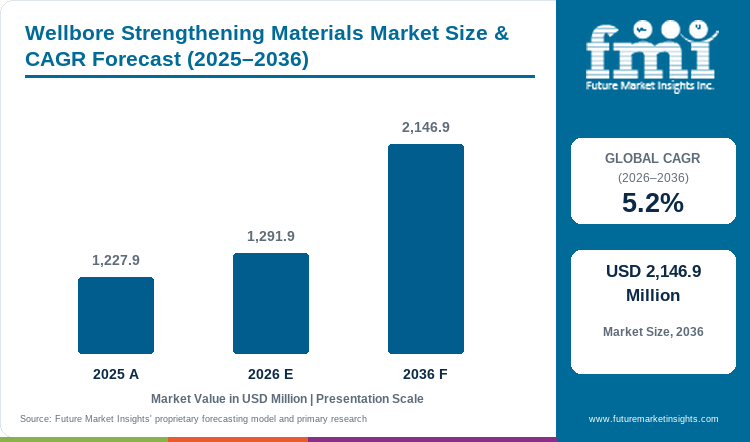
USD 1,291.9 million in 2026 and USD 2,146.9 million by 2036 at a 5.2% CAGR.
Demand for wellbore strengthening materials is projected to expand at 5.2% CAGR between 2026 and 2036, growing from USD 1,227.9 million in 2025 to USD 1,291.9 million in 2026, and escalating to USD 2,146.9 million by 2036. Preventive fracture sealing is moving material selection into the fluid plan before severe losses interrupt drilling. A 2025 AADE Baker Hughes paper documented a single-sack system that sealed large fractures under depleted-reservoir conditions. The single-sack route favors qualified strengthening packages that remain pumpable while bridging the predicted fracture range.
Country demand follows drilling systems with different installed bases and project timing during active drilling programs. The United States combines recurring land activity with mature fluid-service networks whereas Spain relies more on emerging geothermal drilling. EIA counted 918,481 producing US oil and natural gas wells nationally during 2024. The producing-well base supports repeat treatment qualification across major basins even if annual drilling activity softens. Spain's faster forecast rate is consistent with a smaller project base that can expand quickly without becoming the larger current market.
Key Takeaways
- Longer horizontal sections and narrow pressure margins increase preventive strengthening demand before high-rate fluid losses interrupt drilling schedules.
- Based on material type, graphitic materials are projected to account for 29.0% in 2026, supported by resilient particles that retain bridging function during circulation.
- By application, lost circulation prevention is estimated to hold 31.0% in 2026, owing to planned treatments that protect known weak intervals before severe losses develop.
- Onshore wells are set to lead the well type category with 32.0% share in 2026, shaped by repeat basin programs that shorten logistics and qualification cycles.
- Formation-specific particle sizing and fluid compatibility slow standardization because a treatment must survive shear and solids-control equipment before field approval.
- Some of the key players in this market include Halliburton, SLB, Baker Hughes, Newpark Fluids Systems, TETRA Technologies, IMDEX, Sharp-Rock Technologies, Inc., Riteks, Global Drilling Fluids and Chemicals Limited, and Impact Fluid Solutions.
Analyst Perspective
"Wellbore strengthening earns its value before a severe loss event because the treatment must widen the usable pressure window without destabilizing the active mud system. Commercial offers gain repeat use when fracture geometry guides particle selection and field inventory keeps the qualified design available for the full risk interval."
- Nikhil Kaitwade, Principal Consultant, Future Market Insights
How is the wellbore strengthening materials market segmented?
The market is segmented by Material Type, Application, Well Type, Form, Sales Channel, and Region.
The wellbore strengthening materials market is segmented by material type, application, well type, form, sales channel, and region. Material types include graphitic materials, calcium carbonate blends, cellulosic fibers, resilient particles, and engineered composite blends. Applications cover lost circulation prevention, fracture sealing, managed pressure drilling, wellbore stability, and depleted zone drilling. Well types span onshore, offshore, deepwater, HPHT, and unconventional wells under different pressure and logistics conditions. Forms include granular, fiber, flake, and blend - package formats used for different bridging mechanisms. Sales channels include drilling fluid companies, oilfield service companies, direct operator supply, and chemical distributors.
How do resilient graphitic particles protect a planned strengthening treatment during circulation?
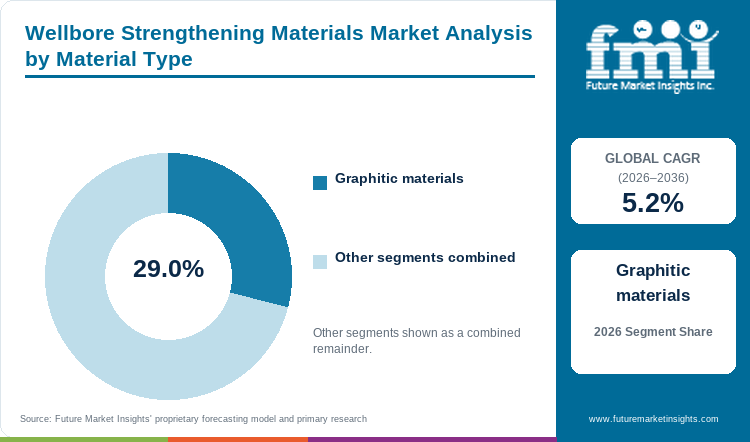
Graphitic materials suit strengthening programs because resilient particles survive repeated circulation before the weak interval is reached. Repeated shear can reduce brittle-particle size and leave fewer particles available to bridge the predicted fracture opening. Graphitic particles deform under load and remain mechanically engaged as pressure changes. The carrier system uses oil-based mud additives to keep the selected graphitic size distribution suspended and pumpable during circulation. Drilling engineers qualify the material against the fracture model and circulating system before setting treatment concentration.
- By material type, graphitic materials are forecast to represent 29.0% in 2026, enabled by particle resilience during pressure and circulation cycles.
- AADE hosted an SLB wellbore-strengthening laboratory session in February 2025 that compared fracture-sealing test methods before field qualification decisions.
Why does planned lost circulation prevention move material spending ahead of the failure event?
Lost circulation prevention moves material spending into the well plan before a depleted sand or naturally fractured interval becomes a severe loss zone. Drilling teams condition the active system with strengthening solids once offset data and geomechanical models identify the expected risk interval. The commercial decision compares a planned treatment with remedial pills and rig time lost during a circulation failure. Drilling mud chemicals control suspension and equivalent density during treatment so qualification includes carrier-fluid behavior. Repeat use depends on bridging the expected fracture range without creating a new circulation problem.
- In 2026, lost circulation prevention is expected to lead the application category with 31.0% share, driven by planned placement before high-rate losses develop.
- A 2025 AADE Baker Hughes paper documented a single-sack system that sealed fracture slots up to 10 mm and held approximately 4,000 psi during testing.
Why do repeat land programs favor onshore strengthening material demand?
Onshore drilling supports repeat strengthening purchases because mud plants and field engineers operate close to recurring basin programs. Short replenishment loops keep several qualified particle grades near active rigs as offset-well evidence changes. Basin teams reuse proven designs in formations with comparable geology and fluid practice from well to well. Regional laboratories working with onshore drilling fluids qualify strengthening treatments and maintain nearby inventory. Suppliers with local qualified material support repeat land programs without rebuilding the logistics plan for each well.
- The well type category is forecast to be led by onshore wells at 32.0% share in 2026, attributable to repeat land programs that reduce logistics and qualification friction.
- EIA reported 572 onshore rotary rigs in operation during July 2026 compared with 13 offshore rigs in the national monthly drilling series.
How does granular sizing translate fracture geometry into a repeatable fluid treatment?
Granular materials let fluid engineers translate a predicted fracture aperture into a controlled particle-size distribution before treatment enters the well. Coarser particles form the first bridge and smaller particles reduce void space behind that structure. Fluid engineers adjust the design for several expected loss-zone sizes without changing the underlying carrier system. Drilling and completion fluids carry the selected particles to the fracture mouth and maintain suspension during pumping. Commercial acceptance depends on grading consistency because solids-control screens can remove critical particles from an otherwise effective blend.
- Granular material is likely to capture 34.0% of form demand in 2026, influenced by fluid engineers matching graded particle populations to expected fracture apertures.
- AADE's 2025 Baker Hughes paper reported a single-sack treatment with graded particles that sealed modeled fracture slots up to 10 mm during testing.
Why do drilling fluid companies control more strengthening material purchasing decisions than standalone distributors?
Drilling fluid companies control a larger share of strengthening-material purchasing because formulation and field maintenance are part of the active mud program. Their laboratories test carrier-fluid compatibility and set treatment concentration before material enters a known risk interval. Field engineers replace particles removed by shakers or diluted during routine fluid conditioning in recurring field operations. Oilfield chemicals in the active mud system change rheology and solids-control behavior that determine particle retention. Repeat programs favor providers that align qualified inventory with fluid design and adjust treatment concentration as well conditions change.
- Drilling fluid companies are set to lead the sales channel category with 38.0% share in 2026, reinforced by their control of formulation and replenishment inside the active mud program.
- Newpark Fluids Systems opened an Al Khobar technical center in February 2025 to provide regional fluid design and testing support for Gulf drilling programs.
What are the drivers, restraints and opportunities in the Wellbore Strengthening Materials Market?
Longer wells increase planned loss-control demand while qualification variability slows standardization and geothermal drilling adds a new high-temperature application route.
- Driver: Longer lateral sections expose more reservoir footage to depleted sands and weak intervals that preventive strengthening can protect within the available drilling window.
- Restraint: Fracture geometry and fluid-system compatibility extend qualification because a laboratory seal must also survive circulation and field solids-control equipment.
- Opportunity: Geothermal resource drilling is expected to increase demand for strengthening packages that tolerate high temperature and project-specific water chemistry during exploratory wells.
Longer Laterals Move Loss Control Earlier in the Well Plan
Longer horizontal wells increase the footage exposed to pressure changes and heterogeneous rock before casing isolates the interval. EIA reported in August 2026 that 15% of new Permian completions during 2025 exceeded 15,000 feet. The average new lateral reached 10,867 feet and contacted more reservoir rock during each completion cycle. Longer exposure raises the chance of crossing depleted sands or weak zones before the section reaches its planned casing point. Drilling teams are coordinating drilling tools with preventive fluid design to reduce rig time lost to severe circulation problems. Suppliers gain repeat orders when one qualified particle plan stays pumpable and effective for the full risk interval.
Qualification Methods Keep Field Approval Formation-Specific
Qualification slows adoption because wellbore strengthening lacks one universal fracture-sealing laboratory method for every drilling system. AADE's February 2025 SLB session compared slot testing with a purpose-built small-block method and noted the absence of an API fracture-sealing standard. Laboratories select test geometry and fluid conditions that resemble the intended well before results support field approval. Particle-heavy treatments also change drilling waste management requirements because additional solids return to surface with circulating fluid. Fluid teams repeat compatibility and pressure-bearing work before changing a previously qualified treatment program. Suppliers shorten that cycle by providing test methods matched to the buyer's circulating system.
Geothermal Exploration Opens a High-Temperature Qualification Route
Geothermal exploration gives strengthening suppliers a future route into fractured high-temperature wells that challenge conventional drilling-fluid packages. JOGMEC selected four additional Japanese resource-survey projects in September 2026 under a national geothermal exploration support program. Those awards are moving subsurface investigation toward drilling decisions for resources that have not yet proved commercial output. Material suppliers can enter earlier by validating thermal durability and water-system compatibility for exploratory drilling. Qualification also requires low formation damage because later flow testing depends on preserving the productive interval. Supported surveys are expected to convert some prospects into drilling programs that require specialized loss-control materials.
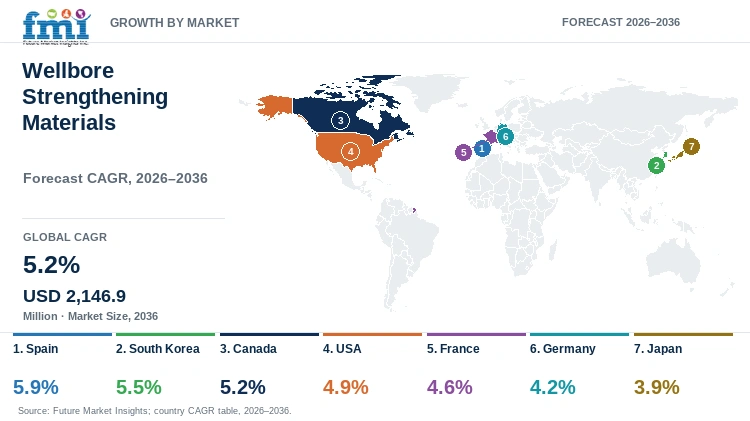
Which country CAGRs are profiled in the Wellbore Strengthening Materials Market?
| Country | CAGR |
|---|---|
| Spain | 5.9% |
| South Korea | 5.5% |
| Canada | 5.2% |
| USA | 4.9% |
| France | 4.6% |
| Germany | 4.2% |
| Japan | 3.9% |
How do country-level CAGRs compare in the Wellbore Strengthening Materials Market?
The country forecasts span two percentage points between Spain and Japan with Spain and South Korea forming the upper group. Canada and USA form the middle range while France through Japan occupy the lower range without establishing current market size.
- Spain's extended geothermal project timelines keep exploratory drilling active and place more emphasis on high-temperature loss-control qualification before developers standardize material specifications for later wells.
- In South Korea, campaign-based offshore exploration concentrates specialist fluid purchases for discrete deepwater wells and rewards suppliers that align inventory with confirmed drilling schedules.
- Canada's western-basin drilling activity favors stocked treatment grades and regional technical support because long transport distances raise the cost of moving specialized materials between well programs.
- Dense land-service infrastructure in the USA shortens mud-plant and field-support loops for complex wells and encourages repeat use of previously qualified strengthening treatments.
- France continues to expand geothermal project support while subsurface uncertainty keeps early wells technically demanding and increases the value of laboratory qualification before material orders repeat.
- Germany's faster geothermal permitting reduces administrative delay but suppliers still need project-specific thermal and fluid-compatibility evidence before field approval.
- For Japan, public geothermal risk-sharing moves more prospects toward exploration while long development schedules keep repeat strengthening-material demand tied to successful drilling and project continuation.
The full report provides country-level CAGR analysis across North America, Latin America, Western Europe, Eastern Europe, East Asia, South Asia and Pacific, and the Middle East and Africa.
Country-wise Analysis
- Spain's deep-geothermal support route gives developers longer execution windows for complex subsurface projects that require exploratory drilling before commercial output is known. Wellbore strengthening materials demand in Spain is forecast to rise at 5.9% CAGR over the forecast period, supported by projects moving from national funding into exploratory drilling. MITECO stated in December 2025 that complex geothermal projects may complete by 2030 under revised national recovery-plan deadlines. Reservoir uncertainty still raises the cost of early wells and limits the local operating record available for new formulations. Local reference data become more useful as supported wells reach execution and establish repeatable fluid requirements.
- South Korea's offshore exploration base remains small and campaign-led because drilling occurs in discrete deepwater windows. Adoption of wellbore strengthening materials in South Korea is estimated to expand at 5.5% CAGR through 2036, influenced by campaign-based offshore exploration. KNOC reported 49 domestic continental-shelf exploration wells completed by June 2026 following decades of intermittent activity. Campaign gaps increase demand for oilfield services that mobilize specialist fluid support for confirmed wells. Deepwater qualification requires reliable technical support for each new treatment entering an active well program.
- Canada combines western-basin fluid-service infrastructure with crude-oil production that supports repeat treatment programs over long land distances. The Canadian wellbore strengthening materials sector is projected to record 5.2% CAGR during the assessment period, reinforced by western-basin activity that keeps qualification and inventory needs active. The Canada Energy Regulator reported in June 2026 that crude oil and equivalent production averaged 5.35 million barrels per day in 2025 with Alberta supplying 83.8%. Long land programs require regional planning for onshore drilling waste management and specialized strengthening-material inventory. Regional inventory reduces mobilization time in repeat programs that justify stocked treatment grades and nearby technical support.
- United States drilling programs pair a large land-service network with repeated fluid qualification routines in major shale basins. Wellbore strengthening materials sales in the United States are forecast to expand at 4.9% CAGR by 2036, driven by complex shale wells that increase preventive treatment needs. EIA's national drilling series recorded 572 onshore rotary rigs and 13 offshore rigs for the July 2026 monthly average. Basin service networks keep oilwell completion tools and strengthening materials close to recurring land campaigns. Commodity-price declines can reduce material throughput by lowering drilling activity in major land basins.
- France is expanding geothermal heat development with national support that covers surface systems and deeper drilling projects. France's wellbore strengthening materials outlook is anticipated to advance at 4.6% CAGR over the assessment period, attributable to deeper geothermal project execution. ADEME reported in April 2026 that more than 300 geothermal projects received support in 2025 and represented 20.7% of supported renewable-heat output. Geological uncertainty can still make an unsuccessful deep well expensive before commercial heat production begins. Suppliers need low-damage treatments and hot-water compatibility evidence to secure repeated material orders locally. Early project teams value laboratory support that narrows formulation choices before drilling consumes a larger share of project capital.
- Germany is reducing administrative delay for geothermal projects that require deep drilling and controlled subsurface risk assessment. In Germany, wellbore strengthening materials demand is predicted to advance at 4.2% CAGR through 2036, aided by permitting reform that moves more projects toward execution. BMWE stated in August 2025 that proposed legislation would digitize procedures and set a twelve-month maximum for mining-law processing. Permitting relief does not remove reservoir uncertainty during drilling and cannot replace technical qualification. Material suppliers still need thermal-performance records and fluid-system compatibility data for each project approval. Developers are more likely to approve a new strengthening package once the evidence reduces uncertainty about first-time use in a geothermal basin.
- Japan uses national financing programs to move geothermal prospects from surveys toward drilling and flow testing. By 2036, Japan's wellbore strengthening materials market is projected to grow at 3.9% CAGR, shaped by risk-sharing programs that move supported prospects toward drilling. JOGMEC revised its geothermal financing review system in January 2026 to evaluate project structure and risk-reduction measures under a revised assessment method. Mountainous terrain and local coordination can significantly extend development schedules ahead of exploratory drilling. Project support can move more prospects toward drilling but repeat material demand still depends on successful wells and continuing development activity.
Who are the notable companies in the Wellbore Strengthening Materials Market?
Halliburton, SLB, Baker Hughes, Newpark Fluids Systems, TETRA Technologies, IMDEX, Sharp-Rock Technologies, Inc., Riteks, Global Drilling Fluids and Chemicals Limited, and Impact Fluid Solutions are the notable companies serving this market.
Competition separates integrated drilling-fluid providers from specialist wellbore-strengthening and LCM suppliers with narrower chemistry portfolios. Integrated groups pair fluid engineering with field service while specialists compete on particle design and focused application support. Impact Fluid Solutions operates within Dorf Ketal and remains a distinct market-facing oilfield-additives business. Entry becomes harder without laboratory evidence or regional inventory because a strengthening treatment must be qualified inside the circulating system before field use.
- Halliburton and SLB join Baker Hughes and Newpark Fluids Systems in combining drilling-fluid engineering with field support and multi-region delivery.
- Sharp-Rock Technologies, Inc. joins Riteks with Global Drilling Fluids and Chemicals Limited plus Impact Fluid Solutions in focused strengthening or loss-control chemistry.
- TETRA Technologies and IMDEX supply well-fluid technologies used in deepwater and exploration programs that share pressure and compatibility qualification requirements with strengthening materials.
Competitive Benchmarking: Wellbore Strengthening Materials Market
| Company | WBS / LCM Material Breadth | Fluid-System Engineering | High-Risk Well Evidence | Geographic Reach |
|---|---|---|---|---|
| Halliburton | High | High | High | Global |
| SLB | High | High | High | Global |
| Baker Hughes | High | High | High | Global |
| Newpark Fluids Systems | Medium | High | High | North America, Europe, Middle East, and selected global markets |
| TETRA Technologies | Medium | Medium | High | North America and international deepwater markets |
| IMDEX | Medium | Medium | Medium | Global mining and exploration drilling markets |
| Sharp-Rock Technologies, Inc. | Medium | Medium | High | North America and selected international projects |
| Riteks | High | Medium | High | North America and international oilfield supply |
| Global Drilling Fluids and Chemicals Limited | High | Medium | Medium | India-based manufacturing with international supply |
| Impact Fluid Solutions | Medium | High | High | North America, Europe, Middle East, and selected international markets |
Scoring basis: High material breadth requires several documented strengthening or LCM routes within the stated market boundary. Medium marks a narrower exact-market set and Low identifies one directly documented strengthening or loss-control route. High fluid-system engineering requires formulation capability plus documented laboratory testing and field-support evidence for active drilling programs. Medium confirms only part of that engineering chain with a narrower laboratory or field-support record. High high-risk-well evidence requires several public records covering deepwater or HPHT applications plus depleted-zone or wellbore-testing work. Medium confirms a narrower high-risk evidence base and Low identifies one qualifying public record under the stated criterion.
Key Developments in the Wellbore Strengthening Materials Market
- In September 2026, Riteks launched RiDrill WS-1 as a dual-mechanism wellbore strengthener for brine plus water- and oil-based mud systems.
- In June 2026, TETRA Technologies launched Neptune Z-Lite for deepwater and high-pressure wells with a three-well 20k psi Gulf of America award starting in 2026.
- In February 2025, Newpark Fluids Systems opened a Technical Center of Excellence in Al Khobar for regional drilling-fluid design and testing support.
Key Players in the Wellbore Strengthening Materials Market
Integrated Drilling-Fluid and Well-Construction Platforms
- Halliburton
- SLB
- Baker Hughes
- Newpark Fluids Systems
Specialist Wellbore-Strengthening and Loss-Control Suppliers
- Sharp-Rock Technologies, Inc.
- Riteks
- Global Drilling Fluids and Chemicals Limited
- Impact Fluid Solutions
Deepwater and Exploration Fluid Providers
- TETRA Technologies
- IMDEX
Wellbore Strengthening Materials Market - Report Scope
| Coverage field | Report scope |
|---|---|
| Market breakdown | By material type, application, well type, form, sales channel and region. |
| Quantitative Units | USD million. |
| Market Definition | Commercial strengthening and loss-control materials sold for preventive or remedial use within drilling-fluid systems and engineered pills. |
| Regions Covered | North America, Latin America, Western Europe, Eastern Europe, East Asia, South Asia and Pacific, and Middle East and Africa. |
| Countries Covered | Spain, South Korea, Canada, USA, France, Germany, Japan, and 20+ countries included in the full report. |
| Key Companies Profiled | Halliburton, SLB, Baker Hughes, Newpark Fluids Systems, TETRA Technologies, IMDEX, Sharp-Rock Technologies, Inc., Riteks, Global Drilling Fluids and Chemicals Limited, and Impact Fluid Solutions. |
| Forecast Period | 2026 to 2036. |
| Approach | Primary and secondary research with market triangulation. |
Wellbore Strengthening Materials Market - Research Methodology
| Method | Approach |
|---|---|
| Primary Research | FMI analysts gathered input from manufacturers, service providers, technology developers, distributors, end users, procurement teams, and subject-matter experts. Interviews examined purchasing decisions, product or service evaluation, adoption barriers, approval requirements, pricing considerations, and expectations for technical or commercial support. Respondents were also asked what evidence is required before a trial, pilot, or initial order develops into regular purchasing. |
| Desk Research | Desk research covered government statistics, regulatory publications, trade data, industry associations, technical literature, standards, company filings, product information, and official corporate announcements. Sources were reviewed for relevance, publication date, geographic coverage, and consistency with the defined market scope. Claims relating to performance, applications, approvals, capacity, investment, and commercial activity were retained only when supported by credible public evidence. |
| Market Sizing and Forecasting | The market model combined the baseline value with historical performance, segment structure, pricing and volume indicators, adoption levels, company participation, and country-level demand conditions. Forecast assumptions considered economic activity, investment trends, regulatory developments, technology adoption, purchasing cycles, supply availability, and barriers to wider market use. Segment and regional estimates were reconciled before the final market total was calculated. |
| Data Validation | Estimates were checked against multiple independent indicators, including public data, company activity, trade patterns, industry developments, and findings from primary interviews. Validation also tested whether products, services, applications, and company revenues fell within the defined market boundaries. Adjacent categories, unsupported claims, overlapping revenues, and activities without direct market relevance were excluded to reduce double counting and maintain consistency across segments and countries. |
Wellbore Strengthening Materials Market by Segments
Wellbore Strengthening Materials Market segmented by Material Type:
- Graphitic materials
- Calcium carbonate blends
- Cellulosic fibers
- Resilient particles
- Engineered composite blends
Wellbore Strengthening Materials Market segmented by Application:
- Lost circulation prevention
- Fracture sealing
- Managed pressure drilling
- Wellbore stability
- Depleted zone drilling
Wellbore Strengthening Materials Market segmented by Well Type:
- Onshore wells
- Offshore wells
- Deepwater wells
- HPHT wells
- Unconventional wells
Wellbore Strengthening Materials Market segmented by Form:
- Granular
- Fiber
- Flake
- Blend - package
Wellbore Strengthening Materials Market segmented by Sales Channel:
- Drilling fluid companies
- Oilfield service companies
- Direct operator supply
- Chemical distributors
Wellbore Strengthening Materials Market by Region:
- North America
- United States
- Canada
- Latin America
- Brazil
- Mexico
- Argentina
- Chile
- Western Europe
- Germany
- France
- United Kingdom
- Italy
- Spain
- Benelux
- Nordics
- Eastern Europe
- Poland
- Czech Republic
- Romania
- Hungary
- East Asia
- China
- Japan
- South Korea
- South Asia and Pacific
- India
- ASEAN
- Australia and New Zealand
- Middle East and Africa
- GCC Countries
- South Africa
- Türkiye
- Israel
Research Sources and Bibliography
- American Association of Drilling Engineers. (2025). Advanced Single Sack Loss Circulation Technology Sealing Larger Fractures suitable to use in Depleted Reservoir conditions.
- USA Energy Information Administration. (2025, December 8). USA Oil and Natural Gas Wells by Production Rate.
- American Association of Drilling Engineers. (2025, February 20). Laboratory Testing for Wellbore Strengthening Versus Lost Circulation Control.
- USA Energy Information Administration. (2026, August 31). Crude Oil and Natural Gas Drilling Activity.
- Riteks. (2026, September 14). More LCM is not the same as less lost circulation: Riteks Case Study Report.
- Newpark Fluids Systems. (2025, February). Serving the GCC region with our new Technical Center of Excellence.
- USA Energy Information Administration. (2026, August 19). Longer wells boost Permian crude oil and natural gas production.
- Japan Organization for Metals and Energy Security. (2026, September 14).
- Ministry for the Ecological Transition and the Demographic Challenge. (2025, December 13). El MITECO abre la posibilidad de ampliar los plazos de ejecución de proyectos beneficiados con más de 1.300 millones en ayudas del Plan de Recuperación.
- Korea National Oil Corporation. (2026, June 30).
- Canada Energy Regulator. (2026, June 17). Market Snapshot: Canada sets new record in crude oil production in 2025.
- ADEME. (2026, April 22). Bilan du Fonds Chaleur 2025 : 1 200 projets d’aide pour sortir des énergies fossiles.
- Federal Ministry for Economic Affairs and Energy. (2025, August 22). Geothermie-Ausbau wird beschleunigt: Neues Gesetz auf den Weg gebracht.
- Japan Organization for Metals and Energy Security. (2026, January 13).
- Riteks. (2026, September 8). Bridge It, Then Seal It: RiDrill WS-1 Dual-Mechanism Wellbore Strengthener.
- American Association of Drilling Engineers. (2025, October 14). Advanced Insight of Wellbore Strengthening Leads to Smart Selection of Preventive LCM.
- Halliburton. (2025, January 30). Halliburton secures major offshore drilling contract with Petrobras.
- SCF Partners. (2025, July 7). Newpark Fluids Systems Strengthens Executive Leadership and Board to Drive Continued Growth.
- Halliburton. (2026, August 25). bp awards Halliburton integrated contract for Bumerangue field appraisal in Brazil.
- SLB. (2025, March 31). SLB Awarded Major Drilling Contract by Woodside Energy for Ultra-deepwater Trion Development, Offshore Mexico.
- Halliburton. (2026, September 15). Halliburton Awarded Bundled Deepwater Well Construction and Completions Contract.
- SLB. (2026, February 12). SLB Awarded Multiple Offshore Drilling Contracts by Mubadala Energy for Tangkulo Deepwater Development in Indonesia.
- Halliburton. (2025, February 26). Halliburton and Sekal deliver world’s first automated on-bottom drilling system for Equinor in the North Sea.
- SLB. (2026, February 3). SLB Awarded Integrated Development Contract for Mutriba Field in Kuwait.
- Baker Hughes. (2026, May). First Baker Hughes Advance Seal AS deployment effectively controls fluid losses, saves $900,000 USD in fluid costs.
- TETRA Technologies, Inc. (2026, June 29). TETRA Technologies Introduces TETRA Neptune Z-Lite Deepwater Completions Fluid.
- IMDEX. (2025, August 12). IMDEX releases xFORM multifunctional drilling fluids range.
- TETRA Technologies, Inc. (2025, July 29). TETRA TECHNOLOGIES, INC. ANNOUNCES STRONG SECOND QUARTER 2025 RESULTS AND PROVIDES FULL YEAR GUIDANCE.
- Impact Fluid Solutions. (2025, April 29). Driving Innovation, Delivering Value.
- Halliburton. (n.d.). BaraECD fluid and WellSET treatment strengthen wellbore. Retrieved September 17, 2026.
- SLB. (n.d.). Wellbore Strengthening Materials. Retrieved September 17, 2026.
- Baker Hughes. (n.d.). Wellbore strengthening. Retrieved September 17, 2026.
- Newpark Fluids Systems. (n.d.). Effective Lost Circulation Solutions. Retrieved September 17, 2026.
- IMDEX. (n.d.). Drilling Fluids & Specialty Products. Retrieved September 17, 2026.
- Global Drilling Fluids and Chemicals Limited. (n.d.). Cellophane Flakes. Retrieved September 17, 2026.
- Impact Fluid Solutions. (n.d.). Drilling Additives. Retrieved September 17, 2026.
- Dorf Ketal. (2024, May 10). Acquisition of Impact Fluid Solutions.
This bibliography is provided for reader reference and is not exhaustive. The full report contains the complete reference list and detailed citations.
This Report Answers
- How large is the wellbore strengthening materials market through the 2036 forecast?
- Which operating conditions move strengthening treatments earlier in the drilling plan?
- Why do graphitic materials hold the 29.0% material type share?
- How does lost circulation prevention shape application demand and material qualification?
- Why do onshore wells support repeat strengthening material purchases and inventory?
- Which companies pair fluid engineering with specialist loss-control material capabilities?
- What qualification risks prevent one strengthening package from serving every formation?
- How does geothermal drilling expand the addressable high-temperature application route?
Frequently Asked Questions
How big is the Wellbore Strengthening Materials Market in 2026?
The wellbore strengthening materials market is valued at USD 1,291.9 million in 2026. It is projected to reach USD 2,146.9 million by 2036 at a 5.2% CAGR as complex wells increase preventive loss-control requirements.
What is the CAGR of the Wellbore Strengthening Materials Market from 2026 to 2036?
The wellbore strengthening materials market is projected to grow at a 5.2% CAGR between 2026 and 2036. Growth depends on planned strengthening treatments that protect narrow pressure margins without compromising mud-system circulation or field solids control.
Which material type segment leads the Wellbore Strengthening Materials Market?
Based on material type, the graphitic materials segment is projected to account for 29.0% in 2026. Resilient particles remain engaged during pressure cycles and require distributions matched to the predicted fracture range and carrier system.
Which application segment leads the Wellbore Strengthening Materials Market?
By application, the lost circulation prevention segment is estimated to hold 31.0% in 2026. Planned treatments protect known weak intervals before severe losses develop and field approval still depends on pumpability and active-fluid compatibility.
Which selected countries record the upper-range CAGRs through 2036?
Spain is projected to grow at 5.9% CAGR through 2036 and South Korea is forecast at 5.5%. Canada is projected at 5.2% CAGR and these rates describe forecast pace instead of current market size.
Which companies are active in the Wellbore Strengthening Materials Market?
Key companies active in the wellbore strengthening materials market include Halliburton, SLB, Baker Hughes, Newpark Fluids Systems, TETRA Technologies, IMDEX, Sharp-Rock Technologies, Inc., Riteks, Global Drilling Fluids and Chemicals Limited, and Impact Fluid Solutions. Integrated fluid providers compete with specialist strengthening and loss-control suppliers on qualification evidence plus field support and material availability.
Preview the report firsthand - request a free sample
Get SampleGet the brochure for pricing and purchase details.
Get PDFTable of Content
- Key Takeaways
- Market Size and CAGR
- Top Growth Driver
- Fastest Growing Segment
- Leading Region
- Key Companies
- Emerging Opportunities
- Executive Summary
- Global Market Outlook
- Demand-side Trends
- Supply-side Trends
- Technology Roadmap Analysis
- Analysis and Recommendations
- Analyst Perspective (What is happening? Why now? What should investors know?)
- Key Questions Answered
- How large is the market?
- What is the CAGR?
- What are key trends?
- Which region dominates?
- Who are the leaders?
- Market Overview
- Market Coverage / Taxonomy
- Market Definition / Scope / Limitations
- Research Methodology
- Chapter Orientation
- Analytical Lens and Working Hypotheses
- Market Structure, Signals, and Trend Drivers
- Benchmarking and Cross-market Comparability
- Market Sizing, Forecasting, and Opportunity Mapping
- Research Design and Evidence Framework
- Desk Research Programme (Secondary Evidence)
- Expert Input and Fieldwork (Primary Evidence)
- Tooling, Models, and Reference Databases
- Data Engineering and Model Build
- Quality Assurance and Audit Trail
- Market Background
- Market Dynamics (Drivers, Restraints, Opportunity, Trends)
- Scenario Forecast (Optimistic, Likely, Conservative)
- Impact Analysis
- AI Impact
- Sustainability Impact
- Regulatory Impact
- Technology Impact
- Consumer / Buyer Analysis
- Purchase Drivers
- Adoption Barriers
- Buyer Journey
- Opportunity Map Analysis
- Product Life Cycle Analysis
- Supply Chain Analysis
- Investment Feasibility Matrix
- Value Chain Analysis
- PESTLE and Porter's Analysis
- Regulatory Landscape
- Regional Parent Market Outlook
- Production and Consumption Statistics
- Import and Export Statistics
- Global Market Analysis and Forecast, 2021 to 2036
- Historical Market Size Value (USD Million) Analysis, 2021 to 2025
- Current and Future Market Size Value (USD Million) Projections, 2026 to 2036
- Y-o-Y Growth Trend Analysis
- Absolute $ Opportunity Analysis
- Global Market Pricing Analysis, 2021 to 2036
- Global Market Analysis and Forecast, By Material Type, 2021 to 2036
- Introduction / Key Findings
- Historical Market Size Value (USD Million) Analysis By Material Type, 2021 to 2025
- Current and Future Market Size Value (USD Million) Analysis and Forecast By Material Type, 2026 to 2036
- Graphitic materials
- Calcium carbonate blends
- Cellulosic fibers
- Resilient particles
- Engineered composite blends
- Y-o-Y Growth Trend Analysis By Material Type, 2021 to 2025
- Absolute $ Opportunity Analysis By Material Type, 2026 to 2036
- Global Market Analysis and Forecast, By Application, 2021 to 2036
- Introduction / Key Findings
- Historical Market Size Value (USD Million) Analysis By Application, 2021 to 2025
- Current and Future Market Size Value (USD Million) Analysis and Forecast By Application, 2026 to 2036
- Lost circulation prevention
- Fracture sealing
- Managed pressure drilling
- Wellbore stability
- Depleted zone drilling
- Y-o-Y Growth Trend Analysis By Application, 2021 to 2025
- Absolute $ Opportunity Analysis By Application, 2026 to 2036
- Global Market Analysis and Forecast, By Well Type, 2021 to 2036
- Introduction / Key Findings
- Historical Market Size Value (USD Million) Analysis By Well Type, 2021 to 2025
- Current and Future Market Size Value (USD Million) Analysis and Forecast By Well Type, 2026 to 2036
- Onshore wells
- Offshore wells
- Deepwater wells
- HPHT wells
- Unconventional wells
- Y-o-Y Growth Trend Analysis By Well Type, 2021 to 2025
- Absolute $ Opportunity Analysis By Well Type, 2026 to 2036
- Global Market Analysis and Forecast, By Form, 2021 to 2036
- Introduction / Key Findings
- Historical Market Size Value (USD Million) Analysis By Form, 2021 to 2025
- Current and Future Market Size Value (USD Million) Analysis and Forecast By Form, 2026 to 2036
- Granular
- Fiber
- Flake
- Blend - package
- Y-o-Y Growth Trend Analysis By Form, 2021 to 2025
- Absolute $ Opportunity Analysis By Form, 2026 to 2036
- Global Market Analysis and Forecast, By Sales Channel, 2021 to 2036
- Introduction / Key Findings
- Historical Market Size Value (USD Million) Analysis By Sales Channel, 2021 to 2025
- Current and Future Market Size Value (USD Million) Analysis and Forecast By Sales Channel, 2026 to 2036
- Drilling fluid companies
- Oilfield service companies
- Direct operator supply
- Chemical distributors
- Y-o-Y Growth Trend Analysis By Sales Channel, 2021 to 2025
- Absolute $ Opportunity Analysis By Sales Channel, 2026 to 2036
- Global Market Analysis and Forecast, By Region, 2021 to 2036
- Introduction
- Historical Market Size Value (USD Million) Analysis By Region, 2021 to 2025
- Current Market Size Value (USD Million) Analysis and Forecast By Region, 2026 to 2036
- North America
- Latin America
- Western Europe
- Eastern Europe
- East Asia
- South Asia and Pacific
- Middle East and Africa
- Market Attractiveness Analysis By Region
- North America Market Analysis and Forecast, By Country, 2021 to 2036
- Historical Market Size Value (USD Million) Trend Analysis By Market Taxonomy, 2021 to 2025
- Market Size Value (USD Million) Forecast By Market Taxonomy, 2026 to 2036
- By Country
- United States
- Canada
- By Material Type
- By Application
- By Well Type
- By Form
- By Sales Channel
- By Country
- Market Attractiveness Analysis
- By Country
- By Material Type
- By Application
- By Well Type
- By Form
- By Sales Channel
- Key Takeaways
- Latin America Market Analysis and Forecast, By Country
- Historical Market Size Value (USD Million) Trend Analysis By Market Taxonomy, 2021 to 2025
- Market Size Value (USD Million) Forecast By Market Taxonomy, 2026 to 2036
- By Country
- Brazil
- Mexico
- Argentina
- Chile
- By Material Type
- By Application
- By Well Type
- By Form
- By Sales Channel
- By Country
- Market Attractiveness Analysis
- By Country
- By Material Type
- By Application
- By Well Type
- By Form
- By Sales Channel
- Key Takeaways
- Western Europe Market Analysis and Forecast, By Country
- Historical Market Size Value (USD Million) Trend Analysis By Market Taxonomy, 2021 to 2025
- Market Size Value (USD Million) Forecast By Market Taxonomy, 2026 to 2036
- By Country
- Germany
- France
- United Kingdom
- Italy
- Spain
- Benelux
- Nordics
- By Material Type
- By Application
- By Well Type
- By Form
- By Sales Channel
- By Country
- Market Attractiveness Analysis
- By Country
- By Material Type
- By Application
- By Well Type
- By Form
- By Sales Channel
- Key Takeaways
- Eastern Europe Market Analysis and Forecast, By Country
- Historical Market Size Value (USD Million) Trend Analysis By Market Taxonomy, 2021 to 2025
- Market Size Value (USD Million) Forecast By Market Taxonomy, 2026 to 2036
- By Country
- Poland
- Czech Republic
- Romania
- Hungary
- By Material Type
- By Application
- By Well Type
- By Form
- By Sales Channel
- By Country
- Market Attractiveness Analysis
- By Country
- By Material Type
- By Application
- By Well Type
- By Form
- By Sales Channel
- Key Takeaways
- East Asia Market Analysis and Forecast, By Country
- Historical Market Size Value (USD Million) Trend Analysis By Market Taxonomy, 2021 to 2025
- Market Size Value (USD Million) Forecast By Market Taxonomy, 2026 to 2036
- By Country
- China
- Japan
- South Korea
- By Material Type
- By Application
- By Well Type
- By Form
- By Sales Channel
- By Country
- Market Attractiveness Analysis
- By Country
- By Material Type
- By Application
- By Well Type
- By Form
- By Sales Channel
- Key Takeaways
- South Asia and Pacific Market Analysis and Forecast, By Country
- Historical Market Size Value (USD Million) Trend Analysis By Market Taxonomy, 2021 to 2025
- Market Size Value (USD Million) Forecast By Market Taxonomy, 2026 to 2036
- By Country
- India
- ASEAN
- Australia and New Zealand
- By Material Type
- By Application
- By Well Type
- By Form
- By Sales Channel
- By Country
- Market Attractiveness Analysis
- By Country
- By Material Type
- By Application
- By Well Type
- By Form
- By Sales Channel
- Key Takeaways
- Middle East and Africa Market Analysis and Forecast, By Country
- Historical Market Size Value (USD Million) Trend Analysis By Market Taxonomy, 2021 to 2025
- Market Size Value (USD Million) Forecast By Market Taxonomy, 2026 to 2036
- By Country
- GCC Countries
- South Africa
- Türkiye
- Israel
- By Material Type
- By Application
- By Well Type
- By Form
- By Sales Channel
- By Country
- Market Attractiveness Analysis
- By Country
- By Material Type
- By Application
- By Well Type
- By Form
- By Sales Channel
- Key Takeaways
- Key Countries Market Analysis
- United States
- Pricing Analysis
- Market Share Analysis, 2025
- By Material Type
- By Application
- By Well Type
- By Form
- By Sales Channel
- Canada
- Pricing Analysis
- Market Share Analysis, 2025
- By Material Type
- By Application
- By Well Type
- By Form
- By Sales Channel
- Mexico
- Pricing Analysis
- Market Share Analysis, 2025
- By Material Type
- By Application
- By Well Type
- By Form
- By Sales Channel
- Brazil
- Pricing Analysis
- Market Share Analysis, 2025
- By Material Type
- By Application
- By Well Type
- By Form
- By Sales Channel
- Chile
- Pricing Analysis
- Market Share Analysis, 2025
- By Material Type
- By Application
- By Well Type
- By Form
- By Sales Channel
- Germany
- Pricing Analysis
- Market Share Analysis, 2025
- By Material Type
- By Application
- By Well Type
- By Form
- By Sales Channel
- United Kingdom
- Pricing Analysis
- Market Share Analysis, 2025
- By Material Type
- By Application
- By Well Type
- By Form
- By Sales Channel
- Italy
- Pricing Analysis
- Market Share Analysis, 2025
- By Material Type
- By Application
- By Well Type
- By Form
- By Sales Channel
- Spain
- Pricing Analysis
- Market Share Analysis, 2025
- By Material Type
- By Application
- By Well Type
- By Form
- By Sales Channel
- France
- Pricing Analysis
- Market Share Analysis, 2025
- By Material Type
- By Application
- By Well Type
- By Form
- By Sales Channel
- India
- Pricing Analysis
- Market Share Analysis, 2025
- By Material Type
- By Application
- By Well Type
- By Form
- By Sales Channel
- ASEAN
- Pricing Analysis
- Market Share Analysis, 2025
- By Material Type
- By Application
- By Well Type
- By Form
- By Sales Channel
- Australia and New Zealand
- Pricing Analysis
- Market Share Analysis, 2025
- By Material Type
- By Application
- By Well Type
- By Form
- By Sales Channel
- China
- Pricing Analysis
- Market Share Analysis, 2025
- By Material Type
- By Application
- By Well Type
- By Form
- By Sales Channel
- Japan
- Pricing Analysis
- Market Share Analysis, 2025
- By Material Type
- By Application
- By Well Type
- By Form
- By Sales Channel
- South Korea
- Pricing Analysis
- Market Share Analysis, 2025
- By Material Type
- By Application
- By Well Type
- By Form
- By Sales Channel
- Poland
- Pricing Analysis
- Market Share Analysis, 2025
- By Material Type
- By Application
- By Well Type
- By Form
- By Sales Channel
- Hungary
- Pricing Analysis
- Market Share Analysis, 2025
- By Material Type
- By Application
- By Well Type
- By Form
- By Sales Channel
- Türkiye
- Pricing Analysis
- Market Share Analysis, 2025
- By Material Type
- By Application
- By Well Type
- By Form
- By Sales Channel
- South Africa
- Pricing Analysis
- Market Share Analysis, 2025
- By Material Type
- By Application
- By Well Type
- By Form
- By Sales Channel
- United States
- Market Structure Analysis
- Competition Dashboard
- Competition Benchmarking
- Market Share Analysis of Top Players
- By Regional
- By Material Type
- By Application
- By Well Type
- By Form
- By Sales Channel
- Emerging Startups
- Innovation Benchmarking
- Competition Analysis
- Competition Deep Dive
- Halliburton
- Overview
- Product Portfolio
- Profitability by Market Segments
- Sales Footprint
- Strategy Overview
- Marketing Strategy
- Product Strategy
- Channel Strategy
- SLB
- Baker Hughes
- Newpark Fluids Systems
- TETRA Technologies
- IMDEX
- Sharp-Rock Technologies, Inc.
- Riteks
- Global Drilling Fluids and Chemicals Limited
- Impact Fluid Solutions
- Halliburton
- Case Studies
- Success Stories
- Recent Developments
- Competition Deep Dive
- Assumptions & Acronyms Used


