

- Market Size (2026)
- USD 414.3 Mn
- Forecast (2036)
- USD 1252.7 Mn
- CAGR (2026 to 2036)
- 11.7%
How big is Yogurt Coatings Market in 2026?
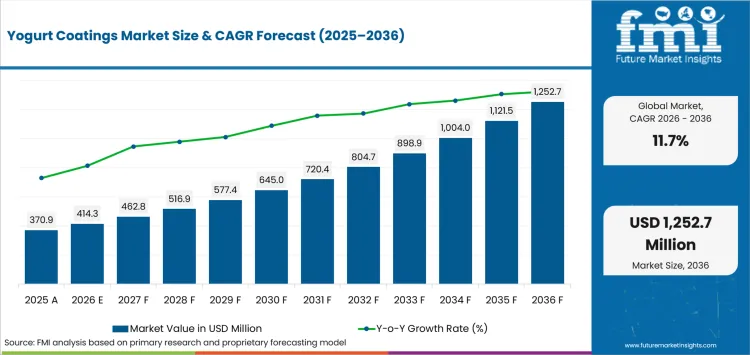
USD 414.3 million in 2026 and USD 1,252.7 million by 2036 at an 11.7% CAGR.
Demand for yogurt coatings is projected to expand the valuation from USD 414.3 million in 2026 to USD 1,252.7 million by 2036 at an 11.7% CAGR. Industrial demand rises as cultured-dairy flavor runs across established bakery ingredient systems without changing the core coating line. Cargill reopened its Singapore Innovation Center in April 2025 with laboratories covering dairy, bakery and confectionery development. That application access shortens formulation work before a coating reaches full production trials across industrial bakery accounts.
Conversion rates differ across national markets as finished bakery products face different nutrition and labeling pressures. France adopted a stricter Nutri-Score calculation in March 2025 that gives greater weight to sugars, salt and saturated fat. That change raises reformulation pressure around sweet coatings even though Nutri-Score remains voluntary for participating food companies. Markets with fewer front-of-pack constraints can place more weight on sensory novelty, while stricter systems increase the testing burden for specialty shortening platforms and dairy solids.
Key Takeaways of Yogurt Coatings Market
- Industrial bakeries purchase yogurt coatings to introduce a cultured dairy note without reducing line speed or finished-product stability.
- Standard grade is estimated to hold 44.0% of product type demand in 2026 owing to predictable processing and broad formulation flexibility.
- Powder / dry is projected to account for 38.0% of form demand in 2026 because controlled dosing and storage suit centralized premix workflows.
- Bread & rolls are anticipated to represent 31.0% of application demand in 2026 as high-volume lines reward repeatable deposition and set behavior.
- Nutrition targets and ingredient interactions can extend approval work as sugar reduction must preserve viscosity, crystallization and sensory performance.
- Some of the key players in this market include Cargill, AAK, Barry Callebaut, Puratos, Corbion, Arla Foods Ingredients, FrieslandCampina Ingredients, and IFF.
Analyst Perspective
"Yogurt coatings win repeat orders when the acidic dairy note survives the same viscosity and cooling window used by the bakery line. Commercial value rises as formulation support prevents scrap and keeps nutrition claims defensible without slowing the depositor or extending pack-out time."
- Nandini Roy Choudhury, Principal Consultant, Future Market Insights
How is the yogurt coatings market segmented?
The yogurt coatings market is segmented by product type, form, application, claim, sales channel and region.
Product type covers standard grade, premium / specialty grade, organic certified and clean label grade. Form includes powder / dry, liquid, paste / semi-solid and granules / pieces. Applications cover bread & rolls, cakes & muffins, biscuits & cookies, viennoiserie & pastry and other bakery & snacks. Claim includes conventional, clean label, organic and non-GMO / identity preserved. Sales channels include direct industrial supply, ingredient distributors, foodservice & artisan supply and online B2B.
Why does standard grade lead demand within the product type category?
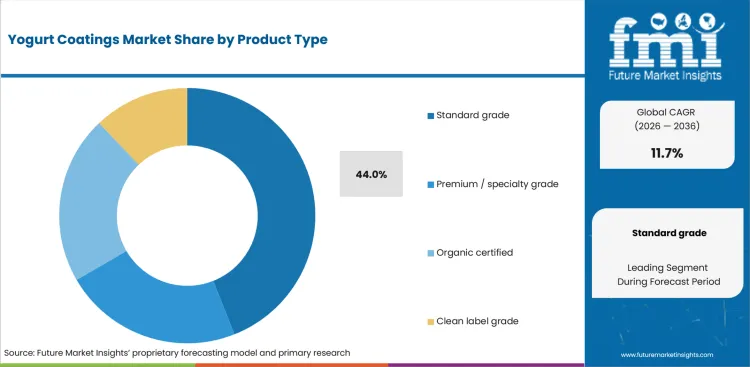
Standard formulations suit plants that prioritize repeatable melt behavior and controlled setting over a certified ingredient claim. Broader ingredient choice also lets formulators manage dairy solids and clean-label ingredients without rebuilding a coating specification during routine cost or supply changes.
- By product type, standard grade is estimated to hold 44.0% in 2026 owing to broad ingredient choice and lower qualification effort on established coating lines.
- Cargill expanded its Port Klang specialty-fats facility in March 2026 with a new line serving bakery and fillings applications. The added capacity broadens regional access to fat systems used in compound-style coatings for industrial bakery lines.
Why does powder / dry lead demand within the form category?
Powder / dry systems suit plants that stage coating batches near production with standardized storage and dosing across sites. Cargill broke ground on its Beijing expansion in January 2026 with separate lines for flavored powders for beverages and flavored coatings.
- Powder / dry is projected to represent 38.0% of form demand in 2026 owing to storage efficiency and controlled dosing across centralized premix operations.
- Poor wet-out produces uneven acidity and viscosity, making dispersion quality a commercial adoption criterion during local batch preparation. Multi-site bakeries therefore value powders that reproduce the same coating behavior after local batch preparation.
Why do bread & rolls lead demand within the application category?
Bread and roll lines run long enough for small viscosity changes to become visible as coating-weight drift or packaging marks. Formulators test deposition and set behavior against existing bakery improver systems during pre-rollout qualification at each plant.
- In 2026, bread & rolls are expected to lead application demand with 31.0% share because long production runs reward stable coating weight and predictable cooling.
- Corbion used IBIE in September 2025 to address clean-label reformulation for commercial bakers facing shelf-life and consistency requirements. Those constraints tie coating approval to finished-recipe performance across production runs rather than visual appearance alone.
Why does direct to industrial bakeries lead the sales channel category?
Direct technical contact matters for coatings matched to one depositor and one finished-pack format during commercial qualification. Puratos announced Montreal and Costa Rica Innovation Centers in August 2025 within its network for industrial bakery mixes and adjacent bakery application work.
- Direct to industrial bakeries is set to lead sales channel demand with 53.0% share in 2026 due to plant-specific trials and recurring technical coordination.
- Direct account teams can carry trial feedback into specification changes without handing the project between commercial intermediaries. That continuity reduces scale-up rework by catching adhesion or set defects during full commercial production runs.
What are the drivers, restraints and opportunities in the Yogurt Coatings Market?
Cultured-dairy differentiation supports demand while nutrition reformulation slows approvals and claim-led variants create higher-value programs.
- Driver: Industrial bakeries use yogurt-style coatings to introduce visible flavor differentiation on established enrobing and decorating lines without major capital changes.
- Restraint: Sugar and fat targets can conflict with viscosity or set performance and extend bench work until a formulation reaches plant approval.
- Opportunity: Organic and identity-preserved variants can support premium programs provided traceability survives the same processing and shelf-life tests as conventional coatings.
Existing Bakery Platforms Support Cultured-Dairy Differentiation
Industrial bakeries can test yogurt-style taste on familiar finishing equipment, which limits capital change during new SKU work. The American Bakers Association reported in September 2025 that baking-company representation at IBIE rose 5% versus pre-pandemic levels. Application teams gain more value from fermented dairy ingredients as their acidity and solids profile fit existing depositors and cooling windows.
Nutrition Reformulation Extends the Approval Cycle
Sugar reduction can shift coating viscosity and crystallization enough to alter deposition or finished appearance during cooling. Reformulators therefore need plant trials that compare revised recipes against the approved production window for commercial release. The FDA proposed a front-of-package Nutrition Info box in January 2025 covering saturated fat and added sugars as two variables under closer nutrition scrutiny.
Organic Dairy Demand Supports Higher-Value Claim Programs
Claim-led coatings earn higher value with ingredient records that support the bakery promise without changing normal line performance. The Organic Trade Association reported USA organic yogurt sales of USD 1.893 billion in 2025, giving organic dairy positioning a documented commercial base. Coating developers can pair dry yogurt inputs with traceable fats for premium programs while meeting ordinary viscosity and cooling requirements.
Which country CAGRs are profiled in the Yogurt Coatings Market?
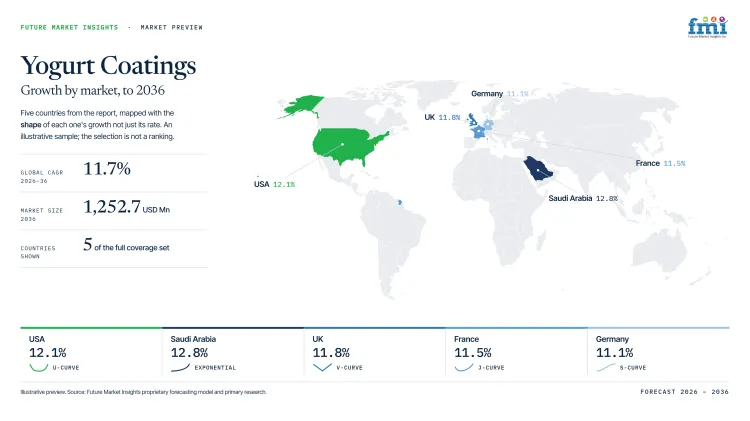
| Country | CAGR |
|---|---|
| United Arab Emirates | 13.1% |
| Saudi Arabia | 12.8% |
| South Korea | 12.4% |
| United States | 12.1% |
| United Kingdom | 11.8% |
How do country-level CAGRs compare in the Yogurt Coatings Market?
The 1.3 percentage-point spread between United Arab Emirates and United Kingdom keeps all five markets within one growth band. Gulf markets form the upper tier as import registration rewards prepared documentation and distributor execution. South Korea occupies the middle position as bakery experimentation raises the need for substrate-specific application work.
- UAE leads as Dubai registration volume rewards complete import files and temperature-stable samples from distributors.
- Saudi Arabia follows as hot logistics raise formulation demands for dairy-style coatings across distribution networks.
- South Korea sits mid-band as floury-rice programs increase substrate-specific coating trials across commercial bakery chains.
- United States growth reflects bakery scale although nutrition reformulation extends approval cycles for coating formulas.
- United Kingdom growth remains close as promotion rules increase retailer scrutiny of richer coated products.
The full report provides country-level CAGR analysis across North America, Latin America, Europe, East Asia, South Asia, Oceania and the Middle East and Africa.
Country-wise Analysis
- Dubai importers route large food volumes through registration systems that place document quality beside sample performance during retailer and distributor evaluation. United Arab Emirates is projected to grow at 13.1% CAGR through 2036 as experienced Gulf distributors shorten approval work for repeat bakery programs. In January 2026, Dubai Municipality reported inspecting 579,913 food consignments containing about 1,947,200 products during 2025 across the emirate's control system. Heat exposure and registration mismatches remain material frictions, so entrants need temperature-managed samples and local warehousing that matches filed storage specifications for national bakery accounts approving repeat orders across major retail programs.
- Saudi bakery importers rely on local distributors to prepare Arabic labels and align ingredient files for shipments entering large urban bakery accounts. Hot logistics increase the value of stable non-hydrogenated fats and controlled samples for richer dairy-style coatings during commercial trials and seasonal promotions. The Ministry of Health reported in May 2026 that bread supplies 40% of daily salt intake across the national diet, reinforcing nutrition scrutiny around bakery formulas. Saudi Arabia is forecast to expand at 12.8% CAGR through 2036 as documented reformulation support and experienced distributors reduce qualification risk for recurring imports and large retailer programs nationwide.
- Korean bakery developers working across the yogurt category increasingly validate coatings against reformulated substrates as floury-rice breads can change adhesion and moisture transfer from standard wheat formulas. MAFRA reported in April 2025 that 30 bakeries participated in its floury-rice recipe program, developing 120 new kinds of floury-rice breads and confections, giving application teams a broad base for substrate-specific trials and regional sensory work. Yogurt coatings demand in South Korea is forecast to rise at 12.4% CAGR through 2036 as frequent bakery experimentation sustains new product work across urban chains. Entrants need disciplined allergen records and separate performance checks across each bakery base and retail format during commercial scale-up.
- Large American bakeries qualify coatings on automated finishing lines that serve national retail and foodservice programs with repeat-volume production schedules. The United States is projected to record 12.1% CAGR through 2036 as direct technical relationships support recurring trials for dairy-style finishes and national launches. USDA NASS reported in May 2026 that USA flour production reached 419 million hundredweight during 2025, confirming the scale of commercial baking inputs moving through domestic plants. Nutrition reformulation can change coating set and viscosity, so coating formulators using dairy ingredient systems need documented calculations and plant trials for national rollout of revised formulas across major retail accounts.
- United Kingdom bakeries increasingly face retailer reviews that assess richer coated products against promotion rules covering foods high in fat, salt or sugar. National manufacturing depth gives coating developers a practical base for repeat trials and lower-sugar prototypes across major bakery accounts and convenience channels. Yogurt coatings demand in the United Kingdom is forecast to expand at 11.8% CAGR through 2036 as those established plants support recurring programs. The Department of Health and Social Care updated its HFSS promotion impact assessment in October 2025. Retailer nutrition gates continue to require clear portion assumptions and verified line performance for national listings.
Who are the notable companies in the Yogurt Coatings Market?
Cargill, AAK, Barry Callebaut, Puratos, Corbion, Arla Foods Ingredients, FrieslandCampina Ingredients and IFF are the notable companies serving this market.
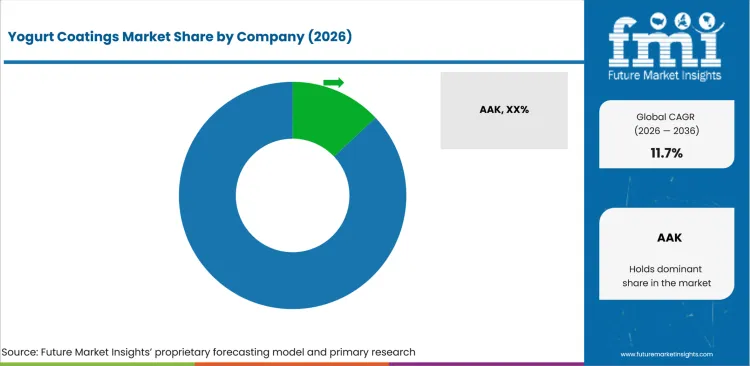
Competition spans compound coatings and specialty fats alongside dairy ingredients and bakery application support for industrial finishing programs. Cargill and Barry Callebaut cover compound-style coatings while AAK concentrates on functional fats that control heat response and set. Puratos and Corbion support bakery processing through technical centers while Arla Foods Ingredients and FrieslandCampina Ingredients provide dairy functionality. IFF supplies flavor application support while entry barriers rise for companies lacking plant-level evidence or dependable specialty-fat and dairy access.
- Coating and fat platforms include Cargill, AAK and Barry Callebaut with direct relevance to melting behavior and compound-style coating performance.
- Bakery application specialists include Puratos and Corbion with technical centers that support commercial formulation and processing work across finished bakery programs.
- Dairy and flavor formulation inputs include Arla Foods Ingredients, FrieslandCampina Ingredients and IFF with application support for cultured sensory positioning.
Competitive Benchmarking: Yogurt Coatings Market
| Company | Coating & Fat Platform | Cultured-Dairy Formulation | Bakery Application Support | Geographic Reach |
|---|---|---|---|---|
| Cargill | High | High | High | Global |
| AAK | High | Medium | High | Europe, Americas and Asia-Pacific |
| Barry Callebaut | High | Low | High | Global |
| Puratos | High | Low | High | 100+ countries |
| Corbion | Medium | Low | High | Americas, Europe and Asia-Pacific |
| Arla Foods Ingredients | Low | High | High | Europe, Americas and Asia-Pacific |
| FrieslandCampina Ingredients | Low | High | Medium | Europe, North America and international sales |
| IFF | Medium | High | High | Global |
Scoring basis: High coating-platform depth requires several verified routes, Medium requires one direct route and Low records adjacent activity. High cultured-dairy depth requires several dairy routes, Medium requires one and Low records adjacent formulation evidence. High bakery support requires dedicated multi-use infrastructure, Medium reflects narrower support and Low records limited application work. Geographic reach reflects documented commercial or application operations across the regions listed for each company.
Key Developments in the Yogurt Coatings Market
- In May 2026, IFF opened a Vanilla Innovation Center in Madagascar with an application laboratory supporting dairy and bakery prototypes plus confectionery work.
- In February 2026, Barry Callebaut opened its Singapore Global Innovation Center with the company’s first Cacao Coatings Center of Excellence for compound development.
- In October 2025, AAK entered a joint venture with KLK to build a Malaysian plant for specialty palm fractions used in cocoa butter alternatives.
Key Players in the Yogurt Coatings Market
Coating and Specialty-Fat Platforms
- Cargill
- AAK
- Barry Callebaut
Bakery Application Specialists
- Puratos
- Corbion
Dairy and Flavor Formulation Specialists
- Arla Foods Ingredients
- FrieslandCampina Ingredients
- IFF
Yogurt Coatings Market - Report Scope
| Coverage field | Report scope |
|---|---|
| Market breakdown | By product type, form, application, claim, sales channel and region. |
| Quantitative Units | USD million. |
| Market Definition | Edible yogurt-style or yogurt-containing coating systems used across industrial bakery and snack applications. |
| Regions Covered | North America, Latin America, Europe, East Asia, South Asia and Pacific and Middle East and Africa. |
| Countries Covered | United Arab Emirates, Saudi Arabia, South Korea, United States, United Kingdom and 20+ countries included in the full report. |
| Key Companies Profiled | Cargill, AAK, Barry Callebaut, Puratos, Corbion, Arla Foods Ingredients, FrieslandCampina Ingredients, IFF. |
| Forecast Period | 2026 to 2036. |
| Approach | Primary and secondary research with market triangulation. |
Yogurt Coatings Market - Research Methodology
| Method | Approach |
|---|---|
| Primary Research | FMI analysts gathered input from manufacturers, service providers, technology developers, distributors, end users, procurement teams, and subject-matter experts. Interviews examined purchasing decisions, product or service evaluation, adoption barriers, approval requirements, pricing considerations, and expectations for technical or commercial support. Respondents were also asked what evidence is required before a trial, pilot, or initial order develops into regular purchasing. |
| Desk Research | Desk research covered government statistics, regulatory publications, trade data, industry associations, technical literature, standards, company filings, product information, and official corporate announcements. Sources were reviewed for relevance, publication date, geographic coverage, and consistency with the defined market scope. Claims relating to performance, applications, approvals, capacity, investment, and commercial activity were retained only when supported by credible public evidence. |
| Market Sizing and Forecasting | The market model combined the baseline value with historical performance, segment structure, pricing and volume indicators, adoption levels, company participation, and country-level demand conditions. Forecast assumptions considered economic activity, investment trends, regulatory developments, technology adoption, purchasing cycles, supply availability, and barriers to wider market use. Segment and regional estimates were reconciled before the final market total was calculated. |
| Data Validation | Estimates were checked against multiple independent indicators, including public data, company activity, trade patterns, industry developments, and findings from primary interviews. Validation also tested whether products, services, applications, and company revenues fell within the defined market boundaries. Adjacent categories, unsupported claims, overlapping revenues, and activities without direct market relevance were excluded to reduce double counting and maintain consistency across segments and countries. |
Yogurt Coatings Market by Segments
Yogurt Coatings Market segmented by Product Type:
- Standard grade
- Premium / specialty grade
- Organic certified
- Clean label grade
Yogurt Coatings Market segmented by Form:
- Powder / dry
- Liquid
- Paste / semi-solid
- Granules / pieces
Yogurt Coatings Market segmented by Application:
- Bread & rolls
- Cakes & muffins
- Biscuits & cookies
- Viennoiserie & pastry
- Other bakery & snacks
Yogurt Coatings Market segmented by Claim:
- Conventional
- Clean label
- Organic
- Non-GMO / identity preserved
Yogurt Coatings Market segmented by Sales Channel:
- Direct to industrial bakeries
- Ingredient distributors
- Foodservice & artisan supply
- Online B2B
Yogurt Coatings Market by Region:
- North America
- United States
- Canada
- Latin America
- Brazil
- Mexico
- Chile
- Rest of Latin America
- Western Europe
- Germany
- United Kingdom
- Italy
- Spain
- France
- Nordics
- Benelux
- Rest of Western Europe
- Eastern Europe
- Russia
- Poland
- Hungary
- Balkan and Baltic States
- Rest of Eastern Europe
- East Asia
- China
- Japan
- South Korea
- South Asia and Pacific
- India
- ASEAN
- Australia and New Zealand
- Rest of South Asia and Pacific
- Middle East and Africa
- Kingdom of Saudi Arabia
- Other GCC Countries
- Türkiye
- South Africa
- Other African Union Countries
- Rest of Middle East and Africa
Research Sources and Bibliography
- Cargill. (2025, April 10). Cargill unveils transformed Innovation Center in Singapore to advance food innovation, for Asia from Asia.
- Ministry of Agriculture and Food Sovereignty, France. (2025, March 14). Nutri-Score : signature de l’arrêté tout en demandant une démarche d’amélioration continue du dispositif.
- Cargill. (2026, March 31). Cargill strengthens global specialty fats portfolio with expansion of Port Klang, Malaysia facility.
- Cargill. (2026, January 28). Cargill invests to expand Beijing plant.
- Corbion. (2025, September 2). Corbion leads clean-label reformulation forward at IBIE 2025.
- Puratos. (2025, August 25). Puratos announces two new hubs for food innovation: Montreal and Costa Rica.
- American Bakers Association. (2025, September 25). ABA Celebrated Industry Leadership and Innovation, Highlighting Workforce, Research, and Policy for a United Baking Industry at IBIE.
- USA Food and Drug Administration. (2025, January 14). FDA Issues Proposed Rule on Front-of-Package Nutrition Labeling.
- Organic Trade Association. (2026, March 18). Organic Market Report 2026.
- Dubai Municipality. (2026, January 26). Innovative digital food safety services at Gulfood 2026.
- Ministry of Health, Saudi Arabia. (2026, May 24). Salt.
- Ministry of Agriculture, Food and Rural Affairs, Republic of Korea. (2025, April 2). Invigorating the Floury Rice Industry: a Win-Win Situation for Both Bakeries and Farmers.
- USA Department of Agriculture, National Agricultural Statistics Service. (2026, May 1). Flour Milling Products 2025 Summary.
- Department of Health and Social Care. (2025, October 1). Restricting volume price promotions of HFSS products.
- IFF. (2026, May 11). IFF opens Vanilla Innovation Center in Madagascar.
- Barry Callebaut. (2026, February 10). Barry Callebaut Opens Global Innovation Center in Singapore, Pioneering the Future of Chocolate Through AI and Advanced Innovation.
- AAK. (2025, October 24). AAK strengthens supply of specialty palm fractions.
- Cargill. (2026, May 12). Cargill and Voyage Foods to bring NextCoa™ cocoa-free confectionery alternatives to North America.
- AAK. (2026, May 13). AAK is first to achieve Gold status in coconut sustainability audit.
- Barry Callebaut. (2025, November 5). Barry Callebaut and Planet A Foods Partner to Pioneer Sustainable Chocolate Alternatives Without Cocoa.
- Puratos. (2026, February 24). Puratos Launches World’s First Professional Chocolate with Cultured Cocoa.
- Corbion. (2026, June 15). Corbion launches LUMI™ Set to help bakers reformulate away from titanium dioxide without sacrificing visual appeal.
- Arla Foods Ingredients. (2025, June 3). Arla Foods Ingredients and MasterSense sign new distribution agreement for Chilean market.
- FrieslandCampina Ingredients. (2026, May 15). FrieslandCampina Ingredients opens new North America Application Center to support the development of protein and prebiotic solutions.
- IFF. (2026, June 23). IFF launches first-of-its-kind stabilizer system in Europe, the Middle East and Africa.
- AAK. (2026, April 13). AAK publishes Annual Report 2025
This bibliography is provided for reader reference and is not exhaustive. The full report contains the complete reference list and detailed citations.
This Report Answers
- How large is the yogurt coatings market in 2026 and what value is forecast for 2036?
- Which operating conditions support yogurt coating demand across industrial bakery applications?
- Why does standard grade hold the largest product type share in 2026?
- Why do powder / dry formats fit centralized premix and storage workflows?
- How do national growth rates differ across the five profiled yogurt coatings markets?
- Which formulation constraints can delay coating approval after sugar or fat reformulation?
- Which companies provide coating, dairy and bakery application support within the competitive field?
- What commercial factors should industrial bakeries assess beyond the quoted ingredient price?
Frequently Asked Questions
How big is the Yogurt Coatings Market in 2026?
The yogurt coatings market is expected to be valued at USD 414.3 million in 2026 and is forecast to reach USD 1252.7 million by 2036. Industrial bakery adoption depends on cultured-dairy differentiation that preserves normal coating-line performance during full production and packing.
What is the CAGR of the Yogurt Coatings Market from 2026 to 2036?
The yogurt coatings market is projected to grow at an 11.7% CAGR between 2026 and 2036. Bakery differentiation supports expansion while nutrition reformulation and plant qualification continue to lengthen selected commercial approvals.
Which product type leads the Yogurt Coatings Market?
The standard grade segment is expected to hold 44.0% of the yogurt coatings market in 2026, driven by broad formulation flexibility. Its position also reflects easier qualification on established industrial coating equipment across repeat-volume bakery programs.
Which claim is projected to grow at the fastest pace in the Yogurt Coatings Market?
The claim segmentation does not carry a supported CAGR ranking for 2026 to 2036 within the yogurt coatings market forecast. Conventional holds 47.0% of claim demand in 2026, but current share cannot establish which claim grows fastest.
Which companies are active in the Yogurt Coatings Market?
Key companies in the yogurt coatings market include Cargill, AAK, Barry Callebaut, Puratos, Corbion, Arla Foods Ingredients, FrieslandCampina Ingredients and IFF. Their roles cover compound coatings and specialty fats alongside dairy ingredients and bakery application support.
Preview the report firsthand - request a free sample
Get SampleGet the brochure for pricing and purchase details.
Get PDFTable of Content
- Key Takeaways
- Market Size and CAGR
- Top Growth Driver
- Fastest Growing Segment
- Leading Region
- Key Companies
- Emerging Opportunities
- Executive Summary
- Global Market Outlook
- Demand-side Trends
- Supply-side Trends
- Technology Roadmap Analysis
- Analysis and Recommendations
- Analyst Perspective (What is happening? Why now? What should investors know?)
- Key Questions Answered
- How large is the market?
- What is the CAGR?
- What are key trends?
- Which region dominates?
- Who are the leaders?
- Market Overview
- Market Coverage / Taxonomy
- Market Definition / Scope / Limitations
- Research Methodology
- Chapter Orientation
- Analytical Lens and Working Hypotheses
- Market Structure, Signals, and Trend Drivers
- Benchmarking and Cross-market Comparability
- Market Sizing, Forecasting, and Opportunity Mapping
- Research Design and Evidence Framework
- Desk Research Programme (Secondary Evidence)
- Expert Input and Fieldwork (Primary Evidence)
- Tooling, Models, and Reference Databases
- Data Engineering and Model Build
- Quality Assurance and Audit Trail
- Market Background
- Market Dynamics (Drivers, Restraints, Opportunity, Trends)
- Scenario Forecast (Optimistic, Likely, Conservative)
- Impact Analysis
- AI Impact
- Sustainability Impact
- Regulatory Impact
- Technology Impact
- Consumer / Buyer Analysis
- Purchase Drivers
- Adoption Barriers
- Buyer Journey
- Opportunity Map Analysis
- Product Life Cycle Analysis
- Supply Chain Analysis
- Investment Feasibility Matrix
- Value Chain Analysis
- PESTLE and Porter's Analysis
- Regulatory Landscape
- Regional Parent Market Outlook
- Production and Consumption Statistics
- Import and Export Statistics
- Global Market Analysis and Forecast, 2021 to 2036
- Historical Market Size Value (USD Million) Analysis, 2021 to 2025
- Current and Future Market Size Value (USD Million) Projections, 2026 to 2036
- Y-o-Y Growth Trend Analysis
- Absolute $ Opportunity Analysis
- Global Market Pricing Analysis, 2021 to 2036
- Global Market Analysis and Forecast, By Product Type, 2021 to 2036
- Introduction / Key Findings
- Historical Market Size Value (USD Million) Analysis By Product Type, 2021 to 2025
- Current and Future Market Size Value (USD Million) Analysis and Forecast By Product Type, 2026 to 2036
- Standard grade
- Premium / specialty grade
- Organic certified
- Clean label grade
- Standard grade
- Y-o-Y Growth Trend Analysis By Product Type, 2021 to 2025
- Absolute $ Opportunity Analysis By Product Type, 2026 to 2036
- Global Market Analysis and Forecast, By Form, 2021 to 2036
- Introduction / Key Findings
- Historical Market Size Value (USD Million) Analysis By Form, 2021 to 2025
- Current and Future Market Size Value (USD Million) Analysis and Forecast By Form, 2026 to 2036
- Powder / dry
- Liquid
- Paste / semi-solid
- Granules / pieces
- Powder / dry
- Y-o-Y Growth Trend Analysis By Form, 2021 to 2025
- Absolute $ Opportunity Analysis By Form, 2026 to 2036
- Global Market Analysis and Forecast, By Application, 2021 to 2036
- Introduction / Key Findings
- Historical Market Size Value (USD Million) Analysis By Application, 2021 to 2025
- Current and Future Market Size Value (USD Million) Analysis and Forecast By Application, 2026 to 2036
- Bread & rolls
- Cakes & muffins
- Biscuits & cookies
- Viennoiserie & pastry
- Other bakery & snacks
- Bread & rolls
- Y-o-Y Growth Trend Analysis By Application, 2021 to 2025
- Absolute $ Opportunity Analysis By Application, 2026 to 2036
- Global Market Analysis and Forecast, By Claim, 2021 to 2036
- Introduction / Key Findings
- Historical Market Size Value (USD Million) Analysis By Claim, 2021 to 2025
- Current and Future Market Size Value (USD Million) Analysis and Forecast By Claim, 2026 to 2036
- Conventional
- Clean label
- Organic
- Non-GMO / identity preserved
- Conventional
- Y-o-Y Growth Trend Analysis By Claim, 2021 to 2025
- Absolute $ Opportunity Analysis By Claim, 2026 to 2036
- Global Market Analysis and Forecast, By Sales Channel, 2021 to 2036
- Introduction / Key Findings
- Historical Market Size Value (USD Million) Analysis By Sales Channel, 2021 to 2025
- Current and Future Market Size Value (USD Million) Analysis and Forecast By Sales Channel, 2026 to 2036
- Direct to industrial bakeries
- Ingredient distributors
- Foodservice & artisan supply
- Online B2B
- Direct to industrial bakeries
- Y-o-Y Growth Trend Analysis By Sales Channel, 2021 to 2025
- Absolute $ Opportunity Analysis By Sales Channel, 2026 to 2036
- Global Market Analysis and Forecast, By Region, 2021 to 2036
- Introduction
- Historical Market Size Value (USD Million) Analysis By Region, 2021 to 2025
- Current Market Size Value (USD Million) Analysis and Forecast By Region, 2026 to 2036
- North America
- Latin America
- Western Europe
- Eastern Europe
- East Asia
- South Asia and Pacific
- Middle East & Africa
- Market Attractiveness Analysis By Region
- North America Market Analysis and Forecast, By Country, 2021 to 2036
- Historical Market Size Value (USD Million) Trend Analysis By Market Taxonomy, 2021 to 2025
- Market Size Value (USD Million) Forecast By Market Taxonomy, 2026 to 2036
- By Country
- USA
- Canada
- By Product Type
- By Form
- By Application
- By Claim
- By Sales Channel
- By Country
- Market Attractiveness Analysis
- By Country
- By Product Type
- By Form
- By Application
- By Claim
- By Sales Channel
- Key Takeaways
- Latin America Market Analysis and Forecast, By Country
- Historical Market Size Value (USD Million) Trend Analysis By Market Taxonomy, 2021 to 2025
- Market Size Value (USD Million) Forecast By Market Taxonomy, 2026 to 2036
- By Country
- Brazil
- Mexico
- Chile
- Rest of Latin America
- By Product Type
- By Form
- By Application
- By Claim
- By Sales Channel
- By Country
- Market Attractiveness Analysis
- By Country
- By Product Type
- By Form
- By Application
- By Claim
- By Sales Channel
- Key Takeaways
- Western Europe Market Analysis and Forecast, By Country
- Historical Market Size Value (USD Million) Trend Analysis By Market Taxonomy, 2021 to 2025
- Market Size Value (USD Million) Forecast By Market Taxonomy, 2026 to 2036
- By Country
- Germany
- UK
- Italy
- Spain
- France
- Nordic
- BENELUX
- Rest of Western Europe
- By Product Type
- By Form
- By Application
- By Claim
- By Sales Channel
- By Country
- Market Attractiveness Analysis
- By Country
- By Product Type
- By Form
- By Application
- By Claim
- By Sales Channel
- Key Takeaways
- Eastern Europe Market Analysis and Forecast, By Country
- Historical Market Size Value (USD Million) Trend Analysis By Market Taxonomy, 2021 to 2025
- Market Size Value (USD Million) Forecast By Market Taxonomy, 2026 to 2036
- By Country
- Russia
- Poland
- Hungary
- Balkan & Baltic
- Rest of Eastern Europe
- By Product Type
- By Form
- By Application
- By Claim
- By Sales Channel
- By Country
- Market Attractiveness Analysis
- By Country
- By Product Type
- By Form
- By Application
- By Claim
- By Sales Channel
- Key Takeaways
- East Asia Market Analysis and Forecast, By Country
- Historical Market Size Value (USD Million) Trend Analysis By Market Taxonomy, 2021 to 2025
- Market Size Value (USD Million) Forecast By Market Taxonomy, 2026 to 2036
- By Country
- China
- Japan
- South Korea
- By Product Type
- By Form
- By Application
- By Claim
- By Sales Channel
- By Country
- Market Attractiveness Analysis
- By Country
- By Product Type
- By Form
- By Application
- By Claim
- By Sales Channel
- Key Takeaways
- South Asia and Pacific Market Analysis and Forecast, By Country
- Historical Market Size Value (USD Million) Trend Analysis By Market Taxonomy, 2021 to 2025
- Market Size Value (USD Million) Forecast By Market Taxonomy, 2026 to 2036
- By Country
- India
- ASEAN
- Australia & New Zealand
- Rest of South Asia and Pacific
- By Product Type
- By Form
- By Application
- By Claim
- By Sales Channel
- By Country
- Market Attractiveness Analysis
- By Country
- By Product Type
- By Form
- By Application
- By Claim
- By Sales Channel
- Key Takeaways
- Middle East & Africa Market Analysis and Forecast, By Country
- Historical Market Size Value (USD Million) Trend Analysis By Market Taxonomy, 2021 to 2025
- Market Size Value (USD Million) Forecast By Market Taxonomy, 2026 to 2036
- By Country
- Kingdom of Saudi Arabia
- Other GCC Countries
- Türkiye
- South Africa
- Other African Union
- Rest of Middle East & Africa
- By Product Type
- By Form
- By Application
- By Claim
- By Sales Channel
- By Country
- Market Attractiveness Analysis
- By Country
- By Product Type
- By Form
- By Application
- By Claim
- By Sales Channel
- Key Takeaways
- Key Countries Market Analysis
- USA
- Pricing Analysis
- Market Share Analysis, 2025
- By Product Type
- By Form
- By Application
- By Claim
- By Sales Channel
- Canada
- Pricing Analysis
- Market Share Analysis, 2025
- By Product Type
- By Form
- By Application
- By Claim
- By Sales Channel
- Mexico
- Pricing Analysis
- Market Share Analysis, 2025
- By Product Type
- By Form
- By Application
- By Claim
- By Sales Channel
- Brazil
- Pricing Analysis
- Market Share Analysis, 2025
- By Product Type
- By Form
- By Application
- By Claim
- By Sales Channel
- Chile
- Pricing Analysis
- Market Share Analysis, 2025
- By Product Type
- By Form
- By Application
- By Claim
- By Sales Channel
- Germany
- Pricing Analysis
- Market Share Analysis, 2025
- By Product Type
- By Form
- By Application
- By Claim
- By Sales Channel
- UK
- Pricing Analysis
- Market Share Analysis, 2025
- By Product Type
- By Form
- By Application
- By Claim
- By Sales Channel
- Italy
- Pricing Analysis
- Market Share Analysis, 2025
- By Product Type
- By Form
- By Application
- By Claim
- By Sales Channel
- Spain
- Pricing Analysis
- Market Share Analysis, 2025
- By Product Type
- By Form
- By Application
- By Claim
- By Sales Channel
- France
- Pricing Analysis
- Market Share Analysis, 2025
- By Product Type
- By Form
- By Application
- By Claim
- By Sales Channel
- India
- Pricing Analysis
- Market Share Analysis, 2025
- By Product Type
- By Form
- By Application
- By Claim
- By Sales Channel
- ASEAN
- Pricing Analysis
- Market Share Analysis, 2025
- By Product Type
- By Form
- By Application
- By Claim
- By Sales Channel
- Australia & New Zealand
- Pricing Analysis
- Market Share Analysis, 2025
- By Product Type
- By Form
- By Application
- By Claim
- By Sales Channel
- China
- Pricing Analysis
- Market Share Analysis, 2025
- By Product Type
- By Form
- By Application
- By Claim
- By Sales Channel
- Japan
- Pricing Analysis
- Market Share Analysis, 2025
- By Product Type
- By Form
- By Application
- By Claim
- By Sales Channel
- South Korea
- Pricing Analysis
- Market Share Analysis, 2025
- By Product Type
- By Form
- By Application
- By Claim
- By Sales Channel
- Russia
- Pricing Analysis
- Market Share Analysis, 2025
- By Product Type
- By Form
- By Application
- By Claim
- By Sales Channel
- Poland
- Pricing Analysis
- Market Share Analysis, 2025
- By Product Type
- By Form
- By Application
- By Claim
- By Sales Channel
- Hungary
- Pricing Analysis
- Market Share Analysis, 2025
- By Product Type
- By Form
- By Application
- By Claim
- By Sales Channel
- Kingdom of Saudi Arabia
- Pricing Analysis
- Market Share Analysis, 2025
- By Product Type
- By Form
- By Application
- By Claim
- By Sales Channel
- Türkiye
- Pricing Analysis
- Market Share Analysis, 2025
- By Product Type
- By Form
- By Application
- By Claim
- By Sales Channel
- South Africa
- Pricing Analysis
- Market Share Analysis, 2025
- By Product Type
- By Form
- By Application
- By Claim
- By Sales Channel
- USA
- Market Structure Analysis
- Competition Dashboard
- Competition Benchmarking
- Market Share Analysis of Top Players
- By Regional
- By Product Type
- By Form
- By Application
- By Claim
- By Sales Channel
- Emerging Startups
- Innovation Benchmarking
- Competition Analysis
- Competition Deep Dive
- AAK
- Overview
- Product Portfolio
- Profitability by Market Segments
- Sales Footprint
- Strategy Overview
- Marketing Strategy
- Product Strategy
- Channel Strategy
- Bunge
- Cargill
- Fuji Oil Holdings
- Wilmar International
- Lactalis Ingredients
- FrieslandCampina Ingredients
- Arla Foods Ingredients
- Michael Foods
- Corbion
- AAK
- Case Studies
- Success Stories
- Recent Developments
- Competition Deep Dive
- Assumptions & Acronyms Used


