

- Market Size (2026)
- USD 360.6 Mn
- Forecast (2036)
- USD 722.7 Mn
- CAGR (2026 to 2036)
- 7.2%
How big is Zip Chain Lifter Market in 2026?
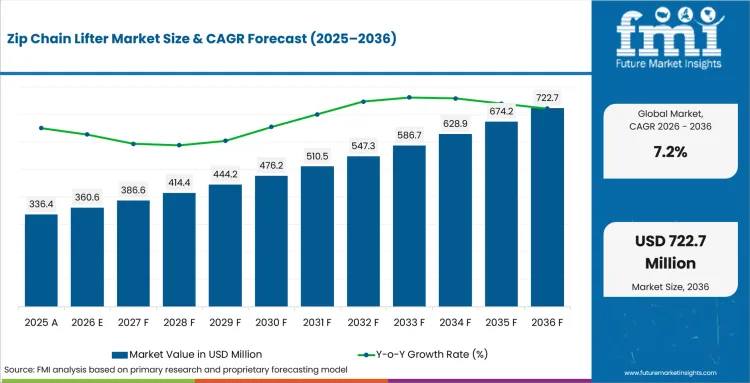
USD 360.6 million in 2026 and USD 722.7 million by 2036 at a 7.2% CAGR.
Zip chain lifter sales are projected to rise at a 7.2% CAGR during the forecast period, with market value increasing from USD 360.6 million in 2026 to USD 722.7 million by 2036. Demand is supported by the ability of stored-chain columns to reduce installation depth beneath lifting tables and replace hydraulic infrastructure in space-sensitive production machinery. Reflecting this focus on compact and electrically driven lifting solutions, Tsubakimoto Korea showcased its ZIP Chain Actuators alongside reducers and electric linear actuators at Smart Factory + Automation World in March 2025.
Commercial adoption depends on a complete package that defines guidance and braking responsibility beyond the chain column. Wippermann stated in March 2026 that Marathon Lift supports precise movement through maintenance-free chain technology for demanding packaging machinery. The disclosure connects factory automation controls with clear commissioning ownership and service planning across repeated equipment programs.
Key Takeaways of Zip Chain Lifter Market
- Stored-chain motion reduces pit depth and hydraulic infrastructure across space-limited machinery requiring repeatable vertical positioning.
- Vertical zip chain lifters are projected to represent 38.0% share in 2026 through repeatable platform alignment.
- The 1-3 m lift-height band is estimated to account for 48.0% share in 2026 across common equipment clearances.
- The 250-1,000 kg range is forecast to capture 41.0% share in 2026 across standard fixtures and pallets.
- Complete-machine validation remains a restraint as guidance and braking responsibilities often span several engineering teams.
- Tsubakimoto Chain and SERAPID serve multi-region projects through proprietary platforms and established application engineering teams. Framo Morat and GROB Antriebstechnik address configured systems, Wippermann supports compact platforms across industrial and stage applications.
Analyst Perspective
“Compact lifting earns repeat orders only when guidance and braking remain consistent across the complete duty cycle. Machinery builders that standardize interfaces and service access reduce repeated engineering across related equipment programs.”
- Nikhil Kaitwade, Principal Consultant, Future Market Insights
How is the Zip Chain Lifter Market segmented?
The zip chain lifter industry is segmented by lifter type and lift height. The assessment also covers load rating, application and end use across each region.
The taxonomy separates five commercial filters that determine system fit and engineering responsibility across the complete lifting package. Lifter type defines motion architecture, lift height and load rating establish the physical operating duty. Application identifies the production task, end use and regional coverage distinguish approval conditions from local service access across automated material handling systems.
What makes vertical zip chain lifters central to the lifter type category?
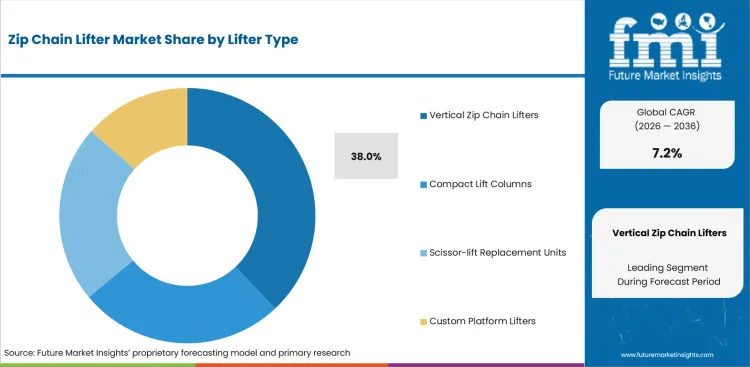
Vertical units place the interlocking chain beneath a lifting table and avoid full-stroke cylinders below the platform. Tsubaki documents high-speed travel and multipoint stopping for repeated production movement inside limited installation depth.
- Vertical zip chain lifters are projected to hold 38.0% share in 2026 owing to familiar platform geometry and compact drive placement.
- Machine builders favor vertical units for repeat production paths without deeper foundations, accessible drives support scheduled maintenance without dismantling adjacent guarding.
Why does the 1-3 m segment hold the strongest lift height position?
The 1-3 m band covers common conveyor clearances and mezzanine transfers inside established buildings without extensive building modifications. This balance supports planned warehouse robotics upgrades although added guidance remains necessary for longer vertical travel.
- Based on lift height the 1-3 m segment is estimated to account for 48.0% share in 2026 as practical retrofit distances support its position across existing production layouts.
- Integrators use the 1-3 m range across related machines with comparable vertical travel because compact chain storage limits foundation work and preserves service access across phased equipment programs.
How does the 250-1,000 kg segment shape the load rating category?
The 250-1,000 kg band covers fixtures and pallets beyond light actuator duties without specialized heavy-lift architecture, standard drives serve recurring payloads across related material handling equipment.
- By load rating, the 250-1,000 kg segment is forecast to represent 41.0% share in 2026, driven by standard production payloads and practical safety margins.
- Production engineers select this band for carriers beside machining and assembly stations as synchronized drives support wider platforms and common motors simplify spare-parts planning across related cells.
What supports workpiece positioning within the application category?
Workpiece positioning raises fixtures to a programmed height and preserves a stable reference during machining or inspection. Repeatable settling helps robots and motion controllers retain alignment across changing production recipes during scheduled equipment changeovers.
- By application, workpiece positioning is projected to capture 28.0% share in 2026, supported by direct links between transfer and processing operations across automated production cells.
- SERAPID documents sub-millimeter positioning for rigid-chain systems used across precision fixtures and industrial machinery which supports repeatable height recipes without manual setup between scheduled production changes.
Why does industrial automation anchor the end use category?
Industrial automation requires lifting devices that communicate with line controls and repeat programmed movement across long duty cycles, compact chain storage supports integration beneath robot and conveyor fixtures.
- Industrial automation is estimated to hold 34.0% share in 2026, underpinned by repeated positioning requirements across production cells and standard interfaces that allow integrators to reuse verified safety logic across equipment platforms.
- System integrators place chain lifters beneath transfer platforms that coordinate with automated material handling equipment, reusable guarding and control logic shorten commissioning across cells with comparable loads.
What are the drivers, restraints, and opportunities in the Zip Chain Lifter Market?
Compact oil-free motion supports adoption. Complete-machine validation delays approvals. Modular platforms reduce repeated engineering across related equipment families.
- Driver: Oil-free stored-chain motion protects limited installation space and contamination-sensitive processes across automated production equipment programs.
- Restraint: Complete-machine approval extends whenever guidance and braking responsibilities remain divided across several engineering teams.
- Opportunity: Standardized chain modules reduce repeated engineering across equipment families sharing comparable payload and travel requirements.
Oil-free chain motion suits paint lines and laboratories that cannot accept hydraulic leakage near sensitive materials, stored-chain geometry reduces site preparation inside compact machinery layouts.
Approval slows as the chain column remains only one component inside a complete lifting machine. Designers must validate platform guidance and braking across every load case before regular equipment operation begins.
Modular platforms let manufacturers reuse verified motion units across related machine sizes because common interfaces preserve visible travel limits and simplify service planning across repeated equipment programs.
Which country CAGRs are profiled in the zip chain lifter market?
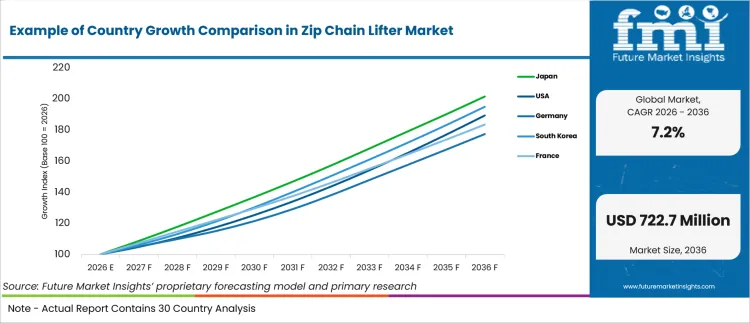
| Country | CAGR |
|---|---|
| Japan | 7.3% |
| South Korea | 6.9% |
| United States | 6.6% |
| France | 6.2% |
| Germany | 5.9% |
How do country-level CAGRs compare in the Zip Chain Lifter Market?
The country forecasts span 1.4 percentage points and show gradual variation across the assessment period as compact production layouts support Japan and South Korea. Regional integrator networks shape United States projects whereas France and Germany rely on formal machinery qualification and specialist application support.
- Japan remains 0.4 percentage point above South Korea through compact machinery layouts and established motion-engineering access.
- South Korea remains 0.3 percentage point above the United States across electronics and automotive automation programs.
- The United States stays 0.4 percentage point above France as regional integrators coordinate mechanical and controls responsibilities.
- France remains 0.3 percentage point above Germany through industrial and stage applications requiring configured lifting systems.
- Germany closes the displayed range through documented load performance and conformity files across customized machinery projects.
Country economics vary as engineering coverage and commissioning responsibility differ across operating markets and equipment programs. Full report coverage includes North America and Latin America alongside Europe, East Asia and the Pacific. The assessment also covers the Middle East and Africa through detailed country-level and regional demand analysis.
Country-wise Analysis
- Japanese machinery programs prioritize compact layouts as demand expands across automotive and electronics production. Japan is projected to record a 7.3% CAGR through 2036, driven by automotive and electronics production. The International Federation of Robotics reported in July 2025 that Japanese automotive plants installed about 13,000 industrial robots during 2024 with an 11% annual increase. Domestic engineering supports commissioning across regional production clusters, customized platforms require documented cycle-life evidence before repeat deployment.
- South Korean factories combine dense electronics production with compact vertical motion. South Korea is estimated to grow at a 6.9% CAGR through 2036, supported by established automotive and electronics manufacturing networks. World Robotics 2025 reported 30,600 industrial robot installations during 2024 across major production bases. Smaller machinery builders face capacity limits for safety validation and regional field service coverage across several operating regions.
- United States projects divide mechanical design and controls work among regional integrators. The United States is anticipated to register a 6.6% CAGR through 2036, underpinned by expanding industrial automation and machinery installation activity. The International Federation of Robotics reported in June 2026 that domestic industrial robot installations reached 38,000 units during 2025 after increasing 11% annually. Dispersed facilities require explicit ownership of commissioning and service responsibilities across machinery builders and regional controls contractors.
- French industrial and stage projects require formal machinery approval. France is forecast to advance at a 6.2% CAGR through 2036, aided by ongoing robotics and automation project investments. The French Ministry of Economy announced 31 robotics and drone projects in June 2026 across 60 companies and laboratories. Local engineering supports configured systems, limited specialist installation capacity often extends testing and maintenance planning.
- German projects place conformity evidence beside load performance. Germany is expected to expand at a 5.9% CAGR through 2036, reinforced by the country's established industrial automation base. World Robotics 2025 reported 26,982 industrial robot installations during 2024, representing 32% of European installations. Domestic drive expertise supports configured systems across established industrial projects, existing guarding files often slow retrofit approval processes.
Who are the notable companies in the Zip Chain Lifter Market?
Tsubakimoto Chain and SERAPID serve multi-region applications. Framo Morat, GROB Antriebstechnik and Wippermann jr. GmbH address configured systems. TransDev, Power-Lift Limited and iwis support specialist projects.
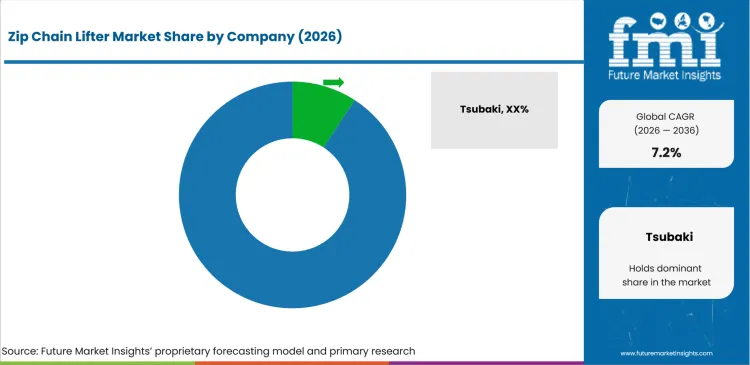
The competitive field combines proprietary chain architectures with regional engineered-lift specialists that provide distinct application and service routes. Multi-region groups compete through application engineering whereas regional providers emphasize configured fabrication and direct installer access. Repeat orders depend on documented cycle performance and dependable maintenance support across commissioned equipment programs.
- Tsubakimoto Chain and SERAPID provide proprietary chain-motion platforms through multi-region application teams that support material handling integration across repeat equipment installations.
- Framo Morat and GROB Antriebstechnik cover configured linear-chain duties across industrial machinery applications and retrofits. Wippermann adds compact Marathon Lift platforms for industrial and stage projects requiring shallow installation space.
- TransDev and Power-Lift Limited support configurable projects through specialist engineering channels, iwis supplies adaptable push-chain modules through a wider power-transmission network.
Competitive Benchmarking: Zip Chain Lifter Market
| Company | Load Capability | Positioning Control | Compact Integration | Geographic Reach |
|---|---|---|---|---|
| Tsubakimoto Chain | Medium | Medium | High | Global or multi-region |
| SERAPID | High | High | High | Global or multi-region |
| Framo Morat | High | High | High | Europe and North America |
| GROB Antriebstechnik | High | High | High | Global partner network |
| Wippermann jr. GmbH | Medium | Medium | High | Global distribution network |
| TransDev | Medium | High | High | United Kingdom |
| Power-Lift Limited | Medium | Medium | Medium | United Kingdom |
| iwis | Medium | Medium | High | Global or multi-region |
Scoring basis: Load capability is High above 30 kN and Medium from 10-30 kN, positioning is High with quantified accuracy. Compact integration is High for stored-chain designs, geographic reach records verified operating regions without inferring performance. Scores use official product data and corporate disclosures.
Key Developments in the Zip Chain Lifter Market
- In May 2025, Tsubakimoto Korea presented the ZIP Chain Actuator beside reducers and linear actuators at the Busan International Machinery Fair. The official listing connected regional product access with components required for integrated vertical movement across automated equipment programs.
- In March 2026, Framo Morat disclosed a Compacta linear-chain lifting mechanism for the KARIS autonomous mobile robot at LogiMAT. The application connected compact vertical movement with automated intralogistics equipment requiring controlled positioning during mobile operation.
- In November 2025, GROB Antriebstechnik completed official acceptance of a theater system using four TC060 Tower Chain units. The synchronized installation moved a 22.5-ton dynamic stage under independent technical inspection and coordinated braking tests.
- In May 2026, Wippermann introduced the Marathon Lift ML500 for compact stage lifting systems requiring shallow installation space. The model supports loads up to 500 kg through a 170 mm installation height across stage platforms.
Zip Chain Lifter Market - Report Scope
| Coverage field | Report scope |
|---|---|
| Market breakdown | Lifter type, lift height, load rating, application, end use, region. |
| Quantitative Units | Revenue in USD million and CAGR in %. |
| Market Definition | Electromechanical lifting systems using interlocking or rigid-chain mechanisms for compact controlled vertical movement. |
| Regions Covered | North America, Latin America, Western Europe, Eastern Europe, East Asia, South Asia and Pacific, Middle East and Africa. |
| Countries Covered | Japan, South Korea, United States, France, Germany. |
| Key Companies Profiled | Tsubakimoto Chain, SERAPID, Framo Morat, GROB Antriebstechnik, Wippermann jr. GmbH, TransDev, Power-Lift Limited, iwis. |
| Forecast Period | 2026 to 2036. |
| Approach | Primary and secondary research with market triangulation. |
Zip Chain Lifter Market - Research Methodology
| Method | Approach |
|---|---|
| Primary Research | Analysts examined manufacturer and integrator views on buying criteria. Interviews also covered approvals, service expectations and adoption barriers. |
| Desk Research | The team reviewed official releases and technical literature. Standards, company filings and credible product evidence supported market-boundary checks. |
| Market Sizing and Forecasting | Models combined demand drivers and supply conditions. Pricing signals, regulations and historical market behavior informed regional forecasts. |
| Data Validation | Findings were checked through triangulation and expert review across regional operating conditions. Adjacent or unsupported activities were excluded. |
Zip Chain Lifter Market by Segments
Zip Chain Lifter Market segmented by Lifter Type:
- Vertical Zip Chain Lifters
- Compact Lift Columns
- Scissor-lift Replacement Units
- Custom Platform Lifters
Zip Chain Lifter Market segmented by Lift Height:
- 1-3 m
- <1 m
- >3 m
Zip Chain Lifter Market segmented by Load Rating:
- 250-1,000 kg
- <250 kg
- 1,000-3,000 kg
- >3,000 kg
Zip Chain Lifter Market segmented by Application:
- Workpiece Positioning
- Automated Storage / Retrieval
- AGV / Logistics Lifts
- Theater / Stage Lifts
- Cleanroom Lifting
Zip Chain Lifter Market segmented by End Use:
- Industrial Automation
- Logistics
- Entertainment / Stage
- Medical / Lab
- Electronics Manufacturing
Zip Chain Lifter Market by Region:
- North America
- United States
- Canada
- Latin America
- Brazil
- Mexico
- Argentina
- Chile
- Western Europe
- Germany
- France
- United Kingdom
- Italy
- Spain
- Benelux
- Nordics
- Eastern Europe
- Poland
- Czech Republic
- Romania
- Hungary
- East Asia
- Japan
- South Korea
- South Asia and Pacific
- ASEAN
- Australia and New Zealand
- Middle East and Africa
- GCC Countries
- South Africa
- Türkiye
- Israel
Research Sources and Bibliography
- Tsubakimoto Chain Co. (2025, March 12). Smart Factory + Automation World 2025 (AW2025).
- Tsubakimoto Chain Co. (2025, May 20). Busan International Machinery Fair 2025 (BUTECH 2025).
- Wippermann jr. GmbH. (2026, March 13). Innovative chain solutions for the packaging industry - live at components 2026.
- Framo Morat. (2026, March 13). Drive solutions for intralogistics: Framo Morat at LogiMAT 2026.
- GROB Antriebstechnik. (2025, November 27). Stage adjustment in a theater using the Tower Chain.
- Wippermann jr. GmbH. (2026, May 26). Wippermann at BTT 2026: New Marathon Lift ML500 for compact stage lifting systems.
- International Federation of Robotics. (2025, July 15). Japan's car industry has highest robot installations in five years.
- International Federation of Robotics. (2025, September 25). World Robotics 2025 report - industrial robots.
- International Federation of Robotics. (2026, June 18). US robot industry returns to double digit growth.
- French Ministry of Economy. (2026, June 18). France 2030: 31 new projects for a French robotics and drone sector.
This Report Answers
- How large is the global Zip Chain Lifter market in 2026 and 2036?
- Which industry conditions and applications are driving demand for zip chain lifting systems?
- Why do vertical zip chain lifters account for 38.0% of the market share?
- How does the 1-3 m lifting travel segment support machinery, automation, and material handling applications?
- Why does the 250-1,000 kg load capacity segment attract the highest project demand?
- How do growth rates and market opportunities vary across key countries and regions?
- Which manufacturers and suppliers are leading the Zip Chain Lifter market?
- What factors contribute to delays in custom zip chain lifter approvals and deployments?
- How do modular and configurable zip chain lifter designs improve operational and cost efficiency?
Frequently Asked Questions
How big is the Zip Chain Lifter Market in 2026?
The zip chain lifter market is valued at USD 360.6 million in 2026 and is forecast to reach USD 722.7 million by 2036. Growth is supported by stored-chain columns that reduce installation depth beneath lifting tables, replacing hydraulic infrastructure across space-sensitive automated production machinery.
What is the CAGR of the Zip Chain Lifter Market from 2026 to 2036?
The zip chain lifter market grows at a CAGR of 7.2% between 2026 and 2036, supported by machinery builders adopting compact, oil-free stored-chain motion once guidance and braking responsibilities are defined across complete lifting packages within space-limited industrial automation programs.
Which lifter type leads the Zip Chain Lifter Market?
Vertical units account for 38.0% of the zip chain lifter market by lifter type in 2026, driven by familiar platform geometry and compact drive placement that let manufacturers avoid full-stroke cylinders below the platform while preserving service access without deeper foundations.
How much will the Zip Chain Lifter Market add between 2026 and 2036?
The zip chain lifter market is set to add USD 362.1 million between 2026 and 2036, growing from USD 360.6 million to USD 722.7 million as modular chain platforms enter repeat equipment programs across a widening base of automated production facilities.
Who are the leading companies in the Zip Chain Lifter Market?
Eight companies lead the zip chain lifter market, including Tsubakimoto Chain, SERAPID, Framo Morat, GROB Antriebstechnik, Wippermann jr. GmbH, TransDev, Power-Lift Limited, and iwis, competing through proprietary chain-motion platforms, configured linear-chain systems, and specialist engineering channels across industrial and stage applications worldwide.
Preview the report firsthand - request a free sample
Get SampleGet the brochure for pricing and purchase details.
Get PDFTable of Content
- Key Takeaways
- Market Size and CAGR
- Top Growth Driver
- Fastest Growing Segment
- Leading Region
- Key Companies
- Emerging Opportunities
- Executive Summary
- Global Market Outlook
- Demand-side Trends
- Supply-side Trends
- Technology Roadmap Analysis
- Analysis and Recommendations
- Analyst Perspective (What is happening? Why now? What should investors know?)
- Key Questions Answered
- How large is the market?
- What is the CAGR?
- What are key trends?
- Which region dominates?
- Who are the leaders?
- Market Overview
- Market Coverage / Taxonomy
- Market Definition / Scope / Limitations
- Research Methodology
- Chapter Orientation
- Analytical Lens and Working Hypotheses
- Market Structure, Signals, and Trend Drivers
- Benchmarking and Cross-market Comparability
- Market Sizing, Forecasting, and Opportunity Mapping
- Research Design and Evidence Framework
- Desk Research Programme (Secondary Evidence)
- Expert Input and Fieldwork (Primary Evidence)
- Tooling, Models, and Reference Databases
- Data Engineering and Model Build
- Quality Assurance and Audit Trail
- Market Background
- Market Dynamics (Drivers, Restraints, Opportunity, Trends)
- Scenario Forecast (Optimistic, Likely, Conservative)
- Impact Analysis
- AI Impact
- Sustainability Impact
- Regulatory Impact
- Technology Impact
- Consumer / Buyer Analysis
- Purchase Drivers
- Adoption Barriers
- Buyer Journey
- Opportunity Map Analysis
- Product Life Cycle Analysis
- Supply Chain Analysis
- Investment Feasibility Matrix
- Value Chain Analysis
- PESTLE and Porter's Analysis
- Regulatory Landscape
- Regional Parent Market Outlook
- Production and Consumption Statistics
- Import and Export Statistics
- Global Market Analysis and Forecast, 2021 to 2036
- Historical Market Size Value (USD Million) Analysis, 2021 to 2025
- Current and Future Market Size Value (USD Million) Projections, 2026 to 2036
- Y-o-Y Growth Trend Analysis
- Absolute $ Opportunity Analysis
- Global Market Pricing Analysis, 2021 to 2036
- Global Market Analysis and Forecast, By Lifter Type, 2021 to 2036
- Introduction / Key Findings
- Historical Market Size Value (USD Million) Analysis By Lifter Type, 2021 to 2025
- Current and Future Market Size Value (USD Million) Analysis and Forecast By Lifter Type, 2026 to 2036
- Vertical Zip Chain Lifters
- Compact Lift Columns
- Scissor-lift Replacement Units
- Custom Platform Lifters
- Vertical Zip Chain Lifters
- Y-o-Y Growth Trend Analysis By Lifter Type, 2021 to 2025
- Absolute $ Opportunity Analysis By Lifter Type, 2026 to 2036
- Global Market Analysis and Forecast, By Lift Height, 2021 to 2036
- Introduction / Key Findings
- Historical Market Size Value (USD Million) Analysis By Lift Height, 2021 to 2025
- Current and Future Market Size Value (USD Million) Analysis and Forecast By Lift Height, 2026 to 2036
- 1–3 m
- <1 m
- >3 m
- 1–3 m
- Y-o-Y Growth Trend Analysis By Lift Height, 2021 to 2025
- Absolute $ Opportunity Analysis By Lift Height, 2026 to 2036
- Global Market Analysis and Forecast, By Load Rating, 2021 to 2036
- Introduction / Key Findings
- Historical Market Size Value (USD Million) Analysis By Load Rating, 2021 to 2025
- Current and Future Market Size Value (USD Million) Analysis and Forecast By Load Rating, 2026 to 2036
- 250–1,000 kg
- <250 kg
- 1,000–3,000 kg
- >3,000 kg
- 250–1,000 kg
- Y-o-Y Growth Trend Analysis By Load Rating, 2021 to 2025
- Absolute $ Opportunity Analysis By Load Rating, 2026 to 2036
- Global Market Analysis and Forecast, By Application, 2021 to 2036
- Introduction / Key Findings
- Historical Market Size Value (USD Million) Analysis By Application, 2021 to 2025
- Current and Future Market Size Value (USD Million) Analysis and Forecast By Application, 2026 to 2036
- Workpiece Positioning
- Automated Storage / Retrieval
- AGV / Logistics Lifts
- Theatre / Stage Lifts
- Cleanroom Lifting
- Workpiece Positioning
- Y-o-Y Growth Trend Analysis By Application, 2021 to 2025
- Absolute $ Opportunity Analysis By Application, 2026 to 2036
- Global Market Analysis and Forecast, By End Use, 2021 to 2036
- Introduction / Key Findings
- Historical Market Size Value (USD Million) Analysis By End Use, 2021 to 2025
- Current and Future Market Size Value (USD Million) Analysis and Forecast By End Use, 2026 to 2036
- Industrial Automation
- Logistics
- Entertainment / Stage
- Medical / Lab
- Electronics Manufacturing
- Industrial Automation
- Y-o-Y Growth Trend Analysis By End Use, 2021 to 2025
- Absolute $ Opportunity Analysis By End Use, 2026 to 2036
- Global Market Analysis and Forecast, By Region, 2021 to 2036
- Introduction
- Historical Market Size Value (USD Million) Analysis By Region, 2021 to 2025
- Current Market Size Value (USD Million) Analysis and Forecast By Region, 2026 to 2036
- North America
- Latin America
- Western Europe
- Eastern Europe
- East Asia
- South Asia and Pacific
- Middle East & Africa
- Market Attractiveness Analysis By Region
- North America Market Analysis and Forecast, By Country, 2021 to 2036
- Historical Market Size Value (USD Million) Trend Analysis By Market Taxonomy, 2021 to 2025
- Market Size Value (USD Million) Forecast By Market Taxonomy, 2026 to 2036
- By Country
- USA
- Canada
- By Lifter Type
- By Lift Height
- By Load Rating
- By Application
- By End Use
- By Country
- Market Attractiveness Analysis
- By Country
- By Lifter Type
- By Lift Height
- By Load Rating
- By Application
- By End Use
- Key Takeaways
- Latin America Market Analysis and Forecast, By Country
- Historical Market Size Value (USD Million) Trend Analysis By Market Taxonomy, 2021 to 2025
- Market Size Value (USD Million) Forecast By Market Taxonomy, 2026 to 2036
- By Country
- Brazil
- Mexico
- Chile
- Rest of Latin America
- By Lifter Type
- By Lift Height
- By Load Rating
- By Application
- By End Use
- By Country
- Market Attractiveness Analysis
- By Country
- By Lifter Type
- By Lift Height
- By Load Rating
- By Application
- By End Use
- Key Takeaways
- Western Europe Market Analysis and Forecast, By Country
- Historical Market Size Value (USD Million) Trend Analysis By Market Taxonomy, 2021 to 2025
- Market Size Value (USD Million) Forecast By Market Taxonomy, 2026 to 2036
- By Country
- Germany
- UK
- Italy
- Spain
- France
- Nordic
- BENELUX
- Rest of Western Europe
- By Lifter Type
- By Lift Height
- By Load Rating
- By Application
- By End Use
- By Country
- Market Attractiveness Analysis
- By Country
- By Lifter Type
- By Lift Height
- By Load Rating
- By Application
- By End Use
- Key Takeaways
- Eastern Europe Market Analysis and Forecast, By Country
- Historical Market Size Value (USD Million) Trend Analysis By Market Taxonomy, 2021 to 2025
- Market Size Value (USD Million) Forecast By Market Taxonomy, 2026 to 2036
- By Country
- Russia
- Poland
- Hungary
- Balkan & Baltic
- Rest of Eastern Europe
- By Lifter Type
- By Lift Height
- By Load Rating
- By Application
- By End Use
- By Country
- Market Attractiveness Analysis
- By Country
- By Lifter Type
- By Lift Height
- By Load Rating
- By Application
- By End Use
- Key Takeaways
- East Asia Market Analysis and Forecast, By Country
- Historical Market Size Value (USD Million) Trend Analysis By Market Taxonomy, 2021 to 2025
- Market Size Value (USD Million) Forecast By Market Taxonomy, 2026 to 2036
- By Country
- China
- Japan
- South Korea
- By Lifter Type
- By Lift Height
- By Load Rating
- By Application
- By End Use
- By Country
- Market Attractiveness Analysis
- By Country
- By Lifter Type
- By Lift Height
- By Load Rating
- By Application
- By End Use
- Key Takeaways
- South Asia and Pacific Market Analysis and Forecast, By Country
- Historical Market Size Value (USD Million) Trend Analysis By Market Taxonomy, 2021 to 2025
- Market Size Value (USD Million) Forecast By Market Taxonomy, 2026 to 2036
- By Country
- India
- ASEAN
- Australia & New Zealand
- Rest of South Asia and Pacific
- By Lifter Type
- By Lift Height
- By Load Rating
- By Application
- By End Use
- By Country
- Market Attractiveness Analysis
- By Country
- By Lifter Type
- By Lift Height
- By Load Rating
- By Application
- By End Use
- Key Takeaways
- Middle East & Africa Market Analysis and Forecast, By Country
- Historical Market Size Value (USD Million) Trend Analysis By Market Taxonomy, 2021 to 2025
- Market Size Value (USD Million) Forecast By Market Taxonomy, 2026 to 2036
- By Country
- Kingdom of Saudi Arabia
- Other GCC Countries
- Türkiye
- South Africa
- Other African Union
- Rest of Middle East & Africa
- By Lifter Type
- By Lift Height
- By Load Rating
- By Application
- By End Use
- By Country
- Market Attractiveness Analysis
- By Country
- By Lifter Type
- By Lift Height
- By Load Rating
- By Application
- By End Use
- Key Takeaways
- Key Countries Market Analysis
- USA
- Pricing Analysis
- Market Share Analysis, 2025
- By Lifter Type
- By Lift Height
- By Load Rating
- By Application
- By End Use
- Canada
- Pricing Analysis
- Market Share Analysis, 2025
- By Lifter Type
- By Lift Height
- By Load Rating
- By Application
- By End Use
- Mexico
- Pricing Analysis
- Market Share Analysis, 2025
- By Lifter Type
- By Lift Height
- By Load Rating
- By Application
- By End Use
- Brazil
- Pricing Analysis
- Market Share Analysis, 2025
- By Lifter Type
- By Lift Height
- By Load Rating
- By Application
- By End Use
- Chile
- Pricing Analysis
- Market Share Analysis, 2025
- By Lifter Type
- By Lift Height
- By Load Rating
- By Application
- By End Use
- Germany
- Pricing Analysis
- Market Share Analysis, 2025
- By Lifter Type
- By Lift Height
- By Load Rating
- By Application
- By End Use
- UK
- Pricing Analysis
- Market Share Analysis, 2025
- By Lifter Type
- By Lift Height
- By Load Rating
- By Application
- By End Use
- Italy
- Pricing Analysis
- Market Share Analysis, 2025
- By Lifter Type
- By Lift Height
- By Load Rating
- By Application
- By End Use
- Spain
- Pricing Analysis
- Market Share Analysis, 2025
- By Lifter Type
- By Lift Height
- By Load Rating
- By Application
- By End Use
- France
- Pricing Analysis
- Market Share Analysis, 2025
- By Lifter Type
- By Lift Height
- By Load Rating
- By Application
- By End Use
- India
- Pricing Analysis
- Market Share Analysis, 2025
- By Lifter Type
- By Lift Height
- By Load Rating
- By Application
- By End Use
- ASEAN
- Pricing Analysis
- Market Share Analysis, 2025
- By Lifter Type
- By Lift Height
- By Load Rating
- By Application
- By End Use
- Australia & New Zealand
- Pricing Analysis
- Market Share Analysis, 2025
- By Lifter Type
- By Lift Height
- By Load Rating
- By Application
- By End Use
- China
- Pricing Analysis
- Market Share Analysis, 2025
- By Lifter Type
- By Lift Height
- By Load Rating
- By Application
- By End Use
- Japan
- Pricing Analysis
- Market Share Analysis, 2025
- By Lifter Type
- By Lift Height
- By Load Rating
- By Application
- By End Use
- South Korea
- Pricing Analysis
- Market Share Analysis, 2025
- By Lifter Type
- By Lift Height
- By Load Rating
- By Application
- By End Use
- Russia
- Pricing Analysis
- Market Share Analysis, 2025
- By Lifter Type
- By Lift Height
- By Load Rating
- By Application
- By End Use
- Poland
- Pricing Analysis
- Market Share Analysis, 2025
- By Lifter Type
- By Lift Height
- By Load Rating
- By Application
- By End Use
- Hungary
- Pricing Analysis
- Market Share Analysis, 2025
- By Lifter Type
- By Lift Height
- By Load Rating
- By Application
- By End Use
- Kingdom of Saudi Arabia
- Pricing Analysis
- Market Share Analysis, 2025
- By Lifter Type
- By Lift Height
- By Load Rating
- By Application
- By End Use
- Türkiye
- Pricing Analysis
- Market Share Analysis, 2025
- By Lifter Type
- By Lift Height
- By Load Rating
- By Application
- By End Use
- South Africa
- Pricing Analysis
- Market Share Analysis, 2025
- By Lifter Type
- By Lift Height
- By Load Rating
- By Application
- By End Use
- USA
- Market Structure Analysis
- Competition Dashboard
- Competition Benchmarking
- Market Share Analysis of Top Players
- By Regional
- By Lifter Type
- By Lift Height
- By Load Rating
- By Application
- By End Use
- Emerging Startups
- Innovation Benchmarking
- Competition Analysis
- Competition Deep Dive
- Tsubaki
- Overview
- Product Portfolio
- Profitability by Market Segments
- Sales Footprint
- Strategy Overview
- Marketing Strategy
- Product Strategy
- Channel Strategy
- Serapid
- Framo Morat
- Grob GmbH
- Joyce Dayton
- Thomson Industries
- Nook Industries
- Duff-Norton
- ZIMM
- Linak
- Tsubaki
- Case Studies
- Success Stories
- Recent Developments
- Competition Deep Dive
- Assumptions & Acronyms Used


