

- Industry Size (2026)
- USD 5575.6 Mn
- Forecast (2036)
- USD 9256.5 Mn
- CAGR (2026 to 2036)
- 5.2%
2-Ethyl Anthraquinone Market Forecast and Outlook 2026 to 2036
In 2025, the 2-ethyl anthraquinone market was valued at USD 5,575.6 million. Based on Future Market Insights' analysis, demand for 2-ethyl anthraquinone is estimated to grow to USD 5,865.5 million in 2026 and USD 9,737.9 million by 2036. FMI projects a CAGR of 5.2% during the forecast period.
Absolute dollar growth of USD 3,872.4 million over the decade reflects a supply-constrained expansion where capacity additions in China and India are being committed to long-term hydrogen peroxide production contracts rather than spot-market sales. The global shift from chlorine-based to peroxide-based bleaching in pulp and paper manufacturing is the primary structural demand driver. Catalyst efficiency improvements by producers such as BASF are reducing per-unit energy costs in the cyclic anthraquinone process, partially offsetting feedstock price volatility.
As Carlos Silveira, President of Solvay's Peroxides business, stated regarding the company's technology licensing agreement with North Huajin, 'Through these partnerships, we assist our customers in producing high-quality hydrogen peroxide with the same performance as our own facilities.' [1]
China (6.0% CAGR) leads capacity formation through integrated anthraquinone-to-hydrogen-peroxide complexes. India (5.8% CAGR) benefits from HOCL's ongoing process plant operations and growing domestic demand for peroxide-based textile bleaching. Germany (4.5% CAGR) grows through BASF's advanced catalyst development. The United States (4.2% CAGR) generates demand primarily through pulp-and-paper bleaching conversion and semiconductor-grade hydrogen peroxide requirements.
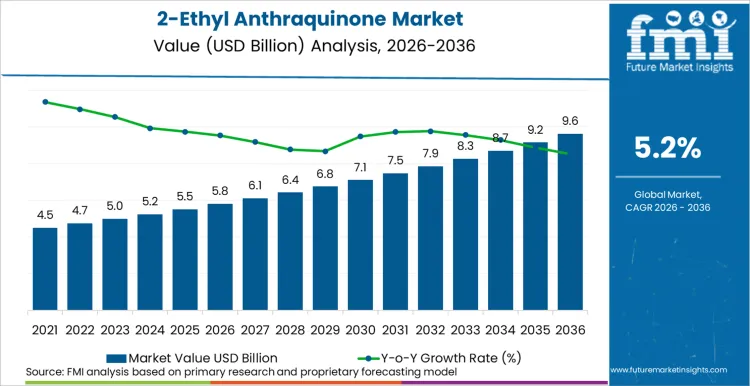
2-Ethyl Anthraquinone Market Market Definition
The 2-ethyl anthraquinone (2-EAQ) market covers the global production, trade, and industrial consumption of 2-ethyl anthraquinone, an organic compound used primarily as a working substance in the cyclic anthraquinone process for hydrogen peroxide (H2O2) manufacturing. Secondary applications include use as a dye intermediate and in specialty chemical synthesis.
2-Ethyl Anthraquinone Market Market Inclusions
The report covers global and regional market sizes by revenue for the 2026 to 2036 forecast period. It includes segmental breakdowns by purity grade, application, and end use. Pricing analysis, capacity utilization benchmarking, and trade flow analysis are included.
2-Ethyl Anthraquinone Market Market Exclusions
The scope excludes downstream hydrogen peroxide market sizing (covered separately). It also omits other anthraquinone derivatives unless used as direct substitutes. Anthraquinone-based dyes as finished products are outside scope.
2-Ethyl Anthraquinone Market Research Methodology
Primary Research: Interviews were conducted with 2-EAQ producers, hydrogen peroxide manufacturers, catalyst suppliers, and chemical trading companies across China, India, Germany, and the United States.
Desk Research: UN Comtrade chemical trade data, Chinese chemical industry capacity databases, Indian HOCL tender filings, and European chemical production statistics supported volume benchmarking.
Market-Sizing and Forecasting: A hybrid top-down and bottom-up model was developed. Demand was reconstructed from hydrogen peroxide production volumes, per-unit 2-EAQ consumption rates, and plant-level capacity utilization, validated against trade flow statistics.
Data Validation and Update Cycle: Outputs undergo anomaly screening, variance checks across production capacity and trade datasets, and structured peer review prior to release.
Summary of 2-Ethyl Anthraquinone Market
Power in the 2-ethyl anthraquinone value chain is concentrated among a small number of integrated chemical producers in China and Europe. Solvay controls process technology licensing for the anthraquinone route to hydrogen peroxide, giving it leverage over downstream producers. Chinese producers such as Jilin Zirui New Material and Changzhou Hongyu Chemical control a large share of global 2-EAQ capacity, while BASF leads in catalyst optimization. As per FMI, downstream hydrogen peroxide manufacturers who lack captive 2-EAQ supply face procurement risk during capacity-tight periods.
Pricing asymmetry reflects the gap between technical-grade and high-purity-grade products. Technical-grade 2-EAQ sold into bulk hydrogen peroxide production trades at commodity-level margins, while high-purity grades required for semiconductor-grade H2O2 and pharmaceutical applications command premium pricing at two to three times technical-grade levels. FMI analysts note that producers who can deliver high-purity product capture margin premium and secure longer-term supply agreements.
Sourcing fragility is concentrated in catalyst supply and feedstock availability. The anthraquinone process depends on proprietary catalysts that require periodic regeneration. Palladium-based hydrogenation catalysts are subject to precious-metal price volatility. On the feedstock side, 2-EAQ synthesis depends on phthalic anhydride and ethylene, both tied to petrochemical cycles.
Brand and compliance risks centre on environmental regulation of chemical manufacturing processes. China's tightening environmental enforcement has forced smaller producers to invest in waste treatment or face production curtailment. FMI opines that producers who invest in circular-economy waste recovery, such as Jilin Zirui's combined sulfur-containing waste liquid processing, will face lower regulatory disruption risk.
Geographic leverage in the 2-EAQ market is heavily tilted toward China, which controls the majority of global production capacity. India is a secondary production centre through HOCL's Kochi unit. Germany anchors European supply through BASF's catalyst leadership. The United States is primarily a demand market with limited domestic 2-EAQ synthesis. The Middle East is an emerging demand region through water treatment applications.
For C-suite executives in chemical manufacturing, the 2-EAQ market through 2036 rewards producers who secure long-term catalyst supply, invest in high-purity production, and lock in multi-year offtake agreements with hydrogen peroxide manufacturers. Capacity control is the primary source of competitive advantage.
Category-wise Insights
The section explains the growth trajectories of the leading segments in the industry. In terms of Chemical Type, the electronics grade category will likely dominate and generate a share of around 59.5% in 2026.
The growing demand for high-purity chemicals in various industries drives the crystal segment’s growth
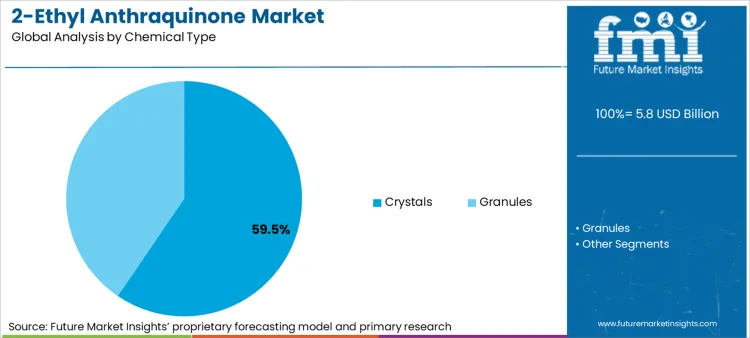
| Segment | Value Share (2026) |
|---|---|
| Crystals (Chemical Type) | 59.5% |
Crystals are the most widely used form in the 2-Ethyl Anthraquinone market. This is because they have higher purity and stability, which are critical for industrial use. Crystalline 2-Ethyl Anthraquinone is often used in the production of hydrogen peroxide, a major product in most industries. The crystal form ensures consistent quality and reliable performance in various processes.
Major applications include textiles, chemicals, and pharmaceuticals. Hydrogen peroxide from crystalline 2-Ethyl Anthraquinone is applied in bleaching of fabrics during textile production. This product is also applied for sterilization as well as disinfection purposes by the pharmaceutical industry. High-purity products in these are necessary. Thus, it is the dominant form in the market.
The rising demand for eco-friendly textiles is boosting hydrogen peroxide use in the textile industry
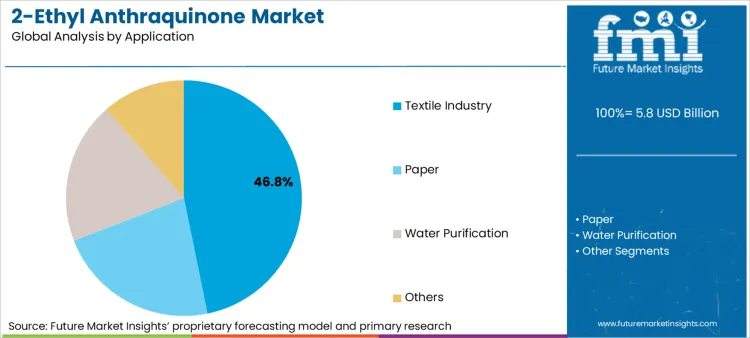
| Segment | Value Share (2026) |
|---|---|
| Textile Industry (Application) | 46.8% |
The largest consumer of 2-Ethyl Anthraquinone is the textile industry. This is because hydrogen peroxide, a product of 2-Ethyl Anthraquinone, is applied in the bleaching of fabrics. Hydrogen peroxide is popular because it is effective and more environmentally friendly than chlorine-based bleaches. It is applied to remove natural impurities from fabrics and whiten them before dyeing or printing. This process creates clean brighter textiles which are part of the textile manufacturing process.
As more people consider sustainability in the textile industry, there has been a steady upward trend in demand for hydrogen peroxide. Many companies are now seeking more environmentally friendly production options. Hydrogen peroxide is safer than many chemicals used and helps companies reduce their environmental footprint.
Global demand for sustainable textiles is growing and, with that, the textile industry is experiencing growth in countries like China and India. The increase in the textile industry directly enhances the demand for hydrogen peroxide and 2-Ethyl Anthraquinone. With this trend of sustainable production, the textile industry will be the most dominant application for 2-Ethyl Anthraquinone.
Semi-annual Market Update
The table below presents the annual growth rates of the global 2 - ethyl anthraquinone industry from 2025 to 2035. With a base year of 2024 extending to the current year 2025, the report examines how the sector's growth trajectory evolves from the first half of the year (January to June, H1) to the second half (July to December, H2). This analysis offers stakeholders insights into the industry's performance over time, highlighting potential developments that may emerge.
These figures indicate the growth of the sector in each half year, between the years 2024 and 2025. The industry is expected to grow at a CAGR of 4.3% in H1-2024. In H2, the growth rate increases.
| Particular | Value CAGR |
|---|---|
| H1 | 4.3% (2021 to 2025) |
| H2 | 4.2% (2021 to 2025) |
| H1 | 4.1% (2026 to 2036) |
| H2 | 4.4% (2026 to 2036) |
Moving into the subsequent period, from H1 2021 to H2 2026, the CAGR is projected to slightly decrease to 4.1% in the first half and relatively increase to 4.4% in the second half. In the first half (H1), the sector saw an increase of 10 BPS while in the second half (H2), there was a slight increase of 10 BPS.
Key Industry Highlights
Growing Demand for Hydrogen Peroxide Drives 2-Ethyl Anthraquinone Market Growth
The demand for 2-ethyl anthraquinone is closely correlated with its leading application in hydrogen peroxide manufacturing that occupies its worldwide market application. This universal chemical is vastly utilized in an entire range of applications, especially as a bleach agent in textile and cotton mill industries.
It is also a very essential ingredient in the production of detergents because this substance utilizes its oxidation property to effect better cleaning effects. As there was an increasing demand for good quality in both textiles and cleaning agents worldwide, the total consumption of hydrogen peroxide increased as well. The heightened demand for hydrogen peroxide thereby created direct demand in 2-Ethyl Anthraquinone.
Hydrogen peroxide found another industry, paper packaging solutions, that is moving its market upward with the advent of paper packing solutions. Paper, as any other packing material, needs to go through the bleaching process to achieve desired quality attributes. Hydrogen peroxide was dominant in the bleaching processes.
Since sustainability is the primary concern of companies across all sectors, growth in environmentally friendly packaging materials such as paper is quite crucial for 2-ethyl anthraquinone. This expansion of its applications is going to take the precursor, 2-ethyl anthraquinone, into the next few years at a growth rate.
Expanding Markets in Developing Regions Propel Growth
The market of 2-ethyl anthraquinone is moving towards the emerging developing regions that are Asia-Pacific, Africa, and South America. These areas due to rapid industrialization with growing urbanization, are focusing more on demand of consumer goods, textiles, and cleaning agents.
Awareness and change in lifestyles due to higher hygiene has promoted an immense growth rate for a detergent market across the geographies of these regions. Therefore, there has been higher detergent production in turn creating high demand for hydrogen peroxide and thereby for 2-ethyl anthraquinone.
Additional factors to further the growth of this market are macroeconomic in nature. This includes growth in GDP and growth in industrial infrastructure within developing nations. The paper industry is yet another area with growth in the Asia-Pacific, spurred by an increased demand for paper-based packaging solutions to adapt to global trends towards sustainability. This is having a ripple effect in increasing the demand for hydrogen peroxide in paper bleaching processes, hence fuelling the 2-ethyl anthraquinone market growth.
The industrial activity, disposable income, and evolution of consumer demand in these countries will propel the 2-ethyl anthraquinone market to experience a long way of growth during the following periods. Up-and-coming markets like these are quite an opportunity for manufacturers looking to cash in on emerging demand from this versatile chemical.
Shift Towards Bio-based Hydrogen Peroxide Production for Sustainable Practices
The industries around the world are becoming more environmentally conscious. This has resulted in a major shift toward the production of hydrogen peroxide through bio-based methods. These methods use renewable feedstocks instead of fossil fuels, which have been used traditionally. This makes the process more sustainable and less harmful to the environment. There is an increasing demand for greener solutions, especially in sectors such as healthcare, food processing, and water treatment.
For instance, companies are working on production technologies that consume fewer energies and also produce less waste. These technologies utilize bio-based chemicals, such as plant-derived precursors. The result is a hydrogen peroxide that has a lower carbon footprint.
The current trend further emphasizes the rise in demand of 2-Ethyl Anthraquinone. It constitutes the backbone for the anthraquinone method of hydrogen peroxide production-the most popular worldwide. The current interest of every industrial concern will definitely focus toward developing more sustainability for hydrogen peroxide through 2-Ethyl Anthraquinone. But again, manufacturing houses are obliged to further make this process worthwhile as per cost effectiveness and effectiveness criteria.
High Production Costs from Raw Material Prices and Energy-intensive Processes
The production of 2-Ethyl Anthraquinone is expensive in the sense that it requires the most expensive raw materials. For instance, some materials used as ethylene and anthraquinone precursors are derived from petrochemical products. Shifts in the price of crude oil cause fluctuations in the prices of these raw materials.
When crude oil prices increase, so do their costs. For this reason, producers have no option but to increase the product price to maintain their costs. This is a problem for smaller manufacturers, which cannot absorb the added expenses as larger companies can.
The energy-intensive process is another challenge in the production of 2-Ethyl Anthraquinone. The process calls for a lot of energy; hence its production is very expensive. This is particularly so in areas with very high energy prices. The surging energy costs are such that smaller companies find it hard to deal with, and therefore they cannot compete easily as larger firms have more resources to cope with these costs. All these factors create a barrier, limiting market growth, thereby making it difficult for smaller players in the 2-Ethyl Anthraquinone market.
2021 to 2025 2 - Ethyl Anthraquinone Sales Outlook Compared to Demand Forecast from 2026 to 2036
The global 2-Ethyl Anthraquinone market was witnessing steady growth between 2020 and 2024. Such growth was driven by strong demand in the textiles, water treatment, and pulp and paper industries, which require hydrogen peroxide to be produced through 2-Ethyl Anthraquinone. As the requirement for hydrogen peroxide increased, so did that of 2-Ethyl Anthraquinone.
Hydrogen peroxide derivatives including peracetic acid also witnessed rising usage, aiding the growth further. The companies started to make a switch in favor of safer hydrogen peroxide over chlorine-based chemicals due to the increasing trends of sustainability; this led to an increase in demand for 2-Ethyl Anthraquinone. A rise in methods of production meant that it is easier and cost-effective to make the chemical as well, making the market gain.
In 2025 to 2035, the demand for 2-Ethyl Anthraquinone will be further increased. One major reason will be the change to bio-based hydrogen peroxide production, driven by environmental concerns and stricter regulations. This will lead to an increased demand for 2-Ethyl Anthraquinone because it is a major component in making hydrogen peroxide.
More growth in industrial areas in developing regions such as Asia-Pacific, Latin America, and Africa is going to contribute more to demand in hydrogen peroxide, followed by 2-Ethyl Anthraquinone. Use of hydrogen peroxide in industries like pharmaceutical, electronics, and water treatment will grow even further with further opportunities in all these directions. Newer technologies will become efficient in their productions, so as to fill up the requirements for 2-Ethyl Anthraquinone in the near future.
Market Concentration
Tier 1 companies include industry leaders with annual revenues exceeding USD 200 to 300 million. These companies are currently capturing a significant share of 20% to 25% globally. These frontrunners are characterized by high production capacity and a wide product portfolio. &These companies stand out due to their extensive expertise in manufacturing and broad geographical reach, supported by a robust consumer base. They offer a wide range of products and leverage the latest technology to meet regulatory standards. Prominent companies within Tier 1 include BASF, Clariant, DIC Corporation, Hebei Kailite Sensitizing Chemicals Co. and others.
Tier 2 companies encompass mid-sized participants with revenues ranging from USD 100 to150 million, holding a presence in specific regions and exerting significant influence in local economies. These firms are distinguished by robust presence overseas and in-depth industry expertise. They possess strong technology capabilities and adhere strictly to regulatory requirements. However, the firms may not wield cutting-edge technology or maintain an extensive global reach. Noteworthy entities in Tier 2 include Henan Baofeng Chemical Industry Co., Huntsman Corporation, Jiangsu Honglin Chemical Co. and Other.
Tier 3 encompasses most of the small-scale enterprises operating within the regional sphere and catering to specialized needs with revenues below USD 50 to 100 million. These businesses are notably focused on meeting local demand and are hence categorized within the Tier 3 segment. They are small-scale participants with limited geographical presence. In this context, Tier 3 is acknowledged as an informal sector, indicating a segment distinguished by a lack of extensive organization and formal structure in comparison to the structured one. Tier 3 includes Lanxess, North China Pharmaceutical Group Corporation, Puyang Tianyuan Chemical Co. and others.
Country-wise Insights
The section below highlights assessments of 2 - Ethyl Anthraquinone sale across key countries. USA, China, Germany region, and Turkey are expected to showcase promising double-digit growth, with each exhibiting a strong CAGR through the forecast period.
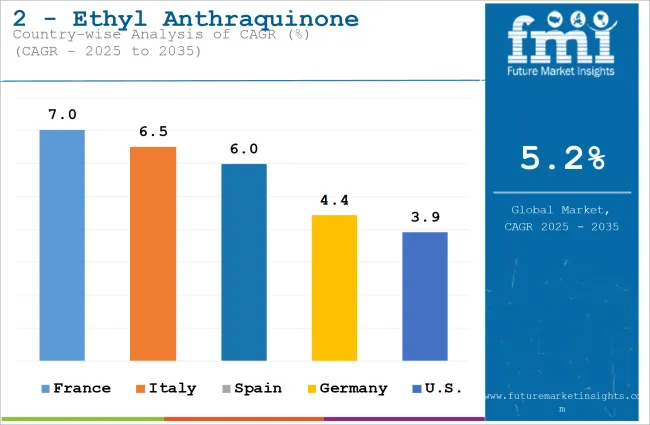
| Countries | Value CAGR (2026 to 2036) |
|---|---|
| China | 6.3% |
| USA | 4.9% |
| Germany | 5.4% |
| India | 5.0% |
| Japan | 3.9% |
China: The Leading Consumer of 2-Ethyl Anthraquinone
China is the largest consumer of 2-Ethyl Anthraquinone. This is majorly because of its huge industrial sector. It has a big textile industry using hydrogen peroxide for fabric bleaching. Hydrogen peroxide is manufactured from 2-Ethyl Anthraquinone, and its demand increases along with the textile industry. Besides, the country has a large chemical industry that similarly uses hydrogen peroxide for oxidation and disinfection and wastewater treatment processes. As these industries continue to expand, 2-Ethyl Anthraquinone in China continues to grow in demand.
China is also putting efforts in the area of environmental sustainability. It is fighting pollution and needs hydrogen peroxide to do that. Hydrogen peroxide has the ability to treat water; therefore, the purification of polluted water makes it relevant to this activity. These efforts of environmental improvement increase the use of hydrogen peroxide and 2-Ethyl Anthraquinone. As such, due to the promise that China keeps for industrialization and environmental care, it continues to be the greatest consumer of 2-Ethyl Anthraquinone.
United States: Industrial Growth Driving 2-Ethyl Anthraquinone Demand
The second large consumer of 2-Ethyl Anthraquinone is the United States. This is mainly because such well-established industries exist in the country. The USA textile industry uses hydrogen peroxide for fabric bleaching. The chemical industry also uses it for oxidation and disinfection. The demand for hydrogen peroxide and 2-Ethyl Anthraquinone thus drives upwards with the growth of the USA manufacturing sector. The health care sector in the USA uses hydrogen peroxide for sterilization, creating further demand.
The USA is also moving towards a greener mode of operation. With the increasingly stringent regulations over industries, people are turning to safer, more environmentally friendly modes of operation. Hydrogen peroxide is considered safer and a more environment-friendly alternative to most chemicals. Therefore, with increasing demand for safer chemicals in the USA, the demand for 2-Ethyl Anthraquinone will also be on the rise, and this is likely to remain so in the future.
India: Industrial Growth and Sustainability Drive 2-Ethyl Anthraquinone Consumption
2-Ethyl Anthraquinone is the fastest-growing emerging market in India, due to rapid industrialization. India's textile industry is one of the largest in the world and consumes hydrogen peroxide for bleaching fabrics. When the textile industry expands, hydrogen peroxide usage increases, followed by an increase in the use of 2-Ethyl Anthraquinone. In addition, India's chemical industry consumes hydrogen peroxide for oxidation and disinfection purposes, further increasing the requirement for 2-Ethyl Anthraquinone.
India also focuses on sustainability and environmental protection. Water treatment projects are in place by the government to make water clean. Hydrogen peroxide is applied in the purification of water as well as minimizing pollution. Hydrogen peroxide will continue to rise in demand in India because the industrial base will keep growing with the adoption of greener practices. This means the consumption of 2-Ethyl Anthraquinone will increase. The trend is expected to continue, thus making India a key consumer of 2-Ethyl Anthraquinone in the future.
Competitive Landscape
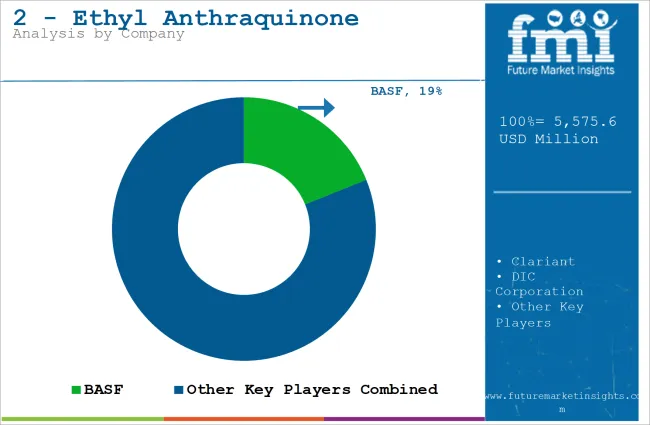
The 2-Ethyl Anthraquinone market is moderately competitive, with competitors trying to take on top share through technologically advancement and regional expansion. Companies like BASF SE, Mitsubishi Gas Chemical Company, Eastman Chemical Company, and Solvay hold significant amounts of market share due to the sheer established production capabilities and robust distribution networks.
These players focus on the improvement of catalyst efficiency and enhancement of sustainability in the production process of hydrogen peroxide, which is crucial for paper, textile, and water treatment industries. For instance, BASF SE has successfully achieved significant cuts in CO2 emissions through superior technologies.
Emerging players are rapidly gaining a market share mainly from the Asia-Pacific region. The reason for this is their ability to provide cheaper solutions, focusing on huge markets like China and India. Strategic partnerships and investment in advanced manufacturing technologies are providing these companies an opportunity to challenge the global giants.
Innovation in the synthesis of 2-Ethyl Anthraquinone and new application development is yet another factor driving competition. However, with more stringent regulatory demands and a desire for greener solutions, it is the sustainability and operational efficiency-oriented companies that will remain in the forefront.
Recent Developments
- The report includes full coverage of key trends from competitive benchmarking. Some of the recent developments covered in the report:
- In August 2025, Solvay licensed its hydrogen peroxide technology to North Huajin for a 300,000-tonne-per-year Propylene Oxide plant launching in 2026. [1]
- In February 2025, Changzhou Hongyu Chemical expanded its production capacity for 2-EAQ and derivatives. [2]
- In February 2025, BASF developed advanced catalysts for the anthraquinone process, reducing energy consumption. [3]
- In February 2026, HOCL issued tenders for waste heat boiler maintenance at its Kochi unit. [4]
- In February 2026, Jilin Zirui New Material continued operating its 10,000 tonnes per year 2-EAQ plant. [5]
Key Players of 2 - Ethyl Anthraquinone Industry
- BASF
- Clariant
- DIC Corporation
- Hebei Kailite Sensitizing Chemicals Co.
- Henan Baofeng Chemical Industry Co.
- Huntsman Corporation
- Jiangsu Honglin Chemical Co.
- Lanxess
- North China Pharmaceutical Group Corporation
- Puyang Tianyuan Chemical Co.
- Veolia Water Technologies
Scope of the Report
| Items | Values |
|---|---|
| Quantitative Units | USD 5,865.5 million (2026) to USD 9,737.9 million (2036), at a CAGR of 5.2% |
| Market Definition | Covers global production, trade, and industrial consumption of 2-EAQ used primarily in hydrogen peroxide manufacturing. |
| Purity Grade Segmentation | Technical Grade, High Purity Grade |
| Application Segmentation | Hydrogen Peroxide Production, Dye Intermediates, Pulp and Paper Bleaching, Others |
| Regions Covered | North America, Latin America, Europe, East Asia, South Asia, Oceania, Middle East and Africa |
| Countries Covered | China, India, Germany, United States, Japan, South Korea, Brazil, Saudi Arabia, Russia and 30 plus countries |
| Key Companies Profiled | Solvay, BASF SE, Jilin Zirui New Material, Changzhou Hongyu Chemical, HOCL, Camlin Fine Sciences, Zhonglan Industry, Atul Ltd, Chembridge International, Pandian Chemicals |
| Forecast Period | 2026 to 2036 |
| Approach | Hybrid top-down and bottom-up modeling validated through interviews with 2-EAQ producers, H2O2 manufacturers, and catalyst suppliers |
Key Segments of 2 - Ethyl Anthraquinone Market
By Chemical Type:
In terms of chemical type, the industry is divided into Granules and Crystals.
By Application:
In terms of Application, the industry is divided into Paper, Textile, Detergent Bleaches, Water Purification and Others.
By Region:
The report covers key regions, including North America, Latin America, Western Europe, Eastern Europe, East Asia, South Asia, and the Middle East and Africa (MEA).
Bibliography
- [1] Solvay. (2025). H2O2 Technology License to North Huajin. August 2025. https://www.solvay.com/en/press-release/solvay-licenses-hydrogen-peroxide-process-technology-north-huajin-refining
- [2] Changzhou Hongyu Chemical. (2025). Production Capacity Expansion. February 2025.
- [3] BASF SE. (2025). Advanced Catalyst Development. February 2025.
- [4] HOCL. (2026). Waste Heat Boiler Maintenance Tender, Kochi Unit. February 2026. https://www.hoclindia.com/manufacturing-process
- [5] Jilin Zirui New Material. (2026). Company Profile. http://www.jlziruichem.com/about_en.html
- [6] UN Comtrade. (2025). Chemical Trade Statistics. https://comtrade.un.org
- [7] ECHA. (2025). REACH: Anthraquinone Derivatives. https://echa.europa.eu
- [8] National Bureau of Statistics of China. (2025). Chemical Industry Statistics. https://www.stats.gov.cn
- [9] Ministry of Chemicals, Government of India. (2025). Chemical Industry Report. https://chemicals.gov.in
- [10] World Bank. (2025). Commodity Markets Outlook. https://www.worldbank.org
- [11] Future Market Insights. (2026). 2-Ethyl Anthraquinone Market Report. https://www.futuremarketinsights.com/reports/2-ethyl-anthraquinone-market
- [12] Future Market Insights. (2025). Hydrogen Peroxide Market. https://www.futuremarketinsights.com/reports/hydrogen-peroxide-market
Frequently Asked Questions
How large is the 2-EAQ market in 2026?
The global 2-ethyl anthraquinone market is estimated at USD 5,865.5 million in 2026.
What will the market size be by 2036?
The market is projected to reach USD 9,737.9 million by 2036.
What is the expected CAGR between 2026 and 2036?
Demand is expected to grow at a CAGR of 5.2%.
Which application dominates demand?
Hydrogen peroxide production is the dominant application, accounting for the majority of global 2-EAQ consumption.
Which country leads production capacity?
China leads global 2-EAQ production capacity through integrated producers.
What drives the shift to peroxide bleaching?
Environmental regulation of chlorine-based bleaching in pulp and paper manufacturing is driving conversion to hydrogen peroxide alternatives.
Preview the report firsthand - request a free sample
Get SampleGet the brochure for pricing and purchase details.
Get PDFTable of Content
- Executive Summary
- Global Market Outlook
- Demand-side Trends
- Supply-side Trends
- Technology Roadmap Analysis
- Analysis and Recommendations
- Market Overview
- Market Coverage / Taxonomy
- Market Definition / Scope / Limitations
- Research Methodology
- Chapter Orientation
- Analytical Lens and Working Hypotheses
- Market Structure, Signals, and Trend Drivers
- Benchmarking and Cross-market Comparability
- Market Sizing, Forecasting, and Opportunity Mapping
- Research Design and Evidence Framework
- Desk Research Programme (Secondary Evidence)
- Company Annual and Sustainability Reports
- Peer-reviewed Journals and Academic Literature
- Corporate Websites, Product Literature, and Technical Notes
- Earnings Decks and Investor Briefings
- Statutory Filings and Regulatory Disclosures
- Technical White Papers and Standards Notes
- Trade Journals, Industry Magazines, and Analyst Briefs
- Conference Proceedings, Webinars, and Seminar Materials
- Government Statistics Portals and Public Data Releases
- Press Releases and Reputable Media Coverage
- Specialist Newsletters and Curated Briefings
- Sector Databases and Reference Repositories
- FMI Internal Proprietary Databases and Historical Market Datasets
- Subscription Datasets and Paid Sources
- Social Channels, Communities, and Digital Listening Inputs
- Additional Desk Sources
- Expert Input and Fieldwork (Primary Evidence)
- Primary Modes
- Qualitative Interviews and Expert Elicitation
- Quantitative Surveys and Structured Data Capture
- Blended Approach
- Why Primary Evidence is Used
- Field Techniques
- Interviews
- Surveys
- Focus Groups
- Observational and In-context Research
- Social and Community Interactions
- Stakeholder Universe Engaged
- C-suite Leaders
- Board Members
- Presidents and Vice Presidents
- R&D and Innovation Heads
- Technical Specialists
- Domain Subject-matter Experts
- Scientists
- Physicians and Other Healthcare Professionals
- Governance, Ethics, and Data Stewardship
- Research Ethics
- Data Integrity and Handling
- Primary Modes
- Tooling, Models, and Reference Databases
- Desk Research Programme (Secondary Evidence)
- Data Engineering and Model Build
- Data Acquisition and Ingestion
- Cleaning, Normalisation, and Verification
- Synthesis, Triangulation, and Analysis
- Quality Assurance and Audit Trail
- Market Background
- Market Dynamics
- Drivers
- Restraints
- Opportunity
- Trends
- Scenario Forecast
- Demand in Optimistic Scenario
- Demand in Likely Scenario
- Demand in Conservative Scenario
- Opportunity Map Analysis
- Product Life Cycle Analysis
- Supply Chain Analysis
- Investment Feasibility Matrix
- Value Chain Analysis
- PESTLE and Porter’s Analysis
- Regulatory Landscape
- Regional Parent Market Outlook
- Production and Consumption Statistics
- Import and Export Statistics
- Market Dynamics
- Global Market Analysis 2021 to 2025 and Forecast, 2026 to 2036
- Historical Market Size Value (USD Million) Analysis, 2021 to 2025
- Current and Future Market Size Value (USD Million) Projections, 2026 to 2036
- Y-o-Y Growth Trend Analysis
- Absolute $ Opportunity Analysis
- Global Market Pricing Analysis 2021 to 2025 and Forecast 2026 to 2036
- Global Market Analysis 2021 to 2025 and Forecast 2026 to 2036, By Chemical Type
- Introduction / Key Findings
- Historical Market Size Value (USD Million) Analysis By Chemical Type , 2021 to 2025
- Current and Future Market Size Value (USD Million) Analysis and Forecast By Chemical Type , 2026 to 2036
- Crystals
- Granules
- Crystals
- Y-o-Y Growth Trend Analysis By Chemical Type , 2021 to 2025
- Absolute $ Opportunity Analysis By Chemical Type , 2026 to 2036
- Global Market Analysis 2021 to 2025 and Forecast 2026 to 2036, By Application
- Introduction / Key Findings
- Historical Market Size Value (USD Million) Analysis By Application, 2021 to 2025
- Current and Future Market Size Value (USD Million) Analysis and Forecast By Application, 2026 to 2036
- Textile Industry
- Paper
- Water Purification
- Others
- Textile Industry
- Y-o-Y Growth Trend Analysis By Application, 2021 to 2025
- Absolute $ Opportunity Analysis By Application, 2026 to 2036
- Global Market Analysis 2021 to 2025 and Forecast 2026 to 2036, By Region
- Introduction
- Historical Market Size Value (USD Million) Analysis By Region, 2021 to 2025
- Current Market Size Value (USD Million) Analysis and Forecast By Region, 2026 to 2036
- North America
- Latin America
- Western Europe
- Eastern Europe
- East Asia
- South Asia and Pacific
- Middle East & Africa
- Market Attractiveness Analysis By Region
- North America Market Analysis 2021 to 2025 and Forecast 2026 to 2036, By Country
- Historical Market Size Value (USD Million) Trend Analysis By Market Taxonomy, 2021 to 2025
- Market Size Value (USD Million) Forecast By Market Taxonomy, 2026 to 2036
- By Country
- USA
- Canada
- Mexico
- By Chemical Type
- By Application
- By Country
- Market Attractiveness Analysis
- By Country
- By Chemical Type
- By Application
- Key Takeaways
- Latin America Market Analysis 2021 to 2025 and Forecast 2026 to 2036, By Country
- Historical Market Size Value (USD Million) Trend Analysis By Market Taxonomy, 2021 to 2025
- Market Size Value (USD Million) Forecast By Market Taxonomy, 2026 to 2036
- By Country
- Brazil
- Chile
- Rest of Latin America
- By Chemical Type
- By Application
- By Country
- Market Attractiveness Analysis
- By Country
- By Chemical Type
- By Application
- Key Takeaways
- Western Europe Market Analysis 2021 to 2025 and Forecast 2026 to 2036, By Country
- Historical Market Size Value (USD Million) Trend Analysis By Market Taxonomy, 2021 to 2025
- Market Size Value (USD Million) Forecast By Market Taxonomy, 2026 to 2036
- By Country
- Germany
- UK
- Italy
- Spain
- France
- Nordic
- BENELUX
- Rest of Western Europe
- By Chemical Type
- By Application
- By Country
- Market Attractiveness Analysis
- By Country
- By Chemical Type
- By Application
- Key Takeaways
- Eastern Europe Market Analysis 2021 to 2025 and Forecast 2026 to 2036, By Country
- Historical Market Size Value (USD Million) Trend Analysis By Market Taxonomy, 2021 to 2025
- Market Size Value (USD Million) Forecast By Market Taxonomy, 2026 to 2036
- By Country
- Russia
- Poland
- Hungary
- Balkan & Baltic
- Rest of Eastern Europe
- By Chemical Type
- By Application
- By Country
- Market Attractiveness Analysis
- By Country
- By Chemical Type
- By Application
- Key Takeaways
- East Asia Market Analysis 2021 to 2025 and Forecast 2026 to 2036, By Country
- Historical Market Size Value (USD Million) Trend Analysis By Market Taxonomy, 2021 to 2025
- Market Size Value (USD Million) Forecast By Market Taxonomy, 2026 to 2036
- By Country
- China
- Japan
- South Korea
- By Chemical Type
- By Application
- By Country
- Market Attractiveness Analysis
- By Country
- By Chemical Type
- By Application
- Key Takeaways
- South Asia and Pacific Market Analysis 2021 to 2025 and Forecast 2026 to 2036, By Country
- Historical Market Size Value (USD Million) Trend Analysis By Market Taxonomy, 2021 to 2025
- Market Size Value (USD Million) Forecast By Market Taxonomy, 2026 to 2036
- By Country
- India
- ASEAN
- Australia & New Zealand
- Rest of South Asia and Pacific
- By Chemical Type
- By Application
- By Country
- Market Attractiveness Analysis
- By Country
- By Chemical Type
- By Application
- Key Takeaways
- Middle East & Africa Market Analysis 2021 to 2025 and Forecast 2026 to 2036, By Country
- Historical Market Size Value (USD Million) Trend Analysis By Market Taxonomy, 2021 to 2025
- Market Size Value (USD Million) Forecast By Market Taxonomy, 2026 to 2036
- By Country
- Kingdom of Saudi Arabia
- Other GCC Countries
- Turkiye
- South Africa
- Other African Union
- Rest of Middle East & Africa
- By Chemical Type
- By Application
- By Country
- Market Attractiveness Analysis
- By Country
- By Chemical Type
- By Application
- Key Takeaways
- Key Countries Market Analysis
- USA
- Pricing Analysis
- Market Share Analysis, 2025
- By Chemical Type
- By Application
- Canada
- Pricing Analysis
- Market Share Analysis, 2025
- By Chemical Type
- By Application
- Mexico
- Pricing Analysis
- Market Share Analysis, 2025
- By Chemical Type
- By Application
- Brazil
- Pricing Analysis
- Market Share Analysis, 2025
- By Chemical Type
- By Application
- Chile
- Pricing Analysis
- Market Share Analysis, 2025
- By Chemical Type
- By Application
- Germany
- Pricing Analysis
- Market Share Analysis, 2025
- By Chemical Type
- By Application
- UK
- Pricing Analysis
- Market Share Analysis, 2025
- By Chemical Type
- By Application
- Italy
- Pricing Analysis
- Market Share Analysis, 2025
- By Chemical Type
- By Application
- Spain
- Pricing Analysis
- Market Share Analysis, 2025
- By Chemical Type
- By Application
- France
- Pricing Analysis
- Market Share Analysis, 2025
- By Chemical Type
- By Application
- India
- Pricing Analysis
- Market Share Analysis, 2025
- By Chemical Type
- By Application
- ASEAN
- Pricing Analysis
- Market Share Analysis, 2025
- By Chemical Type
- By Application
- Australia & New Zealand
- Pricing Analysis
- Market Share Analysis, 2025
- By Chemical Type
- By Application
- China
- Pricing Analysis
- Market Share Analysis, 2025
- By Chemical Type
- By Application
- Japan
- Pricing Analysis
- Market Share Analysis, 2025
- By Chemical Type
- By Application
- South Korea
- Pricing Analysis
- Market Share Analysis, 2025
- By Chemical Type
- By Application
- Russia
- Pricing Analysis
- Market Share Analysis, 2025
- By Chemical Type
- By Application
- Poland
- Pricing Analysis
- Market Share Analysis, 2025
- By Chemical Type
- By Application
- Hungary
- Pricing Analysis
- Market Share Analysis, 2025
- By Chemical Type
- By Application
- Kingdom of Saudi Arabia
- Pricing Analysis
- Market Share Analysis, 2025
- By Chemical Type
- By Application
- Turkiye
- Pricing Analysis
- Market Share Analysis, 2025
- By Chemical Type
- By Application
- South Africa
- Pricing Analysis
- Market Share Analysis, 2025
- By Chemical Type
- By Application
- USA
- Market Structure Analysis
- Competition Dashboard
- Competition Benchmarking
- Market Share Analysis of Top Players
- By Regional
- By Chemical Type
- By Application
- Competition Analysis
- Competition Deep Dive
- BASF
- Overview
- Product Portfolio
- Profitability by Market Segments (Product/Age /Sales Channel/Region)
- Sales Footprint
- Strategy Overview
- Marketing Strategy
- Product Strategy
- Channel Strategy
- Clariant
- DIC Corporation
- Hebei Kailite Sensitizing Chemicals Co.
- Henan Baofeng Chemical Industry Co.
- Huntsman Corporation
- BASF
- Competition Deep Dive
- Assumptions & Acronyms Used


