

- Market Size (2026)
- USD 4.3 Bn
- Forecast (2036)
- USD 9.0 Bn
- CAGR (2026 to 2036)
- 7.7%
How big is Alumina Trihydrate (ATH) Market in 2026?
USD 4.3 billion in 2026 and USD 9.0 billion by 2036 at a 7.7% CAGR.
Demand for alumina trihydrate is projected to expand at 7.7% CAGR from 2026 to 2036, increasing valuation from USD 4.3 billion to USD 9.0 billion. Flame-retardant chemicals provide one volume route through engineered grades that must pass application-specific qualification. Aluminum hydroxide conversion provides a separate bulk route with different grade specifications and purchasing schedules for chemical processors. Huber reinforced the engineered route in May 2025 by acquiring R.J. Marshall's ATH and selected antimony-free flame-retardant assets. Huber's acquisition places established formulations under one technical platform and can shorten qualification for customers already using those grades.
Country growth reflects how quickly local manufacturing programs convert industrial investment into qualified mineral demand and repeat purchasing. Mexico is forecast at 9.4% CAGR while Japan is projected at 6.4% through 2036 under different manufacturing conditions. INEGI recorded 1,642,083 light vehicles produced in Mexico during the first five months of 2026. Mexico's vehicle-production base supports wire compounds and filled-polymer demand, although every application still requires its own fire-performance and processing qualification.
-market-value-analysis.webp "Alumina Trihydrate (ath) Market Value Analysis")
Key Takeaways of Alumina Trihydrate (ATH) Market
- Demand rises as chemical processors require dependable hydrate feedstock and formulators qualify ATH for halogen-free fire and smoke control.
- Chemicals is estimated to hold 34.4% of end-use demand in 2026 because aluminum-chemical conversion supports repeat bulk purchasing.
- Plastics remain a specification-intensive end use because filler loading must preserve compound processing while meeting required fire performance.
- Paints and coatings require controlled particle behavior where formulators balance whiteness, viscosity and mineral loading during production trials.
- High filler loading and thermal limits lengthen qualification work for polymer applications that operate near ATH processing boundaries.
- Some of the key players in this market include Huber Engineered Materials (J.M. Huber Corporation), Nabaltec AG, RUSAL, Hindalco Industries Limited, National Aluminium Company Ltd. (NALCO), Aluminum Corporation of China Ltd. (Chalco), Sumitomo Chemical Co., Ltd., and SCR-Sibelco NV.
Analyst Perspective
"ATH earns its margin at the qualification stage because a lower quoted price has little value if viscosity or particle distribution forces another production trial. The strongest offers pair lot-to-lot control with application support that lets chemical processors and compounders reproduce an approved result at commercial scale."
- Nikhil Kaitwade, Principal Consultant, Future Market Insights
How is the Alumina Trihydrate (ATH) Market segmented?
The alumina trihydrate (ATH) market is segmented by product type, application, end use and region.
The alumina trihydrate market is segmented by product type, application, end use and region for commercial demand analysis and forecasting. Product types cover Ground ATH, Precipitated ATH and Fine Precipitated ATH, reflecting differences in particle size, production route and formulation behavior. Applications cover flame retardants, fillers, antacids and glass, with flame retardants holding the dominant 2026 application share as cable, construction and polymer formulators move toward halogen-free and low-smoke systems. End uses cover chemicals, plastics, paints and coatings, papers, adhesives and other industrial uses, with chemicals leading because aluminum-chemical conversion supports repeat bulk hydrate purchasing. Regional analysis covers North America, Latin America, Western Europe, Eastern Europe, East Asia, South Asia and Pacific, and the Middle East and Africa.
Why do Flame Retardants lead demand within the Application category?
-market-analysis-by-application.webp "Alumina Trihydrate (ath) Market Analysis By Application")
Flame-retardant applications lead because ATH releases water when exposed to heat, helping reduce flame spread and smoke generation while avoiding halogenated chemistry. Recent 2026 market references identify rising demand for halogen-free flame retardants in construction, wire and cable, plastics and electrical applications as a core driver of ATH demand.
- Based on applications, flame retardants are projected to lead with 41.0% share in 2026 because ATH remains a widely used halogen-free mineral additive for wire and cable, coatings and polymer systems.
- Fillers/ antacids and glass applications remain important secondary routes, with fillers using ATH for whiteness and loading economics, antacids requiring pharmaceutical-grade purity and glass or ceramic applications depending on controlled alumina contribution.
Why does Ground ATH lead demand within the Product Type category?
Ground ATH serves high-volume flame-retardant and filler applications because standard grades offer a familiar balance of particle size, whiteness, stability and commercial availability. Public market references published in 2026 describe ground ATH as a whitening agent, filler material, flame retardant and smoke suppressant, supporting its use across paper, plastics, coatings and related industrial formulations.
- By product type, ground ATH is estimated to hold 58.0% in 2026 owing to broad availability and established qualification in high-volume flame-retardant and filler formulations.
- Precipitated ATH and Fine Precipitated ATH serve more specification-led applications where controlled particle behavior, low impurities and viscosity management determine qualification for cable compounds, specialty polymers and advanced materials.
Why do Chemicals lead demand within the End-Use category?
Chemical end users purchase ATH as a repeat feedstock for aluminum-chemical conversion routes where stable composition, low impurities and dependable delivery matter more than one-time spot availability. Integrated alumina producers also document hydrate output and sales separately, reinforcing the importance of chemical conversion as a recurring commercial demand route.
- By end use, chemicals are estimated to hold 34.4% share in 2026 as alumina hydrate is purchased in repeat bulk volumes for downstream aluminum-chemical and specialty-alumina production.
- Plastics, paints and coatings, papers, adhesives and other uses remain specification-led segments where ATH must satisfy processing/loading and performance requirements before recurring purchasing begins.
What are the drivers, restraints and opportunities in the Alumina Trihydrate (ATH) Market?
Flame-retardant qualification supports demand, high mineral loading complicates processing, and engineered particle control offers a route to higher-value applications.
- Driver: Cable and polymer compounders purchase ATH where halogen-free fire performance must coexist with stable commercial processing.
- Restraint: High loading and viscosity sensitivity increase formulation work before a replacement grade can enter routine production.
- Opportunity: Fine precipitated and low-viscosity grades can expand usable loading in cable compounds, adhesives and thermal-management formulations.
Halogen-Free Compounds Extend Specification Demand
Fire-performance requirements translate into repeat demand for cable and construction compounds that need mineral flame retardancy during commercial qualification. Sibelco's August 2025 half-year results linked strong ATH sales to growth in the non-halogenated flame retardants sector. Compounders still need fire performance and process stability to remain reproducible before a grade moves into routine production on established high-volume commercial extrusion lines.
High Loading Raises Processing Friction
Higher mineral loading can restrict throughput if particle packing raises viscosity beyond the working range of existing compounding equipment. Nabaltec's April 2025 Annual Report documented capacity expansion for viscosity-optimized hydrates and linked those grades to thermal-management demand. Plastic fillers therefore require a balance between mineral concentration and resin flow before a replacement grade enters routine production under customer-approved line conditions.
Engineered Particle Control Expands Higher-Value Routes
Particle engineering provides a higher-value route for formulations requiring more filler without sacrificing processing control in cable compounds or thermally conductive systems. Hindalco's April 2025 Investor Day presentation set out a first-phase 20 KTPA superfine precipitated ATH project for halogen-free flame-retardant wire and cable applications. The same particle-control logic extends into thermal management and thermal interface materials where loading and viscosity jointly determine usable formulation windows.
Which country CAGRs are profiled in the Alumina Trihydrate (ATH) Market?
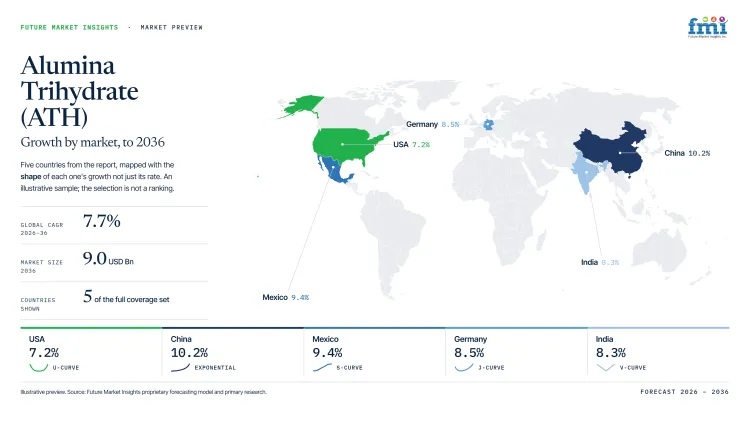
| Country | CAGR |
|---|---|
| China | 10.2% |
| Mexico | 9.4% |
| Germany | 8.5% |
| India | 8.3% |
| United States | 7.2% |
How do country-level CAGRs compare in the Alumina Trihydrate (ATH) Market?
The four profiled markets span 2.2 percentage points, from Mexico at 9.4% to the United States at 7.2%. Mexico holds the strongest growth position, followed by Germany and India, while the United States records the slowest CAGR among the profiled countries. Differences in growth reflect variations in manufacturing expansion, infrastructure investment, qualification requirements, and the pace of formulation adoption across end-use industries.
- China expands ATH demand through manufacturing and infrastructure growth.
- Mexico converts automotive demand through shared specifications and nearby inventory.
- Germany's cable base supports local trials before utility projects reach approved material schedules.
- India grows ATH use through manufacturing and infrastructure expansion.
- United States relies on standard grades while mature certifications limit formulation changes.
Comparable CAGRs still produce different order timing because qualification friction occurs at different conversion stages. The full report provides country-level CAGR analysis across North America, Latin America, Europe, East Asia, South Asia, Oceania and the Middle East and Africa.
Country-wise Analysis
- China’s extensive manufacturing base supports strong alumina trihydrate (ATH) demand across wire and cable compounds, plastics, and other flame-retardant applications. The country is forecast to record the highest CAGR of 10.2% through 2036, supported by expanding industrial production, domestic material sourcing, and rising demand for fire-resistant polymer formulations. Local availability, consistent particle quality, and reliable supply are increasingly important as processors seek to minimize qualification delays and maintain uninterrupted production.
- Mexico’s northern and central manufacturing corridors are driving ATH consumption in wire harnesses, filled polymer parts, and automotive components serving North American vehicle programs. The Mexican ATH market is projected to expand at a 9.4% CAGR through 2036, supported by continued localization of manufacturing and stronger domestic participation in global value chains. OEM qualification requirements make consistent mineral grades, nearby inventory, and technical support important for compounders supplying export-oriented automotive and industrial facilities.
- German cable compounders work against long transmission-project schedules that require fire performance and extrusion behavior to stay stable before approved materials reach contracted construction programs. Germany is estimated to post 8.5% CAGR through 2036 owing to transmission investment after Bundesnetzagentur reported in January 2026 that roughly 2,000 kilometers of power lines received approval during 2025 at about 45% above 2024. Nearby European inventory shortens replenishment time for cable plants. Each formulation change still needs customer approval and technical evidence before project volumes shift to a new grade without disrupting scheduled construction work or contracted delivery windows at active sites.
- India’s expanding manufacturing, infrastructure, electrical, and construction sectors are creating broader opportunities for ATH in flame-retardant polymers, cables, and industrial materials. The country is projected to achieve an 8.3% CAGR through 2036, supported by rising domestic production and infrastructure development. Growing demand for reliable fire-performance materials is encouraging processors to prioritize consistent ATH quality, dependable domestic supply, and technical support to mee
- USA compounders use ATH extensively in cable, polymer, and other flame-retardant applications where established certification and performance requirements govern material selection. The U.S. market is expected to grow at a 7.2% CAGR through 2036, supported by transmission investment, grid modernization, and continued demand for low-smoke and halogen-free formulations. Because formulation changes can require additional testing and customer qualification, suppliers offering stable grades and dependable delivery are better positioned to support established cable and infrastructure programs.
Who are the notable companies in the Alumina Trihydrate (ATH) Market?
Huber Engineered Materials (J.M. Huber Corporation), Nabaltec AG, RUSAL, Hindalco Industries Limited, National Aluminium Company Ltd. (NALCO), Aluminum Corporation of China Ltd. (Chalco), Sumitomo Chemical Co., Ltd., and SCR-Sibelco NV are the notable companies profiled in this market.
-market-analysis-by-company.webp "Alumina Trihydrate (ath) Market Analysis By Company")
Competition separates ATH specialists from integrated alumina groups and mineral platforms. Huber and Nabaltec focus on precipitated grades where application testing determines qualification. RUSAL, Hindalco, NALCO and Chalco control refinery-linked hydrate routes. Sumitomo Chemical serves specialty conversion while Sibelco supplies polymers and coating additives. Entry depends on grade evidence and supply continuity.
- Huber Engineered Materials and Nabaltec AG focus on application-tuned hydroxides for qualified polymer flame-retardant systems.
- RUSAL, Hindalco Industries Limited, NALCO and Chalco operate refinery-linked hydrate production routes with upstream feedstock control.
- Sumitomo Chemical and SCR-Sibelco NV serve high-specification conversion or mineral-distribution demand through specialty material platforms.
Competitive Benchmarking: Alumina Trihydrate (ATH) Market
| Company | Hydroxide Grade Breadth | Flame-Retardant Application Depth | Feedstock and Supply Integration | Geographic Reach |
|---|---|---|---|---|
| Huber Engineered Materials (J.M. Huber Corporation) | High | High | Medium | North America and Europe |
| Nabaltec AG | High | High | Medium | Europe and North America |
| RUSAL | Medium | Low | High | Russia and international markets |
| Hindalco Industries Limited | High | High | High | India and international markets |
| National Aluminium Company Ltd. (NALCO) | Medium | Low | High | India and export markets |
| Aluminum Corporation of China Ltd. (Chalco) | High | Low | High | China and international markets |
| Sumitomo Chemical Co., Ltd. | Medium | Low | Medium | Japan and international markets |
| SCR-Sibelco NV | Low | Medium | Medium | Europe and global distribution |
Scoring basis: Grade breadth is High for three documented hydrate routes, Medium for two and Low for one. Flame-retardant depth is High for multiple dedicated ATH uses, Medium for one route and Low for hydrate activity without fire-retardant evidence. Supply integration is High for refinery production with upstream control, Medium for owned production or dedicated distribution and Low for downstream participation.
Key Developments in the Alumina Trihydrate (ATH) Market
- In July 2026, Hindalco Industries Limited introduced superfine precipitated hydrate for halogen-free cable and polymer formulations.
- In April 2026, RUSAL deployed neural-network control at Kamensk-Uralsky and reduced aluminum-hydroxide fine-fraction content by 4.4%.
- In April 2026, National Aluminium Company Ltd. (NALCO) reported record FY2025-26 alumina-hydrate output of 23.00 lakh tonnes.
Key Players in the Alumina Trihydrate (ATH) Market
Engineered Flame-Retardant ATH Platforms
- Huber Engineered Materials (J.M. Huber Corporation)
- Nabaltec AG
Integrated Hydrate and Alumina Producers
- RUSAL
- Hindalco Industries Limited
- National Aluminium Company Ltd. (NALCO)
- Aluminum Corporation of China Ltd. (Chalco)
Specialty Conversion and Mineral Distribution
- Sumitomo Chemical Co., Ltd.
- SCR-Sibelco NV
Alumina Trihydrate (ATH) Market - Report Scope
| Coverage field | Report scope |
|---|---|
| Market breakdown | By product type, application, end use and region. |
| Quantitative Units | USD Million. |
| Market Definition | Revenue includes commercial alumina trihydrate or aluminum hydroxide sold into the defined end-use categories. Downstream calcined alumina and finished products are excluded. |
| Regions Covered | North America, Latin America, Europe, East Asia, South Asia and Pacific, and Middle East and Africa. |
| Countries Covered | Mexico, Russia, Germany, United States, Japan, and 20+ countries included in the full report. |
| Key Companies Profiled | Huber Engineered Materials (J.M. Huber Corporation), Nabaltec AG, RUSAL, Hindalco Industries Limited, National Aluminium Company Ltd. (NALCO), Aluminum Corporation of China Ltd. (Chalco), Sumitomo Chemical Co., Ltd., SCR-Sibelco NV. |
| Forecast Period | 2026 to 2036. |
| Approach | Primary and secondary research with market triangulation. |
Alumina Trihydrate (ATH) Market - Research Methodology
| Method | Approach |
|---|---|
| Primary Research | FMI analysts gathered input from manufacturers, service providers, technology developers, distributors, end users, procurement teams, and subject-matter experts. Interviews examined purchasing decisions, product or service evaluation, adoption barriers, approval requirements, pricing considerations, and expectations for technical or commercial support. Respondents were also asked what evidence is required before a trial, pilot, or initial order develops into regular purchasing. |
| Desk Research | Desk research covered government statistics, regulatory publications, trade data, industry associations, technical literature, standards, company filings, product information, and official corporate announcements. Sources were reviewed for relevance, publication date, geographic coverage, and consistency with the defined market scope. Claims relating to performance, applications, approvals, capacity, investment, and commercial activity were retained only when supported by credible public evidence. |
| Market Sizing and Forecasting | The market model combined the baseline value with historical performance, segment structure, pricing and volume indicators, adoption levels, company participation, and country-level demand conditions. Forecast assumptions considered economic activity, investment trends, regulatory developments, technology adoption, purchasing cycles, supply availability, and barriers to wider market use. Segment and regional estimates were reconciled before the final market total was calculated. |
| Data Validation | Estimates were checked against multiple independent indicators, including public data, company activity, trade patterns, industry developments, and findings from primary interviews. Validation also tested whether products, services, applications, and company revenues fell within the defined market boundaries. Adjacent categories, unsupported claims, overlapping revenues, and activities without direct market relevance were excluded to reduce double counting and maintain consistency across segments and countries. |
Alumina Trihydrate (ATH) Market by Segments
Alumina Trihydrate (ATH) Market segmented by Product Type:
- Ground ATH
- Precipitated ATH
- Fine Precipitated ATH
Alumina Trihydrate (ATH) Market segmented by Application:
- Flame Retardants
- Fillers
- Antacids
- Glass
Alumina Trihydrate (ATH) Market segmented by End Use:
- Chemicals
- Plastics
- Paints and Coatings
- Papers
- Adhesives
- Others
Alumina Trihydrate (ATH) Market by Region:
- North America
- United States
- Canada
- Latin America
- Brazil
- Mexico
- Chile
- Rest of Latin America
- Western Europe
- Germany
- United Kingdom
- Italy
- Spain
- France
- Nordics
- Benelux
- Rest of Western Europe
- Eastern Europe
- Russia
- Poland
- Hungary
- Balkan and Baltic States
- Rest of Eastern Europe
- East Asia
- China
- Japan
- South Korea
- South Asia and Pacific
- India
- ASEAN
- Australia and New Zealand
- Rest of South Asia and Pacific
- Middle East and Africa
- Kingdom of Saudi Arabia
- Other GCC Countries
- Türkiye
- South Africa
- Other African Union Countries
- Rest of Middle East and Africa
Research Sources and Bibliography
- J.M. Huber Corporation. (2025, May 9). J.M. Huber Corporation Announces Acquisition of The R.J. Marshall Company's Alumina Trihydrate (ATH), Antimony-Free Flame Retardant, and Molybdate-Based Smoke Suppressant Assets.
- Instituto Nacional de Estadística y Geografía. (2026, June 8). Registro Administrativo de la Industria Automotriz de Vehículos Ligeros. Mayo de 2026.
- Aluminum Corporation of China Ltd. (2026, April 23). 2025 Annual Report.
- SCR-Sibelco NV. (2025, August 29). Sibelco announces 2025 half-year results.
- Nabaltec AG. (2025, April 30). Annual Report 2024.
- Hindalco Industries Limited. (2025, April 1). Investor Day 2025.
- Presidencia de la República. (2025, January 13). Presidenta Claudia Sheinbaum presenta el Plan México que contempla un portafolio de inversiones de 277 mmdd.
- Federal State Statistics Service of Russia. (2026, February 6). On industrial production in 2025.
- Bundesnetzagentur. (2026, January 2). Energy transition clears crucial hurdle - significant progress in electricity grid expansion in 2025.
- USA Department of Energy. (2026, March 12). Energy Department Announces $1.9B Investment in Critical Grid Infrastructure to Reduce Electricity Costs.
- Ministry of Economy, Trade and Industry. (2026, February 27). Indices of Industrial Production: Preliminary Report for January 2026.
- Hindalco Industries Limited. (2026, July 23). Chairman's Speech at the 67th AGM of Hindalco Industries Limited.
- RUSAL. (2026, April 6). RUSAL Implements Neural Networks to Improve Alumina Quality.
- National Aluminium Company Limited. (2026, April 2). NALCO Delivers Historic FY26 Performance, Setting New Benchmarks in Production and Sale.
- Nabaltec AG. (2026, April 30). Annual Report 2025.
- Alteo. (2026, June 25). Alteo strengthens the security of its supply chain with a warehouse in Fos-sur-Mer.
- United Company RUSAL, international public joint-stock company. (2026, April 29). Consolidated Report 2025.
- Aluminum Corporation of China Ltd. (2025, August 28). 2025 Interim Results Announcement.
- National Aluminium Company Limited. (2025, November 7). NALCO Achieves Best-Ever Q2 and H1 Physical and Financial Performance.
- Hindalco Industries Limited. (2026). Flame retardant solutions.
- Huber Advanced Materials. (2026). Aluminum hydroxide flame retardant ATH.
- J.M. Huber Corporation. (2025, March 11). Successful coal phase-out in the chemical industry: Martinswerk and GETEC reduce CO2 emissions by 100,000 tons per year with state-of-the-art combined cycle gas power plant.
- LKAB Minerals. (2025, February 17). Our two new Environmental Product Declarations (EPDs).
- Hindalco Industries Limited. (2026, August 13). Hindalco’s Baphlimali becomes India’s first bauxite mine to secure ASI certification.
- Sumitomo Chemical Co., Ltd. (2026, May 7). Sumitomo Chemical to Expand its High-Purity Alumina Portfolio to Accelerate Business Growth in the Advanced Semiconductor Market.
This bibliography is provided for reader reference and is not exhaustive. The full report contains the complete reference list and detailed citations
This Report Answers
- How large is the alumina trihydrate (ATH) market in 2026 and 2036?
- Which chemical-processing and flame-retardant applications support repeat ATH purchasing?
- Why does chemicals hold the leading 34.4% end-use share in 2026?
- How do particle loading and viscosity affect qualification in polymer formulations?
- Which country growth rates are profiled between 2026 and 2036?
- Which companies supply engineered grades and integrated hydrate production?
- How do regional manufacturing programs change the route from trial to repeat orders?
- Which operating factors matter before replacing an approved ATH grade?
Frequently Asked Questions
How big is the Alumina Trihydrate (ATH) Market in 2026?
The alumina trihydrate (ATH) market is valued at USD 4.3 billion in 2026 and is projected to reach USD 9.0 billion by 2036. Chemical conversion and halogen-free formulations support repeat ATH demand.
What is the CAGR of the Alumina Trihydrate (ATH) Market from 2026 to 2036?
The alumina trihydrate (ATH) market is projected to grow at a CAGR of 7.7% between 2026 and 2036. Expansion follows repeat chemical purchasing and engineered-filler qualification.
Which end-use segment leads the Alumina Trihydrate (ATH) Market?
The chemicals segment is expected to hold 34.4% of the alumina trihydrate (ATH) market in 2026, attributable to repeat feedstock purchasing for aluminum-chemical conversion. Controlled chemistry and delivery consistency support routine plant orders.
How much value will the Alumina Trihydrate (ATH) Market add between 2026 and 2036?
The alumina trihydrate (ATH) market is expected to add USD 4.7 billion in value between 2026 and 2036. Chemical conversion and flame-retardant formulations support additional demand.
Which countries are projected to record the highest growth in the Alumina Trihydrate (ATH) Market?
Mexico is projected to grow at 9.4% CAGR followed by Russia at 8.7% and Germany at 8.5% through 2036. Manufacturing programs create different qualification routes for repeat ATH orders.
Which companies are active in the Alumina Trihydrate (ATH) Market?
Key companies operating in the alumina trihydrate (ATH) market include Huber Engineered Materials, Nabaltec AG, RUSAL, Hindalco Industries Limited, NALCO, Chalco, Sumitomo Chemical and Sibelco. They compete on grade breadth, feedstock control and application support.
Preview the report firsthand - request a free sample
Get SampleGet the brochure for pricing and purchase details.
Get PDFTable of Content
- Key Takeaways
- Market Size and CAGR
- Top Growth Driver
- Fastest Growing Segment
- Leading Region
- Key Companies
- Emerging Opportunities
- Executive Summary
- Global Market Outlook
- Demand-side Trends
- Supply-side Trends
- Technology Roadmap Analysis
- Analysis and Recommendations
- Analyst Perspective (What is happening? Why now? What should investors know?)
- Key Questions Answered
- How large is the market?
- What is the CAGR?
- What are key trends?
- Which region dominates?
- Who are the leaders?
- Market Overview
- Market Coverage / Taxonomy
- Market Definition / Scope / Limitations
- Research Methodology
- Chapter Orientation
- Analytical Lens and Working Hypotheses
- Market Structure, Signals, and Trend Drivers
- Benchmarking and Cross-market Comparability
- Market Sizing, Forecasting, and Opportunity Mapping
- Research Design and Evidence Framework
- Desk Research Programme (Secondary Evidence)
- Expert Input and Fieldwork (Primary Evidence)
- Tooling, Models, and Reference Databases
- Data Engineering and Model Build
- Quality Assurance and Audit Trail
- Market Background
- Market Dynamics (Drivers, Restraints, Opportunity, Trends)
- Scenario Forecast (Optimistic, Likely, Conservative)
- Impact Analysis
- AI Impact
- Sustainability Impact
- Regulatory Impact
- Technology Impact
- Consumer / Buyer Analysis
- Purchase Drivers
- Adoption Barriers
- Buyer Journey
- Opportunity Map Analysis
- Product Life Cycle Analysis
- Supply Chain Analysis
- Investment Feasibility Matrix
- Value Chain Analysis
- PESTLE and Porter's Analysis
- Regulatory Landscape
- Regional Parent Market Outlook
- Production and Consumption Statistics
- Import and Export Statistics
- Global Market Analysis and Forecast, 2021 to 2036
- Historical Market Size Value (USD Billion) Analysis, 2021 to 2025
- Current and Future Market Size Value (USD Billion) Projections, 2026 to 2036
- Y-o-Y Growth Trend Analysis
- Absolute $ Opportunity Analysis
- Global Market Pricing Analysis, 2021 to 2036
- Global Market Analysis and Forecast, By End-use, 2021 to 2036
- Introduction / Key Findings
- Historical Market Size Value (USD Billion) Analysis By End-use, 2021 to 2025
- Current and Future Market Size Value (USD Billion) Analysis and Forecast By End-use, 2026 to 2036
- Chemicals
- Plastics
- Others
- Paints and Coatings
- Papers
- Adhesives
- Chemicals
- Y-o-Y Growth Trend Analysis By End-use, 2021 to 2025
- Absolute $ Opportunity Analysis By End-use, 2026 to 2036
- Global Market Analysis and Forecast, By Region, 2021 to 2036
- Introduction
- Historical Market Size Value (USD Billion) Analysis By Region, 2021 to 2025
- Current Market Size Value (USD Billion) Analysis and Forecast By Region, 2026 to 2036
- North America
- Latin America
- Western Europe
- Eastern Europe
- East Asia
- South Asia and Pacific
- Middle East & Africa
- Market Attractiveness Analysis By Region
- North America Market Analysis and Forecast, By Country, 2021 to 2036
- Historical Market Size Value (USD Billion) Trend Analysis By Market Taxonomy, 2021 to 2025
- Market Size Value (USD Billion) Forecast By Market Taxonomy, 2026 to 2036
- By Country
- USA
- Canada
- By End-use
- By Country
- Market Attractiveness Analysis
- By Country
- By End-use
- Key Takeaways
- Latin America Market Analysis and Forecast, By Country
- Historical Market Size Value (USD Billion) Trend Analysis By Market Taxonomy, 2021 to 2025
- Market Size Value (USD Billion) Forecast By Market Taxonomy, 2026 to 2036
- By Country
- Brazil
- Mexico
- Chile
- Rest of Latin America
- By End-use
- By Country
- Market Attractiveness Analysis
- By Country
- By End-use
- Key Takeaways
- Western Europe Market Analysis and Forecast, By Country
- Historical Market Size Value (USD Billion) Trend Analysis By Market Taxonomy, 2021 to 2025
- Market Size Value (USD Billion) Forecast By Market Taxonomy, 2026 to 2036
- By Country
- Germany
- UK
- Italy
- Spain
- France
- Nordic
- BENELUX
- Rest of Western Europe
- By End-use
- By Country
- Market Attractiveness Analysis
- By Country
- By End-use
- Key Takeaways
- Eastern Europe Market Analysis and Forecast, By Country
- Historical Market Size Value (USD Billion) Trend Analysis By Market Taxonomy, 2021 to 2025
- Market Size Value (USD Billion) Forecast By Market Taxonomy, 2026 to 2036
- By Country
- Russia
- Poland
- Hungary
- Balkan & Baltic
- Rest of Eastern Europe
- By End-use
- By Country
- Market Attractiveness Analysis
- By Country
- By End-use
- Key Takeaways
- East Asia Market Analysis and Forecast, By Country
- Historical Market Size Value (USD Billion) Trend Analysis By Market Taxonomy, 2021 to 2025
- Market Size Value (USD Billion) Forecast By Market Taxonomy, 2026 to 2036
- By Country
- China
- Japan
- South Korea
- By End-use
- By Country
- Market Attractiveness Analysis
- By Country
- By End-use
- Key Takeaways
- South Asia and Pacific Market Analysis and Forecast, By Country
- Historical Market Size Value (USD Billion) Trend Analysis By Market Taxonomy, 2021 to 2025
- Market Size Value (USD Billion) Forecast By Market Taxonomy, 2026 to 2036
- By Country
- India
- ASEAN
- Australia & New Zealand
- Rest of South Asia and Pacific
- By End-use
- By Country
- Market Attractiveness Analysis
- By Country
- By End-use
- Key Takeaways
- Middle East & Africa Market Analysis and Forecast, By Country
- Historical Market Size Value (USD Billion) Trend Analysis By Market Taxonomy, 2021 to 2025
- Market Size Value (USD Billion) Forecast By Market Taxonomy, 2026 to 2036
- By Country
- Kingdom of Saudi Arabia
- Other GCC Countries
- Türkiye
- South Africa
- Other African Union
- Rest of Middle East & Africa
- By End-use
- By Country
- Market Attractiveness Analysis
- By Country
- By End-use
- Key Takeaways
- Key Countries Market Analysis
- USA
- Pricing Analysis
- Market Share Analysis, 2025
- By End-use
- Canada
- Pricing Analysis
- Market Share Analysis, 2025
- By End-use
- Mexico
- Pricing Analysis
- Market Share Analysis, 2025
- By End-use
- Brazil
- Pricing Analysis
- Market Share Analysis, 2025
- By End-use
- Chile
- Pricing Analysis
- Market Share Analysis, 2025
- By End-use
- Germany
- Pricing Analysis
- Market Share Analysis, 2025
- By End-use
- UK
- Pricing Analysis
- Market Share Analysis, 2025
- By End-use
- Italy
- Pricing Analysis
- Market Share Analysis, 2025
- By End-use
- Spain
- Pricing Analysis
- Market Share Analysis, 2025
- By End-use
- France
- Pricing Analysis
- Market Share Analysis, 2025
- By End-use
- India
- Pricing Analysis
- Market Share Analysis, 2025
- By End-use
- ASEAN
- Pricing Analysis
- Market Share Analysis, 2025
- By End-use
- Australia & New Zealand
- Pricing Analysis
- Market Share Analysis, 2025
- By End-use
- China
- Pricing Analysis
- Market Share Analysis, 2025
- By End-use
- Japan
- Pricing Analysis
- Market Share Analysis, 2025
- By End-use
- South Korea
- Pricing Analysis
- Market Share Analysis, 2025
- By End-use
- Russia
- Pricing Analysis
- Market Share Analysis, 2025
- By End-use
- Poland
- Pricing Analysis
- Market Share Analysis, 2025
- By End-use
- Hungary
- Pricing Analysis
- Market Share Analysis, 2025
- By End-use
- Kingdom of Saudi Arabia
- Pricing Analysis
- Market Share Analysis, 2025
- By End-use
- Türkiye
- Pricing Analysis
- Market Share Analysis, 2025
- By End-use
- South Africa
- Pricing Analysis
- Market Share Analysis, 2025
- By End-use
- USA
- Market Structure Analysis
- Competition Dashboard
- Competition Benchmarking
- Market Share Analysis of Top Players
- By Regional
- By End-use
- Emerging Startups
- Innovation Benchmarking
- Competition Analysis
- Competition Deep Dive
- Huber Engineered Materials (J.M. Huber Corporation)
- Overview
- Product Portfolio
- Profitability by Market Segments
- Sales Footprint
- Strategy Overview
- Marketing Strategy
- Product Strategy
- Channel Strategy
- Sumitomo Chemical Co., Ltd.
- Aluminum Corporation of China Ltd. (Chalco)
- Nabaltec AG
- National Aluminium Company Ltd. (NALCO)
- SCR-Sibelco NV
- R.J. Marshall Company
- Alteo
- Southern Ionics Incorporated
- Almatis GmbH
- Huber Engineered Materials (J.M. Huber Corporation)
- Case Studies
- Success Stories
- Recent Developments
- Competition Deep Dive
- Assumptions & Acronyms Used


