

- Market Size (2026)
- USD 52.2 Bn
- Forecast (2036)
- USD 83.5 Bn
- CAGR (2026 to 2036)
- 4.8%
Coated Fabrics Market Size, Market Forecast and Outlook By FMI
Summary of the Coated Fabrics Market
- Demand and Growth Drivers
- Coated fabrics continue to gain ground in technical textile applications where durability, barrier performance, and cleanability matter.
- Transportation remains the clearest demand anchor, while industrial safety and protective wear add steady support.
- Buyers are increasingly looking for specification fit, compliance readiness, and service life rather than low upfront cost alone.
- Product and Segment View
- Polymer-coated fabrics remain central to market revenues because PU, PVC, and TPU systems serve a broad spread of uses.
- Polyester substrates retain strong weight through their balance of stability, cost, and coating compatibility.
- Protective and industrial applications continue to support higher-value specification-led demand.
- Geography and Competitive Outlook
- Asia Pacific remains the main growth region through vehicle production and industrial expansion.
- Europe and North America remain important value markets where standards, replacement demand, and technical performance carry more weight.
- Competitive position depends on coating chemistry, processing consistency, and the ability to serve demanding OEM and industrial accounts.
- Analyst Opinion
- Nikhil Kaitwade, notes that coated fabrics remain a specification-driven market in which performance fit matters more than broad category volume.
- Buyers place more weight on service life, compliance, and repeatable coating quality when they qualify suppliers.
- Suppliers that can support transportation, protective wear, and industrial accounts with consistent product performance remain better positioned.
- Growth is likely to stay strongest in applications where coated fabrics solve a clear durability or barrier problem.
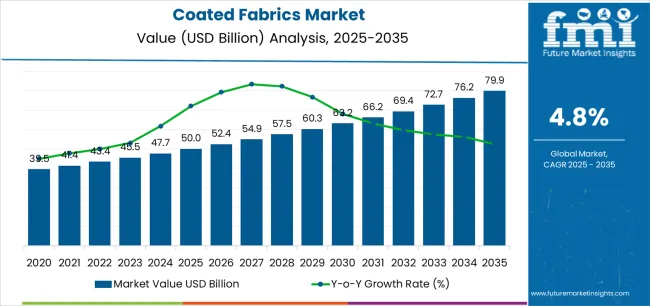
Key Takeaways, Market Size, and Forecast
| Metric | Value |
|---|---|
| Market Size (2026) | USD 52.2 Billion |
| Market Size (2036) | USD 83.5 Billion |
| CAGR (2026–2036) | 4.8% |
| Incremental Opportunity | USD 31.3 Billion |
| Leading Application (2026) | Transportation |
| Transportation Share (2026) | ~30.0% |
| Leading Material Type (2026) | Polymer-Coated Fabrics |
| Polymer-Coated Fabrics Share (2026) | 25.0% |
| Fastest-Growing Country | China |
| China CAGR | 5.3% |
Coated Fabrics Market Definition
The coated fabrics market covers textile substrates that are treated with polymer, rubber, silicone, fluoropolymer, or related coating systems to improve durability, barrier properties, weather resistance, chemical resistance, flame performance, or aesthetics. These fabrics are used across transportation, industrial operations, protective clothing, furniture, and architectural structures.
Coated Fabrics Market Inclusions
The scope includes:
- Coated fabrics used in transportation interiors and safety-related textile systems
- Fabrics used in protective clothing, industrial covers, and engineered structures
- Polymer-coated, rubber-coated, silicone-coated, and fluoropolymer-coated products
- Woven, knitted, and nonwoven substrates used in commercial coated fabric applications
- OEM, project, aftermarket, and industrial channel demand
Coated Fabrics Market Exclusions
The scope excludes:
- Uncoated technical textiles sold without a meaningful functional coating
- Commodity tarpaulin materials assessed outside the broader coated fabrics value chain
- Finished protective apparel brands where garment assembly economics dominate over coated fabric content
- Pure film products without a textile substrate
Research Methodology
- Primary Research: Review of demand patterns across coated fabric producers and converters; Assessment of procurement behavior across transportation, industrial, and protective end uses; Review of specification needs across OEM and institutional buying environments.
- Desk Research: Review of OICA production statistics for vehicle-linked demand context; Review of OSHA guidance for PPE use and standards in workplace safety; Review of the European Commission’s textiles strategy for sustainability direction in textile materials.
- Market sizing and forecasting: Revenue estimates are presented for 2026 and forecast through 2036. Segment sizing has been structured across material type, substrate, application, coating chemistry, distribution channel, performance property, and region.
Why is the Coated Fabrics Market Growing?
- Transportation demand remains a major support base for coated fabric consumption.
- Protective wear and industrial safety applications keep specification-led demand active.
- Growth is strongest where durability, cleanability, and barrier performance matter in day-to-day use.
The coated fabrics market is expanding as end users continue to need materials that can withstand abrasion, weather exposure, and repeated use.
Protective clothing is also supporting growth. OSHA makes clear that PPE is required across multiple workplace settings and that protective clothing is used to shield workers from chemical, physical, and biological hazards. That keeps coated fabrics relevant in hazardous industrial settings.
Construction and engineered structures also add demand. Tensile architecture, commercial tents, and membrane systems use coated fabrics for weatherability and service life. In Europe, the sustainability push in textiles is adding pressure for cleaner chemistry, longer life, and more circular material pathways. That does not reduce demand for coated fabrics. It changes what buyers now expect from them.
The market still faces limits. Resin costs can move sharply. Environmental scrutiny on certain coating systems also remains high. Even so, coated fabrics keep their position in end uses where plain textiles cannot deliver the needed performance.
Market Segmentation Analysis
- Polymer-coated fabrics continue to lead because they cover the widest commercial use base.
- Transportation remains a major end-use block in revenue terms.
- Polyester substrates keep a strong installed base because they balance performance and cost well.
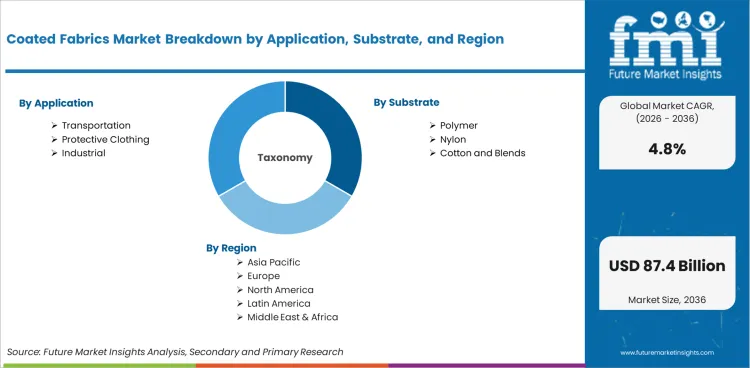
The coated fabrics market is segmented by material type, substrate, application, coating chemistry, distribution channel, performance property, and region. This reflects how the market is bought in practice. Buyers assess coated fabrics by end use, service demands, and specification fit.
Insights into the Polymer-coated Fabrics Segment
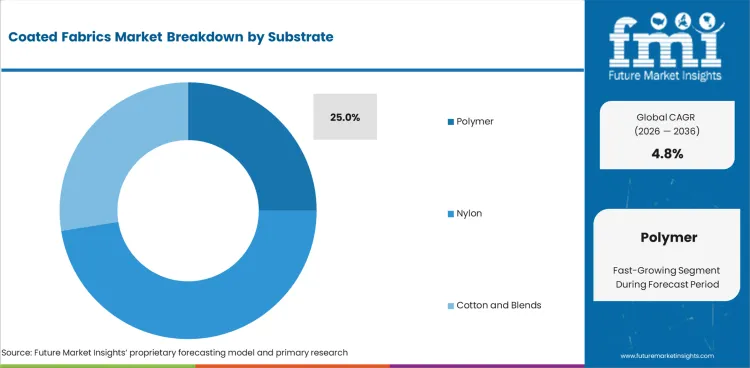
Its position is reinforced by the broad range of end uses that can be served with tuned PU, PVC, or TPU systems. Suppliers that can tailor coating performance without disrupting converting efficiency remain better placed to keep share.
Polymer-coated fabrics are expected to remain the leading material segment. The segment stays ahead as PU, PVC, and TPU systems work across multiple end uses and support scale production.
This segment also benefits from processing familiarity. Converters and OEM suppliers already know how these systems behave in automotive interiors, furniture covers, and industrial products. That reduces adoption friction for repeat demand.
Insights into the Transportation Segment
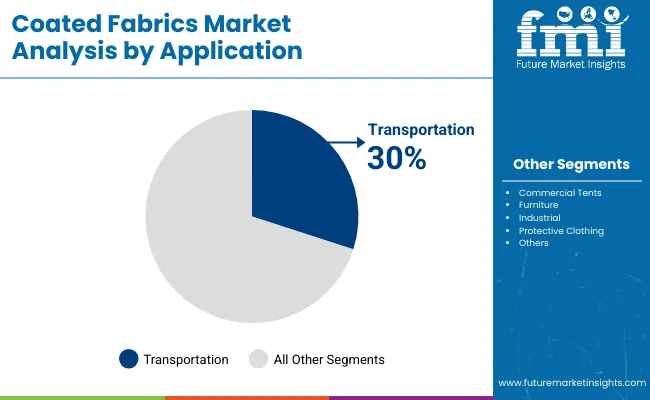
Demand in transportation remains durable because coated fabrics are still used where abrasion resistance, cleanability, and finish quality must be maintained over long service cycles. OEM qualification standards also slow supplier switching in this segment.
Transportation is expected to remain the largest application segment. As per FMI analysis, this segment is likely to account for nearly 30% share in 2026. This segment is led by automotive interiors and transport trim applications.
Demand remains strong as vehicle makers need materials that hold appearance and wear performance over long service periods. Global auto production volumes continue to support this use case.
Insights into the Polyester Substrate Segment
Polyester stays commercially strong because it supports a wide spread of coated-fabric applications without pushing costs too high. Its compatibility with common coating systems also makes it easier for processors to scale production efficiently.
Polyester is expected to remain the largest substrate family. As per FMI’s analysis, this segment is likely to account for a share of 46.0% in 2026. Polyester stays strong because it offers good dimensional stability, strength, and cost discipline across high-volume applications.
Insights into the Protective Clothing Segment
The segment also benefits from procurement frameworks that place more weight on performance verification and safety compliance. That favors suppliers that can show consistent barrier properties and repeatable coating quality in certified programs.
Protective clothing remains one of the most resilient uses for coated fabrics. As per FMI, this segment is likely to account for 22.0% of market share in 2026. OSHA guidance supports the ongoing role of chemical-resistant and hazard-protective garments in workplace safety systems.
Coated Fabrics Market Drivers, Restraints, and Opportunities
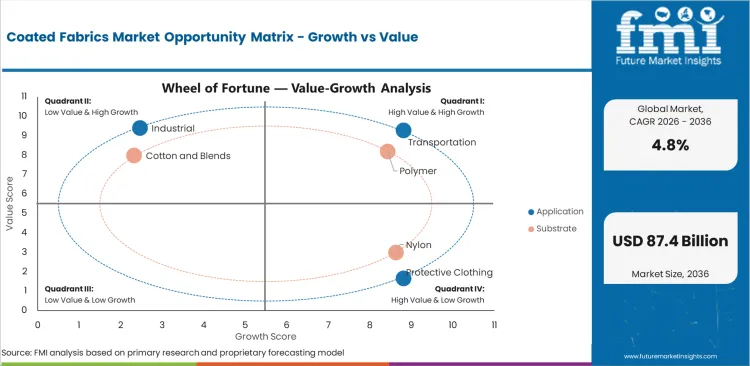
Key Factors Driving Growth
- Transportation demand continues to support coated fabric use in interiors and safety-linked applications.
- Industrial PPE standards keep demand firm for coated protective materials.
- Architectural membranes and engineered structures continue to use coated fabrics for weatherability and durability.
- Sustainability pressure is pushing the market toward cleaner coating systems and longer-life materials.
Key Restraints
- Resin and input cost volatility can pressure margins in cost-sensitive applications.
- Environmental scrutiny around selected coating chemistries can slow approvals or change formulation choices.
- In some end uses, lighter alternatives or uncoated engineered textiles can limit penetration.
Key Opportunities
- Solvent-free and lower-emission coating systems
- PVC-free and bio-attributed material platforms
- EV interior applications with stricter interior air quality expectations
- Growth in industrial safety applications across emerging markets
- Long-life membrane systems for commercial structures
Regional Market Analysis
- Asia Pacific remains the fastest-growing block through industrial production and vehicle demand.
- North America stays relevant through replacement demand and industrial safety applications.
- Europe remains important for technical specifications and evolving sustainability expectations.
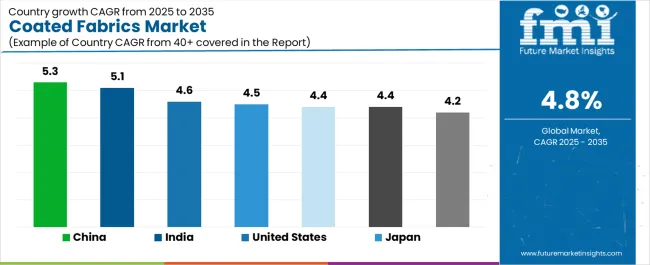
The global coated fabrics market is expected to expand at 4.8% CAGR from 2026 to 2036. Asia Pacific is likely to remain the fastest-growing regional block, while North America and Europe retain strong value share. FMI highlights China at 5.3% CAGR and India at 5.1% CAGR in its country outlook for the 2025 to 2035 period.
How is China Shaping the Coated Fabrics Market?
China remains one of the most important country markets for coated fabrics. Its role is supported by automotive production, industrial manufacturing, and broad technical textile capacity. FMI forecasts that China will be among the fastest-growing markets with a 5.3% CAGR during the forecast period.
China’s relevance comes from scale. It has deep supply chains in synthetic textiles, converting, and industrial production. That gives coated fabric suppliers a strong local demand base and export capability.
What is India’s Role in the Coated Fabrics Market?
India is expected to remain a strong growth market. As per FMI, the market is set to grow at a CAGR of 5.1% during the assessment period. Growth is supported by vehicle manufacturing and infrastructure spending.
India also offers room for localized supply. Buyers in transportation and industrial safety continue to expand sourcing options as domestic manufacturing scales up.
Why Does the United States Remain Important in the Coated Fabrics Market?
The United States remains a key value market because transportation interiors, industrial safety, and replacement demand all stay material. OSHA’s standards framework also supports specification-led procurement in protective applications.
The market is not the fastest-growing globally, but it remains important because buyers place weight on compliance, quality, and service life.
How is Europe Contributing to the Coated Fabrics Market?
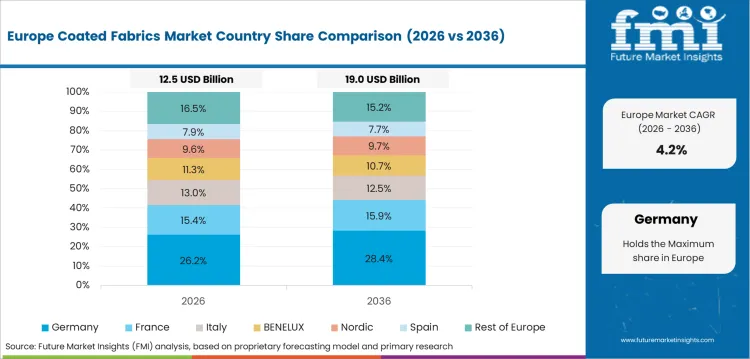
Europe remains important because automotive specifications are demanding and sustainability expectations are rising. The European Commission’s textiles strategy is keeping circularity, durability, and greener chemistry in focus.
That matters for coated fabrics because suppliers will need to show better lifecycle performance and cleaner formulations in future programs.
Competitive Landscape and Strategic Positioning
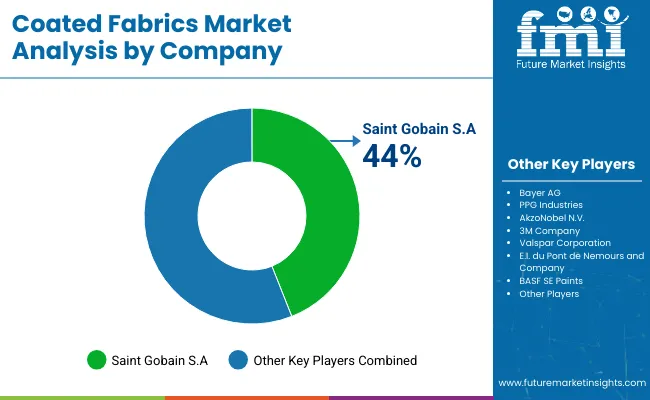
- Competitive advantage comes from coating chemistry, process control, and the ability to meet application-specific standards.
- Buyers prefer suppliers that can deliver stable quality across OEM, industrial, and protective-use programs.
- The strongest vendors are those that combine formulation know-how with dependable customer support and supply execution.
The coated fabrics market includes large technical textile groups, specialty converters, and application-focused suppliers. FMI identifies Continental AG, Serge Ferrari Group, Trelleborg AB, Sioen Industries, Saint-Gobain Performance Fabrics, Seaman Corporation, Spradling International, Haartz Corporation, Cooley Group, and SRF Limited among the leading participants.
Competition is strongest where suppliers can deliver durable coating systems and dependable conversion quality. Buyers also care about qualification support and performance consistency. In transportation, OEM approval remains important. In protective wear, certification support matters more. In engineered structures, long service life remains a key selling point.
Sustainability is also becoming more important. The strongest suppliers are moving toward lower-emission chemistries, PVC-free options, and longer-life products where the application justifies it. Europe’s textiles policy direction is likely to keep that pressure in place.
Key Companies in the Coated Fabrics Market
Key companies active in the market include:
- Continental AG
- Serge Ferrari Group
- Trelleborg AB
- Sioen Industries NV
- Saint-Gobain Performance Fabrics
- Seaman Corporation
- Spradling International
- Haartz Corporation
- Cooley Group
- SRF Limited
Key Players in the Coated Fabrics Market
Major Global Players
- Continental AG
- Serge Ferrari Group
- Trelleborg AB
- Sioen Industries NV
- Saint-Gobain Performance Fabrics
- Seaman Corporation
Regional and Specialist Players
- Spradling International
- Haartz Corporation
- Cooley Group
- SRF Limited
- Other technical textile converters and coated-fabric specialists
Report Scope and Coverage
| Attribute | Details |
|---|---|
| Estimated market size (2026) | USD 52.2 billion |
| Projected market size (2036) | USD 83.5 billion |
| CAGR (2026 to 2036) | 4.8% |
| Historical period | 2021 to 2025 |
| Forecast period | 2026 to 2036 |
| Quantitative units | USD billion / USD billion |
| Key segment coverage | Material Type, Substrate, Application, Coating Chemistry, Distribution Channel, Performance Property, Region |
| Regions covered | North America, Latin America, Western Europe, Eastern Europe, East Asia, South Asia and Pacific, Middle East and Africa |
Market by Segments
By Material Type
- Polymer-coated Fabrics
- Rubber-coated Fabrics
- Fabric-backed Vinyl Composites
- Silicone-coated Fabrics
- Fluoropolymer-coated Fabrics
By Substrate
- Polyester
- Nylon
- Cotton and Blends
- Fiberglass
- Aramid and High-modulus Fibers
By Application
- Transportation
- Protective Clothing
- Industrial
- Commercial Tents and Structures
- Furniture and Upholstery
- Other Applications
By Coating Chemistry
- PU
- PVC
- TPU
- Silicone
- PTFE/PVDF Systems
By Distribution Channel
- Direct OEM Supply
- Converters and Fabricators
- Industrial Distributors
- Project-based Procurement
- Aftermarket and Replacement Sales
By Performance Property
- Abrasion Resistance
- Chemical Resistance
- Flame Retardancy
- Weatherability
- Low-emission Interiors
By Region
- North America
- Latin America
- Western Europe
- Eastern Europe
- East Asia
- South Asia and Pacific
- Middle East and Africa
Research Sources and Bibliography
- Future Market Insights. Coated Fabrics Market. Published October 14, 2025.
- OICA. Production Statistics. 2025.
- OSHA. Personal Protective Equipment Overview.
- European Commission. EU Strategy for Sustainable and Circular Textiles.
- European Commission. Textiles, leather and fur industries.
This Report Answers
- What is the projected size of the coated fabrics market in 2026 and 2036?
- How fast is the coated fabrics market expected to grow through 2036?
- Which application segment is likely to lead the market?
- Which material type remains the largest revenue contributor?
- Why does transportation continue to anchor demand?
- How important is protective clothing in the market mix?
- Which countries are expected to outpace the global average?
- Which companies remain active in the competitive landscape?
Frequently Asked Questions
How big is the coated fabrics market in 2026?
The global coated fabrics market is estimated at USD 52.2 billion in 2026. This is built on FMI’s published 2025 base of USD 50.0 billion and the same 4.8% growth track.
What will be the size of the coated fabrics market in 2036?
The coated fabrics market is projected to reach USD 83.5 billion by 2036. FMI’s published 2035 value is USD 79.9 billion.
How fast will the coated fabrics market grow from 2026 to 2036?
The market is expected to grow at a CAGR of 4.8% during the forecast period.
Which application segment is expected to lead the coated fabrics market?
Transportation is expected to remain the leading application segment. FMI places this segment at 30.0% of the market in 2025.
Which material type is expected to contribute the largest share in 2026?
Polymer-coated fabrics are expected to remain the leading material segment. FMI places this category at 25.0% in 2025.
What is driving long-term demand in the coated fabrics market?
Long-term demand is being driven by transportation interiors, industrial safety needs, and engineered structures that require durable coated materials.
Preview the report firsthand - request a free sample
Get SampleGet the brochure for pricing and purchase details.
Get PDFTable of Content
- Executive Summary
- Global Market Outlook
- Demand-side Trends
- Supply-side Trends
- Technology Roadmap Analysis
- Analysis and Recommendations
- Market Overview
- Market Coverage / Taxonomy
- Market Definition / Scope / Limitations
- Research Methodology
- Chapter Orientation
- Analytical Lens and Working Hypotheses
- Market Structure, Signals, and Trend Drivers
- Desk Research Programme (Secondary Evidence)
- Company Annual and Sustainability Reports
- Peer-reviewed Journals and Academic Literature
- Corporate Websites, Product Literature, and Technical Notes
- Earnings Decks and Investor Briefings
- Statutory Filings and Regulatory Disclosures
- Technical White Papers and Standards Notes
- Trade Journals, Industry Magazines, and Analyst Briefs
- Conference Proceedings, Webinars, and Seminar Materials
- Government Statistics Portals and Public Data Releases
- Press Releases and Reputable Media Coverage
- Specialist Newsletters and Curated Briefings
- Sector Databases and Reference Repositories
- FMI Internal Proprietary Databases and Historical Market Datasets
- Subscription Datasets and Paid Sources
- Social Channels, Communities, and Digital Listening Inputs
- Additional Desk Sources
- Expert Input and Fieldwork (Primary Evidence)
- Primary Modes
- Qualitative Interviews and Expert Elicitation
- Quantitative Surveys and Structured Data Capture
- Blended Approach
- Why Primary Evidence is Used
- Field Techniques
- Interviews
- Surveys
- Focus Groups
- Observational and In-context Research
- Social and Community Interactions
- Stakeholder Universe Engaged
- C-suite Leaders
- Board Members
- Presidents and Vice Presidents
- R&D and Innovation Heads
- Technical Specialists
- Domain Subject-matter Experts
- Scientists
- Physicians and Other Healthcare Professionals
- Governance, Ethics, and Data Stewardship
- Research Ethics
- Data Integrity and Handling
- Primary Modes
- Tooling, Models, and Reference Databases
- Data Engineering and Model Build
- Data Acquisition and Ingestion
- Cleaning, Normalisation, and Verification
- Synthesis, Triangulation, and Analysis
- Quality Assurance and Audit Trail
- Market Background
- Market Dynamics
- Drivers
- Restraints
- Opportunity
- Trends
- Scenario Forecast
- Demand in Optimistic Scenario
- Demand in Likely Scenario
- Demand in Conservative Scenario
- Opportunity Map Analysis
- Product Life Cycle Analysis
- Supply Chain Analysis
- Investment Feasibility Matrix
- Value Chain Analysis
- PESTLE and Porter’s Analysis
- Regulatory Landscape
- Regional Parent Market Outlook
- Production and Consumption Statistics
- Import and Export Statistics
- Market Dynamics
- Global Market Analysis 2021 to 2025 and Forecast, 2026 to 2036
- Historical Market Size Value (USD billion) Analysis, 2021 to 2025
- Current and Future Market Size Value (USD billion) Projections, 2026 to 2036
- Y-o-Y Growth Trend Analysis
- Absolute $ Opportunity Analysis
- Global Market Pricing Analysis 2021 to 2025 and Forecast 2026 to 2036
- Global Market Analysis 2021 to 2025 and Forecast 2026 to 2036, By Application
- Introduction / Key Findings
- Historical Market Size Value (USD billion) Analysis By Application , 2021 to 2025
- Current and Future Market Size Value (USD billion) Analysis and Forecast By Application , 2026 to 2036
- Transportation
- Protective Clothing
- Industrial
- Transportation
- Y-o-Y Growth Trend Analysis By Application , 2021 to 2025
- Absolute $ Opportunity Analysis By Application , 2026 to 2036
- Global Market Analysis 2021 to 2025 and Forecast 2026 to 2036, By Substrate
- Introduction / Key Findings
- Historical Market Size Value (USD billion) Analysis By Substrate, 2021 to 2025
- Current and Future Market Size Value (USD billion) Analysis and Forecast By Substrate, 2026 to 2036
- Polymer
- Nylon
- Cotton and Blends
- Polymer
- Y-o-Y Growth Trend Analysis By Substrate, 2021 to 2025
- Absolute $ Opportunity Analysis By Substrate, 2026 to 2036
- Global Market Analysis 2021 to 2025 and Forecast 2026 to 2036, By Region
- Introduction
- Historical Market Size Value (USD billion) Analysis By Region, 2021 to 2025
- Current Market Size Value (USD billion) Analysis and Forecast By Region, 2026 to 2036
- North America
- Latin America
- Western Europe
- Eastern Europe
- East Asia
- South Asia and Pacific
- Middle East & Africa
- Market Attractiveness Analysis By Region
- North America Market Analysis 2021 to 2025 and Forecast 2026 to 2036, By Country
- Historical Market Size Value (USD billion) Trend Analysis By Market Taxonomy, 2021 to 2025
- Market Size Value (USD billion) Forecast By Market Taxonomy, 2026 to 2036
- By Country
- USA
- Canada
- Mexico
- By Application
- By Substrate
- By Country
- Market Attractiveness Analysis
- By Country
- By Application
- By Substrate
- Key Takeaways
- Latin America Market Analysis 2021 to 2025 and Forecast 2026 to 2036, By Country
- Historical Market Size Value (USD billion) Trend Analysis By Market Taxonomy, 2021 to 2025
- Market Size Value (USD billion) Forecast By Market Taxonomy, 2026 to 2036
- By Country
- Brazil
- Chile
- Rest of Latin America
- By Application
- By Substrate
- By Country
- Market Attractiveness Analysis
- By Country
- By Application
- By Substrate
- Key Takeaways
- Western Europe Market Analysis 2021 to 2025 and Forecast 2026 to 2036, By Country
- Historical Market Size Value (USD billion) Trend Analysis By Market Taxonomy, 2021 to 2025
- Market Size Value (USD billion) Forecast By Market Taxonomy, 2026 to 2036
- By Country
- Germany
- UK
- Italy
- Spain
- France
- Nordic
- BENELUX
- Rest of Western Europe
- By Application
- By Substrate
- By Country
- Market Attractiveness Analysis
- By Country
- By Application
- By Substrate
- Key Takeaways
- Eastern Europe Market Analysis 2021 to 2025 and Forecast 2026 to 2036, By Country
- Historical Market Size Value (USD billion) Trend Analysis By Market Taxonomy, 2021 to 2025
- Market Size Value (USD billion) Forecast By Market Taxonomy, 2026 to 2036
- By Country
- Russia
- Poland
- Hungary
- Balkan & Baltic
- Rest of Eastern Europe
- By Application
- By Substrate
- By Country
- Market Attractiveness Analysis
- By Country
- By Application
- By Substrate
- Key Takeaways
- East Asia Market Analysis 2021 to 2025 and Forecast 2026 to 2036, By Country
- Historical Market Size Value (USD billion) Trend Analysis By Market Taxonomy, 2021 to 2025
- Market Size Value (USD billion) Forecast By Market Taxonomy, 2026 to 2036
- By Country
- China
- Japan
- South Korea
- By Application
- By Substrate
- By Country
- Market Attractiveness Analysis
- By Country
- By Application
- By Substrate
- Key Takeaways
- South Asia and Pacific Market Analysis 2021 to 2025 and Forecast 2026 to 2036, By Country
- Historical Market Size Value (USD billion) Trend Analysis By Market Taxonomy, 2021 to 2025
- Market Size Value (USD billion) Forecast By Market Taxonomy, 2026 to 2036
- By Country
- India
- ASEAN
- Australia & New Zealand
- Rest of South Asia and Pacific
- By Application
- By Substrate
- By Country
- Market Attractiveness Analysis
- By Country
- By Application
- By Substrate
- Key Takeaways
- Middle East & Africa Market Analysis 2021 to 2025 and Forecast 2026 to 2036, By Country
- Historical Market Size Value (USD billion) Trend Analysis By Market Taxonomy, 2021 to 2025
- Market Size Value (USD billion) Forecast By Market Taxonomy, 2026 to 2036
- By Country
- Kingdom of Saudi Arabia
- Other GCC Countries
- Turkiye
- South Africa
- Other African Union
- Rest of Middle East & Africa
- By Application
- By Substrate
- By Country
- Market Attractiveness Analysis
- By Country
- By Application
- By Substrate
- Key Takeaways
- Key Countries Market Analysis
- USA
- Pricing Analysis
- Market Share Analysis, 2025
- By Application
- By Substrate
- Canada
- Pricing Analysis
- Market Share Analysis, 2025
- By Application
- By Substrate
- Mexico
- Pricing Analysis
- Market Share Analysis, 2025
- By Application
- By Substrate
- Brazil
- Pricing Analysis
- Market Share Analysis, 2025
- By Application
- By Substrate
- Chile
- Pricing Analysis
- Market Share Analysis, 2025
- By Application
- By Substrate
- Germany
- Pricing Analysis
- Market Share Analysis, 2025
- By Application
- By Substrate
- UK
- Pricing Analysis
- Market Share Analysis, 2025
- By Application
- By Substrate
- Italy
- Pricing Analysis
- Market Share Analysis, 2025
- By Application
- By Substrate
- Spain
- Pricing Analysis
- Market Share Analysis, 2025
- By Application
- By Substrate
- France
- Pricing Analysis
- Market Share Analysis, 2025
- By Application
- By Substrate
- India
- Pricing Analysis
- Market Share Analysis, 2025
- By Application
- By Substrate
- ASEAN
- Pricing Analysis
- Market Share Analysis, 2025
- By Application
- By Substrate
- Australia & New Zealand
- Pricing Analysis
- Market Share Analysis, 2025
- By Application
- By Substrate
- China
- Pricing Analysis
- Market Share Analysis, 2025
- By Application
- By Substrate
- Japan
- Pricing Analysis
- Market Share Analysis, 2025
- By Application
- By Substrate
- South Korea
- Pricing Analysis
- Market Share Analysis, 2025
- By Application
- By Substrate
- Russia
- Pricing Analysis
- Market Share Analysis, 2025
- By Application
- By Substrate
- Poland
- Pricing Analysis
- Market Share Analysis, 2025
- By Application
- By Substrate
- Hungary
- Pricing Analysis
- Market Share Analysis, 2025
- By Application
- By Substrate
- Kingdom of Saudi Arabia
- Pricing Analysis
- Market Share Analysis, 2025
- By Application
- By Substrate
- Turkiye
- Pricing Analysis
- Market Share Analysis, 2025
- By Application
- By Substrate
- South Africa
- Pricing Analysis
- Market Share Analysis, 2025
- By Application
- By Substrate
- USA
- Market Structure Analysis
- Competition Dashboard
- Competition Benchmarking
- Market Share Analysis of Top Players
- By Regional
- By Application
- By Substrate
- Competition Analysis
- Competition Deep Dive
- Continental AG
- Overview
- Product Portfolio
- Profitability by Market Segments (Product/Age /Sales Channel/Region)
- Sales Footprint
- Strategy Overview
- Marketing Strategy
- Product Strategy
- Channel Strategy
- Serge Ferrari Group
- Trelleborg AB
- Sioen Industries NV
- Saint-Gobain Performance Fabrics
- Seaman Corporation
- Continental AG
- Competition Deep Dive
- Assumptions & Acronyms Used


