


- Clean-label textured protein is gaining pricing power because buyers are no longer evaluating only protein content; they are evaluating source, allergen profile, processing perception, and label simplicity.
- Soy remains the scale leader in textured vegetable protein, but soy-free and pulse-based alternatives are becoming premium options where brands need differentiation.
- Pea, chickpea, fava, and blended textured proteins are benefiting from demand for non-GMO, allergen-aware, vegan, high-protein, and recognizable ingredient claims.
- The clean-label premium is strongest when the ingredient improves both label appeal and finished-product performance; weak texture cannot be rescued by a clean claim alone.
- The biggest risk is treating clean label as a marketing add-on. In textured protein, clean label must be supported by extrusion consistency, sensory quality, and application fit.
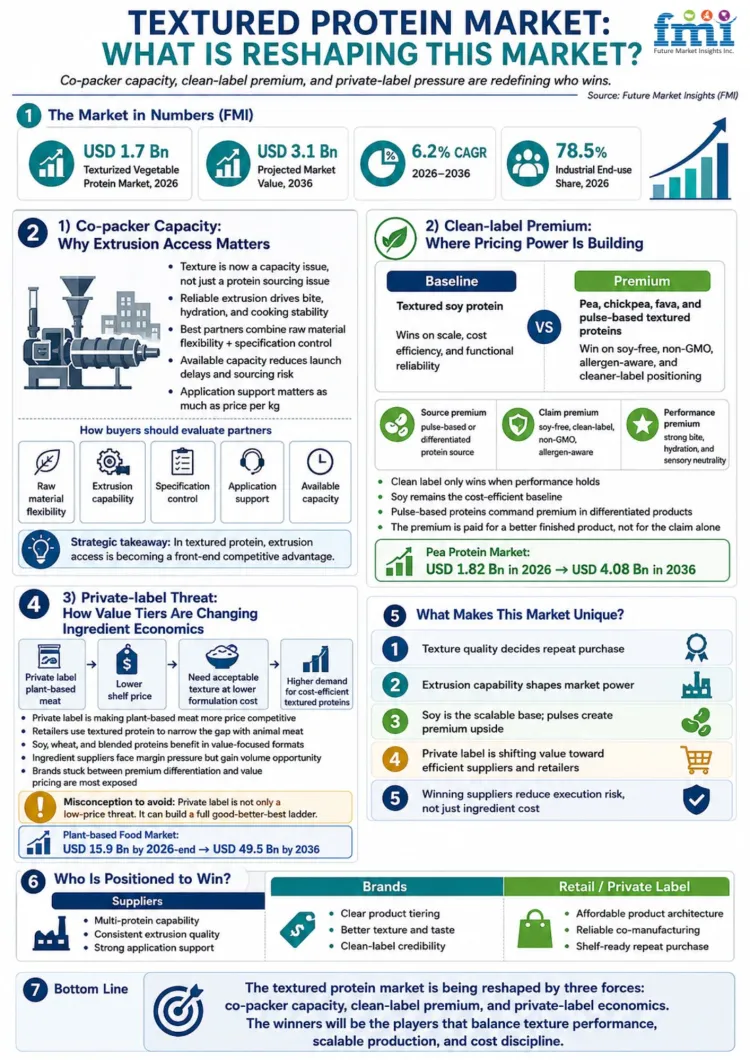
Textured protein is entering a more disciplined phase of growth. The market is no longer driven only by the need to replace meat or add plant protein. The sharper question is now: which textured proteins can justify a premium because they deliver both clean-label positioning and reliable product performance?
This is an important shift. In the early stage of plant-based formulation, brands often focused on protein grams, meat-like claims, and vegan positioning. Today, buyers are more selective. They want textured protein that supports simpler labels, recognizable sources, allergen-aware claims, non-GMO positioning, and better sensory performance. This is why clean-label premium is becoming one of the most important pricing questions in the textured protein market.
FMI’s Texturized Vegetable Protein Market shows that the category is already moving at scale, with the market projected to expand from USD 1.7 billion in 2026 to USD 3.1 billion by 2036. FMI identifies textured vegetable proteins as functional plant derivatives extruded to create fibrous structural textures, delivering chewiness and moisture retention in finished foods. That definition matters because textured protein is not only a nutrition ingredient. It is a structure-building ingredient. The clean-label premium therefore depends on both label value and functional performance.
Soy remains central to the market because it offers cost efficiency, scale, protein density, and processing familiarity. FMI identifies soy protein as the leading source in the texturized vegetable protein market. This leadership is logical. Soy-based textured protein is widely used in meat alternatives, meat extenders, ready meals, sauces, fillings, and industrial food applications. For many processors, soy provides the best balance between price, availability, and functional reliability.
However, soy leadership does not eliminate the clean-label opportunity. In fact, it helps define it. Because soy is the baseline, the premium opportunity sits in the gap between scalable textured soy protein and differentiated textured proteins based on pea, chickpea, fava, wheat, rice, or blended plant sources. Buyers are willing to evaluate higher-priced alternatives when the finished product needs stronger label positioning or when the brand wants to avoid soy-related perception barriers.
This is where pulse-based textured proteins become strategically important. Pea protein is one of the clearest examples. FMI’s Pea Protein Market is projected to expand from USD 1.82 billion in 2026 to USD 4.08 billion by 2036, supported by food processing demand and isolate-led growth. For textured protein buyers, pea offers several advantages: it is plant-based, familiar, widely accepted in vegan and vegetarian formulations, and often used where soy-free positioning is important. Pea-based textured protein can therefore command a premium when it helps a finished brand justify a cleaner, more differentiated ingredient statement.
Chickpea protein also fits the premium logic. FMI’s Chickpea Protein Market is projected to grow strongly between 2026 and 2036, with isolates leading product demand. Chickpea has strong consumer familiarity as a food ingredient, which can support cleaner label storytelling. While chickpea-based texturization is still less mature than soy, its appeal is clear: it gives brands a way to move away from commodity soy positioning and toward more recognizable plant-source claims.
The clean-label premium is also linked to the wider plant-based ingredient market. FMI’s Ingredients Market for Plant-based Food & Beverages shows strong growth from 2026 to 2036, reflecting both plant-based category expansion and increasing ingredient complexity. This is directly relevant to textured protein. As plant-based foods mature, brands are no longer satisfied with basic ingredient substitution. They need cleaner, better-performing, more specialized ingredients that can improve taste, texture, nutrition, and label appeal at the same time.
The same logic appears in FMI’s Clean-label Ingredients Market. The market is projected to grow rapidly through 2036, confirming that clean-label demand is not a niche claim. It is becoming a broader formulation principle across food and beverage categories. For textured protein suppliers, this creates an opportunity to position clean-label offerings not only as plant-based but as simpler, more transparent, and more compatible with consumer expectations for processed foods.
However, not every clean-label textured protein can command a premium. The premium must be earned. A soy-free textured protein that delivers weak bite, poor hydration, off-notes, or unstable cooking behavior will not hold value. In plant-based meat, ready meals, and hybrid formulations, the finished product must still taste good and perform commercially. Clean label can increase trial, but texture and repeat eating experience protect repeat purchase.
This is why the clean-label premium in textured protein should be measured through three lenses: source premium, claim premium, and performance premium. Source premium comes from the protein base, such as pea, chickpea, fava, or blended pulses. Claim premium comes from non-GMO, soy-free, allergen-aware, vegan, high-protein, or minimally processed positioning. Performance premium comes from the ability to deliver consistent bite, hydration, cooking stability, and sensory neutrality. The strongest textured protein suppliers are those that can combine all three.
Price premium versus baseline should therefore be calculated carefully. The baseline is usually conventional textured soy protein because it is scalable, familiar, and cost-efficient. A clean-label alternative should be evaluated against that baseline not only by price per kilogram but also by finished product economics. If a higher-priced pulse-based textured protein reduces masking agents, improves label appeal, supports premium positioning, or improves consumer acceptance, the real value may be higher than the raw ingredient premium suggests.
For brands, this creates a clear segmentation strategy. Mass-market and value products may continue to rely heavily on soy-based textured protein because cost, supply, and functional dependability remain critical. Premium and better-for-you products may use pea, chickpea, fava, or blended textured proteins to support a stronger label story. Hybrid products may use a cost-balanced approach, combining baseline textured soy with differentiated proteins where label claims or sensory benefits justify the added cost.
For suppliers, the opportunity is to avoid selling clean label as a vague promise. Buyers need proof. They need documentation, specification control, origin transparency, allergen statements, non-GMO support where applicable, application testing, and clear guidance on finished-product use. The winning suppliers will not simply say their protein is clean label. They will show how it performs in burgers, nuggets, mince, fillings, sauces, ready meals, and foodservice formats.
For co-packers and extrusion partners, clean-label demand creates a different type of capacity challenge. Pulse-based proteins may behave differently during extrusion compared with soy. They may require different moisture control, preconditioning, temperature settings, particle sizing, drying, and post-processing. This means clean-label textured protein is not only a sourcing decision. It is also a manufacturing capability decision. Suppliers with experience in multiple protein sources will be better placed to capture premium demand.
For food processors, the key question is whether the clean-label premium can be passed through to the customer. In premium plant-based meat, health-focused ready meals, natural food retail, and specialty diet products, the premium may be easier to justify. In value plant-based products or institutional foodservice, the premium may be harder to recover unless the ingredient also improves yield, reduces waste, or supports broader procurement goals.
The regional angle also matters. In markets where soy is accepted and cost sensitivity is high, textured soy protein will remain difficult to displace. In markets where soy-free, non-GMO, allergen-aware, or natural positioning carries stronger value, pulse-based alternatives can gain faster. Europe and North America are likely to remain important clean-label positioning regions because consumers and brands are more sensitive to ingredient lists, allergen claims, and plant-source differentiation. Asia may offer a different mix, where soy familiarity is high but premium plant-based formats are expanding in urban markets.
Clean-label textured protein also intersects with the plant-based food market. FMI’s Plant-Based Food Market is projected to expand strongly between 2026 and 2036, with food and beverage leading the end-use share. This supports a broader interpretation: textured protein demand is not isolated. It is linked to the mainstreaming of plant-based foods, where product quality, label simplicity, and price-positioning are all becoming more important.
The misconception to avoid is that clean label automatically means “less processed.” Textured protein is produced through extrusion or similar structuring processes, so the real clean-label question is not whether processing exists. The question is whether the ingredient source, label declaration, functionality, and finished-product experience feel acceptable to the target buyer. Clean label in textured protein is about better perceived transparency, not the absence of processing.
Another misconception is that soy-free always wins. Soy-free can command a premium in the right application, but soy continues to win where cost, protein density, and established functionality matter most. The clean-label shift should therefore be seen as a portfolio expansion, not a full replacement of soy. The market is likely to move toward a layered structure: soy as the scalable base, pea as the leading premium alternative, and chickpea, fava, wheat, rice, and blends as application-specific options.
Bottom line: the clean-label premium in textured protein will not be captured by every supplier that offers a soy-free or pulse-based option. It will be captured by suppliers that combine clean source positioning with extrusion consistency, sensory performance, documentation, and application support. In textured protein, the premium is not paid for the claim alone. It is paid when the claim helps the brand sell a better finished product.

