


- Frozen food growth is not decided only by consumer demand; it is also limited by freezing capacity, cold storage, co-manufacturing access, packaging lines, and retailer-ready execution.
- FMI identifies Individual Quick Freezing as the leading freezing technique in the Frozen Food Market, showing that preservation quality is now a competitive requirement.
- Co-packers matter most in frozen ready meals, frozen bakery, frozen fruits and vegetables, seafood, snacks, plant-based frozen foods, and private-label ranges.
- Brands can create trial with strong recipes and claims, but they cannot scale without dependable temperature control, freezer-safe packaging, and consistent production discipline.
- Capacity pressure rises when brands move from basic frozen products into premium, high-protein, plant-based, clean-label, cuisine-specific, and foodservice-ready formats.
- The biggest misconception is that frozen food scale is mainly a marketing problem. In reality, it is often a manufacturing, freezing, packaging, and cold-chain execution problem.
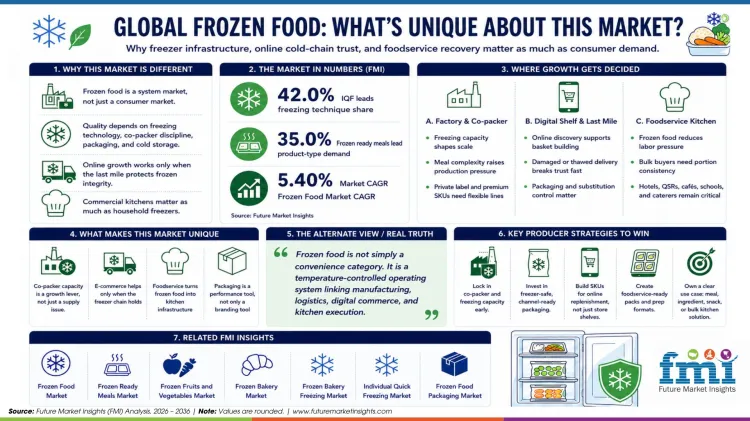
Frozen food is often discussed as a demand-led category. Consumers want convenience, retailers want higher freezer traffic, foodservice operators want lower prep complexity, and brands want wider distribution. That view is directionally right, but incomplete. In the Frozen Food Market, the sharper constraint is often not demand. It is the ability to freeze, pack, store, move, and replenish products without damaging quality.
This is why co-packer capacity is one of the most practical angles for frozen food. A brand can have strong recipes, attractive claims, good retail interest, and a promising consumer need state. But if the manufacturer cannot secure the right freezing line, filling system, tray-sealing capability, cold storage, allergen controls, or temperature-managed logistics, the product cannot scale reliably. Frozen food exposes operational weakness faster than many ambient categories because quality loss is visible in the eating experience.
The category is broad. It includes frozen ready meals, frozen fruits and vegetables, frozen meat, seafood, dairy products, bakery products, soups, sauces, snacks, appetizers, desserts, and prepared components. Each product family carries a different capacity requirement. A frozen berry line, frozen vegetable line, frozen pizza line, frozen seafood line, frozen bakery line, and frozen ready meal facility are not interchangeable. A co-packer that is strong in bagged vegetables may not be suited to premium multi-compartment meals. A bakery freezer with strong dough-handling capability may not be appropriate for seafood or cooked entrées.
FMI’s Frozen Food Market identifies Individual Quick Freezing as the leading freezing technique. This matters because IQF is not just a technical detail; it is a quality-preservation advantage. In products such as fruits, vegetables, seafood, potato products, and prepared ingredients, IQF helps protect individual piece integrity, reduce clumping, support portioning, and maintain texture. Consumers may not always know the term, but they notice the outcome when berries separate cleanly, vegetables retain bite, and seafood portions cook evenly.
The Individual Quick Freezing Equipment Market is therefore directly linked to frozen food competitiveness. Brands and co-packers with access to better freezing systems can support products where texture, color, moisture control, and piece separation matter. This is especially relevant as frozen food moves away from basic storage convenience and toward premium quality cues. A weak freezing process can damage the very product attributes that premium brands depend on.
Co-packer capacity becomes more complicated in frozen ready meals. The Frozen Ready Meals Market shows why complete meal formats are central to the broader frozen food category. These products require coordination across several ingredient systems: cooked protein, rice or pasta, vegetables, sauces, seasoning, fat systems, tray format, portion control, and reheating performance. A meal must survive freezing and still behave like a meal after microwave or oven preparation. This makes co-manufacturing far more complex than simply filling a pack and freezing it.
Frozen cooked meals add another layer. The Frozen Cooked Ready Meals Market is relevant because cooked formats require strict control over food safety, moisture migration, sauce stability, and heat regeneration. A brand may want restaurant-style curry, lasagna, rice bowl, pasta, or protein entrée, but the factory must translate that concept into a stable frozen system. The issue is not only recipe taste at the development kitchen. The issue is whether the product can be produced repeatedly at scale and still perform after distribution.
Frozen bakery has a different capacity logic. The Frozen Bakery Market depends on dough handling, proofing behavior, butter or fat stability, lamination, bake-off performance, and freeze-thaw tolerance. Croissants, pastries, pizza bases, parathas, bread rolls, cakes, and ready-to-bake products all require different line capabilities. For bakery brands and foodservice suppliers, capacity is not only about volume. It is about whether the product finishes correctly after storage, thawing, baking, or reheating.
Frozen fruits and vegetables are more ingredient-led but still capacity-sensitive. The Frozen Fruits and Vegetables Market and Frozen Vegetable Market show why household and commercial users value year-round access, waste reduction, and portion control. However, quality depends heavily on harvest timing, blanching, cutting, freezing, sorting, packaging, and cold storage. Poor upstream handling cannot be corrected later through marketing.
Private label makes co-packer capacity even more important. Retailers often want frozen products across value, mainstream, premium, health-led, and cuisine-led tiers. Many retailers do not manufacture these products themselves. They rely on co-packers and private-label suppliers to convert briefs into freezer-ready products. The best co-packers are not simply low-cost producers. They can manage retailer specifications, pack formats, promotional surges, allergen requirements, product claims, and delivery schedules.
Capacity pressure increases when brands pursue cleaner labels and premium positioning. Removing additives, reducing sodium, using whole ingredients, adding plant-based proteins, or developing global cuisine sauces can make production more complex. Sauces must remain stable. Vegetables must avoid water release. Proteins must not become dry. Bakery items must not collapse. Seafood must retain texture. Cheese and plant-based sauces must not split. Frozen food innovation may look simple on the front of the pack, but it is often difficult inside the production line.
Packaging is another constraint. The Frozen Food Packaging Market is closely connected to capacity because packaging must protect against freezer burn, moisture migration, seal failure, frost damage, and handling stress. It also has to support microwave or oven use, portioning, shelf visibility, online presentation, and retailer logistics. A weak pack can undermine a strong product.
For brands, the strategic decision is whether to build, buy, or partner. Building owned frozen capacity gives control, but requires capital, technical talent, energy management, food safety systems, and cold storage. Using a co-packer accelerates market entry, but creates dependency on available line time, confidentiality, quality systems, and production scheduling. A brand that scales faster than its co-packer can handle may face stock-outs, inconsistent quality, or retailer frustration.
The misconception to avoid is that frozen food scale is mainly about winning retail listings. Listings matter, but they expose weakness if the production base is not ready. A brand that secures national distribution before locking in reliable freezing, packing, and cold-chain capacity can damage its own credibility.
Bottom line: frozen food winners are not only the brands with strong consumer demand. They are the brands with access to reliable freezing assets, co-packer discipline, freezer-safe packaging, cold storage, and logistics systems that allow the product to perform from factory to freezer to plate.
Related FMI Reports
- Frozen Food Market
- Individual Quick Freezing Equipment Market
- Individual Quick Freezing Market
- Frozen Ready Meals Market
- Frozen Cooked Ready Meals Market
- Frozen Bakery Market
- Frozen Food Packaging Market

