


- Format expansion can support repeat demand in collagen peptides, but only when dosage, taste, solubility, convenience, and claim clarity are already strong.
- Buyers are willing to build collagen peptides into powders, gummies, capsules, RTD beverages, shots, stick packs, and functional foods, but FMI public data does not show one universal collagen peptide format winner.
- The strongest repeat-demand opportunity sits in daily powders, beauty-from-within stick packs, RTD collagen drinks, skin health gummies, joint health supplements, active nutrition blends, and healthy aging formats.
- Format matters more in collagen peptides when it reduces consumer friction: hard-to-mix powders, poor taste, fishy odor, unclear dosage, inconvenient routines, and weak benefit communication.
- The biggest risk is treating collagen format innovation as packaging only. In collagen peptides, the winning format is the one that makes daily use easier and still protects ingredient performance.
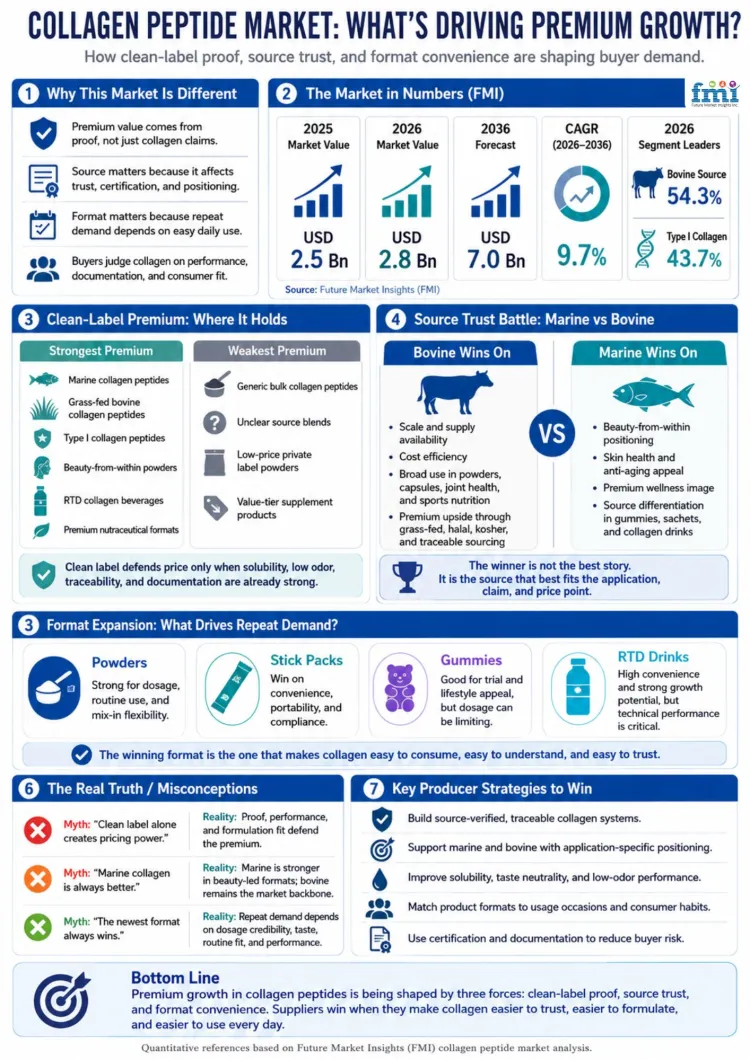
Collagen peptide demand is no longer being shaped only by ingredient source or collagen type. It is increasingly being shaped by format. The same collagen peptide ingredient can behave very differently when placed in a powder, gummy, RTD drink, capsule, shot, sachet, bar, or functional food product. That means the repeat-demand question is not simply 'Do consumers want collagen?' It is 'Which format makes collagen easy enough to use every day?'
FMI’s Collagen Peptide Market shows why format expansion matters. FMI indicates that the collagen peptide market was valued at USD 2.5 billion in 2025, is expected to reach USD 2.8 billion in 2026, and is projected to reach USD 7.0 billion by 2036, reflecting a 9.7% CAGR. This growth is linked to the wider use of collagen peptides across nutraceuticals, medical nutrition, beauty-from-within, sports nutrition, functional foods, beverages, joint health, powders, gummies, and healthy aging products.
The first format layer is powders. Powders remain one of the most important collagen peptide formats because they allow higher serving sizes, flexible dosing, and easy positioning around beauty, joints, mobility, sports recovery, and healthy aging. A powder can be added to water, coffee, smoothies, dairy alternatives, functional beverages, or protein blends. This makes powders attractive for consumers who want a daily collagen routine and for brands that need stronger dosage communication.
However, powders do not win automatically. Repeat purchase depends on whether the product mixes easily, tastes neutral, avoids odor, and fits into the consumer’s daily habit. A collagen powder that clumps, smells unpleasant, or requires heavy flavor masking will struggle even if the source claim is strong. In powders, the premium is defended by solubility, sensory neutrality, and routine convenience.
Stick packs are a sharper version of the powder opportunity. They reduce measuring friction and make collagen easier to carry, sample, and consume. Beauty-from-within brands, women’s wellness brands, and active lifestyle brands can use stick packs to create a controlled daily-use format. For buyers, stick packs are useful because they connect collagen with habit formation. The consumer does not need to open a tub, measure a scoop, or think about serving size.
The second format layer is gummies. Gummies are attractive because they make collagen feel easy, familiar, and enjoyable. They are especially relevant for beauty, skin health, hair and nail support, and general wellness positioning. A collagen gummy can reach consumers who may not want powders or capsules. This gives gummies a strong role in trial, impulse purchase, and lifestyle-led wellness routines.
But gummies have a technical ceiling. Collagen peptides require meaningful dosage, and gummies create formulation constraints around serving size, sugar systems, texture, stability, taste, and active loading. If the collagen dose is too low, the product may feel weak. If the dose is too high, the gummy may lose texture or taste appeal. This is why gummies are strong for convenience and consumer appeal, but they must be carefully positioned around realistic dosage and benefit communication.
The third format layer is RTD collagen nutrition. Ready-to-drink collagen beverages are one of the most strategically interesting formats because they place collagen peptides into a high-convenience, lifestyle-led consumption occasion. RTD collagen drinks can target beauty, hydration, active nutrition, recovery, skin health, and healthy aging. They can also help brands move collagen from supplement shelves into beverage occasions.
FMI highlights the importance of highly soluble peptide variants and hydrolysis precision in cold collagen drinks. This matters because RTD beverages create higher formulation risk than capsules or powders. Beverage brands must manage solubility, taste, clarity, heat stability, acidity, precipitation, and sedimentation. A collagen peptide that performs well in powder may not automatically perform well in a cold-fill or acidic beverage.
This is why RTD collagen has strong growth potential but also higher technical barriers. The winning suppliers are those that can deliver low-molecular-weight, water-soluble peptides with consistent batch performance. If a beverage develops cloudiness, sedimentation, or off-notes, the format loses repeat demand quickly. In RTD collagen, convenience attracts the buyer, but formulation stability keeps the buyer.
Capsules and tablets play a different role. They are less experiential than gummies or RTD drinks, but they remain important for consumers who want simplicity, portability, and controlled supplementation. Capsules are useful in joint health, beauty supplements, healthy aging products, and clinical-style nutraceutical positioning. The challenge is that capsules may limit serving size, which means the brand must be clear about dosage and expected use.
Functional foods and bars create another format path. Collagen peptides can be added to bars, snacks, dairy-style products, and fortified foods, but these formats depend heavily on taste, texture, and claim fit. The consumer may like the idea of collagen in a snack, but repeat demand still depends on whether the product tastes good and whether the collagen claim feels meaningful rather than decorative.
The role of source also changes by format. FMI expects bovine collagen to lead the source type segment with 54.3% share in 2026. Bovine collagen peptides are well suited to larger-volume formats such as powders, capsules, joint health supplements, sports nutrition blends, and healthy aging products because they offer scale, cost efficiency, and broad commercial availability. Marine collagen peptides may be more attractive in beauty sachets, premium gummies, collagen drinks, and skin health formats where source differentiation supports the brand story.
The role of collagen type also matters. FMI expects Type I collagen peptides to lead the product type segment with 43.7% share in 2026. Type I collagen fits strongly with beauty, skin, bone, tendon, ligament, and connective tissue positioning. This makes it especially useful in powders, beauty stick packs, collagen drinks, skin health gummies, and healthy aging supplements where the consumer-facing benefit needs to be easy to understand.
The format premium is strongest when the format matches the use occasion. Powders work well for routine and dosage. Stick packs work well for convenience and compliance. Gummies work well for taste-led wellness and trial. RTD drinks work well for lifestyle nutrition and impulse consumption. Capsules work well for simple supplement behavior. Functional foods work well when the collagen claim supports a familiar eating occasion.
The format premium is weakest when the product creates confusion. A low-dose collagen gummy with weak benefit communication may look convenient but fail to build trust. A premium RTD collagen drink with sedimentation or off-notes may attract first purchase but lose repeat demand. A large collagen powder with poor mixability may offer better dosage but fail in daily use. A capsule product may feel simple but may not communicate enough value if the dosage is unclear.
The comparison with adjacent collagen categories is useful. FMI’s Collagen Market is projected to grow from USD 5.5 billion in 2026 to USD 9.6 billion by 2036, while the Collagen Hydrolysates Market is projected to rise from USD 1.3 billion in 2025 to USD 3.0 billion by 2036. These categories show that collagen demand is broadening, but collagen peptides have a specific advantage in format expansion because they are designed for bioavailability, solubility, and functional nutrition use.
The misconception to avoid is that the newest format automatically wins. It does not. RTD drinks may look more modern than powders, and gummies may feel more consumer-friendly than capsules, but repeat demand depends on dosage credibility, taste, habit fit, and performance. In collagen peptides, a boring daily powder can outperform a trendy gummy if it delivers a clearer dose and better routine value.
For suppliers, the practical lesson is simple. Do not sell collagen peptides only as ingredients. Sell them as format solutions. Beverage brands need solubility and stability. Gummy brands need taste and active loading support. Powder brands need neutral sensory performance and easy dispersion. Capsule brands need purity and documentation. Functional food brands need compatibility with texture and processing.
Bottom line: collagen peptide repeat demand is not being driven by one format alone. Powders remain strong because they support dosage and daily routine. Gummies expand trial and convenience. RTD drinks create lifestyle-led growth but require stronger technical performance. The winning format is the one that makes collagen easier to consume, easier to understand, and easier to trust.

