


- Animal feed additives are moving beyond growth and gut-health claims into emissions, nutrient-use efficiency, and sustainability-linked performance.
- Methane-reduction additives show how feed inputs can become tools for dairy and beef supply-chain decarbonization.
- Nitrogen efficiency, enzyme systems, mineral bioavailability, and gut-health additives can support lower waste and better feed utilization.
- Retailers, dairy processors, meat buyers, and regulators are increasingly asking for measurable outcomes rather than broad sustainability narratives.
- The strongest opportunity sits where additive use can be linked to verified performance, feed conversion, animal welfare, and environmental reporting.
- The misconception to avoid is that sustainability additives are separate from productivity. In feed, environmental outcomes must still work through animal performance and farm economics.
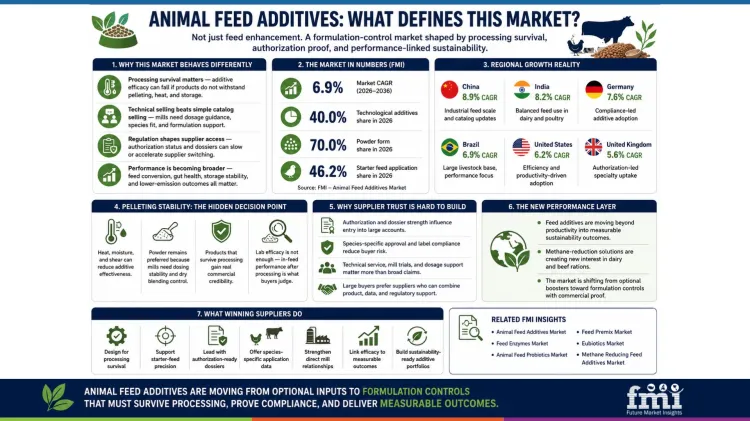
The animal feed additives market has traditionally been evaluated through livestock performance: better feed conversion, improved gut health, stronger growth, feed preservation, disease-pressure management, and palatability. Those priorities remain central. What is changing is that sustainability outcomes are becoming part of the performance equation. Feed additives are increasingly being assessed for their ability to reduce methane, improve nutrient-use efficiency, lower waste, and support documented animal protein supply-chain goals.
This makes emissions-linked additives a strong trend angle for the Animal Feed Additives Market. The market is not shifting away from productivity; it is expanding the definition of productivity. A feed program that improves output while reducing emissions intensity, nutrient loss, or feed waste can create value for producers, processors, retailers, and end customers. The additive becomes a tool not only for the animal, but for the supply chain.
FMI's Animal Feed Additives Market discussion notes that livestock producers are seeking higher feed efficiency and that additive use is tied to animal health and feed stability. The same logic now extends to sustainability. Improving digestibility can reduce undigested nutrients. Enzymes can improve nutrient release from feed materials. Organic acids and gut-health products can support intestinal efficiency. Mineral source selection can affect excretion and bioavailability. Preservatives can reduce feed spoilage. Each of these effects can connect operational performance with environmental outcomes.
Methane-reduction additives are the most visible example. FMI's discussion of the animal feed additives sector cites DSM-Firmenich's Bovaer authorization in Canada and reported methane-reduction results for dairy and feedlot beef cattle. This example matters because it shows how additives can move from nutrition support into measurable supply-chain sustainability. Dairy processors, beef buyers, and retailers increasingly need credible ways to reduce emissions intensity without reducing output. Feed additives offer one route, but only if the results are measurable and economically workable.
The Algae based Animal Feed Market is also relevant because algae-derived feed inputs are being explored across poultry, ruminant, swine, aquaculture, and pet nutrition. Some algae-based inputs are positioned around natural functionality, pigmentation, omega fatty acids, immune support, or methane-related applications depending on species and formulation. The broader signal is that sustainability-linked ingredients are entering feed formulation through multiple routes, not only synthetic additives.
Enzymes provide another route to sustainability through nutrient efficiency. The Feed Enzymes Market supports the logic that improving nutrient release can reduce reliance on excess raw material inclusion. Phytase can improve phosphorus availability. Carbohydrases can improve use of non-starch polysaccharides. Proteases can support amino acid availability. When enzymes improve nutrient utilization, they can support feed cost control and reduce nutrient excretion. The sustainability benefit depends on real performance, not only the enzyme claim.
The Multi-Enzyme Blends Market is relevant because feed materials vary by region, season, crop quality, and ration structure. Multi-enzyme systems can help feed mills manage variability and improve digestibility across mixed raw material bases. This matters as climate variability and raw-material volatility make feed quality less predictable. A system that increases the usable value of feed inputs can support both economic and environmental efficiency.
Gut-health additives can also fit this sustainability logic. The Animal Feed Probiotic Market, Animal Feed Prebiotics Market, and Eubiotics Market all connect with feed efficiency, intestinal balance, and reduced dependence on antibiotic growth promotion. A healthier gut can support better nutrient absorption and lower performance losses. The sustainability claim should not be exaggerated, but the pathway is commercially relevant: better health and digestion can reduce waste, mortality, and inefficient feed use.
Minerals create another example. The Trace Minerals in Feed Market highlights the importance of bioavailability and direct technical selling in mineral nutrition. Highly bioavailable mineral sources may allow more precise dosing and lower excretion compared with less efficient sources. For integrated supply chains facing environmental scrutiny, mineral efficiency is not only a technical nutrition issue; it can become part of waste and compliance management.
However, sustainability-linked additives must clear a high proof bar. Broad claims about lower emissions or improved sustainability are not enough for commercial adoption. Feed mills and integrators need to understand the species, dose, baseline diet, production system, measurement method, and expected outcome. A methane additive for dairy cattle is not the same as an enzyme strategy for poultry or a mineral strategy for aquaculture. The end-use logic must be specific.
Economics also decide adoption. Producers will not adopt sustainability additives at scale if they damage productivity, feed intake, animal health, or margin. A sustainability additive that reduces emissions but lowers milk yield or growth rate will face resistance unless the economics are offset through premiums, regulatory support, or supply-chain incentives. This is why additive suppliers must connect environmental outcomes to farm-level value.
Retailer and processor pressure can accelerate adoption. Dairy companies, meat processors, restaurant chains, and grocers increasingly set sourcing standards related to emissions, animal welfare, antibiotic use, and supply-chain transparency. When these buyers demand measurable improvements, integrators may be more willing to test additives that support reporting. This shifts the selling conversation from "Does it improve animal performance?" to "Can it improve animal performance and satisfy customer sustainability requirements?"
The challenge is measurement. Sustainability-linked performance must be verified through field trials, lifecycle assumptions, emissions models, feed conversion data, manure or nutrient indicators, or processor-level reporting systems. Without measurement, claims remain vulnerable. Suppliers that provide trial design, data interpretation, and practical implementation support will be better positioned than suppliers that sell sustainability language without proof.
For additive suppliers, the opportunity is to build solutions that combine performance, documentation, and environmental relevance. Methane-reduction compounds, enzymes, probiotics, prebiotics, organic acids, mineral systems, antioxidants, preservatives, and algae-based inputs may all play roles, but each must be tied to a clear use case. The strongest products will not be marketed as generic green additives. They will be positioned around a measurable production problem.
The misconception to avoid is that sustainability additives are separate from productivity additives. In feed, the two are increasingly linked. Environmental performance is commercially meaningful only when it works through animal biology, feed economics, and customer requirements.
Bottom line: emissions-linked feed additives are reshaping the animal feed additives market by adding a new layer of performance measurement. The winners will be suppliers that can prove productivity, sustainability, and economic value in the same formulation.

