


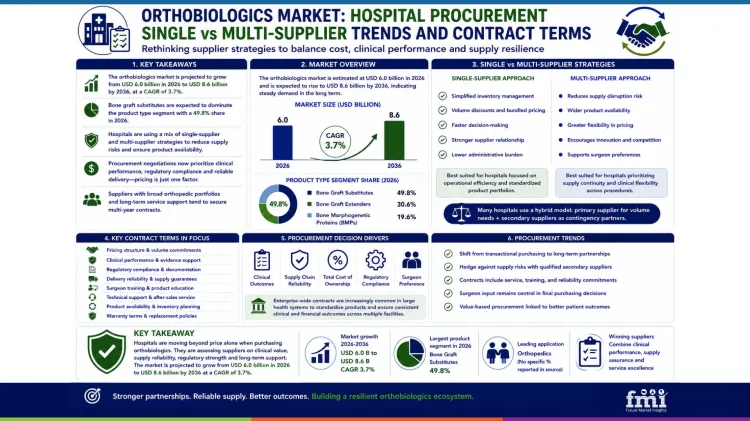
- The orthobiologics market is projected to grow from USD 6.0 billion in 2026 to USD 8.6 billion by 2036, at a CAGR of 3.7%.
- The product type segment is anticipated to be dominated by bone graft substitutes, which are expected to hold 49.8% of the product type segment in 2026.
- Hospitals are hedging their bets, using both single supplier contracts and multi-supplier approaches to mitigate supply chain risks and ensure product availability.
- In procurement negotiations, pricing is becoming as important as clinical performance, regulatory compliance and reliable delivery schedules.
- Suppliers with broad orthopedic portfolios and long-term service support tend to get multi-year buying contracts.
- Growing use of bone graft substitutes in spinal fusion, trauma repair and reconstructive surgery is reinforcing demand across hospital procurement networks
Procurement Strategies Are Evolving Beyond Lowest-Cost Purchasing
The buying of orthobiologics has changed dramatically in the past decade. Procurement teams no longer choose suppliers based on acquisition cost alone. Instead, clinical performance, supply continuity, physician preference, inventory management and contract flexibility are driving the purchasing decisions.
According to Future Market Insights, the orthobiologics market is expected to reach a value of USD 6.0 billion in 2026 and USD 8.6 billion by 2036, growing at a CAGR of 3.7% over the forecast period. The product type segment is expected to hold 49.8% of the market share in 2026 due to increasing importance of bone graft substitutes in orthopedic purchasing strategies.
Historically hospitals have often opted to contract with one supplier for simplified inventory management and better prices. With one vendor, administration was simplified and discounts were often bundled across multiple orthopedic product categories.
Recent supply chain disruptions have procurement teams questioning this strategy. In fact, many healthcare providers now have qualified secondary suppliers to mitigate the risk of shortages impacting planned orthopedic procedures. Multi-supplier strategies increase resilience to operations and continuity of patient care.
This trend is especially strong for high-volume products like bone graft substitutes. These materials are widely used in spinal fusion, trauma repair and reconstructive surgery, so hospitals need consistent availability of inventory throughout the year. Procurement managers may be able to award primary contracts to other approved vendors as contingency partners.
The scope of the contracts is also expanding. Hospitals are looking past price, to supplier commitments around delivery reliability, technical training, product availability, regulatory documentation and post-sales support. Companies that can provide these services often forge long-term relationships with clients.
The role of doctors in procurement decisions remains central. Surgeons generally favor biologic products that handle predictably and have clinical data to support their use. When making final purchasing agreements, procurement committees will look at financial aims versus doctor experience and patient results.
Integrated delivery networks and large health systems frequently negotiate enterprise-wide contracts across multiple facilities. Suppliers with diversified orthopedic portfolios and the capacity to manufacture and supply a broader range of products under a single contract could be attracted to consolidated purchasing models.
The buying environment is expected to remain competitive, as hospitals weigh the need for financial efficiency against the desire to retain access to leading-edge regenerative technologies. Manufacturers with a history of successful clinical outcomes that can combine with reliable supply chains are likely to remain preferred partners in future buying cycles.
Bottom Line
Hospitals buying orthobiologics are looking beyond price negotiations to judge suppliers on a wider range of issues, including the clinical evidence they bring, reliability of their delivery and security of their supply. Though single-supplier contracts can still be more efficient operationally, many healthcare providers are opting for multi-supplier strategies to mitigate risk of disruption. The market size is estimated to grow from USD 6.0 billion in 2026 to USD 8.6 billion by 2036. Good partnerships and reliable products will still be a key competitive advantage.
Related FMI Reports
- Orthobiologics Market
- Bone Graft Substitutes Market
- Regenerative Medicine Market
- Spinal Implants and Devices Market
- Orthotic Devices, Orthotic Splints, and Orthopedic Braces and Support Market
- Sports Medicine Market
- Joint Reconstruction Devices Market
- Biomaterials Market
- Bone Growth Stimulators Market
- Surgical Navigation Systems Market

