


- Automotive pillar materials are evolving around a controlled trade-off, namely reducing body weight without weakening roof strength, side-impact protection, cabin stiffness, and windshield support.
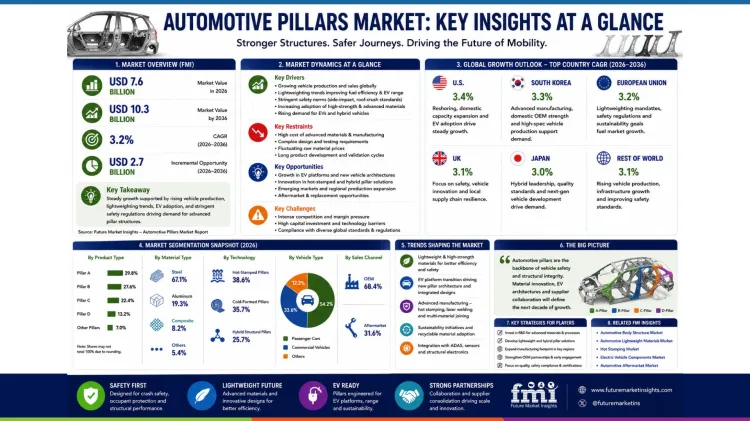
- Pillar A leads the product category with 29.8% share in 2026, making front structural visibility, roof-load transfer, and windshield reinforcement central to material decisions.
- Passenger cars account for 54.2% of vehicle-type demand, which keeps material selection highly exposed to mass-production cost and platform-level crash requirements.
- Steel remains the practical base for many pillar applications because advanced and ultra-high-strength grades can deliver crash performance at scale.
- Aluminum and composites are gaining attention where vehicle lightweighting, EV range, premium design, or multi-material body structures justify higher engineering cost.
- The market signal is not a simple shift away from steel. It is a move toward hot-stamped steel, hybrid structures, selective aluminum, and composite reinforcement in application-specific locations.
Automotive pillars are small in visible surface area and large in safety responsibility. The A-pillar supports the windshield opening and helps transmit roof and frontal loads. The B-pillar is central to side-impact protection and door aperture strength. C- and D-pillars influence rear body stiffness, roof support, styling, and crash load paths. A lighter pillar can help fuel economy or EV range, and a weaker pillar can compromise occupant protection.
That tension makes lightweighting different in pillars than in cosmetic body panels. A hood, fender, or exterior closure can be redesigned for mass reduction with fewer safety implications. A pillar sits inside the safety cage. It must absorb, transfer, or resist crash forces while preserving the occupant survival space. This is why pillar material evolution is measured and highly validated rather than disruptive.
FMI values the automotive pillar market at USD 7.3 billion in 2025, rising to USD 7.6 billion by 2026 and USD 10.3 billion by 2036 at a 3.2% CAGR. Pillar A is expected to hold 29.8% of product-type demand in 2026, while passenger cars account for 54.2% of vehicle-type demand. Original equipment manufacturer supply accounts for 68.4% of sales channel demand. These shares indicate a market led by high-volume, platform-integrated, safety-certified components.
Material choices in this category begin with steel. Advanced high-strength steel and ultra-high-strength steel remain widely used because they combine crash strength, manufacturability, cost control, and established joining methods. Hot-stamped boron steels are often selected for safety-critical zones because they deliver very high strength after forming and heat treatment. A B-pillar reinforcement may require strength that allows the passenger compartment to resist intrusion during a side impact.
WorldAutoSteel and the broader steel industry have consistently positioned advanced steel as a lightweighting material rather than only a traditional metal. The reason is that higher-strength grades allow thinner sections or optimized geometries while retaining crash performance. This is relevant for pillars because designers often need stiffness, energy management, weldability, and predictable deformation in one component set.
Aluminum enters the conversation where mass reduction has a stronger value case. Premium vehicles, EVs, and certain body-in-white architectures may use aluminum extrusions, castings, or stamped parts to reduce weight. The advantage is density. Aluminum can lower mass, which helps range, fuel efficiency, and handling. The complication is crash design. Aluminum behaves differently from steel under deformation, and it may require larger sections, special joining, corrosion management, and costlier manufacturing steps.
Composites occupy a more selective position. Carbon fiber reinforced plastics and glass fiber composites can offer weight advantages and stiffness benefits in targeted applications. Their use in pillars is limited by cost, cycle time, repairability, joining complexity, and crash validation. A premium or performance vehicle may justify composite reinforcement, and high-volume passenger cars usually need lower-cost and faster manufacturing routes.
The evolution is therefore toward multi-material design rather than wholesale material replacement. One vehicle may use hot-stamped steel in B-pillars, aluminum in adjacent structural members, polymer-composite reinforcements in selected zones, and cold-formed steel in less critical areas. The pillar is increasingly part of a load-path system, not a standalone part chosen by material family.
Crash standards keep this evolution disciplined. The NHTSA side crash rating represents an intersection-type collision using a 3,000-pound moving deformable barrier at 38.5 mph into a standing vehicle. Pillar and side structure performance influence how crash loads enter the cabin and how occupant space is protected. Roof crush requirements add another layer. The NHTSA roof-crush standard is intended to reduce deaths and serious injuries caused when the roof is pushed into the occupant compartment during rollover crashes.
These safety pressures explain why lightweighting cannot be treated as a weight-reduction exercise alone. A-pillar thickness affects visibility, and reducing it without preserving strength can create structural risk. B-pillar reinforcements influence side-impact intrusion, and making them too heavy affects mass and manufacturing cost. C- and D-pillars influence body stiffness and rear crash behavior, and they also shape design and visibility.
The role of hot-stamped pillars is likely to strengthen where automakers need high strength with controlled part geometry. FMI includes hot-stamped pillars, cold-formed pillars, and hybrid structural pillars in the market taxonomy. Hot stamping supports ultra-high-strength structures. Cold forming can remain appropriate for standard body sections. Hybrid structures are likely to gain when OEMs need to combine crash protection, mass savings, and material efficiency.
For suppliers, this creates a technology ladder. A basic cold-formed steel supplier may remain relevant in cost-sensitive programs, and higher-value opportunities sit in hot stamping, tailored blanks, laser welding, advanced joining, simulation support, and multi-material integration. Suppliers that can validate crash performance early in development may have an advantage over those offering only fabrication capacity.
The cost-performance balance remains central. Automotive pillars are usually supplied through OEM contracts, and FMI places OEMs at 68.4% of sales channel demand. That channel structure favors established suppliers with quality certifications, delivery reliability, and engineering capability. Material innovation must fit production takt times, tooling investments, joining systems, corrosion protection, repair standards, and warranty expectations.
Passenger cars create the broadest demand base, and commercial vehicles also influence material choices. Light commercial vehicles may prioritize durability and cost over extreme lightweighting. Heavy commercial vehicles need robust structural parts. EV passenger cars may push more aggressively toward lightweighting because additional mass affects range and battery sizing. Hybrid vehicles need a balanced approach because efficiency gains matter and cost remains important.
The material transition also interacts with visibility and styling. A-pillars have become thicker in many vehicles because of safety requirements and airbags, raising concerns around driver visibility. Engineers may use high-strength materials to preserve strength while controlling section size. That is a different type of lightweighting, not only reducing kilograms, but optimizing structural geometry to meet safety and visibility targets together.
A common procurement assumption deserves revision. Lower-weight material is not automatically the better pillar material. The better material is the one that meets the crash target, fits the vehicle architecture, can be manufactured at scale, and delivers weight savings without downstream cost penalties. In this market, material selection is an engineering decision before it is a purchasing decision.
The direction appears clear. Steel will remain central, particularly advanced and hot-stamped grades. Aluminum will gain where platform economics reward mass reduction. Composites will remain selective and strategically useful in premium, EV, and advanced structural designs. Suppliers that understand crash load paths, not just material substitution, will be better positioned.
The more credible reading is that automotive pillar materials are evolving toward smarter use of strength, not simply lighter materials. The winning structure may use less material in some locations, stronger material in others, and multiple joining methods across the body-in-white. Lightweighting is becoming more precise because crash safety leaves little room for generic substitution.

