


- Fermented ingredients are shifting from traditional preservation and culture-led foods toward controlled bio-manufacturing, functional nutrition, and precision-produced ingredients.
- Food and beverages lead fermented ingredient application demand, but the market now extends into amino acids, enzymes, proteins, probiotics, postbiotics, preservatives, and functional compounds.
- Precision fermentation is changing the competitive frontier by producing targeted proteins, fats, enzymes, and bioactive molecules through controlled microbial systems.
- Postbiotics and fermentation-derived metabolites create opportunities in shelf-stable, heat-treated, and functional products where live cultures may be difficult to use.
- The strongest growth logic is not fermentation as a claim; it is fermentation as a platform that delivers functionality, traceability, and product-specific performance.
- The misconception to avoid is that fermented ingredient growth is only about consumers liking fermented foods. The larger shift is toward fermentation-enabled ingredient systems.
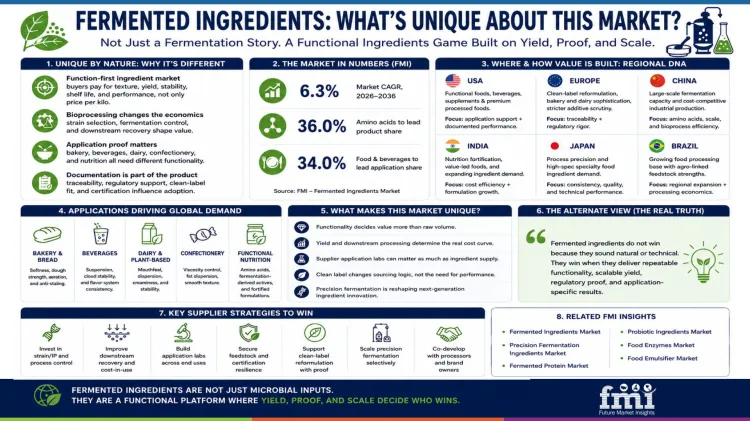
The fermented ingredients category is changing because fermentation is no longer viewed only as an old food-preservation method. It is becoming a platform for functional nutrition, clean-label formulation, alternative proteins, natural preservation, flavor development, and controlled bio-manufacturing. In the Fermented Ingredient Market, the macro shift is from fermentation as a traditional process to fermentation as an ingredient innovation system.
This shift is visible across several layers. Traditional fermentation still matters in fermented dairy, sauces, beverages, bakery, soy foods, vinegar, and cultured foods. Industrial fermentation supports amino acids, organic acids, vitamins, enzymes, and preservatives. Precision fermentation is opening routes to targeted proteins, fats, enzymes, and specialty molecules. Postbiotic and probiotic ingredients are expanding functional health positioning. These are connected by biology, but they serve different commercial needs.
FMI identifies food and beverages as the leading application area in the fermented ingredient market. That makes sense because food manufacturers are using fermentation-derived ingredients to solve problems that are difficult to address through simple formulation. They need flavor depth, texture improvement, protein functionality, digestive-health positioning, shelf-life support, label acceptability, and new nutrition cues. Fermentation can support all of these, but only when the ingredient is matched to the right use case.
The Fermented Food and Beverage Market shows the consumer-facing side of the shift. Products such as yogurt, kefir, kombucha, kimchi, sauerkraut, miso, tempeh, and fermented beverages benefit from consumer interest in gut health, tradition, natural processing, and flavor complexity. However, fermented ingredients are broader than the finished foods themselves. They are also inputs that help manufacturers build function into products that may not look traditionally fermented.
Probiotics remain one of the most visible fermented ingredient families. The Probiotic Ingredients Market is relevant because it connects fermentation with digestive health, immunity positioning, dietary supplements, dairy, beverages, and functional foods. Yet the probiotic market is moving beyond generic claims. Buyers increasingly need strain identity, stability, dosage guidance, application compatibility, and evidence. The trend is not simply more probiotics; it is more documented, application-ready probiotic systems.
The Functional Food Ingredients Market provides useful context because fermented ingredients increasingly compete within the wider functional nutrition ecosystem. A fermented ingredient may support gut health, protein enrichment, mineral bioavailability, flavor enhancement, or immune-positioned formulations. But it competes with fibers, botanicals, vitamins, minerals, proteins, and other functional ingredient systems. Fermentation creates differentiation only when the benefit is clear and the ingredient performs in the product.
Postbiotics are part of the next phase. The Postbiotic Supplements Market and Postbiotic Ingredients Market show why non-viable microbial preparations and metabolites are gaining attention. Postbiotics can offer stability advantages in applications where live probiotics struggle. They may be easier to use in powders, gummies, shelf-stable beverages, bars, and heat-treated products. This expands the range of products that can carry microbiome-related positioning.
Precision fermentation is the strongest macro disruption. The Precision Fermentation Ingredients Market reframes fermentation from a traditional process into a bio-manufacturing platform. Instead of relying only on naturally occurring fermentation outputs, companies can use engineered microorganisms to produce specific proteins, enzymes, fats, flavors, or bioactive molecules. This could reshape dairy alternatives, egg alternatives, specialty nutrition, flavor systems, enzymes, and high-value food ingredients.
The Fermented Protein Market is where this shift becomes especially visible. Fermented proteins may help food companies address nutrition, texture, sustainability, and animal-free ingredient goals. But the success of fermented proteins depends on more than technology. Food manufacturers need solubility, neutral taste, allergen fit, protein quality, processing behavior, and cost competitiveness. The ingredient must work in beverages, bars, bakery, meat alternatives, dairy alternatives, or supplements without creating sensory problems.
Fermented dairy ingredients show the bridge between traditional and modern fermentation. The Fermented Dairy Ingredients Market is relevant because dairy fermentation connects consumer familiarity with functional ingredient development. Cultured dairy components can support taste, texture, nutrition, and digestive positioning. At the same time, dairy alternatives are using fermentation-derived tools to imitate creaminess, acidity, umami, and protein functionality.
Fermentation is also shaping preservation. The Natural Food Preservatives Market supports the logic that microbial and fermentation-linked preservation systems can gain relevance where brands want cleaner shelf-life solutions. Natural preservation does not mean weak preservation. It must protect safety, taste, and shelf life under real processing and distribution conditions. This is why fermentation-derived preservatives need technical validation as much as consumer-friendly positioning.
Food enzymes are another important part of the macro shift. The Food Enzymes Market highlights bio-catalysts used in bakery, dairy, meat processing, beverages, and other applications. Many enzymes are produced through fermentation. They help food manufacturers improve dough handling, lactose breakdown, flavor development, protein modification, juice clarification, and process efficiency. Enzymes show how fermentation can be invisible to consumers but central to food manufacturing.
The shift also changes product-development behavior. Food companies are no longer using fermented ingredients only as single additives. They are building systems: probiotic plus prebiotic, fermented protein plus flavor system, postbiotic plus supplement format, fermentation-derived enzyme plus bakery process, organic acid plus preservation strategy, fermented amino acid plus nutrition positioning. The ingredient's value depends on how it fits into the wider formulation architecture.
Regulation and claims will shape the pace of adoption. Fermented ingredients often sit near health, nutrition, microbiome, natural, bio-based, or clean-label claims. These claims require careful documentation. A gut-health positioning needs more evidence than a flavor positioning. A precision-fermented protein may need regulatory review and allergen assessment. A postbiotic ingredient needs characterization and safety support. The more advanced the claim, the more important the technical file becomes.
Consumer trust is another breakpoint. Fermentation has a positive heritage story, but precision fermentation can feel unfamiliar to some consumers. Brands need to explain whether the ingredient is traditional, naturally fermented, fermentation-derived, bio-based, or precision-fermented. The language must be accurate. Overstating naturalness or hiding biotechnology can create trust risk. The winning communication will connect fermentation with performance, safety, sustainability, and product benefit without confusing the consumer.
This is why the market is likely to separate into three lanes. The first lane is traditional fermentation, where culture, taste, preservation, and familiarity matter most. The second lane is industrial fermentation, where amino acids, organic acids, enzymes, and preservatives are judged by cost, purity, and reliability. The third lane is precision fermentation, where targeted molecules compete on performance, sustainability, novelty, and regulatory credibility. These lanes overlap, but they do not follow the same adoption curve.
Application developers need to avoid treating all fermented ingredients as one innovation pool. A fermented protein for dairy alternatives, a postbiotic for supplements, a fermented amino acid for fortified foods, and a natural preservative for sauces each requires a different proof package. The winning products will be those where the fermentation story is supported by the right technical evidence for the end use. The trend is not only toward more fermentation. It is toward more disciplined matching between fermentation route, ingredient function, and consumer promise.
The next stage will also be shaped by partnerships. Ingredient developers, fermentation capacity providers, food manufacturers, universities, and regulatory specialists increasingly need to work together because no single player owns every capability. A precision-fermented ingredient may need biotech development, food-grade manufacturing, sensory optimization, regulatory approval, and brand education. This makes ecosystem strength part of the macro trend, not just individual company innovation.
The misconception to avoid is that the fermented ingredient market is growing only because consumers like fermented foods. That is too narrow. The market is also expanding because fermentation is becoming a production technology for functional, scalable, and application-specific ingredients. The category is moving from culture-led foods to bio-manufactured ingredient systems.
Bottom line: the macro shift in fermented ingredients is not just more yogurt, kombucha, or probiotic claims. It is the rise of fermentation as a platform for proteins, amino acids, enzymes, postbiotics, natural preservatives, and functional food systems that must prove both health relevance and manufacturing reliability.
Related FMI Reports
- Fermented Ingredient Market: Primary interlink in introduction and conclusion
- Fermented Food and Beverage Market: Use when discussing consumer-facing fermented foods and beverages
- Precision Fermentation Ingredients Market: Use when discussing controlled bio-manufacturing
- Fermented Protein Market: Use when discussing fermentation-enabled proteins
- Probiotic Ingredients Market: Use when discussing probiotic ingredient systems
- Postbiotic Supplements Market: Use when discussing postbiotic applications and supplement formats
- Food Enzymes Market: Use when discussing fermentation-derived enzymes

