


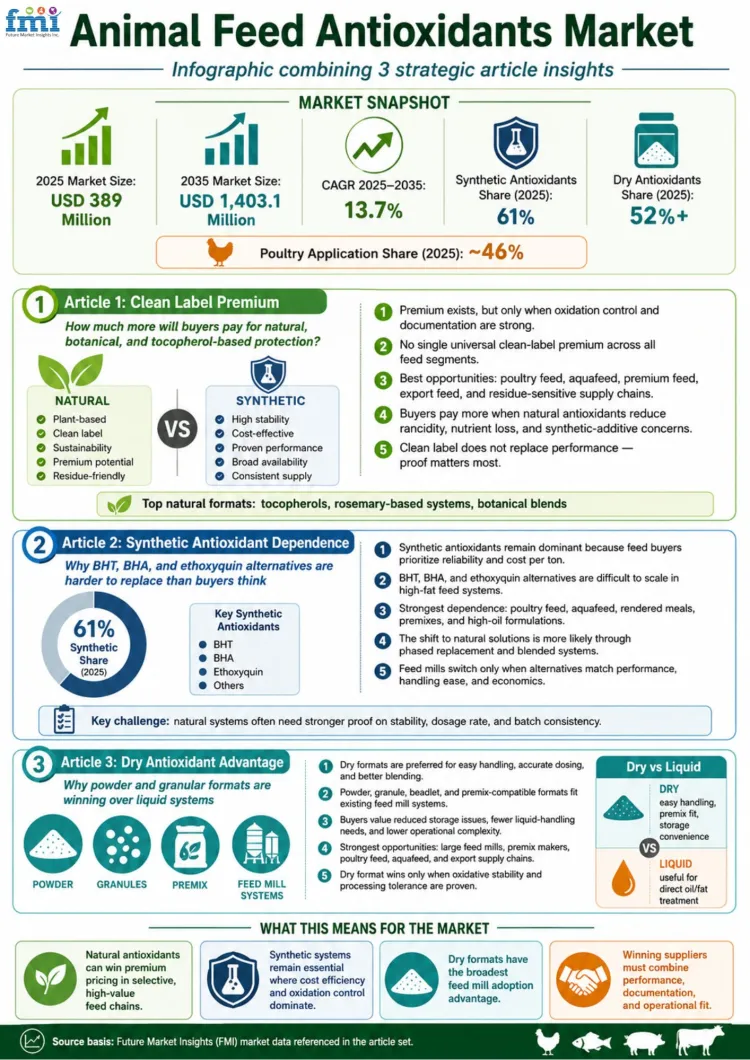
- Synthetic antioxidants still dominate the animal feed antioxidants market because feed buyers prioritize oxidation control, shelf-life protection, dosage efficiency, and cost per ton before clean-label positioning.
- BHT, BHA, ethoxyquin, and propyl gallate remain difficult to replace in high-fat feed systems because natural alternatives often need stronger proof on stability, inclusion rate, heat tolerance, and batch consistency.
- The strongest dependence on synthetic antioxidants is seen in poultry feed, aquafeed, rendered meals, premixes, high-oil formulations, compound feed, and regions where feed cost pressure is high.
- The shift toward natural antioxidants is real, but it is more likely to happen through phased replacement, blended systems, and customer-specific reformulation rather than sudden synthetic displacement.
- The biggest risk for suppliers is assuming regulatory and clean-label pressure alone will drive conversion. Feed mills switch only when alternatives protect feed quality without creating cost, handling, or performance risk.
Synthetic antioxidants continue to hold a strong position in the animal feed antioxidants market because they solve a practical problem that feed manufacturers cannot ignore. Animal feed is exposed to oxidation during ingredient storage, mixing, pelleting, transport, warehousing, and farm-level use. Oils, fats, fishmeal, rendered meals, vitamins, pigments, and other sensitive nutrients can deteriorate when exposed to oxygen, heat, light, and moisture. Once oxidation begins, feed can lose nutritional value, develop rancid odors, reduce palatability, and create performance concerns for livestock and aquaculture producers. This is why buyers still rely heavily on proven synthetic antioxidant systems.
The market is not rejecting natural antioxidants, but it is not ready to abandon synthetic systems either. Synthetic antioxidants account for a major share of the animal feed antioxidants market because they are familiar, efficient, widely available, and often easier to price into large-volume feed formulations. Feed mills operate on thin margins, especially in poultry, swine, ruminant, and commodity compound feed. For these buyers, the key question is not whether a product sounds cleaner. The key question is whether it protects each ton of feed at the lowest reliable cost.
BHT and BHA remain important because they are established antioxidant options used to delay oxidation in fat-containing feed systems. Their appeal comes from predictable performance, low dosage requirements, and long commercial history. In many feed applications, buyers understand how these ingredients behave in premixes, oils, grains, and finished feed. That familiarity reduces formulation risk. Natural antioxidants may offer cleaner positioning, but they must prove they can match this performance under real feed conditions, not just in controlled laboratory comparisons.
Ethoxyquin is more complicated. It has historically been used in animal feed, especially where lipid oxidation risk is high, including certain fishmeal, aquafeed, poultry feed, and rendered ingredient applications. However, ethoxyquin also faces stronger regulatory scrutiny and customer concern in some markets. This creates a replacement push, but replacement is not simple. Feed producers still need to protect high-risk ingredients against oxidation, especially in aquaculture and high-fat feed systems. When ethoxyquin is reduced or avoided, suppliers must provide alternatives that can handle demanding storage and transport conditions.
This is where the replacement challenge becomes clear. Natural antioxidants such as tocopherols, rosemary extract, botanical extracts, carotenoids, and vitamin-based systems can support cleaner feed positioning, but they may require higher inclusion rates, more careful formulation, or combination with synergistic ingredients. In cost-sensitive feed systems, even a small increase in cost per ton can affect buying decisions. If a natural alternative needs more dosage to deliver similar stability, the clean-label benefit may not be enough to justify the switch.
The strongest synthetic antioxidant dependence is visible in high-fat and oxidation-sensitive feed chains. Aquafeed is a clear example because fish oil, fishmeal, and other marine-derived ingredients can oxidize quickly if not protected. Poultry feed is another major area because large-scale poultry production requires consistent feed quality, energy density, and supply reliability. Rendered meals, animal fats, and premix systems also depend on effective antioxidant protection because oxidation can damage feed value before the feed even reaches the animal.
Compound feed manufacturers are especially cautious because they manage many ingredients from different suppliers. A feed mill may receive oils, grains, meals, vitamins, minerals, and additives from multiple origins, each with different oxidation risks. Synthetic antioxidants offer a familiar safety margin in this complex environment. When buyers consider natural alternatives, they do not only test the antioxidant itself. They test how it works across variable raw materials, different storage temperatures, pelleting conditions, transport times, and finished feed shelf-life targets.
The economics of feed production also protect synthetic antioxidants. Feed buyers usually evaluate antioxidants through total cost-in-use. This means they compare price, inclusion rate, stability benefit, handling convenience, storage life, and the cost of feed spoilage or nutrient loss. A lower-priced synthetic antioxidant may remain attractive if it prevents oxidation at a lower dose and fits easily into existing operations. Natural alternatives need to show value beyond label appeal. They must reduce risk, preserve quality, or unlock premium customer access.
Regulatory pressure is one of the strongest drivers behind synthetic replacement, but regulation does not move all markets at the same speed. Some regions are stricter about specific synthetic antioxidants, while others continue to permit controlled use under defined limits. This creates a fragmented global market. Multinational feed producers may reformulate for stricter regions, while local feed producers in cost-sensitive markets may continue using synthetic systems where allowed. As a result, synthetic dependence will reduce unevenly rather than disappear globally.
Customer pressure is another important factor. Meat, egg, dairy, seafood, and pet-linked supply chains are becoming more sensitive to clean-label and residue-related questions. Large animal protein buyers may ask feed suppliers to reduce certain synthetic additives, especially when selling into premium or export markets. This creates an opening for natural and blended antioxidant systems. However, the buyer still expects feed quality to remain stable. A cleaner antioxidant system that creates rancidity risk or shortens shelf life will not survive commercial testing.
The practical path forward is likely to be blended antioxidant systems. Instead of replacing synthetic antioxidants with one natural ingredient, suppliers may combine tocopherols, botanical extracts, organic acids, chelators, vitamins, and other synergistic compounds to improve oxidation control. These systems can be customized for poultry feed, aquafeed, premixes, rendered meals, and compound feed. This approach is more realistic because it treats antioxidant replacement as a performance challenge, not only a label change.
Dry-format solutions will also matter. Feed mills prefer antioxidants that are easy to dose, blend, store, and transport. If a natural or reduced-synthetic solution comes in a stable dry powder, granule, or beadlet form, adoption becomes easier. If the solution requires new liquid handling equipment, special storage, or complicated dosing, the switching barrier increases. This is why form and handling are as important as ingredient origin in the animal feed antioxidants market.
For suppliers, the opportunity is not to attack synthetic antioxidants broadly. The better strategy is to identify where synthetic replacement pressure is strongest and where buyers have a commercial reason to pay for alternatives. Premium aquafeed, export poultry, pet-linked nutrition, natural feed programs, and branded animal protein supply chains are more likely to consider reduced-synthetic or natural antioxidant systems. Commodity feed buyers will move more slowly unless the alternative is cost-competitive and operationally simple.
The risk for natural antioxidant suppliers is overpromising. Buyers have heard many claims about clean label, botanical extracts, and natural preservation. What they need is proof. Suppliers must provide oxidation stability data, dosage guidance, species suitability, ingredient compatibility, heat tolerance, shelf-life performance, batch consistency, and regulatory documentation. Without this evidence, feed mills may test the product once and return to synthetic systems.
The strongest competitors in this market will be suppliers that understand both sides of the transition. Synthetic antioxidants are not disappearing because they continue to deliver cost-effective protection. Natural antioxidants are not a passing trend because regulatory scrutiny and clean-label pressure are real. The winning position sits between these two forces: reliable antioxidant systems that protect feed quality while helping buyers reduce synthetic dependence where it matters most.
Synthetic antioxidant dependence in animal feed is therefore not just a resistance-to-change story. It is a performance, cost, regulation, and risk-management story. BHT, BHA, ethoxyquin, and similar systems remain difficult to replace because they are embedded in feed mill economics and quality assurance. Natural alternatives can gain share, but only when they match technical expectations and solve a buyer problem. The market will move toward cleaner antioxidant systems, but the transition will be selective, evidence-led, and slower in commodity feed than in premium or regulated channels.
Related Markets
- Animal Feed Additives Market: Animal feed antioxidants sit within the wider feed additives ecosystem where feed mills evaluate stability, safety, performance, and cost control.
- Natural Feed Additives Market: Natural feed antioxidants benefit from the broader shift toward chemical-free, sustainable, and cleaner livestock nutrition programs.
- Compound Feed Market: Compound feed manufacturers are key buyers because antioxidants help protect mixed feed formulations during storage, transport, and feeding.
- Pet Food Antioxidants Market: Pet food has stronger clean-label pressure, making it an important adjacent market for natural antioxidant positioning and premium claims.
- Poultry Feed Market: Poultry feed is a major application area because high-volume production, feed efficiency, and oil-rich diets increase the need for oxidation control.

