


The Common Narrative
The sustainable packaging debate is often led by product claims. Packaging is described as recyclable, compostable, reusable, refillable, paper-based, bio-based, or made with recycled content. These claims help brands communicate progress and allow consumers to identify formats that appear better aligned with circularity.
The underlying assumption is that a better-designed package will produce a better environmental outcome. If the material is technically recyclable or compostable, the market is expected to collect and process it. If the pack is reusable, consumers are expected to return it. If the format contains recycled material, the circular system is assumed to be functioning.
This places design and communication at the center of the strategy. Infrastructure is treated as a downstream issue that will gradually catch up.
In practice, infrastructure determines whether the claim creates real recovery value or only design intent.
Why That Narrative Is Incomplete
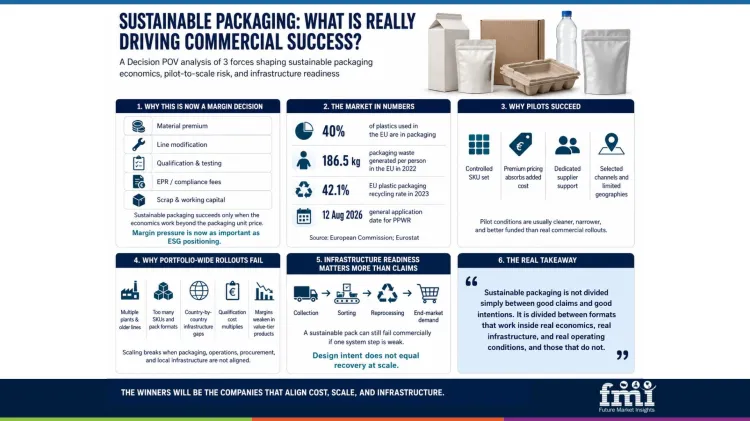
A package can only be recycled if it is collected, recognized, sorted, processed, and sold into a viable end market. Compostable packaging needs appropriate collection and industrial treatment. Reuse requires return points, washing, inspection, redistribution, and sufficient circulation density.
Technical compatibility therefore represents only one part of the system. A format can satisfy a design guideline and still be sent to disposal because local collection does not accept it, sorting equipment cannot identify it, contamination is too high, or recyclers lack a profitable outlet.
Infrastructure is also material-specific. Paper, glass, metal, PET bottles, polyolefin films, trays, composite cartons, and compostable materials rely on different collection and processing routes. A country that performs strongly in one stream may remain weak in another.
Country economics further affect outcomes. EPR design, municipal responsibilities, deposit-return systems, landfill costs, energy prices, labour, transport distances, and recycled-material demand influence whether recovery is commercially attractive.
How the Market Actually Behaves
Sustainable packaging performs best where design and infrastructure are already aligned. Clear collection rules, high participation, modern sorting, stable recycler capacity, and demand for recovered material improve the probability that packaging returns to productive use.
Adoption becomes less reliable where systems are fragmented. Consumers may face different instructions by municipality. Flexible films may be collected in one market and excluded in another. Compostable packaging may enter the wrong waste stream. Reuse may fail where return points are sparse or transport distances are long.
Brands operating across Europe therefore face several commercial realities inside one regulatory framework. PPWR harmonizes key requirements, but national EPR systems, waste infrastructure, enforcement readiness, and collection performance continue to differ.
Large retailers can sometimes create their own infrastructure through controlled collection points, private-label systems, or closed-loop logistics. Smaller brands depend more heavily on public systems and local partners.
Infrastructure readiness also shapes supplier power. Converters and recyclers with access to established streams, documented recovery pathways, and reliable recycled feedstock can offer more credible commercial solutions than suppliers relying only on design claims.
Structural Constraints or Breakpoints
Collection coverage is the foundation. Without convenient and clearly communicated collection, material cannot reach sorting facilities in sufficient quantity or quality.
Sorting capability is another breakpoint. Packaging size, shape, colour, labels, closures, carbon-black pigments, multilayer composition, and contamination affect detection and separation. Technical recyclability does not guarantee that the pack will be captured correctly.
Processing capacity also matters. Recyclers need appropriate technology, throughput, quality control, and end-market demand. A material stream can be collected but remain uneconomic if yield is low or buyers will not pay for the recyclate.
Reuse depends on network density. Return rates, trip distances, wash capacity, asset loss, and redistribution determine cost per use. A durable package cannot create a viable reuse system by itself.
Consumer instructions create a further constraint. Labels can guide behaviour, but inconsistent local rules weaken confidence. A simple claim may be technically accurate and still be operationally misleading in a specific location.
Where Decisions Commonly Break
A common failure is selecting packaging based on theoretical end-of-life performance without mapping the markets in which it will be sold.
Another failure is using a national recycling rate as proof that a specific packaging format will be recovered. Average performance can hide weak collection for films, trays, caps, or compostable formats.
Brands also overestimate the power of labels. Clear instructions improve participation, but they cannot create missing collection, sorting, washing, or processing capacity.
Reuse programs can fail when environmental analysis assumes high return rates and many rotations that the commercial network does not achieve.
A further mistake is applying one European packaging solution without accounting for differences in EPR fees, infrastructure, retailer participation, and recycled-material markets.
What Decision-Makers Should Do Differently
Companies should map infrastructure before approving a sustainable packaging format. The assessment should cover collection acceptance, sorting capability, processing capacity, end-market demand, EPR treatment, and regional availability.
Packaging portfolios should be segmented by country and material stream. A common design can still be used where appropriate, but commercial assumptions should reflect local recovery conditions.
Claims should be matched to verified pathways. Recyclable, compostable, and reusable statements should reflect where and how the pack can actually be managed, not only its laboratory properties.
Brands should prioritize formats that fit established systems while supporting infrastructure development for more difficult streams. This may involve long-term recycler partnerships, retailer collection, take-back programs, or investment in sorting and processing capacity.
Reuse should begin in dense, controlled channels where returns can be measured and managed. Expansion should follow demonstrated return rates and washing economics.
The strongest sustainability strategy combines design improvement with system readiness. Neither can compensate fully for the absence of the other.
The Misconception to Avoid
The misconception is that a credible sustainability claim proves a credible end-of-life outcome.
Claims describe an intended property. Infrastructure determines whether that property becomes real collection, recovery, reuse, or recycled material.
Bottom Line
Sustainable packaging succeeds when it fits the system that receives it. Infrastructure readiness, not the strength of the claim, determines whether design intent becomes commercial and environmental value.
Related Future Market Insights Reports
- Sustainable Packaging Market: Primary FMI report covering materials, formats, end uses, regional adoption and supplier strategies.
- Sustainable Packaging Market Share Analysis: Supports competitive benchmarking, supplier positioning and capability comparison.
- Recyclable Packaging Market: Relevant to design-for-recycling, material compatibility and market recovery pathways.
- Packaging Waste Recycling Market: Provides context on collection, sorting, processing capacity and end-market development.
- Recycled Plastic Packaging Market: Supports analysis of PCR availability, qualification, premiums and supplier risk.
- Reusable Packing Market: Relevant to closed-loop systems, return rates, asset circulation and reverse logistics.
- Paper Packaging Market: Supports analysis of fibre substitution, paperisation and cost-performance trade-offs.
Sources
- European Commission, Packaging waste and PPWR: https://environment.ec.europa.eu/topics/waste-and-recycling/packaging-waste_en
- EUR-Lex, Regulation (EU) 2025/40: https://eur-lex.europa.eu/eli/reg/2025/40/oj/eng
- Future Market Insights, Sustainable Packaging Market: https://www.futuremarketinsights.com/reports/sustainable-packaging-market
- Future Market Insights, Sustainable Packaging Market Share Analysis: https://www.futuremarketinsights.com/reports/sustainable-packaging-market-share-analysis
- Future Market Insights, Packaging Waste Recycling Market: https://www.futuremarketinsights.com/reports/packaging-waste-recycling-market
- Future Market Insights, Recyclable Packaging Market: https://www.futuremarketinsights.com/reports/recyclable-packaging-market
- Future Market Insights, Recycled Plastic Packaging Market: https://www.futuremarketinsights.com/reports/recycled-plastic-packaging-market
- Future Market Insights, Reusable Packing Market: https://www.futuremarketinsights.com/reports/reusable-packing-market

