

- Market Size (2026)
- USD 1.2 Bn
- Forecast (2036)
- USD 2.3 Bn
- CAGR (2026 to 2036)
- 6.7%
How big is Acoustic Testing Systems Market in 2026?
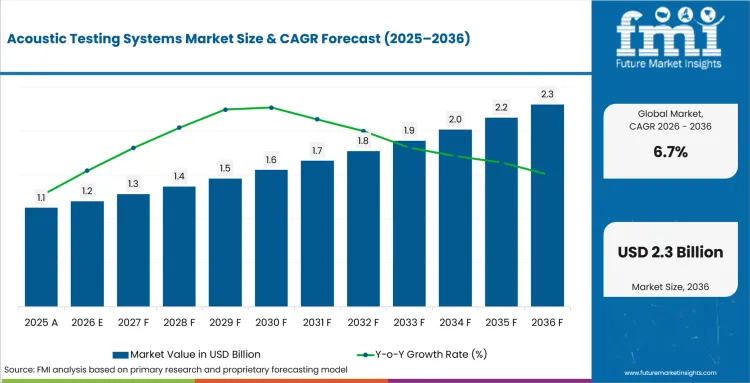
USD 1.2 billion in 2026 and USD 2.3 billion by 2036 at a 6.7% CAGR.
The acoustic testing systems market is projected to expand from USD 1.2 billion in 2026 to USD 2.3 billion by 2036 at a 6.7% CAGR. Automated manufacturing lines continue to increase the importance of precise and repeatable liquid application across coating and process-spraying operations. Dewesoft released DewesoftX 2026.2 in April 2026 with multi-channel Campbell plotting for rotational machinery analysis. Multi-channel Campbell analysis strengthens synchronized comparison of rotating noise and vibration signatures before engineering teams approve component or system changes.
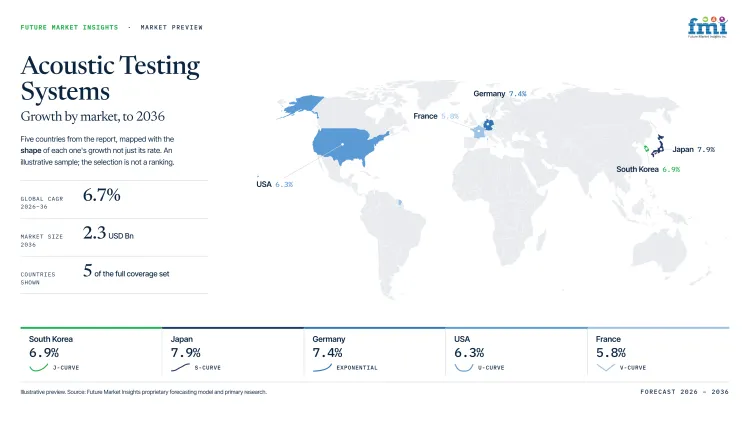
Country adoption reflects different investment priorities across manufacturing economies. Japan is projected to record 7.9% CAGR through 2036 compared with 6.9% CAGR for South Korea. Manufacturers in Japan place strong emphasis on machine reliability and production-quality verification before equipment changes are approved. The International Federation of Robotics reported 446 industrial robots per 10,000 manufacturing employees in Japan and 1,220 in South Korea based on 2024 manufacturing data. Higher robot density does not automatically translate into faster growth because acoustic testing demand depends on monitoring and condition-assessment requirements rather than automation levels alone. Japan's larger focus on precision manufacturing and equipment verification creates additional opportunities for noise and vibration analysis during production development and process qualification, while South Korea benefits more directly from established automation infrastructure.
Key Takeaways of Acoustic Testing Systems Market
- Electrified powertrains increase acoustic test intensity because quieter propulsion exposes motor tones and road noise during vehicle validation.
- Based on system type, NVH test systems are projected to account for 34.0% in 2026 due to synchronized measurements that support root-cause decisions.
- In 2026, data acquisition systems are expected to lead hardware with 27.0% share because every transducer requires a common time base.
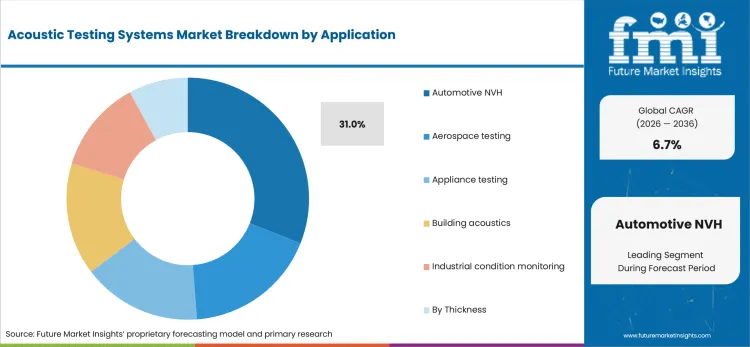
- By application, automotive NVH is forecast to represent 31.0% in 2026 driven by repeated validation across vehicle development stages.
- Calibration traceability and specialist setup constrain adoption because complex multi-channel tests require defensible configuration before results support engineering release decisions.
- HBK and Dewesoft provide integrated measurement platforms for laboratory and production acoustic testing programs globally. GRAS Sound & Vibration and PCB Piezotronics supply precision transducers for calibrated repeatable acoustic measurement chains. Norsonic and RION address standards-led instruments while HEAD acoustics and NTi Audio provide specialized analysis workflows.
Analyst Perspective
"Engineering teams should compare synchronization and calibration traceability before channel count because weak measurement control can invalidate otherwise detailed acoustic results. Commercial value rises when software and application support let laboratories reuse qualified setups across development and production programs."
- Nikhil Kaitwade, Principal Consultant, Future Market Insights
How is the Acoustic Testing Systems Market segmented?
The acoustic testing systems market is segmented by system type, hardware, application, end use, sales model and region.
System types cover NVH, sound-level, acoustic emission, chamber and end-of-line systems. Hardware covers data acquisition, microphone arrays, sound sources, calibrators and analysis software. Applications span automotive NVH, aerospace, appliances, building acoustics and industrial monitoring. End uses include automotive OEMs, test labs, electronics, research and industrial plants. Sales models cover complete systems, bundles, testing contracts and upgrades.
Why does automotive NVH lead the application category?
Automotive engineering programs combine perceived-quality targets with regulatory noise tests across components and complete vehicles. GRAS released two six-microphone automotive arrays in August 2025 for repeatable in-cabin acoustic measurements across cabins. Their fixed geometry supports consistent comparisons as pass-by noise testing and cabin work expand alongside noise control systems for quieter electric drivetrains.
- Automotive NVH is projected to hold 31.0% share in 2026 owing to repeated acoustic validation across vehicle development stages.
- Electric propulsion changes dominant sources instead of removing NVH work because road noise and cooling systems become easier for occupants to hear inside cabins.
What makes NVH test systems central to the system type category?
Engineering teams use NVH testing platforms when one sound signature must correlate with vibration and operating state. Hyundai Motor Group opened a 25,000 square meter European test facility in November 2025 with the largest semi-anechoic chamber within the Group, supporting NVH and drive-by testing. The facility shows why vehicle interior acoustic testing depends on controlled environments that reproduce vehicle conditions.
- By system type, NVH test systems are estimated to hold 34.0% in 2026 owing to synchronized measurements that connect acoustic symptoms with mechanical causes.
- Vehicle programs retain NVH testing even after simulation because prototypes reveal transient behavior and production variation that models do not fully capture.
Why do data acquisition systems lead the hardware category?
Data acquisition hardware sets the shared time base for microphones and accelerometers before analysis begins. Dewesoft released DewesoftX 2025.3 in December 2025 with native openDAQ support across several current DAQ platforms. The change strengthens interoperability for dynamic measurement systems that must synchronize growing channel counts with existing laboratory infrastructure and broader test and measurement equipment.
- Data acquisition systems are set to lead the hardware category with 27.0% share in 2026 due to shared timing across acoustic and vibration channels.
- Modular front ends reduce replacement exposure because laboratories can expand channel capacity without rebuilding calibrated sensors and established analysis routines.
Why do automotive OEMs lead the end use category?
Automotive OEMs own final vehicle acoustic targets and must reconcile integrated component behavior before every production release decision. Hyundai Motor Group reported in February 2025 that more than 5,000 vehicles had completed testing at its California Proving Ground across twenty years. OEM laboratories therefore combine contact measurements with targeted laser vibrometer testing when engineers need structural response without adding sensor mass.
- The end use category is forecast to be led by automotive OEMs at 29.0% share in 2026 due to vehicle-level acceptance responsibility.
- Their purchase criteria extend beyond instruments because calibration and training determine whether one qualified setup can support several vehicle programs.
What are the drivers, restraints and opportunities in the Acoustic Testing Systems Market?
Electrified products increase acoustic validation while calibration complexity limits adoption and workflow automation creates the strongest expansion route.
- Driver: Electric and hybrid vehicle programs expose acoustic signatures that require synchronized validation across development and release testing.
- Restraint: Advanced acoustic work requires calibrated transducers and controlled synchronization before engineering teams can rely on comparative results.
- Opportunity: Automated acquisition and reporting can extend repeatable acoustic testing into laboratories that cannot assign specialists to every measurement cycle.
Electrification Expands In-Cabin Measurement Requirements
Quieter electric powertrains expose road and cooling sources that combustion noise previously masked inside occupied vehicle cabins. GRAS launched the 45BD AutoKEMAR in March 2026 for repeatable automotive in-cabin acoustic testing across OEM and laboratory workflows. Engineering teams therefore need sound level meters and synchronized multi-channel systems that compare occupant-facing sound across operating states without changing the measurement reference.
Calibration and Synchronization Raise the Cost of Defensible Results
Complex acoustic programs cost more than the instrument because setup quality determines whether results remain comparable across tests. HEAD acoustics stated in December 2025 that reporting and documentation for blocked-force work had been time-consuming and user-dependent before its revised workflow. Laboratories must therefore budget for calibration and controlled processing alongside hardware before expanding advanced methods across additional teams.
Workflow Automation Extends Specialist Methods to Repeated Testing
Automation creates a practical revenue route where laboratories repeat similar tests across rooms or production units. Norsonic released Nor850 version 4.2 in March 2026 with project-workflow and reporting improvements that reduce repeated setup effort. Comparable automation can extend acoustic methods into machine condition monitoring programs where recurring measurements need consistent acquisition and documentation without continuous specialist intervention.
Which country CAGRs are profiled in the Acoustic Testing Systems Market?
| Country | CAGR |
|---|---|
| Japan | 7.9% |
| Germany | 7.4% |
| South Korea | 6.9% |
| USA | 6.3% |
| France | 5.8% |
How do country-level CAGRs compare in the Acoustic Testing Systems Market?
The 2.1-point spread separates Japan and Germany from a steadier USA-France group, with South Korea positioned between them in forecast pacing. The pattern follows testing intensity rather than current revenue because electrified-vehicle programs dominate the upper group while mature compliance work and fragmented acoustic applications moderate lower expansion rates.
- Japan combines measurement expertise with electrification policy sustaining repeated passenger-vehicle acoustic validation.
- Germany pairs electric-car production with engineering networks sustaining recurring component NVH qualification.
- South Korea concentrates testing in OEM centers that reward synchronized measurement and local support.
- USA laboratories prioritize compatibility with calibration records and installed hardware across mixed programs.
- France combines vehicle engineering with building-acoustic rules that fragment equipment use across projects.
Similar CAGRs mask different service requirements and replacement economics across these countries.
The full report provides country-level CAGR analysis across North America, Latin America, Europe, East Asia, South Asia, Oceania and the Middle East and Africa.
Country-wise Analysis
- Japanese laboratories combine domestic measurement suppliers with vehicle engineering programs that demand traceable calibration and Japanese-language support before teams approve unfamiliar platforms for repeated qualification work across multiple passenger-vehicle programs and established laboratory routines. The acoustic testing systems market in Japan is projected to grow at 7.9% CAGR through 2036 as METI's August 2026 automobile roadmap retained electrified vehicles for all new passenger-car sales by 2035 nationwide. Policy continuity sustains electric-drive and alert-sound validation but strict qualification expectations remain a friction, giving entrants better prospects when they provide dependable calibration routes and rapid local technical response during early account qualification stages.
- German automotive laboratories operate inside dense engineering networks where test benches and measurement software must fit established development data before teams approve a new platform for component and complete-vehicle qualification work across major regions. Acoustic testing systems demand in Germany is forecast to rise at 7.4% CAGR through 2036 as VDA reported in February 2026 that domestic factories produced 1.67 million electric passenger cars during 2025 alone. Electric production provides a recurring NVH test base but capital discipline remains a material friction, so entrants gain access by protecting installed sensors and software while providing technical support during phased laboratory expansion programs.
- South Korean demand concentrates around large OEM research centers that shorten development cycles and reward repeatable test setups with nearby engineering support during compressed vehicle-program schedules and internal release reviews across domestic product launches. South Korea is estimated to post 6.9% CAGR through 2036 as Hyundai Motor Group documented in July 2026 that its Namyang Digital Measuring Center verifies 1,000 measurement points across 600 quality criteria including NVH. Concentrated programs support sophisticated instrumentation but virtual-to-physical data integration remains difficult, so entrants need synchronized acquisition and reusable methods that fit established OEM processes without interrupting rapid validation cycles across successive model cycles.
- United States laboratories span automotive proving grounds and industrial test facilities where installed instrumentation creates strict compatibility requirements for new acoustic systems across regional engineering organizations and contract testing partners during replacement planning cycles. The acoustic testing systems market in USA is anticipated to advance at 6.3% CAGR over the assessment period as Argonne National Laboratory reported 212,187 hybrid-electric vehicle sales during June 2026 across the country. A broad engineering base supports recurring acoustic work but calibration traceability and mixed legacy hardware slow replacement, so entrants improve conversion by preserving existing sensors and validated analysis routines during phased upgrades.
- French acoustic testing demand combines vehicle engineering with building measurements performed near project completion, creating uneven utilization for high-end equipment across regional construction programs and independent consulting laboratories and public compliance work. Acoustic testing systems sales in France are forecast to expand at 5.8% CAGR by 2036 as SDES data published through Insee showed 94.3 thousand individual homes and 170.6 thousand collective units started during 2025. Construction volume supports portable building-acoustic work but fragmented schedules weaken equipment utilization, so manufacturers and service firms compete through automated reporting and flexible access models matched to short field-measurement windows during recurring project cycles.
Who are the notable companies in the Acoustic Testing Systems Market?
HBK and Dewesoft provide integrated platforms for acoustic testing. GRAS Sound & Vibration and PCB Piezotronics specialize in precision transducers. Norsonic and RION serve standards-led measurement. HEAD acoustics and NTi Audio provide application-focused acoustic analysis.
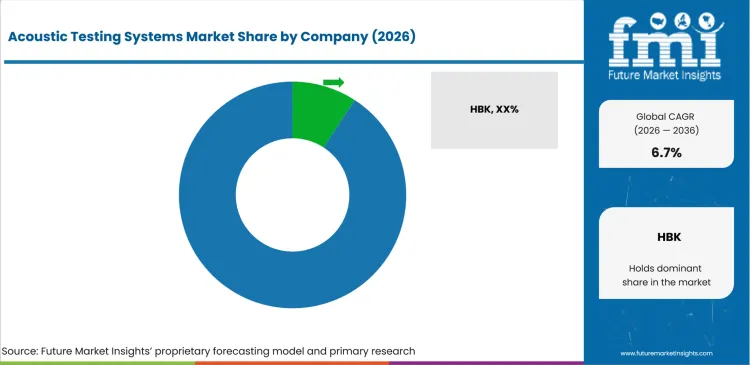
Competition divides between integrated sound-and-vibration platforms and precision instruments serving distinct laboratory and field acoustic workflows. Engineering accounts compare software continuity and calibration support while noise monitoring devices extend recurring work beyond laboratory programs. Validated workflows and nearby service response create the main entry barriers for new acoustic testing suppliers.
- HBK and Dewesoft join HEAD acoustics in integrated NVH platforms that combine multi-channel measurement with laboratory analysis workflows.
- Precision instrumentation suppliers include GRAS Sound & Vibration and PCB Piezotronics while RION adds standards-oriented sound and vibration measurement instruments.
- Norsonic and NTi Audio focus on field and building acoustic workflows where portable measurement and standards reporting shape purchase decisions.
Competitive Benchmarking: Acoustic Testing Systems Market
| Company | Multi-channel NVH Integration | Acoustic Transducer Depth | Standards & Production Workflow Coverage | Geographic Reach |
|---|---|---|---|---|
| HBK | High | High | High | Global engineering and service footprint |
| Dewesoft | High | Medium | High | Global offices and distributor network |
| GRAS Sound & Vibration | Low | High | Medium | Europe and North America with international distribution |
| Norsonic | Medium | Medium | High | Europe with international distributor coverage |
| RION | Medium | Medium | High | Japan with international measurement channels |
| PCB Piezotronics | Low | High | Medium | North America with Europe and Asia channels |
| HEAD acoustics | High | High | High | Europe and North America with major Asian markets |
| NTi Audio | Medium | Medium | High | Europe with international sales and service partners |
Scoring basis: High NVH integration requires synchronized acquisition with automated analysis while Medium reflects narrower integration and Low identifies one specialist role. High transducer depth requires three verified sensor classes while Medium requires two and Low one. High workflow coverage requires three standardized use groups while Medium requires two and Low one. Geographic reach describes documented offices and service or distributor coverage rather than a capability score.
Key Developments in the Acoustic Testing Systems Market
- In June 2026, HEAD acoustics introduced ArtemiS SUITE 18.0 with added analysis methods and automation for acoustic and vibration development workflows.
- In July 2025, NTi Audio introduced Site View for Sound Insulation Reporter to manage multiple partitions and compare compliance indicators within one project.
- In February 2025, GRAS Sound & Vibration released two EQset production-line microphones that standardize sensitivity and simplify calibration across repeated audio testing locations.
Key Players in the Acoustic Testing Systems Market
Integrated NVH and Analysis Platforms
- HBK
- Dewesoft
- HEAD acoustics
Precision Acoustic Sensors and Instruments
- GRAS Sound & Vibration
- PCB Piezotronics
- RION
Standards-Led Field and Building Acoustic Systems
- Norsonic
- NTi Audio
Acoustic Testing Systems Market - Report Scope
| Coverage field | Report scope |
|---|---|
| Market breakdown | By system type, hardware, application, end use, sales model and region. |
| Quantitative Units | USD billion. |
| Market Definition | Revenue includes acoustic and vibroacoustic test systems, measurement hardware, acoustic sensors, sound sources, calibrators, analysis software and related testing or service contracts. |
| Regions Covered | North America, Latin America, Europe, East Asia, South Asia and Pacific and Middle East and Africa. |
| Countries Covered | Japan, Germany, South Korea, USA, France, and 20+ countries included in the full report. |
| Key Companies Profiled | HBK, Dewesoft, GRAS Sound & Vibration, Norsonic, RION, PCB Piezotronics, HEAD acoustics, NTi Audio. |
| Forecast Period | 2026 to 2036. |
| Approach | Primary and secondary research with market triangulation. |
Acoustic Testing Systems Market - Research Methodology
| Method | Approach |
|---|---|
| Primary Research | FMI analysts gathered input from manufacturers, service providers, technology developers, distributors, end users, procurement teams, and subject-matter experts. Interviews examined purchasing decisions, product or service evaluation, adoption barriers, approval requirements, pricing considerations, and expectations for technical or commercial support. Respondents were also asked what evidence is required before a trial, pilot, or initial order develops into regular purchasing. |
| Desk Research | Desk research covered government statistics, regulatory publications, trade data, industry associations, technical literature, standards, company filings, product information, and official corporate announcements. Sources were reviewed for relevance, publication date, geographic coverage, and consistency with the defined market scope. Claims relating to performance, applications, approvals, capacity, investment, and commercial activity were retained only when supported by credible public evidence. |
| Market Sizing and Forecasting | The market model combined the baseline value with historical performance, segment structure, pricing and volume indicators, adoption levels, company participation, and country-level demand conditions. Forecast assumptions considered economic activity, investment trends, regulatory developments, technology adoption, purchasing cycles, supply availability, and barriers to wider market use. Segment and regional estimates were reconciled before the final market total was calculated. |
| Data Validation | Estimates were checked against multiple independent indicators, including public data, company activity, trade patterns, industry developments, and findings from primary interviews. Validation also tested whether products, services, applications, and company revenues fell within the defined market boundaries. Adjacent categories, unsupported claims, overlapping revenues, and activities without direct market relevance were excluded to reduce double counting and maintain consistency across segments and countries. |
Acoustic Testing Systems Market by Segments
Acoustic Testing Systems Market segmented by System Type:
- NVH test systems
- Sound level testing systems
- Acoustic emission testing
- Reverberation chamber systems
- End-of-line acoustic test systems
Acoustic Testing Systems Market segmented by Hardware:
- Data acquisition systems
- Microphone arrays
- Sound sources
- Calibrators
- Analysis software
Acoustic Testing Systems Market segmented by Application:
- Automotive NVH
- Aerospace testing
- Appliance testing
- Building acoustics
- Industrial condition monitoring
Acoustic Testing Systems Market segmented by End Use:
- Automotive OEMs
- Test labs
- Electronics & appliances
- Universities, research
- Industrial plants
Acoustic Testing Systems Market segmented by Sales Model:
- Complete systems
- Software + hardware bundle
- Service, testing contract
- Sensor replacement, upgrade
Acoustic Testing Systems Market by Region:
- North America
- United States
- Canada
- Latin America
- Brazil
- Mexico
- Chile
- Rest of Latin America
- Western Europe
- Germany
- United Kingdom
- Italy
- Spain
- France
- Nordics
- Benelux
- Rest of Western Europe
- Eastern Europe
- Russia
- Poland
- Hungary
- Balkan and Baltic States
- Rest of Eastern Europe
- East Asia
- China
- Japan
- South Korea
- South Asia and Pacific
- India
- ASEAN
- Australia and New Zealand
- Rest of South Asia and Pacific
- Middle East and Africa
- Kingdom of Saudi Arabia
- Other GCC Countries
- Türkiye
- South Africa
- Other African Union Countries
- Rest of Middle East and Africa
Research Sources and Bibliography
- Dewesoft. (2026, April 22). DewesoftX 2026.2 Release - New Data Merger, Custom Widgets, and EIS Analyzer.
- International Federation of Robotics (IFR), World Robotics 2026. Japan recorded 446 robots per 10,000 manufacturing employees and South Korea recorded 1,220 robots per 10,000 manufacturing employees based on 2024 manufacturing data.
- European Automobile Manufacturers’ Association. (2026, January 27). New car registrations: +1.8% in 2025; battery-electric 17.4% market share.
- Hyundai Motor Group. (2025, November 6). Hyundai Motor Group Opens New European Test Facility to Lead Development of Next-Generation Technology.
- Dewesoft. (2025, December 19). DewesoftX 2025.3 Released.
- GRAS Sound & Vibration. (2025, August 5). GRAS Releases New Automotive 6-microphone Arrays.
- Hyundai Motor Group. (2025, February 12). Hyundai Motor Group Celebrates 20 Years of Driving Innovation at the Hyundai California Proving Ground.
- GRAS Sound & Vibration. (2026, March 18). Introducing the GRAS 45BD AutoKEMAR.
- HEAD acoustics. (2025, December 4). New release: ArtemiS SUITE 17.5.
- Norsonic. (2026, March 2). Version 4.2.260302 - Nor850.
- Ministry of Economy, Trade and Industry. (2026, August 4). Technology Roadmap for Automobile Sector.
- German Association of the Automotive Industry. (2026, February 4). Production and market in January 2026.
- Hyundai Motor Group. (2026, July 22). [Inside HMG’s Digital R&D Revolution ②] Digital Measuring Center: How Hyundai Motor and Kia Validate 1,000 Measurement Points on Every Vehicle.
- Argonne National Laboratory. (2026, June). Light Duty Electric Drive Vehicles Monthly Sales Updates.
- Insee. (2026, July 9). Logements mis en chantier.
- HBK. (2025). BK Connect 2025.1 and PULSE 29.1 updates.
- RION Co., Ltd. (2026, June). RION Technical Journal, Vol. 16.
- PCB Piezotronics. (2025, August 6). Introducing Endevco Model 7262A Amplified Piezoresistive MEMS Accelerometer.
- HEAD acoustics. (2026, June 17). ArtemiS SUITE 18.0. New Analysis Methods, Enhanced Automation, and More Efficient Development Processes.
- NTi Audio. (2025, July 10). Introducing Smarter Sound Insulation Measurement with the New “Site View”.
- GRAS Sound & Vibration. (2025, February 18). GRAS Releases New Microphones with EQset™.
This bibliography is provided for reader reference and is not exhaustive. The full report contains the complete reference list and detailed citations
This Report Answers
- How does electrification change acoustic test requirements across vehicle development and certification programs?
- Why do NVH test systems hold the leading system type share in this acoustic testing market?
- Which hardware requirements determine whether data acquisition systems fit existing laboratory measurement chains?
- Why does automotive NVH remain the leading application for repeated validation across vehicle programs?
- How do automation and standards reporting change complete acoustic testing system economics?
- Why do Japan and Germany hold the highest profiled country growth rates?
- Which local frictions affect order conversion across the five profiled country markets?
- Which commercial criteria should engineering teams compare beyond instrument price before approving an acoustic testing platform?
Frequently Asked Questions
How big is the Acoustic Testing Systems Market in 2026?
The acoustic testing systems market is expected to be valued at USD 1.2 billion in 2026 and reach USD 2.3 billion by 2036. Expansion follows recurring synchronized acoustic validation across vehicle and industrial engineering programs.
What is the CAGR of the Acoustic Testing Systems Market from 2026 to 2036?
The acoustic testing systems market is projected to grow at a 6.7% CAGR from 2026 to 2036. Expansion is supported by repeated NVH validation for electrified vehicles and standards-led acoustic testing across additional applications.
Which system type leads the Acoustic Testing Systems Market?
NVH test systems is expected to lead the market with a 31.0% share in 2026. Their position reflects repeated correlation of sound and vibration measurements before engineers approve design changes.
How much value will the Acoustic Testing Systems Market add between 2026 and 2036?
The acoustic testing systems market is expected to add USD 1.1 billion between 2026 and 2036. The increase reflects broader use of synchronized acoustic validation across vehicle engineering and standards-led field applications.
Which companies are active in the Acoustic Testing Systems Market?
The acoustic testing systems market includes HBK and Dewesoft alongside GRAS Sound & Vibration and Norsonic as active companies. RION and PCB Piezotronics join HEAD acoustics and NTi Audio across precision measurement and specialized acoustic workflows.
Preview the report firsthand - request a free sample
Get SampleGet the brochure for pricing and purchase details.
Get PDFTable of Content
- Key Takeaways
- Market Size and CAGR
- Top Growth Driver
- Fastest Growing Segment
- Leading Region
- Key Companies
- Emerging Opportunities
- Executive Summary
- Global Market Outlook
- Demand-side Trends
- Supply-side Trends
- Technology Roadmap Analysis
- Analysis and Recommendations
- Analyst Perspective (What is happening? Why now? What should investors know?)
- Key Questions Answered
- How large is the market?
- What is the CAGR?
- What are key trends?
- Which region dominates?
- Who are the leaders?
- Market Overview
- Market Coverage / Taxonomy
- Market Definition / Scope / Limitations
- Research Methodology
- Chapter Orientation
- Analytical Lens and Working Hypotheses
- Market Structure, Signals, and Trend Drivers
- Benchmarking and Cross-market Comparability
- Market Sizing, Forecasting, and Opportunity Mapping
- Research Design and Evidence Framework
- Desk Research Programme (Secondary Evidence)
- Expert Input and Fieldwork (Primary Evidence)
- Tooling, Models, and Reference Databases
- Data Engineering and Model Build
- Quality Assurance and Audit Trail
- Market Background
- Market Dynamics (Drivers, Restraints, Opportunity, Trends)
- Scenario Forecast (Optimistic, Likely, Conservative)
- Impact Analysis
- AI Impact
- Sustainability Impact
- Regulatory Impact
- Technology Impact
- Consumer / Buyer Analysis
- Purchase Drivers
- Adoption Barriers
- Buyer Journey
- Opportunity Map Analysis
- Product Life Cycle Analysis
- Supply Chain Analysis
- Investment Feasibility Matrix
- Value Chain Analysis
- PESTLE and Porter's Analysis
- Regulatory Landscape
- Regional Parent Market Outlook
- Production and Consumption Statistics
- Import and Export Statistics
- Global Market Analysis and Forecast, 2021 to 2036
- Historical Market Size Value (USD Billion) Analysis, 2021 to 2025
- Current and Future Market Size Value (USD Billion) Projections, 2026 to 2036
- Y-o-Y Growth Trend Analysis
- Absolute $ Opportunity Analysis
- Global Market Pricing Analysis, 2021 to 2036
- Global Market Analysis and Forecast, By System Type, 2021 to 2036
- Introduction / Key Findings
- Historical Market Size Value (USD Billion) Analysis By System Type, 2021 to 2025
- Current and Future Market Size Value (USD Billion) Analysis and Forecast By System Type, 2026 to 2036
- NVH test systems
- Sound level testing systems
- Acoustic emission testing
- Reverberation chamber systems
- End-of-line acoustic test systems
- By Filter Type
- NVH test systems
- Y-o-Y Growth Trend Analysis By System Type, 2021 to 2025
- Absolute $ Opportunity Analysis By System Type, 2026 to 2036
- Global Market Analysis and Forecast, By Hardware, 2021 to 2036
- Introduction / Key Findings
- Historical Market Size Value (USD Billion) Analysis By Hardware, 2021 to 2025
- Current and Future Market Size Value (USD Billion) Analysis and Forecast By Hardware, 2026 to 2036
- Data acquisition systems
- Microphone arrays
- Sound sources
- Calibrators
- Analysis software
- By Cut-on Wavelength
- Data acquisition systems
- Y-o-Y Growth Trend Analysis By Hardware, 2021 to 2025
- Absolute $ Opportunity Analysis By Hardware, 2026 to 2036
- Global Market Analysis and Forecast, By Application, 2021 to 2036
- Introduction / Key Findings
- Historical Market Size Value (USD Billion) Analysis By Application, 2021 to 2025
- Current and Future Market Size Value (USD Billion) Analysis and Forecast By Application, 2026 to 2036
- Automotive NVH
- Aerospace testing
- Appliance testing
- Building acoustics
- Industrial condition monitoring
- By Thickness
- Automotive NVH
- Y-o-Y Growth Trend Analysis By Application, 2021 to 2025
- Absolute $ Opportunity Analysis By Application, 2026 to 2036
- Global Market Analysis and Forecast, By End Use, 2021 to 2036
- Introduction / Key Findings
- Historical Market Size Value (USD Billion) Analysis By End Use, 2021 to 2025
- Current and Future Market Size Value (USD Billion) Analysis and Forecast By End Use, 2026 to 2036
- Automotive OEMs
- Test labs
- Electronics & appliances
- Universities / research
- Industrial plants
- By Application
- Automotive OEMs
- Y-o-Y Growth Trend Analysis By End Use, 2021 to 2025
- Absolute $ Opportunity Analysis By End Use, 2026 to 2036
- Global Market Analysis and Forecast, By Sales Model, 2021 to 2036
- Introduction / Key Findings
- Historical Market Size Value (USD Billion) Analysis By Sales Model, 2021 to 2025
- Current and Future Market Size Value (USD Billion) Analysis and Forecast By Sales Model, 2026 to 2036
- Complete systems
- Software + hardware bundle
- Service / testing contract
- Sensor replacement / upgrade
- By Sales Channel
- Complete systems
- Y-o-Y Growth Trend Analysis By Sales Model, 2021 to 2025
- Absolute $ Opportunity Analysis By Sales Model, 2026 to 2036
- Global Market Analysis and Forecast, By Region, 2021 to 2036
- Introduction
- Historical Market Size Value (USD Billion) Analysis By Region, 2021 to 2025
- Current Market Size Value (USD Billion) Analysis and Forecast By Region, 2026 to 2036
- North America
- Latin America
- Western Europe
- Eastern Europe
- East Asia
- South Asia and Pacific
- Middle East & Africa
- Market Attractiveness Analysis By Region
- North America Market Analysis and Forecast, By Country, 2021 to 2036
- Historical Market Size Value (USD Billion) Trend Analysis By Market Taxonomy, 2021 to 2025
- Market Size Value (USD Billion) Forecast By Market Taxonomy, 2026 to 2036
- By Country
- USA
- Canada
- By System Type
- By Hardware
- By Application
- By End Use
- By Sales Model
- By Country
- Market Attractiveness Analysis
- By Country
- By System Type
- By Hardware
- By Application
- By End Use
- By Sales Model
- Key Takeaways
- Latin America Market Analysis and Forecast, By Country
- Historical Market Size Value (USD Billion) Trend Analysis By Market Taxonomy, 2021 to 2025
- Market Size Value (USD Billion) Forecast By Market Taxonomy, 2026 to 2036
- By Country
- Brazil
- Mexico
- Chile
- Rest of Latin America
- By System Type
- By Hardware
- By Application
- By End Use
- By Sales Model
- By Country
- Market Attractiveness Analysis
- By Country
- By System Type
- By Hardware
- By Application
- By End Use
- By Sales Model
- Key Takeaways
- Western Europe Market Analysis and Forecast, By Country
- Historical Market Size Value (USD Billion) Trend Analysis By Market Taxonomy, 2021 to 2025
- Market Size Value (USD Billion) Forecast By Market Taxonomy, 2026 to 2036
- By Country
- Germany
- UK
- Italy
- Spain
- France
- Nordic
- BENELUX
- Rest of Western Europe
- By System Type
- By Hardware
- By Application
- By End Use
- By Sales Model
- By Country
- Market Attractiveness Analysis
- By Country
- By System Type
- By Hardware
- By Application
- By End Use
- By Sales Model
- Key Takeaways
- Eastern Europe Market Analysis and Forecast, By Country
- Historical Market Size Value (USD Billion) Trend Analysis By Market Taxonomy, 2021 to 2025
- Market Size Value (USD Billion) Forecast By Market Taxonomy, 2026 to 2036
- By Country
- Russia
- Poland
- Hungary
- Balkan & Baltic
- Rest of Eastern Europe
- By System Type
- By Hardware
- By Application
- By End Use
- By Sales Model
- By Country
- Market Attractiveness Analysis
- By Country
- By System Type
- By Hardware
- By Application
- By End Use
- By Sales Model
- Key Takeaways
- East Asia Market Analysis and Forecast, By Country
- Historical Market Size Value (USD Billion) Trend Analysis By Market Taxonomy, 2021 to 2025
- Market Size Value (USD Billion) Forecast By Market Taxonomy, 2026 to 2036
- By Country
- China
- Japan
- South Korea
- By System Type
- By Hardware
- By Application
- By End Use
- By Sales Model
- By Country
- Market Attractiveness Analysis
- By Country
- By System Type
- By Hardware
- By Application
- By End Use
- By Sales Model
- Key Takeaways
- South Asia and Pacific Market Analysis and Forecast, By Country
- Historical Market Size Value (USD Billion) Trend Analysis By Market Taxonomy, 2021 to 2025
- Market Size Value (USD Billion) Forecast By Market Taxonomy, 2026 to 2036
- By Country
- India
- ASEAN
- Australia & New Zealand
- Rest of South Asia and Pacific
- By System Type
- By Hardware
- By Application
- By End Use
- By Sales Model
- By Country
- Market Attractiveness Analysis
- By Country
- By System Type
- By Hardware
- By Application
- By End Use
- By Sales Model
- Key Takeaways
- Middle East & Africa Market Analysis and Forecast, By Country
- Historical Market Size Value (USD Billion) Trend Analysis By Market Taxonomy, 2021 to 2025
- Market Size Value (USD Billion) Forecast By Market Taxonomy, 2026 to 2036
- By Country
- Kingdom of Saudi Arabia
- Other GCC Countries
- Türkiye
- South Africa
- Other African Union
- Rest of Middle East & Africa
- By System Type
- By Hardware
- By Application
- By End Use
- By Sales Model
- By Country
- Market Attractiveness Analysis
- By Country
- By System Type
- By Hardware
- By Application
- By End Use
- By Sales Model
- Key Takeaways
- Key Countries Market Analysis
- USA
- Pricing Analysis
- Market Share Analysis, 2025
- By System Type
- By Hardware
- By Application
- By End Use
- By Sales Model
- Canada
- Pricing Analysis
- Market Share Analysis, 2025
- By System Type
- By Hardware
- By Application
- By End Use
- By Sales Model
- Mexico
- Pricing Analysis
- Market Share Analysis, 2025
- By System Type
- By Hardware
- By Application
- By End Use
- By Sales Model
- Brazil
- Pricing Analysis
- Market Share Analysis, 2025
- By System Type
- By Hardware
- By Application
- By End Use
- By Sales Model
- Chile
- Pricing Analysis
- Market Share Analysis, 2025
- By System Type
- By Hardware
- By Application
- By End Use
- By Sales Model
- Germany
- Pricing Analysis
- Market Share Analysis, 2025
- By System Type
- By Hardware
- By Application
- By End Use
- By Sales Model
- UK
- Pricing Analysis
- Market Share Analysis, 2025
- By System Type
- By Hardware
- By Application
- By End Use
- By Sales Model
- Italy
- Pricing Analysis
- Market Share Analysis, 2025
- By System Type
- By Hardware
- By Application
- By End Use
- By Sales Model
- Spain
- Pricing Analysis
- Market Share Analysis, 2025
- By System Type
- By Hardware
- By Application
- By End Use
- By Sales Model
- France
- Pricing Analysis
- Market Share Analysis, 2025
- By System Type
- By Hardware
- By Application
- By End Use
- By Sales Model
- India
- Pricing Analysis
- Market Share Analysis, 2025
- By System Type
- By Hardware
- By Application
- By End Use
- By Sales Model
- ASEAN
- Pricing Analysis
- Market Share Analysis, 2025
- By System Type
- By Hardware
- By Application
- By End Use
- By Sales Model
- Australia & New Zealand
- Pricing Analysis
- Market Share Analysis, 2025
- By System Type
- By Hardware
- By Application
- By End Use
- By Sales Model
- China
- Pricing Analysis
- Market Share Analysis, 2025
- By System Type
- By Hardware
- By Application
- By End Use
- By Sales Model
- Japan
- Pricing Analysis
- Market Share Analysis, 2025
- By System Type
- By Hardware
- By Application
- By End Use
- By Sales Model
- South Korea
- Pricing Analysis
- Market Share Analysis, 2025
- By System Type
- By Hardware
- By Application
- By End Use
- By Sales Model
- Russia
- Pricing Analysis
- Market Share Analysis, 2025
- By System Type
- By Hardware
- By Application
- By End Use
- By Sales Model
- Poland
- Pricing Analysis
- Market Share Analysis, 2025
- By System Type
- By Hardware
- By Application
- By End Use
- By Sales Model
- Hungary
- Pricing Analysis
- Market Share Analysis, 2025
- By System Type
- By Hardware
- By Application
- By End Use
- By Sales Model
- Kingdom of Saudi Arabia
- Pricing Analysis
- Market Share Analysis, 2025
- By System Type
- By Hardware
- By Application
- By End Use
- By Sales Model
- Türkiye
- Pricing Analysis
- Market Share Analysis, 2025
- By System Type
- By Hardware
- By Application
- By End Use
- By Sales Model
- South Africa
- Pricing Analysis
- Market Share Analysis, 2025
- By System Type
- By Hardware
- By Application
- By End Use
- By Sales Model
- USA
- Market Structure Analysis
- Competition Dashboard
- Competition Benchmarking
- Market Share Analysis of Top Players
- By Regional
- By System Type
- By Hardware
- By Application
- By End Use
- By Sales Model
- Emerging Startups
- Innovation Benchmarking
- Competition Analysis
- Competition Deep Dive
- HBK
- Overview
- Product Portfolio
- Profitability by Market Segments
- Sales Footprint
- Strategy Overview
- Marketing Strategy
- Product Strategy
- Channel Strategy
- Siemens
- Dewesoft
- GRAS Sound & Vibration
- Norsonic
- RION
- PCB Piezotronics
- Head Acoustics
- NTi Audio
- Müller-BBM VibroAkustik
- HBK
- Case Studies
- Success Stories
- Recent Developments
- Competition Deep Dive
- Assumptions & Acronyms Used


