

- Industry Size (2026)
- USD 414.4 Mn
- Forecast (2036)
- USD 1017.6 Mn
- CAGR (2026 to 2036)
- 9.4%
Activated Persulfate Oxidation Systems Market Forecast and Outlook 2026 to 2036
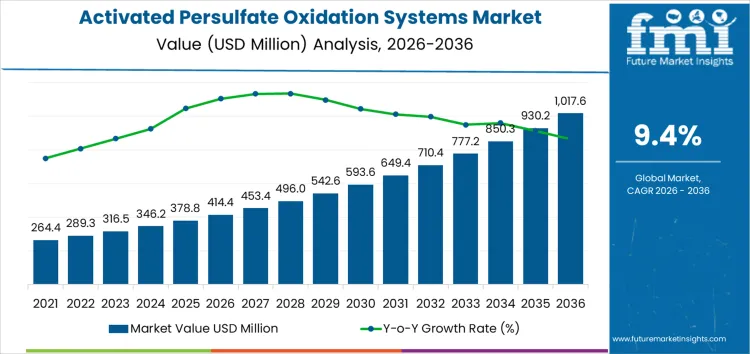
The Activated Persulfate Oxidation Systems market is projected to grow from USD 414.4 million in 2026 to USD 1,017.6 million by 2036, advancing at a compound annual growth rate (CAGR) of 9.4%. This industry occupies a pivotal role in industries focused on environmental remediation, particularly in treating contaminated water and soil. As regulatory pressures tighten and environmental accountability intensifies, the demand for efficient and scalable oxidation systems continues to rise. The market’s influence extends across multiple sectors, including chemical manufacturing, construction, and municipal services, where contamination mitigation is a high priority. The competitive landscape is characterized by both established players and new entrants, with companies vying for dominance by offering reliable, cost-effective solutions. As the market matures, suppliers will need to differentiate themselves not only by performance but also by their ability to offer tailored, long-term solutions that align with shifting environmental regulations. The growing focus on sustainability strengthens the market’s competitive dynamics.
Quick Stats of the Activated Persulfate Oxidation Systems Market
- Activated Persulfate Oxidation Systems Market Value (2026): USD 414.4 million
- Activated Persulfate Oxidation Systems Market Forecast Value (2036): USD 1,017.6 million
- Activated Persulfate Oxidation Systems Market Global Forecast CAGR (2026-2036): 9.4%
- Activated Persulfate Oxidation Systems Market Leading Segment: Application Site (Groundwater & Aquifer Remediation) 36%
- Key Growth Regions in Activated Persulfate Oxidation Systems Market: USA
- Top Players in Activated Persulfate Oxidation Systems Market: PeroxyChem (Evonik), Carus Corporation, Solvay, Regenesis, EOS Remediation
What is the Growth Forecast for the Activated Persulfate Oxidation Systems Market through 2036?
The acceleration and deceleration pattern of the activated persulfate oxidation systems market shows a clear trend of early-stage acceleration followed by a gradual deceleration as the market matures. During the first half of the forecast period, the market will experience rapid growth, with an increasing adoption of activated persulfate systems for environmental remediation. The market will grow from USD 414.4 million in 2026 to USD 669.5 million in 2031, reflecting an acceleration in demand for these systems as industries and municipalities turn to more efficient and sustainable remediation methods.
As the market matures and becomes more widely adopted, the growth rate will moderate, resulting in a deceleration in the latter half of the forecast period. From 2031 to 2036, the market will continue to grow but at a slower pace, reaching USD 1,017.6 million by 2036, with the annual growth rate decreasing as the technology becomes more established in the remediation industry. This deceleration phase reflects the natural transition from high growth in early adoption stages to steady, consistent demand as the market stabilizes.
Activated Persulfate Oxidation Systems Market Key Takeaways
| Metric | Value |
|---|---|
| Industry Sales Value (2026) | USD 414.4 million |
| Industry Forecast Value (2036) | USD 1,017.6 million |
| Industry Forecast CAGR (2026-2036) | 9.4% |
What Is Driving the Demand for the Activated Persulfate Oxidation Systems Market Globally?
The global demand for activated persulfate oxidation systems is driven by the need to address persistent organic contaminants in soil and groundwater with efficient and reliable treatment solutions. Activated persulfate systems use persulfate oxidants that are chemically or thermally activated to generate powerful radicals capable of breaking down chlorinated solvents, petroleum hydrocarbons, and other recalcitrant pollutants. Traditional remediation approaches such as pump and treat or excavation can be costly, slow, and disruptive to site operations. In contrast, activated persulfate systems offer in situ chemical oxidation that can accelerate contaminant destruction, reduce risk to humans and the environment, and shorten remediation timeframes.
Environmental regulators in many regions, including the United States, Europe, and Asia Pacific, are encouraging technologies that deliver measurable reductions in contaminant mass and support achievement of cleanup objectives under risk based corrective action frameworks. Growth in industrial and manufacturing activity has produced a legacy of contaminated sites, particularly in urban and industrial corridors, where stakeholders are under pressure to remediate responsibly and efficiently. Public and corporate focus on sustainable remediation practices and compliance with stricter soil and groundwater protection standards reinforces adoption of advanced oxidation systems.
Future demand for activated persulfate oxidation systems is expected to grow as advances in formulation and delivery improve performance in diverse subsurface conditions. Innovations that enhance activation methods, such as heat, alkaline catalysts, or transition metals, are increasing the generation of reactive species and extending applicability to low permeability soils and complex contaminant mixtures. Integration of these systems with data driven site characterization and real time monitoring will allow more precise design and optimization, reducing uncertainty and cost in remediation programs.
Regulatory frameworks that emphasize performance outcomes, long term stewardship, and life cycle impacts will continue to support the adoption of oxidation technologies that can demonstrate reliable contaminant reduction under field conditions. Expansion of brownfield redevelopment projects and infrastructure renewal initiatives will sustain demand for effective in situ treatment technologies that minimize disruption and enable land reuse. As environmental liability concerns and sustainability goals rise, activated persulfate oxidation systems are poised for continued global expansion because they offer a balance of treatment speed, scalability, and environmental performance.
What are the Leading Segments in the Global Activated Persulfate Oxidation Systems Market?
The global activated persulfate oxidation systems market is segmented by application site and activation method. Among application sites, groundwater & aquifer remediation leads the market, capturing 36% of the share, followed by industrial brownfield sites, oil & gas contaminated land, mining & metallurgical sites, and municipal & landfill sites. Groundwater and aquifer remediation is the largest application due to the increasing need for effective, sustainable solutions for cleaning contaminated groundwater. On the activation method side, alkaline-activated persulfate dominates the market, holding 32% of the share, followed by iron-activated persulfate, heat-activated persulfate, peroxide-assisted activation, and catalytic & chelated activation systems. Alkaline activation is popular due to its simplicity, effectiveness, and cost-efficiency in treating a wide range of contaminants.
What Drives the Growth of Groundwater & Aquifer Remediation in the Activated Persulfate Oxidation Systems Market?
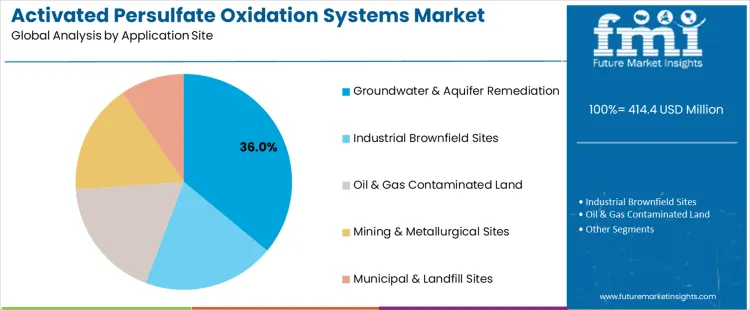
Groundwater & aquifer remediation is the leading application site in the activated persulfate oxidation systems market, capturing 36% of the share. This growth is primarily driven by the rising contamination of groundwater resources, which poses significant environmental and health risks. Groundwater is a critical source of drinking water, and contamination from pollutants such as petroleum hydrocarbons, solvents, and chlorinated compounds requires effective remediation. Activated persulfate oxidation systems, particularly those using alkaline-activated persulfate, are highly effective in breaking down these contaminants through oxidation, making them ideal for groundwater and aquifer cleanup. The growing regulatory pressure to clean up contaminated water sources, coupled with increasing public awareness of water quality issues, is driving the adoption of activated persulfate systems. As governments and industries prioritize the protection and restoration of groundwater resources, the demand for activated persulfate oxidation systems in groundwater & aquifer remediation is expected to continue to grow, securing its dominant position in the market.
What is Driving the Demand for Alkaline-Activated Persulfate in the Activated Persulfate Oxidation Systems Market?

Alkaline-activated persulfate is the leading activation method in the activated persulfate oxidation systems market, holding 32% of the share. This method is preferred due to its simplicity, efficiency, and cost-effectiveness in treating a wide variety of contaminants, particularly in groundwater and soil remediation. Alkaline activation works by enhancing the persulfate compound's ability to break down organic contaminants, such as petroleum hydrocarbons, chlorinated solvents, and industrial chemicals, through oxidation reactions. The increasing demand for environmentally friendly and non-toxic remediation solutions is driving the adoption of alkaline-activated persulfate, as it produces fewer byproducts compared to other methods. Additionally, its ability to treat a broad spectrum of contaminants and its adaptability to a range of environmental conditions make it an attractive solution for large-scale cleanup projects. As environmental regulations continue to tighten and the need for effective contamination control grows, alkaline-activated persulfate is expected to remain a dominant activation method in the market.
What are the Key Dynamics in the Global Activated Persulfate Oxidation Systems Market?
The global activated persulfate oxidation systems market is growing as environmental remediation professionals turn to advanced oxidation technologies to treat contaminated groundwater, soil and industrial waste streams. Activated persulfate systems use chemical, heat or alkaline activation to generate sulfate radicals that break down a wide range of organic pollutants, including petroleum hydrocarbons, chlorinated solvents and emerging contaminants. Growth reflects tightening regulatory standards for cleanup, rising brownfield redevelopment activity, and demand for effective, cost competitive in situ and ex situ remediation solutions. Adoption spans government programs, industrial sites, and consultancy driven cleanup projects where rapid, verifiable contaminant reduction is required.
What are the Key Drivers for the Activated Persulfate Oxidation Systems Market?
A major driver is regulatory pressure to achieve stringent contaminant limits in soil and groundwater, encouraging use of technologies that accelerate degradation compared with natural attenuation. Activated persulfate systems are valued for broad applicability across contaminant classes and effectiveness in diverse subsurface conditions. Expansion of industrial activity and legacy pollution from manufacturing, refineries and waste disposal sites increases demand for advanced remediation methods. Improvements in activation techniques and delivery mechanisms enhance treatment performance and reduce cost per volume of contaminated media treated. Focus on sustainable, low impact cleanup methods that reduce excavation and transport supports wider adoption of persulfate oxidation systems.
What are the Restraints for the Activated Persulfate Oxidation Systems Market?
One restraint is the technical complexity associated with designing and implementing activated persulfate treatment strategies, which require thorough site characterization and optimization of activation conditions. Subsurface heterogeneity, natural oxidant demand and pH variations influence radical generation and distribution, affecting performance outcomes. Perceived cost barriers for reagents, injection infrastructure and monitoring can limit use on smaller projects or in resource constrained settings. Variation in regional regulatory frameworks and approval processes for chemical oxidants adds planning complexity for multinational remediation firms. Misalignment between expected and actual treatment results due to site variability can create hesitation without robust field data.
What are the Key Trends in the Activated Persulfate Oxidation Systems Market?
A key trend is advancement of stabilized and controlled release persulfate formulations that maintain reactivity longer in subsurface environments, improving contact with target contaminants. Enhanced delivery approaches such as direct push injection, recirculation wells and fracturing techniques support better distribution and radical contact. Integration of persulfate oxidation with other remediation strategies like bioremediation, surfactant enhancement and monitored natural attenuation is gaining traction for complex contaminant mixtures. Real time monitoring and data analytics tools help optimize design and validate performance, supporting regulatory compliance. Collaboration between technology providers, remediation contractors and regulatory bodies is fostering development of standardized protocols and performance benchmarks that improve confidence and adoption rates.
What is the Country-Wise Analysis of the Activated Persulfate Oxidation Systems Market?
The activated persulfate oxidation systems market is expected to experience steady growth, driven by the increasing demand for advanced groundwater and soil remediation technologies. These systems, which utilize persulfate to oxidize and break down contaminants like chlorinated solvents, petroleum hydrocarbons, and other toxic substances, are gaining popularity due to their effectiveness and environmental safety. High-growth markets such as the United States, China, and India are seeing strong demand due to expanding industrial sectors, rising environmental awareness, and increasing regulatory pressure on pollution control. Developed markets like Germany and Canada are also witnessing steady growth, supported by stringent environmental regulations, technological advancements, and the increasing adoption of sustainable remediation solutions.

| Country | CAGR (2026-2036) |
|---|---|
| USA | 10% |
| China | 9.7% |
| India | 9.4% |
| Germany | 7.8% |
| Canada | 7.5% |
What is the Growth Outlook for the Activated Persulfate Oxidation Systems Market in the United States?
The activated persulfate oxidation systems market in the United States is expected to grow at the highest rate, with a projected CAGR of 10%. The USA market is driven by stringent environmental regulations and a growing focus on sustainable and effective remediation technologies for contaminated sites. As industries such as oil and gas, manufacturing, and agriculture contribute to soil and groundwater contamination, there is increasing demand for advanced oxidation systems to treat hazardous materials. The USA government’s regulatory frameworks, such as the Environmental Protection Agency (EPA), are pushing for cleaner solutions, which is driving the adoption of activated persulfate systems. With the rising emphasis on environmental sustainability, the market for activated persulfate oxidation systems is expected to expand significantly in the USA.
What is the Market Outlook for the Activated Persulfate Oxidation Systems Market in China?
The activated persulfate oxidation systems market in China is projected to grow steadily, with a projected CAGR of 9.7%. China’s rapid industrialization, growing urbanization, and increasing environmental pollution are driving the demand for more efficient and sustainable soil and groundwater remediation technologies. The government’s tightening environmental regulations and growing focus on pollution control are encouraging industries to adopt advanced technologies like activated persulfate oxidation systems. China’s industrial sectors, including oil and gas, mining, and manufacturing, are significant contributors to contamination, further fueling the need for these effective remediation solutions. As China works to meet international environmental standards, the market for activated persulfate oxidation systems is set to continue its strong growth.
What is the Growth Forecast for the Activated Persulfate Oxidation Systems Market in India?
The activated persulfate oxidation systems market in India is expected to grow steadily, with a projected CAGR of 9.4%. India’s expanding industrial base, rapid urbanization, and increasing environmental concerns are key factors driving demand for advanced remediation technologies. As India faces challenges related to soil and groundwater contamination from industrial waste, agriculture, and urban development, there is growing need for effective and sustainable solutions. The Indian government’s push for eco-friendlier waste management and pollution control practices is expected to support the adoption of activated persulfate systems. With the country’s commitment to improving environmental quality and advancing sustainable development, India’s market for activated persulfate oxidation systems is positioned for continued growth.
What is the Market Outlook for the Activated Persulfate Oxidation Systems Market in Germany?
The activated persulfate oxidation systems market in Germany is projected to grow at a steady pace, with a projected CAGR of 7.8%. Germany’s strong regulatory framework, which emphasizes environmental protection and sustainability, is driving demand for effective pollution control technologies. As Germany continues to prioritize sustainable waste management and soil and groundwater remediation, the need for activated persulfate oxidation systems is rising. The country’s industrial sectors, particularly chemical manufacturing and automotive industries, contribute to contamination, creating an opportunity for advanced oxidation solutions. With increasing awareness of environmental issues and Germany’s leadership in promoting green technologies, the market for activated persulfate oxidation systems is expected to grow steadily in the coming years.
What are the Growth Prospects for the Activated Persulfate Oxidation Systems Market in Canada?
The activated persulfate oxidation systems market in Canada is expected to grow steadily, with a projected CAGR of 7.5%. Canada’s commitment to environmental sustainability and its stringent environmental regulations are key factors driving the demand for innovative remediation technologies. With increasing concerns over soil and groundwater contamination, particularly in industrial zones and agricultural areas, Canada is adopting advanced solutions like activated persulfate oxidation systems to address these issues. The government’s focus on reducing pollution and improving environmental health, combined with a growing interest in sustainable development, is expected to support market growth. As Canada continues to invest in environmental infrastructure and waste management, the market for activated persulfate oxidation systems is expected to see steady expansion.
What is the Competitive Landscape for the Activated Persulfate Oxidation Systems Market?

The activated persulfate oxidation systems market is growing as industries seek effective, sustainable solutions for contaminant remediation, particularly for groundwater and soil. PeroxyChem (Evonik) leads the market with its advanced activated persulfate oxidation systems, offering high-performance solutions that efficiently break down contaminants through oxidation processes. Their focus on environmental sustainability, product effectiveness, and compliance with regulatory standards has made them a dominant player in the market. Carus Corporation, Solvay, and Regenesis are significant competitors, each providing specialized persulfate oxidation systems for environmental cleanup. Carus Corporation offers a variety of oxidation agents designed for efficient contaminant treatment, while Solvay focuses on delivering advanced, sustainable solutions for environmental remediation. Regenesis provides environmentally responsible products tailored to meet the needs of groundwater and soil cleanup projects.
EOS Remediation further strengthens the competitive landscape by offering activated persulfate oxidation systems that provide effective, targeted solutions for contaminant degradation. EOS Remediation specializes in offering eco-friendly, high-performance solutions that accelerate the natural breakdown of contaminants in contaminated sites. These companies compete by focusing on product innovation, sustainability, and the ability to meet the increasing demand for effective, eco-friendly oxidation systems in environmental remediation. As the need for sustainable and efficient contamination cleanup solutions grows, the market for activated persulfate oxidation systems is expected to continue expanding.
Key Players of the Activated Persulfate Oxidation Systems Market
- PeroxyChem (Evonik)
- Carus Corporation
- Solvay
- Regenesis
- EOS Remediation
Scope of the Report
| Items | Values |
|---|---|
| Quantitative Units (2026) | USD Million |
| Activation Method | Alkaline-Activated Persulfate, Iron-Activated Persulfate, Heat-Activated Persulfate, Peroxide-Assisted Activation, Catalytic & Chelated Activation Systems |
| Target Contaminant | Petroleum Hydrocarbons (BTEX, TPH), Chlorinated Solvents (TCE, PCE, VC), PFAS & Emerging Contaminants, PAHs, PCBs & Other Organics, Mixed Organic–Inorganic Pollutants |
| Application Site | Groundwater & Aquifer Remediation, Industrial Brownfield Sites, Oil & Gas Contaminated Land, Mining & Metallurgical Sites, Municipal & Landfill Sites |
| Companies | PeroxyChem (Evonik), Carus Corporation, Solvay, Regenesis, EOS Remediation |
| Regions Covered | North America, Latin America, Western Europe, Eastern Europe, South Asia and Pacific, East Asia, Middle East & Africa |
| Countries Covered | United States, Canada, Mexico, Brazil, Argentina, Germany, France, United Kingdom, Italy, Spain, Netherlands, China, India, Japan, South Korea, ANZ, GCC Countries, South Africa |
| Additional Attributes | Dollar sales by activation method, target contaminant, application site, and region. Includes market trends in activated persulfate oxidation systems, performance in various contamination types, cost-effectiveness, sustainability practices, regulatory compliance, market share and competitive positioning of key companies, and the role of persulfate-based systems in enhancing groundwater treatment, improving oxidation processes, and supporting environmental remediation efforts across industries. |
Activated Persulfate Oxidation Systems Market Segmentation
Activation Method
- Alkaline-Activated Persulfate
- Iron-Activated Persulfate
- Heat-Activated Persulfate
- Peroxide-Assisted Activation
- Catalytic & Chelated Activation Systems
Target Contaminant
- Petroleum Hydrocarbons (BTEX, TPH)
- Chlorinated Solvents (TCE, PCE, VC)
- PFAS & Emerging Contaminants
- PAHs, PCBs & Other Organics
- Mixed Organic–Inorganic Pollutants
Application Site
- Groundwater & Aquifer Remediation
- Industrial Brownfield Sites
- Oil & Gas Contaminated Land
- Mining & Metallurgical Sites
- Municipal & Landfill Sites
Region
- Asia Pacific
- China
- Japan
- South Korea
- India
- Australia & New Zealand
- ASEAN
- Rest of Asia Pacific
- Europe
- Germany
- United Kingdom
- France
- Italy
- Spain
- Nordic
- BENELUX
- Rest of Europe
- North America
- United States
- Canada
- Mexico
- Latin America
- Brazil
- Chile
- Rest of Latin America
- Middle East & Africa
- Kingdom of Saudi Arabia
- Other GCC Countries
- Turkey
- South Africa
- Other African Union
- Rest of Middle East & Africa
Bibliography
- PeroxyChem (Evonik). (n.d.). Activated persulfate oxidation systems for effective environmental remediation.
- Carus Corporation. (n.d.). Persulfate-based oxidation systems for groundwater and soil cleanup.
Frequently Asked Questions
How big is the activated persulfate oxidation systems market in 2026?
The global activated persulfate oxidation systems market is estimated to be valued at USD 414.4 million in 2026.
What will be the size of activated persulfate oxidation systems market in 2036?
The market size for the activated persulfate oxidation systems market is projected to reach USD 1,017.6 million by 2036.
How much will be the activated persulfate oxidation systems market growth between 2026 and 2036?
The activated persulfate oxidation systems market is expected to grow at a 9.4% CAGR between 2026 and 2036.
What are the key activation method types in the activated persulfate oxidation systems market?
The key activation method types in activated persulfate oxidation systems market are alkaline-activated persulfate, iron-activated persulfate, heat-activated persulfate, peroxide-assisted activation and catalytic & chelated activation systems.
Which target contaminant segment to contribute significant share in the activated persulfate oxidation systems market in 2026?
In terms of target contaminant, Petroleum hydrocarbons (BTEX, TPH) are expected to command a 30.0% share of the target contaminant segment in 2026.
Preview the report firsthand - request a free sample
Get SampleGet the brochure for pricing and purchase details.
Get PDFTable of Content
- Executive Summary
- Global Market Outlook
- Demand-side Trends
- Supply-side Trends
- Technology Roadmap Analysis
- Analysis and Recommendations
- Market Overview
- Market Coverage / Taxonomy
- Market Definition / Scope / Limitations
- Market Background
- Market Dynamics
- Drivers
- Restraints
- Opportunity
- Trends
- Scenario Forecast
- Demand in Optimistic Scenario
- Demand in Likely Scenario
- Demand in Conservative Scenario
- Opportunity Map Analysis
- Product Life Cycle Analysis
- Supply Chain Analysis
- Investment Feasibility Matrix
- Value Chain Analysis
- PESTLE and Porter’s Analysis
- Regulatory Landscape
- Regional Parent Market Outlook
- Production and Consumption Statistics
- Import and Export Statistics
- Market Dynamics
- Global Market Analysis 2021 to 2025 and Forecast, 2026 to 2036
- Historical Market Size Value (USD Million) Analysis, 2021 to 2025
- Current and Future Market Size Value (USD Million) Projections, 2026 to 2036
- Y-o-Y Growth Trend Analysis
- Absolute $ Opportunity Analysis
- Global Market Pricing Analysis 2021 to 2025 and Forecast 2026 to 2036
- Global Market Analysis 2021 to 2025 and Forecast 2026 to 2036, By Activation Method
- Introduction / Key Findings
- Historical Market Size Value (USD Million) Analysis By Activation Method , 2021 to 2025
- Current and Future Market Size Value (USD Million) Analysis and Forecast By Activation Method , 2026 to 2036
- Alkaline-Activated Persulfate
- Iron-Activated Persulfate
- Heat-Activated Persulfate
- Peroxide-Assisted Activation
- Catalytic & Chelated Activation Systems
- Alkaline-Activated Persulfate
- Y-o-Y Growth Trend Analysis By Activation Method , 2021 to 2025
- Absolute $ Opportunity Analysis By Activation Method , 2026 to 2036
- Global Market Analysis 2021 to 2025 and Forecast 2026 to 2036, By Target Contaminant
- Introduction / Key Findings
- Historical Market Size Value (USD Million) Analysis By Target Contaminant, 2021 to 2025
- Current and Future Market Size Value (USD Million) Analysis and Forecast By Target Contaminant, 2026 to 2036
- Petroleum Hydrocarbons (BTEX, TPH)
- Chlorinated Solvents (TCE, PCE, VC)
- PFAS & Emerging Contaminants
- PAHs, PCBs & Other Organics
- Mixed Organic–Inorganic Pollutants
- Petroleum Hydrocarbons (BTEX, TPH)
- Y-o-Y Growth Trend Analysis By Target Contaminant, 2021 to 2025
- Absolute $ Opportunity Analysis By Target Contaminant, 2026 to 2036
- Global Market Analysis 2021 to 2025 and Forecast 2026 to 2036, By Application Site
- Introduction / Key Findings
- Historical Market Size Value (USD Million) Analysis By Application Site, 2021 to 2025
- Current and Future Market Size Value (USD Million) Analysis and Forecast By Application Site, 2026 to 2036
- Groundwater & Aquifer Remediation
- Industrial Brownfield Sites
- Oil & Gas Contaminated Land
- Mining & Metallurgical Sites
- Municipal & Landfill Sites
- Groundwater & Aquifer Remediation
- Y-o-Y Growth Trend Analysis By Application Site, 2021 to 2025
- Absolute $ Opportunity Analysis By Application Site, 2026 to 2036
- Global Market Analysis 2021 to 2025 and Forecast 2026 to 2036, By Region
- Introduction
- Historical Market Size Value (USD Million) Analysis By Region, 2021 to 2025
- Current Market Size Value (USD Million) Analysis and Forecast By Region, 2026 to 2036
- North America
- Latin America
- Western Europe
- Eastern Europe
- East Asia
- South Asia and Pacific
- Middle East & Africa
- Market Attractiveness Analysis By Region
- North America Market Analysis 2021 to 2025 and Forecast 2026 to 2036, By Country
- Historical Market Size Value (USD Million) Trend Analysis By Market Taxonomy, 2021 to 2025
- Market Size Value (USD Million) Forecast By Market Taxonomy, 2026 to 2036
- By Country
- USA
- Canada
- Mexico
- By Activation Method
- By Target Contaminant
- By Application Site
- By Country
- Market Attractiveness Analysis
- By Country
- By Activation Method
- By Target Contaminant
- By Application Site
- Key Takeaways
- Latin America Market Analysis 2021 to 2025 and Forecast 2026 to 2036, By Country
- Historical Market Size Value (USD Million) Trend Analysis By Market Taxonomy, 2021 to 2025
- Market Size Value (USD Million) Forecast By Market Taxonomy, 2026 to 2036
- By Country
- Brazil
- Chile
- Rest of Latin America
- By Activation Method
- By Target Contaminant
- By Application Site
- By Country
- Market Attractiveness Analysis
- By Country
- By Activation Method
- By Target Contaminant
- By Application Site
- Key Takeaways
- Western Europe Market Analysis 2021 to 2025 and Forecast 2026 to 2036, By Country
- Historical Market Size Value (USD Million) Trend Analysis By Market Taxonomy, 2021 to 2025
- Market Size Value (USD Million) Forecast By Market Taxonomy, 2026 to 2036
- By Country
- Germany
- UK
- Italy
- Spain
- France
- Nordic
- BENELUX
- Rest of Western Europe
- By Activation Method
- By Target Contaminant
- By Application Site
- By Country
- Market Attractiveness Analysis
- By Country
- By Activation Method
- By Target Contaminant
- By Application Site
- Key Takeaways
- Eastern Europe Market Analysis 2021 to 2025 and Forecast 2026 to 2036, By Country
- Historical Market Size Value (USD Million) Trend Analysis By Market Taxonomy, 2021 to 2025
- Market Size Value (USD Million) Forecast By Market Taxonomy, 2026 to 2036
- By Country
- Russia
- Poland
- Hungary
- Balkan & Baltic
- Rest of Eastern Europe
- By Activation Method
- By Target Contaminant
- By Application Site
- By Country
- Market Attractiveness Analysis
- By Country
- By Activation Method
- By Target Contaminant
- By Application Site
- Key Takeaways
- East Asia Market Analysis 2021 to 2025 and Forecast 2026 to 2036, By Country
- Historical Market Size Value (USD Million) Trend Analysis By Market Taxonomy, 2021 to 2025
- Market Size Value (USD Million) Forecast By Market Taxonomy, 2026 to 2036
- By Country
- China
- Japan
- South Korea
- By Activation Method
- By Target Contaminant
- By Application Site
- By Country
- Market Attractiveness Analysis
- By Country
- By Activation Method
- By Target Contaminant
- By Application Site
- Key Takeaways
- South Asia and Pacific Market Analysis 2021 to 2025 and Forecast 2026 to 2036, By Country
- Historical Market Size Value (USD Million) Trend Analysis By Market Taxonomy, 2021 to 2025
- Market Size Value (USD Million) Forecast By Market Taxonomy, 2026 to 2036
- By Country
- India
- ASEAN
- Australia & New Zealand
- Rest of South Asia and Pacific
- By Activation Method
- By Target Contaminant
- By Application Site
- By Country
- Market Attractiveness Analysis
- By Country
- By Activation Method
- By Target Contaminant
- By Application Site
- Key Takeaways
- Middle East & Africa Market Analysis 2021 to 2025 and Forecast 2026 to 2036, By Country
- Historical Market Size Value (USD Million) Trend Analysis By Market Taxonomy, 2021 to 2025
- Market Size Value (USD Million) Forecast By Market Taxonomy, 2026 to 2036
- By Country
- Kingdom of Saudi Arabia
- Other GCC Countries
- Turkiye
- South Africa
- Other African Union
- Rest of Middle East & Africa
- By Activation Method
- By Target Contaminant
- By Application Site
- By Country
- Market Attractiveness Analysis
- By Country
- By Activation Method
- By Target Contaminant
- By Application Site
- Key Takeaways
- Key Countries Market Analysis
- USA
- Pricing Analysis
- Market Share Analysis, 2025
- By Activation Method
- By Target Contaminant
- By Application Site
- Canada
- Pricing Analysis
- Market Share Analysis, 2025
- By Activation Method
- By Target Contaminant
- By Application Site
- Mexico
- Pricing Analysis
- Market Share Analysis, 2025
- By Activation Method
- By Target Contaminant
- By Application Site
- Brazil
- Pricing Analysis
- Market Share Analysis, 2025
- By Activation Method
- By Target Contaminant
- By Application Site
- Chile
- Pricing Analysis
- Market Share Analysis, 2025
- By Activation Method
- By Target Contaminant
- By Application Site
- Germany
- Pricing Analysis
- Market Share Analysis, 2025
- By Activation Method
- By Target Contaminant
- By Application Site
- UK
- Pricing Analysis
- Market Share Analysis, 2025
- By Activation Method
- By Target Contaminant
- By Application Site
- Italy
- Pricing Analysis
- Market Share Analysis, 2025
- By Activation Method
- By Target Contaminant
- By Application Site
- Spain
- Pricing Analysis
- Market Share Analysis, 2025
- By Activation Method
- By Target Contaminant
- By Application Site
- France
- Pricing Analysis
- Market Share Analysis, 2025
- By Activation Method
- By Target Contaminant
- By Application Site
- India
- Pricing Analysis
- Market Share Analysis, 2025
- By Activation Method
- By Target Contaminant
- By Application Site
- ASEAN
- Pricing Analysis
- Market Share Analysis, 2025
- By Activation Method
- By Target Contaminant
- By Application Site
- Australia & New Zealand
- Pricing Analysis
- Market Share Analysis, 2025
- By Activation Method
- By Target Contaminant
- By Application Site
- China
- Pricing Analysis
- Market Share Analysis, 2025
- By Activation Method
- By Target Contaminant
- By Application Site
- Japan
- Pricing Analysis
- Market Share Analysis, 2025
- By Activation Method
- By Target Contaminant
- By Application Site
- South Korea
- Pricing Analysis
- Market Share Analysis, 2025
- By Activation Method
- By Target Contaminant
- By Application Site
- Russia
- Pricing Analysis
- Market Share Analysis, 2025
- By Activation Method
- By Target Contaminant
- By Application Site
- Poland
- Pricing Analysis
- Market Share Analysis, 2025
- By Activation Method
- By Target Contaminant
- By Application Site
- Hungary
- Pricing Analysis
- Market Share Analysis, 2025
- By Activation Method
- By Target Contaminant
- By Application Site
- Kingdom of Saudi Arabia
- Pricing Analysis
- Market Share Analysis, 2025
- By Activation Method
- By Target Contaminant
- By Application Site
- Turkiye
- Pricing Analysis
- Market Share Analysis, 2025
- By Activation Method
- By Target Contaminant
- By Application Site
- South Africa
- Pricing Analysis
- Market Share Analysis, 2025
- By Activation Method
- By Target Contaminant
- By Application Site
- USA
- Market Structure Analysis
- Competition Dashboard
- Competition Benchmarking
- Market Share Analysis of Top Players
- By Regional
- By Activation Method
- By Target Contaminant
- By Application Site
- Competition Analysis
- Competition Deep Dive
- PeroxyChem (Evonik)
- Overview
- Product Portfolio
- Profitability by Market Segments (Product/Age /Sales Channel/Region)
- Sales Footprint
- Strategy Overview
- Marketing Strategy
- Product Strategy
- Channel Strategy
- Carus Corporation
- Solvay
- Regenesis
- EOS Remediation
- PeroxyChem (Evonik)
- Competition Deep Dive
- Assumptions & Acronyms Used
- Research Methodology


