

- Industry Size (2026)
- USD 613.6 Mn
- Forecast (2036)
- USD 3211.5 Mn
- CAGR (2026 to 2036)
- 18.0%
AI Infection Detection Market Forecast and Outlook 2026 to 2036
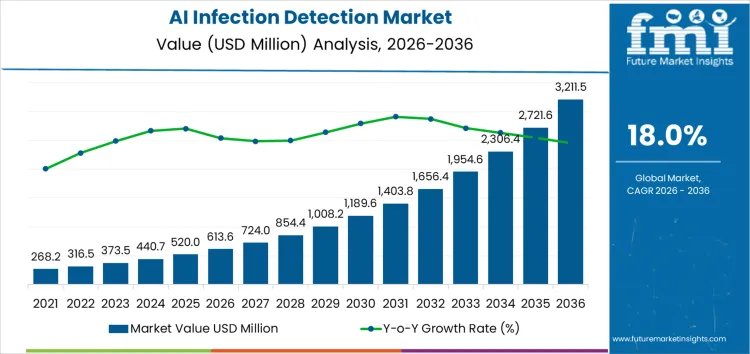
The AI Infection Detection market is estimated at USD 613.6 million in 2026 and is expected to reach USD 3,211.5 million by 2036, growing at a CAGR of 18%. AI software holds the largest product share at 45%, supporting applications in sepsis detection (40%), surgical site infections, and respiratory infections. Hospitals are the primary end users at 55%, while point-of-care facilities and public health institutions contribute to adoption. Services, cloud analytics, and subscription models further enhance accessibility. Key players include Karius, Roche, bioMerieux, and IBM.
Rapid growth is driven by rising demand for early infection detection, reduced hospital readmissions, and improved patient outcomes. Cloud-enabled analytics, integrated systems, and AI-driven predictive models support scalability. Expansion is particularly strong in developed healthcare systems, with emerging markets showing increased adoption. Regulatory approvals, data standardization, and interoperability with existing hospital IT infrastructure are critical for implementation. Continuous software improvements and strategic partnerships ensure broad deployment and high reliability across diverse clinical settings.
Quick Stats for AI Infection Detection Market
- AI Infection Detection Market Value (2026): USD 613.6 million
- AI Infection Detection Market Forecast Value (2036): USD 3,211.5 million
- AI Infection Detection Market Forecast CAGR: 18.0%
- Leading Type in AI Infection Detection Market: AI Software
- Key Growth Regions in AI Infection Detection Market: North America, Europe, and Asia Pacific
- Top Players in AI Infection Detection Market: Karius, Roche, bioMerieux, IBM, Guardant
What is the Growth Forecast for the AI Infection Detection Market through 2036?
From 2026 to 2031, the AI infection detection market grows from USD 613.6 million to approximately USD 1,189.6 million, representing the early to mid-stage adoption phase. Annual increments increase from USD 93.6 million in 2026 to USD 181.4 million in 2031. Growth is concentrated in hospitals, diagnostic laboratories, and clinical research facilities, where AI solutions enhance pathogen detection accuracy, reduce turnaround times, and improve patient outcomes. North America and Europe account for roughly 60% of early adoption, driven by regulatory approvals, pilot program validations, and integration with existing laboratory information systems. Asia Pacific shows emerging uptake in high-volume hospital networks and telemedicine-driven diagnostic programs.
Between 2031 and 2036, the market expands from approximately USD 1,189.6 million to USD 3,211.5 million, illustrating the saturation point trajectory. Annual increments increase from USD 181.4 million to USD 509.9 million by 2036. Saturation is expected as hospital networks, large diagnostic chains, and national healthcare systems achieve near-full adoption, leaving incremental growth dependent on replacement cycles, upgrades, and expansion into emerging markets. Market saturation is first observed in developed regions by 2034–2035, where AI integration in clinical workflows becomes standard, while growth in Asia Pacific, Latin America, and the Middle East drives remaining expansion. Early adoption relied on pilot programs and high-value institutions, whereas late-stage growth reflects portfolio-wide deployment and global standardization of AI infection detection platforms.
AI Infection Detection Market Key Takeaways
| Metric | Value |
|---|---|
| Market Value (2026) | USD 613.6 million |
| Forecast Value (2036) | USD 3,211.5 million |
| Forecast CAGR (2026 to 2036) | 18.0% |
What Is Driving Demand in the AI Infection Detection Market?
Early use of artificial intelligence in infection detection emerged from practical limitations in traditional diagnostic workflows rather than from broad adoption of automation alone. Conventional methods, including culture growth, microscopy, and standard rapid tests, often required time-consuming sample preparation and interpretation by trained personnel. Delays in diagnosis reduced the effectiveness of early treatment and infection control measures in clinical settings. Initial deployment of AI-assisted systems focused on pattern recognition in imaging data, genomic signal interpretation, and predictive modelling where human interpretation lagged behind throughput needs. Historical demand was concentrated in high-acuity hospital environments and specialised laboratories grappling with high volumes of complex cases rather than in routine primary care.
Future demand for AI infection detection is being shaped by structural changes in healthcare delivery and public health expectations rather than incremental performance improvements alone. Healthcare systems are under pressure to provide faster, more consistent diagnoses while controlling costs and enhancing patient outcomes. AI platforms are being integrated with electronic health records, laboratory information systems, and real-time surveillance networks to detect infection patterns earlier and support decision workflows. Regulatory frameworks are evolving to define validation standards, risk classification, and clinical utility requirements for AI diagnostics. Adoption will expand as providers seek scalable solutions that reduce diagnostic delays, minimise empirical treatment reliance, and support population level monitoring. Demand growth will be anchored in documented clinical performance criteria, interoperability with health IT infrastructure, and alignment with regulatory validation pathways rather than isolated pilot implementations.
What Factors Are Affecting the Demand for AI Infection Detection Market in Terms of Product Type and Application?
Demand for AI infection detection solutions is segmented by product type and clinical application across hospital and healthcare diagnostic environments. AI software accounts for about 45% of total demand, making it the leading product type. Integrated systems, cloud analytics platforms, and services represent additional categories without disclosed share splits. These product types differ in deployment complexity, data integration depth, and clinical workflow impact. Application segmentation reflects infection risk profiles and monitoring urgency. Sepsis accounts for about 40% of demand, followed by respiratory infections, surgical site infections, and other hospital acquired conditions. Together, these segments explain demand formation shaped by early detection requirements, data availability, and clinical decision support needs rather than overall hospital IT spending levels.
What Drives Demand by Product Type in the AI Infection Detection Market?
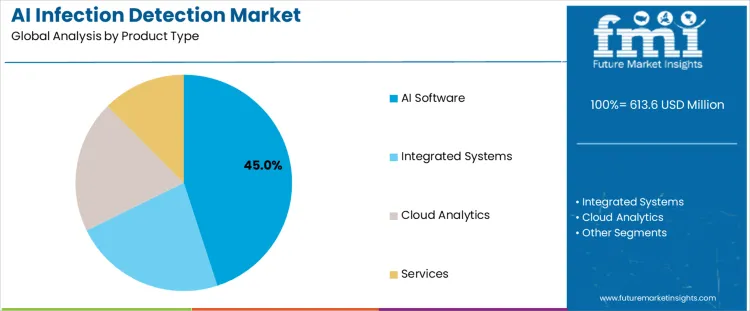
AI software leads demand with a 45% share because it can be deployed across existing hospital IT infrastructure with limited hardware modification. These platforms analyze patient data streams to identify infection patterns and risk signals in real time. Integrated systems combine software with sensors or monitoring devices, supporting closed loop clinical workflows. Cloud analytics platforms enable large scale data processing and cross facility learning but depend on connectivity and data governance readiness. Service offerings support customization, training, and ongoing model refinement. Product type selection reflects hospital digital maturity and integration tolerance rather than preference for standalone or bundled solutions. Demand therefore aligns with deployment flexibility and scalability rather than technology novelty or feature density.
Product type demand remains stable because system selection is tied to long term IT architecture decisions. Software platforms are embedded into clinical workflows once validated. Integrated systems require capital planning and clinical retraining. Cloud solutions expand gradually with data governance approval. Services remain supplementary. These patterns restrict rapid substitution. Product type segmentation therefore highlights dependence on infrastructure readiness rather than short term innovation cycles.
How Does Application Shape Demand for AI Infection Detection Market?
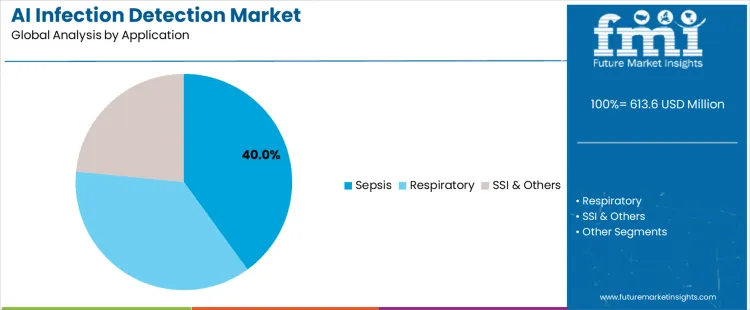
Sepsis accounts for about 40% of total demand, making it the dominant application segment. This reflects the need for rapid identification of systemic infection to reduce mortality risk. AI tools support early warning by analyzing vital signs, lab results, and clinical notes. Respiratory infection detection applies AI to manage pneumonia and viral outbreaks. Surgical site infection monitoring supports post-operative care and quality metrics. Other applications address hospital acquired infections across wards. Application driven demand reflects clinical urgency and outcome sensitivity rather than infection incidence alone.
Sepsis applications maintain leadership due to clear clinical and economic impact. Respiratory monitoring expands with seasonal variability. SSI detection supports compliance and reporting needs. Other applications scale selectively. Once validated, AI models are rarely repurposed across conditions. This stabilizes demand distribution by application.
How Is the AI Infection Detection Market Being Applied Across Healthcare Settings?
Use appears in hospitals, clinics, and diagnostic laboratories where rapid identification of bacterial, viral, or fungal infections is critical. AI-powered platforms analyze patient data, imaging, and laboratory results to detect infections earlier than conventional methods. Point-of-care devices integrate AI algorithms to assist clinicians in triaging patients, predicting sepsis, or monitoring hospital-acquired infections. These applications reflect operational and clinical priorities rather than administrative functions, with adoption driven by diagnostic accuracy, workflow efficiency, and improved patient outcomes.
What Operational and Material Conditions Support Adoption of AI Infection Detection Solutions?
Selection aligns with healthcare environments where electronic health records, imaging systems, and laboratory data can be digitized and integrated into AI platforms. Algorithms are trained on diverse datasets to recognize infection patterns across patient populations. Hospitals implement software compatible with existing diagnostic workflows and regulatory standards. IT teams monitor data security, algorithm updates, and system interoperability. These conditions emerge from operational efficiency, clinical reliability, and regulatory compliance priorities in structured healthcare workflows.
Which Practical Considerations Limit Wider Use of AI Infection Detection Systems?
High upfront cost and integration complexity may restrict adoption to larger hospitals or specialized clinics. Data quality, completeness, and standardization affect algorithm performance. Regulatory approval and clinical validation are required for diagnostic use in different regions. Staff training is necessary to interpret AI-generated recommendations accurately. These factors lead to selective deployment where diagnostic accuracy, workflow efficiency, and patient outcome improvements justify incremental cost and operational adaptation.
What is the Demand for AI Infection Detection by Country?
| Country | CAGR (%) |
|---|---|
| USA | 19.0% |
| Brazil | 19.5% |
| China | 20.0% |
| India | 20.2% |
| Germany | 17.2% |
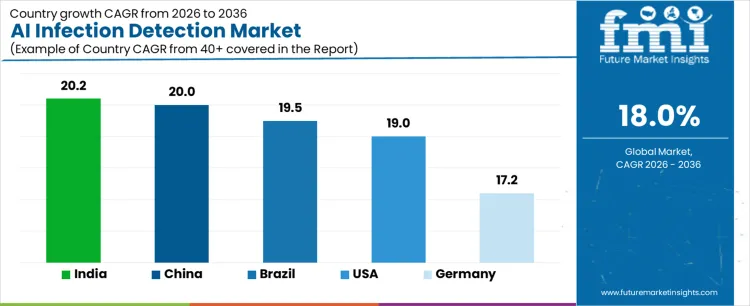
The demand for AI infection detection solutions varies across countries, driven by healthcare digitization, rising infection control requirements, and adoption of advanced diagnostic technologies. India leads with a 20.2% CAGR, supported by increasing healthcare infrastructure, high demand for early infection detection, and integration of AI in medical diagnostics. China follows at 20.0%, driven by large population, hospital expansion, and government initiatives for AI powered healthcare solutions. Brazil records 19.5%, shaped by growing healthcare investments and adoption of digital diagnostics. The USA grows at 19.0%, reflecting established healthcare systems embracing AI technologies. Germany posts 17.2%, supported by advanced healthcare infrastructure and steady integration of AI in diagnostics.
How Is AI Infection Detection Advancing Healthcare in the United States?
In the United States, revenue from the AI Infection Detection Market is expanding at a CAGR of 19% through 2036, driven by growing adoption of artificial intelligence systems for rapid diagnosis and monitoring of infectious diseases. Hospitals, diagnostic laboratories, and research institutions are integrating AI-powered imaging, predictive analytics, and automated reporting tools to improve detection accuracy, reduce turnaround time, and support clinical decision-making. Demand is concentrated in urban healthcare networks, diagnostic centers, and public health monitoring programs. Domestic technology providers are developing high-performance AI solutions compatible with existing laboratory and hospital IT infrastructure. Rising infection awareness and recurring diagnostic needs are sustaining consistent adoption nationwide.
- Hospitals, diagnostic laboratories, and research institutions drive adoption
- AI improves detection accuracy, reduces turnaround time, and supports decisions
- Domestic providers deliver high-performance, IT-compatible solutions
- Recurring diagnostic requirements sustain consistent adoption
How Are Healthcare Networks and AI Integration Supporting Growth in Brazil?
In Brazil, the market is growing at a CAGR of 19.5% through 2036, fueled by expanding hospital networks and increased investment in AI-enabled diagnostic systems. Manufacturers are deploying AI platforms to detect infections in clinical and laboratory settings, improving accuracy and patient outcomes. Demand is concentrated in urban hospitals, private laboratories, and public health initiatives. Local technology providers are supplying scalable, AI-powered systems compatible with hospital IT infrastructures and laboratory workflows. Rising public health initiatives, infection surveillance programs, and recurring diagnostics cycles are driving adoption nationwide.
- Urban hospitals, laboratories, and public health programs drive adoption
- AI platforms enhance diagnostic accuracy and patient outcomes
- Local providers supply scalable, IT-compatible AI systems
- Recurring diagnostics cycles sustain widespread adoption
How Is AI Infection Detection Expanding in China?
China is witnessing growth at a CAGR of 20% through 2036, driven by large-scale adoption of AI for infectious disease detection across hospitals, public health centers, and diagnostic laboratories. Manufacturers are integrating AI-enabled imaging, predictive modeling, and automated monitoring systems to improve detection speed, accuracy, and early warning capabilities. Demand is concentrated in major urban healthcare networks, industrial hospital chains, and public health institutions. Domestic technology providers are scaling AI solutions compatible with hospital IT systems and laboratory infrastructures. Expanding healthcare infrastructure, government-supported AI initiatives, and recurring testing programs are sustaining rapid adoption nationwide.
- Urban hospitals, industrial hospital chains, and public health centers drive adoption
- AI systems improve detection speed, accuracy, and early warning
- Domestic providers scale IT-compatible, high-performance AI solutions
- Recurring testing programs sustain rapid adoption
How Is Infection Detection and Public Health Expansion Driving Growth in India?
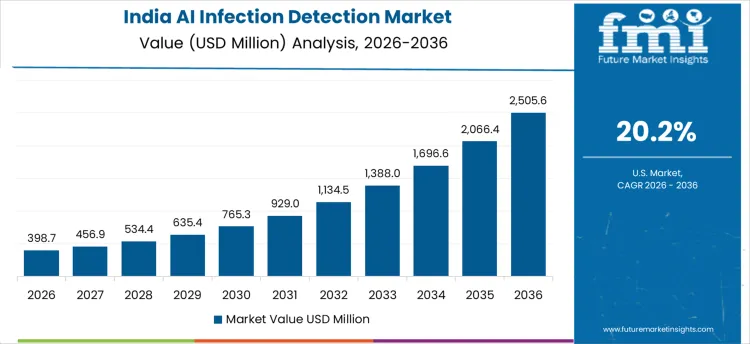
In India, revenue from the AI Infection Detection Market is expanding at a CAGR of 20.2% through 2036, supported by growing demand for rapid, accurate diagnostics in hospitals, laboratories, and public health initiatives. Manufacturers are deploying AI-driven imaging, predictive analytics, and automated reporting platforms to enhance detection and response to infectious diseases. Demand is concentrated in urban hospitals, diagnostic centers, and national health programs. Domestic AI providers supply high-performance, IT-compatible solutions integrated into existing healthcare infrastructure. Increasing infection awareness, government surveillance initiatives, and recurring diagnostic cycles are sustaining robust adoption nationwide.
- Urban hospitals, diagnostic centers, and public health programs drive adoption
- AI improves detection, predictive analytics, and automated reporting
- Domestic providers supply IT-compatible, high-performance AI platforms
- Recurring diagnostic and surveillance cycles sustain robust adoption
How Are Healthcare Standards and AI Systems Supporting Adoption in Germany?
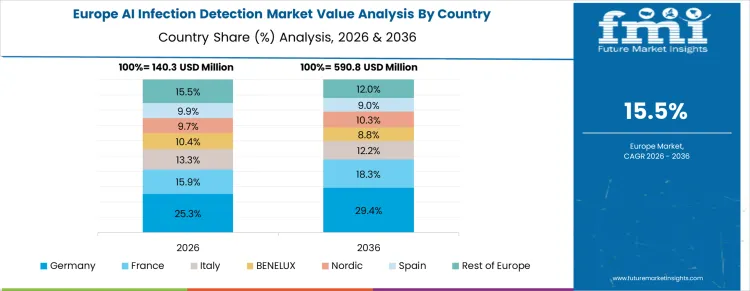
Germany is witnessing growth at a CAGR of 17.2% through 2036, driven by adoption of AI-based infection detection tools in hospitals, laboratories, and research institutions. Manufacturers are integrating AI for rapid diagnostics, predictive modeling, and early detection of infectious diseases to enhance clinical outcomes and workflow efficiency. Demand is concentrated in urban healthcare networks, laboratory facilities, and research centers. Domestic technology providers offer high-performance, IT-compatible AI systems tailored for hospital and laboratory integration. Stringent healthcare standards, recurring diagnostic needs, and technology adoption are sustaining consistent procurement nationwide.
- Hospitals, laboratories, and research centers anchor demand
- AI enhances rapid diagnostics, predictive modeling, and early detection
- Domestic providers offer IT-compatible, high-performance AI systems
- Recurring diagnostic requirements sustain consistent adoption
Which Companies Shape Competition in The AI Infection Detection Market Through Diagnostic Pathways and Clinical Adoption?
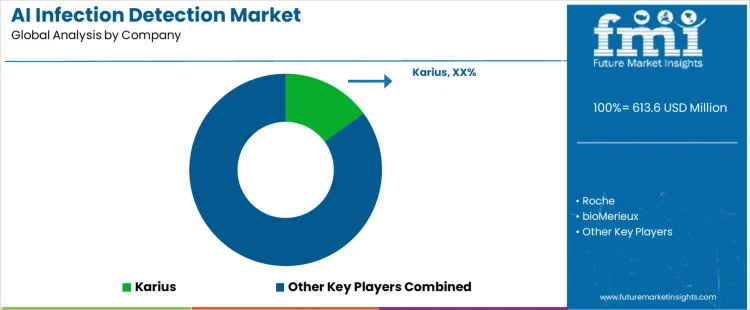
Competition in the AI infection detection market is structured around how rapidly and accurately complex diagnostic data can be translated into actionable clinical insight. Karius occupies a distinct position by applying AI driven interpretation to next generation sequencing for pathogen detection from blood samples, particularly in cases where conventional diagnostics are inconclusive. Roche and bioMérieux influence this market through established diagnostics ecosystems, where AI tools are layered onto molecular testing, microbiology platforms, and laboratory workflows already embedded in hospitals. Their strength lies in integration with regulated diagnostic pathways rather than standalone algorithms. Adoption is driven by clinical validation, turnaround time, and compatibility with existing laboratory infrastructure, with hospitals prioritizing solutions that reduce diagnostic uncertainty without increasing operational burden.
Technology driven entrants and diversified players shape competitive tension differently. IBM participates through clinical decision support and data analytics capabilities applied to infection detection and interpretation rather than direct diagnostics. Guardant contributes expertise in liquid biopsy and genomic analysis that overlaps with infectious disease detection in specific use cases. Smaller companies and research driven firms operate in niche areas such as antimicrobial resistance prediction or sepsis risk modeling, often through pilot deployments. Competitive positioning depends on clinical evidence, regulatory clearance, and physician trust rather than algorithm sophistication alone. Market progress is constrained by validation timelines, reimbursement considerations, and integration into care protocols, making sustained clinical adoption more decisive than early technical capability.
Key Players in the AI Infection Detection Market
- Karius
- Roche
- bioMerieux
- IBM
- Guardant
- Others
Scope of the Report
| Items | Values |
|---|---|
| Quantitative Units (2026) | USD million |
| Product Type | AI Software, Integrated Systems, Cloud Analytics, Services |
| Application | Sepsis, Respiratory, SSI & Others |
| End-Use Industry | Hospitals, Point-of-Care, Public Health, Subscription Models |
| Region | Asia Pacific (China, Japan, South Korea, India, Australia & New Zealand, ASEAN, Rest of Asia Pacific), Europe (Germany, United Kingdom, France, Italy, Spain, Nordic, BENELUX, Rest of Europe), North America (United States, Canada, Mexico), Latin America (Brazil, Chile, Rest of Latin America), Middle East & Africa (KSA, Other GCC Countries, Turkey, South Africa, Other African Union, Rest of Middle East & Africa) |
| Key Companies Profiled | Karius, Roche, bioMerieux, IBM, Guardant, Others |
| Additional Attributes | Dollar by sales by product type, Dollar by sales by application, Dollar by sales by end-user, Dollar by sales by region, Clinical validation and regulatory approval, Integration with hospital IT systems, Data interoperability and security, Diagnostic accuracy and turnaround time, Scalability across hospital networks, Predictive and early detection performance, Cloud-based analytics adoption, Subscription and service model penetration, Recurring use in hospital and lab workflows |
AI Infection Detection Market Segmentation
Product Type:
- AI Software
- Integrated Systems
- Cloud Analytics
- Services
Application:
- Sepsis
- Respiratory
- SSI & Others
End User:
- Hospitals
- POC
- Public Health
- Subscriptions
Region:
- Asia Pacific
- China
- Japan
- South Korea
- India
- Australia & New Zealand
- ASEAN
- Rest of Asia Pacific
- Europe
- Germany
- United Kingdom
- France
- Italy
- Spain
- Nordic
- BENELUX
- Rest of Europe
- North America
- United States
- Canada
- Mexico
- Latin America
- Brazil
- Chile
- Rest of Latin America
- Middle East & Africa
- Kingdom of Saudi Arabia
- Other GCC Countries
- Turkey
- South Africa
- Other African Union
- Rest of Middle East & Africa
Bibliography
- Topol, E. J. (2019). High-performance medicine: The convergence of human and artificial intelligence. Nature Medicine, 25(1), 44-56.
- Komorowski, M., Celi, L. A., Badawi, O., Gordon, A. C., & Faisal, A. A. (2018). The Artificial Intelligence Clinician learns optimal treatment strategies for sepsis in intensive care. Nature Medicine, 24(11), 1716-1720.
Frequently Asked Questions
How big is the ai infection detection market in 2026?
The global ai infection detection market is estimated to be valued at USD 613.6 million in 2026.
What will be the size of ai infection detection market in 2036?
The market size for the ai infection detection market is projected to reach USD 3,211.5 million by 2036.
How much will be the ai infection detection market growth between 2026 and 2036?
The ai infection detection market is expected to grow at a 18.0% CAGR between 2026 and 2036.
What are the key product types in the ai infection detection market?
The key product types in ai infection detection market are ai software, integrated systems, cloud analytics and services.
Which application segment to contribute significant share in the ai infection detection market in 2026?
In terms of application, sepsis segment to command 40.0% share in the ai infection detection market in 2026.
Preview the report firsthand - request a free sample
Get SampleGet the brochure for pricing and purchase details.
Get PDFTable of Content
- Executive Summary
- Global Market Outlook
- Demand-side Trends
- Supply-side Trends
- Technology Roadmap Analysis
- Analysis and Recommendations
- Market Overview
- Market Coverage / Taxonomy
- Market Definition / Scope / Limitations
- Market Background
- Market Dynamics
- Drivers
- Restraints
- Opportunity
- Trends
- Scenario Forecast
- Demand in Optimistic Scenario
- Demand in Likely Scenario
- Demand in Conservative Scenario
- Opportunity Map Analysis
- Product Life Cycle Analysis
- Supply Chain Analysis
- Investment Feasibility Matrix
- Value Chain Analysis
- PESTLE and Porter’s Analysis
- Regulatory Landscape
- Regional Parent Market Outlook
- Production and Consumption Statistics
- Import and Export Statistics
- Market Dynamics
- Global Market Analysis 2021 to 2025 and Forecast, 2026 to 2036
- Historical Market Size Value (USD Million) Analysis, 2021 to 2025
- Current and Future Market Size Value (USD Million) Projections, 2026 to 2036
- Y-o-Y Growth Trend Analysis
- Absolute $ Opportunity Analysis
- Global Market Pricing Analysis 2021 to 2025 and Forecast 2026 to 2036
- Global Market Analysis 2021 to 2025 and Forecast 2026 to 2036, By Product Type
- Introduction / Key Findings
- Historical Market Size Value (USD Million) Analysis By Product Type , 2021 to 2025
- Current and Future Market Size Value (USD Million) Analysis and Forecast By Product Type , 2026 to 2036
- AI Software
- Integrated Systems
- Cloud Analytics
- Services
- AI Software
- Y-o-Y Growth Trend Analysis By Product Type , 2021 to 2025
- Absolute $ Opportunity Analysis By Product Type , 2026 to 2036
- Global Market Analysis 2021 to 2025 and Forecast 2026 to 2036, By Application
- Introduction / Key Findings
- Historical Market Size Value (USD Million) Analysis By Application, 2021 to 2025
- Current and Future Market Size Value (USD Million) Analysis and Forecast By Application, 2026 to 2036
- Sepsis
- Respiratory
- SSI & Others
- Sepsis
- Y-o-Y Growth Trend Analysis By Application, 2021 to 2025
- Absolute $ Opportunity Analysis By Application, 2026 to 2036
- Global Market Analysis 2021 to 2025 and Forecast 2026 to 2036, By End User
- Introduction / Key Findings
- Historical Market Size Value (USD Million) Analysis By End User, 2021 to 2025
- Current and Future Market Size Value (USD Million) Analysis and Forecast By End User, 2026 to 2036
- Hospitals
- POC
- Public Health
- Subscriptions
- Hospitals
- Y-o-Y Growth Trend Analysis By End User, 2021 to 2025
- Absolute $ Opportunity Analysis By End User, 2026 to 2036
- Global Market Analysis 2021 to 2025 and Forecast 2026 to 2036, By Region
- Introduction
- Historical Market Size Value (USD Million) Analysis By Region, 2021 to 2025
- Current Market Size Value (USD Million) Analysis and Forecast By Region, 2026 to 2036
- North America
- Latin America
- Western Europe
- Eastern Europe
- East Asia
- South Asia and Pacific
- Middle East & Africa
- Market Attractiveness Analysis By Region
- North America Market Analysis 2021 to 2025 and Forecast 2026 to 2036, By Country
- Historical Market Size Value (USD Million) Trend Analysis By Market Taxonomy, 2021 to 2025
- Market Size Value (USD Million) Forecast By Market Taxonomy, 2026 to 2036
- By Country
- USA
- Canada
- Mexico
- By Product Type
- By Application
- By End User
- By Country
- Market Attractiveness Analysis
- By Country
- By Product Type
- By Application
- By End User
- Key Takeaways
- Latin America Market Analysis 2021 to 2025 and Forecast 2026 to 2036, By Country
- Historical Market Size Value (USD Million) Trend Analysis By Market Taxonomy, 2021 to 2025
- Market Size Value (USD Million) Forecast By Market Taxonomy, 2026 to 2036
- By Country
- Brazil
- Chile
- Rest of Latin America
- By Product Type
- By Application
- By End User
- By Country
- Market Attractiveness Analysis
- By Country
- By Product Type
- By Application
- By End User
- Key Takeaways
- Western Europe Market Analysis 2021 to 2025 and Forecast 2026 to 2036, By Country
- Historical Market Size Value (USD Million) Trend Analysis By Market Taxonomy, 2021 to 2025
- Market Size Value (USD Million) Forecast By Market Taxonomy, 2026 to 2036
- By Country
- Germany
- UK
- Italy
- Spain
- France
- Nordic
- BENELUX
- Rest of Western Europe
- By Product Type
- By Application
- By End User
- By Country
- Market Attractiveness Analysis
- By Country
- By Product Type
- By Application
- By End User
- Key Takeaways
- Eastern Europe Market Analysis 2021 to 2025 and Forecast 2026 to 2036, By Country
- Historical Market Size Value (USD Million) Trend Analysis By Market Taxonomy, 2021 to 2025
- Market Size Value (USD Million) Forecast By Market Taxonomy, 2026 to 2036
- By Country
- Russia
- Poland
- Hungary
- Balkan & Baltic
- Rest of Eastern Europe
- By Product Type
- By Application
- By End User
- By Country
- Market Attractiveness Analysis
- By Country
- By Product Type
- By Application
- By End User
- Key Takeaways
- East Asia Market Analysis 2021 to 2025 and Forecast 2026 to 2036, By Country
- Historical Market Size Value (USD Million) Trend Analysis By Market Taxonomy, 2021 to 2025
- Market Size Value (USD Million) Forecast By Market Taxonomy, 2026 to 2036
- By Country
- China
- Japan
- South Korea
- By Product Type
- By Application
- By End User
- By Country
- Market Attractiveness Analysis
- By Country
- By Product Type
- By Application
- By End User
- Key Takeaways
- South Asia and Pacific Market Analysis 2021 to 2025 and Forecast 2026 to 2036, By Country
- Historical Market Size Value (USD Million) Trend Analysis By Market Taxonomy, 2021 to 2025
- Market Size Value (USD Million) Forecast By Market Taxonomy, 2026 to 2036
- By Country
- India
- ASEAN
- Australia & New Zealand
- Rest of South Asia and Pacific
- By Product Type
- By Application
- By End User
- By Country
- Market Attractiveness Analysis
- By Country
- By Product Type
- By Application
- By End User
- Key Takeaways
- Middle East & Africa Market Analysis 2021 to 2025 and Forecast 2026 to 2036, By Country
- Historical Market Size Value (USD Million) Trend Analysis By Market Taxonomy, 2021 to 2025
- Market Size Value (USD Million) Forecast By Market Taxonomy, 2026 to 2036
- By Country
- Kingdom of Saudi Arabia
- Other GCC Countries
- Turkiye
- South Africa
- Other African Union
- Rest of Middle East & Africa
- By Product Type
- By Application
- By End User
- By Country
- Market Attractiveness Analysis
- By Country
- By Product Type
- By Application
- By End User
- Key Takeaways
- Key Countries Market Analysis
- USA
- Pricing Analysis
- Market Share Analysis, 2025
- By Product Type
- By Application
- By End User
- Canada
- Pricing Analysis
- Market Share Analysis, 2025
- By Product Type
- By Application
- By End User
- Mexico
- Pricing Analysis
- Market Share Analysis, 2025
- By Product Type
- By Application
- By End User
- Brazil
- Pricing Analysis
- Market Share Analysis, 2025
- By Product Type
- By Application
- By End User
- Chile
- Pricing Analysis
- Market Share Analysis, 2025
- By Product Type
- By Application
- By End User
- Germany
- Pricing Analysis
- Market Share Analysis, 2025
- By Product Type
- By Application
- By End User
- UK
- Pricing Analysis
- Market Share Analysis, 2025
- By Product Type
- By Application
- By End User
- Italy
- Pricing Analysis
- Market Share Analysis, 2025
- By Product Type
- By Application
- By End User
- Spain
- Pricing Analysis
- Market Share Analysis, 2025
- By Product Type
- By Application
- By End User
- France
- Pricing Analysis
- Market Share Analysis, 2025
- By Product Type
- By Application
- By End User
- India
- Pricing Analysis
- Market Share Analysis, 2025
- By Product Type
- By Application
- By End User
- ASEAN
- Pricing Analysis
- Market Share Analysis, 2025
- By Product Type
- By Application
- By End User
- Australia & New Zealand
- Pricing Analysis
- Market Share Analysis, 2025
- By Product Type
- By Application
- By End User
- China
- Pricing Analysis
- Market Share Analysis, 2025
- By Product Type
- By Application
- By End User
- Japan
- Pricing Analysis
- Market Share Analysis, 2025
- By Product Type
- By Application
- By End User
- South Korea
- Pricing Analysis
- Market Share Analysis, 2025
- By Product Type
- By Application
- By End User
- Russia
- Pricing Analysis
- Market Share Analysis, 2025
- By Product Type
- By Application
- By End User
- Poland
- Pricing Analysis
- Market Share Analysis, 2025
- By Product Type
- By Application
- By End User
- Hungary
- Pricing Analysis
- Market Share Analysis, 2025
- By Product Type
- By Application
- By End User
- Kingdom of Saudi Arabia
- Pricing Analysis
- Market Share Analysis, 2025
- By Product Type
- By Application
- By End User
- Turkiye
- Pricing Analysis
- Market Share Analysis, 2025
- By Product Type
- By Application
- By End User
- South Africa
- Pricing Analysis
- Market Share Analysis, 2025
- By Product Type
- By Application
- By End User
- USA
- Market Structure Analysis
- Competition Dashboard
- Competition Benchmarking
- Market Share Analysis of Top Players
- By Regional
- By Product Type
- By Application
- By End User
- Competition Analysis
- Competition Deep Dive
- Karius
- Overview
- Product Portfolio
- Profitability by Market Segments (Product/Age /Sales Channel/Region)
- Sales Footprint
- Strategy Overview
- Marketing Strategy
- Product Strategy
- Channel Strategy
- Roche
- bioMerieux
- IBM
- Guardant
- Others
- Karius
- Competition Deep Dive
- Assumptions & Acronyms Used
- Research Methodology


