

- Market Size (2026)
- USD 1.5 Bn
- Forecast (2036)
- USD 3.4 Bn
- CAGR (2026 to 2036)
- 8.5%
How big is Air Leak Detection Systems Market in 2026?
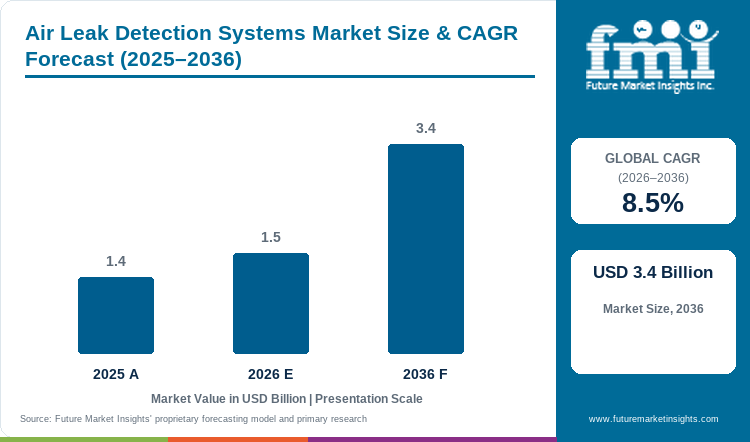
The air leak detection systems market is valued at USD 1.5 billion in 2026 and is projected to reach USD 3.4 billion by 2036, growing at an 8.5% CAGR.
Demand for air leak detection systems is projected to expand at 8.5% CAGR from 2026 to 2036. Market value rises from USD 1.4 billion in 2025 to USD 1.5 billion in 2026, reaching USD 3.4 billion by 2036. Plant teams assign a repair value to lost air before managers approve maintenance budgets. In May 2025, DOE summit material reported that Nissan reduced compressed-air leakage by 30% with ultrasonic meters. The same project cut peak demand by 27% and strengthened the measurable savings case for repairs. Measured losses help plants compare leak repairs with other energy projects during budget reviews.
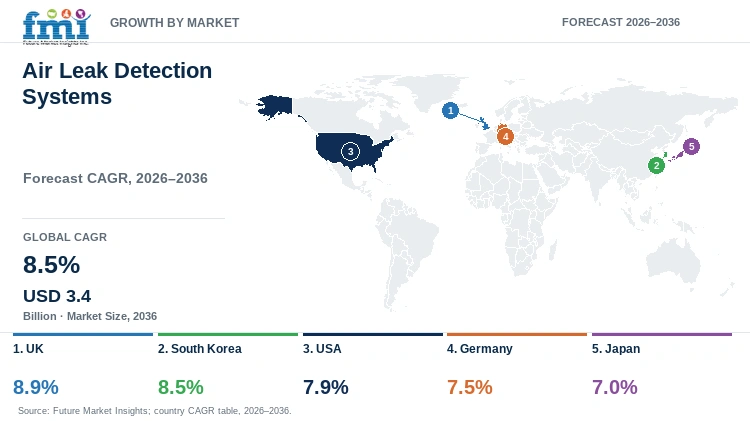
Country rules shape how quickly energy-saving evidence becomes an equipment order. UK demand is projected at 8.9% CAGR through 2036, compared with 7.0% for Japan. In July 2026, UK ESOS guidance kept progress reports tied to action plans for large organizations. That reporting structure supports energy management systems that retain repair records and documented savings. Japanese plants face similar air-loss costs but stricter approval routines can extend replacement decisions. Vendors need consistent leak readings and clear savings records to support plant approval decisions in both countries.
Key Takeaways of Air Leak Detection Systems Market
- Measured air loss gives plant teams a clear basis for maintenance budgets and repair priorities.
- Routine point checks during plant rounds favor ultrasonic detectors, which are estimated to hold 31.0% of system type revenue in 2026.
- Handheld systems are projected to hold 42.0% of deployment demand in 2026 as route flexibility reduces fixed setup needs.
- Compressed air systems are forecast to represent 38.0% of application demand in 2026 with measurable losses giving repairs clear value.
- Detection alone cannot close leaks or verify completed maintenance work, so repair delays reduce the savings that plants can realize.
- Key companies include Fluke, Teledyne FLIR, UE Systems, SDT Ultrasound, Distran, NL Acoustics (Flir), EXAIR, SUTO iTEC, SKF and CS Instruments.
Analyst Perspective
“Adoption gains ground when plants use measured leak losses to rank repairs and connect survey records with maintenance budgets. The main challenge is turning each verified leak into completed repair work with clear records that prove the expected savings.”
- Nikhil Kaitwade, Principal Consultant, Future Market Insights
How is the Air Leak Detection Systems Market segmented?
The market is segmented by System Type, Deployment, Application, End Use, Sales Channel and Region.
The air leak detection systems market uses five segment axes with region as the geographic split.
System type covers ultrasonic detectors, acoustic imaging systems, fixed leak monitoring, compressed air audit kits, and AI-enabled leak analytics.
Deployment covers handheld units, portable carts, fixed sensor networks, and drone- or robot-mounted systems.
Application covers compressed air, vacuum, gas pipelines, HVAC ducts, and industrial pneumatics.
End use covers manufacturing, utilities, oil & gas, food & beverage, and pharma.
Sales channel covers direct instrument OEM, reliability service providers, industrial distributors, and energy audit firms.
Why do ultrasonic detectors lead system type?
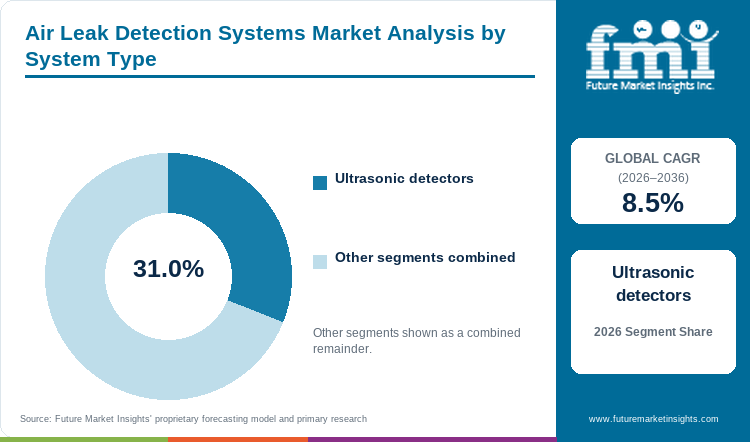
Ultrasonic detectors identify high-frequency leak sounds while production equipment continues running. Maintenance staff use them on valves, fittings and air lines that need close point checks. In May 2025, DOE summit material reported that Nissan reduced compressed-air leakage by 30% using ultrasonic meters. The documented result connects point inspection with plant energy work and repair prioritization. Maintenance teams compare measured losses before deciding which leaks should receive repair attention first. Technicians can inspect equipment during operation, which lets surveys fit regular maintenance windows with less disruption. Later checks let teams confirm whether repaired points remain closed during routine inspection rounds.
- Familiar inspection rounds favor direct point checks and strengthen ultrasonic detectors, estimated at 31.0% of system type revenue in 2026.
- Maintenance staff use ultrasonic sensors before repairs and verify measured leaks after technicians complete the work.
Why does handheld lead deployment in 2026?
Handheld tools move across valves and hose joints during routine surveys of machines and overhead lines. The format lets maintenance staff inspect changing routes without installing a fixed sensor network. In September 2026, Fluke announced the ii01 acoustic camera for Android devices. The launch brings acoustic imaging to a mobile device that technicians can carry across inspection routes. Buyers can test local leaks first and decide whether wider monitoring justifies additional equipment. Mobile use lets technicians move between assets without waiting for fixed network installation. That flexibility matters when inspection routes change with production schedules or temporary maintenance priorities.
- Handheld systems are projected at 42.0% of deployment demand in 2026 with route flexibility reducing fixed setup requirements.
- Portable tools connect with condition monitoring systems across changing routes and help teams schedule confirmed leaks for repair.
Why do compressed air systems lead application?
Compressed-air leaks make compressors run longer even when the extra air produces no useful work. In April 2025, DOE's Better Plants overview listed compressed air as a plant energy-savings focus. The program covered 14% of U.S. manufacturing and gave the issue national operating scale. Plants compare leak findings with compressor load and decide which repairs offer the clearest energy value. That link keeps leak detection inside routine energy management instead of treating surveys as isolated maintenance tasks. Maintenance staff repeat the same checks after repairs and compare later compressor conditions with the original loss record.
- Compressed air systems are forecast at 38.0% of application demand in 2026 as measurable air loss guides repair priorities.
- Longer run times can expose measurable losses and give plants a stronger basis for repair work on industrial air compressors.
Why does manufacturing lead end use?
Manufacturing plants operate air tools and compressed-air lines alongside vacuum equipment and gas systems across production areas. These networks create many joints and fittings that maintenance teams inspect during planned rounds. Maintenance teams have expanded adoption of ultrasonic detection across large manufacturing sites following documented energy savings at major production facilities. The case connects leak checks with plant energy use and planned repairs. Manufacturers retain repair histories beside other asset records so later surveys can compare recurring problems. That history helps reliability teams identify returning leaks and decide whether another repair or component change is needed. The same record supports maintenance planning across repeated production cycles.
- Utility networks create many routine inspection points and support manufacturing, projected at 33.0% of end-use demand in 2026.
- Leak findings feed predictive maintenance programs during planned work and keep repair history available for later surveys.
Why does direct instrument OEM lead sales channel?
Leak tools need sizing functions and reporting support, making direct OEM sales important for many buyers. Buyers also need software, firmware and user training alongside the hardware. Some buyers need live tests under normal plant noise before approving regular use. In March 2025, CS Instruments presented the LeakCam 600 at Hannover Fair with its compressed-air measurement range. Direct technical support helps users confirm setup choices and reporting requirements before deployment. Buyers resolve equipment questions earlier instead of separating hardware selection from reporting support. Plant noise can change acoustic test conditions, which makes direct support valuable during equipment trials. The same channel keeps firmware and reporting questions tied to the purchased instrument.
- Direct instrument OEM is projected at 37.0% of sales channel demand in 2026 with setup and service needs shaping purchase decisions.
- Direct sales connect leak tools with industrial automation teams that manage plant data and maintenance work.
What are the drivers, restraints and opportunities in the Air Leak Detection Systems Market?
In the air leak detection systems market, the key driver is industrial plants measuring compressed-air loss and connecting wasted energy with maintenance budgets and repair priorities, since converting lost air into a clear repair value helps budget managers approve work with more confidence during energy project reviews. The key restraint is that detected leaks create no savings until technicians gain access and complete verified repair work, as plants with formal repair controls still need approved work orders and safe access before any survey finding closes into an actual energy saving. The key opportunity is imaging and connected analytics turning one-time leak surveys into repeat maintenance programs with tracked repair records, letting plants keep each leak location beside its measured loss and repair status so recurring problems can be ranked and verified across later inspection rounds.
- Driver: Industrial plants measure compressed-air loss and connect wasted energy with maintenance budgets and repair priorities.
- Restraint: Detected leaks create no savings until technicians gain access and complete verified repair work.
- Opportunity: Imaging and connected analytics can turn one-time leak surveys into repeat maintenance programs with tracked repair records.
Energy-loss measurement turns a maintenance finding into a budget decision
In May 2025, DOE summit material reported that Nissan reduced compressed-air leakage by 30% using ultrasonic meters at a Tennessee plant. The same project cut peak demand by 27% and gave the repair case a measurable energy value. Plant teams use measured losses to rank leak repairs beside other energy projects during budget reviews. Budget managers approve work more confidently when reports convert lost air into a clear repair value. Plant budgets favor gas leak detectors that size losses before maintenance staff schedule repair work. Survey costs can then be compared with expected savings before higher-value repairs receive priority. Clear cost comparisons give managers a stronger basis for funding repairs and verifying later results.
Repair execution can break the savings chain
Acoustic cameras can find leaks before technicians have safe access or the required spare parts. Maintenance staff also need approved work orders at sites with formal repair controls. In July 2026, UK ESOS guidance kept progress reports tied to action plans rather than audits alone. Detection does not save energy until maintenance staff close the leak and verify the result. Technicians confirm leak size and plan safe access before ordering the required parts. Plant teams route findings into factory automation controls that already support maintenance work. Software tracks tasks and stores repair records but cannot complete the physical repair. Weak handoffs can leave known leaks open for weeks and delay the expected savings.
Connected records extend value across regular surveys
In May 2026, UE Systems introduced UE ONE to connect ultrasound data with reports and alerts for maintenance work. Plants with many assets need one record that follows each leak across survey routes and sites. Acoustic imaging speeds the first scan across wide production areas before technicians confirm individual leaks. Connected records keep each leak location beside its measured loss and repair status. AI predictive maintenance can rank repair work when plants keep leak data consistent across repeated surveys. One shared record helps teams compare returning leaks with completed repairs during later inspections. Maintenance staff can reopen the same history instead of rebuilding the evidence from separate notes. That continuity turns one-time surveys into repeat programs with clearer repair verification.
Which country CAGRs are profiled in the Air Leak Detection Systems Market?
| Country | CAGR |
|---|---|
| UK | 8.9% |
| South Korea | 8.5% |
| USA | 7.9% |
| Germany | 7.5% |
| Japan | 7.0% |
How do country-level CAGRs compare in the Air Leak Detection Systems Market?
The country CAGRs span 1.9 percentage points across the 2026 to 2036 forecast period. The UK and South Korea remain at the upper end while the USA and Germany form the middle. Japan records a 7.0% CAGR through the same forecast period. These rates describe forecast pace rather than current country sales. Energy rules, service support and plant approval steps shape equipment timing differently across the five countries.
- Portable leak imaging helps UK multi-site operators shorten surveys while keeping repair records consistent across facility networks.
- Korean-language reporting and local technical service reduce adoption friction when plants connect leak tools with existing maintenance routines.
- Large U.S. manufacturing networks favor leak tools that standardize inspection records across multiple plants and service teams.
- German industrial buyers value local technical support for converting measured losses into documented repair actions across established plants.
- Local service support in Japan helps maintenance teams introduce leak tools without rebuilding established inspection and approval routines.
Similar forecast rates can follow different buying paths across the five profiled countries. Local rules and service networks affect how quickly plant teams approve equipment orders. The full report provides country-level CAGR analysis across North America, Latin America, Western Europe, Eastern Europe, East Asia, South Asia and Pacific, and the Middle East and Africa.
Country-wise Analysis
- Plant energy programs continue to shape leak-detection purchases across U.S. manufacturing sites. Air leak detection sales in the USA are forecast to expand at 7.9% CAGR through 2036. DOE reported in April 2025 that Better Plants covered more than 270 partners and 3,700 plants. Those facilities represented 14% of U.S. manufacturing and gave the program national scale. Better Plants lists compressed air as a focus for plant energy savings. Plant teams use measured air loss to build repair cases before funding decisions. Production schedules can limit access to leaking equipment during normal operations. Portable sound sensors support surveys without forcing teams to rebuild maintenance records. Clear savings records help facilities compare completed repairs with later energy checks.
- Formal energy requirements shape leak-detection purchasing across Germany's larger industrial energy users. Germany's leak detection outlook is projected to grow at 7.5% CAGR through 2036. In June 2026, the federal cabinet approved draft changes to the Energy Efficiency Act. The draft set a 23.6 GWh threshold for company energy-management systems. Fewer firms would fall under that requirement if the proposed threshold takes effect. Large energy users still need measured efficiency work and records that explain expected savings. Leak tools compete on loss estimates and audit-ready reporting rather than legal language alone. Wasted compressed air continues to create an operating cost outside the proposed threshold. Vendors must show repair value without presenting every survey as a compliance requirement.
- National energy planning expands the role of digital diagnosis in South Korean industrial efficiency programs. Leak detection adoption in South Korea is projected to grow at 8.5% CAGR through 2036. In June 2026, the IEA reported that the national plan targets 4.7 million toe of industrial energy savings. The plan also promotes AI-based energy diagnosis across industrial energy work. Leak records can connect with wider plant data under that policy direction. Existing control systems can slow installation when data formats or reporting routines differ. Simple data exchange becomes more important as surveys expand across several plants. Tools that fit current records avoid unnecessary changes to established maintenance processes.
- Energy policy gives Japanese plants a national reason to measure efficiency losses across industrial operations. Leak detection demand in Japan is forecast to rise at 7.0% CAGR through 2036. In February 2025, METI approved the Seventh Strategic Energy Plan with a 73% greenhouse-gas reduction target for FY2040. The plan links energy security with economic growth and efficiency work. Plant approval teams require stable readings and clear records before replacing familiar inspection tools. Vendors support those reviews with repeatable measurements and simple documentation. Existing maintenance processes can slow adoption when a new system demands major workflow changes. Buyers favor equipment that fits normal plant checks without rebuilding maintenance procedures. Clear proof during routine operation strengthens the replacement case for plant approval.
- ESOS reporting keeps leak detection connected with documented energy actions across large UK organizations. UK demand is projected to grow at 8.9% CAGR through 2036. In July 2026, GOV.UK kept a second ESOS progress update due in December 2026. Large organizations must connect energy reviews with action plans under ESOS phase 3. The reporting cycle favors tools that record leak size and completed repair work. Multi-site maintenance budgets can delay action even after teams identify savings measures. Vendors need audit-ready reports that separate open jobs from completed repairs. Funding becomes easier when records show which repairs are closed and which remain outstanding. Consistent documentation supports the purchase case across repeated reporting cycles.
Who are the notable companies in the Air Leak Detection Systems Market?
Fluke, Teledyne FLIR, UE Systems, SDT Ultrasound, Distran, NL Acoustics (Flir), EXAIR, SUTO iTEC, SKF and CS Instruments are active within the defined air leak detection systems boundary.
Three company groups organize the main competitive routes for leak checks and repair support. SUTO iTEC joined Atlas Copco Group in October 2025 and added its air measurement tools to Compressor Technique. Buyers compare detection range and noise handling before selecting equipment for routine surveys. Reporting support and local service also matter when leak findings must move into completed maintenance work.
- Acoustic imaging and mobile inspection: Fluke, Teledyne FLIR, Distran and NL Acoustics (Flir) help users locate leaks and measure air loss.
- Ultrasound inspection: UE Systems, SDT Ultrasound, EXAIR and SKF support focused point checks and planned leak survey routes.
- Compressed-air audits: SUTO iTEC and CS Instruments combine leak checks with air measurement and structured reporting support.
Competitive Benchmarking: Air Leak Detection Systems Market
| Company | Leak Localization Breadth | Quantification & Reporting | Connected Workflow Integration | Geographic Reach |
|---|---|---|---|---|
| Fluke | High | High | High | Global |
| Teledyne FLIR | High | High | High | Global |
| UE Systems | High | Medium | High | Global |
| SDT Ultrasound | High | Medium | Medium | Global distributor network |
| Distran | High | High | High | Europe, North America, Middle East and distributors |
| NL Acoustics (Flir) | High | High | High | Flir global network |
| EXAIR | Medium | Medium | Low | North America with international distributors |
| SUTO iTEC | High | High | High | Atlas Copco Group network |
| SKF | Medium | Medium | Low | Global |
| CS Instruments | High | High | High | Europe, Americas, Asia and distributors |
Scoring uses High when public proof covers a broad part of the named measure. Medium applies when public proof covers a narrower part and Low marks a focused stand-alone route. Geographic reach describes documented sales or service areas and does not receive a score.
Key Developments in the Air Leak Detection Systems Market
- In September 2026, Fluke announced the ii01 Acoustic Camera for Android devices within its mobile imaging series.
- In May 2026, UE Systems introduced UE ONE to connect ultrasound data with reports and alerts for maintenance work.
- In October 2025, SUTO iTEC joined Atlas Copco Group and added leak and air measurement tools to Compressor Technique.
Key Players in the Air Leak Detection Systems Market
Acoustic imaging and visual leak localization
- Fluke
- Teledyne FLIR
- Distran
- NL Acoustics (Flir)
Ultrasound inspection and reliability tools
- UE Systems
- SDT Ultrasound
- EXAIR
- SKF
Compressed-air measurement and leak-management platforms
- SUTO iTEC
- CS Instruments
Air Leak Detection Systems Market - Report Scope
| Coverage field | Report scope |
|---|---|
| Market breakdown | By system type, deployment, application, end use, sales channel and region. |
| Quantitative Units | USD billion. |
| Market Definition | Systems used to locate, visualize, quantify, monitor, or document leaks in compressed air, vacuum, gas, HVAC and pneumatic systems are included. |
| Regions Covered | North America, Latin America, Western Europe, Eastern Europe, East Asia, South Asia and Pacific and Middle East and Africa. |
| Countries Covered | UK, South Korea, USA, Germany, Japan and 20+ countries included in the full report. |
| Key Companies Profiled | Fluke, Teledyne FLIR, UE Systems, SDT Ultrasound, Distran, NL Acoustics (Flir), EXAIR, SUTO iTEC, SKF, CS Instruments. |
| Forecast Period | 2026 to 2036. |
| Approach | Primary and secondary research with market triangulation. |
Air Leak Detection Systems Market - Research Methodology
| Method | Approach |
|---|---|
| Primary Research | FMI analysts gathered input from manufacturers, service providers, technology developers, distributors, end users, procurement teams and subject-matter experts. Interviews examined purchasing decisions, product or service evaluation, adoption barriers, approval requirements, pricing considerations and expectations for technical or commercial support. Respondents were also asked what evidence is required before a trial, pilot, or initial order develops into regular purchasing. |
| Desk Research | Desk research covered government statistics, regulatory publications, trade data, industry associations, technical literature, standards, company filings, product information and official corporate announcements. Sources were reviewed for relevance, publication date, geographic coverage and consistency with the defined market scope. Claims relating to performance, applications, approvals, capacity, investment and commercial activity were retained only when supported by credible public evidence. |
| Market Sizing and Forecasting | The market model combined the baseline value with historical performance, segment structure, pricing and volume indicators, adoption levels, company participation and country-level demand conditions. Forecast assumptions considered economic activity, investment trends, regulatory developments, technology adoption, purchasing cycles, supply availability and barriers to wider market use. Segment and regional estimates were reconciled before the final market total was calculated. |
| Data Validation | Estimates were checked against multiple independent indicators, including public data, company activity, trade patterns, industry developments and findings from primary interviews. Validation also tested whether products, services, applications and company revenues fell within the defined market boundaries. Adjacent categories, unsupported claims, overlapping revenues and activities without direct market relevance were excluded to reduce double counting and maintain consistency across segments and countries. |
Air Leak Detection Systems Market by Segments
Air Leak Detection Systems Market segmented by System Type:
- Ultrasonic detectors
- Acoustic imaging systems
- Fixed leak monitoring
- Compressed air audit kits
- AI-enabled leak analytics
Air Leak Detection Systems Market segmented by Deployment:
- Handheld
- Portable cart
- Fixed sensor network
- Drone - robot mounted
Air Leak Detection Systems Market segmented by Application:
- Compressed air systems
- Vacuum systems
- Gas pipelines
- HVAC ducts
- Industrial pneumatics
Air Leak Detection Systems Market segmented by End Use:
- Manufacturing
- Utilities
- Oil & gas
- Food & beverage
- Pharma
Air Leak Detection Systems Market segmented by Sales Channel:
- Direct instrument OEM
- Reliability service providers
- Industrial distributors
- Energy audit firms
Air Leak Detection Systems Market by Region:
- North America
- United States
- Canada
- Latin America
- Brazil
- Mexico
- Chile
- Rest of Latin America
- Western Europe
- Germany
- United Kingdom
- Italy
- Spain
- France
- Nordics
- Benelux
- Rest of Western Europe
- Eastern Europe
- Russia
- Poland
- Hungary
- Balkan and Baltic States
- Rest of Eastern Europe
- East Asia
- China
- Japan
- South Korea
- South Asia and Pacific
- India
- ASEAN
- Australia and New Zealand
- Rest of South Asia and Pacific
- Middle East and Africa
- Kingdom of Saudi Arabia
- Other GCC Countries
- Türkiye
- South Africa
- Other African Union Countries
- Rest of Middle East and Africa
Research Sources and Bibliography
- U.S. Department of Energy. (2025, April). Better Plants Program Overview.
- U.S. Department of Energy. (2025, May). 2025 Summit Executive Panel: Leadership in Energy Efficiency.
- GOV.UK and Environment Agency. (2026, July 30). Comply with the Energy Savings Opportunity Scheme (ESOS): phase 3.
- International Energy Agency. (2026, June 24). 7th Basic Plan for Rational Energy Use (2025-2029).
- Ministry of Economy, Trade and Industry, Japan. (2025, February 18). Cabinet Decision on the Seventh Strategic Energy Plan.
- Federal Ministry for Economic Affairs and Energy (BMWE), Germany. (2026, June 24). Simplifications implemented and bureaucracy reduced: Federal Cabinet adopts Energy Efficiency Act.
- Fluke Corporation. (2026, September 1). Fluke Expands iSee Mobile Series with New TC03A Thermal Camera and ii01 Acoustic Camera.
- Flir. (2026, April 15). Flir Si1 LD Acoustic Imaging Camera Wins “Product of the Year 2026” Award from Computer & Automation.
- UE Systems. (2026, May 14). UE Systems Introduces UE ONE™, Turning What Industry Hears Into Action.
- Distran. (2025, June 2). Distran Strengthens Its Presence in the USA and Canada.
- Atlas Copco Group. (2025, October 1). Compressed Air and Gas Measurement Technology Company Has Become Part of Atlas Copco Group.
- CS Instruments. (2025, March 31). CS INSTRUMENTS from March 31-April 4, 2025 at HANNOVER FAIR.
- EXAIR. (2025, April 18). “Did You Hear That!?”-EXAIR’s Ultrasonic Leak Detector.
- SKF. (2026, June). Quick and Easy Detection of Air Leaks: SKF Ultrasonic Leak Detector TKSU 10.
- Teledyne Technologies Incorporated. (2026). 2025 Annual Report.
- SDT Ultrasound. (2025, April 24). Meet the Two New Additions to the CRYSOUND Range of Acoustic Imaging Cameras.
This bibliography gives readers the main sources used throughout the article. The full report contains the complete reference list and detailed supporting citations.
This Report Answers
- What values define the air leak detection systems market in 2026 and 2036?
- Which operating conditions support purchases of air leak detection systems?
- Which system type holds the highest estimated share in 2026?
- Why do handheld systems lead deployment demand during the forecast period?
- Why do compressed air systems lead the application category in 2026?
- How do profiled country CAGRs differ across the 2026 to 2036 period?
- Which companies compete through acoustic imaging and ultrasound leak detection tools?
- How are reporting and repair workflows changing air leak system selection?
- Which repair barriers prevent leak findings from becoming verified energy savings?
Frequently Asked Questions
How big is the Air Leak Detection Systems Market in 2026?
The air leak detection systems market is valued at USD 1.5 billion in 2026. The current forecast projects the market to reach USD 3.4 billion by 2036. Plant teams use measured air loss and repair value to support equipment purchases and rank maintenance work.
What is the CAGR of the Air Leak Detection Systems Market from 2026 to 2036?
The market is projected to grow at 8.5% CAGR from 2026 through 2036. Plants measure air loss during energy reviews and use acoustic tools to speed routine leak checks. Measured losses help maintenance teams rank repairs by expected savings across planned work. Survey records keep completed repairs connected with later maintenance checks and energy reviews.
Which system type leads the Air Leak Detection Systems Market?
Ultrasonic detectors are expected to hold 31.0% of system type revenue in 2026. Plant teams use portable units on valves and pneumatic lines while production equipment keeps running. The tools help maintenance staff locate leaks without stopping normal plant work.
Which deployment type leads the Air Leak Detection Systems Market?
Handheld systems are projected to hold 42.0% of deployment category demand in 2026. One handheld unit moves across changing routes without the setup needs of fixed sensor networks. That flexibility supports surveys across valves, machines and overhead lines during normal plant maintenance work.
Which application leads the Air Leak Detection Systems Market?
Compressed air systems are forecast to represent 38.0% of application demand in 2026. Plants link air leakage with compressor load and repair priority during normal operations. The same check helps maintenance teams find wasted energy and rank repairs before later verification. Teams compare completed repairs with later checks to confirm whether measured losses have fallen.
Which countries are projected to record the highest growth in the Air Leak Detection Systems Market?
The UK is projected to grow at 8.9% CAGR through 2036. South Korea follows at 8.5% CAGR and the USA follows at 7.9% CAGR. National energy programs and plant rules shape reporting, approval and service needs across these countries. Local conditions affect how quickly a measured leak becomes funded repair work.
Which companies are active in the Air Leak Detection Systems Market?
Key companies include Fluke, Teledyne FLIR, UE Systems, SDT Ultrasound, Distran, NL Acoustics (Flir), EXAIR, SUTO iTEC, SKF and CS Instruments. These companies compete through leak-finding tools and loss measurement alongside reporting software and service access. Buyers compare those capabilities before adopting a system for regular plant maintenance.
Preview the report firsthand - request a free sample
Get SampleGet the brochure for pricing and purchase details.
Get PDFTable of Content
- Key Takeaways
- Market Size and CAGR
- Top Growth Driver
- Fastest Growing Segment
- Leading Region
- Key Companies
- Emerging Opportunities
- Executive Summary
- Global Market Outlook
- Demand-side Trends
- Supply-side Trends
- Technology Roadmap Analysis
- Analysis and Recommendations
- Analyst Perspective (What is happening? Why now? What should investors know?)
- Key Questions Answered
- How large is the market?
- What is the CAGR?
- What are key trends?
- Which region dominates?
- Who are the leaders?
- Market Overview
- Market Coverage / Taxonomy
- Market Definition / Scope / Limitations
- Research Methodology
- Chapter Orientation
- Analytical Lens and Working Hypotheses
- Market Structure, Signals, and Trend Drivers
- Benchmarking and Cross-market Comparability
- Market Sizing, Forecasting, and Opportunity Mapping
- Research Design and Evidence Framework
- Desk Research Programme (Secondary Evidence)
- Expert Input and Fieldwork (Primary Evidence)
- Tooling, Models, and Reference Databases
- Data Engineering and Model Build
- Quality Assurance and Audit Trail
- Market Background
- Market Dynamics (Drivers, Restraints, Opportunity, Trends)
- Scenario Forecast (Optimistic, Likely, Conservative)
- Impact Analysis
- AI Impact
- Sustainability Impact
- Regulatory Impact
- Technology Impact
- Consumer / Buyer Analysis
- Purchase Drivers
- Adoption Barriers
- Buyer Journey
- Opportunity Map Analysis
- Product Life Cycle Analysis
- Supply Chain Analysis
- Investment Feasibility Matrix
- Value Chain Analysis
- PESTLE and Porter's Analysis
- Regulatory Landscape
- Regional Parent Market Outlook
- Production and Consumption Statistics
- Import and Export Statistics
- Global Market Analysis and Forecast, 2021 to 2036
- Historical Market Size Value (USD Billion) Analysis, 2021 to 2025
- Current and Future Market Size Value (USD Billion) Projections, 2026 to 2036
- Y-o-Y Growth Trend Analysis
- Absolute $ Opportunity Analysis
- Global Market Pricing Analysis, 2021 to 2036
- Global Market Analysis and Forecast, By System Type, 2021 to 2036
- Introduction / Key Findings
- Historical Market Size Value (USD Billion) Analysis By System Type, 2021 to 2025
- Current and Future Market Size Value (USD Billion) Analysis and Forecast By System Type, 2026 to 2036
- Ultrasonic detectors
- Acoustic imaging systems
- Fixed leak monitoring
- Compressed air audit kits
- AI-enabled leak analytics
- Y-o-Y Growth Trend Analysis By System Type, 2021 to 2025
- Absolute $ Opportunity Analysis By System Type, 2026 to 2036
- Global Market Analysis and Forecast, By Deployment, 2021 to 2036
- Introduction / Key Findings
- Historical Market Size Value (USD Billion) Analysis By Deployment, 2021 to 2025
- Current and Future Market Size Value (USD Billion) Analysis and Forecast By Deployment, 2026 to 2036
- Handheld
- Portable cart
- Fixed sensor network
- Drone - robot mounted
- Y-o-Y Growth Trend Analysis By Deployment, 2021 to 2025
- Absolute $ Opportunity Analysis By Deployment, 2026 to 2036
- Global Market Analysis and Forecast, By Application, 2021 to 2036
- Introduction / Key Findings
- Historical Market Size Value (USD Billion) Analysis By Application, 2021 to 2025
- Current and Future Market Size Value (USD Billion) Analysis and Forecast By Application, 2026 to 2036
- Compressed air systems
- Vacuum systems
- Gas pipelines
- HVAC ducts
- Industrial pneumatics
- Y-o-Y Growth Trend Analysis By Application, 2021 to 2025
- Absolute $ Opportunity Analysis By Application, 2026 to 2036
- Global Market Analysis and Forecast, By End Use, 2021 to 2036
- Introduction / Key Findings
- Historical Market Size Value (USD Billion) Analysis By End Use, 2021 to 2025
- Current and Future Market Size Value (USD Billion) Analysis and Forecast By End Use, 2026 to 2036
- Manufacturing
- Utilities
- Oil & gas
- Food & beverage
- Pharma
- Y-o-Y Growth Trend Analysis By End Use, 2021 to 2025
- Absolute $ Opportunity Analysis By End Use, 2026 to 2036
- Global Market Analysis and Forecast, By Sales Channel, 2021 to 2036
- Introduction / Key Findings
- Historical Market Size Value (USD Billion) Analysis By Sales Channel, 2021 to 2025
- Current and Future Market Size Value (USD Billion) Analysis and Forecast By Sales Channel, 2026 to 2036
- Direct instrument OEM
- Reliability service providers
- Industrial distributors
- Energy audit firms
- Y-o-Y Growth Trend Analysis By Sales Channel, 2021 to 2025
- Absolute $ Opportunity Analysis By Sales Channel, 2026 to 2036
- Global Market Analysis and Forecast, By Region, 2021 to 2036
- Introduction
- Historical Market Size Value (USD Billion) Analysis By Region, 2021 to 2025
- Current Market Size Value (USD Billion) Analysis and Forecast By Region, 2026 to 2036
- North America
- Latin America
- Western Europe
- Eastern Europe
- East Asia
- South Asia and Pacific
- Middle East and Africa
- Market Attractiveness Analysis By Region
- North America Market Analysis and Forecast, By Country, 2021 to 2036
- Historical Market Size Value (USD Billion) Trend Analysis By Market Taxonomy, 2021 to 2025
- Market Size Value (USD Billion) Forecast By Market Taxonomy, 2026 to 2036
- By Country
- United States
- Canada
- By System Type
- By Deployment
- By Application
- By End Use
- By Sales Channel
- By Country
- Market Attractiveness Analysis
- By Country
- By System Type
- By Deployment
- By Application
- By End Use
- By Sales Channel
- Key Takeaways
- Latin America Market Analysis and Forecast, By Country
- Historical Market Size Value (USD Billion) Trend Analysis By Market Taxonomy, 2021 to 2025
- Market Size Value (USD Billion) Forecast By Market Taxonomy, 2026 to 2036
- By Country
- Brazil
- Mexico
- Chile
- Rest of Latin America
- By System Type
- By Deployment
- By Application
- By End Use
- By Sales Channel
- By Country
- Market Attractiveness Analysis
- By Country
- By System Type
- By Deployment
- By Application
- By End Use
- By Sales Channel
- Key Takeaways
- Western Europe Market Analysis and Forecast, By Country
- Historical Market Size Value (USD Billion) Trend Analysis By Market Taxonomy, 2021 to 2025
- Market Size Value (USD Billion) Forecast By Market Taxonomy, 2026 to 2036
- By Country
- Germany
- United Kingdom
- Italy
- Spain
- France
- Nordics
- Benelux
- Rest of Western Europe
- By System Type
- By Deployment
- By Application
- By End Use
- By Sales Channel
- By Country
- Market Attractiveness Analysis
- By Country
- By System Type
- By Deployment
- By Application
- By End Use
- By Sales Channel
- Key Takeaways
- Eastern Europe Market Analysis and Forecast, By Country
- Historical Market Size Value (USD Billion) Trend Analysis By Market Taxonomy, 2021 to 2025
- Market Size Value (USD Billion) Forecast By Market Taxonomy, 2026 to 2036
- By Country
- Russia
- Poland
- Hungary
- Balkan and Baltic States
- Rest of Eastern Europe
- By System Type
- By Deployment
- By Application
- By End Use
- By Sales Channel
- By Country
- Market Attractiveness Analysis
- By Country
- By System Type
- By Deployment
- By Application
- By End Use
- By Sales Channel
- Key Takeaways
- East Asia Market Analysis and Forecast, By Country
- Historical Market Size Value (USD Billion) Trend Analysis By Market Taxonomy, 2021 to 2025
- Market Size Value (USD Billion) Forecast By Market Taxonomy, 2026 to 2036
- By Country
- China
- Japan
- South Korea
- By System Type
- By Deployment
- By Application
- By End Use
- By Sales Channel
- By Country
- Market Attractiveness Analysis
- By Country
- By System Type
- By Deployment
- By Application
- By End Use
- By Sales Channel
- Key Takeaways
- South Asia and Pacific Market Analysis and Forecast, By Country
- Historical Market Size Value (USD Billion) Trend Analysis By Market Taxonomy, 2021 to 2025
- Market Size Value (USD Billion) Forecast By Market Taxonomy, 2026 to 2036
- By Country
- India
- ASEAN
- Australia and New Zealand
- Rest of South Asia and Pacific
- By System Type
- By Deployment
- By Application
- By End Use
- By Sales Channel
- By Country
- Market Attractiveness Analysis
- By Country
- By System Type
- By Deployment
- By Application
- By End Use
- By Sales Channel
- Key Takeaways
- Middle East and Africa Market Analysis and Forecast, By Country
- Historical Market Size Value (USD Billion) Trend Analysis By Market Taxonomy, 2021 to 2025
- Market Size Value (USD Billion) Forecast By Market Taxonomy, 2026 to 2036
- By Country
- Kingdom of Saudi Arabia
- Other GCC Countries
- Türkiye
- South Africa
- Other African Union Countries
- Rest of Middle East and Africa
- By System Type
- By Deployment
- By Application
- By End Use
- By Sales Channel
- By Country
- Market Attractiveness Analysis
- By Country
- By System Type
- By Deployment
- By Application
- By End Use
- By Sales Channel
- Key Takeaways
- Key Countries Market Analysis
- United States
- Pricing Analysis
- Market Share Analysis, 2025
- By System Type
- By Deployment
- By Application
- By End Use
- By Sales Channel
- Canada
- Pricing Analysis
- Market Share Analysis, 2025
- By System Type
- By Deployment
- By Application
- By End Use
- By Sales Channel
- Mexico
- Pricing Analysis
- Market Share Analysis, 2025
- By System Type
- By Deployment
- By Application
- By End Use
- By Sales Channel
- Brazil
- Pricing Analysis
- Market Share Analysis, 2025
- By System Type
- By Deployment
- By Application
- By End Use
- By Sales Channel
- Chile
- Pricing Analysis
- Market Share Analysis, 2025
- By System Type
- By Deployment
- By Application
- By End Use
- By Sales Channel
- Germany
- Pricing Analysis
- Market Share Analysis, 2025
- By System Type
- By Deployment
- By Application
- By End Use
- By Sales Channel
- United Kingdom
- Pricing Analysis
- Market Share Analysis, 2025
- By System Type
- By Deployment
- By Application
- By End Use
- By Sales Channel
- Italy
- Pricing Analysis
- Market Share Analysis, 2025
- By System Type
- By Deployment
- By Application
- By End Use
- By Sales Channel
- Spain
- Pricing Analysis
- Market Share Analysis, 2025
- By System Type
- By Deployment
- By Application
- By End Use
- By Sales Channel
- France
- Pricing Analysis
- Market Share Analysis, 2025
- By System Type
- By Deployment
- By Application
- By End Use
- By Sales Channel
- India
- Pricing Analysis
- Market Share Analysis, 2025
- By System Type
- By Deployment
- By Application
- By End Use
- By Sales Channel
- ASEAN
- Pricing Analysis
- Market Share Analysis, 2025
- By System Type
- By Deployment
- By Application
- By End Use
- By Sales Channel
- Australia and New Zealand
- Pricing Analysis
- Market Share Analysis, 2025
- By System Type
- By Deployment
- By Application
- By End Use
- By Sales Channel
- China
- Pricing Analysis
- Market Share Analysis, 2025
- By System Type
- By Deployment
- By Application
- By End Use
- By Sales Channel
- Japan
- Pricing Analysis
- Market Share Analysis, 2025
- By System Type
- By Deployment
- By Application
- By End Use
- By Sales Channel
- South Korea
- Pricing Analysis
- Market Share Analysis, 2025
- By System Type
- By Deployment
- By Application
- By End Use
- By Sales Channel
- Russia
- Pricing Analysis
- Market Share Analysis, 2025
- By System Type
- By Deployment
- By Application
- By End Use
- By Sales Channel
- Poland
- Pricing Analysis
- Market Share Analysis, 2025
- By System Type
- By Deployment
- By Application
- By End Use
- By Sales Channel
- Hungary
- Pricing Analysis
- Market Share Analysis, 2025
- By System Type
- By Deployment
- By Application
- By End Use
- By Sales Channel
- Kingdom of Saudi Arabia
- Pricing Analysis
- Market Share Analysis, 2025
- By System Type
- By Deployment
- By Application
- By End Use
- By Sales Channel
- Türkiye
- Pricing Analysis
- Market Share Analysis, 2025
- By System Type
- By Deployment
- By Application
- By End Use
- By Sales Channel
- South Africa
- Pricing Analysis
- Market Share Analysis, 2025
- By System Type
- By Deployment
- By Application
- By End Use
- By Sales Channel
- United States
- Market Structure Analysis
- Competition Dashboard
- Competition Benchmarking
- Market Share Analysis of Top Players
- By Regional
- By System Type
- By Deployment
- By Application
- By End Use
- By Sales Channel
- Emerging Startups
- Innovation Benchmarking
- Competition Analysis
- Competition Deep Dive
- Fluke
- Overview
- Product Portfolio
- Profitability by Market Segments
- Sales Footprint
- Strategy Overview
- Marketing Strategy
- Product Strategy
- Channel Strategy
- Teledyne FLIR
- UE Systems
- SDT Ultrasound
- Distran
- NL Acoustics (Teledyne FLIR)
- EXAIR
- SUTO iTEC
- SKF
- CS Instruments
- Fluke
- Case Studies
- Success Stories
- Recent Developments
- Competition Deep Dive
- Assumptions & Acronyms Used


