

- Market Size (2026)
- USD 7.8 Bn
- Forecast (2036)
- USD 13.5 Bn
- CAGR (2026 to 2036)
- 5.7%
How big is Aircraft Fan Frames Market in 2026?
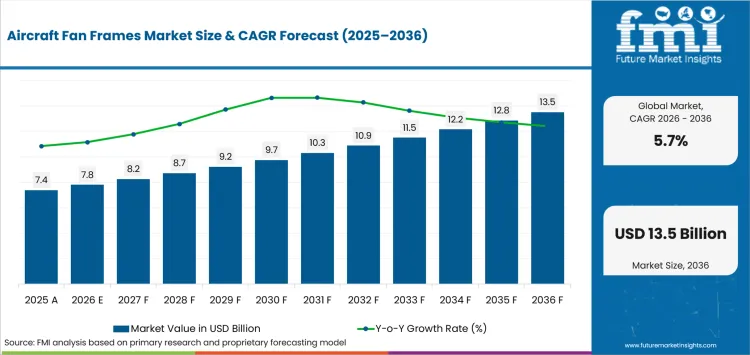
USD 7.8 billion in 2026 and USD 13.5 billion by 2036 at a 5.7% CAGR.
Sales of aircraft fan frames are estimated to rise at 5.7% CAGR through 2036, increasing valuation from USD 7.8 billion in 2026 to USD 13.5 billion by 2036. Each engine shipset requires certified structures that carry fan-module loads and preserve engine geometry, so aircraft production schedules translate directly into frame-capacity needs. IATA stated in June 2026 that the aircraft order backlog exceeded 18,000. That backlog commits capacity for qualified aircraft engine components well ahead of final assembly.
France converts civil-engine demand into fan-frame work through a concentrated aerospace production base, whereas Canada depends more on export-oriented component packages. Insee reported in April 2026 that industrial aerospace employment in Occitanie rose 1.4% in 2025 and supply-chain employment rose 2.0%. That regional depth gives French engine programs more local engineering and titanium processing capacity as structural packages move from qualification into production.
Key Takeaways
- Aircraft production and fleet replacement raise fan-frame demand as qualified structures are committed several manufacturing stages ahead of engine delivery.
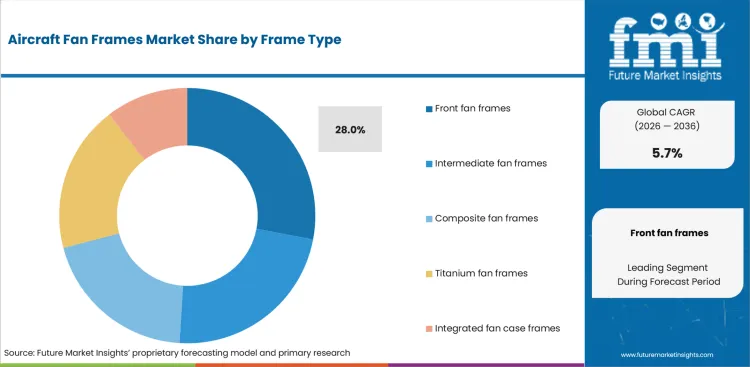
- Based on frame type, front fan frames are projected to account for 28.0% in 2026 due to their load-transfer role and multiple engine interfaces.
- By engine type, turbofan engines are estimated to hold 45.0% in 2026 owing to large civil fleets and sustained single-aisle production.
- In 2026, titanium is expected to lead material with 34.0% share because qualified fatigue performance and familiar inspection routes support repeated engine-program use.
- Long certification cycles and constrained large-format processing can delay source changes even when engine programs require additional output.
- Some of the key players in this market include Safran Aircraft Engines, GE Aerospace, Pratt & Whitney, Rolls-Royce, MTU Aero Engines, IHI Corporation, Kawasaki Heavy Industries, and GKN Aerospace.
Analyst Perspective
"Fan-frame awards are decided well ahead of visible machine-cell shortages after the engine design authority accepts material routes, geometry and inspection evidence. Manufacturers holding those approvals can take higher production rates without forcing the engine program through unnecessary requalification."
- Nikhil Kaitwade, Principal Consultant, Future Market Insights
How is the aircraft fan frames market segmented?
The aircraft fan frames market is assessed by frame type, engine type, material, sales channel, manufacturing and region.
Frame type covers front fan frames, intermediate fan frames, composite fan frames, titanium fan frames and integrated fan case frames. Engine type includes turbofan, geared turbofan, business jet, military turbofan and regional jet engines. Material covers titanium, carbon composite, aluminum-lithium, nickel alloys and hybrid structures. Sales channel includes engine OEMs, engine structure suppliers, defense programs and MRO/spares. Manufacturing covers forging/machining, precision casting, composite layup and additive-assisted fabrication.
What makes front fan frames central to the frame type category?
Front fan frames carry bearing, mount and case-interface loads near the fan module, so design authorities evaluate concentricity and attachment geometry as part of rate qualification. Several engine interfaces converge on the structure instead of separate rings or brackets.
- By frame type, front fan frames are forecast to represent 28.0% in 2026, driven by their role as a primary structural interface on multiple engine architectures.
- In September 2025, GKN Aerospace opened a dedicated Newington production line for the additively fabricated Fan Case Mount Ring used on Pratt & Whitney GTF engines. The line places certified additive manufacturing output beside final machining and serial production capacity.
Why do turbofan engines lead the engine type category?
Turbofan programs carry the broadest serial requirement as large commercial fleets pair new-engine deliveries with decades of overhaul activity. Larger fan diameters also increase structural content in cases, frames and mount rings on high-volume single-aisle engines.
- Turbofan engines are set to lead the engine type category with 45.0% share in 2026, owing to high commercial installed-base exposure and repeated production call-offs.
- The backlog fixes future demand into engine schedules ahead of frame release. Pratt & Whitney recorded nearly 1,100 GTF engine orders and commitments by June 2025, taking the program total above 12,000. That backlog also enlarges the engine MRO pool.
How does titanium retain leadership in the material category?
Engine teams specify titanium for highly loaded rings and struts given its well-understood fatigue behavior, machining response and nondestructive inspection routes. carbon composites remove more mass but require separate resin, impact and repair qualification.
- Titanium is projected to hold 34.0% share in 2026 owing to mature approval routes for load-bearing engine structures and established forging practice.
- Large-format additive routes are moving titanium engine structures beyond conventional forging while keeping material and inspection control inside the qualification path. In June 2025, GKN Aerospace reported a large-scale titanium engine case for the CFM RISE demonstrator as its largest all-additive component.
What supports engine OEMs in the sales channel category?
Engine OEMs control drawings, certification bases and configuration approvals that determine whether a frame source enters serial production. Tier-one manufacturers can own substantial process expertise, yet each engine program still governs approved materials, interfaces and change control.
- Engine OEMs are likely to capture 55.0% share in 2026, attributable to design authority over qualification, sourcing approval and configuration changes.
- Wizz Air selected Pratt & Whitney GTF engines in June 2025 to power 177 additional A321neo aircraft. The selection fixes engine configuration and qualification authority ahead of structural work release, which keeps engine modules tied to OEM contracting.
What are the drivers, restraints and opportunities in the Aircraft Fan Frames Market?
Aircraft build rates raise serial demand, qualification limits slow source changes, and certified near-net manufacturing can shorten material and production lead times.
- Driver: New engine orders convert aircraft fleet growth into serial demand for qualified fan-frame and case structures.
- Restraint: Certification evidence and process reapproval limit how quickly a new source can replace established structural capacity.
- Opportunity: Near-net and additive-assisted routes can reduce buy-to-fly loss once the complete manufacturing chain holds flight approval.
Engine backlog reaches frame manufacturers through production slots, with fan structures released early enough to protect module build schedules. In May 2025, GE Aerospace and Qatar Airways signed agreements covering more than 400 GE9X and GEnx engines, which commits upstream case and ring capacity well ahead of final engine assembly. Manufacturers entering those schedules need material, geometry and inspection approvals that match the design authority so capacity can convert into serial work on composite airframes and adjacent engine structures.
A new machining or fabrication route cannot enter a safety-critical fan structure until the engine program accepts its material, process and component evidence. Pratt & Whitney received FAA type certification for GTF Advantage in February 2025 after more than 100,000 hours of engine and rig testing. That validation burden explains why new equipment does not immediately become qualified fan-frame capacity, especially if high-performance composites or another process change alters a controlled manufacturing route.
Large rings consume expensive alloy and long machining hours, so near-net and additive-assisted routes can reduce material removal once the route is qualified. GE Aerospace announced nearly USD 1 billion of USA manufacturing investment in March 2025, including more than USD 100 million for additive manufacturing and advanced-material parts. Qualified engine-structure plants can use those processes to shorten rough-machining work and part count without weakening final dimensional acceptance at aerospace fasteners and other controlled interfaces.
Which country CAGRs are profiled in the Aircraft Fan Frames Market?
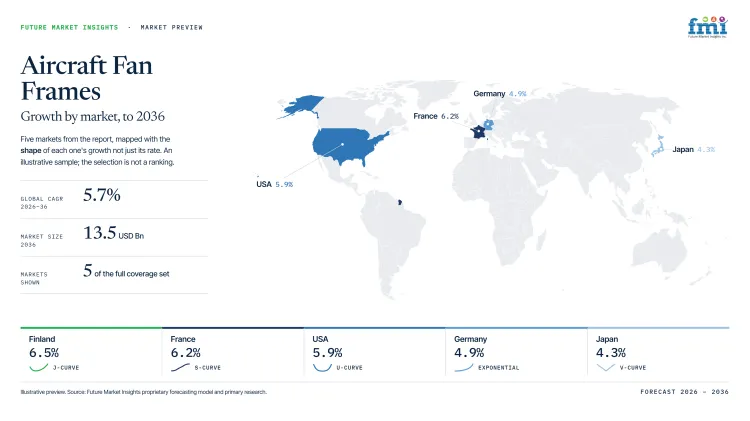
| Country | CAGR |
|---|---|
| Finland | 6.5% |
| France | 6.2% |
| USA | 5.9% |
| Canada | 5.5% |
| Italy | 5.2% |
| Germany | 4.9% |
| Japan | 4.3% |
How do country-level CAGRs compare in the Aircraft Fan Frames Market?
The country profile spans 2.2 percentage points from Finland at 6.5% to Japan at 4.3%. Finland, France at 6.2%, and USA at 5.9% form the highest-growth band. Canada at 5.5% and Italy at 5.2% sit in the middle. Germany at 4.9% and Japan at 4.3% expand more steadily. The bands reflect program timing and local industrial roles.
- Finland’s smaller base magnifies growth from each new engine work package.
- France grows from a deep aerospace base with dense specialist capacity.
- The USA larger production base tempers percentage gains despite broad engine activity.
- Canada’s regional-engine mix favors flexible structural production at lower volumes.
- Italy’s mature service base keeps growth below the faster European pair.
- Japanese suppliers usually enter fan-system revenue through international risk-sharing and module workshare.
- Germany german engine suppliers buy around tightly controlled module workshare and highly automated production systems.
Similar CAGRs therefore carry different qualification timing and capital needs. The full report provides country-level CAGR analysis across North America, Latin America, Europe, East Asia, South Asia, Oceania and the Middle East and Africa.
Country-wise Analysis
- Canadian plants serve export-heavy aircraft and engine programs through cross-border work packages that favor flexible cells, although smaller work packages can leave dedicated equipment underused between program call-offs. Innovation, Science and Economic Development Canada stated in July 2026 that 70% of 2025 aerospace revenue was export-oriented and 53% of that export revenue came from supply-chain activity. Aircraft fan frame demand in Canada is positioned to record 5.5% CAGR during the forecast period tied to its component-export role, so qualified cells that also serve air transport MRO programs can spread fixed costs over several engine families instead of relying on one award alone.
- Safran's French engine programs place fan testing, composite processing and design engineering close to teams that move structural components from qualification into serial production for major civil engine programs. Insee reported in September 2025 that aerospace activity in Occitanie increased 7% in 2024 and industrial aerospace employment rose 2.5%, confirming a production base that is expanding even as specialized staffing stays tight. Aircraft fan frame sales in France are forecast to rise at 6.2% CAGR over the assessment period attributable to CFM program concentration and composite-fan engineering, though high-rate cell qualification can still slow the path from engineering participation to serial frame output.
- At Linnavuori, Finland is adding F135 assembly and maintenance capacity beside domestic machining and inspection resources that can qualify for F-35 sustainment and adjacent certified engine work at scale. Aircraft fan frame demand in Finland is projected to expand at 6.5% CAGR through 2036 because the F-35 industrial-cooperation program localizes propulsion support and gives Finnish firms a clearer route into certified engine packages. The Ministry of Defence stated in March 2025 that the program is estimated to generate 4,500 direct and 1,500 indirect person-years, which expands the local skills base without removing security screening or Pratt & Whitney qualification requirements.
- USA award reviews test recovery plans and alternate-source readiness as engine OEMs shift constrained work between qualified plants, and the FAA's 2026 forecast places the commercial fleet at 6,949 aircraft in 2025 and 10,677 by 2046. Aircraft fan frame demand in USA is estimated to advance at 5.9% CAGR through 2036 supported by fleet replacement and several civil and military engine programs that share domestic production capacity and repair infrastructure. Factory scale does not secure approval by itself, so producers need stable large-diameter geometry, traceable materials and repeatable inspection results for alternate-source status to translate into faster responses on constrained programs.
- Italy's civil-aviation service base gives specialized propulsion manufacturers access to production and overhaul work, but specialized machines carry high fixed costs between production awards and overhaul cycles. Aircraft fan frame demand in Italy is expected to maintain 5.2% CAGR by 2036 given sustained fleet utilization and multinational engine workshare that keeps qualified structures near active service channels. ENAC's May 2026 consolidated data recorded more than 229.7 million airport passengers in 2025 and a 5% increase from 2024, a service environment that favors established engine partners able to share qualified equipment over greenfield entrants built around one program alone.
- German engine suppliers buy around tightly controlled module workshare and highly automated production systems. Demand for aircraft fan frames in Germany is forecast to expand at 4.9% CAGR from 2026 to 2036. In July 2024, MTU Aero Engines opened a 14,000-square-meter Munich manufacturing hall. The site networks lathes and milling machines with coating and inspection. The main constraint is the capital and skill intensity of qualifying new high-rate cells. Suppliers need automation that improves yield while maintaining auditable process capability for multinational engine programs.
- Japanese suppliers usually enter fan-system revenue through international risk-sharing and module workshare. Demand for aircraft fan frames in Japan is forecast to expand at 4.3% CAGR from 2026 to 2036. In April 2024, the Ministry of Economy, Trade and Industry adopted a national Aircraft Industry Strategy that emphasized stronger industrial capability and future-aircraft participation. The main constraint is the long path from build-to-print work to broader design authority. Suppliers need automation and deeper engineering responsibility while preserving the quality discipline expected by overseas OEM partners.
Who are the notable companies in the Aircraft Fan Frames Market?
Safran Aircraft Engines, GE Aerospace, Pratt & Whitney, Rolls-Royce, MTU Aero Engines, IHI Corporation, Kawasaki Heavy Industries, and GKN Aerospace are the notable companies serving this market.
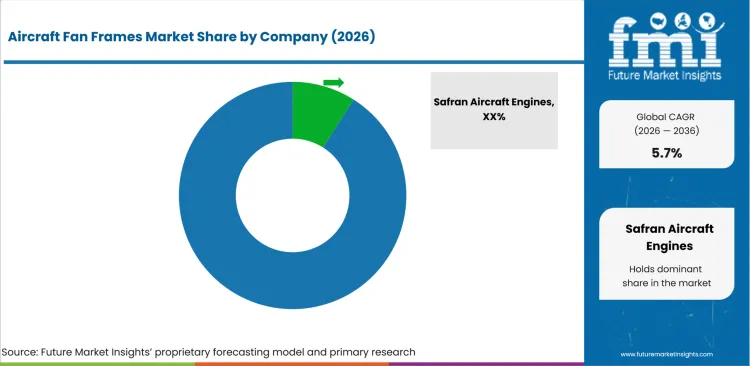
Engine design authority concentrates among Safran Aircraft Engines, GE Aerospace, Pratt & Whitney and Rolls-Royce. MTU Aero Engines, IHI Corporation and Kawasaki Heavy Industries hold assigned module workshare. GKN Aerospace supplies certified GTF fan-case structures. Entry depends on approved processes and serial-rate proof.
- Design authorities: Safran Aircraft Engines, GE Aerospace, Pratt & Whitney and Rolls-Royce control engine architecture.
- Program partners: MTU Aero Engines, IHI Corporation and Kawasaki Heavy Industries carry assigned module workshare.
- Fan-structure specialist: GKN Aerospace supplies certified fan-case and mount-ring content on GTF programs.
Competitive Benchmarking: Aircraft Fan Frames Market
| Company | Frame Architecture Integration | Material and Process Depth | Program and Lifecycle Support | Geographic Reach |
|---|---|---|---|---|
| Safran Aircraft Engines | High | High | High | Global CFM programs |
| GE Aerospace | High | High | High | Global engine programs |
| Pratt & Whitney | High | High | High | Global commercial and defense programs |
| Rolls-Royce | High | High | High | Global Trent network |
| MTU Aero Engines | Medium | High | High | Europe, North America and global partnerships |
| IHI Corporation | High | High | Medium | Japan, North America and Europe |
| Kawasaki Heavy Industries | Medium | Medium | Medium | Japan and international civil programs |
| GKN Aerospace | High | High | Medium | Europe, North America and global programs |
Scoring basis: High frame integration requires design authority or direct fan-structure responsibility, Medium means module responsibility, and Low means adjacent structural work. High process depth requires several qualified routes, Medium covers fewer routes, and Low covers one. High lifecycle support includes serial production and broad service, Medium covers limited support, and Low covers one role.
Key Developments in the Aircraft Fan Frames Market
- In April 2026, Pratt & Whitney announced more than USD 100 million for USA GTF MRO expansion in Texas, Florida and Arkansas. Added shop capacity increases approved fan-module inspection and repair throughput for the installed fleet.
- In June 2025, Safran Aircraft Engines reported more than 175 Open Fan ingestion and endurance tests plus a new Villaroche facility. Added test capacity supports qualification of fan structures ahead of future flight demonstrations.
- In June 2025, Rolls-Royce launched a certified Trent 1000 durability package with phase one entering new engines and phase two under test. The package preserves approved structural interfaces while changing durability-limited hot-section content.
Key Players in the Aircraft Fan Frames Market
Integrated Engine OEMs and Design Authorities
- Safran Aircraft Engines
- GE Aerospace
- Pratt & Whitney
- Rolls-Royce
Engine Program and Module Specialists
- MTU Aero Engines
- IHI Corporation
- Kawasaki Heavy Industries
Fan-Structure and Advanced Manufacturing Specialist
- GKN Aerospace
Aircraft Fan Frames Market - Report Scope
| Coverage field | Report scope |
|---|---|
| Market breakdown | By frame type, engine type, material, sales channel, manufacturing and region. |
| Quantitative Units | USD billion. |
| Market Definition | Commercial load-bearing fan frames, integrated fan-case structures and related mounting rings supplied for qualified aircraft engine programs. |
| Regions Covered | North America, Latin America, Western Europe, Eastern Europe, East Asia, South Asia and Pacific, and Middle East and Africa. |
| Countries Covered | Finland, France, USA, Canada, Italy, and 20+ countries included in the full report. |
| Key Companies Profiled | Safran Aircraft Engines, GE Aerospace, Pratt & Whitney, Rolls-Royce, MTU Aero Engines, IHI Corporation, Kawasaki Heavy Industries, GKN Aerospace. |
| Forecast Period | 2026 to 2036. |
| Approach | Primary and secondary research with market triangulation. |
Aircraft Fan Frames Market - Research Methodology
| Method | Approach |
|---|---|
| Primary Research | FMI analysts gathered input from manufacturers, service providers, technology developers, distributors, end users, procurement teams, and subject-matter experts. Interviews examined purchasing decisions, product or service evaluation, adoption barriers, approval requirements, pricing considerations, and expectations for technical or commercial support. Respondents were also asked what evidence is required before a trial, pilot, or initial order develops into regular purchasing. |
| Desk Research | Desk research covered government statistics, regulatory publications, trade data, industry associations, technical literature, standards, company filings, product information, and official corporate announcements. Sources were reviewed for relevance, publication date, geographic coverage, and consistency with the defined market scope. Claims relating to performance, applications, approvals, capacity, investment, and commercial activity were retained only when supported by credible public evidence. |
| Market Sizing and Forecasting | The market model combined the baseline value with historical performance, segment structure, pricing and volume indicators, adoption levels, company participation, and country-level demand conditions. Forecast assumptions considered economic activity, investment trends, regulatory developments, technology adoption, purchasing cycles, supply availability, and barriers to wider market use. Segment and regional estimates were reconciled before the final market total was calculated. |
| Data Validation | Estimates were checked against multiple independent indicators, including public data, company activity, trade patterns, industry developments, and findings from primary interviews. Validation also tested whether products, services, applications, and company revenues fell within the defined market boundaries. Adjacent categories, unsupported claims, overlapping revenues, and activities without direct market relevance were excluded to reduce double counting and maintain consistency across segments and countries. |
Aircraft Fan Frames Market by Segments
Aircraft Fan Frames Market segmented by Frame Type:
- Front fan frames
- Intermediate fan frames
- Composite fan frames
- Titanium fan frames
- Integrated fan case frames
Aircraft Fan Frames Market segmented by Engine Type:
- Turbofan engines
- Geared turbofan engines
- Business jet engines
- Military turbofans
- Regional jet engines
Aircraft Fan Frames Market segmented by Material:
- Titanium
- Carbon composite
- Aluminum-lithium
- Nickel alloys
- Hybrid structures
Aircraft Fan Frames Market segmented by Sales Channel:
- Engine OEMs
- Engine structure suppliers
- Defense programs
- MRO/spares
Aircraft Fan Frames Market segmented by Manufacturing:
- Forging/machining
- Precision casting
- Composite layup
- Additive-assisted fabrication
Aircraft Fan Frames Market by Region:
- North America
- United States
- Canada
- Latin America
- Brazil
- Mexico
- Argentina
- Chile
- Western Europe
- Germany
- France
- United Kingdom
- Italy
- Spain
- Benelux
- Nordics
- Eastern Europe
- Poland
- Czech Republic
- Romania
- Hungary
- East Asia
- China
- Japan
- South Korea
- South Asia and Pacific
- India
- ASEAN
- Australia and New Zealand
- Middle East and Africa
- GCC Countries
- South Africa
- Türkiye
- Israel
Research Sources and Bibliography
- International Air Transport Association (IATA). (2026, June 24). IATA Outlines Four Priorities to Strengthen the Aviation Supply Chain.
- Institut national de la statistique et des études économiques (Insee). (2026, April 9). En 2025, l’économie tourne au ralenti en Occitanie.
- GKN Aerospace. (2025, September 4). GKN Aerospace accelerates additive fabrication ramp-up with US expansion.
- RTX. (2025, June 18). RTX's Pratt & Whitney GTF engines near 1,100 orders and commitments in 2025.
- GKN Aerospace. (2025, June 17). GKN Aerospace accelerates additive fabrication industrialisation for Fan Case Mount Ring.
- RTX. (2025, June 17). Wizz Air Selects RTX Pratt & Whitney GTF Engines to Power Up to an Additional 177 Airbus A321neo Aircraft.
- GE Aerospace. (2025, May 14). GE Aerospace and Qatar Airways strengthen partnership with agreement for 400+ GE9X and GEnx engines.
- RTX. (2025, February 27). RTX's Pratt & Whitney GTF Advantage engine achieves USA FAA type certification.
- GE Aerospace. (2025, March 12). GE Aerospace to Invest Nearly $1B in USA Manufacturing in 2025.
- Ministry of Defence of Finland. (2025, March 17). Construction of F-35 fighter engine assembly and maintenance facilities in Finland progresses as scheduled.
- Institut national de la statistique et des études économiques (Insee). (2025, September 4). Filière aéronautique et spatiale en Occitanie : L’activité progresse de 7 % en 2024 mais l’emploi marque le pas.
- Federal Aviation Administration. (2026). FAA Aerospace Forecast Fiscal Years 2026-2046.
- Innovation, Science and Economic Development Canada. (2026, July 23). Minister Joly advances the Canadian aerospace industry at the Farnborough International Airshow in the United Kingdom.
- Italian Civil Aviation Authority (ENAC). (2026, May 11). Enac pubblica i Dati di Traffico 2025: +5% rispetto al 2024 per oltre 229,7 milioni di passeggeri negli aeroporti italiani.
- Safran. (2026, March 31). Availability of Safran's 2025 Universal Registration Document.
- GE Aerospace. (2026, January 29). GE Aerospace Releases 2025 Annual Report and 10-K.
- Rolls-Royce Holdings plc. (2026). Annual Report 2025.
- MTU Aero Engines AG. (2026). Annual Report and Management Compensation Report 2025.
- Melrose Industries PLC. (2026, March 23). Annual Report 2025.
- IHI Corporation. (2025, September 30). IHI Integrated Report 2025.
- Kawasaki Heavy Industries, Ltd. (2025, November 28). The Kawasaki Report 2025 Issued.
- Safran Aircraft Engines. (2025, June 16). Safran reaches major milestones with composite fan blades for future engines.
- Rolls-Royce. (2025, June 12). Rolls-Royce launches Durability Enhancement Package that will double Trent 1000 Time-on-Wing.
- RTX. (2026, April 21). RTX's Pratt & Whitney invests more than $100M to expand MRO footprint in the USA
- GE Aerospace. (2025, November 24). GE Aerospace Invests $53M in West Jefferson Facility to Support Engine Production.
- Rolls-Royce. (2026, January 8). Rolls-Royce and Turkish Technic break ground on world-leading aero engine maintenance facility.
- Safran. (2025, November 26). Safran steps up expansion in India for civil and military aviation.
- Rolls-Royce. (2025, November 20). Emirates to join Rolls-Royce global Maintenance, Repair and Overhaul network from 2027.
- IHI Corporation. (2026, July 21). The Consortium for the GCAP Power and Propulsion System progresses toward ground-testing engine demonstrator.
- Safran. (2026, July 18). Open Fan Advances Toward Flight Test Demonstration This Decade.
- GE Aerospace. (2026, March 9). GE Aerospace to Invest Another $1B in USA Manufacturing.
- RTX. (2026, April 17). RTX's Pratt & Whitney GTF Advantage engine certified for Airbus A320neo aircraft family.
- Rolls-Royce. (2025, December 10). Rolls-Royce celebrates the official opening of BAESL, its MRO joint venture in Beijing, China.
- MTU Aero Engines. (2025, June 30). EME Aero inaugurates second test cell and increases capacity.
- GKN Aerospace. (2026, July 20). GKN Aerospace and RTX’s Pratt & Whitney expand additive manufacturing collaboration to F135 engine.
- IHI Corporation. (2025, September 10). GCAP Consortium Expands Partnership Toward First Flight.
- Kawasaki Heavy Industries, Ltd. (2026, May 12). Financial Results for FY2025.
This bibliography is provided for reader reference and is not exhaustive. The full report contains the complete reference list and detailed citations
This Report Answers
- How large is the aircraft fan frames market in 2026 and 2036?
- Which aircraft-production conditions convert engine schedules into fan-frame demand?
- Why do front fan frames lead the frame type category in 2026?
- Why do turbofan engines hold the largest engine type share?
- How does titanium qualification affect material selection for fan structures?
- How do five profiled countries differ in forecast growth and market-entry conditions?
- Which companies control engine architecture, module workshare and fan-structure production?
- Where do certification and large-format process capacity restrict new sourcing?
- How can additive-assisted manufacturing alter fan-frame lead times after approval?
Frequently Asked Questions
How big is the Aircraft Fan Frames Market in 2026?
The aircraft fan frames market is valued at USD 7.8 billion in 2026 and is projected to reach USD 13.5 billion by 2036. New aircraft production supports fan-frame demand tied to long-duration engine programs.
What is the CAGR of the Aircraft Fan Frames Market from 2026 to 2036?
The aircraft fan frames market is projected to grow at a CAGR of 5.7% between 2026 and 2036. Expansion follows commercial and defense engine production, fleet replacement and approved lifecycle support for fan-module structures.
Which frame type leads the Aircraft Fan Frames Market?
The front fan frames segment is expected to hold 28.0% of the aircraft fan frames market in 2026, attributable to its load-transfer role and multiple engine interfaces. Qualification breadth keeps the segment relevant to several civil and military architectures.
Which countries are projected to record the highest growth in the Aircraft Fan Frames Market?
Finland is projected to grow at 6.5% CAGR, followed by France at 6.2% and USA at 5.9% through 2036. Their growth routes differ between new defense-engine localization, concentrated civil-engine engineering and broad production capacity.
Which companies are active in the Aircraft Fan Frames Market?
Key companies in the aircraft fan frames market include Safran Aircraft Engines, GE Aerospace, Pratt & Whitney, Rolls-Royce, MTU Aero Engines, IHI Corporation, Kawasaki Heavy Industries, and GKN Aerospace. Their positions differ by design authority, assigned program workshare and qualified structural manufacturing on certified engines.
Preview the report firsthand - request a free sample
Get SampleGet the brochure for pricing and purchase details.
Get PDFTable of Content
- Key Takeaways
- Market Size and CAGR
- Top Growth Driver
- Fastest Growing Segment
- Leading Region
- Key Companies
- Emerging Opportunities
- Executive Summary
- Global Market Outlook
- Demand-side Trends
- Supply-side Trends
- Technology Roadmap Analysis
- Analysis and Recommendations
- Analyst Perspective (What is happening? Why now? What should investors know?)
- Key Questions Answered
- How large is the market?
- What is the CAGR?
- What are key trends?
- Which region dominates?
- Who are the leaders?
- Market Overview
- Market Coverage / Taxonomy
- Market Definition / Scope / Limitations
- Research Methodology
- Chapter Orientation
- Analytical Lens and Working Hypotheses
- Market Structure, Signals, and Trend Drivers
- Benchmarking and Cross-market Comparability
- Market Sizing, Forecasting, and Opportunity Mapping
- Research Design and Evidence Framework
- Desk Research Programme (Secondary Evidence)
- Expert Input and Fieldwork (Primary Evidence)
- Tooling, Models, and Reference Databases
- Data Engineering and Model Build
- Quality Assurance and Audit Trail
- Market Background
- Market Dynamics (Drivers, Restraints, Opportunity, Trends)
- Scenario Forecast (Optimistic, Likely, Conservative)
- Impact Analysis
- AI Impact
- Sustainability Impact
- Regulatory Impact
- Technology Impact
- Consumer / Buyer Analysis
- Purchase Drivers
- Adoption Barriers
- Buyer Journey
- Opportunity Map Analysis
- Product Life Cycle Analysis
- Supply Chain Analysis
- Investment Feasibility Matrix
- Value Chain Analysis
- PESTLE and Porter's Analysis
- Regulatory Landscape
- Regional Parent Market Outlook
- Production and Consumption Statistics
- Import and Export Statistics
- Global Market Analysis and Forecast, 2021 to 2036
- Historical Market Size Value (USD Billion) Analysis, 2021 to 2025
- Current and Future Market Size Value (USD Billion) Projections, 2026 to 2036
- Y-o-Y Growth Trend Analysis
- Absolute $ Opportunity Analysis
- Global Market Pricing Analysis, 2021 to 2036
- Global Market Analysis and Forecast, By Frame Type, 2021 to 2036
- Introduction / Key Findings
- Historical Market Size Value (USD Billion) Analysis By Frame Type, 2021 to 2025
- Current and Future Market Size Value (USD Billion) Analysis and Forecast By Frame Type, 2026 to 2036
- Front fan frames
- Intermediate fan frames
- Composite fan frames
- Titanium fan frames
- Integrated fan case frames
- Front fan frames
- Y-o-Y Growth Trend Analysis By Frame Type, 2021 to 2025
- Absolute $ Opportunity Analysis By Frame Type, 2026 to 2036
- Global Market Analysis and Forecast, By Engine Type, 2021 to 2036
- Introduction / Key Findings
- Historical Market Size Value (USD Billion) Analysis By Engine Type, 2021 to 2025
- Current and Future Market Size Value (USD Billion) Analysis and Forecast By Engine Type, 2026 to 2036
- Turbofan engines
- Geared turbofan engines
- Business jet engines
- Military turbofans
- Regional jet engines
- Turbofan engines
- Y-o-Y Growth Trend Analysis By Engine Type, 2021 to 2025
- Absolute $ Opportunity Analysis By Engine Type, 2026 to 2036
- Global Market Analysis and Forecast, By Material, 2021 to 2036
- Introduction / Key Findings
- Historical Market Size Value (USD Billion) Analysis By Material, 2021 to 2025
- Current and Future Market Size Value (USD Billion) Analysis and Forecast By Material, 2026 to 2036
- Titanium
- Carbon composite
- Aluminum-lithium
- Nickel alloys
- Hybrid structures
- Titanium
- Y-o-Y Growth Trend Analysis By Material, 2021 to 2025
- Absolute $ Opportunity Analysis By Material, 2026 to 2036
- Global Market Analysis and Forecast, By Sales Channel, 2021 to 2036
- Introduction / Key Findings
- Historical Market Size Value (USD Billion) Analysis By Sales Channel, 2021 to 2025
- Current and Future Market Size Value (USD Billion) Analysis and Forecast By Sales Channel, 2026 to 2036
- Engine OEMs
- Engine structure suppliers
- Defense programs
- MRO/spares
- Engine OEMs
- Y-o-Y Growth Trend Analysis By Sales Channel, 2021 to 2025
- Absolute $ Opportunity Analysis By Sales Channel, 2026 to 2036
- Global Market Analysis and Forecast, By Manufacturing, 2021 to 2036
- Introduction / Key Findings
- Historical Market Size Value (USD Billion) Analysis By Manufacturing, 2021 to 2025
- Current and Future Market Size Value (USD Billion) Analysis and Forecast By Manufacturing, 2026 to 2036
- Forging/machining
- Precision casting
- Composite layup
- Additive-assisted fabrication
- Forging/machining
- Y-o-Y Growth Trend Analysis By Manufacturing, 2021 to 2025
- Absolute $ Opportunity Analysis By Manufacturing, 2026 to 2036
- Global Market Analysis and Forecast, By Region, 2021 to 2036
- Introduction
- Historical Market Size Value (USD Billion) Analysis By Region, 2021 to 2025
- Current Market Size Value (USD Billion) Analysis and Forecast By Region, 2026 to 2036
- North America
- Latin America
- Western Europe
- Eastern Europe
- East Asia
- South Asia and Pacific
- Middle East & Africa
- Market Attractiveness Analysis By Region
- North America Market Analysis and Forecast, By Country, 2021 to 2036
- Historical Market Size Value (USD Billion) Trend Analysis By Market Taxonomy, 2021 to 2025
- Market Size Value (USD Billion) Forecast By Market Taxonomy, 2026 to 2036
- By Country
- USA
- Canada
- By Frame Type
- By Engine Type
- By Material
- By Sales Channel
- By Manufacturing
- By Country
- Market Attractiveness Analysis
- By Country
- By Frame Type
- By Engine Type
- By Material
- By Sales Channel
- By Manufacturing
- Key Takeaways
- Latin America Market Analysis and Forecast, By Country
- Historical Market Size Value (USD Billion) Trend Analysis By Market Taxonomy, 2021 to 2025
- Market Size Value (USD Billion) Forecast By Market Taxonomy, 2026 to 2036
- By Country
- Brazil
- Mexico
- Chile
- Rest of Latin America
- By Frame Type
- By Engine Type
- By Material
- By Sales Channel
- By Manufacturing
- By Country
- Market Attractiveness Analysis
- By Country
- By Frame Type
- By Engine Type
- By Material
- By Sales Channel
- By Manufacturing
- Key Takeaways
- Western Europe Market Analysis and Forecast, By Country
- Historical Market Size Value (USD Billion) Trend Analysis By Market Taxonomy, 2021 to 2025
- Market Size Value (USD Billion) Forecast By Market Taxonomy, 2026 to 2036
- By Country
- Germany
- UK
- Italy
- Spain
- France
- Nordic
- BENELUX
- Rest of Western Europe
- By Frame Type
- By Engine Type
- By Material
- By Sales Channel
- By Manufacturing
- By Country
- Market Attractiveness Analysis
- By Country
- By Frame Type
- By Engine Type
- By Material
- By Sales Channel
- By Manufacturing
- Key Takeaways
- Eastern Europe Market Analysis and Forecast, By Country
- Historical Market Size Value (USD Billion) Trend Analysis By Market Taxonomy, 2021 to 2025
- Market Size Value (USD Billion) Forecast By Market Taxonomy, 2026 to 2036
- By Country
- Russia
- Poland
- Hungary
- Balkan & Baltic
- Rest of Eastern Europe
- By Frame Type
- By Engine Type
- By Material
- By Sales Channel
- By Manufacturing
- By Country
- Market Attractiveness Analysis
- By Country
- By Frame Type
- By Engine Type
- By Material
- By Sales Channel
- By Manufacturing
- Key Takeaways
- East Asia Market Analysis and Forecast, By Country
- Historical Market Size Value (USD Billion) Trend Analysis By Market Taxonomy, 2021 to 2025
- Market Size Value (USD Billion) Forecast By Market Taxonomy, 2026 to 2036
- By Country
- China
- Japan
- South Korea
- By Frame Type
- By Engine Type
- By Material
- By Sales Channel
- By Manufacturing
- By Country
- Market Attractiveness Analysis
- By Country
- By Frame Type
- By Engine Type
- By Material
- By Sales Channel
- By Manufacturing
- Key Takeaways
- South Asia and Pacific Market Analysis and Forecast, By Country
- Historical Market Size Value (USD Billion) Trend Analysis By Market Taxonomy, 2021 to 2025
- Market Size Value (USD Billion) Forecast By Market Taxonomy, 2026 to 2036
- By Country
- India
- ASEAN
- Australia & New Zealand
- Rest of South Asia and Pacific
- By Frame Type
- By Engine Type
- By Material
- By Sales Channel
- By Manufacturing
- By Country
- Market Attractiveness Analysis
- By Country
- By Frame Type
- By Engine Type
- By Material
- By Sales Channel
- By Manufacturing
- Key Takeaways
- Middle East & Africa Market Analysis and Forecast, By Country
- Historical Market Size Value (USD Billion) Trend Analysis By Market Taxonomy, 2021 to 2025
- Market Size Value (USD Billion) Forecast By Market Taxonomy, 2026 to 2036
- By Country
- Kingdom of Saudi Arabia
- Other GCC Countries
- Türkiye
- South Africa
- Other African Union
- Rest of Middle East & Africa
- By Frame Type
- By Engine Type
- By Material
- By Sales Channel
- By Manufacturing
- By Country
- Market Attractiveness Analysis
- By Country
- By Frame Type
- By Engine Type
- By Material
- By Sales Channel
- By Manufacturing
- Key Takeaways
- Key Countries Market Analysis
- USA
- Pricing Analysis
- Market Share Analysis, 2025
- By Frame Type
- By Engine Type
- By Material
- By Sales Channel
- By Manufacturing
- Canada
- Pricing Analysis
- Market Share Analysis, 2025
- By Frame Type
- By Engine Type
- By Material
- By Sales Channel
- By Manufacturing
- Mexico
- Pricing Analysis
- Market Share Analysis, 2025
- By Frame Type
- By Engine Type
- By Material
- By Sales Channel
- By Manufacturing
- Brazil
- Pricing Analysis
- Market Share Analysis, 2025
- By Frame Type
- By Engine Type
- By Material
- By Sales Channel
- By Manufacturing
- Chile
- Pricing Analysis
- Market Share Analysis, 2025
- By Frame Type
- By Engine Type
- By Material
- By Sales Channel
- By Manufacturing
- Germany
- Pricing Analysis
- Market Share Analysis, 2025
- By Frame Type
- By Engine Type
- By Material
- By Sales Channel
- By Manufacturing
- UK
- Pricing Analysis
- Market Share Analysis, 2025
- By Frame Type
- By Engine Type
- By Material
- By Sales Channel
- By Manufacturing
- Italy
- Pricing Analysis
- Market Share Analysis, 2025
- By Frame Type
- By Engine Type
- By Material
- By Sales Channel
- By Manufacturing
- Spain
- Pricing Analysis
- Market Share Analysis, 2025
- By Frame Type
- By Engine Type
- By Material
- By Sales Channel
- By Manufacturing
- France
- Pricing Analysis
- Market Share Analysis, 2025
- By Frame Type
- By Engine Type
- By Material
- By Sales Channel
- By Manufacturing
- India
- Pricing Analysis
- Market Share Analysis, 2025
- By Frame Type
- By Engine Type
- By Material
- By Sales Channel
- By Manufacturing
- ASEAN
- Pricing Analysis
- Market Share Analysis, 2025
- By Frame Type
- By Engine Type
- By Material
- By Sales Channel
- By Manufacturing
- Australia & New Zealand
- Pricing Analysis
- Market Share Analysis, 2025
- By Frame Type
- By Engine Type
- By Material
- By Sales Channel
- By Manufacturing
- China
- Pricing Analysis
- Market Share Analysis, 2025
- By Frame Type
- By Engine Type
- By Material
- By Sales Channel
- By Manufacturing
- Japan
- Pricing Analysis
- Market Share Analysis, 2025
- By Frame Type
- By Engine Type
- By Material
- By Sales Channel
- By Manufacturing
- South Korea
- Pricing Analysis
- Market Share Analysis, 2025
- By Frame Type
- By Engine Type
- By Material
- By Sales Channel
- By Manufacturing
- Russia
- Pricing Analysis
- Market Share Analysis, 2025
- By Frame Type
- By Engine Type
- By Material
- By Sales Channel
- By Manufacturing
- Poland
- Pricing Analysis
- Market Share Analysis, 2025
- By Frame Type
- By Engine Type
- By Material
- By Sales Channel
- By Manufacturing
- Hungary
- Pricing Analysis
- Market Share Analysis, 2025
- By Frame Type
- By Engine Type
- By Material
- By Sales Channel
- By Manufacturing
- Kingdom of Saudi Arabia
- Pricing Analysis
- Market Share Analysis, 2025
- By Frame Type
- By Engine Type
- By Material
- By Sales Channel
- By Manufacturing
- Türkiye
- Pricing Analysis
- Market Share Analysis, 2025
- By Frame Type
- By Engine Type
- By Material
- By Sales Channel
- By Manufacturing
- South Africa
- Pricing Analysis
- Market Share Analysis, 2025
- By Frame Type
- By Engine Type
- By Material
- By Sales Channel
- By Manufacturing
- USA
- Market Structure Analysis
- Competition Dashboard
- Competition Benchmarking
- Market Share Analysis of Top Players
- By Regional
- By Frame Type
- By Engine Type
- By Material
- By Sales Channel
- By Manufacturing
- Emerging Startups
- Innovation Benchmarking
- Competition Analysis
- Competition Deep Dive
- Safran Aircraft Engines
- Overview
- Product Portfolio
- Profitability by Market Segments
- Sales Footprint
- Strategy Overview
- Marketing Strategy
- Product Strategy
- Channel Strategy
- GE Aerospace
- Pratt & Whitney
- Rolls-Royce
- MTU Aero Engines
- GKN Aerospace
- IHI Corporation
- Kawasaki Heavy Industries
- Spirit AeroSystems
- Senior Aerospace
- Safran Aircraft Engines
- Case Studies
- Success Stories
- Recent Developments
- Competition Deep Dive
- Assumptions & Acronyms Used


