

- Market Size (2026)
- USD 853.9 Mn
- Forecast (2036)
- USD 1446.2 Mn
- CAGR (2026 to 2036)
- 5.4%
How big is Ammonium Carbonate Market in 2026?
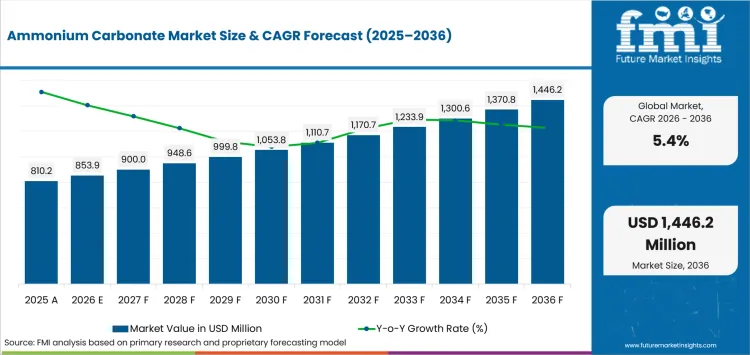
USD 853.9 million in 2026 and USD 1446.2 million by 2036 at a 5.4% CAGR.
Demand for ammonium carbonate is projected to lift the market from USD 853.9 million in 2026 to USD 1446.2 million by 2036, reflecting a 5.4% CAGR. The forecast represents USD 592.3 million in incremental value over the ten-year interval. Food processing anchors demand, driven by ammonium carbonate’s permitted leavening and pH-control functions in validated formulas. The FDA's July 2026 food-substance inventory lists both technical effects for ammonium carbonate. That status keeps food additives purchasing tied to validated recipes rather than novelty-led reformulation.
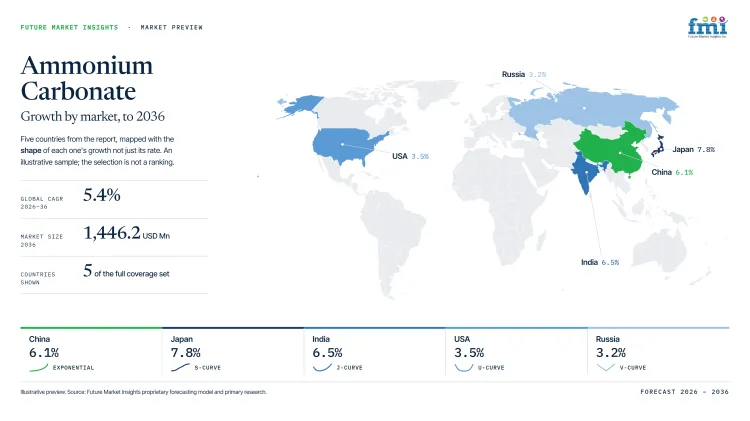
Japan is projected to grow at a 7.8% CAGR, compared with Canada at 4.6%, as bakery demand follows different qualification paths in each market. Agriculture and Agri-Food Canada reported in August 2025 that leavened bread represented 99.7% of Japan's bread market during 2023. Although that figure does not measure ammonium carbonate consumption directly, it gives bakery ingredients producers denser account coverage than markets where permitted-use conditions narrow formulation options.
Key Takeaways
- Food processors provide the largest repeat demand, driven by permitted leavening and pH-control functions that keep qualified recipes tied to the same input.
- Food grade is estimated to hold 49.1% of 2026 revenue because ingredient qualification concentrates repeat volume in qualified processing accounts.
- Powder is projected at 68.3% of 2026 revenue as routine weighing and dispersion fit standard plant and laboratory dosing practices.
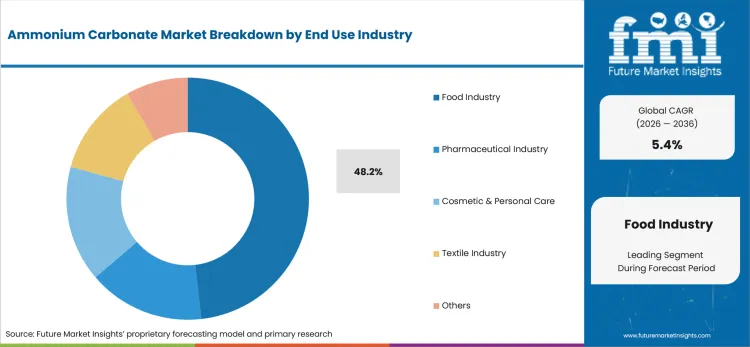
- The food industry accounts for a 48.2% share in 2026, attributable to validated recipes that create broader repeat purchasing than smaller specification-led applications.
- Ammonia release and thermal decomposition increase ventilation and storage requirements which can narrow qualification in odor-sensitive or heat-sensitive processes.
- Some of the key players in this market include BASF SE, Solstice Advanced Materials Inc., Thermo Fisher Scientific Inc., Merck KGaA (Sigma-Aldrich), Avantor, Inc., Spectrum Chemical Mfg. Corp., Kanto Chemical Co., Inc., and Nacalai Tesque, Inc.
Analyst Perspective
“Ammonium carbonate should be evaluated on qualification cost and process fit before commercial teams compare unit price. Food-grade producers earn repeat business from current documentation while laboratory channels defend value with controlled purity and dependable technical records.”
- Nikhil Kaitwade, Principal Consultant, Future Market Insights
How is the ammonium carbonate market segmented?
The ammonium carbonate market is segmented by product grade, product form, and end use industry.
Product grade covers food grade, pharmaceutical grade, and technical grade within the defined revenue boundary. Product form separates powder from lumps while end use industry covers food, pharmaceutical, cosmetic and personal care, textile, and other qualified applications.
How does the food industry anchor the end use industry category?
Food processors buy ammonium carbonate for a defined technical function during routine production instead of a finished-product marketing claim. USDA NASS reported in May 2026 that USA mills produced 419 million hundredweight of flour during 2025. That production base sustains repeat purchasing of qualified bakery inputs.
- The food industry is projected to hold 48.2% share in 2026, owing to validated formulations that create broader repeat volume than pharmaceutical or laboratory accounts.
- Recipe owners still need plant-level handling records that keep producer qualification tied to consistency instead of permitted status alone. Programs using clean-label ingredients do not remove exact permitted-use records when processors review existing formulation inputs.
What makes food grade central to the product grade category?
Food processors qualify ammonium carbonate around declared ingredient use and controlled composition before changing a validated recipe. Health Canada's October 2025 permitted-use list allows ammonium carbonate in cocoa products and unstandardized foods under stated conditions. Those defined uses make food-grade documentation part of commercial qualification.
- Food grade accounts for 49.1% share in 2026, supported by regulated food use that concentrates the largest pool of repeat manufacturing orders.
- Plants require current grade declarations during reformulation which favors documented producers over chemically similar material lacking food-use support. Validated recipes using food and beverage additives require documentation continuity before a processor changes an approved source.
Why does powder lead the product form category?
Powder fits routine weighing and dissolution better than larger solid pieces in processes already using dry feeders or laboratory scoops. FUJIFILM Wako's February 2026 safety sheet describes ammonium carbonate in crystals and crystalline powder or mass form for research use.
- In 2026, powder is expected to represent 68.3% share, as standard dosing equipment can meter small quantities without requiring a separate size-reduction step.
- Laboratories and formulation teams match physical presentation to routine weighing procedures while retaining the same chemistry and qualification record. Users of precision chemicals also require current handling records before approving routine material changes at production scale.
What are the drivers, restraints and opportunities in the Ammonium Carbonate Market?
Regulated food functionality sustains repeat purchases while handling burdens limit qualification and higher-specification supply leaves room for better documented premium offers.
- Driver: Validated bakery formulations reorder ammonium carbonate because leavening and pH-control functions remain useful in dry bakery processing.
- Restraint: Ammonia release and thermal decomposition increase ventilation plus storage and worker-control requirements for sensitive production environments.
- Opportunity: Higher-purity grades and stronger qualification records can raise order value in laboratory and pharmaceutical channels without changing the chemistry.
Validated Food Uses Sustain Repeat Orders
Food manufacturers reorder ammonium carbonate when validated bakery formulas depend on rapid gas release during heating in stable commercial runs. Statistics Canada reported in May 2025 that domestic mills produced 2.5 million tonnes of flour in 2024, creating a sizeable processing base for qualified bakery ingredients and flour improvers. Repeat purchasing is therefore tied to recipe continuity and validated composition during scheduled production.
Handling Requirements Narrow Convenient Use
Handling requirements can slow qualification even when ammonium carbonate meets the requested analytical specification during routine receiving and storage. Avantor's November 2025 safety sheet classifies its AnalaR NORMAPUR material for acute oral toxicity and serious eye damage. Receiving teams therefore need appropriate controls during industrial chemical packaging and storage, raising qualification costs for sites with limited safety infrastructure during daily operations.
High-Purity Channels Reward Better Qualification
Higher-specification channels pay for evidence that reduces qualification work and protects repeatable laboratory results during regulated purchasing and supplier review. Spectrum Chemical extended its preferred Macco Organiques partnership in February 2026 for high-purity parenteral mineral salts serving biomanufacturing. The agreement shows how fine chemicals distributors can defend value through documented quality systems and disciplined warehousing for pharmaceutical or analytical accounts requiring formal qualification.
Which country CAGRs are profiled in the Ammonium Carbonate Market?
| Country | CAGR |
|---|---|
| Japan | 7.8% |
| Canada | 4.6% |
| KSA | 3.8% |
| United States | 3.5% |
| Russia | 3.2% |
How do country-level CAGRs compare in the Ammonium Carbonate Market?
The CAGRs span 4.6 percentage points, ranging from Japan at 7.8% to Russia at 3.2%. Japan forms a clear upper position, driven by bakery qualification and reagent distribution that support faster account conversion. Canada follows at 4.6%, while KSA and the USA cluster below 4.0%. Russia closes the set, reflecting standards upkeep and import friction that lengthen commercial routes.
- Japan's reagent networks shorten local qualification and replenishment cycles.
- Canada's permitted-use lists make application-specific documentation central to reformulation.
- KSA's border controls place greater weight on distributor document readiness.
- USA accounts favor incumbent specifications within mature chemical distribution channels.
- Russia's Eurasian standards increase the cost of maintaining current qualification records.
Similar CAGRs therefore translate into different channel costs and qualification timelines for producers. The full report provides country-level CAGR analysis across North America, Latin America, Europe, East Asia, South Asia, Oceania and the Middle East and Africa.
Country-wise Analysis
- Japan's 2025 food-additive standards place ammonium carbonate among raising agents permitted for all foods and keep formal category status visible during formulation review. Ammonium carbonate demand in Japan is forecast to rise at a 7.8% CAGR through 2036, supported by dense reagent distribution and mature bakery accounts. The Foundation for the Promotion of Food Science Research updated those standards in August 2025, giving producers with Japanese documentation a practical qualification advantage. Local service expectations and conservative source changes still limit rapid switching, as food processors also expect Japanese-language specifications and prompt distributor responses during routine qualification in high-specification local accounts.
- Canadian food processors buy against explicit permitted-use conditions and large domestic flour channels that give technical teams a defined application base for qualification and routine supplier comparison. Statistics Canada's May 2025 release stated that domestic disappearance accounted for an average 87.9% of wheat flour supply during 2019-2023, supporting a substantial local baking route while category permissions remain a separate sales hurdle for food-grade chemicals. The Canadian market is projected to grow at a 4.6% CAGR through 2036, underpinned by clear food-use rules, although detailed application guidance and local technical response remain necessary for producers entering incumbent accounts during routine formulation reviews.
- Saudi importers prepare certificates and compliant labeling before food ingredients reach processors, as border inspection can interrupt shipments that fail local requirements or arrive with incomplete supporting records. The ammonium carbonate market in KSA is projected to record a 3.8% CAGR through 2036, driven by expanding food-processing activity and distributor-led import support. SFDA reported in May 2025 that its Hajj-season controls prevented more than 301 tons of non-compliant food products from entering the Kingdom, making documentary readiness a direct operating issue and favoring distributors that can resolve testing or clearance questions before customer inventory is exposed during seasonal demand peaks.
- USA food and laboratory accounts typically buy through formal specifications and broad chemical distribution networks, making incumbent qualification records difficult to displace on price alone during routine replenishment. USDA's April 2026 food-price review recorded a 1.0% increase for cereal and bakery products during 2025, keeping ingredient-cost scrutiny active without removing documentation requirements for approved chemical inputs. Ammonium carbonate demand in the USA is forecast to expand at a 3.5% CAGR from 2026 to 2036, attributable to regulated food functions and analytical demand, while mature channel coverage limits the pace of new account conversion for incumbent production accounts.
- Russian food users work under Eurasian additive standards, while imported chemical supply can travel through longer commercial routes than comparable Western European accounts and regional laboratory distributors. Ammonium carbonate demand in Russia is forecast to grow at a 3.2% CAGR through 2036, reflecting long-standing food and technical uses alongside tighter route-to-market conditions. The Eurasian Economic Commission amended TR CU 029/2012 standards lists in June 2025 by adding three documents and removing one, requiring external producers to maintain current testing references as constrained import options raise the cost of specification-led accounts and smaller-order replenishment under changing route economics for distributors.
Who are the notable companies in the Ammonium Carbonate Market?
BASF SE, Solstice Advanced Materials Inc., Thermo Fisher Scientific Inc., Merck KGaA (Sigma-Aldrich), Avantor, Inc., Spectrum Chemical Mfg. Corp., Kanto Chemical Co., Inc., and Nacalai Tesque, Inc. are the notable companies serving this market.
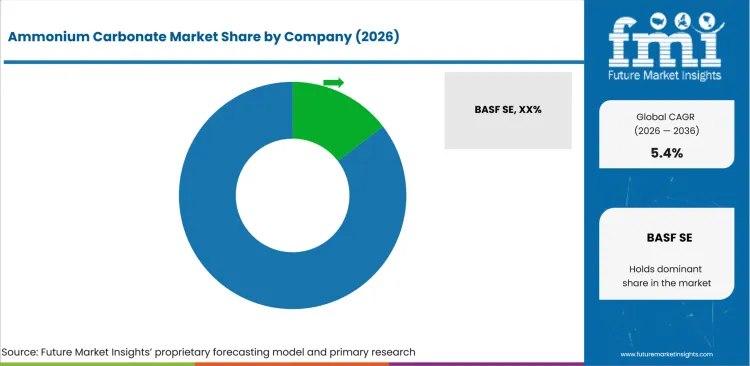
Food processors and laboratories require different documentation before changing ammonium carbonate sources. BASF and Solstice cover broad specialty chemicals channels while Thermo Fisher and Merck focus on laboratory procurement. Grade records and distribution support matter more than molecule-level differentiation during supplier selection.
- BASF SE with Solstice Advanced Materials Inc. and Spectrum Chemical Mfg. Corp. cover documented food-grade or high-purity supply.
- Thermo Fisher Scientific Inc. with Merck KGaA and Avantor, Inc. focus on high-specification laboratory procurement and service.
- Kanto Chemical Co., Inc. and Nacalai Tesque, Inc. provide Japan-centered reagent access backed by formal quality records.
Competitive Benchmarking: Ammonium Carbonate Market
| Company | Grade and Purity Breadth | Qualification Documentation | Distribution and Service Coverage | Geographic Reach |
|---|---|---|---|---|
| BASF SE | Medium | High | High | Global |
| Solstice Advanced Materials Inc. | High | High | High | Global |
| Thermo Fisher Scientific Inc. | High | High | High | Global |
| Merck KGaA (Sigma-Aldrich) | High | High | High | Global |
| Avantor, Inc. | Medium | High | High | Global |
| Spectrum Chemical Mfg. Corp. | High | High | High | North America with international distribution |
| Kanto Chemical Co., Inc. | Medium | High | Medium | Japan and selected international markets |
| Nacalai Tesque, Inc. | High | High | Medium | Japan with international distributors |
Benchmark scores use current company documentation and chemical testing services records rather than corporate scale or brand reputation. Grade breadth is rated High when two documented ammonium carbonate grades are available and Medium when one qualified grade is present, while Low identifies one narrower route. Qualification documentation is High with safety records plus certificates, Medium with one formal document set and Low with narrower public support. Distribution coverage is High for multi-region service, Medium for one regional network and Low for limited access that increases lead times.
Key Developments in the Ammonium Carbonate Market
- In March 2026, Thermo Fisher Scientific Inc. opened an Ireland distribution center that expanded local access to laboratory and process materials.
- In November 2025, Avantor, Inc. opened its Watertown service center with chemical management and daily logistics support for Boston-area laboratories.
- In August 2025, Kanto Chemical Co., Inc. opened the Saitama Distribution Center to strengthen domestic reagent fulfillment in Japan.
Key Players in the Ammonium Carbonate Market
Food-Grade and Broad Inorganic Supply
- BASF SE
- Solstice Advanced Materials Inc.
- Spectrum Chemical Mfg. Corp.
Global Laboratory and Qualification Channels
- Thermo Fisher Scientific Inc.
- Merck KGaA (Sigma-Aldrich)
- Avantor, Inc.
Japan-Centered Reagent Networks
- Kanto Chemical Co., Inc.
- Nacalai Tesque, Inc.
Ammonium Carbonate Market - Report Scope
| Coverage field | Report scope |
|---|---|
| Market breakdown | By product grade, product form, end use industry and region. |
| Quantitative Units | USD million. |
| Market Definition | Revenue from ammonium carbonate sold within the listed grade, form, and end-use segments. Downstream finished-product revenue and adjacent or substitute chemical revenue are excluded. |
| Regions Covered | North America, Latin America, Europe, East Asia, South Asia and Pacific, and Middle East and Africa. |
| Countries Covered | Japan, Canada, KSA, United States, Russia, and 20+ countries included in the full report. |
| Key Companies Profiled | BASF SE, Solstice Advanced Materials Inc., Thermo Fisher Scientific Inc., Merck KGaA (Sigma-Aldrich), Avantor, Inc., Spectrum Chemical Mfg. Corp., Kanto Chemical Co., Inc., Nacalai Tesque, Inc. |
| Forecast Period | 2026 to 2036 |
| Approach | Primary and secondary research with market triangulation. |
Ammonium Carbonate Market - Research Methodology
| Method | Approach |
|---|---|
| Primary Research | FMI analysts gathered input from manufacturers, service providers, technology developers, distributors, end users, procurement teams, and subject-matter experts. Interviews examined purchasing decisions, product or service evaluation, adoption barriers, approval requirements, pricing considerations, and expectations for technical or commercial support. Respondents were also asked what evidence is required before a trial, pilot, or initial order develops into regular purchasing. |
| Desk Research | Desk research covered government statistics, regulatory publications, trade data, industry associations, technical literature, standards, company filings, product information, and official corporate announcements. Sources were reviewed for relevance, publication date, geographic coverage, and consistency with the defined market scope. Claims relating to performance, applications, approvals, capacity, investment, and commercial activity were retained only when supported by credible public evidence. |
| Market Sizing and Forecasting | The market model combined the baseline value with historical performance, segment structure, pricing and volume indicators, adoption levels, company participation, and country-level demand conditions. Forecast assumptions considered economic activity, investment trends, regulatory developments, technology adoption, purchasing cycles, supply availability, and barriers to wider market use. Segment and regional estimates were reconciled before the final market total was calculated. |
| Data Validation | Estimates were checked against multiple independent indicators, including public data, company activity, trade patterns, industry developments, and findings from primary interviews. Validation also tested whether products, services, applications, and company revenues fell within the defined market boundaries. Adjacent categories, unsupported claims, overlapping revenues, and activities without direct market relevance were excluded to reduce double counting and maintain consistency across segments and countries. |
Ammonium Carbonate Market by Segments
Ammonium Carbonate Market segmented by Product Grade:
- Food grade
- Pharmaceutical grade
- Technical grade
Ammonium Carbonate Market segmented by Product Form:
- Powder
- Lumps
Ammonium Carbonate Market segmented by End Use Industry:
- Food Industry
- Pharmaceutical Industry
- Cosmetic & Personal Care
- Textile Industry
- Others
Ammonium Carbonate Market by Region:
- North America
- United States
- Canada
- Latin America
- Brazil
- Mexico
- Chile
- Rest of Latin America
- Western Europe
- Germany
- United Kingdom
- Italy
- Spain
- France
- Nordics
- Benelux
- Rest of Western Europe
- Eastern Europe
- Russia
- Poland
- Hungary
- Balkan and Baltic States
- Rest of Eastern Europe
- East Asia
- China
- Japan
- South Korea
- South Asia and Pacific
- India
- ASEAN
- Australia and New Zealand
- Rest of South Asia and Pacific
- Middle East and Africa
- Kingdom of Saudi Arabia
- Other GCC Countries
- Türkiye
- South Africa
- Other African Union Countries
- Rest of Middle East and Africa
Research Sources and Bibliography
- USA Food and Drug Administration. (2026, July 28). Substances Added to Food: Ammonium Carbonate.
- Agriculture and Agri-Food Canada. (2025, August 26). Sector Trend Analysis - Bakery products in Japan.
- Health Canada. (2025, October 20). List of Permitted Acidity Regulators and Acid-Reacting Materials.
- FUJIFILM Wako Pure Chemical Corporation. (2026, February 9). Safety Data Sheet: Ammonium Carbonate.
- USA Department of Agriculture, National Agricultural Statistics Service. (2026, May). Flour Milling Products 2025 Summary.
- Statistics Canada. (2025, May 13). Milled wheat and wheat flour produced, Canada and United States, 2024.
- Avantor, Inc. (2025, November 19). Safety Data Sheet: Ammonium carbonate AnalaR NORMAPUR®.
- Spectrum Chemical Mfg. Corp. (2026, February 3). Spectrum Chemical and Macco Organiques Extend Preferred Partnership.
- Foundation for the Promotion of Food Science Research. (2025, August 25). Standards for Use, according to Use Categories.
- Saudi Food and Drug Authority. (2025, May 17). The SFDA Laboratories: Exceptional Efforts Dedicated to Ensuring Food Safety for Hajj Pilgrims.
- Sinclair, W., & Stewart, H. (2026, April 30). Ag and Food Statistics: Charting the Essentials - Food Prices and Spending. USA Department of Agriculture, Economic Research Service.
- Eurasian Economic Commission. (2025, June 18). EEC amended lists of standards to technical regulations on certain types of specialized food products, packaged drinking water, food additives and flavorings.
- Merck KGaA. (2025, July 16). 安全資料表: Ammonium carbonate for analysis EMSURE® ACS, Reag. Ph Eur.
- BASF SE. (2025, October 24). Safety Data Sheet: Ammonium carbonate Food Grade (E503i).
- Thermo Fisher Scientific Inc. (2026, March 6). Thermo Fisher Scientific opens New Distribution Center in Ireland.
- Avantor, Inc. (2025, November 19). Avantor® Expands Centralized Service Center Model with Opening of Boston-Area Facility.
- Kanto Chemical Co., Inc. (2025, August). History of Growth.
- BASF SE. (2025, June 17). BASF strengthens its commitment to the biopharma and pharmaceutical ingredients industries through a new investment in North America.
- Solstice Advanced Materials Inc. (2025, October 30). Solstice Advanced Materials completes spin-off from Honeywell and begins trading on Nasdaq.
- Thermo Fisher Scientific Inc. (2025, September 2). Thermo Fisher Scientific Completes Acquisition of Solventum’s Purification and Filtration Business.
- Merck KGaA. (2026, April 1). Merck Completes Acquisition of JSR Life Sciences’ Chromatography Business.
- Avantor, Inc. (2026, April 13). Avantor® Enhances USA Biomanufacturing Infrastructure with Expanded Stability and Microbial Testing Facility.
- Spectrum Chemical Mfg. Corp. (2025, October 24). Spectrum Chemical and Greenfield Global Announce Strategic Distribution Agreement.
- Nacalai Tesque, Inc. (2025, August 21). DHL Express “GoGreen Plus”.
- Spectrum Chemical Mfg. Corp. & FUJIFILM Wako Pure Chemical Corporation. (2025, July 24). Spectrum Chemical China and FUJIFILM Wako Announce Strategic Distribution Partnership.
This bibliography is provided for reader reference and is not exhaustive. The full report contains the complete reference list and detailed citations
This Report Answers
- What are the 2026 and 2036 ammonium carbonate market values?
- What operating conditions sustain ammonium carbonate purchasing?
- Why does food grade lead product grade demand?
- Why does powder lead product form demand?
- Which handling requirements limit ammonium carbonate qualification?
- How do the five profiled country growth rates compare?
- Which companies serve the ammonium carbonate market?
- Which recent company developments affect distribution and qualification?
Frequently Asked Questions
How big is the ammonium carbonate market in 2026?
The ammonium carbonate market is valued at USD 853.9 million in 2026 and is projected to reach USD 1,446.2 million by 2036. Food processing supports repeat demand.
What is the CAGR of the ammonium carbonate market from 2026 to 2036?
The ammonium carbonate market is projected to grow at a CAGR of 5.4% between 2026 and 2036. Regulated food functions and high-purity reagent demand support growth.
Which product grade leads the ammonium carbonate market?
Food grade is expected to hold 49.1% of the ammonium carbonate market in 2026, supported by repeat qualification in qualified formulations. Current documentation protects repeat purchasing.
Which product form leads the ammonium carbonate market?
Powder is expected to hold 68.3% of the ammonium carbonate market in 2026, attributable to routine weighing and direct dispersion. Standard dosing equipment supports use.
How much value will the ammonium carbonate market add between 2026 and 2036?
The ammonium carbonate market is expected to add USD 592.3 million in value between 2026 and 2036. Repeat food use and analytical purchasing explain the increase.
Which countries are projected to record the highest growth in the ammonium carbonate market?
Japan is projected to grow at 7.8% CAGR, followed by Canada at 4.6% and KSA at 3.8% through 2036. Local rules shape account conversion.
Which companies are active in the ammonium carbonate market?
Key companies operating in the ammonium carbonate market include BASF SE, Solstice Advanced Materials Inc., Thermo Fisher Scientific Inc., Merck KGaA (Sigma-Aldrich), Avantor, Inc., Spectrum Chemical Mfg. Corp., Kanto Chemical Co., Inc., and Nacalai Tesque, Inc. They compete on documentation and distribution support.
Preview the report firsthand - request a free sample
Get SampleGet the brochure for pricing and purchase details.
Get PDFTable of Content
- Key Takeaways
- Market Size and CAGR
- Top Growth Driver
- Fastest Growing Segment
- Leading Region
- Key Companies
- Emerging Opportunities
- Executive Summary
- Global Market Outlook
- Demand-side Trends
- Supply-side Trends
- Technology Roadmap Analysis
- Analysis and Recommendations
- Analyst Perspective (What is happening? Why now? What should investors know?)
- Key Questions Answered
- How large is the market?
- What is the CAGR?
- What are key trends?
- Which region dominates?
- Who are the leaders?
- Market Overview
- Market Coverage / Taxonomy
- Market Definition / Scope / Limitations
- Research Methodology
- Chapter Orientation
- Analytical Lens and Working Hypotheses
- Market Structure, Signals, and Trend Drivers
- Benchmarking and Cross-market Comparability
- Market Sizing, Forecasting, and Opportunity Mapping
- Research Design and Evidence Framework
- Desk Research Programme (Secondary Evidence)
- Expert Input and Fieldwork (Primary Evidence)
- Tooling, Models, and Reference Databases
- Data Engineering and Model Build
- Quality Assurance and Audit Trail
- Market Background
- Market Dynamics (Drivers, Restraints, Opportunity, Trends)
- Scenario Forecast (Optimistic, Likely, Conservative)
- Impact Analysis
- AI Impact
- Sustainability Impact
- Regulatory Impact
- Technology Impact
- Consumer / Buyer Analysis
- Purchase Drivers
- Adoption Barriers
- Buyer Journey
- Opportunity Map Analysis
- Product Life Cycle Analysis
- Supply Chain Analysis
- Investment Feasibility Matrix
- Value Chain Analysis
- PESTLE and Porter's Analysis
- Regulatory Landscape
- Regional Parent Market Outlook
- Production and Consumption Statistics
- Import and Export Statistics
- Global Market Analysis and Forecast, 2021 to 2036
- Historical Market Size Value (USD Million) Analysis, 2021 to 2025
- Current and Future Market Size Value (USD Million) Projections, 2026 to 2036
- Y-o-Y Growth Trend Analysis
- Absolute $ Opportunity Analysis
- Global Market Pricing Analysis, 2021 to 2036
- Global Market Analysis and Forecast, By Product Grade, 2021 to 2036
- Introduction / Key Findings
- Historical Market Size Value (USD Million) Analysis By Product Grade, 2021 to 2025
- Current and Future Market Size Value (USD Million) Analysis and Forecast By Product Grade, 2026 to 2036
- Food grade
- Pharmaceutical grade
- Technical grade
- Food grade
- Y-o-Y Growth Trend Analysis By Product Grade, 2021 to 2025
- Absolute $ Opportunity Analysis By Product Grade, 2026 to 2036
- Global Market Analysis and Forecast, By Product Form, 2021 to 2036
- Introduction / Key Findings
- Historical Market Size Value (USD Million) Analysis By Product Form, 2021 to 2025
- Current and Future Market Size Value (USD Million) Analysis and Forecast By Product Form, 2026 to 2036
- Powder
- Lumps
- Powder
- Y-o-Y Growth Trend Analysis By Product Form, 2021 to 2025
- Absolute $ Opportunity Analysis By Product Form, 2026 to 2036
- Global Market Analysis and Forecast, By End Use Industry, 2021 to 2036
- Introduction / Key Findings
- Historical Market Size Value (USD Million) Analysis By End Use Industry, 2021 to 2025
- Current and Future Market Size Value (USD Million) Analysis and Forecast By End Use Industry, 2026 to 2036
- Food Industry
- Pharmaceutical Industry
- Cosmetic & Personal Care
- Textile Industry
- Others
- Food Industry
- Y-o-Y Growth Trend Analysis By End Use Industry, 2021 to 2025
- Absolute $ Opportunity Analysis By End Use Industry, 2026 to 2036
- Global Market Analysis and Forecast, By Region, 2021 to 2036
- Introduction
- Historical Market Size Value (USD Million) Analysis By Region, 2021 to 2025
- Current Market Size Value (USD Million) Analysis and Forecast By Region, 2026 to 2036
- North America
- Latin America
- Western Europe
- Eastern Europe
- East Asia
- South Asia and Pacific
- Middle East & Africa
- Market Attractiveness Analysis By Region
- North America Market Analysis and Forecast, By Country, 2021 to 2036
- Historical Market Size Value (USD Million) Trend Analysis By Market Taxonomy, 2021 to 2025
- Market Size Value (USD Million) Forecast By Market Taxonomy, 2026 to 2036
- By Country
- USA
- Canada
- By Product Grade
- By Product Form
- By End Use Industry
- By Country
- Market Attractiveness Analysis
- By Country
- By Product Grade
- By Product Form
- By End Use Industry
- Key Takeaways
- Latin America Market Analysis and Forecast, By Country
- Historical Market Size Value (USD Million) Trend Analysis By Market Taxonomy, 2021 to 2025
- Market Size Value (USD Million) Forecast By Market Taxonomy, 2026 to 2036
- By Country
- Brazil
- Mexico
- Chile
- Rest of Latin America
- By Product Grade
- By Product Form
- By End Use Industry
- By Country
- Market Attractiveness Analysis
- By Country
- By Product Grade
- By Product Form
- By End Use Industry
- Key Takeaways
- Western Europe Market Analysis and Forecast, By Country
- Historical Market Size Value (USD Million) Trend Analysis By Market Taxonomy, 2021 to 2025
- Market Size Value (USD Million) Forecast By Market Taxonomy, 2026 to 2036
- By Country
- Germany
- UK
- Italy
- Spain
- France
- Nordic
- BENELUX
- Rest of Western Europe
- By Product Grade
- By Product Form
- By End Use Industry
- By Country
- Market Attractiveness Analysis
- By Country
- By Product Grade
- By Product Form
- By End Use Industry
- Key Takeaways
- Eastern Europe Market Analysis and Forecast, By Country
- Historical Market Size Value (USD Million) Trend Analysis By Market Taxonomy, 2021 to 2025
- Market Size Value (USD Million) Forecast By Market Taxonomy, 2026 to 2036
- By Country
- Russia
- Poland
- Hungary
- Balkan & Baltic
- Rest of Eastern Europe
- By Product Grade
- By Product Form
- By End Use Industry
- By Country
- Market Attractiveness Analysis
- By Country
- By Product Grade
- By Product Form
- By End Use Industry
- Key Takeaways
- East Asia Market Analysis and Forecast, By Country
- Historical Market Size Value (USD Million) Trend Analysis By Market Taxonomy, 2021 to 2025
- Market Size Value (USD Million) Forecast By Market Taxonomy, 2026 to 2036
- By Country
- China
- Japan
- South Korea
- By Product Grade
- By Product Form
- By End Use Industry
- By Country
- Market Attractiveness Analysis
- By Country
- By Product Grade
- By Product Form
- By End Use Industry
- Key Takeaways
- South Asia and Pacific Market Analysis and Forecast, By Country
- Historical Market Size Value (USD Million) Trend Analysis By Market Taxonomy, 2021 to 2025
- Market Size Value (USD Million) Forecast By Market Taxonomy, 2026 to 2036
- By Country
- India
- ASEAN
- Australia & New Zealand
- Rest of South Asia and Pacific
- By Product Grade
- By Product Form
- By End Use Industry
- By Country
- Market Attractiveness Analysis
- By Country
- By Product Grade
- By Product Form
- By End Use Industry
- Key Takeaways
- Middle East & Africa Market Analysis and Forecast, By Country
- Historical Market Size Value (USD Million) Trend Analysis By Market Taxonomy, 2021 to 2025
- Market Size Value (USD Million) Forecast By Market Taxonomy, 2026 to 2036
- By Country
- Kingdom of Saudi Arabia
- Other GCC Countries
- Türkiye
- South Africa
- Other African Union
- Rest of Middle East & Africa
- By Product Grade
- By Product Form
- By End Use Industry
- By Country
- Market Attractiveness Analysis
- By Country
- By Product Grade
- By Product Form
- By End Use Industry
- Key Takeaways
- Key Countries Market Analysis
- USA
- Pricing Analysis
- Market Share Analysis, 2025
- By Product Grade
- By Product Form
- By End Use Industry
- Canada
- Pricing Analysis
- Market Share Analysis, 2025
- By Product Grade
- By Product Form
- By End Use Industry
- Mexico
- Pricing Analysis
- Market Share Analysis, 2025
- By Product Grade
- By Product Form
- By End Use Industry
- Brazil
- Pricing Analysis
- Market Share Analysis, 2025
- By Product Grade
- By Product Form
- By End Use Industry
- Chile
- Pricing Analysis
- Market Share Analysis, 2025
- By Product Grade
- By Product Form
- By End Use Industry
- Germany
- Pricing Analysis
- Market Share Analysis, 2025
- By Product Grade
- By Product Form
- By End Use Industry
- UK
- Pricing Analysis
- Market Share Analysis, 2025
- By Product Grade
- By Product Form
- By End Use Industry
- Italy
- Pricing Analysis
- Market Share Analysis, 2025
- By Product Grade
- By Product Form
- By End Use Industry
- Spain
- Pricing Analysis
- Market Share Analysis, 2025
- By Product Grade
- By Product Form
- By End Use Industry
- France
- Pricing Analysis
- Market Share Analysis, 2025
- By Product Grade
- By Product Form
- By End Use Industry
- India
- Pricing Analysis
- Market Share Analysis, 2025
- By Product Grade
- By Product Form
- By End Use Industry
- ASEAN
- Pricing Analysis
- Market Share Analysis, 2025
- By Product Grade
- By Product Form
- By End Use Industry
- Australia & New Zealand
- Pricing Analysis
- Market Share Analysis, 2025
- By Product Grade
- By Product Form
- By End Use Industry
- China
- Pricing Analysis
- Market Share Analysis, 2025
- By Product Grade
- By Product Form
- By End Use Industry
- Japan
- Pricing Analysis
- Market Share Analysis, 2025
- By Product Grade
- By Product Form
- By End Use Industry
- South Korea
- Pricing Analysis
- Market Share Analysis, 2025
- By Product Grade
- By Product Form
- By End Use Industry
- Russia
- Pricing Analysis
- Market Share Analysis, 2025
- By Product Grade
- By Product Form
- By End Use Industry
- Poland
- Pricing Analysis
- Market Share Analysis, 2025
- By Product Grade
- By Product Form
- By End Use Industry
- Hungary
- Pricing Analysis
- Market Share Analysis, 2025
- By Product Grade
- By Product Form
- By End Use Industry
- Kingdom of Saudi Arabia
- Pricing Analysis
- Market Share Analysis, 2025
- By Product Grade
- By Product Form
- By End Use Industry
- Türkiye
- Pricing Analysis
- Market Share Analysis, 2025
- By Product Grade
- By Product Form
- By End Use Industry
- South Africa
- Pricing Analysis
- Market Share Analysis, 2025
- By Product Grade
- By Product Form
- By End Use Industry
- USA
- Market Structure Analysis
- Competition Dashboard
- Competition Benchmarking
- Market Share Analysis of Top Players
- By Regional
- By Product Grade
- By Product Form
- By End Use Industry
- Emerging Startups
- Innovation Benchmarking
- Competition Analysis
- Competition Deep Dive
- BASF SE
- Overview
- Product Portfolio
- Profitability by Market Segments
- Sales Footprint
- Strategy Overview
- Marketing Strategy
- Product Strategy
- Channel Strategy
- Honeywell International Inc.
- Thermo Fisher Scientific Inc.
- Merck KGaA (Sigma-Aldrich)
- Avantor, Inc.
- Kanto Chemical Co., Inc.
- Spectrum Chemical Mfg. Corp.
- Tosoh Corporation
- Loba Chemie Pvt. Ltd.
- Nacalai Tesque, Inc.
- BASF SE
- Case Studies
- Success Stories
- Recent Developments
- Competition Deep Dive
- Assumptions & Acronyms Used


